Keywords
Periodic inspection, replacement policy, competing failure modes, degradation, traumatic events, dynamic programming, system reliability, long-term cost optimization, maintenance strategy

Periodic inspection, replacement policy, competing failure modes, degradation, traumatic events, dynamic programming, system reliability, long-term cost optimization, maintenance strategy
In reliability engineering, systems are often exposed to various types of failures, including gradual degradation due to wear and tear and catastrophic failures due to traumatic events. Optimizing the maintenance policy for such systems is a challenging task.1,2 Maintenance strategies generally involve periodic inspections and repairs or replacements, but the decision-making process is complicated by the competing failure modes and associated costs.
The goal of this study is to develop a cost-effective strategy for periodic inspection and replacement of systems exposed to these competing failure modes. We use a dynamic programming approach to model the system, where the decision variables include the timing of inspections, repairs, and replacements. The system can exist in one of three states: Good, Degraded, or Failed. The system’s state transitions are determined by the degradation rate, the occurrence of traumatic events, and the cost of inspections, repairs, and replacements.
Previous studies have shown the importance of considering multiple failure modes in optimizing maintenance policies.3,4 For instance, dynamic programming has been successfully applied to systems under degradation,1 catastrophic events,2 and competing failure modes.3 Moreover,4 and5 have investigated how different maintenance strategies can reduce operational costs while enhancing system reliability.
This paper is organized into six sections: Section 2 presents the system’s degradation and failure model, while Section 3 details the methodology used for optimization. Section 4 presents the results of the simulations, and Section 5 discusses the implications of these findings. Finally, Section 6 concludes the paper and proposes future research directions.
Let V(t,s) represent the minimum expected cost at time t in state s, where s = 0,1,2 corresponds to the good, degraded, and failed states, respectively. The objective is to find the optimal inspection and replacement policy that minimizes the total cost over a given time horizon.
Where:
➢ State 0 (Good State): The system is operating normally, and the cost includes only inspection costs.6,7
➢ State 1 (Degraded State): The system is still functioning but has deteriorated. The cost in this state includes inspection costs and potential repair costs.8,9
➢ State 2 (Failed State): The system has failed, requiring replacement, and the cost is the replacement cost along with any failure-related penalties.10,11
The model uses dynamic programming to recursively solve for V(t,s) over time. The cost at each state can be written as:
Where:
• Inspection cost: The cost incurred when inspecting the system at time t.
• Transition cost: The cost incurred when the system transitions from one state to another, either due to degradation or traumatic events.
• Replacement cost: The cost of replacing the system or a component after a failure.
• Failure cost: The cost incurred when a failure occurs, which includes both the direct cost of failure and any associated consequences.
For each state, we define the following:
• λd: The rate of degradation failure.
• λt: The rate of traumatic event failure.
• Cinspect: The cost of performing an inspection.
• Creplace: The cost of replacing the system after failure.
• Cfailure: The cost of failure, including the replacement and system downtime.
The dynamic programming recursion can be written as:
The model is solved for each state over the time horizon T to determine the optimal replacement and inspection policy that minimizes the total expected cost.
The system also follows a discrete-time dynamic programming approach, where the state transitions depend on the failure rates and maintenance actions taken. The value function V(t,state) represents the minimum cost to reach the end of the time horizon, starting from time t and state.
The dynamic programming equations are as follows:
The value function is updated using backward recursion, starting from the terminal time T where the costs are predefined (e.g., the cost of replacing the system in a failed state).
To solve the optimization problem, we implement dynamic programming using backward induction. Starting from the final time step T, we compute the optimal value function V(t,s) for all t and s, moving backward until we reach the initial time step.
We perform simulations to compare different scenarios based on varying failure rates and cost parameters. The parameters of the system, including inspection frequency and replacement cost, are chosen to reflect realistic conditions for industrial systems.
The dynamic programming algorithm proceeds as follows:
➢ Initialization: Set initial conditions for V(T,s), the value function at the final time step. The terminal cost is set to the replacement cost and failure cost for all states.
➢ Backward Recursion: For each time step t from T−1 to 0, compute V(t,s) for each state using the recursive formula.
➢ Policy Derivation: After computing the value function, extract the optimal policy by selecting the action (inspection or replacement) that minimizes the expected cost at each time step.
From Figure 1, we can conclude that the following simulation results were obtained for the dynamic programming model under varying parameters:
• Good State (State 0): In the initial stages of the simulation, the system stays in the good state, with low inspection costs and no failures. However, over time, the system moves into the degraded state due to gradual degradation.
• Degraded State (State 1): As the system degrades, the costs rise due to increased inspection and maintenance efforts. The likelihood of failure increases, making inspections more frequent and costly.
• Failed State (State 2): The failed state represents the most costly scenario, as the system requires replacement. The failure cost dominates the total cost, leading to significant expenses if not managed properly.
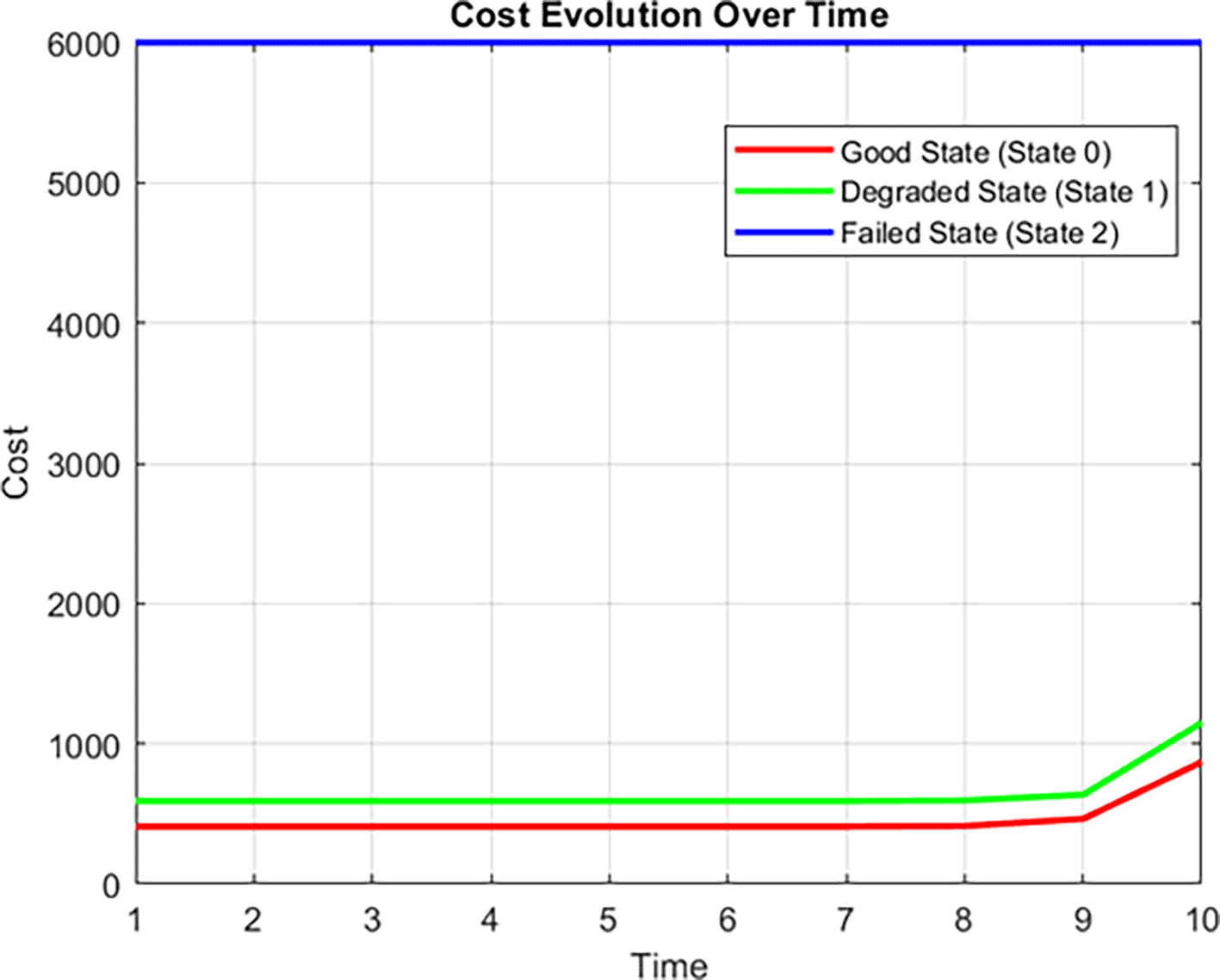
The optimal policy minimizes the total long-term cost by strategically selecting when to inspect and replace components. The model shows that frequent inspections are necessary as the system degrades to avoid catastrophic failures.
The results of the study offer several important insights into the inspection and replacement strategy for systems subjected to both degradation and traumatic events:
As expected, the cost of maintaining a system in the good state is relatively low. In this state, the system is functioning without issues, so the primary cost is that of periodic inspections. However, as the system enters the degraded state, the costs start to rise due to increased inspection and potential repair needs. Once the system enters the failed state, the costs skyrocket, primarily due to the need for a full replacement and the additional penalties that may arise from system downtime or operational failure. This dynamic clearly highlights the importance of performing timely inspections and replacements before the system becomes too degraded or fails completely. Delaying maintenance can result in significantly higher costs as the system transitions into more costly states.
The model makes a crucial distinction between two types of failures:
• Degradation Failures: These occur gradually as the system undergoes wear and tear or aging. While the degradation process is slow, it can accumulate over time, causing the system to move from the good state to the degraded state and eventually to the failed state. Such failures can often be predicted and mitigated through timely inspections.
• Traumatic Event Failures: Unlike degradation, these failures occur suddenly and often unpredictably, such as accidents or extreme events. These failures can cause substantial damage in a short amount of time and are difficult to foresee.
By differentiating between these two failure types, the model allows for a more refined inspection strategy. Maintenance policies can be tailored to address both types of risks—gradual degradation can be tracked over time, while inspections can be adjusted to account for the potential occurrence of catastrophic events.
The dynamic programming model effectively optimizes the balance between two competing factors: inspection frequency and replacement decisions. On one hand, frequent inspections are necessary as the system degrades to detect early signs of potential failure and prevent the system from progressing into the failed state. On the other hand, frequent inspections come with their own costs, which need to be weighed against the benefits of avoiding catastrophic failures. The model thus suggests that as the system moves from good to degraded, the frequency of inspections should increase, though the inspections should be scheduled optimally to minimize the total cost of maintenance, including both inspections and replacements.
The insights derived from this model have broad real-world applications:
• Industrial machinery: Many industrial systems experience gradual degradation and are at risk for sudden traumatic failures (e.g., equipment breakdowns). The model suggests that maintenance strategies should be designed to detect early degradation while also preparing for the possibility of traumatic events.
• Transportation networks: Systems like bridges, tunnels, and roads face both types of risks—degradation from use over time and sudden failure due to accidents or natural disasters. The model can help determine optimal inspection and replacement schedules to avoid costly failures and reduce downtime.
• Infrastructure management: Critical infrastructure, such as power grids or water supply systems, must be inspected regularly to prevent both gradual and sudden failures. The model’s adaptive strategy ensures that inspections are timely and replacements are made before costs escalate.
Overall, the results suggest that maintenance strategies should be adaptive, based on the current state of the system. Systems in a good state might require less frequent inspections, while those in a degraded state may need more frequent checks to prevent expensive replacements. Additionally, the model highlights that replacement decisions should not be made solely based on failure, but should also take into account the cost of degradation and the likelihood of traumatic failures.
This paper presented a dynamic programming approach to optimizing the inspection and replacement policy for systems exposed to competing failure modes, specifically degradation and traumatic events. The findings underscore the critical role of striking a balance between inspection frequency and replacement decisions to minimize long-term operational costs while ensuring the reliability and functionality of the system. By using dynamic programming, we were able to quantify the costs associated with each state and derive an optimal policy that adapts to varying system conditions.
While the current model provides valuable insights for industries managing systems at risk of both gradual and sudden failures, future research could explore several avenues to enhance its applicability. For instance, extending the model to include additional failure modes, such as environmental or operational factors, could further refine maintenance strategies. Moreover, incorporating stochastic variations in failure rates would allow for a more realistic representation of uncertain system behavior and facilitate the development of more robust and adaptive policies. By considering these factors, future work could contribute to more comprehensive, data-driven maintenance optimization frameworks suitable for a wider range of real-world applications.
The results also suggest that future studies should consider real-time data integration, possibly through machine learning and predictive analytics, to dynamically adjust maintenance schedules based on system performance metrics. Such advancements could significantly improve decision-making, allowing for proactive, rather than reactive, maintenance strategies.
| Views | Downloads | |
|---|---|---|
| F1000Research | - | - |
|
PubMed Central
Data from PMC are received and updated monthly.
|
- | - |
Provide sufficient details of any financial or non-financial competing interests to enable users to assess whether your comments might lead a reasonable person to question your impartiality. Consider the following examples, but note that this is not an exhaustive list:
Sign up for content alerts and receive a weekly or monthly email with all newly published articles
Already registered? Sign in
The email address should be the one you originally registered with F1000.
You registered with F1000 via Google, so we cannot reset your password.
To sign in, please click here.
If you still need help with your Google account password, please click here.
You registered with F1000 via Facebook, so we cannot reset your password.
To sign in, please click here.
If you still need help with your Facebook account password, please click here.
If your email address is registered with us, we will email you instructions to reset your password.
If you think you should have received this email but it has not arrived, please check your spam filters and/or contact for further assistance.
 ,
,  ,
,  ,
,  ) are introduced without justification or reference to empirical data. A sensitivity analysis should be conducted to examine how changes in these parameters affect the optimal policy, especially given that cost and failure rates may vary significantly across different industries and operating environments.
Comments on this article Comments (0)