Keywords
Inventory management, Inventory control, cost-control, Inventory system, Fuzzy inventory system

This article is included in the Uttaranchal University gateway.
Inventory management, Inventory control, cost-control, Inventory system, Fuzzy inventory system
Inventory management is the foundation for both financial stability and operational efficiency across various industries, including the automobile sector. It includes strategic oversight of the ordering, holding, and utilization of goods and supplies, which is crucial in manufacturing, distribution, and service delivery. Businesses might benefit from inventory management by establishing a plan that automates the process of monitoring and controlling inventory, such as real-time data on inventory states and levels (Solutions, 2020). Hence, maintaining the ideal quantity stock levels while finding a balance between satisfying the customer demand and reducing excessive cost related to the inventory or stockouts are the keys components of effective inventory management (Dhiman and Sayal, 2022). Striking a balance between demand and supply is quite important in the automobile industry to achieve customer satisfaction, and maintaining production continuity has heavily depended on the ability to ensure that the right products and components are available when needed and avoid funds being tied up in excess stock (Square, 2021). Order fulfilment and customer shipping proceed more swiftly when inventory is being handled well. However, inventory must be controlled to reduce the amount of money blocked. It minimizes the excessive tying up of capital in surplus inventories and enhances the company’s financial position (Tally, 2020).
As the world’s leading electric vehicle manufacturer, Tesla has revolutionized the automotive industry, reshaping perceptions of what is possible in terms of vehicle performance, sustainability, and autonomy. Founded by Elon Musk in 2003, Tesla has quickly become synonymous with cutting-edge technology, sleek design, and commitment to reducing carbon emissions (Olorunfemi, 2024). Choosing Tesla as the focus of a research project offers a unique opportunity to explore cutting-edge inventory management practices in a fast-paced, technology-driven environment. With its vertically integrated business model, direct-to-consumer sales approach, and ambitious production targets, Tesla provides a rich context for studying inventory management challenges and their implications for organizational performance (Hagglund, 2023). This project aims to uncover insights into Tesla’s inventory management strategies, offering valuable lessons for the automotive industry amidst its transformation towards electrification and sustainable mobility.
Selecting Tesla as the focus of a research project offers a unique opportunity. In this study, we aim to explore inventory management in the automobile sector through the lens of both traditional crisp systems and more adaptive fuzzy systems. In this study, we aim to narrow the gap between fuzzification and defuzzification techniques to provide information and improve decision-making. Our focus is to identify strategies that businesses can use to maximize profitability. Effective inventory management can improve the overall market competitiveness and support successful operations.
Gnoni et al. (2003) studied how demand uncertainty affects the supply chain performance in automotive braking equipment manufacturing. Using dynamic simulation models, they found that scheduling priorities between the original and aftermarket equipment significantly impacted operational efficiency under various scenarios. This research highlighted that planning tasks differently can improve the car industry’s supply chain when the demand is uncertain. Yildiz et al. (2016) highlighted ways in 2016 to enhance production and inventory management in the automotive industry and developed an optimization model for JIT production, comparing traditional and modern inventory systems. Kozarević and Puška (2018) introduced a method to analyze data, supply chain practices, and performance using fuzzy-logic techniques. By employing fuzzy logic and the FTOPSIS method, qualitative statements about supply chain practices were translated into crisp numerical values, enabling an assessment of their overall impact. Samanta and Al-Araimi (2001) proposed a model for inventory management in medium-sized production systems based on fuzzy logic, seeking to keep inventory levels stable despite changes in demand, while considering how production processes operate. Wang (2009) suggested ways to make the DRP system more accurate in a continuous model by introducing a new method called CRIM using fuzzy variables. Inventory data were made more precise by turning them into closed intervals instead of using exact values and lower costs by considering uncertain demand. The study suggests further exploration of the impact of learning and forgetting on uncertain parameters in supply chains for future research. In 2023, Idrees and Ayesha discussed the importance of inventory forecasting in the supply chain, especially in the automotive industry. The study suggests using fuzzy logic to examine how inventory affects demand. In 2015, Eida and Siti focused on the low implementation level of an Inventory Management System in the automated service industry and proposed a conceptual model using EOQ as a cost-effective solution. This study highlights the importance of efficient inventory management to improve organizational performance in this sector. Max Maxwell in 2022 discussed the challenges faced in production at Tesla in meeting customer needs accurately. Tesla’s use of exponential smoothing to forecast vehicle demand highlights the need for precise forecasting to keep customers satisfied and business running smoothly, but it is still difficult to manage MPS accurately owing to various factors. Ivanchenko et al. (2017) investigated how Tesla manages inventory and how it affects cash flow. This paper mainly discusses how to improve and increase the popularity of electric vehicles. By capturing uncertainties in demand forecasts, fuzzy models allow for more flexible decision making and help optimize inventory levels, ultimately improving inventory control and supply chain performance. Sayal et al. (2018) proposed an inventory model without shortage that is both developed in crisp and fuzzy inventory systems to find the optimized total production cost and determine the optimal order quantity for the inventory where triangular fuzzy numbers are applied here. Sayal et al. (2018) also developed a model for perishable items that contain the demand rate on a ramp type as it increases in the beginning and becomes constant and drops again. Instead, Sayal et al. proposed a mechanism for the optimization of the total cost of the EOQ inventory system in crisps and fuzzy environments using the Weibull Distribution for the ramp type and deterioration rate. Sayal et al. (2019) also reviewed the application of crisps and fuzzy supply chains to examine their effectiveness in enhancing decision making under uncertain conditions. This study establishes inventory system models in crisps and fuzzy terms with the use of Weibull Distribution for demand and deterioration rates to conduct a comparative analysis including shortages and backlogging (Maxwell, 2022). In 2022, Sayal et al. addressed a deterministic inventory system with a time-dependent demand function and holding cost, in which this model is applied to both crisps and fuzzy models that are valid with relevant numerical examples. In 2022, Sayal et al. developed an optimized inventory model for deteriorating items, addressing both crisp and fuzzy environments with partial backlogging and considered the impact of inflation on the system. Blundell et al. (1993) analyzed consumer demand patterns using microdata and provided insights into household consumption behavior. In 2015, Mike et al. explored the types of fuzzy numbers and their distinct properties, contributing to the understanding of the fuzzy set theory and its applications in decision-making and mathematical modelling. Mondal et al. (2019) proposed crisp and interval inventory models for ameliorating items with Weibull-distributed amelioration and deterioration, utilizing quantum-behaved particle swarm optimization techniques to enhance inventory management efficiency (Nima, 2017). Olorunfemi (2024) examined the key innovations behind Tesla’s success, focusing on technological disruptions and customer transformation. In 2022, Singh et al. analyzed an inventory model with quadratic demand, incorporating three levels of production to optimize inventory management and improve operational efficiency in dynamic demand environments. Gnoni et al. (2003) studied how demand uncertainty affects the supply chain performance in automotive braking equipment manufacturing. Using dynamic simulation models, they found that scheduling priorities between the original and aftermarket equipment significantly impacted operational efficiency under various scenarios. This research highlighted that planning tasks differently can improve the car industry’s supply chain when demand is uncertain. Sayal et al. (2018) highlighted the importance of fuzzy logic models in managing uncertainties, particularly in terms of inventory management. Olorunfemi (2024) examined Tesla’s innovations in inventory management, including the use of advanced forecasting models. Singh et al. (2022) analyzed an inventory model with quadratic demand, incorporating multiple production levels to optimize inventory management and improve operational efficiency in dynamic demand environments. Kayode Coker (n.d.) emphasizes similar techniques for optimizing supply chains in industries with fluctuating demand. Fleetwood (2018) also examined the role of inventory optimization and cost management, specifically using fuzzy systems to handle real-world uncertainties. Sayal and Dhiman (2022) focus on optimizing inventory systems with inflation considerations and partial backlogging. Jaber (2009) also contributes to this area by discussing how fuzzy logic models can optimize both production and inventory in uncertain environments. Zarandi et al. (2007) also contributed to this field by using a fuzzy-logic-based approach for inventory optimization under uncertain conditions, thereby improving supply chain flexibility. Phair and Warren (2021) also noted that fuzzy expert systems allow for more flexible and adaptive decision-making in inventory control. Recent advancements in automotive supply chain optimization have been highlighted by the CFI Team (2023), who discussed the integration of real-time forecasting techniques to enhance inventory management under uncertain demand conditions. Singh (n.d.) proposed fuzzy inventory models that help manage demand fluctuations within the automotive supply chain. Lutkevich (2021) introduced techniques for forecasting under uncertain conditions, particularly for industries with rapidly changing demand patterns. Kumar et al. (2024) developed a fuzzy production inventory model incorporating carbon emissions and optimized production decisions while considering environmental impacts. Mike Dison Ebinesar (2015) explored the properties of fuzzy numbers and their importance in modelling uncertain demand in inventory systems, whereas Mondal et al. (2019) proposed a crisp and interval inventory model for ameliorating items.
In conclusion, the literature review examined a wide range of methodologies and how they affect supply chain performance in the automotive sector when there is demand uncertainty. As highlighted by Olvera and Segura (n.d.) the importance of production optimization and adaptive scheduling in inventory management is discussed. This, in order, can help increase operational effectiveness. This review discusses the integration of fuzzy logic approaches and how they might be used to convert qualitative data into exact numerical values.
This study aims to provide a systematic approach for comparing crisp and fuzzy inventory systems in the automotive industry. By developing mathematical models and deriving total cost functions using quadratic functions (Park, 1987), this methodology addresses key research questions regarding uncertainty and variability. Fuzzification and de-fuzzification techniques were applied in this study. For fuzzification of the variables, the trapezoidal fuzzy number was used, and to defuzzify the variables, the centroid method was applied.
Several assumptions were made to develop a methodology for comparing crisp and fuzzy inventory systems in the automotive industry and deriving a total cost function using quadratic functions.
Assumptions listed below are made for the development of this model considering crisp and fuzzy environments:
1. The inventory system involves only one item and is not subject to additional inventory.
2. The demand function varies with time, following a quadratic function, assuming factors such as seasonality, market trends and economic conditions.
3. Shortages are allowed and completely backlogged in the inventory system, with the associated costs for unsatisfied demand.
4. There is no lead time as replenishment occurs instantaneously once an order is placed.
5. An infinite planning time horizon exists. It was divided into subintervals of length T units. Orders are placed at regular intervals to maintain inventory levels based on a quadratic demand function.
6. Inventory holding costs, including Storage costs, insurance, depreciation), may vary over time.
7. Ordering costs consist administrative costs, transportation costs, setup costs associated with placing orders for automotive components.
8. Backorder costs include Lost sales, customer dissatisfaction, expedited shipping costs.
9. There will be price fluctuations due to market conditions.
10. Buyers and sellers maintain accurate and up-to-date inventory transaction records.
Notation for crisps system
The notation used in this paper for crisp environment is as follows:
Demand rate dependent on time i.e. (days)
– Assume that the values of a, b, and c > 0
Period of time expressed in units,
Length of the replenishment cycle (days)
p Production number of automotive components in a certain amount of time
Production cost per unit
Holding cost per unit
Deterioration cost per unit
Setup cost per production cycle
Ordering cost per unit
Inventory level of automotive components at time ‘t’
Constant deterioration rate
Inventory close at time
Inventory close at time
Inventory close at time
We assume that production starts at time and stops at time . The cycle begins with the opening of the market and ends with its closing. Let the production rate be and demand rate be , where are positive values with . The inventory level reaches at time In the intervals and , the inventory level increases at rates and respectively, where and are constants, with . The inventory level reached at time and at time . Production stops at time . Demand and deterioration caused the inventory level to decrease until it reached zero at time .
The differential equation for the instantaneous inventory at time t in is given by:
From equation (1), for ,
From equation (2), for ,
From equation (3), for ,
From equation (4), ,
Maximum inventory level refers to the highest amount of goods a business keeps in stock at a time. Setting an optimal maximum inventory level to balance customer demand while minimizing costs and risks.
The maximum inventory level during the period is given as follows from
The maximum inventory level during the period is given as follows from
The maximum inventory level during the period is given as follows from
For the respective costs in the model:
The production cost over the interval :
The setup cost over the interval :
The holding cost over the interval :
The deterioration cost of finished products:
To simplify the total cost equation by letting
This substitution allows us to express the terms in terms of the common variable which can simplify the overall expression and reduce complexity in calculations and analysis.
Therefore, by inserting (24), the total cost is given by
To minimize the total relevant cost and investigate the optimal time as follows, differentiates with respect to
The notation used in this paper for fuzzy environment is as follows:
Demand rate dependent on time i.e. (days)
– Assume that the values of a, b, and c > 0
Period of time expressed in units,
Length of the replenishment cycle (days)
p Production number of automotive components in a certain amount of time
Production cost per unit
Holding cost per unit per unit time
Deterioration cost per unit
Setup cost per production cycle
Ordering cost per unit
Inventory level of automotive components at time ‘t’
Constant deterioration rate
Inventory close at time
Inventory close at time
Inventory close at time
Fuzzy numbers can be classified into several types based on their shape and properties. There are some common types of fuzzy numbers, such as Triangular Fuzzy Numbers (TFNs), Trapezoidal Fuzzy Numbers (TrFNs), and Gaussian fuzzy numbers etc. (Mike Dison Ebinesar, 2015)
Owing to the uncertainty in the surrounding environment, it is challenging to precisely define all the specified parameters. Therefore, we assume that some of them, such as production cost , holding cost ( , deterioration cost , and setup cost will fluctuate within certain limits. The costs are considered trapezoidal fuzzy numbers.
Trapezoidal Fuzzy Number:
Let be a fuzzy set on R = (−∞,∞) it is a trapezoidal fuzzy number if the membership functions of is defined as:
The differential equation for the instantaneous inventory at time t in is given by:
From equation (29), for ,
From equation (30), for ,
From equation (31), for ,
From equation (32), ,
Maximum inventory level : The maximum inventory level during period is solved as follows from
Maximum inventory level : The maximum inventory level during period is solved as follows from
Maximum inventory level : The maximum inventory level during period is solved as follows from
For the respective costs in the designed model:
The production cost over the interval :
The setup cost over the interval :
The holding cost over the interval :
The deterioration cost of Finished Products
To simplify the total cost equation by letting
This substitution allows us to express the terms in terms of the common variable which can simplify the overall expression and reduce complexity in calculations and analysis.
Therefore, by inserting (52), the total cost is given by
To minimize the total relevant cost and investigate the optimal time as follows, differentiates with respect to
Considering:
Demand rate of parameter
Production cost c1 is $10, holding costs c2 is $0.1 per unit, deterioration cost c3 is $1, set-up cost c4 is $150
By using Mathematica software 14.0, we obtain the optimal solution for from equation.
The optimal value of are as below in Table 1:
| TC | ||||
|---|---|---|---|---|
| 0.5641914 | 0.06582233 | 0.07522552 | 0.0940319 | 143.326 |
EOQ for Crisp,
We can obtain our values of EOQ is 92.6 units
Additional information was considered to validate the proposed model by focusing on the numerical analysis. The use of this analysis ensures the accuracy and reliability of the computations.
Example 1:
Considering:
Demand rate of parameter
Production cost c1 is $8.5, holding costs c2 is $0.015 per unit, deterioration cost c3 is $1.3, set-up cost c4 is $153
The optimal value of are as below in Table 2:
| TC | ||||
|---|---|---|---|---|
| 0.1442016 | 0.1121568 | 0.0961344 | 0.160224 | 105.997 |
Example 2:
Considering:
Demand rate of parameter
Production cost c1 is $9, holding costs c2 is $0.2 per unit, deterioration cost c3 is $1.5, set-up cost c4 is $151
The optimal value of are as below in Table 3:
Considering trapezoidal fuzzy numbers with the median formula of :
Demand rate of parameter remains constant with the crisp environment.
= 8.5
= 0.25
= 1.31
= 152.05
The optimal value of are as below in Table 4:
| TC | ||||
|---|---|---|---|---|
| 0.0575064 | 0.0670908 | 0.0766752 | 0.095844 | 57.0593 |
EOQ for fuzzy
Using Mathematica,
We can obtain our EOQ for 93.2489 units.
EOQ calculated by Mathematica:
The optimal solution of the model is presented in Table 5:
| Model | Crisp | Fuzzy |
|---|---|---|
| Cycle Time ( (months) | 6.7702968 | 0.6900768 |
| Cycle Time ( (months) | 0.7898679 | 0.8050896 |
| Cycle Time ( (months) | 0.9027062 | 0.9201024 |
| Cycle Time ( (months) | 1.1283828 | 1.1501280 |
| Minimum Cost ($) | 143.33 | 57.06 |
We can see that there is a percentage difference between the cost of crisps and fuzzy logic.
Therefore, the percentage difference between the costs of crisps and fuzzy inventory is approximately 86.11%, which indicates that the cost of crisps is higher than that of fuzzy inventory at 86.11%. Hence, crisps are significantly more expensive than fuzzy ones.
From Table 6, we can see that the total inventory cost for a crisp system is significantly larger than that for a fuzzy system. We can conclude that there is inflexibility in crisp systems, where parameters such as demand are fixed values. To avoid stockouts, companies tend to maintain higher safety-stock levels, leading to increased holding costs. Moreover, crisp systems are more sensitive to changes in the input parameters, where a small deviation in demand can lead to significant differences and requires additional inventory adjustments and increased costs. However, fuzzy systems provide a more flexible approach to inventory management, where they can optimize stock levels by considering a range of possible values for demand and other parameters. Hence, this results in a cost-effective inventory strategy and minimizes cost.
Sensitivity analysis plays a crucial role in inventory management by studying how variations in key parameters affect inventory outcomes. This study aimed to identify the variables that produced the greatest change in the results. This provides insights into optimizing inventory management. A sensitivity analysis compares different scenarios to support decision making (Olvera & Segura, n.d.).
In this subsection, we conduct a sensitivity analysis by varying each of the above parameter by +20%, +10%, -20% and -10% by keeping the remaining parameter equivalent. This systematic approach examines the effects of both positive and negative deviations on our inventory management model. The primary parameters under consideration are the production amount, production cost, holding cost, deterioration cost, setup cost, deterioration rate, and quadratic demand rate.
The specified variations of +20%, +10%, -20%, and -10% to each parameter with their base value were used to analyze the impacts on the key inventory metrics such as the time and total overall costs. This analysis provides an understanding of the responsiveness of our inventory management system under different conditions. We aim to enhance the efficiency of inventory management to ensure that our strategies are adaptable to the changing market dynamics and operational challenges.
Table 6 shows the sensitivity of the various parameters to the optimal values of T over all total cost (TC). The base value/original value of the parameters is shown below in the table along with the original total cost.
The value of TC is and is .
Based on the sensitivity analysis in the table above, the following results can be drawn.
Among the various parameters, we can observe that:
(i) , Θ and p had the greatest significant effects on both and
- Changes in cause wide fluctuations in the total cost (TC) from 128.236 (-20%) to 241.977 (+20%). This significantly affected from 0.049179 (+20%) to 0.094032 (10%). This indicates that the setup cost significantly influences the overall total cost and the overall optimum time.
- Changes in Θ also caused TC to change from 48.852 (-20%) to 203.002 (+20%). The value of is changed from 0.077453 (-20%) to 0.111849 (+20%).
- Changes in p resulted in significant changes in TC from 126.294 (-20%) to 177.889 (+20%) and from 0.077753 (-20%) to 0.111849 (+20%). Hence, the production amount is a crucial parameter affecting the total cost.
(ii) , and p showed moderately significant effects on both and
(iii) , a, b, d and ε showed slight changes with the values of both and .
- TC had a minimal variation from 141.62 to 145.698, and is relatively stable between 0.092797 and 0.093921. This indicates that changes in holding costs have a minor impact on the overall total cost and optimal time.
- a, b, d, and ε have minimal changes in TC and , indicating that they have less impact on cost and optimal time.
In this study, we also used graphical analysis to visualize the relationships and trends in the data. In this study, we used 2D graphical analysis and 3D graphical analysis. These are powerful tools in data analysis and research that can provide insights that help in decision-making and hypothesis testing (PV, 2014).
Figure 1 on a 3D plot is showing the behavior of the total cost (TC) over time period T in a crisp system. The x-axis represents the time period, y-axis represents the total cost, and z-axis represents another dimension of the total cost (TC) variation, which suggests additional factors that influence the cost. Unlike the 2D graph, Figure 1 3D surface shows a decrease in the total cost over time. The surface indicates that as time increases, the system becomes more cost-effective, reducing the overall total cost.
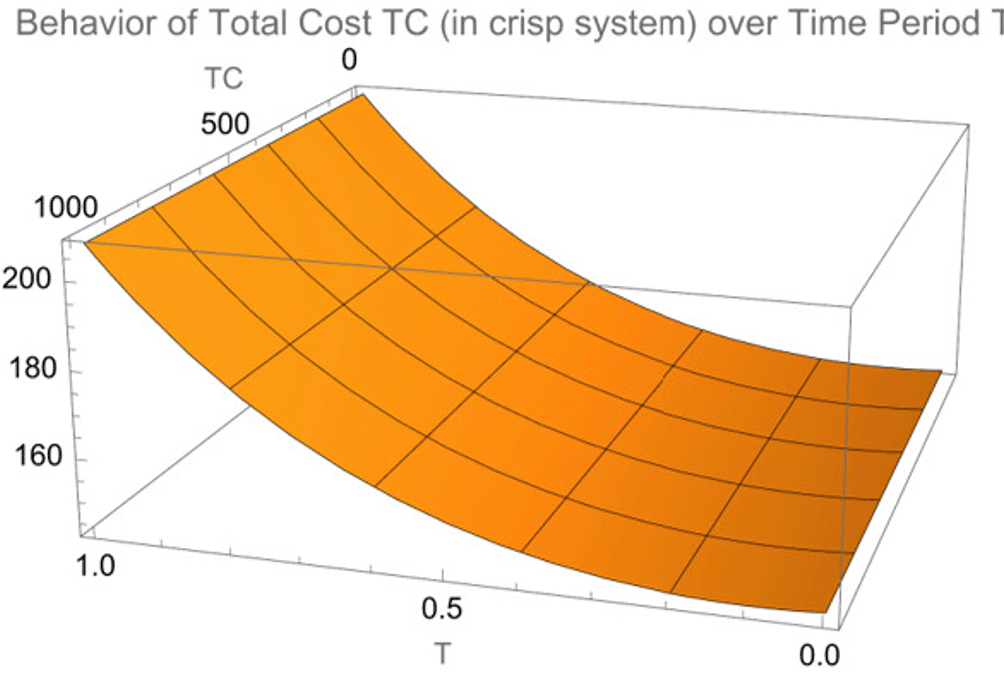
The surface demonstrates how costs vary with time, showing that the Crisp model becomes more expensive over longer planning horizons.
Figure 2 is a 2D plot showing the behavior of the total cost (TC) over time period T, where the x-axis represents the time period and the y-axis represents the total cost.
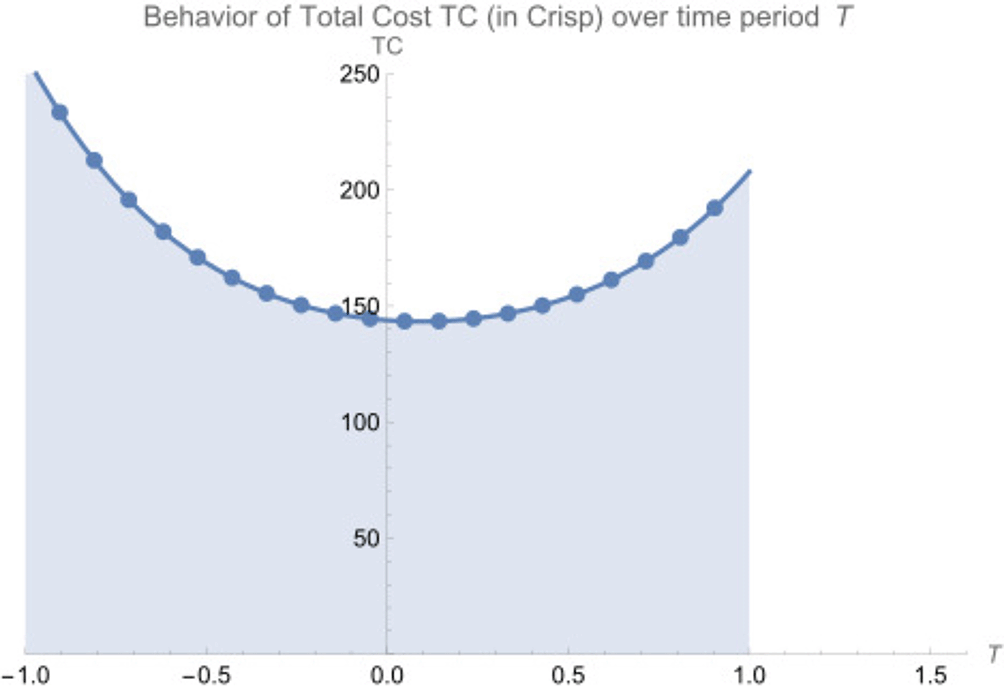
The curve shows a nonlinear increase in cost over time, indicating that inventory costs accelerate as the cycle extends.
As shown in Figure 2, the total cost starts at a lower value and increases over time, indicating that the total cost accumulates as time progresses. However, the curve on the graph shows that the cost accelerates over time instead of increasing at a constant rate, as it is a nonlinear increase. We can say that the behavior of the curve implies that the initial costs are lower at the time being, but when time increases, additional costs contribute to an increase in the total cost.
Figure 3 on a 3D plot is showing the total cost (TC) over time period T in the fuzzy system. The x-axis represents the time period, y-axis represents the total cost, and z-axis represents another dimension of the total cost (TC) variation, which suggests additional factors that influence the cost (Toomey, 2000). Unlike the 2D graph, Figure 1 3D surface shows a decrease in the total cost over time. The surface indicates that as time increases, the system becomes more cost-effective, reducing the overall total cost.
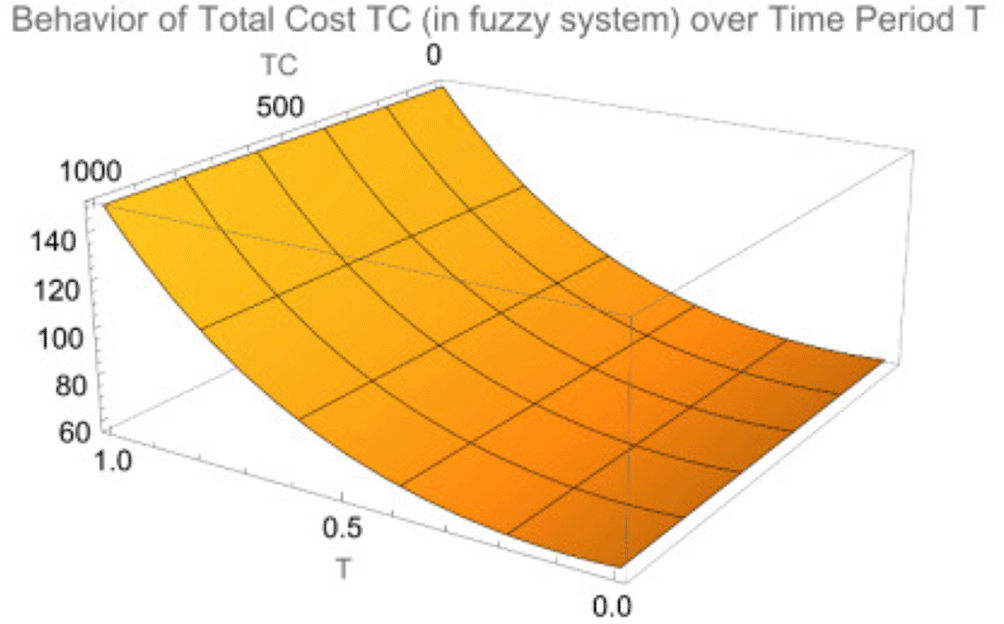
The plot illustrates that the fuzzy system achieves lower costs and greater stability under uncertainty compared to the Crisp system.
Figure 4 is a 2D plot showing the behavior of the total cost (TC) over time period T, where the x-axis represents the time period and the y-axis represents the total cost.
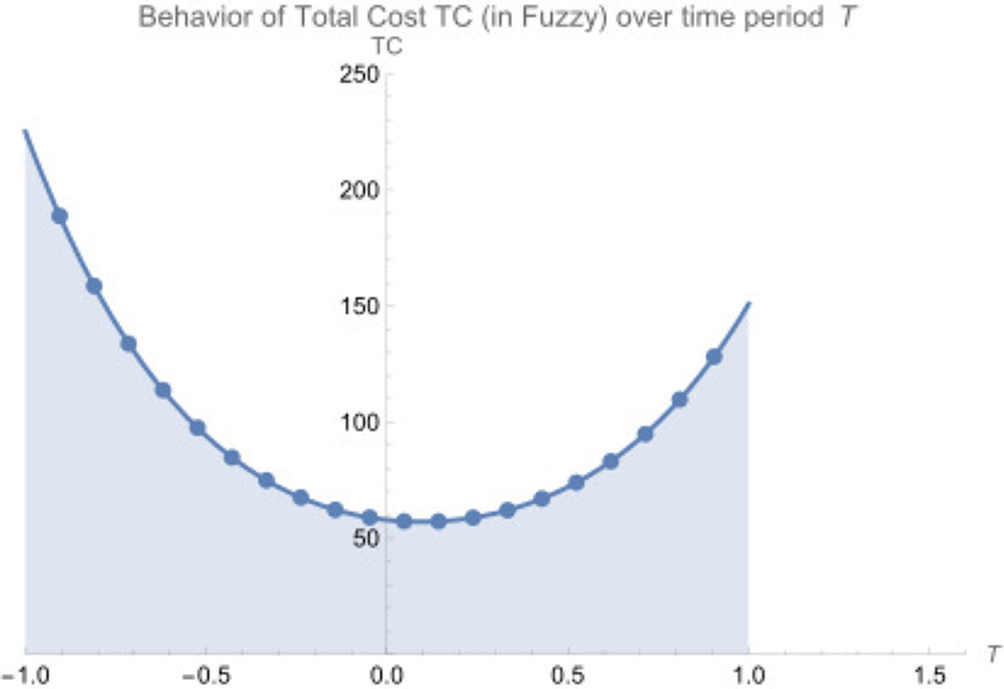
The cost curve shows a slower, more controlled growth in costs over time compared to the Crisp model.
As shown in Figure 4, the total cost starts at a lower value and increases over time, indicating that the total cost accumulates as time progresses. However, the curve on the graph shows that the cost accelerates over time instead of increasing at a constant rate, as it is a nonlinear increase. We can say that the behavior of the curve implies that the initial costs are lower at the time being (SurveyMonkey, 2018), but when time increases, additional costs contribute to an increase in the total cost.
To conclude, this study developed a strong mathematical model designed to optimize inventory management strategies when dealing with fluctuating production rates and time-varying demand. Our findings highlight the significance of production-rate variability in influencing customer satisfaction and maximizing profitability. This model has emphasized the advantages of minimizing the initial stick accumulation, thereby reducing the holding costs and improving the overall operational efficiency (Roslin et al., 2015).
The sensitivity analysis demonstrated the model’s reliability and practical value, providing valuable information for decision-making in the industrial and retail industries (Sayal and Singh, 2022). To ensure accuracy and reliability of our suggestions, we used Mathematica 14.0. This study makes a significant contribution to the literature by providing a structured framework for determining the optimal order quantities, production durations, and inventory costs (Statistics Solutions, 2021). Business can refer to this framework to gain a competitive edge through more efficient supply chain management practices.
For future research purposes, we hope to extend our model to include additional factors such as dynamic market conditions and diverse demand rates, such as the Weibull distribution. This research is expected to provide stakeholders with the capacity to make knowledgeable decisions that can align production capabilities to market demands and, hence, promote profitable growth in the current competitive environment.
The authors declare that all procedures followed in this study were conducted in accordance with ethical standards. The data used in this research were publicly available and anonymized to ensure that no personally identifiable information (PII) of the users was accessed or compromised. The authors have no conflicts of interest to disclose, and all the results have been reported transparently and without bias. Additionally, the research did not involve any human or animal subjects directly, and as such, did not require specific ethical approval from an institutional review board.
| Views | Downloads | |
|---|---|---|
| F1000Research | - | - |
|
PubMed Central
Data from PMC are received and updated monthly.
|
- | - |
Provide sufficient details of any financial or non-financial competing interests to enable users to assess whether your comments might lead a reasonable person to question your impartiality. Consider the following examples, but note that this is not an exhaustive list:
Sign up for content alerts and receive a weekly or monthly email with all newly published articles
Already registered? Sign in
The email address should be the one you originally registered with F1000.
You registered with F1000 via Google, so we cannot reset your password.
To sign in, please click here.
If you still need help with your Google account password, please click here.
You registered with F1000 via Facebook, so we cannot reset your password.
To sign in, please click here.
If you still need help with your Facebook account password, please click here.
If your email address is registered with us, we will email you instructions to reset your password.
If you think you should have received this email but it has not arrived, please check your spam filters and/or contact for further assistance.

Comments on this article Comments (0)