Keywords
Gender, perception, class participation, academic achievement, learners

Gender, perception, class participation, academic achievement, learners
Education is a key element in stimulating the socio-economic development of a nation as a whole and individuals in particular (Alice et al., 2021). As such, access to education has become a fundamental aspect of a citizen’s life, and society inevitably depends on an educated workforce for economic growth (Menon et al., 2018). The 21th century witnessed the rise of the Information Age, with technology revolutionizing education. The advent of the internet and digital tools has opened new frontiers in education, enabling remote learning, instant access to information, and global connectivity. The Information Age has democratized education, making it accessible to a global audience. It has also challenged traditional educational models, fostering lifelong learning and adaptability, which are essential in our fast-paced world (Kanyesigye et al., 2022b).
Globally, academic achievement in terms of grades obtained at different levels of education accompanied by one’s ability to quickly solve societal challenges among other 12st centuries skills are some of the major factors considered by employers while hiring employees in the workforce (Kanyesigye et al., 2023). In Kenya, Andiema (2016) conducted a study examining the effect of child-centered methods on the teaching and learning of science activities in Pre-Schools in Kenya in relation to which factors may influence school achievement at different points in time and over time and identified major factors, amongst others: learners’ gender and learners’ class participation. Learners, regardless of their gender, need to be actively involved in the learning process to develop all the required skills that are beneficial not only to their survival as individuals but to the whole nation, as emphasized by (Ukobizaba et al., 2019).
To produce a well-knowledgeable and skilled graduate, Uganda as a county in 2019, along with other countries through the Ministry of Education (MoE) together with the National Curriculum Development Centre (NCDC), adopted a Competence-Based Curriculum (CBC) and made it compulsory for all secondary schools (Kanyesigye et al., 2023). The implementation of CBC in Ugandan schools has not only been done at an ordinary level, but also at an advanced level of secondary education.
Despite the government’s commitment to providing high-quality education by providing resources and monitoring teaching and learning, learners’ academic achievement remains a challenge in secondary schools in Rukungiri District, Uganda. Learners have consistently experienced observable declines in academic achievement in the last ten years, which poses a serious threat to the socioeconomic development of the country at large (Uganda National Examination Board, 2024). Moreover, since the implementation of a CBC requires grouping learners and each group is required to have a chairperson and secretary for every lesson, it was observed in previous research that in most lessons where learners are required to present their findings, the presenters are mostly males in the case of mixed schools where males and females study together (Teddy et al., 2022). Additionally, previous researchers who have conducted quasi-experimental studies that are based on CBC also found that, usually on classroom tests, males perform better than females (Uwamahoro et al., 2021).
To identify possible ways of having all learners, despite their gender, acquire the necessary knowledge and skills to solve everyday problems, this study aimed to examine learners’ perceptions based on the gender of the influence of class participation in physics among secondary schools in Rukungiri District, Southwestern Uganda.
This study was conducted among secondary schools in Rukungiri District, Southwestern Uganda. This study used quantitative research methods and a cross-sectional design. The target population consisted of physics learners at an advanced level of secondary education. A learner’s perception survey about the influence of class participation on academic achievement was self-constructed based on the purpose of the study and used to collect data from a sample size of 355 participants who were randomly selected to avoid bias. The items of this survey were obtained by extracting and modifying items from Kanyesigye et al. (2022). The items were then discussed by three research experts from related fields. The Content Validity Index (CVI) was computed by taking the ratio of the number of items indicated as valid by all experts (n = 8) to the total number of items in the instrument (N = 10), which was obtained as 0.8, indicating that the instrument was valid according to Cohen (1988). In addition, after conducting a pilot study on 20 respondents, Cronbach’s alpha coefficient was computed using the Statistical Package for Social Sciences (IBM SPSS), giving a value of 0.78, rendering the instrument reliable, measured against the minimum value of 0.7, as documented in Creswell (2014).
After validation of the instrument, a research ethics clearance was obtained from the Valley University of Science and Technology (VUST) Research Ethics Committee under protocol number VUST-2025-081. This ethical clearance was then presented to the District Education Officer (DEO) of Rukungiri District and to the head teachers of the participating schools for permission to interact and collect data from participants. Upon meeting the participants, the researchers assured them of anonymity, confidentiality of their personal identifications, and information provided, and that they could withdraw their participation at any time they felt like without any penalty. The purpose of the study was explained to all participants at all stages. Apart from giving two (02) ball pens to each participant, there was no other form of renumeration given. Before collecting data, written informed consent was obtained from the selected participants, who were required to be at least 18 years old. Thus, the study excluded all those below 18 years of age at the time of seeking their written consent.
After data were collected, they were organized into tables and graphs, and analyzed using both descriptive statistics (means and standard deviation) and inferential statistics (independent samples t-test) to better understand how learners’ perception of the influence of class participation on academic achievement is based on their gender in secondary schools in Rukungiri District, southwestern Uganda.
A summary of the findings based on the means and standard deviations and grouped according to gender was generated to understand the general perception of the learners concerning class participation, and academic achievement is in form of descriptive statistics as presented in Table 1.
According to the findings of the study based on descriptive statistics ( Table 1), males had an average mean of 3.886 with an average standard deviation of 0.9642, while females had an average mean of 4.001 with an average standard deviation of 0.7434. These findings indicate that most strongly agree (average above four) and most males agree (average above three) that increased class participation leads to enhanced academic achievement. To better understand the trends in the above findings, a graph was generated ( Figure 1).
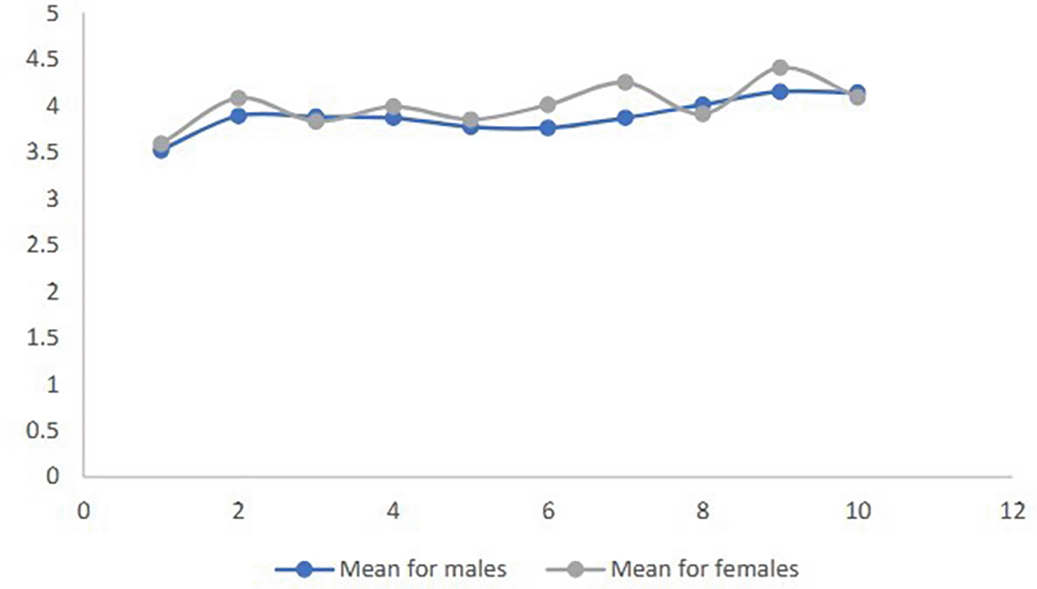
The horizontal axis contained the items asked while the vertical axis represented the mean response of per item for all learners. The blue (lower) curve represents mean responses of males and the grey (upper) curve represented mean responses of females. Much as both curves are around the mean value of 4.0 (meaning that al learners agreed that gender affects class participation), females agreed more than males indicated by the curve of females being above that of males.
According to Figure 1, there is a slight variation in the responses of males and females concerning their views on the influence of class participation on academic achievement. Both genders agreed that active class participation booted academic achievement, with the graph of females being slightly above 4 and the curve of males being slightly below 4.
To determine the level of variation between males and females concerning the influence of class participation on academic achievement, an independent sample t-test was run using learners’ gender as the grouping factor, as presented in Table 2.
Levene’s test was conducted on each item to test for equality of variance in the responses between males and females. A p-value of less than 0.05 (average p = 0.196) for the Leven’s test indicated that there was a statistically non-significant variation between the responses of males and females. The t-test for Equality of Means between the responses of males and females also showed a statistically non-significant difference (average p = 0.247), indicating that both males and females have similar perceptions of how class participation affects their academic achievement. The study findings revealed that learners’ perceptions of how class participation relates to academic achievement were not influenced by gender.
Supporting literature, especially studies related to active learning instruments, indicates that active participation of learners in class, irrespective of their gender, positively influences their academic achievement. For example, in item 4 ( Tables 1 and 2), both genders perceived that learners who actively participated in class discussions were usually more prepared for exams and assignments (mean of males = 3.87, mean of females = 3.99, p = 0.121). Both males and females believe that when they actively participate in learning, they are exposed to various ways of solving problems, and as such, they gain confidence and become more ready to perform their examination (Alarbi et al., 2024). Similarly, Kerkhoven et al. (2016) found a non-significant difference in the number of males and females involved in performing science activities. This result indicates that both males and females achieve equally if exposed to similar instructional methods that do not segregate learners, as was also discovered by Kanyesigye (Kanyesigye et al., 2022) about the effect of problem-based learning on students’ attitudes towards learning physics: a cohort study.
Similarly, the responses to item 5 ( Table 1), both males (mean = 3.77) and females (mean = 3.85), pointed out that respondents believed that learners who are more involved in classroom activities tend to do better academically. The difference in their responses was statistically non-significant (p = 0.530), as shown in Table 2. This finding agreed with Kanyesigye et al. (2023) where in their experiment study using problem-based learning instruction as the intervention, found out that the difference in the academic achievement between males and females in the post test was statistically non-significant (p > 0.05). This implies that exposing learners to similar learning conditions influenced them equally, irrespective of their gender.
Findings of the study by De Witte and Rogge (2012) about “Problem-based learning in secondary education: evaluation by an experiment” established that in the experiment group where both males and females studied together, all learners had improved results in the experiment with a non-significant difference based on their gender (p = 0.1385). This result conforms with the findings of this study, in which all learners agreed (average of males = 4.01, average of females = 3.91) to Item 8 that the more they contributed in class, the more they improved their grades and overall academic achievement.
In another study, Kanyesigye et al. (Kanyesigye et al., 2022a) analyzed data to determine whether there was a difference in the academic achievement of males and females after exposing them to similar learning conditions; the level of significance in their difference in achievement was obtained as p = 0.539, indicating a statistically non-significant difference. This finding informs the study that learners possess similar abilities and that teachers should equally help them perform better.
These findings generally suggest that all learners believe that education is an important component of their lives irrespective of their biological makeup, and that if they become more engaged and participate in class, it could enable them to achieve good academic grades.
Based on the study findings in Tables 1 and 2 and Figure 1, it was concluded that learners’ active participation in class most likely enhanced their academic achievement. Additionally, both males and females had similar perceptions of how class participation influences academic achievement. Thus, the findings of this study indicate that learners’ gender does not significantly affect their perceptions of the influence of class participation on academic achievement.
The study recommended designing and implementing school-based gender-sensitive policies by relevant authorities, training teachers in interactive teaching methods, and creating initiatives to promote engaging and non-discriminatory interactive methods to boost learners’ class participation positively.
| Views | Downloads | |
|---|---|---|
| F1000Research | - | - |
|
PubMed Central
Data from PMC are received and updated monthly.
|
- | - |
Provide sufficient details of any financial or non-financial competing interests to enable users to assess whether your comments might lead a reasonable person to question your impartiality. Consider the following examples, but note that this is not an exhaustive list:
Sign up for content alerts and receive a weekly or monthly email with all newly published articles
Already registered? Sign in
The email address should be the one you originally registered with F1000.
You registered with F1000 via Google, so we cannot reset your password.
To sign in, please click here.
If you still need help with your Google account password, please click here.
You registered with F1000 via Facebook, so we cannot reset your password.
To sign in, please click here.
If you still need help with your Facebook account password, please click here.
If your email address is registered with us, we will email you instructions to reset your password.
If you think you should have received this email but it has not arrived, please check your spam filters and/or contact for further assistance.

Comments on this article Comments (0)