Keywords
Press Freedom

Press Freedom
In the modern world and in today’s times press freedom plays a crucial component of democratic society, functioning as the foundation of accountability, the unrestricted interchange of ideas, and the safeguarding of individual and collective rights. A free press serves as a sentinel, an advocate for under-represented populations, and a channel for educated civic engagement. It employs a composite technique to evaluate a nation’s press freedom based on legal, political, economic, social, and safety-related criteria.1 This research paper depicts a comparative analysis of three nations that exemplify markedly divergent positions on the press freedom spectrum: Norway (ranked best), India (experiencing a drop), and North Korea (consistently ranked lowest). This paper seeks to examine how varying political systems, legal frameworks, media infrastructures, and societal influences either protect or undermine journalistic independence through a comparative analysis.
The core aim is to examine the factors that affects the media independence and how it is different in either countries and also the suggestive reforms
1.1.1 Analysing relevant legislation: Focus on core legislation and regulations that regulate the press freedom especially the constitutional law which is the law of the land alongside the other laws.
1.1.2 To identify compliance challenges: Examine the various challenges encountered by the press during their procedure.
1.1.3 To provide recommendations: Provide practical guidance for organisations to adeptly manoeuvre through the regulatory landscape while improving their press freedom rankings with special focus on each sectors.
1.2.1 (Norris, 2023) Discussed about the Shifting Media Landscape, where the study of press freedom occupies a critical place in media studies and political science, particularly in evaluating the health of democratic institutions and the degree of authoritarian control. India presents a complex case of a constitutionally democratic country facing a decline in press freedom. Scholars have documented the increasing concentration of media ownership and the politicization of editorial practices. Legal scholars argue that while Article 19(1)(a) of the Indian Constitution guarantees free speech, the “reasonable restrictions” clause under Article 19(2) has been invoked increasingly to silence dissenting voices. Recent empirical studies have shown a rise in the use of laws like sedition and UAPA against journalists, alongside increasing violence and digital harassment Scholars and global watchdogs alike have emphasized that the degree of media freedom within a nation serves as a reliable indicator of broader civil liberties and governance quality.2
1.2.2 (Skogerbø, 2020) Basically focused on Press Freedom and Democracy, Numerous studies underscore the link between press freedom and democratic development. Famously argued that no substantial famine has ever occurred in a functioning democracy due to the presence of a free press and public scrutiny. A free press serves as the “fourth estate,” essential for transparency, accountability, and public discourse. Norway exemplifies this model, consistently ranking highest on the Press Freedom Index, supported by a legal framework that protects journalistic integrity and prevents government interference.3
1.2.3 (Armstrong, 2013) Focused on the totalitarian control in North Korea, In authoritarian regimes such as North Korea, press freedom is virtually nonexistent.4 How state-controlled propaganda systems work to shape public perception and suppress dissent. North Korean media serves purely as a tool of the regime, with international bodies consistently reporting the imprisonment, torture, and execution of those who attempt to disseminate unapproved information. Comparative literature has explored how such regimes use media not just for control, but for cultural indoctrination and legitimization of power.
1.2.4 (Kumar, 2022) Gained wide scholarly acceptance as a reliable comparative tool, despite criticisms about methodological transparency and cultural bias. It aggregates expert assessments and quantitative data across five key dimensions: political context, legal framework, economic context, sociocultural environment, and safety of journalists. Comparative political communication studies often utilize case study frameworks to evaluate press freedom across regimes. Typology of media systems has been instrumental in categorizing democracies like Norway under the “Democratic Corporatist Model,” whereas India’s hybrid system and North Korea’s totalitarian structure fall outside traditional classifications. This comparative methodology enables researchers to identify patterns, anomalies, and policy implications across different governance models. While it accurately captures macro-level trends, some researchers argue that the Index may underrepresent ground-level nuances, particularly in large, heterogeneous nations like India.
While there is an increasing amount of research on global press freedom, significant gaps remain in comparative studies, especially those contrasting liberal democracies, flawed democracies, and totalitarian regimes. The existing literature predominantly emphasizes single-country analyses or broad regional assessments, lacking detailed cross-regime comparisons.1,2 Norway is frequently referenced as a benchmark for media freedom, whereas North Korea exemplifies media repression. However, there is a scarcity of academic research that directly contrasts these extremes with hybrid or transitional systems such as that of India. Furthermore, studies have generally concentrated on legal and institutional frameworks independently, neglecting to analyse their intersections with political dynamics, economic pressures, digital surveillance, and journalist safety within various governance models. In India, there is a lack of scholarly examination regarding the impact of economic consolidation of media ownership and rising digital threats on press autonomy, despite the existence of democratic legal protections. Furthermore, although the Press Freedom Index serves as a common comparative instrument, it is frequently referenced in a descriptive manner rather than subjected to critical analysis or situated within broader theoretical contexts. Integrative research is necessary to combine data with field-based qualitative studies, journalist testimonies, and media content analysis, particularly in countries like India that exhibit internal variation across regions and media platforms. In authoritarian regimes such as North Korea, research predominantly depends on secondary data or accounts from defectors because of limited access to primary sources. This results in a deficiency in detailed, verifiable, and up-to-date insights regarding the internal operations of state media and the ways in which citizens may engage with or oppose information control.
1.4.1 Research design
Here the assesses countries based on five principal indicators: the political context for journalists, the legal framework regulating media practices, the economic conditions impacting media sustainability, the sociocultural environment, and the security level for media professionals.5 This analysis utilized data from many International journals, websites along with reports, national constitutions, peer-reviewed academic literature, policy briefs, and journalistic record.4,6,7 The study includes historical contextualization and content analysis of legal legislation and media case studies from various nations. This study employs a comparative qualitative research approach that incorporates content analysis, legal-text scrutiny, and secondary data interpretation to assess press freedom in Norway, India, and North Korea. These three nations were intentionally selected to exemplify a broad spectrum of media freedom spanning from complete democratic openness (Norway), through democratic regression (India), to totalitarian oppression (North Korea) as indicated by their consistent standings.
1.4.2 Analytical framework
The analysis employs a thematic comparison methodology, utilizing the five dimensions of the as analytical categories:
1. Political environment
2. Regulatory structure
3. Financial limitations
4. Sociocultural milieu
5. Journalist safety
Each nation is analyzed within this framework to guarantee a uniform and systematic assessment. Additionally, qualitative content analysis is utilized to scrutinize legislative texts and policy papers to assess the practical implications of constitutional protections and governmental restrictions on press freedom.
For a summary of political, legal, economic, socio-cultural and safety indicators across the countries considered refer to Table 1. A line graph showing the average global press freedom ranking over a period 2025. This bar chart presents the highest and lowest scoring countries in the 2025 World Press Freedom Index, as assessed by Reporters Without Borders. The top-performing countries Norway, India, North Korea with significant restrictions on journalistic freedom. The press freedom ranking is measured on a scale from 1 (best) to 180 (worst). For a visual representation of the press freedom rankings over time refer to Figure 1.
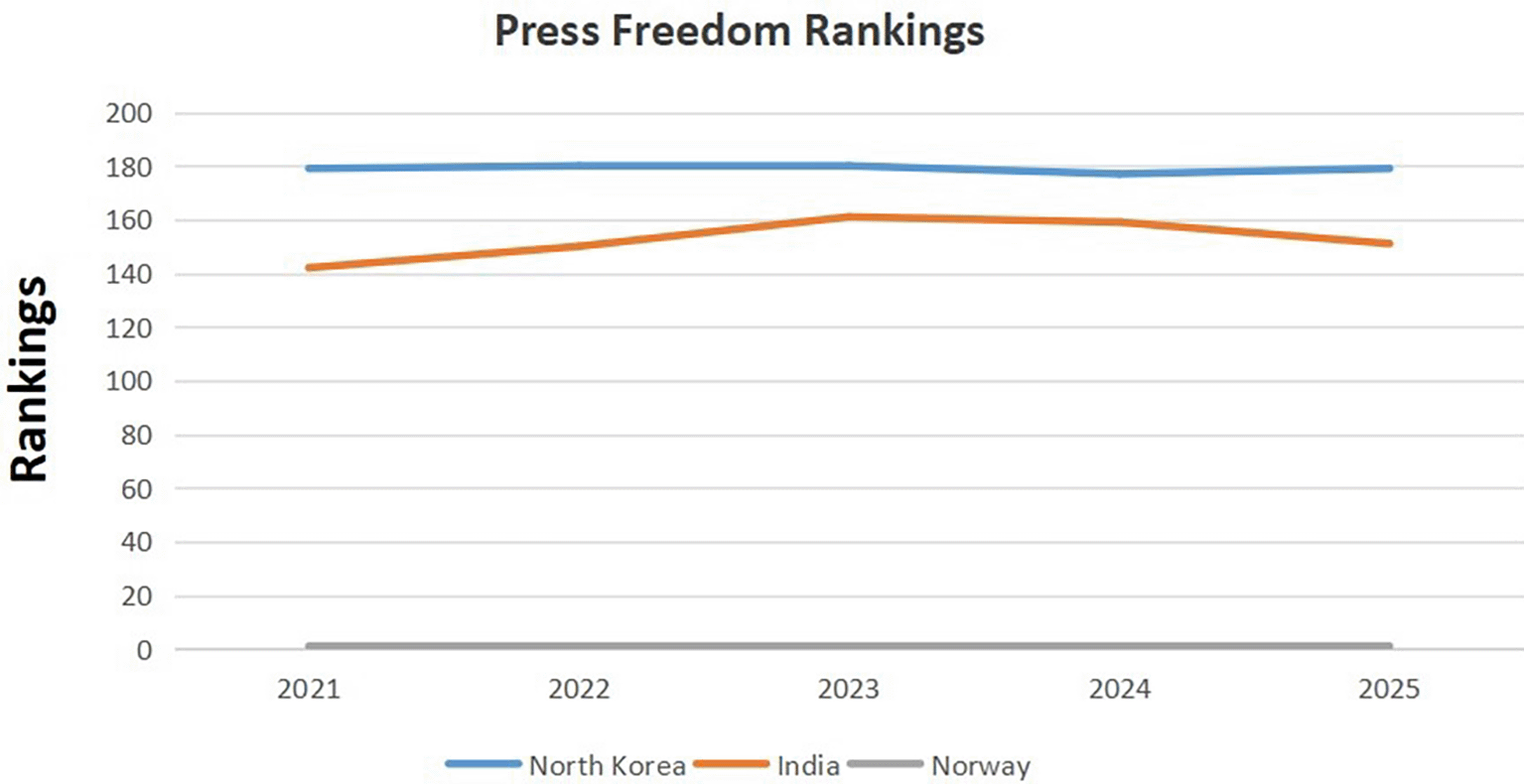
Global Decline in Press Freedom Scores (2015–2025). Source: Reporters Without Borders. (2025). World Press Freedom Index 2025. RSF. https://rsf.org/en/index.
If we say a ideal country in the press freedom then the name comes Norway which has deliberately became the iconic country on the World Press Freedom Index for seven years, a differentiation founded on its robust peoples traditions, law enforcers structures, and institutional integrity. The legum structure in Norway that save the freedom of the journalist or the press or media we can say is strong. The media place is dynamic, characterized by a strong general service broadcaster and a nonuniform private sector, with publishing enterprises enjoying considerable editorial autonomy. Like we can say the Article 100 of the Norway Constitution unequivocally protects freedom of expression and the media, promising that journalists can function without apprehension of public enforcer retribution or censorship.8 The public service broadcaster NRK predominates the audiovisual market, with primarily one rival in news transmission. The online edition of the VG newspaper most read in the digital realm. Approximately 176 news organization function inside the nation. Norway media advantages stem from fiscal openness, governmental subsidies that foster independent media. The law of the land ensures the right to free speech which is further safeguarded by many additional statutes. Press sector follows a shared ethical code. The government’s comprehensive accumulation of communication data presents a significant threat to the safeguarding of journalistic sources. Broadcasters like NRK are financed by the state while maintaining editorial independence, exemplifying a model where governmental assistance coexists with autonomy. Physical violence is rare also threats to journalists are prevalent. The nation’s journalistic ecology is enhanced by significant public faith, strong safeguards for whistle-blowers, and few occurrences of physical or digital assaults on media personnel. Norway openness and information accessibility fosters an informed populace and fortifies its democratic institutions.
India, the world’s largest democracy, has traditionally maintained a robust journalistic culture. Recent trends have shown a concerning decline in media independence. Article 19(1)(a) of the Indian Constitution ensures the right to freedom of speech and expression, encompassing the press.9 The Indian media landscape is extensive in this nation of 1.4 billion people and 210 million households equipped with television sets. The nation possesses over 900 privately owned television channels, with half of them focused on news coverage. Doordarshan, the public television broadcaster, functions in 23 languages and engages millions of people. Approximately 140,000 publications are released in over 20 languages, comprising almost 20,000 daily newspapers. Their aggregate circulation exceeds 390 million copies. Online news, especially via social media, is preferred by a younger demographic and has surpassed print media as the primary news source. Radio news transmission continues to be a state monopoly, dominated by the national public broadcaster All India Radio (AIR), which, along with Doordarshan, constitutes the public broadcasting entity Prasar Bharati. This freedom is compromised by the constraints established by Article 19(2), which permits “reasonable restrictions” for the sake of state sovereignty, public order, morality, and security. These provisions have often been utilized to rationalize governmental overreach. The constitution does not explicitly mention freedom of the press; rather, it is safeguarded by the right to freedom of speech. Governments have consistently utilized colonial-era legislation, including laws pertaining to sedition, defamation, and anti-state actions, to repress the media. Anti-terrorism legislation is progressively employed against journalists. The principal opposition party, the Indian National Congress, together with several regional parties, has employed legal mechanisms to intimidate journalists and retaliate against them. India has enacted many new laws that confer the government with exceptional authority to regulate the media, censor information, and suppress dissent, including the 2023 Telecommunications Act, the 2023 draft Broadcasting Services (Regulation) Bill, and the 2023 Digital Personal Data Protection Act. The use of colonial-era legislation, such as sedition (Section 124A of the Indian Penal Code), alongside modern regulations like the Unlawful Activities Prevention Act (UAPA), has resulted in the criminalisation of dissent and the imprisonment of journalists. India has experienced an increase in targeted violence, internet harassment, and orchestrated campaigns against independent journalists. Media ownership is significantly concentrated within a limited number of corporate groups, many of which have tight relationships with political elites. The governmental control over public broadcasters such as Doordarshan and the Press Information Bureau further erodes journalistic autonomy. Internet shutdowns, particularly in politically sensitive areas such as Jammu and Kashmir, hinder access to information and obstruct journalistic endeavour. The great diversity of Indian society is not represented in the media landscape. The journalistic profession, particularly in leadership roles, is predominantly held by upper-caste Hindu men, resulting in a bias that influences the perspectives and topics of stories and reports. For instance, on prominent nighttime talk programs, women constitute fewer than 15% of the guests. Hindu nationalist ideology is gaining prominence. Numerous television media sources, especially those broadcasting in Hindi, provide a considerable amount of attention to religious news, occasionally overtly promoting animosity towards Muslims. India is among the most perilous nations for journalists, with an annual average of two to three media professionals murdered in connection with their employment. Journalists critical of the government frequently endure internet abuse, intimidation, threats, physical assaults, criminal prosecutions, and arbitrary detentions. They may suffer violence from law enforcement, political activists, criminal organisations, and corrupt local authorities. Public punishment for individuals deemed as “traitors” and “anti-national” is advocated by proponents of Hindutva, the extreme right-wing nationalist ideology within Hinduism. When women journalists have their identities revealed, they are the targets of coordinated campaigns of hate speech and calls to violence on social media. Particularly worrisome is the fact that journalists covering environmental concerns in Kashmir are subject to regular harassment by police and paramilitary groups and, in extreme cases, “provisional” imprisonment that lasts for years. The Khabar Lahariya news outlet is one of many contrasting examples in India; it is run entirely by women from rural areas and religious or ethnic minorities.
Now if we come to the unique country that is North Korea offers the most extreme example of media restraint in the modern world. Generally People’s Republic of Korea Democractic (DPRK), among the most totalitarian countries globally, rigorously regulates information and prohibits press freedom. Central News of Agency in Korea also known as (KCNA), the official government entity, plays the sole authorized news source for North Korean media. Korea rigorously regulates the creation and dissemination of information and categorically prohibits independent journalism. Many press agencies in international forums, including France Press agency is formally established in the country but function under stringent supervision it limits the capabilities of reporting. Also the 67th Article of Korean constitution guarantees freedom of the press nevertheless, the leadership consistently violates this provision. All news outlets are state-owned and function as mouthpieces for regime propaganda.10 The Korean Central News Agency (KCNA) disseminates heavily curated content designed to glorify the leadership and suppress any form of dissent or external influence. The government tightly controls internet access, with ordinary citizens restricted to a domestic intranet that contains only government-approved material. North Korea operates a centrally planned economy; but, due to recent economic mismanagement, the state has forced to relax its control over the private sector. Over 400 private marketplaces (Jangmadang) are reportedly operational nationwide, facilitating the dissemination of knowledge among residents. Popular South Korean television programs and films are frequently disseminated using USB flash drives, notwithstanding the severe penalties imposed on anyone apprehended for accessing external material. Foreign journalists are rarely granted access, and those who are permitted entry are under constant surveillance. Domestic journalists are not protected by any legal rights or professional codes but are instead subject to intense scrutiny by the state. Penalties for disseminating unauthorized information range from forced labor to execution. Due to the regime’s pursuit of total isolation from the global community, journalists have been apprehended, deported, subjected to forced labour camps, and murdered for diverging from the party’s narrative. In 2017, the government condemned South Korean journalists to death in absentia merely for remarking on the nation’s economic and social conditions. The lack of press freedom in North Korea correlates directly with widespread human rights violations, poverty, and misinformation. The regime’s control over information has created a population that is largely isolated from global realities.
Table 1 compares the press freedom conditions in Norway (Rank 1), India (Rank 151), and North Korea (Rank 179) using key indicators from the RSF World Press Freedom Index 2025. The indicators reflect political influence, legal protections, economic viability, sociocultural environment, and safety of journalists. The data reveals stark contrasts between a highly free press system (Norway), a partially free and increasingly restricted environment (India), and a completely state-controlled media landscape (North Korea).
The extent of press freedom in a nation signifies and bolsters the robustness of its democratic institutions and its dedication to human rights. Norway exemplifies how an independent press may foster openness, informed discourse, and public responsibility. India’s regression serves as a cautionary tale for other democracies on the perils of equating national security with the repression of free expression. The deterioration of journalistic freedom in India negatively impacts civil rights, judicial autonomy, and electoral integrity. In contrast, North Korea exemplifies the totalitarian extreme, where the lack of journalistic freedom enables unrestrained governmental authority and pervasive human rights violations. The press freedom scores across various dimensions can be found in Figure 2 which clearly states the transition of press freedom.
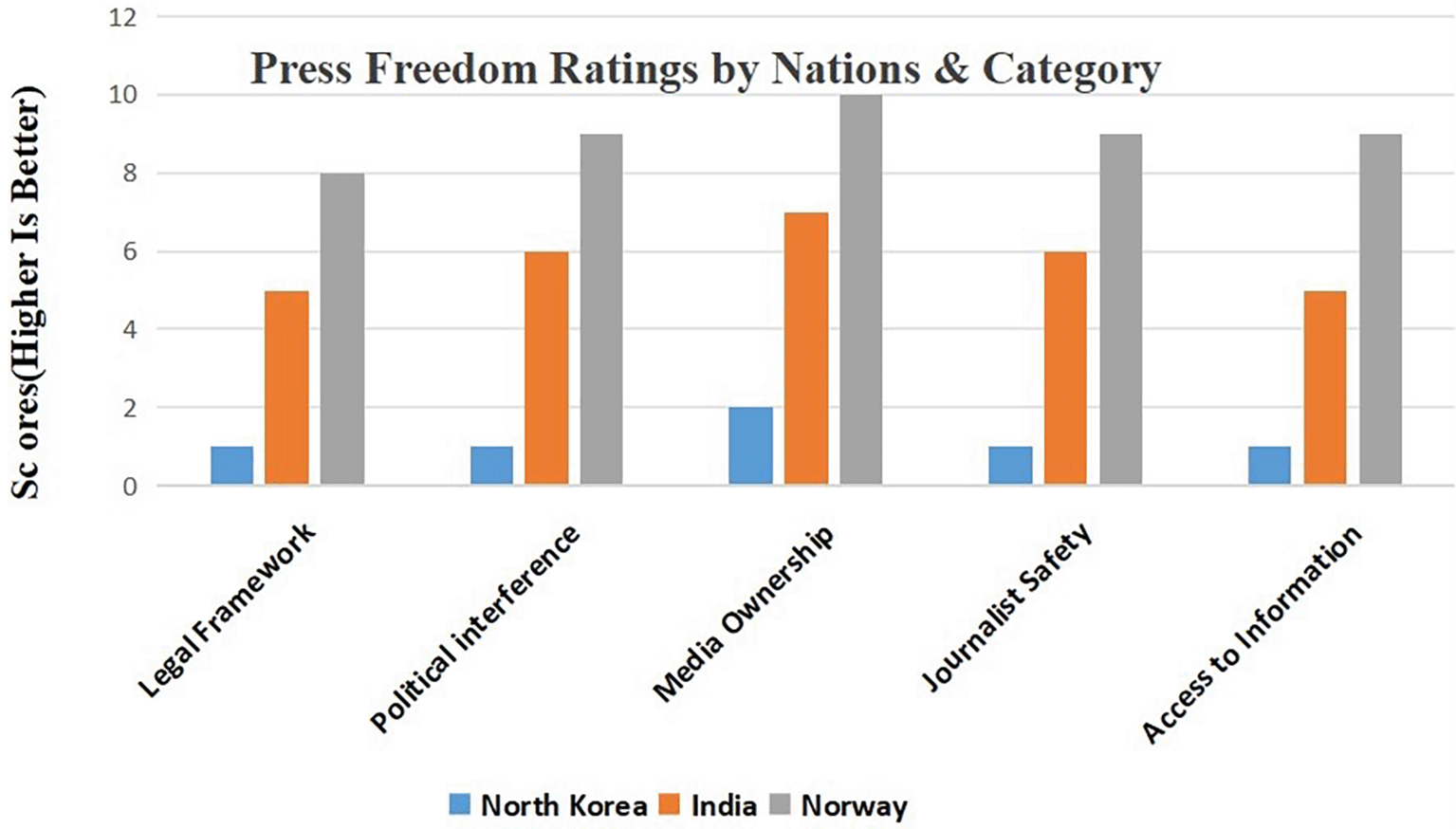
This figure analyzes five key dimensions influencing press freedom: legal framework, political interference, media ownership, journalistic safety, and access to information. The comparison among Norway, India, and North Korea reveals a spectrum from a free, independent press to a completely controlled media system.
Source: Reporters Without Borders. (2025). 2025 World Press Freedom Index: Economic fragility is now the main threat to media. https://rsf.org/en/rsf-world-press-freedom-index-2025-economic-fragility-leading-threat-press-freedom.
In India there needs a several necessary adjustments to restore journalistic freedom. Legal modernization is need of the hour colonial era acts like sedition must be repealed or narrowly interpreted also the UAPA must be reviewed for human rights compliance. Secondly media regulators should be independent from government monitoring. Norway policy regarding the press freedom should be adopted as the constitution of norway is free for the press. Public broadcasters must have editorial autonomy charters. Thirdly law, police reform alongside judicial accountability must be established to protect journalists. Last but not the least diversify media ownership and improve local journalism. International watchdogs, human rights groups and foreign governments must continue to restrain regimes like Korea diplomatically and economically while backing civil society press freedom activists. Investment in journalist safety training, whistleblower protections, and internet freedom technologies is crucial.
This distinction between the countries highlights the key role of press freedom in recognising the strength and trajectory of a nation’s democratic progress. An efficient media ecosystem that supports peoples governance may be fostered by well-established legal and institutional frameworks, as seen in the Norway ideal model. The difficulties India is experiencing show how precarious democratic values are in the absence of long-term safeguards and reforms. The totalitarian regime in North Korea is an exemplerary model of how totalitarian control of the media may stifle free speech, prevent government oversight. Protecting the freedom of the press is essential to maintaining democracy not only for the sake of journalists. Press freedom, bravery, and basic independence are prerequisites for every society that aspires to democratic integrity and global leadership.
The research paper presents many dimensions for further research on worldwide press freedom, particularly among varied political systems. The comparative study might encompass other nations from different parts of the globe, facilitating a more comprehensive knowledge of regional dynamics and systemic tendencies. However frequent study may employ a mixed-methods approach, integrating qualitative evaluations with quantitative data due diligence for the correlation between press freedom and democratic health indicators, including transparency and institutional accountability. Whereas in India comprehensive regional analyses may reveal how federal frameworks and local political environments dynamic affect journalistic freedom among states. Electronic media continues to transform the information landscape, additional examination is required about the impact of monitoring, algorithmic restriction alongside online harassment on press freedom. Integrating fieldwork via interviews with journalists, editors could enhance the study with useful firsthand insights. Longitudinal research utilizing historical Press Freedom Index data may elucidate the trajectories of media freedom throughout time. Ultimately, policy-oriented research can assess the efficacy of legislative reforms and international lobbying initiatives designed to safeguard journalistic integrity and freedom of speech.
| Views | Downloads | |
|---|---|---|
| F1000Research | - | - |
|
PubMed Central
Data from PMC are received and updated monthly.
|
- | - |
Provide sufficient details of any financial or non-financial competing interests to enable users to assess whether your comments might lead a reasonable person to question your impartiality. Consider the following examples, but note that this is not an exhaustive list:
Sign up for content alerts and receive a weekly or monthly email with all newly published articles
Already registered? Sign in
The email address should be the one you originally registered with F1000.
You registered with F1000 via Google, so we cannot reset your password.
To sign in, please click here.
If you still need help with your Google account password, please click here.
You registered with F1000 via Facebook, so we cannot reset your password.
To sign in, please click here.
If you still need help with your Facebook account password, please click here.
If your email address is registered with us, we will email you instructions to reset your password.
If you think you should have received this email but it has not arrived, please check your spam filters and/or contact for further assistance.

Comments on this article Comments (0)