Keywords
S-Pseudo bounded module, Fully polyform module, Multiplication module, Critically compressible module, Scalar module.

This article is included in the Fallujah Multidisciplinary Science and Innovation gateway.
S-Pseudo bounded module, Fully polyform module, Multiplication module, Critically compressible module, Scalar module.
1- we mentioned some more recent works in the introduction part based on modules in logical algebras such as modules over JU algebras and some other structures and consequently add in the reference part.
2- We Shift the definition of bounded modules from introduction part to Preliminaries part. Definitions 2.1, 2.27
3- We Revise the English once again throughout the paper.
See the authors' detailed response to the review by Moin A Ansari
See the authors' detailed response to the review by Annet Kyomuhangi
The notion of bounded module was studied by Carl Faith.1 Moreover, bounded submodule introduced with details by AL-LNI.2 The concept of almost bounded submodule was submitted by Buthyna Najad.3 Recently, restricted bounded submodule was studied by Mohammed Murad.7 Also, modules in logical algebras such as modules over JU algebras and some other structures were introduced.18 The scalar modules and prime modules are involved in several properties in our study as a condition to attach S-Pseudo bounded module with other modules. Note that if for every submodule of then is said to be prime module.4 Furthermore, if is finitely generated , then is compressible if and only if it is uniform and prime.5 This study investigated how S-PS.B. modules relate to other well-known module types offering new insights into these connections. We explored how these modules relate to monoform modules, compressible modules, critically compressible modules and Rickart modules directly or with some conditions.
In this article, we investigate a new class of module called S-Pseudo bounded module where in Section 2 some related facts are reviewed and Section 3 contained some definitions with examples while in Section 4 we introduced some significant relationships and connected with other modules.
1An is bounded module if there exists an element such that
6An is said to be scalar if for every there exists such that
7An is called monoform if of is dense where a submodule of is dense if for any there exists such that and .
Equivalently, An is said to be monoform if of and then is monomorphism.7 Also , if is monoform module, then it is uniform and prime and hence we deduce that is prime ideal of
8An is said to be finitely annihilated if there exists a finitely generated submodule of such that
9An is called quasi-Dedekind if of is quasi-invertible where is quasi-invertible if
Equivalently, an is said to be quasi-Dedekind if for each non-zero endomorphism of is a
10 An is called polyform if every essential submodule of is dense. Note that every monoform is polyform.
10An is said to be fully polyform if every P-essential submodule of is dense where is called P-essential if every pure submodule of such that implies that
10An is said to be fully retractable if for every non-zero submodule of and each non-zero homomorphism implies that
11An is called coprime if for every proper submodule of
6If is a multiplication finitely generated then is a scalar
6Let be an injective scalar . Then is a scalar submodule of
12Every finitely generated is finitely annihilated.
12Let be a multiplication Then is finitely generated if and only if is finitely annihilated.
6Let be a scalar torsion-free with ( is an integral domain). Then every is
13Let be a quasi-Dedekind retractable If every is a monomorphism, then is compressible module.
14Let be a retractable such that End( is a domain. Then is critically compressible module if and only if it is polyform.
14Let be a retractable Then is critically compressible module if and only if every non-zero partial endomorphism of is monomorphism.
14Let be a fully retractable with End( is a domain. Then is polyform.
15An is called Rickart if and only if is a direct summand of
15If is an injective prime then is Rickart module.
16An is called N-Rickart if for every homomorphism is a summand of
14If is uniform module, then is fully polyform if and only if is monoform module.
17If is finitely generated , then is compressible if and only if is uniform prime module.
14A module is called compressible module if it can be embedded in any of its nonzero submodules.
14A compressible module is called critically compressible if it cannot be embedded in any proper factor module.
14A partial endomorphism of a module is a homomorphism from a submodule of into .
3If there exists an element , such that ann = ann then ℵ is called almost bounded submodule.
In this part, a new class of an will be investigated with some definitions and examples related to S-PS.B. -module which depends on an endomorphism map over an
A proper submodule of an is called S-pseudo bounded (symbolically S-PS.B. -submodule) if there exists such that for some implies that
1- Let as a and Define by If then . Therefore, and hence is S-PS.B. submodule of
2- Consider as a and , then there exists defined by clearly, Now, suppose that . Sequently, . Thus Therefore, is S-PS.B. submodule of
3- Suppose that as a and . An endomorphism defined by if , we have is not S-PS.B. submodule.
We established that every Endo-R.B. is S.PS.B. submodule but the converse is not necessary true in general. If is an Endo-R.B. then there exists such that implies that by Ref. 7. But and from above equality we get Hence, is S-PS.B. submodule. But the converse is not true in general for example:
Let as . Define as: if we take then implies that = and .Thus is S-PS.B. submodule, but is not equal to . Therefore is not Endo-R.B. submodule.
An is said to be S-PS.B. if every proper submodule of is S-PS.B submodule.
More properties of S.PS.B. module (submodule):
(i) Let M1 and M2 be two S-PS.B. F-modules, then M1 ⨁ M2 is S-PS.B. F-module.
(ii) Let M be an F-module and I⊆ ( ) where I is an ideal of F. Then M is S-PS.B. F-module if and only if M is S-PS.B. F/I-module.
(iii) If ℵ1 and ℵ2 are S-PS.B. F-submodules of M1 and M2 respectively, then ℵ1⨁ℵ2 is S-PS.B. F-submodule of M=M1⨁M2.
(iv) Let M be an F-module. If M is S-PS.B.E-module, then M is S-PS.B.F-module, where E=End(M).
In this section, many modules played a major role in getting S-Pseudo bounded module such that monoform, compressible, quasi-Dedekind module and others modules. We got more results through several relationships.
If is a multiplication torsion-free with ( is an integral domain), then the following statements are equivalent.
is S-PS.B.
is monoform module.
Suppose that is S-PS.B. Since is a multiplication torsion-free, then is finitely generated, by Remark (2.12) and Proposition (2.13). Therefore is scalar by Corollary (2.10). By Proposition (2.14), every is monomorphism. Suppose that be an and is inclusion map, then is monomorphism and is monoform module.
Let is monoform module implies that is uniform prime module and every submodule of is dense. Suppose that such that and Since is uniform, then Hence and thus Let implies that which implies and Since is dense submodule and is prime ideal of then and Thus and is S-PS.B.
However, the condition torsion-free is suffice to prove is monoform module.
Let be a torsion-free S-PS.B. Then is monoform module.
Suppose that be any non-zero submodule of Since is a torsion-free module, then there exists such that we obtain Since is S-PS.B. , then such that defined as and hence Now, assume that we have to show that Let implies that since is torsion-free module which is contradiction and thus Since is an artibrary submodule, then is monoform module.
If is quasi-Dedekind S-PS.B. then is monoform module.
It is sufficient to show that every non-zero submodule of is dense. Assume that is any non-zero submodule of Define by Suppose that and , since is S-PS.B. implies that and which means Since is quasi-Dedekind module, then is monomorphism. Hence which is contradiction. Thus and is dense submodule.
Every S-PS.B. is retractable
Assume that is a non-zero submodule of S-PS.B. then there exists such that defined as with Let and the inclusion map. Then where Thus that means which is a contradiction. Hence of Therefore is retractable
Conversely is not true in general, we have this example:
Consider as a and Define as Since then is retractable module. But is not S-PS.B , since where
If is S-PS.B. torsion-free module, then is critically compressible module.
By Corollary (4.2) and Proposition (2.17) we get is critically compressible.
Let be S-PS.B. Then is critically compressible if and only if every non-zero partial endomorphism of is monomorphism.
If is a duo S-PS.B. then is fully retractable module.
Since is S-PS.B. then there exists is a non-zero endomorphism of such that and where is a submodule of For every we have since is a duo. Thus the partial endomorphism of is not zero and Therefore is retractable module, by Proposition (4.4) so that there exists a homomorphism. Hence and thus is fully retractable module.
If is a duo S-PS.B. and is a domain, then is polyform module.
Assume that is S-PS.B. then by previous proposition, is fully retractable module. Applying Proposition (2.18) we get the result.
Let be a uniform S-PS.B. and is a domain. Then the following statements are equivalent:
is critically compressible module.
is polyform module.
Suppose that is critically compressible module, then is monoform, by Corollary(4.6) and thus is polyform.
Assume that is polyform module, then by Corollary (2.22), is monoform, since is uniform. Since is S-PS.B. , then is retractable. By Proposition (2.16), is critically compressible module.
If is S-PS.B. uniform where is a domain, then the following statements are equivalent:
is fully polyform module.
is critically compressible module.
If is uniform, then polyform and fully polyform are equivalent, by Ref. 10.
If is a compressible then is S-PS.B.
Assume that where define as For each submodule of there exists a monomorphism map, since is a compressible module. If where is the inclusion map, then Suppose that implies that Thus so that and which means Hence and since is prime module. Therefore and is S-PS.B.
Let be a torsion-free multiplication with ( is an integral domain). Then is S-PS.B. if and only if is a compressible module.
Let be S-PS.B. . By Corollary (2.10) is a scalar module and hence every is monomorphism. Since is retractable module by Proposition (4.4), then there exists a homomorphism for every submodule of Hence is monomorphism where is an inclusion map. Thus is a monomorphism and hence is a compressible module.
Conversely, applying previous proposition.
If is a quasi-Dedekind retractable then is S-PS.B. .
Since M is a quasi-Dedekind, then every is monomorphism. Hence is a compressible module, by Proposition (2.15) and thus is S-PS.B. , by Proposition (4.11).
If is a finitely generated, then every uniform prime is S-PS.B. .
Since is a finitely generated implies that is a compressible module, by (2.23). The result is obtained by Proposition (4.11).
If is a quasi-Dedekind and where and is a submodule of then is S-PS.B.
Suppose that then such that Thus is retractable module. Since is a quasi-Dedekind module, then is S-PS.B. by proposition (4.13).
Let is a quasi-Dedekind S-PS.B. Then
Assume that and Hence since is prime. Thus for every such that and so that which is contradiction since is monoform module by Proposition (2.18). Thus
Let is a quasi-Dedekind S-PS.B. Then is not coprime
Let and be a quasi-Dedekind . Then is S-PS.B. .
Suppose that and defined as , . Since be a quasi-Dedekind module so if we define as , then either or is a monomrphism. Let and then which means Therefore, so that and Hence . If we obtain so and also Now, let so and then Thus and we get
If is S-PS.B. , then
Assume that and such that defined as , since is S-PS.B. Thus is retractable by (4.4) which means for every submodule of Therefore so that and since implies which is contradiction. Thus
Let is S-PS.B. such that Then is not epimorphism.
Suppose that . Since is S-PS.B. then is retractable module ad there exists a homomorphism for every submodule of Put where is the inclusion map. Therefore is not epimorphism.
Let be S-PS.B. torsion-free . Then is an injective.
Since is a torsion-free and S-PS.B. , so that is a monoform module by Corollary (4.2) and thus there exists a non-zero monmorphism defined by Since is S-PS.B. then is retractable and there exists a homomorphism defined by Moreover we consider the diagram.
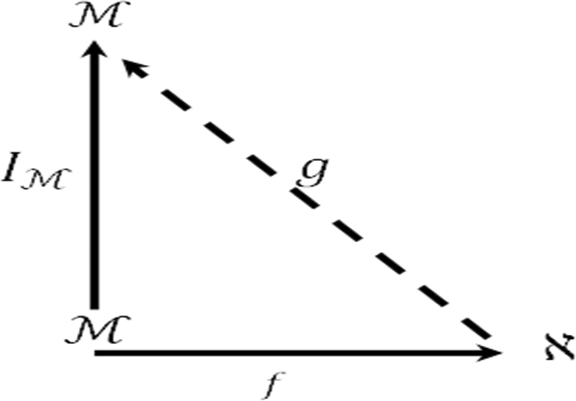
Suppose that then . Thus and the diagram is commutative so is an injective
If is a torsion-free and S-PS.B. then has no zero-divisors.
Suppose that are two non-zero homomorphism implies that such that where Since is monoform by (4.2) and thus is quasi-Dedekind module. Hence are two monomorphisms. Thus and which means has no zero-divisors.
If is torsion-free S-PS.B., then is a Rickart
Since is an injective, by Proposition (4.21) and hence is prime module since every torsion-free S-PS.B. is monoform. By Proposition (2.20) we obtain that is a Rickart.
Let be an indecomposable S-PS.B. with is N-Rickart. Then is quasi-Dedekind.
Suppose that is S-PS.B. , then is a retractable module, by (4.4) and thus for every non-zero submodule of Suppose that is an endomorphism of Since is N-Rickart, then is direct summand of Since be an indecomposable so that Thus is a and is quasi-Dedekind module.
Let be a torsion-free S-PS.B. Then for each there exists once is splits in
From (4.23) we get is a Rickart , Consider the following short exact sequence .
Consequently, is direct summand of , since is Rickart module. But which means is splits in
Let be a S-PS.B. . Then is a Rickart ring if and only if is a Rickart module.
Since is a S-PS.B. which means is retractable module so that we get the result by (proposition (3.3), Ref. 16).
In our article, we have a new class of module called S-Pseudo Bounded and we explained the relation of this module with other modules. Also, we introduced many nicely properties that join S-Pseudo Bounded with important modules such that monoform modules, retractable modules, quasi-Dedekind modules, and compressible modules. In addition, using S-Pseudo Bounded as supposition lead us to get some statements that will be important for other who want to study in this field.
| Views | Downloads | |
|---|---|---|
| F1000Research | - | - |
|
PubMed Central
Data from PMC are received and updated monthly.
|
- | - |
Provide sufficient details of any financial or non-financial competing interests to enable users to assess whether your comments might lead a reasonable person to question your impartiality. Consider the following examples, but note that this is not an exhaustive list:
Sign up for content alerts and receive a weekly or monthly email with all newly published articles
Already registered? Sign in
The email address should be the one you originally registered with F1000.
You registered with F1000 via Google, so we cannot reset your password.
To sign in, please click here.
If you still need help with your Google account password, please click here.
You registered with F1000 via Facebook, so we cannot reset your password.
To sign in, please click here.
If you still need help with your Facebook account password, please click here.
If your email address is registered with us, we will email you instructions to reset your password.
If you think you should have received this email but it has not arrived, please check your spam filters and/or contact for further assistance.

Comments on this article Comments (0)