Revised
Amendments from Version 1
The revisions introduced in version 2 of the manuscript were made in response to the reviewers’ comments and suggestions.
No changes were made to the title, abstract, author list, figures, tables, or underlying data. The reviewers did not request any revisions to the abstract.
The introduction was revised by modifying the first paragraph and by briefly adding some of the relevant literature recommended by the reviewers.
In addition, several minor revisions were made throughout the manuscript, including improvements in wording, clarification of certain expressions, and formatting adjustments across multiple sections. These modifications are clearly marked in the revised manuscript.
Overall, the revised version was prepared to address the reviewers’ recommendations and to enhance the clarity, readability, and overall presentation of the work.
The revisions introduced in version 2 of the manuscript were made in response to the reviewers’ comments and suggestions.
No changes were made to the title, abstract, author list, figures, tables, or underlying data. The reviewers did not request any revisions to the abstract.
The introduction was revised by modifying the first paragraph and by briefly adding some of the relevant literature recommended by the reviewers.
In addition, several minor revisions were made throughout the manuscript, including improvements in wording, clarification of certain expressions, and formatting adjustments across multiple sections. These modifications are clearly marked in the revised manuscript.
Overall, the revised version was prepared to address the reviewers’ recommendations and to enhance the clarity, readability, and overall presentation of the work.
See the authors' detailed response to the review by Enes Ata
See the authors' detailed response to the review by Nguyen Minh Tuan
1. Introduction
In recent years, fractional calculus (FC) has emerged as an important and rapidly developing field due to its powerful capability to model complex phenomena in various areas of science and engineering, including physics, biology, medicine, and engineering sciences. Its significance primarily stems from its ability to incorporate memory and hereditary effects into mathematical models, meaning that the present state of a system is influenced not only by current conditions but also by its past evolution. This essential characteristic enables fractional-order operators to provide more realistic and flexible descriptions than classical integer-order derivatives for many physical and applied processes. Consequently, fractional calculus has received increasing attention in both theoretical analysis and practical applications. In this context, several recent studies have highlighted the broad applicability and growing relevance of fractional differential operators. For example, Sun et al.36 presented a comprehensive survey of real-world applications of fractional calculus in science and engineering, while Baleanu and et al.37,38 introduced a number of fractional models based on non-singular kernels and demonstrated their effectiveness in describing various applied phenomena. These contributions further confirm the important role of fractional calculus in modern mathematical modeling and applied scientific research.1,2,19–24
A common example of this memory effect is cancer cells, where the mass and presence of cells depend not only on the current time but also on their past history of spread. Such a case cannot be accurately described by ordinary derivatives.1–4 The present work utilizes the YJDM method in order to construct series representations of solutions for 1D fractional variants of the Swift-Hohenberg equation, starting from its standard classical formulation.
(1)
The Swift-Hohenberg equation, proposed in 1977 by J. Swift and P. Hohenberg,5 serves as a general framework for modeling the evolution of velocity and temperature fields in thermal convection. In this formulation,
denotes a scalar field defined on either a plane or a line,
represents the bifurcation parameter, and
stands for the nonlinear contribution. Beyond analyzing the influence of noise on bifurcations, defect dynamics, and spatiotemporal chaos, the Swift-Hohenberg equation has been widely employed to describe pattern formation in both simple systems, such as Rayleigh-Bénard convection, and in more intricate media, including biological tissues like the brain.6 Its scope of application extends to various areas, including chemical and biological processes, hydrodynamics,laser physics, magneto-convection, and liquid-crystal light-valve experiments.7–11 Furthermore, the equation constitutes a fundamental model in understanding pattern formation in fluid layers constrained by horizontally conducting boundaries.
More precisely, we consider the following fractional versions of the S-H equation:
(2)
(3)
and
(4)
Here, (
) denotes the independent variables,
, and
corresponds to the fractional order parameter, while
and
are interpreted as dispersion and bifurcation coefficients, respectively. Over the years, a variety of approximate solutions for different forms of the Swift-Hohenberg equation have been reported. For example, Akyildiz et al.12 utilized the homotopy ana1ysis method (HAM) to establish solutions for its classical form (2). Khan et al.13 applied both the differentia1 transform method (DTM) and the homotopy perturbation method (HPM) to study the time-fractional case of (2). In another contribution, the Adomian Laplace decomposition method (LADM) was utilized in14 to investigate fractional generalizations (2)-(4). Similarly, Vishal and co-authors proposed approximate analytical treatments for nonlinear time-fractional S-H equations, whereas Merdan15 applied the variational fractional iteration method(FVIM), incorporating the modified Riemann-Liouvi11e derivative, to obtain further approximate solutions. Moreover, a variety of sophisticated tools have been utilized to tackle both nolinear and linear (FPDEs).3,16–18
In light of the increasing complexity introduced by fractional operators, the timefractional variant of the Swift-Hohnberg equation has attracted notable scholarly attention. Recent research trends have focused on constructing precise analytical frameworks capable of addressing the unique characteristics imposed by the fractional-order terms. These efforts have resulted in the development of several innovative techniques aimed at deriving meaningful and accurate solutions.
This study introduces a novel and efficient methodology for deriving analytical solutions to the fractional-order Swift-Hohenberg equation. The approach is computationally economical and methodologically straightforward, yielding reliable results with minimal analytical complexity. A convergence analysis validates the method, highlighting its practical utility. This work advances the development of solution techniques for fractional partial differential equations (FPDEs), which are critical to numerous scientific and engineering applications.33–36
Specifically, the study utilizes the recently developed Yasser-Jassim integral transform31 in conjunction with the Variational Itration Method (VIM) to handle the fractional swiftHohnberg equation formulated with Atangana-Baleanu fractional derivatives. The procedure yields semi-analytical solutions represented in the form of rapidly converging series.
2. Preliminaries
Definition 2.1.
The Mittag-Leffler function of two-parameter, denoted by
, is a generalization of the exponential function and is given by the following series expansion34:
(5)
Remark 2.1.
Based on Definition 2.1, the following identities can be established:
Definition 2.2.
For a function
defined on
, the Caputo derivative of order
is expressed (see32) as
(6)
Definition 2.3.
Following,33 the Atangana-Baleanu derivative of order
for a function
on
is defined by
(7)
where the normalization function
obeys
.
Definition 2.4.
The Atangana-Baleanu integral of order
is given in26,33 by
(8)
Definition 2.5.
(Yasser-Jassim Transform). The Yasser-Jassim transform of a function
is introduced in31 as:
(9)
This transformation moves the function from the time domain to a new spectral domain determined by the parameter
.
Some fundamental properties31:
1.
.
2.
Lemma 2.1.
1. For the Caputo fractional derivative:
(10)
2. For the Atangana-Baleanu derivative:
(11)
Proof.
Applying the convolution property of the YJ transform31:
Substituting the transformation of the
th derivative yields:
Using the convolution theorem31:
Upon simplification, we obtain:
Theorem 2.1.
(Banach’s Fixed Point Theorem) Let (
) be a Hilbert space with
. If
is a contraction on
, then
possesses a unique fixed point.14
Theorem 2.2.
Let
be a Hilbert space and
be a self-map satisfying14
where
and
. Then,
is Picard
-stable.
3. Methodology of YJVIM
In this section, we will explain the algorithm of the new technique, Yasser-Jassim variational iteration Method (YJVIM). Consider the fractional S-H equation:
(12)
with:
(13)
We will use this formula in the paper because it allows us to express the three forms of the Swift-Hohenberg equation from it. For simplicity, we will denote the linear part by
.
Now, by using the VIM22 to
Equation (12), we obtain:
(14)
Applying the YJ Transform
(15)
Since the Lagrange multiplier depends on
and the equation written in terms of
, we apply the convolution theorem
31(16)
Introducing
to both side of
Equation (16):
(17)
Considering the nonlinear terms as restricted variation
, we have
(18)
The optimally condition for
requires that
, leading that
(19)
then,
(20)
Thus
(21)
by substituting
Equation (21) into
Equation (16), we get
(22)
Applying the transformation to the equation and substitute in order to eliminate the fractional derivative,
(23)
Finally, the application of the inverse YJ Transform yields the following recurrence relation:
(24)
Accordingly, to obtain the solution of
Equation (12), the Equation (24) yield an analytical solution in the form of an infinite series.
The solution can be expressed in the form:
(25)
4. Stability analysis of YJVIM
Theorem 4.1.
Let (
) be a Hilbert space and
. Then, the iteration proceeds of YJVIM defined by:
(26)
is
-stable if
Proof.
Beginning by proving the existence of a fixed point for
. To this end, let
, and give thought to the two sequences of solutions defined as:
(27)
(28)
By subtracting (27) from (28), we obtain
(29)
Considering the norm on each side of (29), one may, without loss of generality, deduce that
(30)
Due to the linear nature of the YJ transform and its inverse, we arrive at
(31)
Applying the fundamental norm properties to (31), the derivation proceeds
(32)
Now, assuming that
Since
then, (32) becomes
(33)
Observe that
Therefore, from (33), we have
(34)
Here,
. Therefore, the operator
admits a fixed point. Moreover, we verify that it fulfills the requirement stated in Theorem 2.2. In particular, we obtain
This shows that the assumptions of the theorem are satisfied for the operator
. Therefore, according to Theorem 2.2, the YJVIM scheme is Picard
-stable whenever
.
5. Convergence of YJ-VIN
In this part, we analyze the convergence of the newly proposed YJ-VIM method applied to the S-F equation discussed earlier. The necessary conditions ensuring the method’s convergence, as well as the associated error estimates, are outlined through the upcoming theorems.
Using Equation (31) to defined the following operator
(35)
where
. For simplicity, let
.
By simplifying and using the convolution property (see31), we obtain the following equivalent formula:
Defined the component
as
(36)
Thus, it follows that
. Accordingly, the solution to the problem (12)-(13) can be expressed as
(37)
Where the initial approximation
.
Theorem 5.1.
Let
be an operator such that
. The series solution
converges provided that there exists a constant
satisfying
for all
, where
denotes a Hilbert space.
Proof.
Let define the sequence
as
(38)
In order to prove that the sequence
forms a Cauchy sequence in the Hilbert space
, we consider
(39)
For every
we have
(40)
Because
, it follows that
. Therefore, the sequence
is Cauchy in the Hilbert space, ensuring the convergence of the series solution
.
Theorem 5.2.
If the series
converges, then it represents the exact solution to the problem (12)-(13)
Proof.
Assuming the series solution converges, denoted by
, it follows that,
and so,
(41)
Utilizing the operator
(42)
Meanwhile, based on definition (36), we obtain
(43)
provided that
it follows from definition (35) that
(44)
Observe in
Equation (44) that when applying the operator
, the second and third terms are the inverse of the operator, resulting in the following:
Consequently, we have
Therefore,
(45)
From
Equations (42) and (45), observe that the solution series represents the exact solution to Problem (19)-(20).
Theorem 5.3.
Assume the infinite series
converges to the exact solution
. If one uses the partial sum
as an approximation, then the truncation error
can be bounded by
Proof.
From inequality (40), we have
(46)
For
, Now, as
then
. So,
(47)
Also, since
we have
, Then, we conclude
(48)
6. Illustrative example
In this part of paper, we solve three numerical examples utilizing the Atangana-Baleanu fractional operator and present corresponding graphs and tables of the absolute error.
Example 6.1.
Consider the linear fractional S-H equation:
(49)
with the initial condition:
(50)
Solution. Based on the above method derivation,
Equation (24) provides the foundation for determining the iterations, the solution proceeds as follows:
The solution can be written in series form:
(51)
It is worth noting that the solution at order
equals
, which corresponds to the exact solution of
Equation (49).
Example 6.2.
Consider the linear fractional S-H equation:
(52)
with the initial condition:
(53)
Solution. Based on the above method derivation,
Equation (24) provides the foundation for determining the iterations, the solution proceeds as follows:
The solution can be written in series form:
(54)
It should be noted that the solution at order
equals
, which represents the exact solution of
Equation (52).
Example 6.3.
Consider the nonlinear fractional S-H equation:
(55)
with the initial condition:
(56)
Solution.
Equation (24) can be applied to obtain
The solution can be written in series form:
(57)
One should observe that the solution at
is equal to
, which gives the exact solution of
Equation (55).
As illustrated in
Figures 1 through 3, the numerical solutions obtained using the scheme based on the Atangana-Baleanu fractional derivative demonstrate a consistent convergence towards the exact analytical solution as the parameter
approaches
. This behavior, where the curve at
nearly overlaps with that of the exact solution at
, validates the accuracy and efficacy of the proposed method. These qualitative findings are strongly reinforced by the absolute error tables (
Table 1 for Example 6.1,
Table 2 for Example 6.2, and
Table 3 for Example 6.3), which clearly demonstrate a significant decrease in error values as
increases, providing compelling quantitative evidence for the robustness and precision of the proposed scheme.
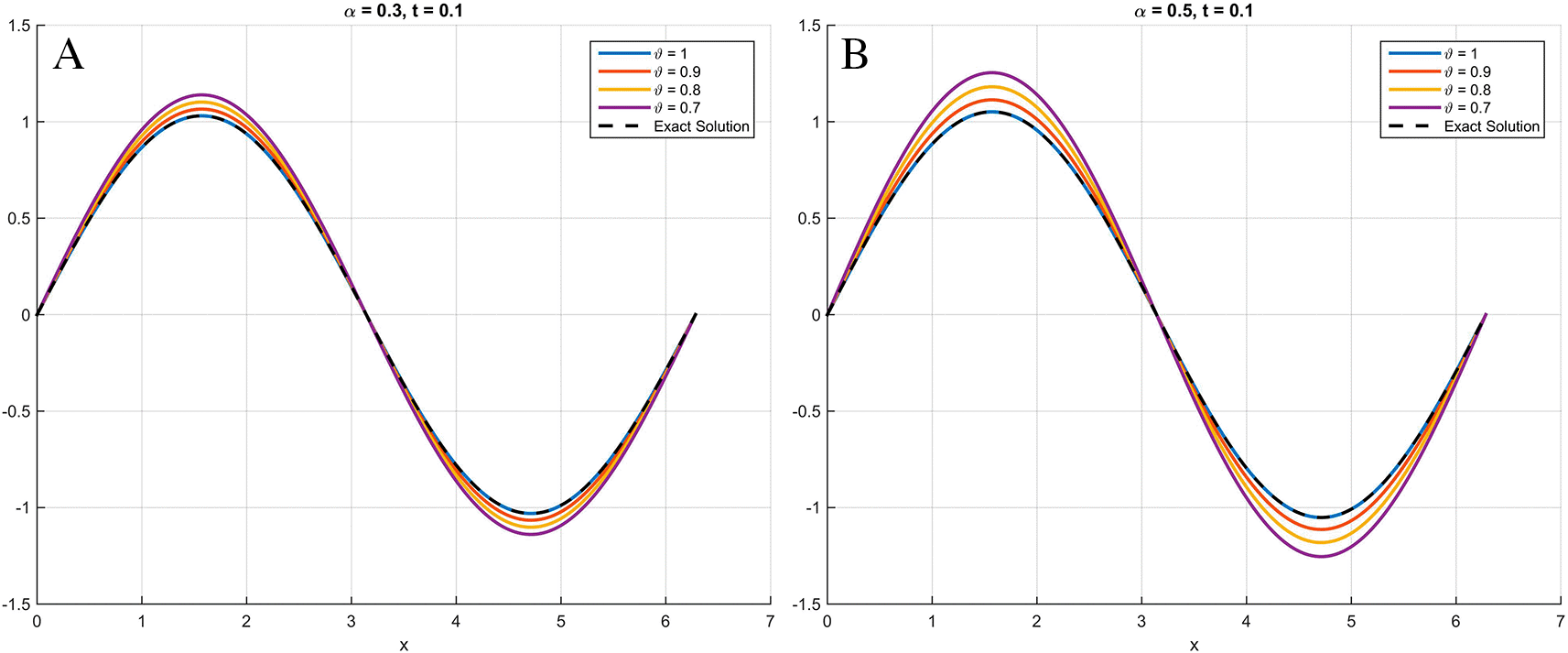
Figure 1. In Example 6.1, plots (A) and (B) illustrate that the curve increasingly converges toward the exact solution as θ approaches 1.
Specifically, at θ = 0.9, the curve nearly overlaps with that of θ = 1.
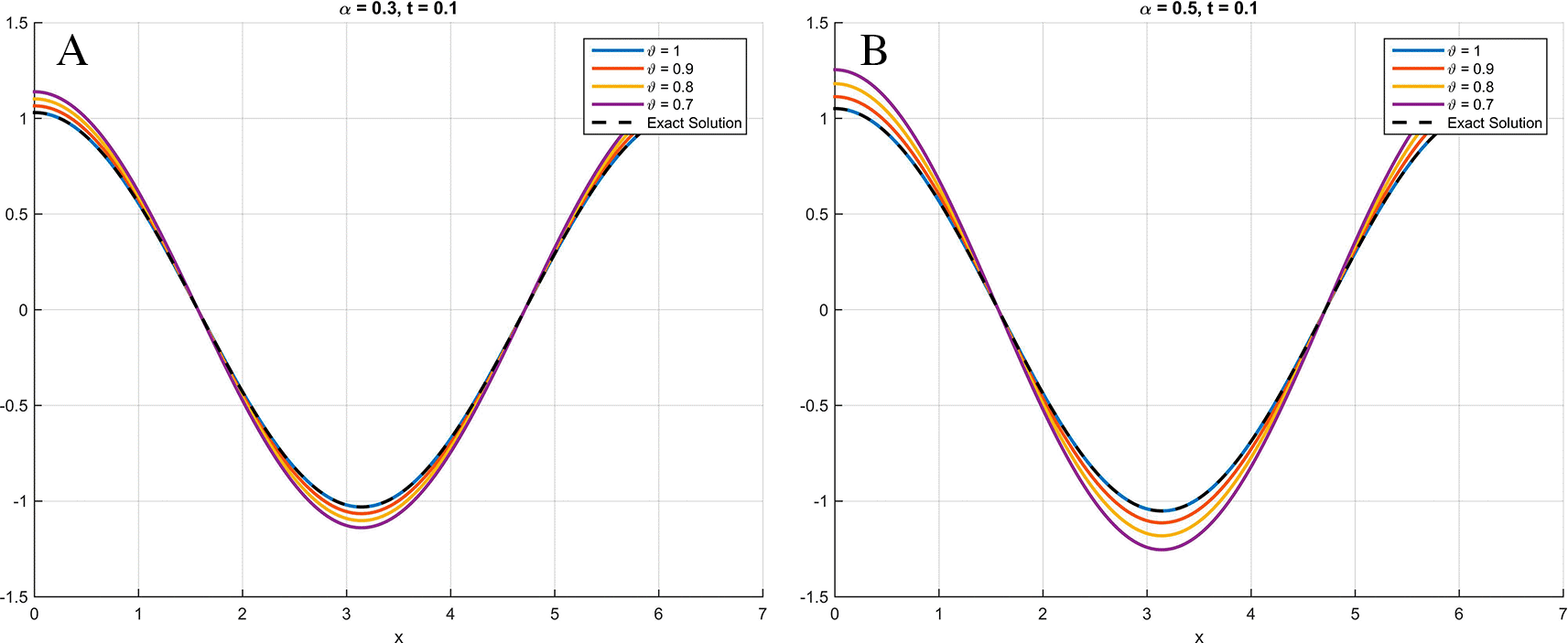
Figure 2. In Example 6.2, plots (A) and (B) illustrate that the curve increasingly converges toward the exact solution as θ approaches 1.
Specifically, at θ = 0.9, the curve nearly overlaps with that of θ = 1.
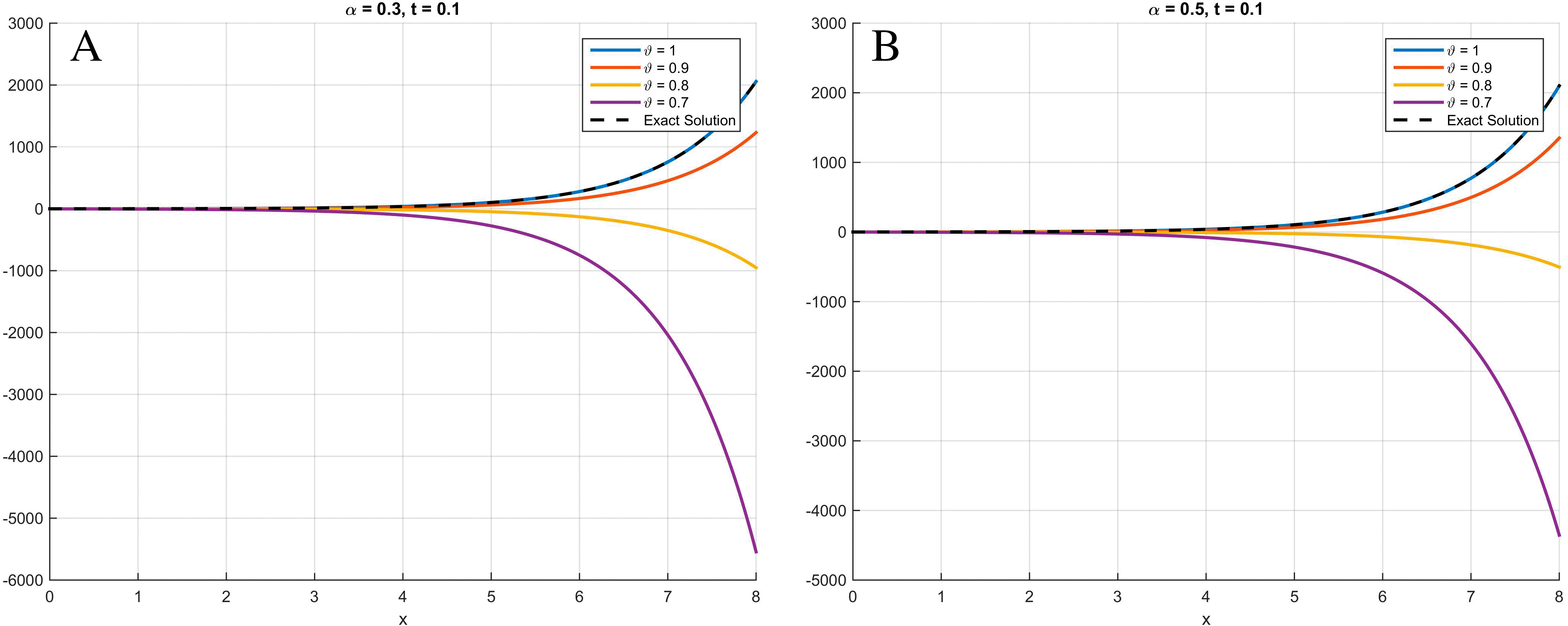
Figure 3. In Example 6.3, plots (A) and (B) illustrate that the curve increasingly converges toward the exact solution as θ approaches 1.
Specifically, at θ = 0.9, the curve nearly overlaps with that of θ = 1.
Table 1. A table showing the absolute error for Example 6.1, where the Atangana-Baleanu operator is used.
|
t
|
x
|
AE
θ
= 1 |
AE
θ
= 0.9 |
AE
θ
= 0.8 |
AE
θ
= 0.7 |
|---|
| 0.1 | 0 | 0 | 0 | 0 | 0 |
| 0.2 | 5.2259 × 10⁻⁸ | 0.012341 | 0.025804 | 0.040299 |
| 0.4 | 1.0243 × 10⁻⁷ | 0.024191 | 0.050579 | 0.078991 |
| 0.6 | 1.4853 × 10⁻⁷ | 0.035076 | 0.073338 | 0.114530 |
| 0.8 | 1.8870 × 10⁻⁷ | 0.044562 | 0.093173 | 0.145510 |
| 1 | 2.2134 × 10⁻⁷ | 0.052272 | 0.109290 | 0.170690 |
| 0.5 | 0 | 0 | 0 | 0 | 0 |
| 0.2 | 3.4022 × 10⁻⁵ | 0.011583 | 0.022722 | 0.033049 |
| 0.4 | 6.6688 × 10⁻⁵ | 0.022705 | 0.044538 | 0.064780 |
| 0.6 | 9.6695 × 10⁻⁵ | 0.032921 | 0.064579 | 0.093929 |
| 0.8 | 0.000122850 | 0.041825 | 0.082045 | 0.119330 |
| 1 | 0.000144100 | 0.049061 | 0.096240 | 0.139980 |
Table 2. A table showing the absolute error for Example 6.2, where the Atangana-Baleanu operator is used.
|
t
|
|
AE
θ
= 1 |
AE
θ
= 0.9 |
AE
θ
= 0.8 |
AE
θ
= 0.7 |
|---|
| 0.1 | 0 | 2.6304 × 10⁻⁷ | 0.062120 | 0.129880 | 0.20284 |
| 0.2 | 2.5780 × 10⁻⁷ | 0.060882 | 0.127290 | 0.19880 |
| 0.4 | 2.4228 × 10⁻⁷ | 0.057216 | 0.119630 | 0.18683 |
| 0.6 | 2.1710 × 10⁻⁷ | 0.051270 | 0.107200 | 0.16741 |
| 0.8 | 1.8326 × 10⁻⁷ | 0.043279 | 0.090491 | 0.14132 |
| 1 | 1.4212 × 10⁻⁷ | 0.033564 | 0.070177 | 0.10960 |
| 0.5 | 0 | 0.00017125 | 0.058304 | 0.114370 | 0.16635 |
| 0.2 | 0.00016784 | 0.057142 | 0.112090 | 0.16304 |
| 0.4 | 0.00015773 | 0.053702 | 0.105340 | 0.15322 |
| 0.6 | 0.00014134 | 0.048121 | 0.094395 | 0.13730 |
| 0.8 | 0.00011931 | 0.040621 | 0.079683 | 0.11590 |
| 1 | 9.2527 × 10⁻⁵ | 0.031502 | 0.061795 | 0.08988 |
Table 3. A table showing the absolute error for Example 6.3, where the Atangana-Baleanu operator is used.
|
t
|
x
|
AE
θ
= 1 |
AE
θ
= 0.9 |
AE
θ
= 0.8 |
AE
θ
= 0.7 |
|---|
| 0.1 | -6 | 1.4474 × 10⁻⁶ | 0.00062413 | 0.0021663 | 0.0053680 |
| -5.8 | 1.7679 × 10⁻⁶ | 0.00076231 | 0.0026459 | 0.0065565 |
| -5.6 | 2.1593 × 10⁻⁶ | 0.00093109 | 0.0032317 | 0.0080082 |
| -5.4 | 2.6373 × 10⁻⁶ | 0.00093109 | 0.0039472 | 0.0097812 |
| -5.2 | 3.2212 × 10⁻⁶ | 0.00138900 | 0.0048211 | 0.0119470 |
| -5 | 3.9344 × 10⁻⁶ | 0.00169660 | 0.0058885 | 0.0145920 |
| 0.5 | -6 | 0.00070831 | 0.0047265 | 0.012274 | 0.022038 |
| -5.8 | 0.00086513 | 0.0057730 | 0.014991 | 0.026917 |
| -5.6 | 0.00105670 | 0.0070512 | 0.018311 | 0.032877 |
| -5.4 | 0.00129060 | 0.0086123 | 0.022365 | 0.040156 |
| -5.2 | 0.00157640 | 0.0105190 | 0.027316 | 0.049047 |
| -5 | 0.00192540 | 0.0128480 | 0.033364 | 0.059906 |
7. Conclusion
This work tackles the Swift–Hohenberg equation, a pivotal partial differential equation in engineering and physics. Our contribution is a novel semi-analytical technique founded on a fusion of the variational iteration method and the newly introduced Yasser–Jassim transform. The proposed method’s convergence is rigorously examined, and sufficient conditions are formulated to ensure reliable results.
The adoption of the Atangana–Baleanu fractional derivative further provides a more accurate framework for solution description and enhances the model’s adaptability to practical scenarios. Numerical experiments, supported by graphical illustrations and absolute error tables, validated the efficiency of the proposed methodology. The stability of the solution under the fractional derivative framework was also rigorously investigated and proven. Notably, the results demonstrate that even the third iterative solution—showcased in the absolute error tables—delivers the accuracy required for real-world implementation.
The model’s capacity for effortless derivation of higher-order iterations offers a clear pathway to achieving even greater precision and robustness. Overall, the findings confirm that the proposed approach is effective, robust, and extendable, making it a powerful tool not only for solving fractional-order partial differential equations but also for tackling ordinary and integral equations in future applications.
Ethics statement
This research does not involve human participants, animal subjects, or sensitive personal data. Therefore, ethical approval was not required.
Data availability statement
All data generated or analysed during this study are included in this published article. No additional datasets were used or created.
Acknowledgments
The authors would like to express their sincere gratitude to the reviewers for their valuable comments and constructive suggestions, which have significantly enhanced the scientific quality of this article. We also extend our heartfelt thanks to the faculty members of the Department of Mathematics at our university for their continuous support and guidance throughout this research.
References
- 1.
Hilfer R:
Applications Of Fractional Calculus In Physics.
World Scientific Publishing Company;
2000; vol. 35. .
- 2.
Sabatier J, Agrawal OP, Machado JAT:
Advances in Fractional Calculus: Theoretical Developments and Applications in Physics and Engineering.
Netherlands:
Springer;
2007.
- 3.
Tuan NH, Mohammadi H, Rezapour S:
A mathematical model for COVID-19 transmission by using the Caputo fractional derivative.
Chaos, Solitons Fractals.
2020; 140: 110107. PubMed Abstract
| Publisher Full Text
| Free Full Text
- 4.
He JH:
Approximate solution of nonlinear differential equations with convolution product nonlinearities.
Comput. Methods Appl. Mech. Eng.
1998; 167: 69–73. Publisher Full Text
- 5.
Swift JB, Hohenberg PC:
Hydrodynamics fluctuations at the convective instability.
Phys. Rev. A.
1977; 15: 319–328. Publisher Full Text
- 6.
Rashid N, Nasir A, Laiq Z, et al.:
Extension of natural transform method with Daftardar-Jafari polynomials for fractional order differential equations.
Alex. Eng. J.
2021; 60: 3205–3217.
- 7.
Cross M, Hohenberg P:
Pattern formation outside of equilibrium.
Rev. Mod. Phys.
1993; 65: 851–1112. Publisher Full Text
- 8.
Hohenberg PC, Swift JB:
Effects of additive noise at the onset of Rayleigh-Benard convection.
Phys. Rev. A.
1992; 46: 4773–4785. PubMed Abstract
| Publisher Full Text
- 9.
Lega L, Moloney J, Newell A:
Swift-Hohenberg equation for lasers.
Phys. Rev. Lett.
1994; 73: 2978–2981. PubMed Abstract
| Publisher Full Text
- 10.
Peletier L, Rottschafer V:
Large time behaviour of solutions of the Swift-Hohenberg equation.
R. Acad. Sci. Paris Ser I.
2003; 336: 225–230. Publisher Full Text
- 11.
Pomeau Y, Zaleski S:
Dislocation motion in cellular structures.
Phys. Rev. A.
1983; 27: 2710–2726. Publisher Full Text
- 12.
Akyildiz FT, Siginer DA, Vajravelu K, et al.:
Analytical and numerical re- sults for the Swift-Hohenberg equation.
Appl. Math. Comput.
2010; 216: 221–226. Publisher Full Text
- 13.
Khan N, Khan N, Ayaz M, et al.:
Analytical methods for solving the time- fractional Swift-Hohenberg (S-H) equation.
Comput. Math. Appl.
2011; 61: 2182–2185.
- 14.
Xu J, Khan H, Shah R, et al.:
The analytical analysis of nonlinear fractional-order dynamical models.
AIMS Math.
2021; 6: 6201–6219. Publisher Full Text
- 15.
Merdan M:
A numeric-analytic method for time-fractional Swift-Hohenberg (S- H) equation with modified Riemann-Liouville derivative.
Appl. Math. Model.
2013; 37: 4224–4231. Publisher Full Text
- 16.
Hussein MA, Jassim HK, Jassim AK:
An innovative iterative approach to solving Volterra integral equations of second kind.
Acta Polytechnica.
2024; 64(2): 87–102. Publisher Full Text
- 17.
Jassim HK, Hussein MA:
A Novel Formulation of the Fractional Derivative with the Order α > 0 and without the Singular Kernel.
Mathematics.
2022; 10(21): 4123. Publisher Full Text
- 18.
Cui P, Jassim HK:
Local Fractional Sumudu Decomposition Method to Solve Fractal PDEs Arising in Mathematical Physics.
Fractals.
2024; 32(4): 1–6. Publisher Full Text
- 19.
Jafari H, Jassim HK, Ansari A, et al.:
Local Fractional Variational Iteration Transform Method: A Tool For Solving Local Fractional Partial Differential Equations.
Fractals.
2024; 32(4): 1–8.
- 20.
Hussein MA:
Approximate methods for solving fractional differential equations.
Journal of Education for Pure Science-University of Thi-Qar.
2022; 12(2): 32–40. Publisher Full Text
- 21.
Jafari H, Jassim HK, Ünlü C, et al.:
Laplace Decomposition Method for Solving the Two-Dimensional Diffusion Problem in Fractal Heat Transfer.
Fractals.
2024; 32(4): 1–6. Publisher Full Text
- 22.
He JH:
Variational iteration method – a kind of non-linear analytical technique: some examples.
International Journal of Non-Linear Mechanics.
1999; 34: 699–708. Publisher Full Text
- 23.
Jassim HK, Khafif S:
SVIM for solving Burger’s and coupled Burger’s equations of fractional order.
Progress in Fractional Differentiation and Applications.
2021; 7(1): 1–6.
- 24.
Rhaif N, Yasser MT, Ziane D:
An Analytical Approach to Nonlinear Fractional Dif- ferential Equations Using Daftardar-Jafari Method.
Journal of Education for Pure Science.
2025; 15(1). Publisher Full Text
- 25.
Rhaif N, Yasser MT, Tajadodi H:
An Efficient Approach for Nonlinear Fractional PDEs: Elzaki Homotopy Perturbation Method.
Journal of Education for Pure Science.
2025; 15(1). Publisher Full Text
- 26.
Swain NR, Jassim HK:
Innovation of Yang Hussein Jassim’s method in solving non- linear telegraph equations across multiple dimensions.
Partial Differential Equations in Applied Mathematics.
2025; 14: 101182. Publisher Full Text
- 27.
Swain NR, Jassim HK:
Solving Multidimensional Fractional Telegraph Equation by Using Yang Hussein Jassim method.
Iraqi Journal for Computer Science and Math- ematics.
2025; 6(2): 2.
- 28.
Farhan K, Taimah M, Rhaif N:
A New Technique for Solving Nonlinear Partial Dif- ferential Equations Using the Homotopy Perturbation Method.
Journal of Education for Pure Science.
2025; 15(2). Publisher Full Text
- 29.
Farhan K:
A Novel Approach to Solving Singularly Perturbed differential algebraic equations: Regularized Laplace Homotopy Perturbation Method.
Statistics, Optimization Information Computing.
2025; 14: 2503–2517. Publisher Full Text
- 30.
Yasser MT, Seewn NR, Cherif MH:
Semi-Analytical Solutions of Nonlinear Time- Fractional Fornberg–Whitham Equation.
Journal of Education for Pure Science.
2025; 15(2). Publisher Full Text
- 31.
Yasser MT, Jassim HK:
A New Integral Transform for Solving Integral and Ordinary Differential Equations.
Math. Comput. Sci.
2025; 6(2): 32–42.
- 32.
Diethelm K:
The Analysis of Fractional Differential Equations: An Application- Oriented Exposition Using Differential Operators of Caputo Type.
Berlin Heidelberg:
Springer;
2010.
- 33.
Syam MI, Al-Refai M:
Fractional differential equations with Atangana–Baleanu fractional derivative: analysis and applications.
Chaos, Solitons Fractals: X.
2019; 2: 100013. Publisher Full Text
- 34.
Haubold HJ, Mathai AM, Saxena RK:
Mittag-Leffler functions and their applications.
J. Appl. Math.
2011; 2011: 298628. Publisher Full Text
- 35.
Shukla AK, Prajapati JC:
On a generalization of Mittag-Leffler function and its properties.
J. Math. Anal. Appl.
2007; 336: 797–811. Publisher Full Text
- 36.
Sun H, Zhang Y, Baleanu D, et al.:
A new collection of real world applications of fractional calculus in science and engineering.
Communications in Nonlinear Science and Numerical Simulation.
2018; 64: 213–231. Publisher Full Text
- 37.
Baleanu D, Jajarmi A, Mohammadi H, et al.:
A new study on the mathematical modelling of human liver with Caputo–Fabrizio fractional derivative.
Chaos, Solitons & Fractals.2020;
134.
- 38.
Baleanu D, Jajarmi A, Sajjadi S, et al.:
A new fractional model and optimal control of a tumor-immune surveillance with non-singular derivative operator.
Chaos: An Interdisciplinary Journal of Nonlinear Science.
2019; 29:
29
. Publisher Full Text


Comments on this article Comments (0)