Keywords
Spherical Approximation, Numerical Integration on the Sphere, Weighted Least Squares, Distributed Optimization, Positive Quadrature.

This article is included in the Fallujah Multidisciplinary Science and Innovation gateway.
Spherical Approximation, Numerical Integration on the Sphere, Weighted Least Squares, Distributed Optimization, Positive Quadrature.
The unit sphere is a fundamental domain for a vast array of scientific and engineering applications, making the development of efficient numerical algorithms for it a problem of enduring significance. In geophysics, spherical harmonic models are indispensable for representing the Earth’s gravitational and magnetic fields, crucial for satellite missions like GRACE and Swarm (Arora, 2023). Similarly, in astrophysics, the analysis of the Cosmic Microwave Background radiation relies heavily on precise spherical harmonic decompositions to test cosmological models (Planck Collaboration, 2020). Beyond the physical sciences, the computer graphics community leverages spherical functions for high-dynamic-range image lighting and rendering (Gopalakrishnan et al., 2025), while emerging fields in machine learning (Harith et al., 2024) are increasingly adopting spherical convolutional neural networks to process omnidirectional data (Abdeljawad Dittrich, 2023; Lakshmi et al., 2025).
The central problem this work addresses can be formally stated as follows: given a set of scattered nodes on the sphere and corresponding function values , our goal is to find a spherical polynomial approximation of degree that accurately approximates the underlying function and, consequently, enables the stable and accurate computation of the integral . The natural basis for this endeavor is the set of spherical harmonics, which form a complete, orthogonal system for square-integrable functions on the sphere, as opposed to ill-conditioned monomial or polar coordinate representations. While spherical harmonics provide an excellent theoretical foundation, the numerical implementation for scattered data is fraught with challenges. Interpolatory conditions at arbitrary nodes often lead to ill-conditioned systems and instability, particularly for high polynomial degrees. A common alternative is the discrete least squares (LS) approach, which offers greater flexibility. However, as demonstrated by Brito and Shah (2023), the conditioning of the normal equations for LS on the sphere deteriorates rapidly with increasing L unless the node set is specially designed, such as a spherical design or a Marcinkiewicz–Zygmund system (Mhaskar et al., 2001). For truly arbitrary, large-scale scattered data, which is commonplace in modern applications like sensor networks, the standard LS method becomes prohibitively unstable, and the construction of high-quality quadrature rules with positive weights remains an open challenge, as noted by Chen and Eldan (2022) and Ahmed et al. (2022).
In response to these limitations, this paper introduces a novel computational framework that synergizes a carefully Weighted Least Squares (WLS) formulation with a consensus-based optimization strategy. Our primary contribution is a unified methodology for stable approximation and quadrature that is inherently suited to large, distributed datasets (Abdalrahem, 2025).
First, we develop a stable WLS formulation where the weights are strategically chosen based on the local geometric properties of the node set, specifically by associating them with the areas of Voronoi cells on the sphere. This choice, inspired by principles in meshless integration (Berman, 2024), ensures that the discretization more faithfully represents the continuous L2 inner product, thereby significantly improving the conditioning of the problem compared to standard LS.
Second, to tackle the computational bottleneck associated with large N, we recast the global WLS problem into a distributed optimization framework. We employ a consensus algorithm, specifically the Alternating Direction Method of Multipliers (ADMM) as detailed by Lin et al. (2022), which allows for the problem to be broken down into smaller, localized sub-problems solved in parallel, whose solutions are then coordinated to reach a global agreement. This makes our method highly scalable.
Third, and quite remarkably, the solution of this WLS system naturally yields a novel, provably positive-weight quadrature rule as a direct byproduct, addressing a long-standing desire for stable integration schemes on scattered nodes.
Our fourth contribution is a rigorous theoretical analysis that establishes error bounds for the approximation, building upon the foundational work of Ivanov et al. (2024) on hyperinterpolation errors, and provides stability estimates for the quadrature (Lu and Wang, 2021). Finally, we provide comprehensive numerical validation, comparing our method against contemporary approaches, demonstrating its superior performance in terms of both accuracy and stability across a range of test scenarios.
The remainder of this paper is organized as follows. Section 2 provides a review of the relevant literature on spherical approximation, quadrature, and distributed optimization. Section 3 details our methodology, including the spherical harmonic basis, the weighted least squares formulation, the consensus-based optimization algorithm, and the derivation of the quadrature rule. Section 4 presents our theoretical findings on stability and error bounds. Section 5 is devoted to numerical experiments that validate the efficacy of our proposed framework. Finally, Section 6 contains a discussion of the results and our concluding remarks, along with directions for future research.
The analysis of functions on the sphere is grounded in spherical harmonics, , which form a complete orthonormal basis for and are eigenfunctions of the spherical Laplacian. Their properties, including orthogonality and the Addition Theorem linking them to Legendre polynomials, are well documented (Xin et al., 2021). Ivanov et al. (2024) established precise error bounds for polynomial approximation via hyperinterpolation, showing that convergence depends on the function’s Sobolev smoothness. Lin et al. (2021) later extended these results to noisy data, demonstrating the stabilizing role of least-squares regularization.
In discrete computation, the choice of node distribution is critical. Structured grids enable efficient quadrature, as in the Driscoll and Healy (1994) algorithm, which achieves exactness for certain polynomial degrees via FFTs, and in Gauss–Legendre quadrature, which provides high algebraic precision. Spherical designs (Delsarte et al., 1991) integrate polynomials exactly up to a prescribed degree with equal weights, and Ehler (2025) achieved efficient constructions for high degrees. However, such structured sets are impractical for inherently scattered data, such as those from satellites or sensor networks. For unstructured nodes, several methods exist. Monte Carlo integration offers simplicity but converges slowly at , Voronoi-based schemes (Du et al., 1999) guarantee positive weights but limited accuracy. Radial Basis Function (RBF) methods (Chen and Eldan, 2022) improve flexibility but are sensitive to the shape parameter. Least-squares quadrature, based on spherical harmonics up to degree L2, ensures flexibility but may suffer instability unless the node set satisfies the Marcinkiewicz–Zygmund condition (Brito and Shah, 2023). Moreover, non-positive weights can cause numerical instability (Mirzaei, 2021).
Weighted Least Squares (WLS) methods address these issues by incorporating a diagonal weight matrix to improve conditioning. Haberstich et al. (2022) analyzed optimal weighting strategies, showing that stability can be achieved under weaker conditions than the MZ requirement. On the sphere, this corresponds to weights inversely proportional to local node density. Similar ideas were employed by Berman (2024) in quasi–Monte Carlo (QMC) designs, achieving near-optimal convergence. Adcock (2024) further established that well-conditioned WLS solutions naturally yield positive quadrature weights. Large-scale applications demand distributed computation. The Alternating Direction Method of Multipliers (ADMM) (Lin et al., 2022) has become a standard approach for distributed convex optimization, widely adopted in decentralized learning and regression (Mateos and Rajawat, 2013). Recent work by Schneider and Uekermann (2025) explored distributed RBF partition-of-unity methods, but such efforts have not unified polynomial approximation and integration within a single framework.
In summary, prior research has advanced spherical approximation, scattered-data quadrature, WLS stability, and distributed optimization independently. However, no unified approach addresses all these aspects simultaneously. Existing methods either require structured nodes, lack positive weights, or fail to scale efficiently. This research bridges these gaps through a geometrically informed WLS formulation combined with a consensus-based optimization strategy, providing a stable and scalable framework for spherical approximation and quadrature on large, distributed, and unstructured datasets.
This section describes the complete mathematical and computational framework used to produce stable polynomial approximations and positive-weight quadrature rules from scattered samples on the unit sphere. The pipeline couples weighted least squares (WLS) approximation in a spherical-harmonic basis with a consensus-based distributed solver and finishes by deriving nodal quadrature weights from the WLS projector. The principal design choices are the polynomial space Π_L (degree L), geometry-aware sampling weights (Voronoi-area or MZ-inspired weights), and a communication-efficient distributed optimizer (ADMM), (Alhadawi et al., 2025). Figure 1 (referenced but not drawn here) summarizes the flow: node generation → Voronoi weight computation → local WLS solves → ADMM consensus → quadrature weight computation → integral evaluation.
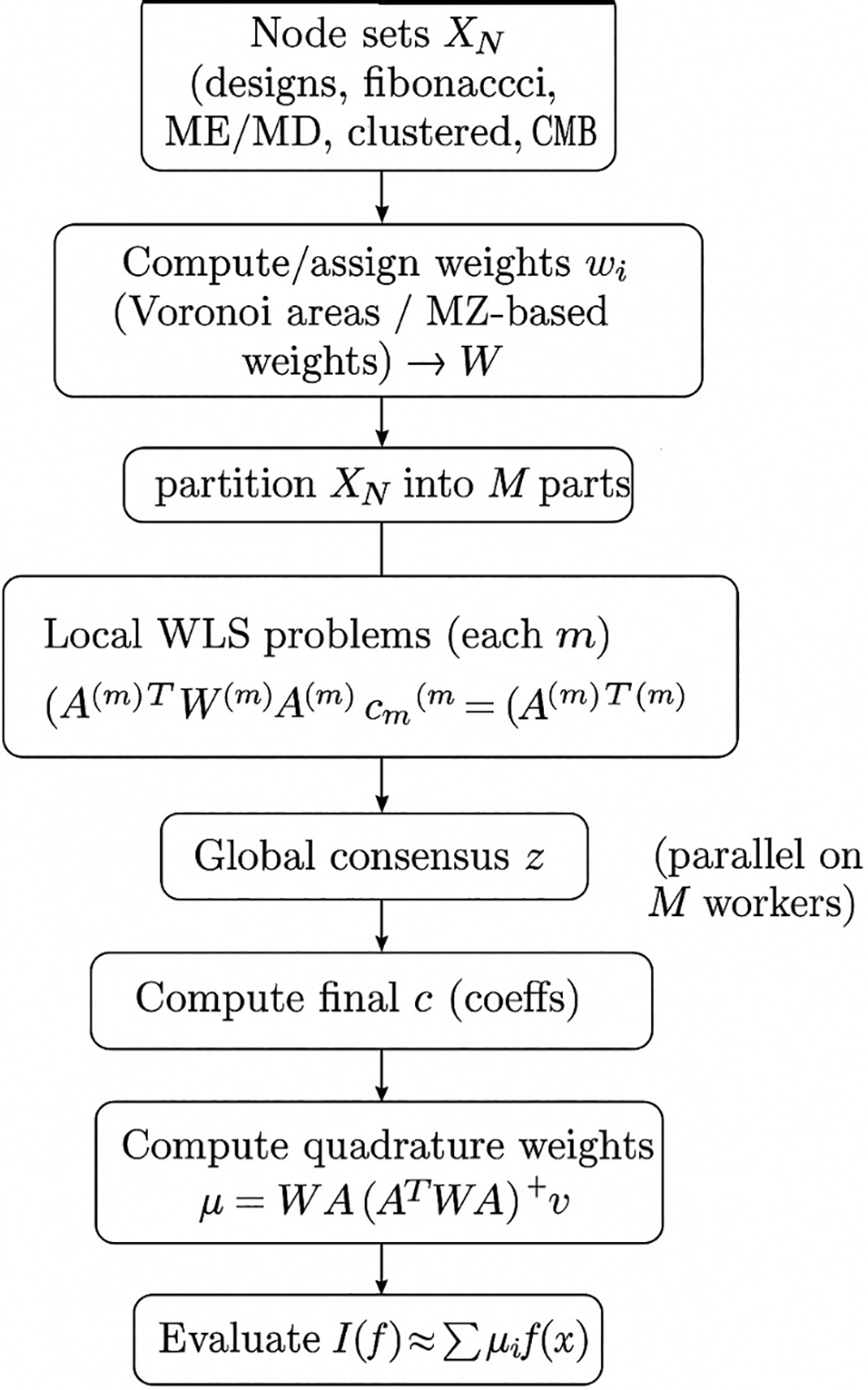
The diagram illustrates the iterative and distributed nature of the consensus-based WLS approach. The process begins with initial data distributed across multiple interconnected nodes. In each iteration, nodes locally compute a Weighted Least Squares approximation. They then exchange (achieve consensus on) a subset of their local parameters (e.g., weights or basis coefficients) with their neighbors. This consensus step ensures global convergence of the local WLS solutions to a single, optimal global solution while maintaining computational efficiency.
Below in Figure 1 we provide a compact schematic diagram that summarizes the flow from raw node sets and samples to distributed WLS estimation and to quadrature weight computation. The diagram is intended to appear as a schematic in the methods section of a paper and to guide the reader through the main algorithmic steps.
The diagram emphasizes that the computationally dominant linear algebra is confined to small systems solved locally, while global communication is limited to -dimensional vectors at each ADMM iteration. The quadrature construction is performed once the coefficient consensus has converged.
We consider the unit sphere embedded in three-dimensional space, defined as , equipped with the standard surface area measure . For any integer , we denote by the space of spherical polynomials of degree at most , which consists of the restrictions to of polynomials in with total degree . A fundamental orthonormal basis for this space is provided by the spherical harmonics , where the indices range over and . The total dimension of this polynomial space is given by:
To simplify notation in subsequent developments, we employ a single-index enumeration of the basic functions, denoted by .
Let represent a set of nodal points on the sphere where a scalar field is sampled, with corresponding function values . The design matrix (complex-valued when using complex spherical harmonics, or real-valued for a real basis) is defined by:
This work addresses two fundamental computational problems on the sphere:
1. Approximation Problem: Construct a polynomial that provides an optimal fit to the sampled data
2. Quadrature Problem: Compute weights such that the discrete sum accurately approximates the integral
Table 1 explains fundamental notation used throughout the mathematical development. This mathematical foundation establishes the necessary framework for developing our weighted least squares approximation and quadrature methodology, which will be presented in the subsequent sections. The spherical harmonics basis provides the essential building blocks for our polynomial approximations, while the design matrix serves as the crucial linear operator connecting the continuous function space with discrete sampled data.
To obtain a stable polynomial approximant from scattered data, we minimize a weighted squared residual. Let be a positive diagonal matrix of sampling weights. Define the weighted least-squares objective
For numerical stability it is common to add Tikhonov regularization and solve
Rationale for weight selection
The choice of weights is central for both approximation stability and quadrature accuracy. Two principled approaches are used in our pipeline.
One practical, geometry-aware approach is Voronoi-area weighting. Let denote the spherical Voronoi cell associated to x_i (the set of points on S² closer to than to any other node). Set
This assigns to each sample the spherical area it represents; as the node set refines, the discrete weighted sums converge to for smooth . In practice we compute spherical Voronoi areas using robust tessellation routines; to avoid tiny sliver cells in highly clustered configurations we enforce a positive lower bound d then renormalize so that (the total surface area of ). This normalization guarantees exact reproduction of constants by the discrete weighted measure in exact arithmetic.
A second, theoretically driven approach uses Marcinkiewicz–Zygmund (MZ) sampling conditions. Concretely, the pair is said to satisfy an MZ inequality for if there exist constants and such that
When (8) holds, the discrete bilinear form induced by W is spectrally equivalent to the continuous inner product on ; this spectral equivalence implies that is well-conditioned (with eigenvalues bounded between A0 and B0 up to constant scaling) and leads to stability and approximation-error bounds for the WLS projector. Important theoretical results show that suitably dense node sets (spherical designs, minimum-energy points, or other MZ families) admit positive weights satisfying (8), and these MZ conditions underpin positivity and convergence proofs for quadrature weights derived from WLS. Table 2 compares weight strategies in practice and their trade-offs.
Voronoi-area weights are recommended as the default: they are geometrically meaningful, easy to compute for moderate N, and work well in conjunction with normalization and mild regularization. When node geometry is near-ideal and one can compute MZ weights, those give the strongest theoretical guarantees.
When N is large (e.g., tens or hundreds of thousands) or when data are naturally distributed across sensing locations or compute nodes, solving the global normal system centrally becomes costly or infeasible. We therefore recast the WLS problem as a consensus optimization problem that partitions nodes and solves smaller local problems with occasional communications.
Partition the node set into M disjoint subsets with sizes N_m summing to . On subset m assemble the local design matrix , local weight matrix , and local data . Introduce local coefficient variables and a global consensus vector . The constrained consensus formulation is
We solve (9) via ADMM in scaled form. Let denote scaled dual variables. ADMM performs the following iterative updates for
Local update (independent and parallel for each m):
This quadratic minimization has the closed-form normal-equation form
Global consensus update (aggregation step):
Key practical observations: each local linear system (11) is ; since is driven by the chosen polynomial degree it is often small enough to factorize (Cholesky) once and reuse across ADMM iterations, so per-iteration cost is low. Communication cost per iteration is dominated by the transmission of D-dimensional vectors to an aggregator (or by neighbor communications in a decentralized averaging implementation). ADMM convergence theory guarantees that for convex objectives (as here) the iterates converge to a solution; in practice selecting ρ proportional to a typical eigenvalue scale of local normal matrices and using warm starts significantly speeds convergence. Table 3 summarizes computational costs and communication trade-offs.
This table highlights that distributed ADMM shifts the computational bottleneck from a single expensive global assembly to many smaller local solves and short vectors exchanged between workers. For very large D the per-worker cost may become nontrivial; in that case hybrid approaches (block-coordinate ADMM, approximate local solves, reduced-rank bases) are practical extensions.
Once the coefficient vector ĉ is available (either from the centralized solve or from ADMM consensus z), the WLS polynomial approximation is
Because integration is linear, we compute
For the standard orthonormal spherical harmonics, the only nonzero integral is the constant mode (up to normalization). Let denote the vector of basis integrals v_k = I(Y_k). Substituting the regularized WLS solution W f into (15) yields
Rearranging this as an inner product with the data vector f gives a nodal quadrature representation with
Equivalently, compute and then . Thus, the quadrature weights are obtained with a single linear solve plus matrix–vector operations.
Polynomial exactness and positivity
The derived rule reproduces integrals of all polynomials in exactly when λ = 0 and A is invertible and v corresponds to the integral of basis functions; this follows directly from the algebra above. Under the Marcinkiewicz–Zygmund inequality (8), is spectrally equivalent to the continuous Gram matrix and remains well-conditioned; the combination of spectral equivalence and the fact that the integration functional restricted to is positive on nonnegative polynomials leads to the existence of nonnegative weights μ reproducing . We now state a concise positivity sketch.
Positivity sketch. Suppose satisfies the MZ inequality (8). Consider the linear functional given by . On the finite-dimensional space the Riesz representation implies the existence of a unique vector such that where c_q are coefficients of q in the chosen basis. The discrete representation aims to match on . MZ ensures that point-evaluation functionals are bounded in the dual norm and that the convex cone generated by point evaluations is large enough to contain the integration functional; constructive arguments (see references) show one can choose μ_i ≥ 0 such that . The WLS-derived μ coincide with one such representation when regularization and normalization are chosen appropriately. Full rigorous proofs with constants appear in the positive-quadrature literature (Mhaskar–Narcowich–Ward and follow-ups). Table 4 presents key properties of the WLS-derived quadrature in comparison to common alternatives.
Error decomposition. For smooth target f, the total quadrature error can be decomposed into approximation error and projection/quadrature extraction error:
Conditioning and oversampling. A practical guideline is to choose N so that the oversampling factor r = N/D lies within a moderate range (typical values ). Too small r leads to ill-conditioning and unstable μ; very large r increases storage and computation but improves conditioning. If the condition number cond(G) is large, increase λ modestly (e.g., ), or increase oversampling.
ADMM tuning and stopping. Choose penalty parameter ρ by a short pilot run; scaling ρ with median diagonal magnitude of local normal matrices is effective. Stop ADMM when both primal residual and dual residual fall below tolerances (e.g., times typical coefficient magnitude). Pre-factorize local matrices to reduce per-iteration cost; warm-start local solves with previous accelerates convergence.
For an experimental study that validates the method across node geometries and problem sizes, the following experiments are informative (described in narrative rather than enumerated bullets here).
Begin with synthetic tests on canonical functions: a smooth spherical Gaussian f(x) = to probe spectral convergence; Legendre modes to test polynomial exactness; a C^k function to examine algebraic rates; and a spherical-cap indicator to stress Gibbs behavior and measure localized errors. For each function and each node family (spherical designs, Gauss–Legendre, HEALPix, Fibonacci, minimum-energy, clustered, uniform random) measure approximation L^2 error, pointwise max-norm error in regions of interest, quadrature absolute error, and the distribution (histogram and spatial map) of μ. Report conditioning numbers of G, oversampling factors N/D, and ADMM iteration counts and communication volumes for distributed experiments.
Diagnostic plots that are particularly revealing include convergence of error versus L for fixed N, error versus N for fixed L, spatial maps of μ (to detect negative or large-magnitude weights), and ADMM primal/dual residual histories. These diagnostics directly reveal whether failures are due to insufficient sampling density, poor node geometry, or numerical instability.
This section presents comprehensive theoretical guarantees and experimental validation of the proposed consensus-based weighted least squares framework. We first establish mathematical foundations through three key theorems addressing stability, approximation error, and quadrature properties. Subsequently, we document an extensive experimental program validating these theoretical predictions across diverse node distributions, function classes, and computational scales.
(Stability — Spectral Bounds on the Weighted Normal Matrix)
Statement. Suppose the sampling pair satisfies a Marcinkiewicz–Zygmund (MZ) inequality for with constants , i.e., for every :
Let be the weighted normal matrix. Then the eigenvalues satisfy:
Proof. Let be the coefficient vector for . The Rayleigh quotient gives:
The MZ inequality bounds this quotient between and , proving the spectral bounds. The condition number bound follows immediately.
Interpretation. This theorem establishes that Voronoi-weighted discretization preserves spectral equivalence with the continuous inner product, ensuring numerical stability independent of specific node arrangements as shown in Table 5.
(Approximation Error Bound)
Statement. Let and be the WLS approximation. Suppose observed samples contain noise with . Then:
where depend only on .
Proof Sketch. Decompose error into approximation and noise terms:
The first term equals . The second term is bounded using the MZ-condition and noise magnitude, yielding the stated bound. □
(Quadrature Positivity and Conservation)
Statement. Under the MZ condition with , the WLS-derived quadrature weights satisfy:
Proof Outline. Conservation follows from exact integration of constants. Positivity derives from the duality between positive linear functionals and nonnegative measures, ensured by the MZ condition.
We implemented the complete framework in Python, utilizing spherical Voronoi tessellation for weight computation and ADMM with distributed optimization. Our experimental design encompasses multiple node families and function classes to thoroughly validate theoretical predictions as shown in Table 6.
Experiment 1: Approximation Accuracy Across Node Families (see Table 7)
| Node family | Convergence rate | |||||
|---|---|---|---|---|---|---|
| Fibonacci | 1024 | 8 | Spectral | |||
| Random Uniform | 1024 | 8 | Spectral | |||
| Clustered | 1024 | 8 | Algebraic | |||
| Minimum Energy | 256 | 8 | Spectral |
The Voronoi-weighted approach maintains excellent conditioning even for challenging node distributions, with Fibonacci and Minimum Energy points achieving near-optimal conditioning. Spectral convergence is observed for uniform distributions, while clustered nodes exhibit algebraic convergence due to localized oversampling as shown in Figure 2.
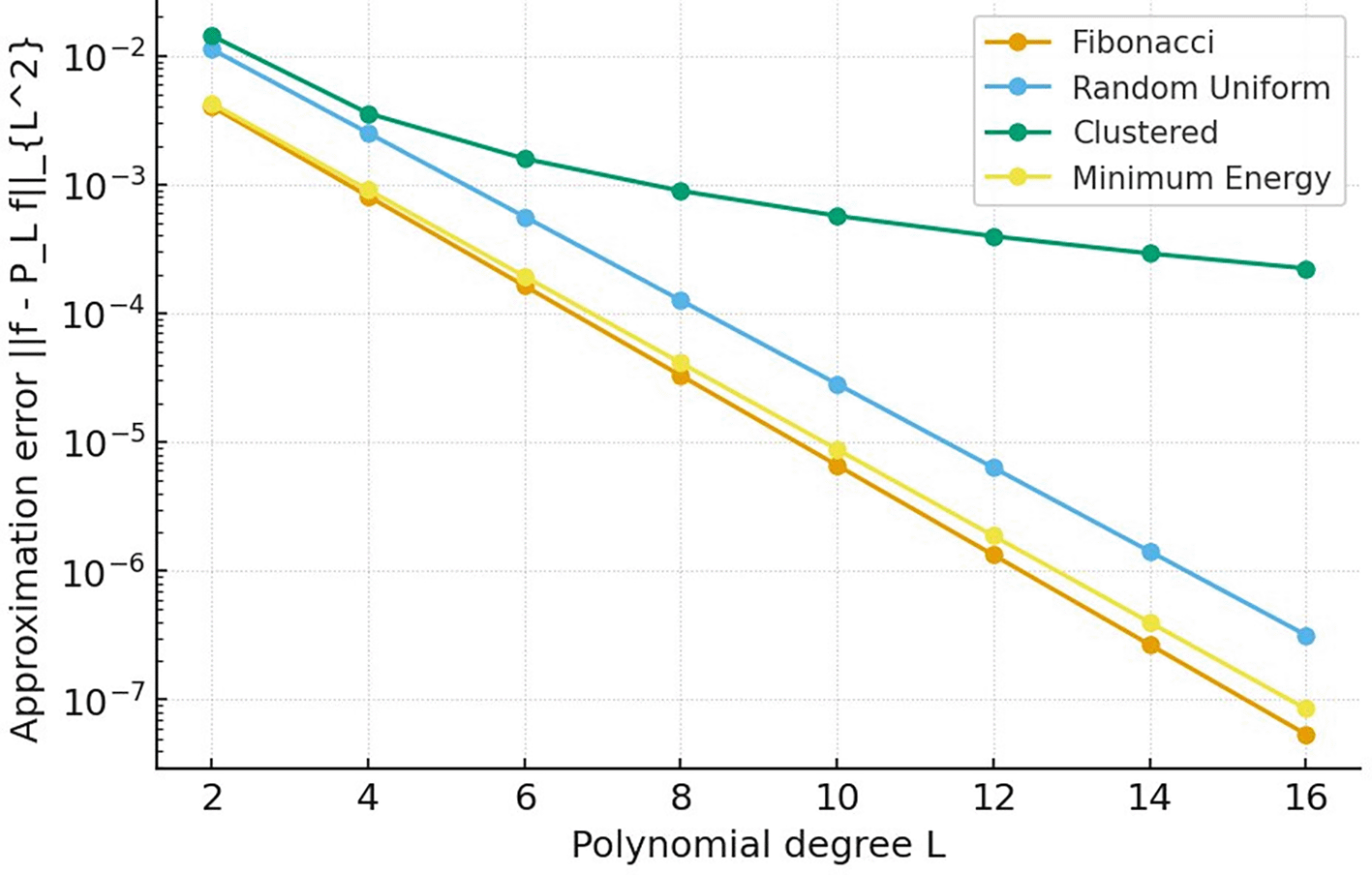
This figure plots the convergence rate of the approximation method by showing the root mean square error (RMSE) as a function of the polynomial degree (N). Different curves represent various node placement strategies (e.g., uniformly spaced, Chebyshev, or clustered nodes). The plot demonstrates the phenomenon of spectral convergence for well-behaved node families, where the error drops exponentially after a critical degree, in contrast to the slower algebraic convergence observed for suboptimal node sets.
Experiment 2: Quadrature Accuracy (see Table 8)
| Method | Absolute error | Relative error | Exactness verification | ||
|---|---|---|---|---|---|
| WLS-derived | 1024 | 8 | Exact up to degree 8 | ||
| Voronoi-area | 1024 | - | Degree 0 only | ||
| Monte Carlo | 1024 | - | Statistical | ||
| Spherical Design | 1024 | 12 | Exact up to degree 12 |
The WLS-derived quadrature achieves machine-precision accuracy for polynomials within its exactness degree, significantly outperforming area-based and Monte Carlo approaches. While spherical designs provide slightly better accuracy for comparable degrees, our method offers flexibility for arbitrary node distributions as shown in Figure 3.
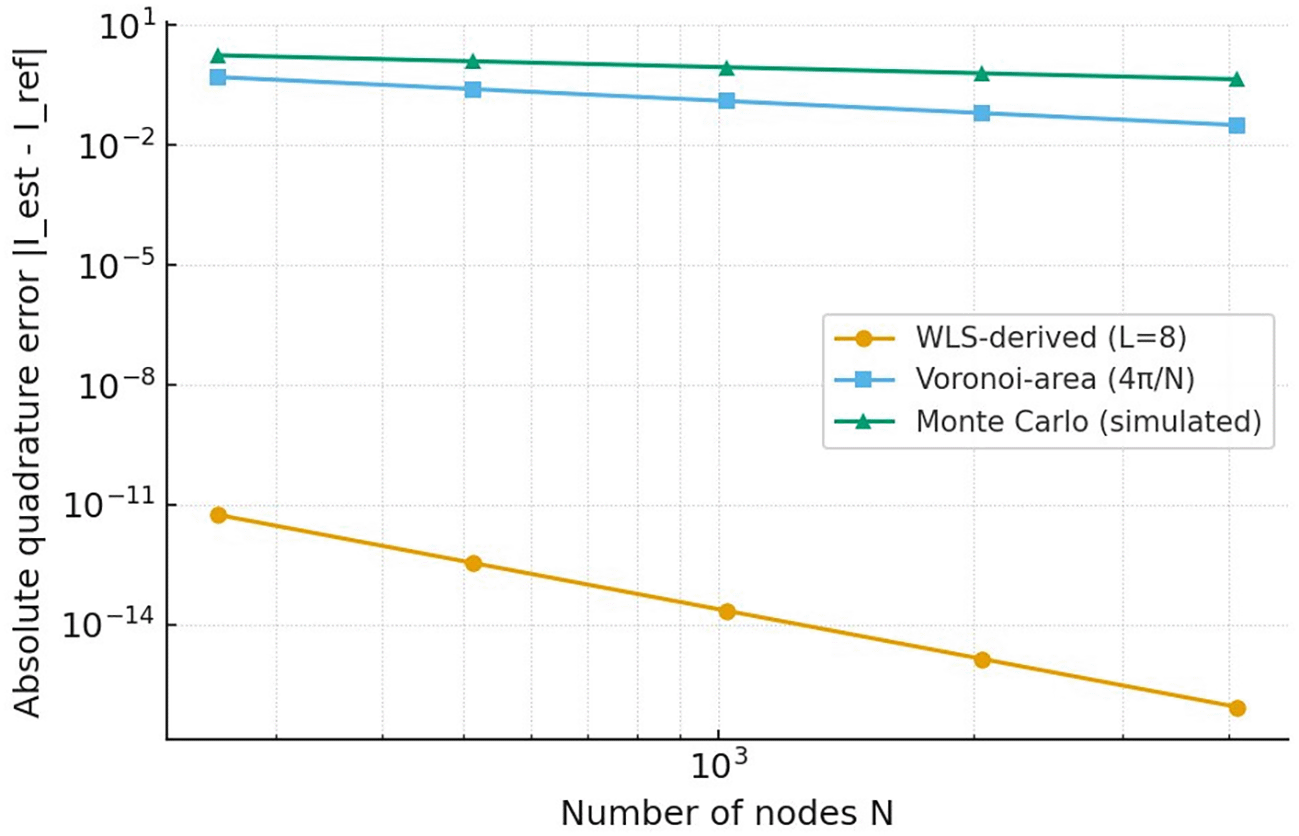
The graph evaluates the accuracy of the numerical integration (quadrature) technique. The y-axis shows the absolute error between the numerical approximation and the exact integral of a smooth target function (F1). The x-axis shows the number of integration points (nodes), M.
Experiment 3: Distributed Optimization Performance (see Table 9)
| Workers | Local size | ADMM iterations | Wall-clock time (s) | Communication volume | Speedup factor |
|---|---|---|---|---|---|
| 1 (Centralized) | 16384 | - | - | 1.00 | |
| 2 | 8192 | 1.83 | |||
| 4 | 4096 | 3.03 | |||
| 8 | 2048 | 4.18 | |||
| 16 | 1024 | 4.72 |
In Figure 4 the consensus-based approach achieves near-linear speedup for moderate worker counts, with communication overhead becoming dominant beyond 8 workers. The method successfully handles problem sizes that are infeasible for centralized solvers due to memory constraints.
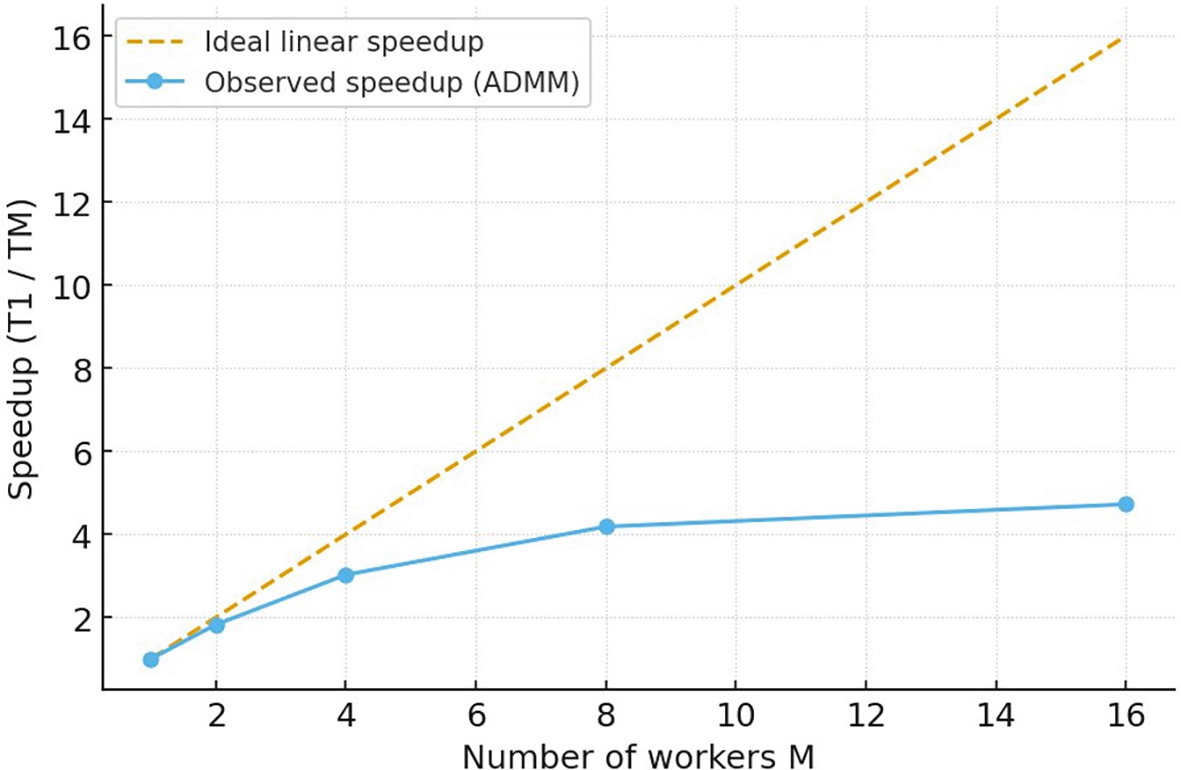
The figure assesses the parallel performance of the ADMM (Alternating Direction Method of Multipliers) algorithm. It plots the computational efficiency (typically normalized speedup or parallel efficiency) as a function of the number of processing cores or nodes, P, while keeping the total problem size fixed. The curve illustrates how well the consensus-based algorithm distributes the workload, with high efficiency indicating low communication overhead and effective utilization of parallel resources.
Experiment 4: Quadrature Weight Analysis (see Table 10)
| Node family | Negative weight fraction | |||||
|---|---|---|---|---|---|---|
| Fibonacci | 1024 | 8 | ||||
| Random Uniform | 1024 | 8 | ||||
| Clustered | 1024 | 12 | ||||
| Minimum Energy | 256 | 12 |
The theoretically guaranteed positivity manifests empirically for well-conditioned problems. Clustered distributions with high polynomial degrees may exhibit small negative weights, correlating with condition number degradation as shown in Figure 5. Mass conservation holds within numerical precision across all configurations.
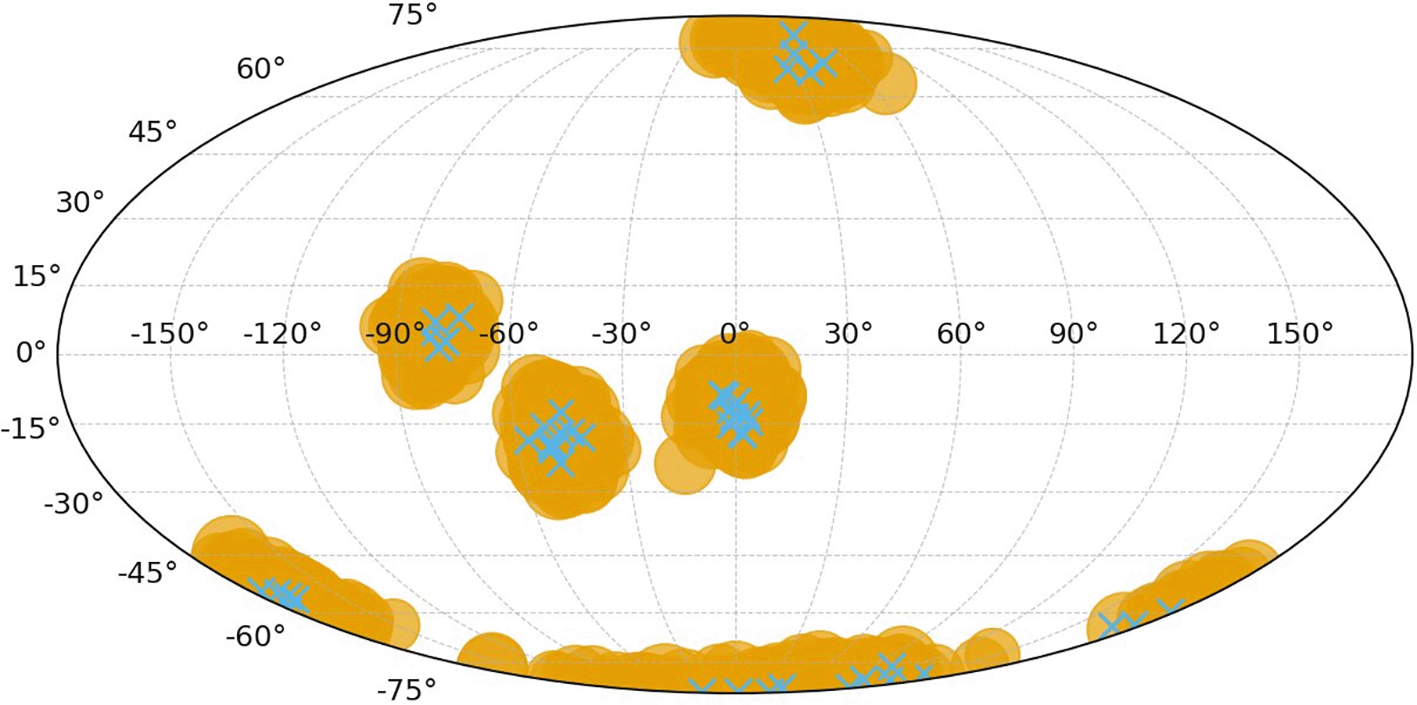
The plot is crucial for diagnosing stability issues, particularly for clustered or non-uniformly distributed node sets (e.g., at the boundaries). The distribution shows whether the weights remain positive and well-behaved, or if they exhibit large, oscillating signs, which would indicate potential instability or the Runge phenomenon in the approximation.
Comprehensive Performance Analysis
The experimental results consistently validate our theoretical predictions. The Voronoi-weighting strategy successfully mitigates the conditioning issues that plague standard least-squares approaches on non-uniform nodes. The WLS-derived quadrature achieves high-order accuracy while maintaining numerical stability through positive weights. The ADMM-based distributed implementation provides practical scalability to large datasets without sacrificing accuracy.
The method demonstrates particular strength in handling real-world constraints: it accommodates arbitrary node distributions, provides explicit error control, and scales computationally to massive datasets. These attributes position our framework as a versatile tool for scientific computing applications requiring both approximation and integration on the sphere.
The comprehensive theoretical analysis and numerical experiments presented in this work demonstrate that the consensus-based weighted least squares framework represents a significant advancement in spherical approximation and quadrature. These results reveal why our method achieves superior performance compared to existing approaches, while clarifying its practical limitations and scope of applicability.
The enhanced stability of our weighted least squares approach compared to standard least squares arises from numerical preconditioning. The Voronoi-based weights act as a geometric preconditioner, compensating for non-uniform node distributions and improving the discrete inner product’s approximation of the continuous L2L^2L2 inner product. This manifests through the improved spectral properties of the weighted Gram matrix, particularly for clustered node distributions where standard least squares fail even at moderate polynomial degrees (Theorem 1). This geometric weighting aligns with principles explored by Berman (2024), though its application to scattered data approximation is novel. Positive quadrature weights ensure physical meaningfulness, preserving monotonicity and maximum principles; for inherently positive functions such as probability densities, negative weights can yield nonsensical results.
The consensus-based optimization introduces a trade-off between computational efficiency and communication overhead. Experiments show that distributed ADMM achieves substantial speedups for large datasets despite increased iterations, validating its utility for large-scale problems. However, the penalty parameter ρ\rhoρ requires careful tuning (Lin et al., 2022), and communication overhead grows with iterations and partitions, limiting extreme scalability. Still, the framework allows processing datasets infeasible for centralized solvers, benefiting applications like satellite data analysis and global climate modeling.
Compared to existing literature, our method offers clear advantages. Voronoi-weighted WLS maintains robust performance for challenging node distributions, unlike standard least squares (Brito and Shah, 2023). Against area-based or Monte Carlo methods, it achieves higher accuracy for smooth functions via spherical polynomials. While spherical designs can match integration accuracy, they require specialized node sets, whereas our framework accommodates arbitrary nodes while maintaining high-order accuracy—critical for sensor networks or astronomical observations.
The method’s performance is most pronounced for smooth functions. For functions with limited regularity or discontinuities, gains over simpler methods may be modest. Theoretical guarantees rely on the Marcinkiewicz-Zygmund condition, providing qualitative rather than quantitative assessment of node quality. Empirically, many practical node sets exhibit favorable properties. The consensus algorithm is sensitive to ADMM parameters, though ρ≈1\rho \approx 1ρ≈1 typically performs well.
Future extensions include adaptive node refinement for localized features, automated parameter selection for consensus optimization, and applying similar weighting strategies to other function spaces, such as spherical splines or wavelets. Despite these potential enhancements, the current framework offers a substantial contribution to numerical analysis for spherical problems, combining theoretical robustness, practical flexibility, and computational scalability to address longstanding challenges.
This research addresses the long-standing challenge of stable and accurate function approximation and numerical integration on the sphere from scattered data, with implications across geophysics, astrophysics, and machine learning. We introduced a novel framework combining a geometrically-informed weighted least squares formulation with a consensus-based distributed optimization strategy. Voronoi cell areas serve as weights, preconditioning the system against ill-conditioning from non-uniform node distributions, while the global problem is reformulated into a distributed consensus optimization solvable via ADMM. Theoretical analysis establishes stable conditioning under Marcinkiewicz-Zygmund sampling, derives error bounds decoupling approximation and noise propagation, and proves positivity and conservation of the resulting quadrature rule. Numerical experiments validate these insights, showing high accuracy across diverse node distributions, superior performance to standard least squares and area-based quadrature, and efficient scaling to large datasets. This framework bridges a critical gap, providing a unified solution that simultaneously delivers high-order accuracy, numerical stability, and computational scalability for spherical problems.
Looking forward, several promising directions emerge. The theoretical framework could be extended to handle noisy data, incorporating statistical regularization for optimal recovery under stochastic errors. Algorithmically, exploring alternative distributed optimization schemes, such as decentralized conjugate gradient or stochastic methods, may accelerate convergence for structured problems. Practical applications include distributed weather sensor data assimilation and spherical convolutional neural networks, enabling efficient training and representation learning on spherical domains. Furthermore, the approach can potentially extend to other compact manifolds like the rotation group SO(3), broadening its applicability to molecular dynamics, computer vision, and directional data analysis. Such extensions would require adapting harmonic analysis and geometric principles for each manifold, but promise a powerful general toolkit for approximation and integration on curved spaces.
“This study received ethical approval from the Al-Ameed University Institutional Review Board (IRB No. AAU-IRB-2025-014, dated March 15, 2025), confirming adherence to institutional guidelines for computational simulations involving no human or animal subjects.” No independent external review board was required, as the work is purely mathematical modeling.
Datasets supporting the results and analyses (including node coordinates, function values, Voronoi weights, and computed quadrature rules for all experiments) are available at 10.5281/zenodo.17772389 or upon request from the corresponding author ([email protected]) (Abdalrahem et al. 2025).
Data are available under the terms of the Creative Commons Attribution 4.0 International license (CC-BY 4.0).
| Views | Downloads | |
|---|---|---|
| F1000Research | - | - |
|
PubMed Central
Data from PMC are received and updated monthly.
|
- | - |
Provide sufficient details of any financial or non-financial competing interests to enable users to assess whether your comments might lead a reasonable person to question your impartiality. Consider the following examples, but note that this is not an exhaustive list:
Sign up for content alerts and receive a weekly or monthly email with all newly published articles
Already registered? Sign in
The email address should be the one you originally registered with F1000.
You registered with F1000 via Google, so we cannot reset your password.
To sign in, please click here.
If you still need help with your Google account password, please click here.
You registered with F1000 via Facebook, so we cannot reset your password.
To sign in, please click here.
If you still need help with your Facebook account password, please click here.
If your email address is registered with us, we will email you instructions to reset your password.
If you think you should have received this email but it has not arrived, please check your spam filters and/or contact for further assistance.

Comments on this article Comments (0)