Keywords
maternal health; health equity; India; Sri Lanka; public health midwives; geographic accountability; skilled birth attendance; quality of care; universal health coverage; conditional cash transfers

maternal health; health equity; India; Sri Lanka; public health midwives; geographic accountability; skilled birth attendance; quality of care; universal health coverage; conditional cash transfers
India has achieved one of the largest expansions in maternal care access in recent years. Institutional delivery increased from 38.7% in 2005 to 88.6% in 2019–21, skilled birth attendance reached about 89%, and the MMR fell from 254 per 100,000 live births in 2004–06 to 97 in 2018–20.1,2,3 Most of this came through conditional cash transfers, above all JSY, launched in 2005, delivered by the world’s largest community health worker cadre: roughly a million Accredited Social Health Activists, or ASHAs.4 The gains are unevenly spread and far from complete. The range across states spans an order of magnitude, from an MMR of approximately 19 in Kerala to above 167 in Uttar Pradesh, Assam, and Madhya Pradesh.1,5 Mortality has also fallen more slowly than coverage because the care a woman receives once she reaches a facility has not kept up with the numbers arriving.2
When India looks abroad for guidance, the usual examples are wealthy countries or systems whose politics differ so sharply from their own that the lessons feel academic. A neighbor who began from a similar position and was far better is harder to set aside, and it answers the familiar objection that equitable maternal care is unaffordable at India’s income level.
Sri Lanka is a neighbor. With a per-capita income of approximately US$3,800, it has brought its MMR down to about 25 per 100,000, roughly 18 by modelled estimates, on a health budget of about 4.2% of GDP.6,7 This brief draws on a broader comparative study of maternal health systems to establish how Sri Lanka did so and what India could take from it.
India’s gains sit on a system with three structural weaknesses: The first is a shortage of skilled staff. Rural Community Health Centers report specialist vacancy rates above 70%, including approximately 74% for obstetricians and gynecologists, so many services exist on paper more than in practice.8 The second is the nature of the front line. ASHAs are drawn from the villages they serve but paid through performance incentives rather than salaries, for example, about INR 600 for institutional delivery in the poorest states, which leaves the most isolated workers the least paid and the most stretched.4 The third problem is fragmentation. Care reaches women through a succession of conditional, eligibility-bound schemes, JSY first and then PMMVY, LaQshya, and PMSMA, which reward facility delivery and tend to leave behind those who cannot comply with the rules.2,4
Underneath this is the problem of a sequence. JSY drew women into facilities for 12 years before the LaQshya labor-room quality program began in 2017, and the gap shows that contact grew faster than the care behind it ( Figure 1). Antenatal coverage is still low, with only approximately 59% of women completing four or more visits, and the caesarean rate has risen from 8.5% in 2005–06 to 21.5% in 2019–21 and 27.2% in 2023–24, nearly half of which are performed in private hospitals. The result is over-treatment in some places alongside under-care in others.2,3
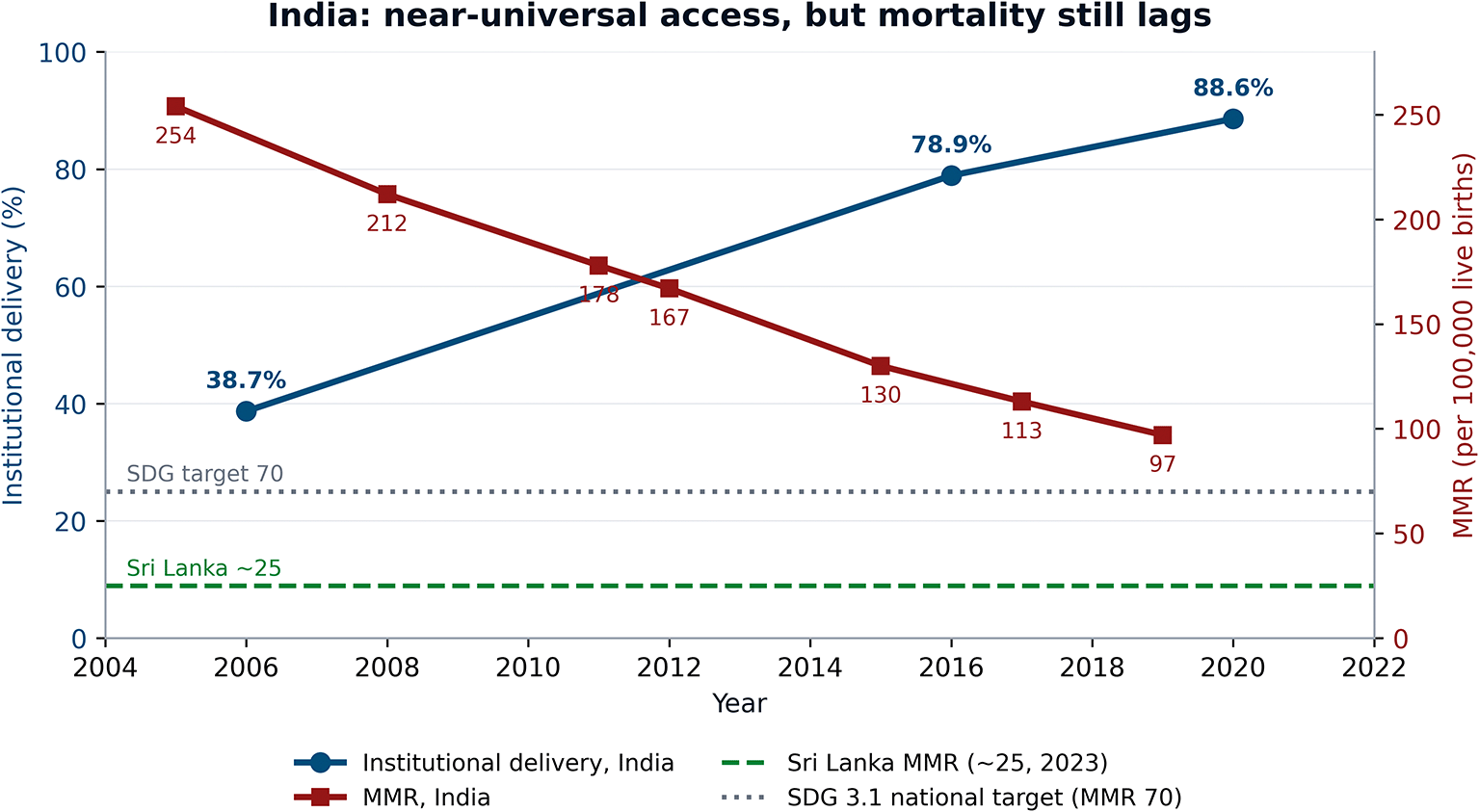
Access has approached universal while the MMR, though much reduced, remains well above both benchmarks.
Sources: Sample Registration System MMR bulletins (2004–06 to 2018–20); NFHS-3/4/5 (institutional delivery); WHO MMEIG (2025) for Sri Lanka.
Sri Lanka’s MMR fell from approximately 1,500 per 100,000 in the early 1940s to about 18 in 2023, a decline of more than 98%, and almost every birth now takes place in a facility with antenatal coverage close to universal.9,10,11 Three things carry the system. Maternity care has been free at the point of use since the free delivery policy of 1952, provided as a right of citizenship alongside free schooling and free outpatient care.9 The Public Health Midwife, a cadre created in 1926 and steadily enlarged, now numbers about 10,000, roughly one for every 2,000 to 3,000 people; each is a salaried professional, trained for a year in hospital and six months in the field, who provides antenatal and postnatal care at doorstep.9,11 Behind her sits a three-tier referral system that keeps comprehensive emergency obstetric care, including caesarean section, blood, anesthesia, oxytocin, and magnesium sulfate, available at district hospitals as a matter of national policy.11,12 None of this waited for prosperity: the 1952 commitment was made when income per head in Sri Lanka was lower than that in many low-income countries today.9
The two features set Sri Lanka apart, and both speak to India’s gaps. The first is geographical accountability. Each midwife is answerable to every pregnant woman in a defined area and seeks out those who do not come forward, so the unit of responsibility is the place, not the register ( Table 1). India’s ASHA works mainly with women who have already entered the system, and so tends to miss the very women whose first contact with care would otherwise be an emergency.9,11 The second factor is universality. Free care for everyone is simpler to run, fairer, and often cheaper than means-tested support because targeting adds administrative cost and tends to exclude the poorest, who are least able to satisfy eligibility rules.9 India’s reliance on conditional cash is exactly the target model that Sri Lanka’s experience calls into question.
Table 2 sets out the comparison. India is, if anything, poorer per head than Sri Lanka and spends a similar modest share of GDP on health, yet Sri Lanka’s MMR is about a quarter of India’s. No difference in income or spending can account for a gap that large. The explanation is the architecture: a free, universal system staffed by professional community midwives, with clear accountability and a referral chain that works, set against India’s volunteer frontline and cash incentives layered onto an uneven base of facilities. The economic collapse of 2022 put this to the test. Sovereign default, a 53% fall in the currency, and the breakdown of medicine imports, which supply about 85% of the country’s drugs, left some 150 essential medicines out of stock and caused oxytocin shortages in facilities.13,14 The MMR rose, with modelled estimates near 34 per 100,000 in 2021, but the system held and recovered to about 18 by 2023.7 The episode cut both ways. It exposed a real weakness in import dependence, and it showed the value of a deep, universal system that could absorb a shock which would have overwhelmed a thinner, incentive-based one.
Sri Lanka’s model is not secret to Indian policymakers, which raises the real question of why India has not adopted it. A part of the answer is structural. Health is largely a state responsibility in India’s federal system, so reform depends on the center and more than two dozen states moving in step, with no single point of accountability. Part is fiscal. The National Health Policy of 2017 set a target of raising public health spending to 2.5% of GDP by 2025, up from approximately 1.15%, with the union government meeting roughly 40% of it.15 This target has not been met: government health spending was about 1.9% of GDP in 2023–24, and the center’s own share has drifted down rather than up, leaving most of the recent increase in the state.16 Part is political. A large private sector now handles a substantial share of births, including most caesareans, and households have built their expectations around it. Therefore, moving to universal public provision means working against established interests rather than on a blank slate. The frontline India built was also designed to be inexpensive: the ASHA is a volunteer in a small honorarium, not a salaried professional, and turning that network into a paid cadre is a fiscal and political commitment that successive governments prefer to defer.
The direction India would need to take, though, is one that it has already chosen on paper. In 2018, the government launched the Midwifery Services Initiative, creating a Nurse Practitioner in Midwifery cadres trained in the International Confederation of Midwives standards to staff midwife-led care units, with a stated goal of about 86,000 professional midwives.17 Its aims read almost as a description of the Sri Lankan system: respectful, lower-intervention care for low-risk births, fewer unnecessary caregivers, and better outcomes. The gap between vision and the ground is practical rather than conceptual. The rollout has been slow and uneven across states, and the new cadre must find its place against an obstetric establishment accustomed to leading maternity care, the kind of professional boundary dispute that has slowed midwifery reform in other countries, and the initiative has not been tied to the financing or the universal-coverage commitment that would carry it to women who need it most. The price of doing this properly is, at the bottom, that one India has already promised to pay. Closing the gap to the 2.5% target means finding roughly 0.6% of GDP, on the order of ₹1.8 lakh crore (about US$21 billion) a year at current output, and holding it across budget cycles instead of letting the center’s share erode.15,16 A salaried community-midwife cadre would be a modest part of that set against the far larger sums households already pay out of pocket for care the public system does not reliably provide. On that basis, the sensible sequence is to scale the midwife cadre first where mortality is highest, in the high-burden northern and eastern states; give it geographic accountability and the free, universal backing that makes the Sri Lankan version work, and guarantee the emergency-obstetric referral behind it, rather than waiting for a single nationwide reform.
These steps follow Sri Lanka’s experience and are framed for India’s federal setting. Several people can move forward once.
• Build a professional frontline with geographic accountability. Over time, the ASHA was developed into a trained, salaried community midwife responsible for every pregnant woman in a defined area, not only those who enroll, with proper supervision and a career path, extending to the community the professional-midwife model India began under the 2018 Midwifery Services Initiative.9,11,17
• Make maternity care free at the point of use, and fold conditional schemes into universal cover. Replace eligibility-bound cash transfers with free antenatal, delivery, postnatal, and emergency obstetric care, so the poorest are reached first rather than being shut out by paperwork.4,9
• Guarantee a referral chain with round-the-clock emergency obstetric care. Connect every frontline worker to a facility with skilled obstetric cover, caesarean capacity, blood, and essential drugs at all hours, and close the rural specialist gap through fair pay, residency support, and clear career paths.8,11
• Tie coverage to quality, and govern the caesarean rate. Make facility quality and respectful care, building on LaQshya and PMSMA, central measures of success alongside coverage, and bring the rising, largely private caesarean rate under control through audit, clinical protocols, and payment reform.2,3
• Institutionalize postnatal home visits and maternal death review. We set a fixed schedule of antenatal and postnatal visits, tracked for continuity at the district level, and reviewed every maternal death in confidence so that findings feed back into practice and reach the women most at risk.10,11
• Invest in girls’ education and the conditions of use. Treat female education and literacy as part of maternal-health infrastructure and pair them with outreach and respectful care that earns the trust of women who expect to be treated poorly.9,10
These proposals have honest caveats. Sri Lanka is smaller, more centrally governed, and more invested in this work than India, and its female literacy is higher; therefore, the lesson lies in the design rather than in copying the country or its timeline. Building a professional cadre will take years, but India has ASHA and midwifery platforms to build on and can begin now.
Maternal survival depends not only on whether services exist, but also on how the system around them runs. India has done the hard work of expanding access; the next advance will come from how that access is organized, from continuity, accountability, and quality, rather than from further schemes.
Sri Lanka shows that a country with modest income, spending modestly, can reach maternal outcomes close to those of far richer nations, and can hold them through political change, civil war, and economic collapse. India does not need to imitate Sri Lanka to learn from it. The most useful example lies not in a distant high-income system, but across the Palk Strait: a professional, universal, community-based service that is free to use, answerable for every woman, and backed by a referral chain that works. This is the distance between the number of deliveries and the prevention of deaths.
No software or code was generated for this article. Figure 1 was produced in Python (matplotlib) from these published values.
Ethical approval and informed consent were not required for this study, and none was sought. This article is a policy analysis based exclusively on previously published, publicly available, aggregate secondary data and literature. It involved no human participants, no intervention or interaction with any individual, no primary data collection, and no identifiable private information. Under the US Common Rule (45 CFR 46.102(e)), such an activity does not meet the definition of human subjects research and therefore does not require review by an institutional review board, consistent with University of North Texas IRB policy (SOP 13.01, Non-Human Subjects Research Determinations).
| Views | Downloads | |
|---|---|---|
| F1000Research | - | - |
|
PubMed Central
Data from PMC are received and updated monthly.
|
- | - |
Provide sufficient details of any financial or non-financial competing interests to enable users to assess whether your comments might lead a reasonable person to question your impartiality. Consider the following examples, but note that this is not an exhaustive list:
Sign up for content alerts and receive a weekly or monthly email with all newly published articles
Already registered? Sign in
The email address should be the one you originally registered with F1000.
You registered with F1000 via Google, so we cannot reset your password.
To sign in, please click here.
If you still need help with your Google account password, please click here.
You registered with F1000 via Facebook, so we cannot reset your password.
To sign in, please click here.
If you still need help with your Facebook account password, please click here.
If your email address is registered with us, we will email you instructions to reset your password.
If you think you should have received this email but it has not arrived, please check your spam filters and/or contact for further assistance.

Comments on this article Comments (0)