Keywords
Ecocriticism; Humanity; Nature; Postcolonial Literature; Survival

Ecocriticism; Humanity; Nature; Postcolonial Literature; Survival
The main aim of this research is to explore how literature depicts the relationship between humans and nature, and to examine aspects of survival, moral responsibility, and environmental awareness. The work of the study is limited to the examination of two influential novels: Yann Martel’s Life of Pi (2001) and Margaret Atwood’s Oryx and Crake (2003). Both literatures depict humankind’s interaction with nature; however, they differ in the way the authors present these ideas both philosophically and from a different time perspective. Concisely, the novel from Yann Martel, ‘Life of Pi’, portrays nature as a complicated, indomitable, and ultimately revitalizing entity of the spiritual side of man. The story is about Pi, a boy of Asian origin, who was stuck on a lifeboat in the middle of the Pacific Ocean along with a Bengal tiger, which he called Richard Parker. However, along the way, nature became his antagonist, as well as his moral and spiritual guide. Endless sea, wild behavior of Richard Parker, and Pi’s fight for life serve to illustrate nature’s role in the interrelation of fear, faith, and instinct. Besides, the author is Canadian and is also known for writing Beatrice and Virgil (2010). In his works, Martel raises moral and existential issues through creative storytelling, and the book notably illustrates this by showing how nature becomes the human friend, sustenance, and ethical mediator. Oppositely, in Margaret Atwood’s Oryx and Crake, we have a curtailed view of the coming times brought about by human greed, scientific experimentation, and pollution. Dare to differ from Martel’s celebratory depiction of nature, Atwood characterizes the environment as a vulnerable entity that is subject to exploitation and is suffering due to the human race’s constant meddling. Snowman, the main character, embodies the effects of environmental neglect and signifies survival as just one among the many challenges humanity faces. Atwood, an extensively published author from Canada, well-known for writing The Handmaid’s Tale (1985) and Cat’s Eye (1988), is, in most cases, an amalgamation of social, ethical, and environmental issues in her writings. In Oryx and Crake, she warns of the repercussions that follow when one disregards the Earth’s limitations alongside the ethical responsibilities that humans owe to nature. By making a parallel comparison of these two novels, this paper is able to bring out the variance in the portrayal of nature and humans’ fight for survival depending on the philosophical, temporal, and narrative contexts of literature. Whereas Life of Pi sees nature as the ultimate source of guidance and enlightenment, which teaches love and thereby the moral and spiritual growth, Oryx and Crake depicts nature as being despoiled, controlled, and unrelentingly testing human ethical and physical strengths. This research seeks to answer the following questions: How do these novels depict humanity under environmental pressure? The authors redefine natural existence and life preservation through their actions. The solutions they provide demonstrate their understanding of current environmental issues that affect society in the twenty-first century. The study uses ecocritical theory to compare two novels that show how fiction reveals human moral values and spiritual beliefs, and environmental aspects of current human life.
The scholarly attention to Yann Martel’s Life of Pi and Margaret Atwood’s Oryx and Crake has been booming notably in areas like ecocriticism, environmental humanities, and contemporary fiction studies. The comparative study directly contrasting the two works is still at its nascent stage, but the existing research has already sufficiently illuminated their common thematic concerns. First of all, these novels address environmental ethics, the interdependence of humans and nature, and the theme of survival in ecological crisis. Their combined power is, on the one hand, the necessary theoretical base that both works can be positioned within the scope of the literary response to the crisis of the environment and, on the other hand, the changing idea of humanity in the twenty-first century.
According to Sarah Appleton (2019), the Atwood dystopia serves as a warning of the results of a society that is reckless in its technological exploitation and neglectful of ecology. Her paper points out the novel as a potent critic of human-centered morality through the depiction of the natural world, which, being a victim of human interference, is now fighting for survival. On the other hand, the majority of literary studies often concentrate on the spiritual and allegorical sides of nature. Daniel Bristow (2020) argues for applying a spiritual ecocritical lens to reading the novel and states that Martel depicts nature as the spiritual energy that drives the transformation of the main character’s identity. This paper supports the interpretation of the novel as an engagement with nature as a source of spiritual profundity, which is in stark opposition to Atwood’s dark ecological vision. Other interpretations of Life of Pi envision the novel as a reflection of the survival narrative trend in the pool of human struggle literature. Monica Ghosh (2016) aims to locate Life of Pi by Martel in modern literature that deals with human frailty in harsh natural conditions. Ghosh (2021) believes that these stories serve as a vehicle for expressing changing views of nature, as writers use survival accounts to bring to the fore the ecological and ethical aspects of human reliance on nonhuman life. The research on Oryx and Crake also serves as a source for the comparative dimension of this investigation. Jonathan Reid (2022) analyzes the portrayal of environmental disasters in today’s fiction. Reid points to the change of attitude in modern literature, which moves away from seeing nature as a moral guide to a victim of human excess.
Other literary studies offer critical frameworks for examining humanity’s fraught relationship with nature in Oryx and Crake and Life of Pi. Alhourani et al. (2025) relate identity and decolonization as narrative strategies to Martel’s reform of survival beyond colonial human–animal hierarchies. Moreover, Adel et al. (2025a) and Khalifa et al. (2025) emphasize the dissolution of human-centered binaries and relational subjectivity, offering Martel’s human–animal coexistence as a critique of human exceptionalism and a theoretical basis for reading Atwood’s genetically engineered species. Alenzi et al. (2026) further contextualize the present study by providing an example of how the literary work questions social hierarchies and human conditions, which can be supported by an ecocritical reading where classes, humanity, and ethical responsibility are interrelated in the context of a broader Anthropocene and postcolonial environmental discourse. In addition, Elhalafawy et al. (2025) focus on crisis aesthetics by drawing conceptual parallels to the environmental disruption shaping Anthropocene fiction.
In addition, some papers indicate a growing ecocritical interest in Life of Pi and Oryx and Crake, particularly regarding environmental ethics. Recent studies confirm that environmental concern is no longer confined to literary or philosophical discourse but is increasingly being translated into legal and political frameworks aimed at protecting the environment and upholding human rights (Khater et al., 2025a; Khater et al., 2025b; Khater, 2023). Critics of Oryx and Crake focus mainly on techno-capitalism, climate anxiety, and ecological collapse, interpreting Atwood’s novel as an environmental exploitation and post-truth culture (Tasnim, 2025; Zainab & Aziz, 2025; Ateş, 2024). On the contrary, other ecocritical studies of Life of Pi highlight ecocentrism, spiritual ecology, and ethical relations between humans and non-human life, framing survival as an ethical and ecological transformation (Shirlin & Selvaraj, 2025; Lison & Mani, 2023). These studies show valuable insights into humanity and nature, but lack a sustained comparative framework. Therefore, this paper addresses that gap by bringing Crake and Life of Pi into dialogue through an ecocritical lens, highlighting environmental ethics, an integrated idea of survival, and human responsibility in contemporary studies.
This study employs a qualitative, text-focused, and Eco-critically informed approach in the environmental humanities and comparative literary analysis. The method involves close reading to assess how each fiction depicts the bond between nature and humanity and how these depictions echo the changes in cultural and environmental issues. The study uses a conceptual and thematic framework to study the role of the narrative structure, figurative language, and characterization in interacting with environmental pressure, spiritual crisis, and ecological collapse. The focus of this analysis is ecocriticism, which examines the interaction between human experience and the nonhuman environment, thereby making nature an active force that shapes narrative meaning and ethical issues. In this context, one of the texts presents the natural world as a factor that contributes to spiritual endurance and human survival. In contrast, the other portrays an environment that is ruined by technological greed and human supremacy. The paper also implements the Anthropocene theory to deal with the cultural, ethical, and environmental consequences of human intervention in planetary systems, especially when it comes to biotechnology, ecological imbalance, and environmental degradation. In this view, it is possible to discuss the way in which modern fiction reflects the conflict between the development of science and ecological concerns. In addition, the study assumes a comparative literature methodology to determine the convergences as well as divergences in the depiction of survival, humanity, and nature in the texts. The analysis of symbolism, narrative, and thematic elements (such as depictions of animals, landscapes, and posthuman futures), as well as questioning the ethical aspect of these depictions, is achieved through close reading. Incorporating ecocriticism, Anthropocene studies, comparative analysis, and in-depth textual analysis, the study sets a clear methodological framework for the study of the ways that literature not only echoes environmental crises but also influences the modern concept of environmental responsibility and the human-nature relationship.
Figure 1 illustrates the study’s qualitative comparative framework by showing how Life of Pi and Oryx and Crake present contrasting views of humanity, nature, and survival: Martel depicts nature as spiritually formative, while Atwood portrays it as damaged by technological excess, ecological collapse, and ethical failure.
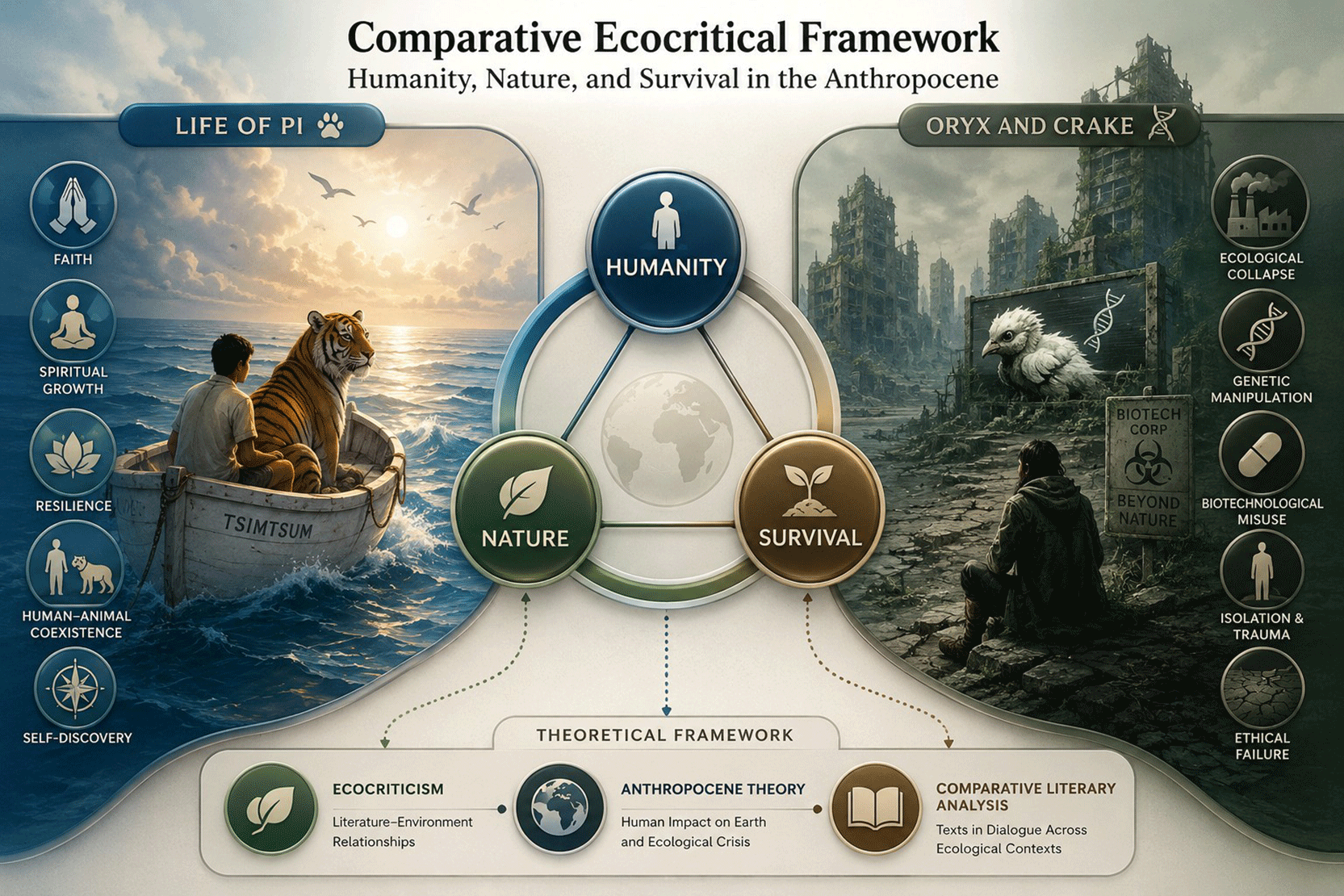
The environment is a crucial element in both Life of Pi by Yann Martel and Oryx and Crake by Margaret Atwood, as it alters the capacity of the human characters to survive and their sense of self. There are numerous differences between the two books, including genre, tone, and environmental setting (the book by Martel is more of a spiritual survival, and the book by Atwood is a dystopian ecological collapse), but both of them have one thing in common: On their part, both books exhibit the similarity of identity as requiring some form of environmental pressure. Pi and Snowman, the protagonists in the two books, through their characters, demonstrate that people change their psychological, moral, and emotional selves due to the surrounding conditions.
In Life of Pi, nature is an active participant in shaping Pi’s character development rather than merely a backdrop. After the shipwreck, Pi had to face the huge and ruthless nature single-handedly. He thought to himself, “I was alone and orphaned, in the middle of the Pacific. I was all alone, and I had to make do with what I had” (Martel, 2001, p. 131). The Pacific Ocean takes away all the social, cultural, and familial roots that Pi was holding on to and leaves him in a state of existential loneliness. As ecocritics Glotfelty & Fromm (1996) argue, nature is often depicted in literature as a “text of survival,” through which humans find their place and meaning in response to nonhuman forces. Pi’s ordeal is exactly like that; the sea is the means by which he reinvents his identity.
Martel presents nature in its two-sidedness with images, which may be either glorious or frightening. The sea is termed as “a boundless circle of blue, indifferent and absolute” (Martel, 2001, p.102). Such apathy causes Pi to doubt his religion, morals, and self-concept. He even questions whether his strength is constructed against the sea, or in fact due to the sea. Each wave, storm, and time of hunger turns into a chapter of the book of survival. From an ecological point of view, Pi is an example of Timothy Morton’s idea of “dark ecology,” a concept in which humans have to come to terms with the unpleasant side of their dependence on nature. Pi’s survival is like a spiritual journey “under the instruction of nature,” whereby his weakness turns into self-realization.
Richard Parker makes the situation even more stressful for the environment. The tiger is not only a pet on the journey but also a sign of nature’s power in its most brutal form. Pi confesses, “Without Richard Parker, I would not be alive today to tell you my story” (Martel, 2001, p.162). The need of the tiger for constant attention has always been the reason for the discipline, vigilance, and emotional control that Pi could hardly have brought to existence if it were not for the environmental threat that Richard Parker stands for. Instead of tearing Pi down, the tiger empowers his identity. The animal, in ecocritical terms, is a ‘nonhuman catalyst of human transformation’ that moves Pi to a higher level of awareness. His fear turns into his goal, his despair into his strategy. It is through this fight that Pi unveils an indomitable spirit within which would have been asleep in a secure environment.
On the other hand, Oryx and Crake portrays an environment that is not the result of nature’s grandeur but of human faults, scientific exploitation, and ecological collapse. Nevertheless, it has a deep impact on Snowman’s identity too. Atwood’s devastated world becomes her protagonist’s psychological mirror. Snowman refers to the post-apocalyptic world as one “where everything was gone: structures, people, sounds. Only the ruins remained” (Atwood, p. 45). His solitude, guilt, and disintegrated sense of self are in harmony with a landscape that has been broken too. Using the language of ecocriticism, Snowman is a subject born from the Anthropocene-induced changes of the planet.
While Pi’s environment supports his resilience, Snowman’s environment wears him down. He confesses, “I used to be Jimmy, but now I am Snowman—the last man, the leftover” (Atwood, 2003, p.7). His change of name is a self-loss and environmental determinism metaphor. He is not reshaped through spiritual trial but trauma. The genetically modified animals, the lack of provisions, and the absence of human companionship push him into a never-ending cycle of terror and memory. The environment guides his every step, routine, and emotional reaction. The concept of trans-corporeality put forward by Stacy Alaimo suggests that the human body is closely related to the environment; therefore, Snowman’s mental fragmentation cannot be separated from the broken world he lives in.
While there is a stark contrast between Pi’s spiritual endurance and Snowman’s psychological decline, the two books come to a point where they both emphasize the crucial idea that environmental pressures fundamentally change human identity. Pi is made by the environment; Snowman is destroyed by the environment. The ocean turns into a teacher for Pi, but the wasteland of the dystopia is the main cause of suffering for Snowman. However, the two journeys bring out the fact that people cannot figure out who they are without taking into consideration their ecological contexts. Thus, these two novels also support the first big finding of the study: the environmental conditions are one of the most important determinants of human resilience and self-discovery, in other words, whether people will rise, adapt, collapse, or transform under the ecological pressure.
Both Yann Martel’s Life of Pi and Margaret Atwood’s Oryx and Crake give details about the natural world that are not only vivid but also very different, reflecting the philosophical, ethical, and narrative stance of each work. In the book Life of Pi, the natural world is represented as the setting and as the source of knowledge, as a motherly power which, in the course of the survival of the main character, contributes to the formation of his moral judgment and spiritual development. The immense Pacific Ocean is what challenges Pi to begin with, and he passes his ordeal of terror, death, and human endurance. He even says, “I must say a word about fear. It is life’s only true opponent. Only fear can defeat life” (Martel, 2001, p.120). Nature is now the adversary and simultaneously the instructor: it is the irresolution that enables the hero to come to life again and to reflect morally. The ecocritics Glotfelty & Fromm cite that often in literature nature is a “‘text of survival,” in which the human identity and meaning are negotiated in relation to nonhuman forces. Moreover, Pi’s tribulations are a perfect example of that: every storm, hunger, or meeting with Richard Parker works as a school of self-discipline, awareness, and adaptation.
Martel’s narration is mainly about nature’s dual aspect: it is lovely at the same time as harmful. The ocean is called “a boundless circle of blue, indifferent and absolute” (Martel, 2001, p.102). With this, however indifferent, vastness Pi is reevaluating his faith, moral values, and self-perception. Every wave, storm, and moment of deprivation is a lesson, coining the term Timothy Morton’s “dark ecology,” and pointing towards human realization of their dependence on and vulnerability within the natural world (Morton, 2016, p.18). Further, the tiger, Richard Parker, escalates the environmental pressure, as a “nonhuman catalyst of human transformation” (Glotfelty & Fromm, 1996, p. 45). Even Pi admits, “Without Richard Parker, I would not be alive today to tell you my story” (Martel, 2001, p.162), thus exemplifying an animal that is both the challenge and the guide. As a result, Pi gains spiritual insight and becomes spiritually strong through the ordeals, thus showing self-exploration can indeed be dependent upon a nurturing nature.
On the other hand, Atwood’s Oryx and Crake depicts a frail, impoverished environment that reflects human mistakes, the exploitation of science, and moral neglect. Snowman is traveling through the world after the apocalypse, where the ecological disaster is the main obstacle to survival, and says, “Everything was gone: structures, people, sounds. Only the ruins remained” (Atwood, 2003, p.45). Unlike Pi, whose environment teaches and strengthens him, Snowman’s world imposes trauma, fear, and isolation. The concept of trans-corporeality by Stacy Alaimo helps to see this interaction by showing how the human body and environment are two aspects of one whole; Snowman’s mental and physical frailty are a reflection of the ecosystem’s deterioration (Alaimo, 2010, p. 22). The idea of “slow violence” by Rob Nixon, which is used here to explain how the gradual environmental deterioration changes the human experience in a way that the psychological and social consequences are invisible at first, but after some time become very pronounced, further supports the idea of the novel (Nixon, 2011, pp. 2–3).
The post-human setting of Atwood’s novel is a sign that the ethical faculties have failed and that there will be moral repercussions. Snowman says, “I used to be Jimmy, but now I am Snowman—the last man, the leftover” (Atwood, 2003, p.7), representing the loss of self, environmental determinism, and the erosion of identity as a result of the ecological disaster. Among the causes of the nature destruction- The Oryx and Crake universe - Genetically modification of living things, scarcity of resources, and absence of human community - all lead to the realization that a dying nature will first of all threaten survival, ethical choices, and human psychology.
The work of Greta Gaard on ecofeminism is a strong point in revealing how the damage done to the environment and the social injustices are deeply interconnected (Gaard, 1993, pp.45–47). Firstly, these novels articulate complementary yet contradictory perceptions of nature. Life of Pi is an example of how nature, a mother, teacher, and challenger, can nurture and develop moral values. Atwood’s Oryx and Crake presents a fragile and damaged environment that serves as a warning to nature and the consequences of neglect. The two works together convey the message that literature can view nature as a teacher and as a reflection of the author’s ethical failure, thus underscoring the essential links between ecological situations and human identity.
Both Yann Martel’s Life of Pi and Margaret Atwood’s Oryx and Crake depict fiction as a vital vehicle for imparting moral and existential values in relation to humanity’s interaction with nature. In Life of Pi, Martel develops a story in which survival goes hand in hand with ethical reflection, empathy, and even spiritual growth. Pi’s relation with Richard Parker is not just about the struggle for survival; it is a fight at the level of a moral code where responsibility, care, and living together are indispensable elements. As Pi thinks over the situation, “I had to tame him. It was not a question of dominance alone; it was a lesson in responsibility and coexistence” (Martel, 2001, p.140). This instance is a perfect example of how fiction can invent a regulated world where ethical problems are solved, thus proving the interaction of human deed, moral decision, and environmental influence.
Glotfelty & Fromm claim that literature frequently depicts nature as a “text of survival” through which humans negotiate meaning and morality in reaction to nonhuman forces (1996, p.5). In Martel’s story, the sea and Richard Parker are the didactic agents that bring about Pi’s moral logic, self-control, and spiritual sturdiness. In addition, Martel’s allegorical mode and narrative creativity provoke the readers to confront the existential questions of human obligations to other species. The whole narrative is replete with examples of challenges to the survival of life, and, at the same time, they are symbolic moral lessons as well.
Timothy Morton’s idea of “dark ecology” is in line with this interpretation: humans have to face their reliance on the nonhuman world and, at the same time, acknowledge the vulnerability that comes with ecological relationships (Morton, 2013, p.18). Hence, Pi’s narrative is an instance of the ability of literature to foster empathy, moral consciousness, and the capacity to withstand moral challenges via its creative depiction of nature.
Margaret Atwood’s Oryx and Crake uses dystopian fiction to show the effects of ethical neglect and environmental collapse. Snowman’s world after the catastrophe depicts how human pride and ecological mismanagement create permanent danger to existence. The story here shows readers how destructive environmental exploitation will create an ethically depleted world. The character reports that “Everything that had been built was now in ruins. The arrogance of humans had changed the world” (Atwood, 2003, p.58). The narrative revolves around the idea of human actions leading to permanent changes that affect both nature and human values, as well as the understanding of existence. Rob Nixon’s concept of “slow violence” is at the core of this argument: the degradation of the environment is mostly a slow and hardly visible process; however, its moral and existential effects are long-lasting and deeply rooted (Nixon, 2011, pp. 3–4).
The way Snowman endures his suffering demonstrates how fiction enables people to think about moral issues while their minds connect with environmental disasters. His constant need to find moral solutions and understand his existence arises from three main influences, which include his resource shortages, his social isolation, and his contact with genetically modified organisms. Stacy Alaimo’s trans-corporeality concept explains how humans maintain their identity and moral values through their interactions with their surrounding environment (2010). Atwood’s story demonstrates that humans will face direct and indirect consequences of their environmental protection failures, which will impact their survival, identity, and ethical standards. The two authors employ different storytelling methods, yet their novels demonstrate that fictional works serve as pathways that lead to moral and existential knowledge. In Life of Pi, nature is portrayed as a positive educational force that helps people develop moral character and empathy. At the same time, Oryx and Crake depicts a destroyed world, which shows how human beings create environmental destruction through their failure to protect the natural world (Adel et al., 2025b). The two works together show how imaginative literature can prompt readers to address ethical dilemmas, human responsibilities toward nature, and the ethical issues that arise during the Anthropocene. The two works demonstrate that fiction may convey ethics and environmental awareness through storytelling.
This paper will analyze both Life of Pi by Yann Martel (2001) and Oryx and Crake by Margaret Atwood (2003) to understand the intricate connection between humans and nature, especially concerning the issue of resilience, self-discovery, and ethical contemplation. The study, through an ecocritical prism, reveals that nature is not the passive background of literature but an active process that influences human identity, morality, and survival. The role of nature in Life of Pi is both nurturing and educative. Because of its challenges, nature builds resilience, compassion, and spiritual awareness. Oryx and Crake, on the contrary, presents a decayed and feeble world that is a result of human exploitation and moral inadequacy that heavily influence the fractured identity of the protagonist. Collectively, the writings highlight the inseparability of humanity and ecology. The comparative analysis shows three major conclusions: environmental situations play a significant role in human resilience and identity formation; the novels provide different images of nature as a nursery or a ravaged place; both works use fiction to share moral and existential lessons, and environmental responsibility is one of the main principles to stay alive. On the whole, the study shows that literature is vital in developing environmental consciousness, moral contemplation, and a greater appreciation of the connection between humans and the natural world.
This paper has re-examined the dynamic interaction among humanity, nature, and survival in both Life of Pi by Yann Martel and Oryx and Crake by Margaret Atwood and established that environmental conditions are not just settings of the story, but determiners of human identity, ethical consciousness, and survival. The study contributes to the development of the argument by a comparative ecocritical framework that postcolonial fiction relates ecological pressure as a constitutive context wherein moral responsibility and self-understanding are negotiated. In this respect, the main contribution of the study is its interpretive synthesis: the comparison of the ecological imaginaries that are, in Life of Pi, a sustaining, morally educative presence, and, in Oryx and Crake, a fragile, depleted object produces contrasting yet connected paradigms of survival. These results place literary survival stories in the context of wider discussions in postcolonial ecocriticism, anticipating the ability of fiction to find a voice to discuss global issues of environmental insecurity and human responsibility in the Anthropocene. In addition to its textual focus, the analysis highlights the modern topicality of the study of literature to the current environmental and ethical debates, locating literature as a critical point where the ecological future of humanity is reflected. Future studies can pursue this comparative ecocritical methodology in other postcolonial and global texts, especially those growing out of those areas most impacted by environmental precarity, thus further clarifying the way literary forms are responding to, and restructuring, global ecological consciousness.
| Views | Downloads | |
|---|---|---|
| F1000Research | - | - |
|
PubMed Central
Data from PMC are received and updated monthly.
|
- | - |
Provide sufficient details of any financial or non-financial competing interests to enable users to assess whether your comments might lead a reasonable person to question your impartiality. Consider the following examples, but note that this is not an exhaustive list:
Sign up for content alerts and receive a weekly or monthly email with all newly published articles
Already registered? Sign in
The email address should be the one you originally registered with F1000.
You registered with F1000 via Google, so we cannot reset your password.
To sign in, please click here.
If you still need help with your Google account password, please click here.
You registered with F1000 via Facebook, so we cannot reset your password.
To sign in, please click here.
If you still need help with your Facebook account password, please click here.
If your email address is registered with us, we will email you instructions to reset your password.
If you think you should have received this email but it has not arrived, please check your spam filters and/or contact for further assistance.

Comments on this article Comments (0)