Keywords
bone marrow, sampling, sound

This article is included in the Japan Institutional Gateway gateway.
bone marrow, sampling, sound
Well-timed bone marrow (BM) sampling (aspiration and biopsy) and prompt diagnostic evaluation are fundamental technique in hematology clinical practice.1 Even in the current era of advanced technologies, the value of these techniques remains high, particularly for critically ill patients. A typical example is the diagnosis of patients with severe pancytopenia. These patients often face complications in the form of with life-threatening infections and transfusion dependency, and their differential diagnoses include various diseases requiring prompt therapeutic interventions, such as aplastic anemia and acute leukemia without circulating blasts, so-called aleukemic leukemia.1 Another example requiring timely BM examination includes assessment of therapy response at cellular and molecular levels in acute leukemia, myelodysplastic syndromes (MDS; also called myelodysplastic neoplasms), and multiple myeloma.2 Traditionally, BM sampling has been carried out bedside using the blind method, in which operators identify appropriate sampling sites by palpation and administer local anesthesia.3–5
Currently, depending on regions, there has been increased utilization of image guidance, such as computed tomography, for identifying the BM sampling site, which is often accompanied by conscious sedation.6 In a study analyzing Centers for Medicare & Medicaid Services data in the United States, the percentage of BM sampling performed using the blind method had dropped to nearly one-third of all BM sampling procedures already in 2016.7 One of the main reasons for this trend is the technical difficulty of BM sampling for less experienced operators.8–10 Additionally, some faculty in hematology struggle to maintain their own BM examination skills and therefore lack confidence in supervising fellows.11 This situation is problematic when treating critically ill patients, common in hematology practice, and when responding to other unscheduled clinical needs.
BM sampling is initiated by identifying the iliac crest through physical landmarks and palpation or imaging, followed by needle insertion at the correct angle and subsequent sample collection. During this process, a sensation of decreased resistance felt by the operators has been recognized as a sign indicating that the needle has entered the BM cavity.5 However, this sign is not clearly observed in many cases. When collected samples are inadequate for diagnostic analysis, such as massive hemodilution, which is a common problem that often leads to misdiagnosis,9 it is recommended to repeat needle insertion with a slightly different angle or by changing the site.12
We noticed that a characteristic sound is audible when BM sampling needles correctly enter the BM cavity and often heralds successful BM samplings, thereby serving as a useful technical guide. In this study, we introduce this sound and present the results of a prospective study analyzing the frequency and value of this sign in consecutive BM examinations.
The characteristic sound introduced in this study was recorded in advance and shared with all staff who participated in the study. We prospectively analyzed whether this sound was audible during BM aspirations and trephine biopsies performed bedside by an experienced hematologist using the blind method. All BM samplings were conducted for clinical purposes between March 2024 and March 2025 at the first affiliation of this study. Commercially available disposable aspiration and biopsy needles (TSK Laboratories, Tochigi, Japan) were used. Two individuals, the hematologist and one of two laboratory personnel who processed BM samples at the bedside, including smear preparation and assessment of aspirated sample quality, independently examined whether the sound was audible with bare ears during routine procedures. The hematologist also logged whether a sensation of decreased resistance was experienced during the BM examinations. Because this institution is a referral therapy center for patients with MDS, mainly those in advanced disease stages, and because therapy was modified based on parameters including BM status, many participants in this study were those with MDS who underwent multiple BM examinations. In addition, as most of these BM examinations were not performed for initial diagnosis, histological analysis (trephine biopsy or clot section of aspirated cells) was conducted only when such information was necessary for clinical decision-making. Diagnoses were made according to the 2022 World Health Organization criteria.13 As a separate analysis, the recorded sound was shared by the study coordinators with experienced hematologists outside the institution. These hematologists were selected based on their extensive clinical experience with BM examinations across a variety of diseases and observant skills. They were asked to complete a questionnaire regarding the sound.
This study was approved by the Institutional Review Board of MRTC Japan (Approval No. 2402), and all procedures were performed in accordance with the Declaration of Helsinki (1975, as revised in 2008). Written informed consent was obtained from all the patients.
BM smears were judged as adequate when one smear contained four or more particles, based on previous reports.9,14 In contrast, BM biopsy samples were judged to be adequate when ≥15 mm of BM tissue was obtained.15 BM cellularity was determined in histological sections of aspirated BM cells (clot sections) or, when available, in biopsy specimens. The grade of myelofibrosis was determined in biopsy specimens according to the previous report.16
The characteristic sound is shown in the Supplemental Video File. After the BM sampling needle penetrates the skin and subcutaneous tissue and advances through the cortical bone, a crunching sound becomes audible at a certain point while the operator advances the needle rotationally. In some cases, operators notice a sensation of decreased resistance when advancing the needles; this sensation and the characteristic sound tend to occur almost simultaneously. In some cases, the sound is subtle, such that operators may feel the crunchy sensation through their fingers rather than actually hear the sound. However, even in such cases, laboratory personnel standing beside the patients and operators can often hear the sound. Moreover, some patients can hear the sound themselves while undergoing BM examinations.
Characteristics of the patients who underwent BM samplings during the study period are summarized in Table 1. The initial diagnoses are shown for patients with MDS, as many of them showed disease progression before and during the study period. In total, 297 samplings were performed for 97 patients. Among these, one sampling was a trephine biopsy alone, while the remaining 296 were BM aspiration with or without trephine biopsies. Each of the aspirated BM samples was subjected to smear preparation at the bedside. If the smears were hypospiculated, the BM aspiration was immediately repeated at a slightly different angle or another site, as recommended in the guidelines, and followed by a trephine biopsy when necessary. This continuous process was counted as a single sampling. Data on the characteristic sound were missing for six samplings, and the remaining 291 samplings were analyzed.
Adequate BM samples, as defined in the Method section, were obtained in 279 of the 291 samplings. Regarding the remaining 12 BM samplings (aspirations), further attempts for obtaining adequate samples, including trephine biopsies, were not performed based on the operator’s judgement (e.g., the operator considered that the difficult BM aspiration itself, together with other clinical data such as the presence of circulating blasts, was sufficient for patient evaluation). Among the 279 samplings, adequate BM samples were obtained on the first attempt in 244 cases ( Table 2), with the characteristic sound audible in 217 (88.9%).
| Total (n = 279) | |
|---|---|
| Adequate BM samples were obtained at the first collection attempt | |
| Typical sound | |
| Audible | 217 (2) |
| Not audible | 27 |
| Adequate BM samples were not obtained at the first collection attempt, but were obtained at the second attempt | |
| Sound pattern A | |
| Typical sound was not audible at the 1st collection attempt, but was audible at the second attempt | 12 |
| Sound pattern B | |
| Typical sound was audible at both attempts | 13 (9*) |
| Sound pattern C | |
| No typical sound at either attempt | 10 (8*) |
In the remaining 35 samplings, adequate BM samples were not obtained on the first attempt but were obtained on the second. In these cases, when the characteristic sound was not audible during the first samplings, the second attempt, accompanied by the characteristic sound, always yielded adequate samples (12 of 12 cases) ( Table 2, Figure 1). Overall, the typical sound was audible in 242 of 279 samplings (86.7%).
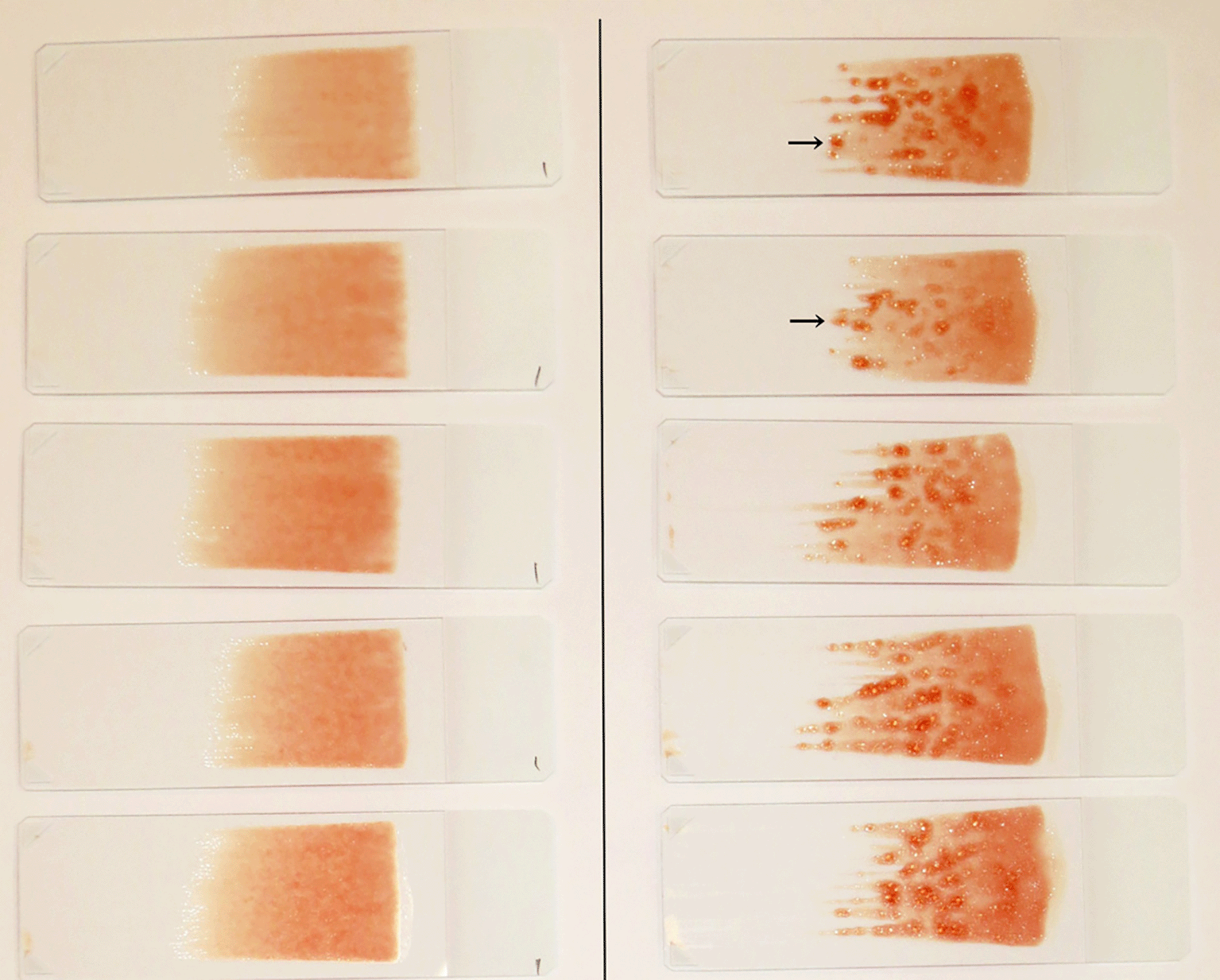
The five smears on the left are from the first sample collection, during which no typical sound was audible, and the smears lacked visible particles. The five smears on the right are from the second sample collection, during which a characteristic sound was audible, and the smears contained many particles (the arrows).
In a vast majority of these 242 samplings, the characteristic sound was audible to both the hematologist and the laboratory personnel (227/242, 86.7%). A clear sensation of decreased resistance during the BM examinations was noted by the hematologist in 39 of the 279 successful samplings. In these 39 samplings, the characteristic sound was audible in 37 cases, which occurred almost simultaneously with the sensation of decreased resistance in all instances.
When patient characteristics (age, sex, blasts [%], diagnosis, BM cellularity [data were available from 174 samples], and the grade of BM fibrosis [data from 18 samples]) were compared between the 242 samplings with an audible characteristic sound and the 37 without it, only sex differed significantly between these two groups (sound audible in 147/162 males (91%) vs. 95/117 females (81%), p = 0.031).
The same video file was presented to three experienced hematologists who had performed many BM examinations for a variety of diseases at tertiary referral hospitals. They completed a questionnaire regarding the sound ( Table 3). One hematologist reported having heard a similar sound during BM examinations, while the remaining two narrated experiencing a similar crunchy sensation. Two of the hematologists felt positively that this sound is associated with successful BM samplings.
This study reports, for the first time, that a crunch sound is audible in most successful BM samplings. In addition, when neither the characteristic sound nor adequate BM samples were obtained in the first attempt, the second sampling, accompanied by the typical sound, was always associated with yielding adequate samples (12 of 12 cases).
Our prospective study was conducted at a single center, and the majority of BM samplings were from patients with MDS. Therefore, we presented the video file to three experienced hematologists, who had performed many BM examinations for a variety of diseases. All three had experience hearing (or feeling with their fingers) a similar sound, and this experience was common in two of them. The finding that two of these hematologists had experienced the sensation through their fingers rather than hearing the sound is worth mentioning. The principal investigator, who designed this study, had long believed that the crunch sensation was perceived through the fingers. The turning point occurred when a patient reported that she had heard the sound during a BM examination. After that, we realized that the crunchy sensation was actually a crunch sound that can often be heard by other people, such as laboratory personnel at the side of patients. In addition, hearing a faint sound is difficult in noisy environments and when operators are focusing on other tasks, such as conversing with patients to relieve anxiety and confirm that they are pain-free. This may partly explain why the reported frequency of hearing or feeling the crunch sound differed among experienced hematologists.
Collecting adequate BM samples is mandatory for diagnosing and treating a variety of diseases affecting the BM. However, recent data highlight that BM sampling is associated with a substantial technical difficulty, and sampling error is a common problem.8–10 For BM sampling, identifying the correct sampling site is the first step, which may be difficult in some patients, particularly those who are obese. Several procedures and precautions were recommended to overcome this problem without image guidance.17 However, for some patients with obesity, image-guidance may be needed, particularly with inexperienced operators. Among image-guidance procedures, computed tomography (CT) is the most reported, followed by fluoroscopy and ultrasonography.6,18–20 The cost of a CT-guided BM sampling with conscious sedation is around 4000 US dollars (12.7-fold higher than the blind method).21 One study reported that the blind method is the most cost-effective among CT-, fluoroscopy-, and non-guided BM biopsies.19 Additionally, the blind method is critical in low resource settings (money, equipment, staff members, and time) and during unscheduled or emergency situations. After determining the sampling site, needle insertion at the correct angle is the next important step; if the collected samples are inadequate for diagnostic analysis, such as with massive hemodilution, repeated needle insertion with a slightly different angle is recommended,12 aligning with our findings.
We believe that the sound presented here serves as a guide to ensure that sampling needles are drilled at the correct site in the correct angle, both of which are essential to obtain good samples. A sensation of decreased resistance has been recognized as a sign indicating that the needle has entered the BM cavity.5 However, this finding is not frequent and is solely dependent on operators. In contrast, the crunch sound occurs very frequently and can be heard by operators and other individuals, such as laboratory personnel. We observed that both signs, the sound and the decrease in resistance, occur almost simultaneously in cases in which both were present. The sound may occur when BM sampling needles penetrate the bony trabeculae that support red marrow, after passing through the cortical bone. The limitation of this study is that there were few severely obese patients and some who received biopsies (as most patients received aspirations). Further studies are needed to confirm that the present sound is effective in obtaining adequate samples in these situations.
In the modern era, clinical hematology has become more complex and demanding than in the past.22,23 Nevertheless, the importance of obtaining adequate BM samples cannot be overemphasized. We believe that the data presented here contribute to improvements in clinical practice in hematology.
| Views | Downloads | |
|---|---|---|
| F1000Research | - | - |
|
PubMed Central
Data from PMC are received and updated monthly.
|
- | - |
Provide sufficient details of any financial or non-financial competing interests to enable users to assess whether your comments might lead a reasonable person to question your impartiality. Consider the following examples, but note that this is not an exhaustive list:
Sign up for content alerts and receive a weekly or monthly email with all newly published articles
Already registered? Sign in
The email address should be the one you originally registered with F1000.
You registered with F1000 via Google, so we cannot reset your password.
To sign in, please click here.
If you still need help with your Google account password, please click here.
You registered with F1000 via Facebook, so we cannot reset your password.
To sign in, please click here.
If you still need help with your Facebook account password, please click here.
If your email address is registered with us, we will email you instructions to reset your password.
If you think you should have received this email but it has not arrived, please check your spam filters and/or contact for further assistance.

Comments on this article Comments (0)