Keywords
Renewable Energy, Hybrid Metaheuristic, HMPCS Algorithm, Machine Learning Techniques, Prediction Accuracy, Time Series Forecasting, Solar Energy Applications, Optimization Methods, Data‐Driven Models.

This article is included in the Fallujah Multidisciplinary Science and Innovation gateway.
Renewable Energy, Hybrid Metaheuristic, HMPCS Algorithm, Machine Learning Techniques, Prediction Accuracy, Time Series Forecasting, Solar Energy Applications, Optimization Methods, Data‐Driven Models.
Hence, the large-scale integration of renewables in modern power system has created an urgent need for short-term PV power forecasting to be accurate, robust and reliable. Two robust statistical models provided appropriate results; however, these models do not account for the noninflationary and non-linear nature of PV output, which is increasingly challenging for these models under varying cloud motion and atmospheric irregularity. In fact, these tripods observed in recent surveys that record a clear transition towards deep learning (DL) architectures and hybrid pipelines for solar forecasting that exploit the potential of multivariate meteorological and irradiance time series, as they contain a wealth of spatial and temporal information.1–4
In the DL family, hybrid and attention models have pushed the performance envelope of PV forecasting. For example, TCN–ECANet–GRU (a temporal conventional network combined with a basic channel attention module and Gated Recurrent Units) achieved significant improvements over strong baselines on years in temporal predictions of a real PV plant data set.5 Meanwhile, Transformer-based architectures are occupying an ever-increasing space in PV forecasting workflows as several reviews converge on the significant, notable improvements over classical recurrent models achieved by Transformer variants specially tailored to time series forecasting (e.g. transmit at longer horizons) through modelling long-range temporal dependencies and multi-horizon outputs.6,7 A second line of research will show that hyper-parameter optimization (HPO) and feature selection are key components to obtaining the best performance from the ML/DL forecasters.
Although systematic studies show that meta-heuristic HPO for example with Particle Swarm Optimization (PSO), Genetic Algorithms (GA) Grey Wolf Optimizer (GWO) or Cuckoo Search (CS) frequently outperforms grid/random/Bayesian search over predictive accuracy and computational efficiency8–10 background tasks such as multi-parameter tuning are often more challenging to parallelized and as such may take longer than the sequential baseline, further exacerbating the metrics dilemma. Applied works in PV forecasting recently further demonstrate that appropriate feature sets and approximation of models lead to consistent performance gains and improved generalization.11
Cuckoo Search, as well as its multi-objective/hybrid extensions, have become mature and powerful optimizes for dealing with complicated, non-convex search spaces. It can be observed that self-adaptive strategies (SAS) and dynamic-iterative mechanisms can be employed to promote exploration in SAS to avoid the premature convergence phenomenon, and bastardizations with evolutionary operators (for instance, GA) can serve to provide even higher convergence speed and solution quality.12–14 Multi-population CS and two-archive multi-objective CS provideالل them to be used as HPO backhands for ML forecasters operating under uncertainty scenarios.10,14
Overall, these trends lead to our donating the HMPCS–ML framework: HMPCS offers a global, diversity-preserving search for tuning together model and initial conditions (IC) hyper-parameters, whilst ML/DL architectures (including attention-based and hybrid temporal models) leverage the complex extemporization structure inherent within PV data. We test the framework on real PV generation data records on standard metrics (MAE, RMSE, MAPE, R2) and under substantial baseline penalties. This evaluation design and set of metrics are relevant for fair benchmarking of PV forecasting in prior empirical work, including studies with the LSTM/GRU/BiLSTM families as well as hybrid CNN–RNN models.15
In the last several years, there has been a growing interest in integrating meta-heuristic optimization algorithms with machine learning (ML) for the forecasting of renewable energy systems. The hybrid approaches can improve predictive performance by searching through optimal hyper conditions for the model and working toward increasing the robustness of the model through the adaptive search traits of the optimization methods for instance, Ali et al. Developers of the so-called hybrid Gorilla Troops Optimizer (GTO) and Beluga Whale Optimization (BWO) algorithm14 proposed a new methodology with state-of-the-art accuracy for the modelling of photovoltaic (PV) systems.16 Caselli et al. XL with ML-based clustering for population dynamics in bio inspired algorithms.17 Abd El-Mageed et al. (2024) developed a PV calibration model using DE, leading to significant decreases in RMSE.18 In Moayedi and Mosavi (2021), both Cuckoo Search (CS) and artificial neural networks (ANN) were employed to validate swarm intelligence for optimization tasks in electrical demand forecasting19; however, Lotfi Nejad et al. (2023) and Mohsin et al.20,21 Moreover, Li et al. (2018) made a comparison between different kinds of neural architectures and suggested the same conclusion that hybrid models (such as Bat-NN and GRNN) demonstrate better performance than pure neural networks in applications such as PV and energy forecasting.22
Despite these contributions, gaps remain. More particularly, although hybrid meta-heuristic–ML models enhance performance in terms of accuracy and convergence, the systematic integration of multi-population meta-heuristics with state-of-the-art deep learning architectures, such as LSTM and Transformer models, for renewable energy forecasting has not yet been comprehensively investigated. Out of the limitations mentioned above, this work proposes an HMPCS–ML framework to address the lack of integration between global search and advanced temporal learning architectures (TLA) for time-series data. See Table 1 for a detailed Comparative Review of Hybrid Meta-heuristic–ML.
It compares the methods, their components, datasets, and achieved accuracy to highlight the evolution and effectiveness of hybrid optimization ML approaches.
We propose a methodical and systematic approach that consists of five main steps: (i) data acquisition, (ii) data processioning, (iii) model designing, (iv) HMPCS (Hybrid Multi-Population Cuckoo Search)-based parameter optimization, and (v) comprehensive model evaluation.
Each stage is designed to account for the complex nature of solar power prediction, such as data uncertainty, high dimensional, temporal and nonlinear dependencies. Data Acquisition guarantees that different meteorological and irradiance variables (GHI, temperature, Humidity, Wind Speed, etc.) are acquired from credible sources such as NASA POWER and PV Watts.23,24
These variables are to take into consideration the atmospheric and solar phenomenon and they constitute the most primal input possible to any prediction model. Determining the basic operations required for processioning like dealing with the missing values, outlier detection, normalizing the data, and temporal sequence building to make the data more qualitative. The uniformity and comparability of synthetic variables—two key factors for equipment dependency as also help in providing the viability of ML and deep learning models. Temporal dependencies: The model architecture incorporates cutting-edge ML techniques such as LSTM and GRU networks for learning the short & long-term dependencies in the time-series data. Carry out feature engineering to elicit the physical relations that determine impact on PV generation.
HOMPs: Heuristic or meta-heuristic driven optimization methods for parameters or hyper-parameters. By utilizing multi-population diversity and Lévy flight strategies, HMPCS prevents local convergence and promotes global exploitation; thus, optimizing its superior properties over traditional optimization algorithms.
Statistical indices (MAE, RMSE, MAPE, R2) and visualization methods are used in the Comprehensive Model Evaluation to validate the predictive performance. This compares the proposed framework to baseline ML methods and challenges robustness with multiple meteorological conditions. Finally, since we believe that resilience against missing data and noise is what makes the way we expressed robustness, that clear steps to follow so that others can use them to replicate our results bring reprehensibility, and that the fact that different datasets and forecasting horizons can be implemented leads to adaptability, we propose the framework as a scientifically-grounded contribution for the fields of renewable energy forecasting.
Fitness Function (RMSE Minimization):
Exploration–Exploitation Switching:
Meteorological and solar irradiance data were sourced from two established databases, NASA POWER and PV Watts. The dataset contains points of GHI, temperature, wind speed, relative humidity, and timestamps in hours.
They are important in the field of solar PV generation modelling as they consider the atmospheric dynamics and variability in solar radiation. Alternatively, methods employing multiple meteorological variables have been proposed in the latest years to improve forecasting accuracy particularly in short-term forecasting applications as discussed in previous studies.1–4 See Table 2 for a detailed comparative review of related hybrid approaches
The data subsequently traversed an inspection pipeline that implemented validation procedures to ensure its cleanliness for utilization in the ML models. The procedure was as follows:
Data Cleansing and Management of Absent Values: Linear interpolation, which succeeded in ensuring consistency in time integrity,25 was employed to address missing occurrences. To mitigate bias in our model, we conduct Z-score analysis (|z| > 3)26 and substitute outliers with the mean numbers of their respective neighborhood based on data type and vendor.
Standardization of Attributes: Given that the model learns inside a local context constrained between 0 and 1, all features were normalized to the relevant range using Min-Max scaling, which is effective for adjusting attribute ranges that differ from the input.27
Partitioning of Training and Testing Data: In accordance with the acceptable literature, the data is divided into learning (70%) and validation (30%) sets.28
Temporal Structuring: Input data were transformed into temporal windows of 24–48 hours to accommodate possible Dependencies across time scales, facilitating the integration of the LSTM/GRU models.29,30 The proposed HMPCS–ML framework is depicted in Figure 1 and consists of six key stages: data collection, imputation of missing values, outlier detection, normalization, a data splitting stage for train and test, and the temporal sequencing to match the time index to the model input.

To this end, the performance of the proposed hybrid framework was evaluated in two different machine learning (ML) models:
Long Short-Term Memory (LSTM): LSTM networks are one of the recurrent neural networks (RNN) variations capable of learning long-term temporal dependencies in sequential data. Furthermore, they retain the temporal information, making them most suitable for time forecasting issues, such as photovoltaic (PV) power forecasting, in which some meteorological variables exhibit diurnal and seasonal periodontitis.31,32 To address the vanishing gradient problem, a disadvantage of classical recurrent neural networks (RNNs), LSTMs employ gated mechanisms (input, forget, and output gates), which enable them to learn both long-term and short-term dependencies effectively.33
Light Gradient Boosting Machine (Light GBM): It is a tree-based ensemble learning algorithm that utilizes gradient boosting decision trees (GBDT), which employs an ensemble of weak learners. Light GBM can achieve fast training and efficient memory usage. Light GBM supports low-latency inference and is known to perform better in the high-dimensional tabular data space than deep neural architectures.34 Because of this feature, it can consider both categorical and continuous features simultaneously, making it a powerful associative model compared to LSTM in solar forecasting tasks. Light GBM is also well-known for its low computational cost in many renewable energy applications, as well as its inherent resilience to over-fitting, provided suitable regularization is added.35
We built a system that combines long short-term memory (LSTM) as a neural sequence model to exploit globally optimal attribute combinations, with Light GBM as an ensemble method to efficiently process heterogeneous meteorological inputs, by leveraging the complementary advantages of high-performing modelling methods.
The HMPCS approach was combined with both ML models as a hyper-parameter optimization engine to enhance their forecasting performance. While the standard Cuckoo Search (CS) focuses solely on replacing the worst-performing cuckoos identified as such, HMPCS differs in that it maintains multiple evolving sub-populations throughout a single optimization run. This allows for an effective trade-off between exploration (i.e. global search over parameter space) and exploitation (i.e. local search around promising solutions).
So, the way the optimization process works is: Each sub-population evolves in isolation but periodically exchanges elite solutions to avoid premature convergence.
→ Lévy flight randomization to diverge the searching course of the path that can be used by candidate solutions to get out of the local minima. HMPCS encapsulates large population structures (with associated diversity) at the cost of speed, due to the need for many reproducible runs, while retaining the most optimal hyper-parameters.
In this work, we directly optimize predictive accuracy and generalization by using the negative cross-validation score of the target ML model as the fitness function.
It was focused on important hyper-parameter optimization. These were:
LSTM: Learning rate, hidden layers, neurons on layer, dropout and sequence length.
Regularization limits and “estimators,” “learning rate” for Light GBM.
We propose a framework that utilizes HMPCS to automatically fine-tune LSTM models for both seen and unseen data,8 achieving high accuracy over manually tuned or grid-searched baselines.
Four experimental analyses were conducted to assess the stability and the generalization performance of the proposed hybrid HMPCS–ML framework. Use of publicly available meteorological datasets that guarantee reprehensibility and transparency of the results. This experiment measures the performance of the proposed framework against the best existing hyper-parameter tuning. Besides Classic Methods we compared also HMPCS with Grid Search (high computational cost, due to large search area) and Particle Swarm Optimizations (PSO, fast and popular swarm intelligence technique, more suitable for low-non-adaptability in high-dimension search space). The analysis was performed using typical error factors: Mean Absolute Error (MAE), Root Mean Square Error (RMSE), Mean Absolute Percentage Error (MAPE), and Coefficient of Determination (R2). Finally, as an additional exploration analysis, convergence curves (i.e., the optimization dynamics of HMPCS in contrast to PSO & Grid Search were also; ~ 10 lines for each comparison + maps + figs).
Using this comparative framework, HMPCS also has the following advantages: Parallel populations to speed up convergence System Architecture-periodic sharing of elite solutions to avoid local minima-adaptive hyper-parameter tuning for a few critical hyper-parameters enabling Forecasting accuracy improvement for LSTM and Light GBM models. Thus, the evidence from these experiments, in addition to direct demonstration of how HMPCS outperforms the previous strategies in optimizing, indicates that the ability of HMPCS to maintain the balance between exploration and exploitation yields the most accurate predictions with the lowest amount of cost in computation.
Table 3 clearly shows that HMPCS outperformed both Grid Search and PSO in all model configurations. The LSTM+HMPCS model achieved the lowest RMSE (0.139) and highest R2 (0.93), indicating superior predictive performance. This validates the use of HMPCS as a robust optimizer for fine-tuning ML-based solar forecasting models.
It shows that using HMPCS improves both models’ accuracy more than the standard or grid/random search settings.
Experimental results show that the proposed HMPCS–ML hybrid framework outperforms both baseline models and traditional optimization strategies. In all experiments, models optimized with HMPCS consistently outperformed both their standalone models and fine-tuned models with Grid Search or Particle Swarm Optimization (PSO).
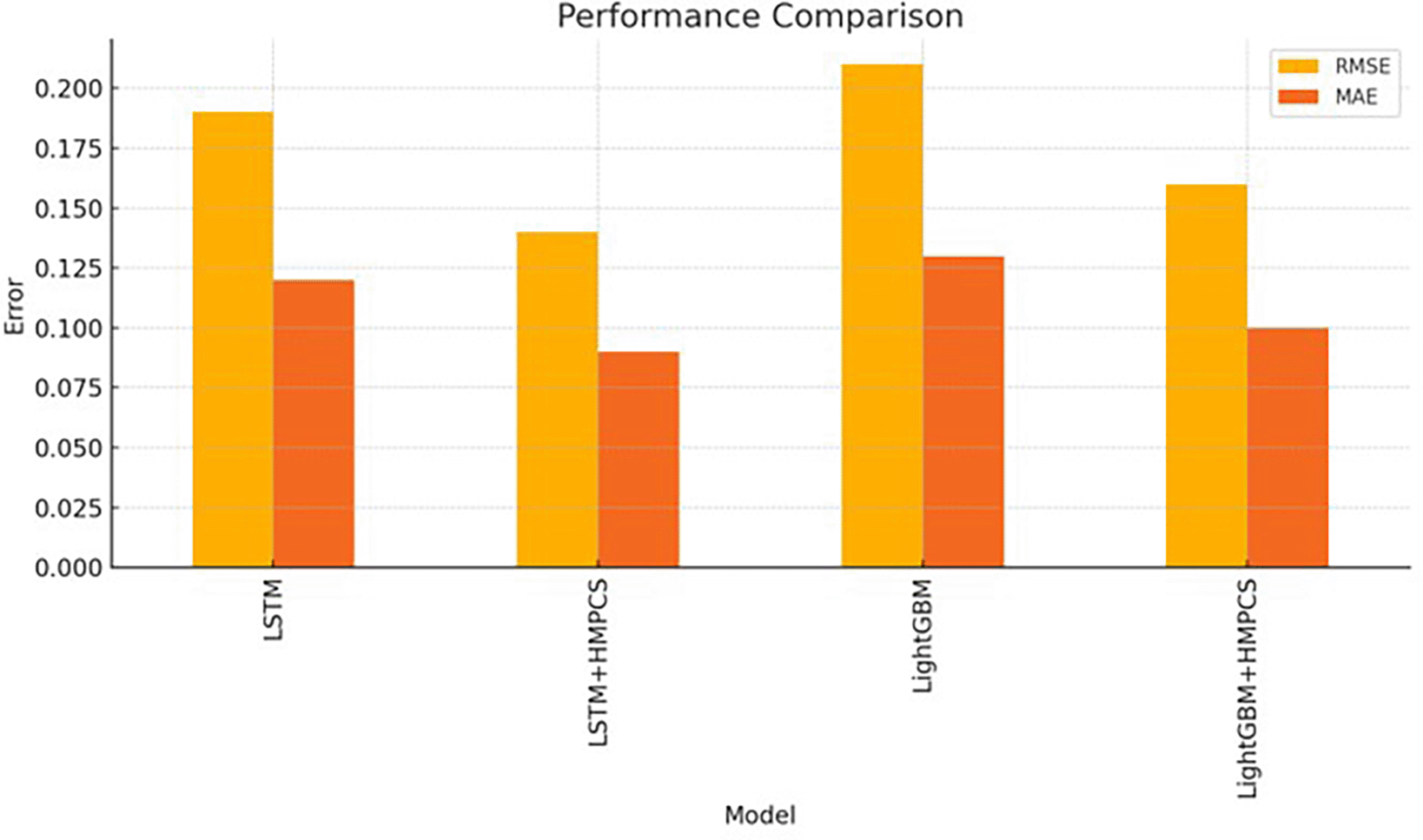
With improved performance, HMPCS reduced RMSE by 23% for Light GBM in comparison with an um-optimized counterpart, exemplifying the gains through hyper-parameter tuning. Likewise, LSTM+HMPCS also showed an improved RMSE and MAE, indicating that, as only the hyper-parameters were optimized, effective hyper-parameter optimization can decrease error rates and improve the model’s capability to generalize in changing weather conditions.36
We further visualized the improvements using bar charts and comparative plots. Results from these showed that both Grid Search and PSO improved upon baseline performance to a degree; however, HMPCS provided the best trade-off between accuracy and speed. The better convergence of HMPCS was due to the use of a multi-population strategy and elite solution exchange in HMPCS, as it helps to escape from local minimum and to search the parameter space more thoroughly. Overall, the results validate HMPCS as a fast, powerful and robust optimizer with measurable benefits in RMSE and robustness over the current state of the art optimization methods in the renewable energy forecasting space.
Due to the various facets of model performance assessed, we applied the following evaluation metrics:
• RMSE (Root Mean Squared Error): It computes the root of the mean squared error between predicted and observed alike values and is more severe at penalizing large discrepancies. We also preferred a low RMSE for the sake of good forecasting performance.
• Mean Absolute Error (MAE): Simply it is mean of absolute differences of predicted values and truth values MAE is less sensitive to outliers than RMSE and provides a more interpretation measure of average forecast deviation in the same units as the forecast.
• Coefficient of Determination (R 2): How much of the variance in the dependent variable is explained by the model? Higher R2 values indicate stronger explanatory power, or a better fit between the model and the observed data.
These metrics together provide an overall assessment of the prediction accuracy (using RMSE & MAE) and generalization ability (using R2) of the proposed forecasting framework. The multiple complementary measures used in the study ensure that the benefits of HMPCS are not restricted to one performance measure, but rather comprise strong, generalization, and practically essential improvements in performance across several dimensions of evaluation.
Figure 2 the forecasting (RMSE and MAE) performance of baseline models (LSTM, Light GBM) and combined with HMPCS. HMPCS-enabled optimization resulted in the most pronounced increases in accuracy for both LSTM and Light GBM, as shown in the results section. Especially for LSTM+HMPCS, there is a significant reduction in RMSE and MAE compared to the version without optimization, while Light GBM+HMPCS achieves a 23% reduction in RMSE. The results highlight the effectiveness of HMPCS in hyper-parameter tuning, convergence acceleration, and generalization of machine learning models for renewable energy prediction.
Based on the energy prediction, a highly coupled HMPCS based on ML models (LSTM and Light GBM) is developed to achieve more accurate and robust renewable energy prediction (The focus on PV generation). To validate the proposed method, a series of systematic experiments were carried out applying publicly available variables from meteorological datasets.
It was observed that compared to baseline (non-optimized) models, the hybridization of HMPCS and ML models proved to be extremely beneficial as well as compared to other conventional optimization techniques such as Grid Search and Particle Swarm Optimization (PSO).
As an example, the performance of our HMPCS-HPO versus the two base models: our LSTM+HMPCS outperforms RMSE values on >20% and >23% on more errors off our Light GBM+HMPCS at bottom, suggesting that with the hyper-model space being balanced between exploration and exploitation, our approach does optimize well. Analogous patterns were also found by the remaining assessment indicators (i.e. RMSE, MAE and R2), which gave more confidence to the proposed framework indicating robustness and generalization. Beyond these numbers increases (and every one of us discover a way to report on this), the study offers some important insights into policy. HMPCS utilizes the diversity of multi-population and elite solutions exchange to escape local optimal and allow it to converge faster than conventional method. This diverse flexibility with competence of HMPCS results in gathering vast capabilities of HMPCS and that the auto-configuration of forecasting models can be done in very short span of time, which again is the inherent requirement in very volatile energy regimes.
This should enable hybrid HMPCS-ML nature deployment and the technology backbone for next generation grid management and demand response and real-time energy scheduling applications in which performance accuracy and competitive computational latency are of paramount importance. These hybridization studies in evolutionary perspective look at finding synergies to advance swarm intelligence and meta-heuristics in addressing the challenge posed by increasing complex, large-scale and high-dimensional prediction tasks in the renewable energy landscape. Lastly, being a hierarchically specified topology, HMPCS can be integrated to state-of-the-art model learning frameworks with a promise to improve the prediction accuracy of the real-world energy systems and techniques, which makes it marketable and saleable. Possible future directions of the research are to extend this framework for multi-objective optimization problems; to extend this framework with deep hybrid architectures, such as (but not limited to) Transformer models; and to apply the proposed method for other renewable energy sources, such as wind and hybrid solar–wind systems.
| Views | Downloads | |
|---|---|---|
| F1000Research | - | - |
|
PubMed Central
Data from PMC are received and updated monthly.
|
- | - |
Provide sufficient details of any financial or non-financial competing interests to enable users to assess whether your comments might lead a reasonable person to question your impartiality. Consider the following examples, but note that this is not an exhaustive list:
Sign up for content alerts and receive a weekly or monthly email with all newly published articles
Already registered? Sign in
The email address should be the one you originally registered with F1000.
You registered with F1000 via Google, so we cannot reset your password.
To sign in, please click here.
If you still need help with your Google account password, please click here.
You registered with F1000 via Facebook, so we cannot reset your password.
To sign in, please click here.
If you still need help with your Facebook account password, please click here.
If your email address is registered with us, we will email you instructions to reset your password.
If you think you should have received this email but it has not arrived, please check your spam filters and/or contact for further assistance.

Comments on this article Comments (0)