Keywords
Electronic payment methods, liquidity risk, Iraqi banks, liquid assets, electronic wallets, electronic cards, ARDL model, Bound Test.

This article is included in the Fallujah Multidisciplinary Science and Innovation gateway.
Electronic payment methods, liquidity risk, Iraqi banks, liquid assets, electronic wallets, electronic cards, ARDL model, Bound Test.
The era of globalization has brought many changes in all areas of life. A key development is the emergence of technological advancements in information and communication technology. These advancements have led to a shift from a cash-based economy to a cashless economy. As a result, there have been radical changes in the financial services sector. Recently, the world has seen a significant move toward digital transactions. These include payment systems, money transfers, and electronic bill payment systems. The implementation of electronic payment systems in commercial banks is now seen as fundamental for improving performance. These systems also help enhance efficiency, increase transparency, support financial inclusion, and reduce banking risks threatening continuity.
In light of these rapid technological developments, Iraqi banks have realized the need to improve and upgrade their services. They are modernizing their payment methods and shifting toward technological solutions. These changes save effort and time, reduce banking risks, and enhance banking performance.
The study (Abdul Shafi and Al-Zubaidi, 2020) aimed to analyze the concept of electronic payment systems, their types, and the performance of the banking sector, as well as to explain how these systems contribute to improving this performance’s efficiency. To this end, an analytical-descriptive approach was applied, and the study community represented Iraqi banks. A questionnaire was used as a study tool, and the study sample consisted of 72 employees from Iraqi banks. The study concluded that electronic payment systems have facilitated a reduction in the time and costs associated with transferring money and financial instruments. Furthermore, they have spurred innovation in new methods for conducting banking transactions and have diminished the risks associated with traditional cash handling. A statistical analysis of the study sample’s responses revealed a significant direct correlation between electronic payment methods and improving banking performance. The study (Ghala et al., 2022) aimed to demonstrate the concept and importance of electronic payment systems, as well as the concept of banking performance, and understanding the measures and role of these systems in raising the efficiency of banking performance. A questionnaire list was prepared. The questionnaire was The questionnaire was presented to a group of employees of commercial banks located in the city of Al-Khums, Libya. The information contained in the questionnaire was analyzed using the SPSS statistical analysis program and conducted a hypothesis test. The study reached a set of results, including the fact that electronic payment systems provide security in the payment of goods and services. This is reflected in banking performance, as well as in reducing financial risks and costs. The research showed a significant relationship between electronic payment systems and banking performance. The study (Alsharaby, 2024) aimed to explore the effect of electronic payment methods on the efficiency of banking performance. Three standard models were developed for the Iraqi banking sector using monthly data from 2018-2022, with 60 time-series observations per model. The study determined that electronic payment methods have a positive influence on the financial performance of the banking sector in Iraq, as they contribute to increased profitability and reduced costs. However, electronic payment methods have also negatively impacted improving the management of internal operations. This is due to their inability to reduce effort and speed in completing transactions and responding to customer demands, because of adherence to traditional methods in banking operations, and the limited use of technology for archiving. This has reinforced bureaucratic processes in banking and negatively impacted the quality of banking services.
Electronic payment methods are defined as the exchange of payment values from buyer to seller through an online payment channel, i.e., the conversion of financial transactions from a traditional environment to an electronic environment without the need to visit a financial institution (Sakanko and David, 2019:144). Some define it as an innovative payment mechanism that uses electronic media instead of cash. Electronic payment systems are described as electronic systems for transferring payment values from the payer to the recipient via electronic payment methods (Mohammed, Ismael, 2024: 29).
They also enable users of e-commerce applications to exchange money electronically instead of using coins, paper money, or paper checks. Online sellers offer easy, fast, and secure methods for customers to make payments for their products (Abu Shaala, 2024: 381).
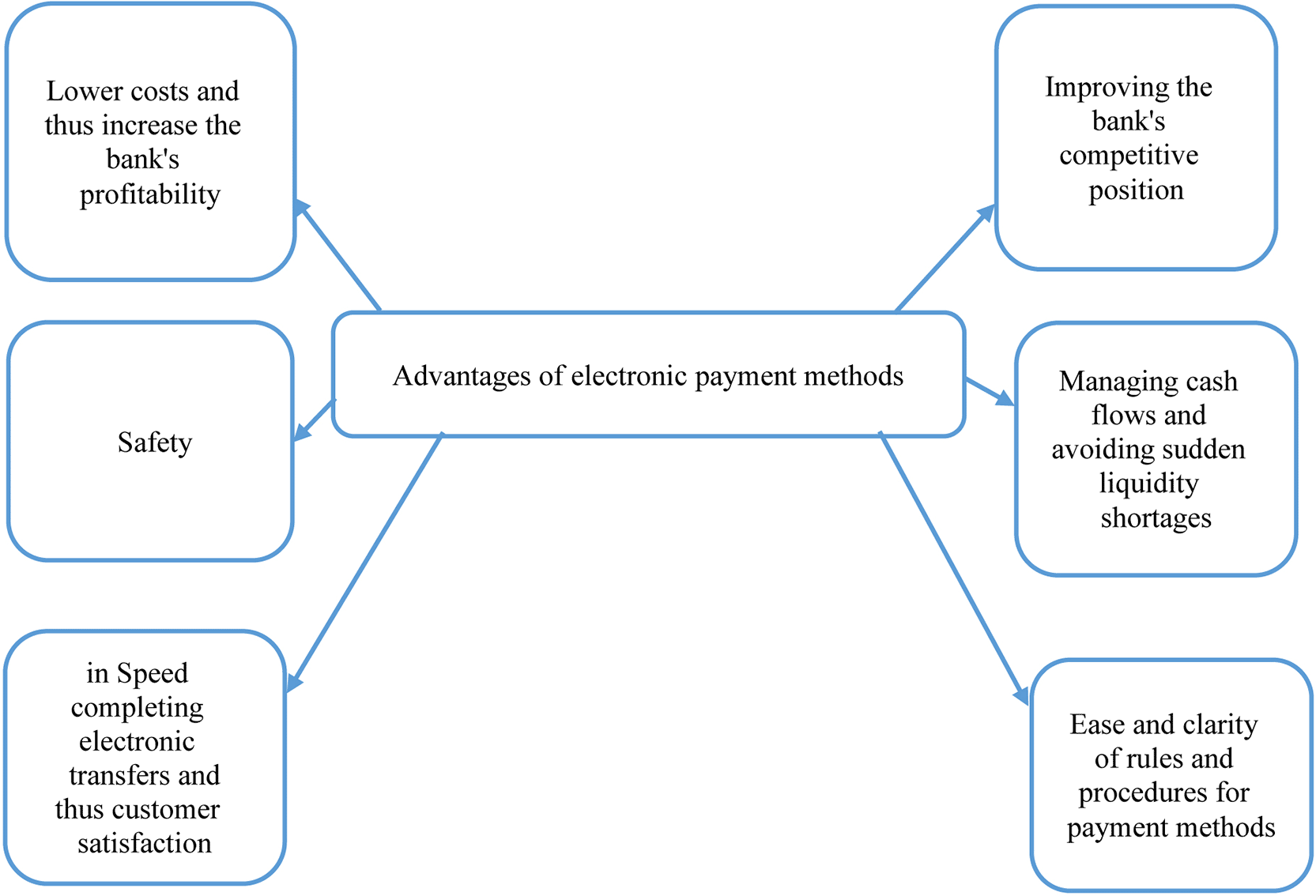
Advantages of electronic payment methods from the perspective of banks:
1. Strengthening the relationship between the bank and its customers, highlighting that the speed and low cost of electronic transfers are key to ensuring customer satisfaction and reinforcing their confidence in banking operations (Mohammed, 2025: 242).
2. Electronic payment systems differ from paper payment systems in that they are more secure, as they enable tracking of financial accounts and thus avoid fraudulent activities (Nasr et al., 2020: 21).
3. Adopting electronic payment methods will reduce the cost of electronic services compared to traditional services, which are characterized by operational costs. This will lead to increased bank profitability (Jassim, Mubarak, 2010: 1).
4. Electronic payment methods are characterized by ease and clarity, i.e., the clarity of the rules and procedures in place makes it easier for banks to understand customer desires and preferences.
5. Electronic payment is characterized by its local and international nature, meaning it is a means used to settle accounts in transactions conducted via electronic space between users around the world.
6. Improving cash flow management: Electronic payment methods allow for accurate and rapid tracking of financial flows, which helps banks predict required liquidity and avoid sudden liquidity shortages.
7. Improving the bank’s competitive position (Shabib et al., 2024: 82).
Figure 1 shows the advantages that banks gain from applying electronic payment methods:
Liquidity risk refers to an institution’s inability to meet its financial obligations when due or pay them at a higher cost, as well as its inability to finance increased assets without having to liquidate assets at unfair prices or resort to high-cost sources of funding (Ahmed, 2013: 206).
Liquidity risk is generally defined as the risk of not being able to provide cash when needed (Bessis, 2015: 4).
It is also possible that a company or institution may face difficulty in meeting its short-term obligations due to a lack of cash liquidity. In other words, it is the risk of not being able to convert assets into cash quickly and at the required value to cover financial obligations (Ghdhaib, 2024: 114).
These risks negatively affect a bank’s ability to both maintain the provision of its services and carry out its operations, as well as to take advantage of the opportunities offered by the banking environment. Liquidity risk arises as a result of internal and external factors (Al-Hashemi & Al-Rifai, 2022: 106). Internal factors include weak liquidity planning within the bank, which leads to a mismatch between assets and liabilities in terms of maturity, the sudden transformation of some contingent liabilities into actual liabilities, or the difficulty of converting liquid balances due to investments and uses of similar degrees. External factors include a recession or economic stagnation affecting the national economy, which leads to the failure of some projects and their inability to meet their obligations to the bank’s creditors on the due date, or severe crises affecting the financial markets.
1. Deepening and Developing Capital Markets and Facilitating Access to Finance:
Electronic platforms enable banks and companies to access capital markets quickly and easily (such as issuing and purchasing commercial paper or short-term bonds electronically). This provides alternative and liquid sources of funding beyond traditional deposits, reducing liquidity risks and contributing to financial stability (Kasri et al., 2022: 3).
2. Improving Treasury Management and Cash Flow Forecasting:
Electronic payment systems provide real-time and accurate data on cash inflows and outflows. This transparency allows bank and company treasury departments to forecast their cash needs more accurately and proactively plan their investment and financing strategies, thus mitigating the impact of unexpected liquidity shortages.
3. Reducing Reliance on Physical Cash and Its Holding Costs:
The widespread adoption of electronic payments reduces the need to maintain large cash reserves in vaults to meet daily demands. This frees up funds that were previously idle and directs them toward more productive investments, while also reducing the costs associated with storing, transporting, and securing cash.
4. Accelerating Working Capital Turnover:
Electronic payments expedite the collection of receivables (from customers) and the settlement of debts (to suppliers). For example, instant fund transfers, rather than waiting for checks to clear for several days, accelerate the conversion of assets (inventory and accounts receivable) into cash. This improves companies’ operating liquidity and reduces their need for short-term borrowing.
5. Enhancing Financial Inclusion and Diversifying Funding Sources:
Electronic payment methods bring non-bank sectors (such as FinTech companies) into the financial market. This creates new and innovative funding channels (such as crowdfunding and microloans via online platforms) for businesses and individuals, reducing the pressure on the traditional banking system as the sole source of liquidity.
6. Improving the Efficiency of Settlement and Clearing Systems:
Modern electronic payment systems, especially Real-Time Gross Settlement (RTGS) systems, settle transactions instantaneously and on an instant and aggregate basis. This reduces settlement risk, a type of liquidity and credit risk that arises when settlement is not completed within the agreed time frame. Netting systems also reduce the total value of payments that need to be settled, thus freeing up tied-up liquidity.
In this section, we will attempt to measure the relationship between the dependent variable (Liquidity Risk Index, represented by liquid assets relative to total assets) and the first independent variable (total electronic cards) and the second independent variable (number of electronic wallets) using a linear model and monthly values for the period (2017-2023). The sample included the entire Iraqi banking sector, and data published in the Central Bank’s bulletins were used. To measure the relationship between the dependent variable and the independent variables, the ARDL co-integration model was used because it provides efficient estimates, especially with small sample sizes. Furthermore, it does not require the time series to be integrals of the same order and can be applied regardless of whether the variables are integrals of order I(0), I(1), or a combination of both, provided that none of the variables are integrals of order I(2). Therefore, the relationship can be tested using the following function:
Y = Liquidity Risk Index, represented by liquid assets to total assets (dependent variable)
X1 = Total electronic cards (first independent variable)
X2 = Number of electronic wallets (second independent variable)
u t: Random error term for the model.
Based on an economic analysis perspective, the increased use of electronic payment methods will lead to a decrease in banking liquidity risks, i.e., there is an inverse relationship between the two.
We observe from the Phillips-Perron test that the time series was stationary when taking only first differences and with a constant term, The t-value we obtained was above the critical t-value at the 1%, 5%, and 10% significance levels. Furthermore, the results according to the augmented Dickey-Fuller (ADF) test did not differ significantly from those obtained using the PP test, further supporting our conclusions. This argument is strengthened by the fact that the p-values remained below 5%. So, with this evidence in hand, we decided to adopt the alternative hypothesis (H1: B ≠ 0), which states that the series can be considered stationary. Table 1 illustrates this:
After conducting stationarity tests for the time series of the research variables, it became appropriate to use the co-integration methodology according to the ARDL model and estimate the equilibrium relationship in the short and long term. This is because the time series of the variables under study are stationary at the first difference; if they were stationary at the second difference, we could not use the ARDL model. Therefore, this model is the best for measuring and analyzing the relationship between the study variables.
Before applying the ARDL model, the appropriate lag period for each model was selected by using auto-regression for each variable, one after the other, until the model that achieved the best results in the criteria (HQ, SC, AIC, FPE, LR) was obtained and selected. The optimal lag period was a single lag interval (Lag = 1).
To test for the long-term equilibrium relationship between the dependent and independent variables (the presence of co-integration), the F-statistic was calculated
Table 2 indicates that the calculated F-statistic value is greater than the critical values at the significance levels of (2.5%, 5%, 10%). This means that there is a co-integration relationship between the study variables, i.e., a long-term equilibrium relationship that runs from the independent to the dependent variable using the Bounds Test, as shown in Table 2.
Table 3 presents the integration of variables and partial elasticities for the short-term. The error correction model helps to demonstrate the short-term elasticities of the studied variables, and the extracted results show that the estimated model has a short-term relationship between the study variables.
| Conditional error correction regression | |||
|---|---|---|---|
| Variables | Co-efficient | t-stats | p-values |
| X1 | 1.10E-06 | 2.892644 | 0.0050 |
| X2 | -3.06E-06 | -3.409241 | 0.0010 |
| cointeq -1 | -0.103316 | -2.460145 | 0.0161 |
It is noted that the value of the error correction coefficient (cointeq-1) reached (0.103-) and the probability value associated with it reached (0.016), which is less than 5%, which means that the two basic conditions for this coefficient have been met, namely its negative value and its statistical significance, i.e., there is a short-term relationship between the dependent variable and the independent variables.
Regarding the long-term relationship, the study results showed a statistically significant positive correlation between the total number of electronic cards and the liquidity risk index. An increase of one unit in this variable leads to an increase in the Liquidity risk Index by (3.05). This contradicts the logic of economic theory. The reason for this may be that increased use of electronic cards by customers, coupled with rising cyberattacks and fraud, reduces customer confidence and puts pressure on bank liquidity. Furthermore, there is the possibility of depositors withdrawing their funds via cards in a mass and sudden manner in the event of a crisis of confidence, which poses a direct threat to bank liquidity.
The study also showed a non-significant inverse relationship between the number of electronic wallets, and the liquidity risk index. An increase of one unit in this variable results in a decrease in the liquidity risk index by (6.14). This aligns with the logic of economic theory, as increased use of electronic wallets leads to greater financial inclusion, a broader customer base for banks, and consequently, increased profits and enhanced liquidity. Table 4 illustrates this.
| Variables | Co-efficient | t-stasts | p-values |
|---|---|---|---|
| X1 | 3.05E-06 | 2.535530 | 0.0133 |
| X2 | -6.14E-06 | -1.909851 | 0.0599 |
| C | 19.32290 | 1.971135 | 0.0523 |
Testing the auto-correlation between errors: This is done through the Lagrange factor for the serial correlation between the residues (Brush-Godfrey), as shown in Table 5 since the results of this test show the absence of auto-correlation between the errors or residues. Since the calculated F value is (0.072) and the probability greater than 5% is (0.78), and since the probability of Obs*R-squared is (0.77), we accept the null hypothesis stating that there is no auto-correlation between errors.
| F-statistic | p -value | Obs*R-squared | p -value |
|---|---|---|---|
| Brush-Godfrey test | |||
| 0.072664 | 0.7882 | 0.079281 | 0.7783 |
| ARCH test | |||
| 0.032997 | 0.8563 | 0.033808 | 0.8541 |
Auto-regressive Conditional Variance Instability Test (ARCH): From Table 5 we can see that the residuals do not suffer from the variance difference problem, as the results showed that the calculated F value was (0.329) with a probability value of (0.856), which is greater than 5%. Also, the probability of Obs*R-squared was (0.033), which is also greater than 5%. This means accepting the null hypothesis, which states that there is no variance difference problem.
To verify that the data had not undergone structural changes, both the cumulative sum test of repeated data (CUSUM) and the CUSUM of squares were performed.
Looking at Figure 2, the two tests show a degree of stability and consistency between the long-term and short-term parameters, as the cumulative sum of recurrent residuals (cusum) test statistic fell within the critical limits at a significance level of 5%.
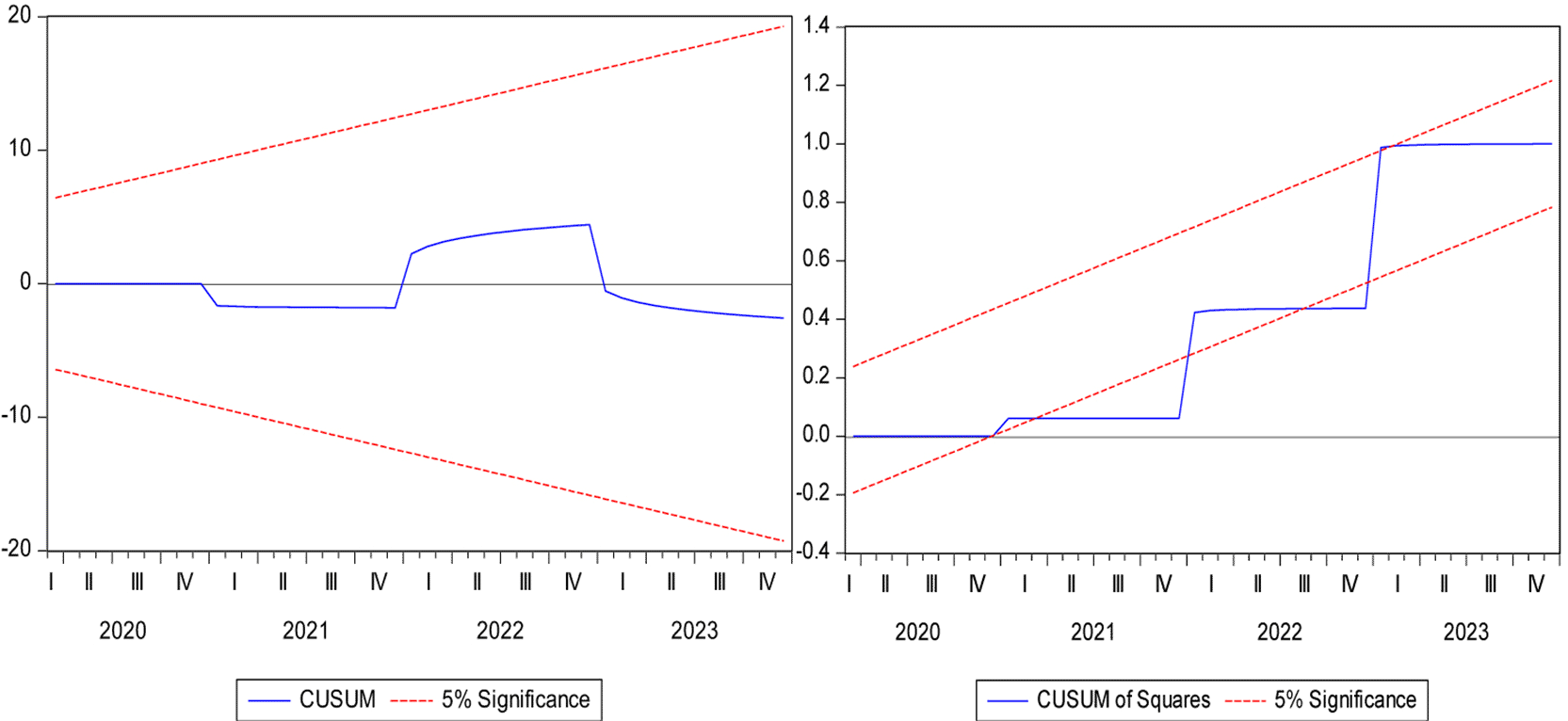
While the cumulative sum of squares test showed that part of the test statistics appeared outside the critical limits during 2021-2022, this reflects the existence of structural changes as a result of the return to life after the Corona crisis and the increase in the number of banks participating in electronic payment operations.
Electronic payment methods are one of the tools used to reduce the risks faced by banks. Adopting these methods will lead to faster and cheaper electronic transfers, thus ensuring customer satisfaction and increasing their confidence in banking transactions. Furthermore, these methods allow for accurate and rapid tracking of financial flows, helping banks to predict required liquidity and avoid sudden liquidity shortages. Accordingly, this study focused on the impact of electronic payment methods on reducing liquidity risk in Iraqi banks using econometric analysis. The ARDL model showed a direct relationship between the total number of electronic cards and the liquidity risk index, which contradicts the logic of economic theory. The results also showed an inverse relationship between the number of electronic wallets and the liquidity risk index, which is consistent with economic theory. The study concluded with a set of recommendations, including directing Iraqi banks towards the expanded use of the internet and electronic payment methods to offer a wider range of modern banking services, given their significant potential to support and enhance banking performance. It also recommended working to bolster customer confidence in the Iraqi banking sector, as well as providing financial and banking awareness programs to educate customers about banking services and how to use them effectively, thereby improving the quality of banking services offered and attracting a broader customer base, as well as reducing withdrawals and renewals of personal accounts, which helps banks to provide the necessary liquidity to sustain their operations.
The study results showed a direct relationship between the total number of electronic cards and the liquidity risk index. An increase of one unit in this variable leads to a 3.05% increase in the banking sector’s liquidity risk index, which contradicts theoretical frameworks and empirical studies.
Regarding the second independent variable, the number of electronic wallets, the study results showed a statistically significant inverse relationship. A one-unit increase in this variable results in a 0.146% decrease in the banking sector’s liquidity risk index. This aligns with economic theory, as increased use of electronic wallets promotes financial inclusion, expands the bank’s customer base, and consequently increases its profits and enhances its liquidity.
| Views | Downloads | |
|---|---|---|
| F1000Research | - | - |
|
PubMed Central
Data from PMC are received and updated monthly.
|
- | - |
Provide sufficient details of any financial or non-financial competing interests to enable users to assess whether your comments might lead a reasonable person to question your impartiality. Consider the following examples, but note that this is not an exhaustive list:
Sign up for content alerts and receive a weekly or monthly email with all newly published articles
Already registered? Sign in
The email address should be the one you originally registered with F1000.
You registered with F1000 via Google, so we cannot reset your password.
To sign in, please click here.
If you still need help with your Google account password, please click here.
You registered with F1000 via Facebook, so we cannot reset your password.
To sign in, please click here.
If you still need help with your Facebook account password, please click here.
If your email address is registered with us, we will email you instructions to reset your password.
If you think you should have received this email but it has not arrived, please check your spam filters and/or contact for further assistance.

Comments on this article Comments (0)