Keywords
A finite group, Semigroup, Wreath product, A free (left) G-act, Total transformation semigroup, Endomorphism monoid, Semigroup morphism.

This article is included in the Fallujah Multidisciplinary Science and Innovation gateway.
A finite group, Semigroup, Wreath product, A free (left) G-act, Total transformation semigroup, Endomorphism monoid, Semigroup morphism.
Amendments from Version 1
The revised version of the manuscript incorporates the corrections suggested by the reviewers. The preliminaries have been carefully revised according to referees’ suggestion to improve. Several square symbols have been placed in the end of proof. In the new version of the article, an extensive grammar check is done, improving the clarity and coherence of the manuscript.
See the authors' detailed response to the review by Dr. Sanaa Ahmed Bajri
See the authors' detailed response to the review by Katrina Belleza Fuentes
In this paper will be a finite monoid (group) and be a free (left)- -act of rank . It is clear that is an independence algebra,1 which is a class of universal algebras of rank generators that includes free (left)- -acts for a finite group For a positive integer , we write the (total) transformation to be which is the monoid of degree, under the operation of a compositions of functions, such that for all and we have As well as, it is a set that maps every transformations into itself (i.e., , . Clearly, if then and becomes a monoid that consists of only one map, which is the (empty) map.
All transformations of this paper are composed from left to right, so for any and for any then will be written as the image of , and for any , we define and and A number of authors appeared in2–9 obtained and described various transformation semigroups, such as the description of the singular transformation 10 and they study the structure of the partial endomorphism monoids of the independence algebra like a free acts and other set such as vector spaces and modules. When is a finite monoids the endomorphism monoids of free (left)- -acts played a major part of semigroup theory, and it can be found in.11
It has long been known that set of the endomorphism monoid of the free (left)- -acts of rank is isomorphic to the (full) wreath product 12,13 or, more generally for arbitrary semigroup Clearly, if , then . Where S is a finite semigroup, the (total) transformation monoid of a free (left) act of rank has been described in,12 for further information we recommend the reader see.14–21 Through this work, the discerption of , has established in particular when is a finite group, and many properties of this concepts have been studied such as the isomorphic of to and the embeddedness of it in the (total) wreath product . Furthermore, in the last section of this work the discerption of Green’s relation of has been found.
12 Let be a non-empty set and be a monoid, then is refed to a (left)- -act if there is a mapping defined by , such the following conditions are satisfied for all and :
12 Suppose that and are two (left)- -acts, then a mapping is named an - acts morphism if , .
12,13 The (total) transformation semigroup on a non-empty set is denoted by If , such that , where we write to be . With respect to the semigroup operation of composition that ( ) for all and . Clearly, is monoid with identity transformation .
1 - If , , then can be written as .
2 - For any the second row of is not a permutation for the first row. Since not all element is injective.
3 - The number of elements of is equal to .
Recall that, if is a semigroup and if , the (principal) left ideal generated by is the smallest left ideal of containing , and it is denoted by . Dually, for .22
22 Let be any semigroup, the Green’s preorder binary relations are defined as follows:
From the above definition we can define the Green’s relations by:
22 Let be any semigroup, the Green’s relations are defined by:
Clearly, if is finite, then So, the above definition can be translated as follows:
22 Let be a finite semigroup, the Green’s relations can be defined as:
This section is devoted to give an explicit description of the set of the free (left)- -acts, when is a finite group.
12,22 Let be a finite group and be a non-empty set, then is known as a free (left)- -acts on if:
1 - For any mapping
2 - For all -acts and every map there exists a unique morphism such that the following diagram is commute:
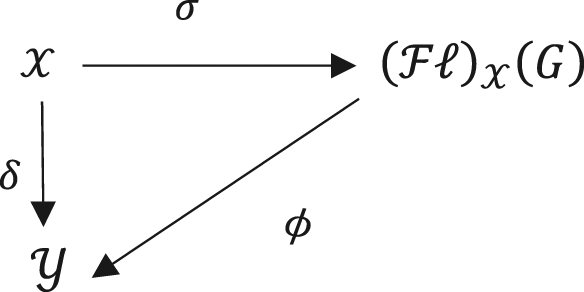
If where and the free (left)- -act can be written as .
It is clear that consists elements of the form where and i.e., such that 1,12 It is well-known that the set of all the morphisms is called the endomorphism monoid, and it is denoted by Therefore, the set of all morphisms from the free (left)- -acts into itself is an endomorphism monoid and it is denoted by such that ; and is a morphism}. If , we define to be where 1 , , and . As is a morphism and for and 1 we have .
The (full) wreath product multiplication in semigroup theory is a multiplication comes from a semidirect product between two semigroups. The next definition gives an abstract construction of the (full) wreath product multiplication.
This section is devoted to describe the set , when is an independence algebra.
Suppose B be an algebra and B be a universe of B ,1,12,13 The sets , and such that is a morphism } are monoids. Furthermore, is submonoid of this result has been proved by Al-Aadhami in,12 and this can be shown by the following lemma:
The semigroup is a submonoid of
See.12
In this subsection we give an explicit description to the (total) transformation monoid .
The set of all morphisms can be defined as , such that is morphism} which is a monoid under the composition of mapping. If then can be expressed as:
Where such that 1 and . Notice, for every selection of with for and this gives .
Clearly, where i.e., ( is a trivial set), then will be isomorphic to .
The next theorem is analogous to Lemma 4.1.12 However, in the following theorem a semigroup is assumed to be a finite group
If , then
Suppose be a mapping such that defined by when for all We must show that is a -acts morphism, i.e., we want to show that for all and . Let . Clearly, an element if and only if for all Where , that means for all , then since is a -acts morphism.
To show is injective. Assume that , then for any obtaining ( Notice that, ( , so , as required.
To prove is onto. Let and let defined from to by
, for each As that implies is a -acts morphism, therefore for some and , we have .
Since, , for all , Therefore, , that gives is onto.
To prove is a homomorphism. Let .We need . From the definition of and from our assumption we have . Conversely, .
Obviously, , so and are a -acts morphisms. Then, . So, , and this complete the proof.□
For all
Assume that then can be written as , such that for 1 . Let defined by . In order to prove is embedding, we have to prove is one to one and a homomorphism map. Let , we need show ( ) . Now, The other side gives ( ) . As then are -acts morphisms such that they take to itself. Hence, and ( . From that, we get , so we obtain and . This implies, is homomorphism.
To prove is one-to-one. Let such that that leads to .
Then for any , we have , and
then and is one-to-one.□
Where is an independence algebra V. Gould,1 gave the characterization of Green’s relations on , after that A. Al-Aadhami,12 described the Green’s relations on , where is a finite semigroup. In this section the characterization of Green’s relations on have been illustrated.
I. Let in that implies for some and so by,12 [Proposition 5.5] we have , and hence
Assume that , so for all , we get
If we select such that , then by defining such that for It is clear that and therefore we can obtain that means
II. (Where in that implies for any . Assume , hence . Therefore,
That means, and so
) If let such that : Since by,12 [Lemma 5.1], define = such that = , and , for all …, .
Now, let = then ( , ) means that implies , therefore, is well –defined.
Since is free on }, and as then must be a -acts morphism. Let be such that also let = , that implies Now, = ( ) =
Because and we must have z . Hence,
III. If we suppose that for any then and by,12 [Remark 5.2]. Recall, and let , where , so that, | |. Because this implies that Notice, As we obtain and then . Therefore, □
For all , we have the following:
The point (1) and (2) can be easily verified using Theorem 6.1.
3) It is direct result from (1) and (2).
Let that means for any . From (1) and (2) we get and . Now, (by the Fundamental Theorem of Semigroup), therefore, , and so and then we get , furthermore, Hence,
Let As for some . With | |=| | =
If we let :Y be a bijection and by defining by ) for all and Clearly, is one to one as where ) that implies = , for all and . Then we must have and = this is because they are in and as is free (left)- -act and is one-one, then . Furthermore, is onto since from definition of we get, for all and because is bijection hence for all , choose with ) .
Suppose . We have = = , therefore,
Let Clearly, if and only if Since is one to one, then , therefore, . Hence,
5) Let that means , for any . From Theorem 6.1, (III), we have .
and for some , with | | and Because then by,12 [Remark 5.7] there is a one to one map . Let , that means and .
Fix and define by z , for all z , and for all z then . Define by Obviously, extends to a -acts morphism therefore, . Since = = = = , we obtain so, by (4) we get and then because . Therefore,
6) If then By Theorem 6.1, (III), = , as well as , that gives
Let , then by using (4), so that as .
7) This is an immediate consequence of (4) and (6).□
Throughout this paper, the independence algebra has been studied, and we show that it is free (left)- -acts under specific conditions. Moreover, the structure of have been considered, and the we show that isomorphic to the endomorphism monoid , with embeddedness in the (full) wreath product of by . For future work we may consider the structure of , where is a finite semigroup.
| Views | Downloads | |
|---|---|---|
| F1000Research | - | - |
|
PubMed Central
Data from PMC are received and updated monthly.
|
- | - |
Provide sufficient details of any financial or non-financial competing interests to enable users to assess whether your comments might lead a reasonable person to question your impartiality. Consider the following examples, but note that this is not an exhaustive list:
Sign up for content alerts and receive a weekly or monthly email with all newly published articles
Already registered? Sign in
The email address should be the one you originally registered with F1000.
You registered with F1000 via Google, so we cannot reset your password.
To sign in, please click here.
If you still need help with your Google account password, please click here.
You registered with F1000 via Facebook, so we cannot reset your password.
To sign in, please click here.
If you still need help with your Facebook account password, please click here.
If your email address is registered with us, we will email you instructions to reset your password.
If you think you should have received this email but it has not arrived, please check your spam filters and/or contact for further assistance.

Comments on this article Comments (0)