Keywords
Transmedia storytelling, bibliometric review, digital education, critical participation, social transformation, interdisciplinary research

Transmedia storytelling, bibliometric review, digital education, critical participation, social transformation, interdisciplinary research
Transmedia storytelling refers to stories expanded across multiple media platforms that invite audiences to participate as prosumers in building the narrative (Santin et al., 2024). The integration of technologies such as augmented reality, virtual worlds, and artificial intelligence poses ongoing challenges to contemporary digital communication (Freire et al., 2023). Within social advertising, digital narratives have become powerful tools to generate new perspectives on social change (Henao et al., 2025).
Recent years have witnessed growing interest from universities and researchers in studying transmedia storytelling as both an artistic and educational phenomenon (Piñeiro, 2025). Critical pedagogy emphasizes that in the digital era, citizens must develop media and transmedia literacy to engage meaningfully in networked societies (Mesquita et al., 2022). This perspective aligns with calls to adapt pedagogical strategies to the realities of digital convergence and interactive learning (Arias & Del Campo, 2024).
Despite an increase in qualitative and applied studies, a comprehensive bibliometric synthesis of transmedia storytelling remains scarce. Therefore, this study aimed to perform a bibliometric analysis of scientific production related to transmedia storytelling between 2020 and 2025, map global research trends, identify publication patterns, and outline key thematic and methodological tendencies within the field.
This study adopted a descriptive and retrospective bibliometric design under a mixed post-positivist and constructivist approach. Quantitative indicators were combined with qualitative interpretation to examine patterns of scientific production on transmedia storytelling between 2020 and 2025.
A descriptive and retrospective bibliometric study was conducted using the Scopus database. Guided by the PRISMA statement Matthew T., et al. (2021), the study combined quantitative indicators with qualitative interpretation, supported by post-positivist and constructivist paradigms.
The ARA framework was applied to classify information into three analytical dimensions:
D1 – Authors: total citations, average citations per year, affiliation, country, h-index ( Table 1).
| Author(s) | Total Citations | Citations per Year | Year of Publication | Affiliation | Country | h-index |
|---|---|---|---|---|---|---|
| Piñeiro (2025) | 399 | 33 | 2025 | University of Salamanca | Spain | 12 |
| Henao et al. (2025) | 0 | 0 | 2025 | Bellas Artes Institution of Valle del Cauca | Colombia | 0 |
| Viñaras et al. (2025) | 315 | 26 | 2025 | CEU San Pablo University | Spain | 12 |
| Fonts & Durán (2024) | 7 | 4 | 2024 | Polytechnic University of Catalonia | Spain | 2 |
| Chamorro (2024) | 2 | 1 | 2024 | University of Granada | Spain | 1 |
| De Barros et al. (2024) | 6 | 2 | 2024 | São Paulo State University (UNESP) | Brazil | 1 |
| Ortega et al. (2024) | 38 | 5 | 2024 | University of Jaén | Spain | 3 |
| Falandes & Renó (2023) | 2 | 1 | 2023 | São Paulo State University (UNESP) | Brazil | 1 |
| Leite (2023) | 0 | 0 | 2023 | University of Algarve | Portugal | 0 |
| Freire et al. (2023) | 46 | 5 | 2023 | Abat Oliba CEU University | Spain | 5 |
| Piñeiro & Crespo (2023) | 399 | 33 | 2023 | University of Salamanca | Spain | 12 |
| Sahagún & Fernández (2023) | 24 | 3 | 2023 | Rey Juan Carlos University | Spain | 2 |
| García (2022) | 1 | 1 | 2022 | University of Málaga | Spain | 1 |
| Loayza (2022) | 0 | 0 | 2022 | Technical University of Loja | Ecuador | 0 |
| Guerrero et al. (2022) | 420 | 20 | 2022 | University of Santiago de Compostela | Spain | 11 |
| Álvarez & Selva (2022) | 47 | 14 | 2022 | University of Cádiz | Spain | 3 |
| Quezada et al. (2022) | 8 | 3 | 2022 | Ismael Pérez Pazmiño Higher Technical Institute | Ecuador | 2 |
| Montoya & Páez (2021) | 1 | 0 | 2021 | University of Boyacá | Colombia | 0 |
| Andrade & Fonseca (2021) | 4 | 1 | 2021 | Pontifical Catholic University of Ecuador | Ecuador | 1 |
| Enríquez & Gómez (2021) | 0 | 0 | 2021 | San Francisco University of Quito | Ecuador | 0 |
| Costa & López (2021) | 562 | 61 | 2021 | University of A Coruña | Spain | 13 |
| Arrobo & Suing (2021) | 18 | 10 | 2021 | Technical University of Loja | Ecuador | 2 |
| Magalhães (2021) | 9 | 8 | 2021 | Catholic University of Portugal | Portugal | 2 |
| Vázquez Herrero (2021) | 1 | 1 | 2021 | University of Santiago de Compostela | Spain | 1 |
| Ulloa et al. (2020) | 7 | 4 | 2020 | ESPOL Polytechnic University | Ecuador | 1 |
| Durán LQ et al. (2020) | 17 | 8 | 2020 | University of Aveiro | Portugal | 3 |
| Freire (2020) | 21 | 7 | 2020 | Pontifical Catholic University of São Paulo | Brazil | 2 |
| Herrero & De la Maza (2020) | 134 | 12 | 2020 | University Carlos III of Madrid | Spain | 7 |
D2 – Journals: quartile, indexation, impact factor, and publication scope ( Table 2).
D3 – Contributions: themes, methodologies, analytical techniques, and research samples.
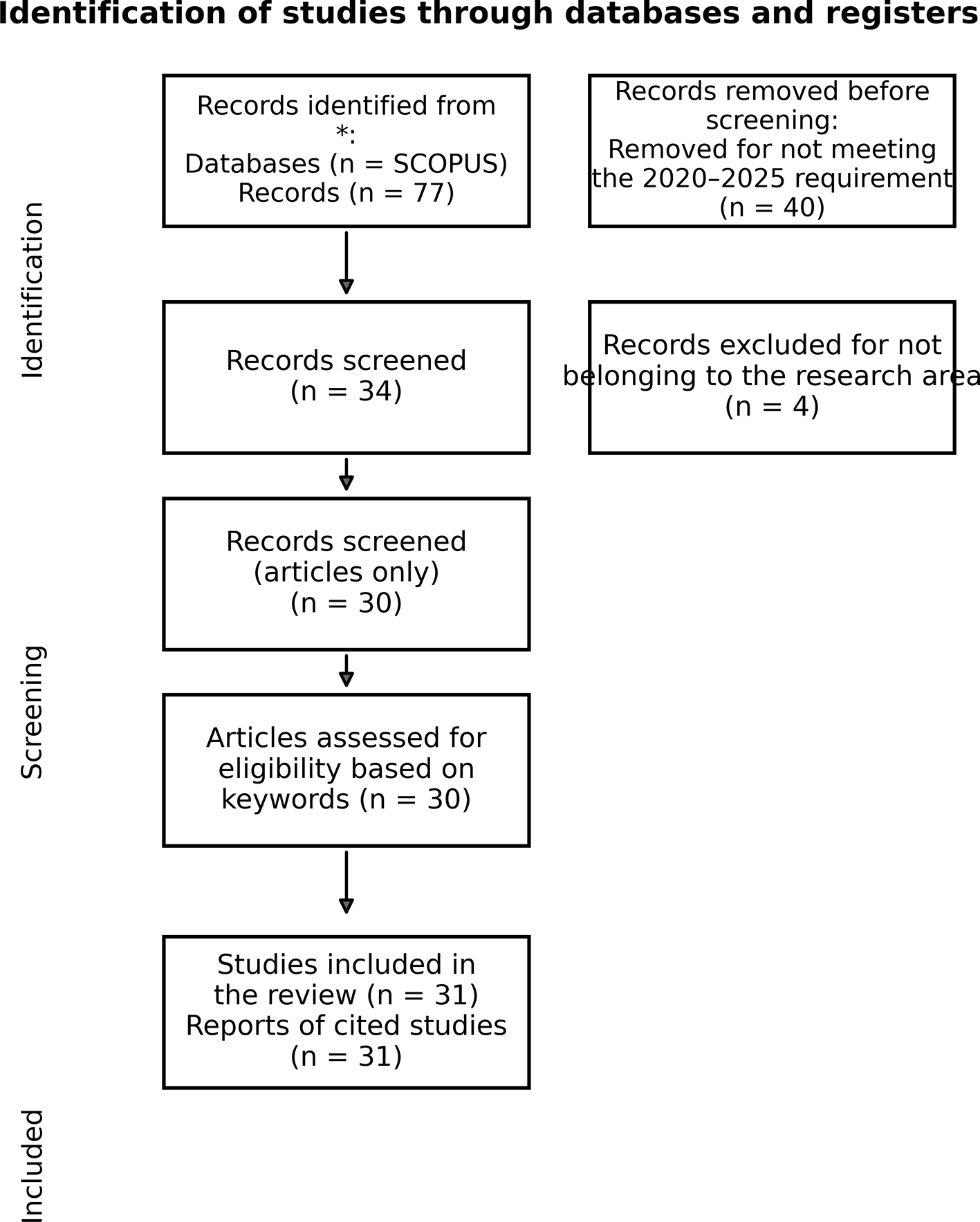
After filtering by publication year (2020–2025), 77 records were retrieved. Following inclusion criteria, 30 peer-reviewed journal articles were retained for analysis ( Figure 1).
TITLE-ABS-KEY (“NARRATIVA TRANSMEDIA” OR “TRANSMEDIA STORYTELLING”) AND PUBYEAR > 2019 AND PUBYEAR < 2026 AND (LIMIT-TO (SUBJAREA, “ENVI”)) AND (LIMIT-TO (DOCTYPE, “ar”)) AND (LIMIT-TO (LANGUAGE, “English”)) AND (LIMIT-TO (EXACTKEYWORD, “Article”)) AND (LIMIT-TO (SRCTYPE, “j”)) AND (LIMIT-TO (EXACTSRCTITLE, “Journal Of Environmental Management”)) AND (LIMIT-TO (OA, “repository”))
The bibliometric visualization was performed with VOSviewer (2025), generating conceptual co-occurrence maps to identify main thematic clusters.
The bibliometric analysis using VOSviewer (2025) identified 514 keywords across 30 Scopus-indexed articles. Through co-occurrence analysis (96% confidence level; 4% margin of error), ten major conceptual categories emerged, reflecting the intellectual structure of transmedia storytelling research ( Figure 2).
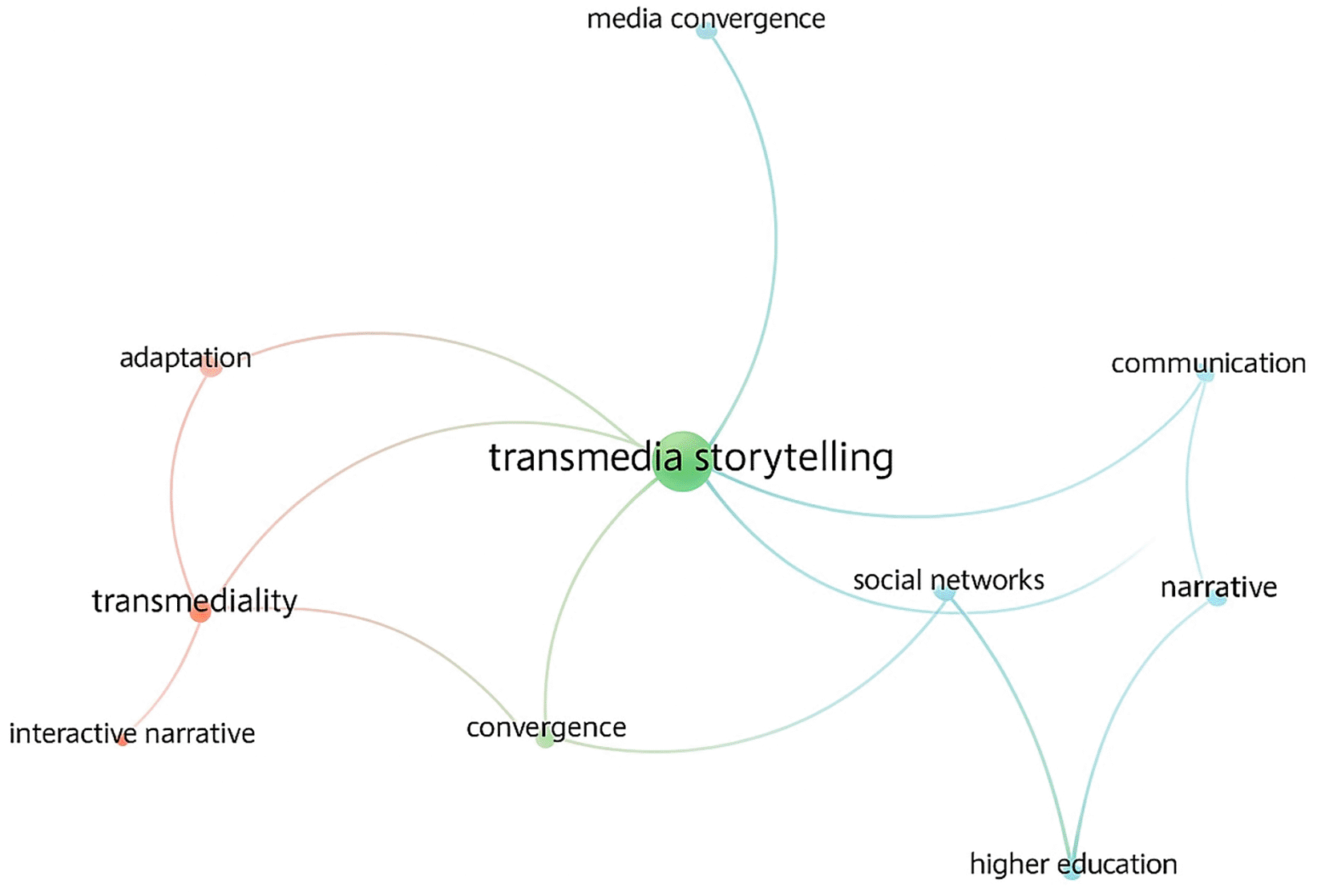
These categories represent the conceptual backbone of the field, revealing the disciplinary intersections between communication, education, and digital media.
Main Conceptual Categories Identified:
• Transmedia storytelling – the core construct of the field, understood as narrative worlds expanded across multiple media that invite users to co-create meaning (Ryan, 2022).
• Adaptation – the creative reinterpretation of texts and stories across platforms, enabling narrative transformation rather than mere translation (Herrero & De la Maza, 2020).
• Transmediality – the ability of stories to develop coherently through diverse media, each contributing unique layers to a broader storyworld (Ryan, 2022; Canción et al., 2025).
• Communication – a dynamic, participatory process of meaning-making within networked societies (Requena Santos, 2024).
• Social networks – socio-digital spaces that sustain symbolic interactions and collective creativity (Requena Santos, 2024).
• Interactive narrative – non-linear storytelling that empowers users through feedback loops and decision-making, producing immersive experiences (Bullock, Shulman, & Huskey, 2021; Ortega et al., 2024).
• Convergence – the technological and media integration enabling the fluid movement of content across devices (Freire et al., 2023).
• Higher education – an emerging area using transmedia storytelling to strengthen creativity, media literacy, and participatory learning (Acevedo, Menese-Camargo, & Da Silva Muñoz, 2024).
• Narrative – a fundamental communicative form central to persuasion and emotional engagement (Bullock, Shulman, & Huskey, 2021).
• Media convergence – the fusion of traditional and digital media ecosystems, transforming journalism and participatory communication (Herrero & De la Maza, 2020).
The conceptual network ( Figure 2) shows a progressive evolution from isolated case studies to integrative frameworks linking technological innovation, cultural participation, and educational transformation.
Dimension 1 – Authors
The bibliometric analysis revealed a strong concentration of authors from Spain, with emerging contributions from Latin America—particularly Brazil, Ecuador, Colombia, and Portugal. The predominance of institutions such as the University of Salamanca, University of Santiago de Compostela, and Universidade da Coruña confirms Spain’s leading position in this field (Piñeiro, 2023; Guerrero, 2022; Costa-Sánchez & López-García, 2021).
Spanish and Brazilian authors contribute over 60% of total output, revealing Ibero-American dominance and emerging diversification among Latin-American researchers.
Dimension 2 – Journals
Most articles appeared in Q1–Q2 Scopus journals from Europe and Latin America, covering communication, digital education, and cultural studies. Journals such as Digital Health [20], Technology, Knowledge and Learning [24], and Digital Education Review [15] hold the highest impact, reinforcing the interdisciplinary relevance of transmedia storytelling.
Dimension 3 – Contributions
Thematic analysis identified five principal domains: education, cultural heritage, social activism, media innovation, and psychosocial health. Representative studies and methodologies are summarized in Table 3.
| Theme | Methodology | Analytical technique | Sample/Scope | Key findings | Main conclusions |
|---|---|---|---|---|---|
| Integration of Transmedia Storytelling (TMS) and Gamification in Museums through XR Technologies | Qualitative study with phenomenological approach | Semi-structured interviews; thematic analysis based on Heidegger’s quadruple model | 27 experts in XR, narrative and museology (Asia, Europe, Canada, U.S.) | Immersive TMS increases participation and transforms museum experiences | Combining TMS and XR redefines visitors as active participants and is recommended for heritage education and entertainment. |
| Consumption of Fictional Transmedia Narratives among University Students | Quantitative descriptive | Frequency analysis of open-ended responses | 230 university students from Spain | Identified 50 fiction titles with 10+ mentions; transmedia consumption is global and genre-conservative | Focus on popular content with limited diversity poses challenges for media literacy. |
| Relationship between Museums and Generation Z in Transmedia Context | Mixed qualitative and quantitative approach | Focus groups, surveys, thematic analysis | 597 young participants from Latin America and Spain | Museums remain symbols of cultural authority but lack shared codes with youth | New transmedia strategies are needed to connect museums with Gen Z through digital culture. |
| Transmedia Narratives Applied to Historical Memory in the Digital Platform of Chile’s Museum of Memory | Qualitative case study with triangulation | Content analysis and focus group with professionals | Five digital sub-platforms of www.mmdh.cl + expert focus group | Reconstructs memory through multi-story formats and participation | Transmedia memory fosters critical reflection, justice, and digital education for future generations. |
| Feminist Transmedia Narratives through Podcast Format | Qualitative case study | Critical discourse analysis and case study | Female-led journalistic podcasts in Brazil | Podcasts express female experiences and challenge patriarchal digital logics | Feminist podcasts create spaces of resistance and identity through transmedia strategies. |
| Transmedia and Artivism as Inclusive Science Communication Strategies | Qualitative descriptive study | Case review and documentary analysis | Artistic and educational projects in Spain | Transmedia and artivism communicate complex science concepts creatively and accessibly | Artivism and transmediality foster co-creation and public understanding of science. |
| Spherical Narrative Models in Non-Fiction Documentaries Using 360° Technology | Exploratory qualitative research | Theoretical and critical analysis of immersive documentaries | Multiple 360° non-fiction documentaries analyzed from audiovisual poetics approach | Identified features of spherical narrative: immersion, decentralized focus, viewer agency | 360° narratives transform non-fiction documentary experience and demand new poetics of sensory immersion. |
Development stages
The temporal evolution of publications revealed three distinct phases:
• Phase 1 (2020–2021): Early exploration of digital journalism and social transmedia storytelling for social awareness.
• Phase 2 (2022–2023): Integration of transmedia storytelling into education through frameworks like INAEP (Investigate, Narrate, Elaborate, Question).
• Phase 3 (2024–2025): Expansion toward digital memory, activism, and affective participation, including museum-based and social media projects.
Publication output peaked in 2021, coinciding with the COVID-19 pandemic, when digital cultural production surged.
Authors and institutional analysis
The leading scholars were Costa & López (2021), Piñeiro (2025), and Guerrero (2022), with Spain as the most productive country. Emerging contributions from Latin America (Ecuador, Brazil, Colombia, and Portugal) reflect a diversification of the field but remain under-cited.
Journals
Articles appeared mainly in Scopus Q1–Q2 journals such as Digital Education Review, Technology, Knowledge and Learning, and Digital Humanities Quarterly. Publication domains span communication, digital arts, and higher education, evidencing interdisciplinary crossovers (Digital Education Review, 2023).
Research contributions cluster around five major applications:
1. Cultural heritage: Use of XR and gamified storytelling to enhance museum engagement Canción Z., et al. (2025).
2. Social activism: Narratives addressing gender equality, environmental awareness, and historical memory Loayza J. (2022).
3. Media innovation: Docuwebs and newsgames fostering critical participation Álvarez-Rodríguez V. & Selva-Ruiz D. (2022).
4. Psychosocial health: Transmedia narratives promoting emotional well-being and public health literacy Duran R. et al. (2020).
At this stage, it is essential to provide a reflective discussion aligned with the guiding research question and the main findings of the study. The analysis reveals patterns, tensions, and emerging perspectives within the field of transmedia storytelling, particularly regarding its social, educational, cultural, and communicative applications across Ibero-America. One of the most relevant aspects to emerge from the results is the variety of methodological approaches and the diversity of research objectives that characterize the analyzed studies. This diversity indicates that transmedia storytelling cannot be understood as a homogeneous phenomenon, but rather as a complex, multidimensional framework that integrates technological, narrative, aesthetic, and participatory dimensions (Guerrero, 2022; Freire et al., 2023).
Such heterogeneity represents a challenge for the development of shared theoretical frameworks, but at the same time opens the way to more transdisciplinary approaches. Regarding the role of audiences, the findings show that transmedia storytelling profoundly transforms reception practices, empowering users as prosumers and co-creators of meaning. Educational projects (García, 2022), activist practices (Loayza, 2022), and mental health interventions (Duran et al., 2020) demonstrate that the audience is no longer a passive agent but an active node in narrative construction. Moreover, this participation occurs through digital platforms enriched with emotional, symbolic, and political components, especially in cases addressing memory, gender, and environmental issues (Chamorro, 2024; Bullock et al., 2021).
From an academic and geographic perspective, despite the evident growth in scientific production, a regional asymmetry persists in which countries such as Spain and Brazil lead transmedia research (Piñeiro, 2025; Costa-Sánchez & López-García, 2021), while other territories still face significant challenges. The centrality of this topic can be understood in light of research policies and the available digital infrastructure, opening a critical debate on the democratization of knowledge and the need to amplify the voices of the Global South within the transmedia research ecosystem.
Another notable finding concerns the emergence of hybrid and immersive formats—such as docuwebs, newsgames, and XR technologies in museums (Herrero & De la Maza, 2020; Ortega et al., 2024). These experiences expand the expressive possibilities of transmedia storytelling and enhance its educational potential by promoting experiential, situated, and affective learning (Duran et al., 2020). In these contexts, transmedia narratives function as interfaces that connect users with complex content through multisensory and interactive experiences, particularly in relation to cultural heritage, environmental awareness, and social memory.
Taken together, this bibliometric analysis (2020–2025) shows that transmedia storytelling has consolidated an interdisciplinary thematic field with a significant presence in countries such as Spain, Brazil, Ecuador, Colombia, and Portugal, and with notable publications in indexed journals addressing communication, education, technology, and digital culture. A key contribution of this study is the identification of thematic approaches that go beyond entertainment-oriented uses: transmedia narratives are increasingly applied to historical memory, environmental activism, health education, political formation, and knowledge appropriation, serving as powerful tools to connect knowledge, create symbolic bonds, and foster active audience participation. This thematic expansion is accompanied by methodological plurality, in which qualitative studies prevail but are complemented by quantitative and experimental approaches, highlighting an ongoing evolution toward social transformation, inclusion, and critical education and reflecting the maturity and adaptability of the field.
This study has several limitations that should be considered when interpreting the findings. First, the analysis is restricted to articles indexed in a single database and within a specific subject area and journal, which may exclude relevant research published in other outlets or in different languages. Second, the relatively small number of documents meeting the inclusion criteria limits the generalizability of the results, even though it allows an in-depth examination of the selected corpus. Third, bibliometric methods provide a structured overview of trends and patterns but do not fully capture the richness of local practices, reception processes, or the long-term social impact of transmedia projects.
Future research could address these limitations by expanding the search to additional databases and subject areas, incorporating multilingual corpora, and including mixed-methods designs that combine bibliometric, qualitative, and audience-based analyses. Comparative studies between regions, especially between the Global North and the Global South, would help clarify how structural inequalities and cultural specificities shape the design, implementation, and reception of transmedia storytelling. Likewise, more empirical work is needed to measure the educational, psychosocial, and civic outcomes of transmedia interventions, particularly in underrepresented contexts such as rural communities, marginalized groups, and low-resource educational settings. It is also essential to investigate the potential of transmedia storytelling to influence public policies, educational innovation, and community development in the digital era.
| Views | Downloads | |
|---|---|---|
| F1000Research | - | - |
|
PubMed Central
Data from PMC are received and updated monthly.
|
- | - |
Provide sufficient details of any financial or non-financial competing interests to enable users to assess whether your comments might lead a reasonable person to question your impartiality. Consider the following examples, but note that this is not an exhaustive list:
Sign up for content alerts and receive a weekly or monthly email with all newly published articles
Already registered? Sign in
The email address should be the one you originally registered with F1000.
You registered with F1000 via Google, so we cannot reset your password.
To sign in, please click here.
If you still need help with your Google account password, please click here.
You registered with F1000 via Facebook, so we cannot reset your password.
To sign in, please click here.
If you still need help with your Facebook account password, please click here.
If your email address is registered with us, we will email you instructions to reset your password.
If you think you should have received this email but it has not arrived, please check your spam filters and/or contact for further assistance.

Comments on this article Comments (0)