Keywords
general relativity, celestial two-body problem, planetary-motion equation, planetary-orbit precession, Mercury's perihelion precession, observation agent, observational locality

general relativity, celestial two-body problem, planetary-motion equation, planetary-orbit precession, Mercury's perihelion precession, observation agent, observational locality
The OR serial reports are reporting to readers and physicists on a new theory in human being’s physics1–4: Observational Relativity (OR). The monograph of OR is divided into two volumes: the 1st volume IOR, i.e., Inertial OR; the 2nd volume GOR, i.e., Gravitational OR.
The theory of OR has revealed the root and essence of the relativistic effects of Einstein’s relativity, both the special and the general, bring new discoveries and insights to human being’s physics. The theory of OR involves many significant issues in physics, and the author attempts to carry on the statement one by one in the form of serial reports. As the beginning, OR serial report 1 (OR01) clarified logical consistency and theoretical validity of OR, as well as, the empirical basis and evidence of OR. OR01 reports5: The speed of light is not really invariant and spacetime is not really curved; OR02 reports6: The rest mass of photons is not really zero; OR03 reports7: Einstein’s prediction of gravitational waves is a historic error.
Now, OR serial report 4 focuses on one of the big puzzles in physics listed in the theory of OR, that is, BP-10: the perihelion precession of Mercury.
In 1915, Einstein, on the basis of his theory of special relativity,8 established his theory of general theory.9 The most important and representative equation in Einstein’s theory of general relativity is the gravitational-field equation. Aiming at the celestial two-body problem, based on the field equation and equivalent gravitational-motion equation, Einstein derived his equation of planetary motion, that is, a theoretical model of the celestial two-body system in which a planet orbit a star.
Unlike Newton’s equation of planetary motion, Einstein’s equation of planetary motion has an additional item: 3GM/c2r2 that suggests that, unlike Newton’s standard closed ellipse, Einstein’s planetary orbit is a non-standard and non-closed ellipse, and the planetary orbit is always drifting or spiraling around the star. Based on his equation of planetary motion, Einstein predicted that Mercury’s perihelion precesses by 43.03″ every Earth Years.
According to the historical records of optical astronomical observation, Mercury orbit actually precesses by 5600.73 arcsec every 100 Earth Years. After deducting the objective or non-idealized factors that cause Mercury orbit precession, there is still 43.11″ left that fails to find a home and can seemingly be attributed to Einstein’s theoretical prediction perfectly.
Thus, Einstein’s prediction seemingly is supported by astronomical observation. This serves as another powerful evidence of the correctness of Einstein general relativity.
In fact, even before the formal establishment of his general relativity, Einstein made theoretical predictions for the gravitational redshift and gravitational deflection of light based on his equivalence principle. And both were observationally and experimentally verified.
Einstein’s three famous theoretical predictions have been supported by observations and experiments, earning him widespread reputation for his theory of general relativity. Nowadays, the mainstream physics community regards Einstein’s theory of general relativity as a better gravitational theory than Newton’s theory of universal gravitation: Einstein is right, and Newton’s theory of universal gravitation is only an approximation.
However, the theory of OR has discovered that Newton’s classical mechanics is a theory of idealized observation with the idealized agent OA∞, representing the objective and real physical world; Einstein’s theory of relativity is a theory of optical observation with the optical agent OA(c), presenting us with only an optical image of the physical world that is not objectively true.
Mankind’s observations and experiments mostly adopt the optical agent OA(c), which is the reason why our observations and experiments mostly conform to Einstein’s theory of relativity. But this does not mean that Einstein is more right than Newton. If mankind had the idealized agent OA∞, then our observations and experiments would tend to support Newton rather than Einstein.
Based on this, OR01 report has already cleared Newton’s name5: Newton is right, and Einstein’s theory of relativity is only an approximation!
The theory of OR,1–4 aiming at the celestial two-body problem, based on the OR gravitational-field equation and equivalent gravitational-motion equation, has also deduced an equation of planetary motion that also has an item of orbital precession: 3GM/η2r2. However, the difference is that the speed of light c in Einstein’s equation of planetary motion is replaced by the speed η of information wave of the general observation agent OA(η) (0<η<∞; η→∞) in the OR equation of planetary motion. This suggests that the orbital precession in the OR equation of planetary motion depends on observation, and is a sort of relativistic apparent phenomenon caused by the observational locality (η<∞) of OA(η), rather than the objectively real precession of planetary orbits.
The theory of OR has clarified1–4 that Einstein’s theory of relativity is only a partial theory of the theory of OR (η=c) in which Einstein employed the optical agent OA(c) as his observation agent. The information wave of OA(c) that transmits observed information is light or electromagnetic wave and travels at the speed of light c. Therefore, optical astronomical observation naturally supports or conforms to Einstein’s theoretical prediction.
It is thus clear that Mercury’s history data from astronomical observation does indeed record relativistic apparent phenomena caused by the observational locality (c<∞) of optical observation, and that the left 43.11″ in the data of Mercury’s orbital precession is not a support for Einstein’s relativity theory, but a support for the theory of OR: Mankind’s perception or observation of the objective physical world does indeed have the observational locality and contain observational effects and apparent phenomena.
It can be imagined that ancient people were curious about the earth they relied on for survival, as well as the sun, moon, and stars that rise and fall every day.
Mankind’s cognizing and understanding of the universe, earth, sun, moon, and stars has naturally undergone a long process of evolution and development: from geocentrism to heliocentrism, from circular celestial orbits to elliptical celestial orbits, from immutable closed orbits to spiral orbits. The concept of The Globe naturally emerged after The Earth, originally referred to by the Chinese as The Great Earth. It was difficult for ancient people to imagine the earth as a ball or a sphere. Ancient people used to believe that the earth was like a Persian carpet: thanks to it, mankind did not fall into the depths of hell.
However, the rising in the east and setting in the west of the sun, moon, and stars had kept reminding ancient people that they were revolving around the Great Earth. And then, ancient people gradually realized that the earth could be a ball. Naturally, at that time, they believed that the orbits of the sun, moon, and stars must be immutable and standard circles, and the earth must be the center of these circles.
And so, The Globe must be the center of the universe.
The concept of The Globe began with Ptolemy’s geocentric theory (see Figure 1 (a)).10 Ptolemy’s geocentric theory was formed around the 2nd century AD, the core idea of which can be summarized as: (1) the earth is a huge sphere; (2) the earth is the center of the universe; (3) the sun, moon, and stars all revolve around the earth. Naturally, in Ptolemy’s geocentric theory, the orbits of the sun, moon, and stars around the earth are idealized as standard circles centered around the earth.
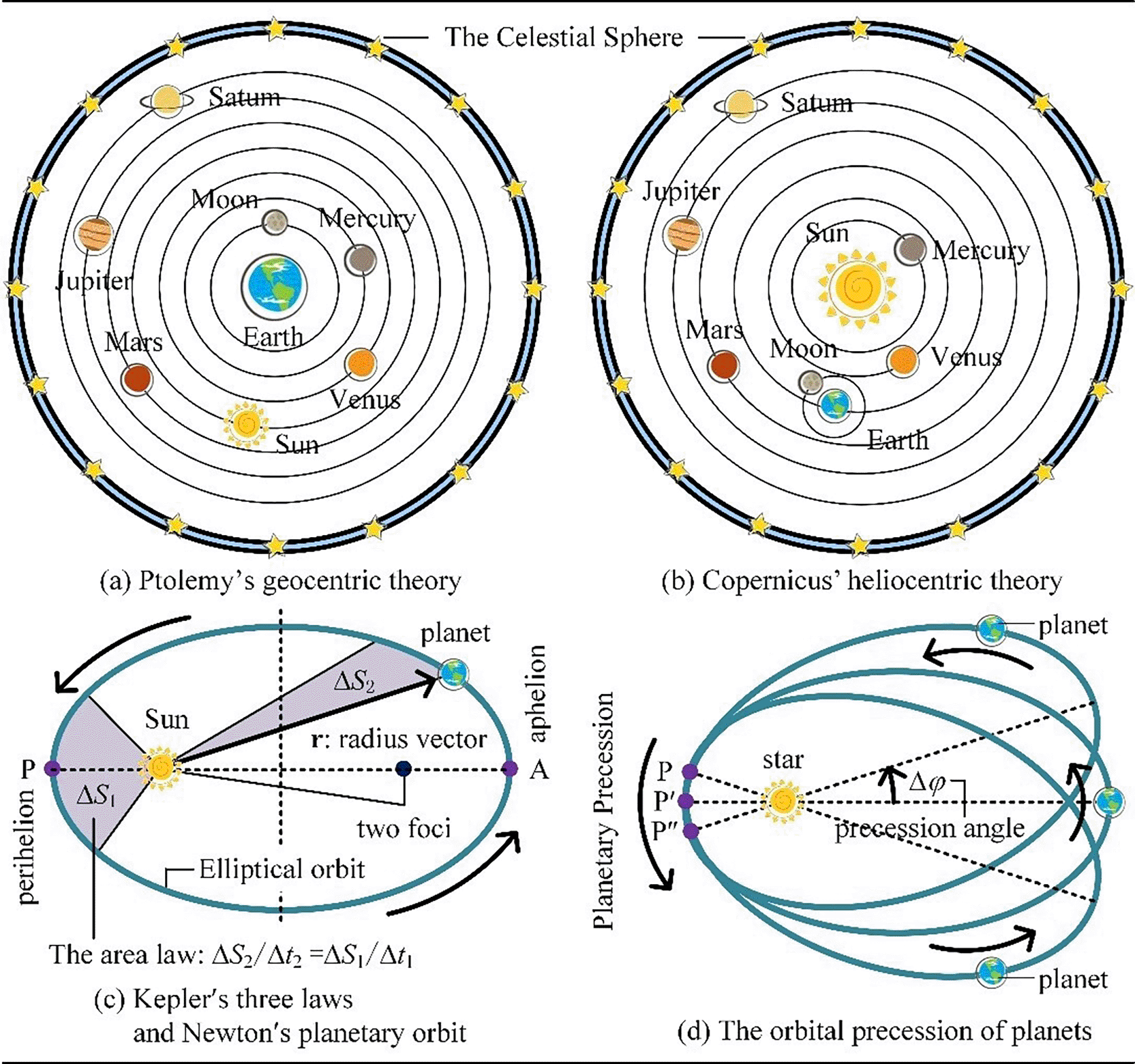
Annotation (a) Ptolemy's geocentric theory. The earth is a ball, that is, the Globe; the earth is the center of the universe, and the sun, moon, and stars revolve around the earth in idealized standard circles.
Annotation (b) Copernicus' heliocentric theory. The sun is the center of the universe, the moon revolves around the earth in an idealized standard circle, and the earth and other planets revolve around the sun in idealized standard circles; the orbits of all planets form the concentric circles centered around the sun.
Annotation (c) Kepler's three laws and Newton's planetary orbit. According Kepler, the orbit of a planet around a star is a closed ellipse with the sun at one of its focal points; Newton's equation of planetary motion supports Kepler's three laws.
Annotation (d) The orbital precession of planets. Astronomical observation shows that the orbit of a planet around a star is not closed ellipse, and the orbit or perihelion of a planet is not fixed, but keeps precessing.
In the 16th century AD, Copernicus created The Heliocentric Theory (see Figure 1(b)),10,11 moving the center of the universe from the earth to the sun. Copernicus’s heliocentric theory has taken a big step in the right direction of mankind’s cognizing and understanding of the universe: all the planets revolve around the sun; the earth is one of the planets, which rotates itself while it is revolving around the sun; the moon revolves around the earth. Of course, in Copernicus’ heliocentric theory, whether the moon revolves around the earth or planets revolve around the sun, they follow standard circular orbits, and the orbits of all planets form concentric circles with the sun as the center. Naturally, the sun is located at the center of the circle.
Then, the sun became the center of the universe.
In the 17th century AD, Kepler established three significant laws about planetary motion based on the astronomical observation data accumulated by Tycho, that is, Kepler’s three laws (see Figure 1(c))10,12: the orbital law, the area law, and the harmonic law. Kepler’s orbit law is also known as the ellipse law: the orbit of a planet around a star is an ellipse, and the star is located at one of the foci of the ellipse. Kepler’s orbital law tells that the orbit of a celestial body is not an idealized standard circle.
It is worth noting that Kepler’s elliptical orbits are idealized as standard ellipses, immutable and closed, and do not drift and spiral. In other words, Kepler’s elliptical orbits have no orbital or perihelion precession.
After Kepler’s three laws, Newton’s three laws and law of universal gravitation were successively born.13
Based on Newton’s laws, Kepler’s three laws can be theoretically derived. Thus, human being’s physics began to evolve from phenomenological physics to theoretical physics. Newtonian mechanics can describe more general conic orbits: the orbit of a celestial body moving in a gravitational field follows a standard conic curve that can be a circle, ellipse, parabola, or hyperbola. Applying Newton’s law of universal gravitation to the celestial two-body problem, one can establish the theoretical model of a planet orbiting a star, that is, Newton’s equation of planetary motion, which supports Kepler’s orbital law: the orbit of a planet orbiting a star is an idealized standard and closed ellipse without drift or spiral.
However, astronomical observation shows that the orbit of a planet is not an idealized standard and closed ellipse. As depicted by Figure 1(d), the orbit or perihelion of a planet is always precessing. In the solar system, the orbital or perihelion precession of Mercury is the most prominent and is found through astronomical observation to be about 5600.73 arcsec every 100 Earth Years.
All theories or models in physics are idealized. The two-body model (M, m) of a star and a planet is an extremely idealized system: gravity is an action at a distance; (M, m) is an isolated system, where both the star M and the planet m are mass points, M is stationary, and m orbits M. This is the reason why Newton’s planetary orbits keep immutable and standard closed ellipses and cannot predict the orbital or perihelion precession of planets.
So, can Einstein’s theory of general relativity and his equation of planetary motion predict the orbital or perihelion precession of planets?
Given the countless objective and non-idealized factors in the objective physical world, it is naturally and inevitable for the actual planetary orbits to be drifting or spiraling. On the contrary, it is difficult for us to imagine that a celestial body would move following the identical closed elliptical orbit eternally. In fact, for Mercury, it only precesses by 13.5″ per revolution around the sun. In this regard, Newton’s equation of planetary motion is already quite precise.
Mercury, as the planet closest to the sun in the solar system, has the most prominent orbital precession: about 5600.73 arcsec per century. Physicists have conducted a corrective calculation for the objective and non-idealized factors of the two-body system of Sun and Mercury. Deducting the effects of the precession of the equinoxes (about 90%) and the perturbations from other planets (especially Venus, Earth, and Jupiter) (about 10%) from the actual observation data of 5600.73, totaling 5557.62 arcsec, finally there is only 43.11″ left that has not found a definite reason.
In 1915, after the establishment of his special relativity8 in 1905, Einstein established his general relativity.9 Einstein applied his general relativity to the celestial two-body problem and built his equation of planetary motion. Compared with Newton’s equation of planetary motion, Newton’s equation of planetary motion has an additional item: 3GM/c2r2 that can be refer to as the item of orbital precession. Thus, by calculation, Einstein made a theoretical prediction: Mercury’s perihelion precesses by 43.03″ per century, which just right coincides with the 43.11″ in the actual observed value of 5600.73 arcsec that have not yet found a home.
Although many physicists still have doubts and propose that it should not be appropriate to draw a final conclusion, the mainstream physics community believes that the 43.03″ supports Einstein’s theory of general relativity.
An early success of Einstein’s theory of general theory was exactly because of the interpretation for the 43.11″ perihelion precession of Mercury per century.
The logical chain of truth has no beginning and no end. In this regard, mankind will never reach the other side of absolute truth, even though we will get closer and closer to it. Restricted by the observational locality, what in the natural world mankind can perceive or observe are only the physical phenomenon rather than the physical essence.
Mankind can employ various observation agents to perceive or observe the objective world, not only by utilizing his sense organs, the eye, ear, nose, tongue, and body, but also by utilizing the observation instruments and equipment that he invents, e.g., sonar and radar.
Mankind seems to heavily rely on for the optical agent, including the eye and the radar.
There is a Chinese proverb that goes: “Seeing is real, hearing is not real.” As a matter of fact, all observation agents that mankind can employ, including eyes and radars, cannot tell you the truth. All they observe are only phenomena rather than the objective physical reality or real physical existence.
In addition to his prediction about gravitational waves,7,9 Einstein had also made three famous theoretical predictions based on his general relativity:
(1) The gravitational redshift of light;
(2) The gravitational deflection of light;
(3) The orbital or perihelion precession of Mercury.
These theoretical predictions seem to have been validated and supported by mankind’s observations or experiments. So, are Einstein’s theoretical predictions really correct? So, do those observations or experiments really represent the objective reality and physical existence?
The focus of this article is to re-examine Einstein’s prediction about the orbital or perihelion precession of Mercury. Before that, let’s briefly discuss Einstein’s predictions about the gravitational redshift and gravitational deflection of light from the perspective of the general observation agent OA(η) of the theory of OR, so that readers can better understand the orbital or perihelion precession of Mercury from the perspective of the theory of OR. This will contribute to our understanding of observation agents and their observational locality, and to our understanding of physical phenomena and physical essence.
The OR serial reports never tire of talking about the most important concept in the theory of OR: Observation Agents, and discussing their Observational Locality.
Human perception and cognition of the objective world not only depend on observation but is also restricted by observation. The theory of OR has discovered that all theoretical systems or spacetime models in physics, including the Galilean transformation and the Lorentz transformation, as well as, Newtonian mechanics and Einstein relativity theory, must be branded with observation.
Observation is to sense or perceive the objective physical world and obtain the information about observed objects. The information of an observed object must be transmitted from the observed object to the observer through a certain observation medium at a certain speed, so that the observer can perceive and cognize the observed object. This led to the formation of the concept of Observational Agent in the theory of OR.
Observation Agent: The observation agent OA(η) is an observation system (P, M(η),O) employs the observation medium M(η) to transmit the information of the observed object P to the observer O at a certain speed η; the matter wave M(η) transmitting observed information is referred to as the information wave of OA(η), and the matter particles constituting the information wave of OA(η) are referred to as the informons of OA(η).
Železnikar ever employed Informon to refer to an information entity and analogized it with an electron.14
For the issue of the orbital or perihelion precession of Mercury, the observation data come from the astronomical observations of optical astronomy with the optical observation agent OA(c) (η=c). The observed object P is Mercury, the observation medium M(c) is light, the information wave is light wave, the informons are photons, the information-wave speed η is the speed of light c, and O is the observer on the earth.
In theory, all forms of matter motion, not just light or photons, can serve as observation media to transmit observed information to observers; the speed η at which the observation agent OA(η) transmits observed information through the observation medium M(η) can be any value: 0<η<∞ or η→∞, not just the speed of light c.
The ear is mankind’s acoustic agent OA (vS) (η=vS≈ 340 m/s), and the eye is mankind’s optical agent OA(c) (η=c). And OA(η) is the General Observational Agent (0<η<∞;η→∞) of the theory of OR.
According to the principle of locality, the speed η of the information wave of an objectively existing observation agent OA(η) must be finite or limited: η<∞. This is the Observational Locality of OA(η), which is described as a principle in the theory of OR1–5: The Principle of Observational Locality -- it must take time for observed information to cross space.
In the objective physical world, no speed of a form of matter motion can be infinite. Therefore, an observation agent OA(η) that mankind can employ must have a limited information-wave speed and have the observation locality (η<∞). In other words, human perception of the objective physical world must be restricted by the observational locality, and cannot represent the objective and real physical world, but rather a certain image of the objective physical world presented in mankind’s subjective world.
A theoretical system or spacetime model in human being’s physics must implicitly have the observation agent of its own. Newtonian mechanics is the theory of the idealized observation agent OA∞, which in a certain sense represents the objectively real physical world; Einstein relativity theory, including the special and the general, is a theory of the optical observation agent OA(c), which presents us with an optical image of the physical world, not the objectively physical reality or really physical existence.
Einstein predicted based on his equivalence principle that the trajectory of light would be curved in a gravitational field, that is, Einstein’s famous prediction of the gravitational deflection of light.
In fact, Newton’s theory of universal gravitation can also lead to this conclusion.
Before the formal establishment of general relativity, the gravitational deflection angle of light calculated by Einstein was the same as that calculated with Newtonian mechanics. However, after the formal establishment of general relativity, the gravitational deflection angle δE of light calculated by Einstein based on his general relativity is twice the gravitational deflection angle δN of light calculated with Newtonian mechanics.
Newton’s gravitational-deflection angle δN:
So, is Newton or Einstein right?
Einstein proposed that, by observing solar eclipses, the deflection angle of starlight passing over the surface of the sun could be determined and thereby verify his theoretical prediction of gravitational deflection of light.
In 1919, during a solar eclipse on the coast of West Africa, Eddington and his team measured the deflection angle of starlight, which concluded that the deflection angle was δ=1.61″±0.40″,15,16 tending to support Einstein’s prediction of gravitational deflection of light. At that time, the British newspaper The Times published a full page news article titled Scientific Revolution -- Newton’s Ideas Overturned. Up to now, almost all observations of total solar eclipses tend to support Einstein’s theoretical prediction,17 rather than Newton’s.
However, according to the theory of OR, this does not mean that Einstein is more right than Newton. Throughout history, the observation agent employed by mankind to observe solar eclipses has been the optical agent OA(c), and naturally, its observation conclusions tend to support Einstein’s theory of general relativity.
The theory of OR has already clarified1–5: under different observation agents, the trajectory of light or photons in a gravitational field will present different degrees of deflection.
It should be pointed out that, during the observation of solar eclipses, starlight is both the observed object P and the observation medium M(c) or the information wave of the optical agent OA(c) transmitting the information of starlight at the speed of light c. Therefore, the speed of light c in Einstein’s starlight deflection angle δE (Eq. (2)) is not only the speed v of the light or photons as the observed object P but also the speed of the information wave or informons of OA(c) -- the information of starlight is carried and transmitted by starlight itself.
However, Newton’s observational agent is the idealized agent OA∞, whose information-wave speed η is idealized as infinity and informon momentum pη=hη/λ is idealized as infinitesimal. The speed of light c in Newton’s starlight deflection angle δN (Eq. (1)) is only the speed v of the light or photons as the observed object P, but not the speed of the information wave or informons of OA∞.
The support of the observation of the optical agent OA(c) for Einstein’s prediction of the gravitational deflection of light does not mean that Einstein is more right than Newton.
On the contrary, Newton’s idealized agent OA∞ has no observational locality or perturbation effects, and therefore could be referred to as God’s eye, representing in a sense the objective reality and physical existence. If mankind has the idealized agent OA∞, then his observation must tend to support Newton’s prediction of the gravitational deflection of light rather than Einstein’s.
It is thus clear that Newton’s theory is right and true, and Einstein’s theory is only an approximation.
Newton’s gravitational deflection angle δN=0.875″ is the objectively real deflection of starlight sweeping over the sun, whereas Einstein’s gravitational deflection angle δE=1.75″ of starlight contains the observational effects of the optical agent OA(c), that is the apparent phenomena caused by the observational locality (c<∞) of OA(c): Δδ=δE−δN=0.875″ is not the really physical existence.
For the detailed statement on the gravitational deflection of light, see Chapter 17 of the 2st volume GOR in Observational Relativity.1–4
Even before the formal establishment of general relativity, Einstein predicted based on his equivalence principle that the frequency of light would decay in a gravitational field, that is, Einstein’s famous prediction of the gravitational redshift of light:
Einstein’s prediction of the gravitational redshift of light is supported by the observation of the solar spectrum18 and the experiment based on Mossbauer effect.19
In fact, based on Newton’s theory of universal gravitation, one can also get the conclusion that the frequency of light in a gravitational field will decay or present redshift.
Everyone was looking forward to another debate on the gravitational redshift of light between Einstein’s theory of general relativity and Newton’s theory of universal gravitation. However, the gravitational redshift ZPN of light based on Newton’s theory of universal gravitation is almost the same as the gravitational redshift ZE of light based on Einstein’s theory of general relativity, with only a difference in the second-order small quantity. It is difficult to distinguish or pass judgement on the two by observation or experiment20:
Thus, the observation of solar spectra and Mossbauer experiment seem to be both a support for Einstein and a support for Newton.
It should be pointed out that both the observation of solar spectra and the experiment of Mossbauer gravitational-redshift employed the optical agent OA(c). Therefore, the observational and experimental conclusions should support Einstein’s theory of general relativity as the theory of the optical agent OA(c) and Einstein’s prediction of gravitational redshift. However, it is unreasonable and confusing that the observational and experimental conclusions of the optical agent OA(c) support the theory of Newton’s theory of universal gravitation as the theory of the idealized agent OA∞ and Newton’s prediction of gravitational redshift.
The mainstream physics community does not fully understand the role played by observation agents in observations and experiments. They still have no convincing answer to the similarity between Newton and Einstein’s predictions on the gravitational redshift of starlight.
The theory of GOR has already clarified that the current so-called Newtonian gravitational-redshift equation of light (Eq. (4)) is pseudo Newtonian,1–4,6 not purely based on Newtonian mechanics, but a mixture of classical mechanics, relativity theory, and quantum theory. This is precisely the reason why the pseudo Newtonian gravitational-redshift ZPN (Eq. (4)) approximates Einstein’s gravitational-redshift ZE (Eq. (3)).
The gravitational-redshift phenomenon of light is the manifestation that the kinetic energy of photons decays, that is, the redshift of kinetic energy. In essence, it is the transformation from the kinetic energy to potential energy of photons in a gravitational field, following the principle of energy conservation. Based on the principle of energy conservation, the theory of OR equivalently transforms the definition of the gravitational redshift of light from that of frequency redshift Z=Δf/f to that of kinetic-energy redshift Z=ΔK/K.
In this way, the theory of OR has deduced the equation of the gravitational redshift of light purely based on Newtonian classical mechanics1–4:
Now, Newton’s gravitational-redshift equation of light (Eq. (5)) is different from both Einstein’s Eq. (3) and the pseudo Newtonian Eq. (4). This is reasonable: the redshift of light in a gravitational field should naturally be different from the perspectives of different observation agents. Of course, in a gravitational field, light may present not only redshift but also blueshift.
Similar to the case of gravitational deflection of light, the support from the optical observation agent OA(c) for Einstein’s theory of gravitational redshift (Eq. (3)) does not mean that Einstein is more right than Newton. If mankind has the idealized agent OA∞, then his observation must tend to support the theory of gravitational redshift purely based on Newtonian mechanics (Eq. (5)).
For the detailed statement on the gravitational redshift of light and the theoretical derivation of the Newtonian gravitational-redshift equation (Eq. (5)), see Chapter 18 of the 2nd volume GOR in Observational Relativity.1–4
This article aims to re-examine Einstein’s theoretical prediction about the orbital or perihelion precession of Mercury from the perspective of the general observation agent OA(η) (0<η<∞; η→∞) of the theory of OR.
After the establishment of his general relativity, Einstein applied it to the celestial two-body problem: (M, m). Based on his gravitational-field and gravitational-motion equations, Einstein derived his equation of planetary motion, and made his famous prediction about the orbital or perihelion precession of Mercury: Mercury’s perihelion precesses by 43.03″ every 100 Earth Years.
In the theory of OR, the orbital or perihelion precession of Mercury is listed as the big puzzle BP-10. Indeed, Einstein’s theoretical prediction on the orbital or perihelion precession of Mercury have many doubts.
Astronomical observation shows that Mercury’s perihelion precesses by 5600.73 arcsec per century. But why did Einstein’s prediction only have 43.03″, less than 0.8% of the actual observed value?
Both Newton and Einstein’s equations of planetary motion are idealized models of the celestial two-body system of a star and a planet, in which there is no prior knowledge or information for Newton and Einstein to predict the orbital or perihelion precession of the planet orbiting the star. Therefore, it is impossible for both Newton and Einstein to make a theoretical prediction for the real orbital or perihelion precession of Mercury.
So, how can Einstein’s equation of planetary motion predict that Mercury precesses by 43.03 arcsec every 100 Earth Years? And, why cannot Einstein’s equation of planetary motion predict the other 5557.70″ orbital precession of Mercury per century?
Now, readers have had the knowledge of observation agents and their observation locality. So, readers may have their own answers to the doubts of Einstein’s predictions on Mercury’s orbital or perihelion precession.
According to Kepler’s first law, that is, Kepler’s law of elliptical orbits,10,12 a planet orbits a star along an elliptical orbit, with the star located at a focal point of the ellipse.
Kepler’s law of elliptical orbits greatly promoted human cognizing and understanding of celestial motion, and promoted human exploration of the motive force behind celestial motion. Thereby, Galileo proposed the concept of Central Force; Newton established the Law of Universal Gravitation. Then, aiming at the celestial two-body problem, one can derive the dynamic model of planetary motion, that is, Newton’s equation of planetary motion.
In particular, from Newton’s dynamic model of planetary motion, Kepler’s three laws of planetary motion, including the law of ellipses, the law of area, and the law of harmonies, can be theoretically derived.
All theories or models of human being’s physics must contain certain idealized logical premises or hypotheses. Newton’s equation of planetary motion belongs to the celestial two-body problem, and is a theoretical model of the celestial two-body system, which is highly idealized, and can be described as follows.
Newton’s Celestial Two-Body System (M, m): The large celestial body M and the small celestial body m interact through gravitational interaction, where M is stationary, radiates gravity or gravitational force, and generates a spherically-symmetric gravitational field, and m moves in the gravitational field.
The Idealized Conditions for Newton’s (M, m):
(1) Gravity is an action at a distance;
(2) (M, m) is an isolated system, both M and m are mass points.
The Coordinate System of Newton’s (M, m): Choose Cartesian 3d coordinates (x, y,z) and corresponding spherical coordinates (r, θ,φ) as depicted in Figure 2(a); set the large celestial body M as the coordinate origin O, the small celestial body m moves in the plane of X-Y (θ=π/2) as depicted in Figure 2(b).
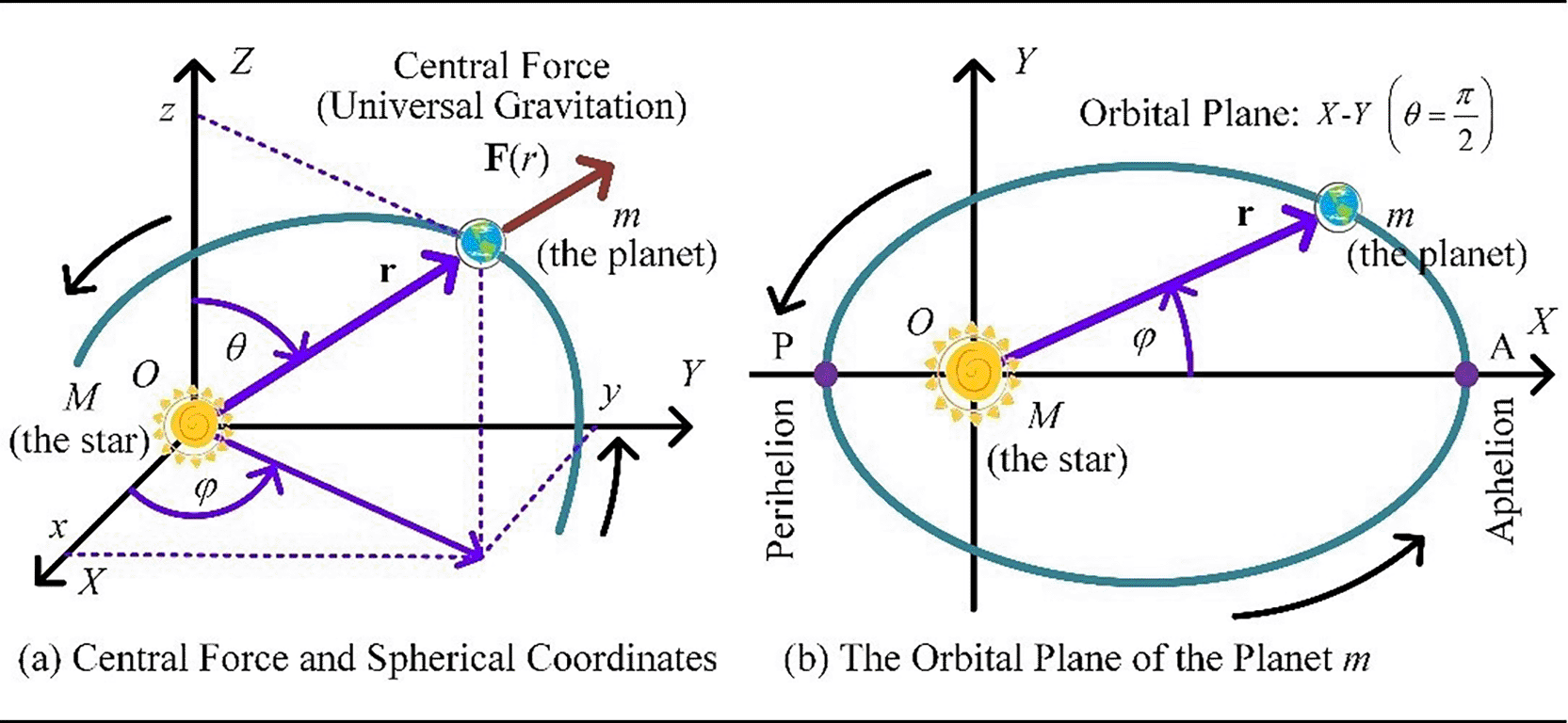
Annotation (a) Central force and spherical coordinates: The celestial two-body system (M, m) is idealized as an isolated system in the space of spherical-coordinate O(r, θ,φ), where the large celestial body M is located at the coordinate origin of O, and the small celestial body m (a planet or comet or satellite or even photon) moves in the gravitational field of M.
Annotation (b) The orbital plane of the small celestial-body m : According to the property of central force, the motion of mass point m is limited to a fixed plane, e.g. X-Y (θ=π/2).
Newton’s Observation Agent: The idealized observation agent OA∞, whose information-wave speed η is idealized as infinity (η→∞), with no observational locality -- it takes no time for observed information to cross space.
It is thus clear that Newton’s celestial two-body system is extremely idealized.
In Newton’s idealized celestial two-body system (M, m), M and m interact through universal gravitation. As depicted in Figure 2(a), the universal gravitation F(r) on m is a sort of central force that always points towards the large celestial body M (at the coordinate origin O), which is a function of the radius vector r: F(r)=Fr r /r (r=|r|).
Omitting theoretical derivation, the motion of mass point m in the gravitational field of M in the corresponding spherical coordinate system (r, θ,φ) can be described by the Binet equation1–4:
Substituting Newton’s law of universal gravitation into Eq. (6), one has the theoretical model of Newton’s celestial two-body system (M, m) in the form of the Binet equation:
This is the motion equation of the small celestial body m (a planet or comet or satellite or even photon) in the gravitational field of M.
By solving differential Eq. (7), one has the solution
This is the standard conic equation, where M is located at a focal point of the conic section and e is the orbital eccentricity of m.
In the celestial two-body system (M, m), the orbital eccentricity e of m depends on the gravitational constant G and the mass of large celestial body M, as well as, the initial mechanical energy E and angular momentum L of the small celestial body m:
Given the conservation of mechanical energy E and angular momentum L of m, according to Eq. (9), in Newton’s model of celestial two-body system (M, m), the orbital eccentricity e of m is a constant.
The eccentricity e determines the form of the orbit of celestial body m:
(1) e=0: The orbit of m is a standard circle;
(2) 1>e>0: The orbit of m is a standard ellipse;
(3) e =1: The orbit of m is a standard parabola;
(4) e >1: The orbit of m is a standard hyperbola.
Let the large celestial body M be a star and the small celestial body m a planet orbiting M. According to Kepler’s law of ellipses, due to being bound to the star M, the planet m must orbit around M along an elliptical path with an eccentricity of e∈(0,1). The eccentricity of Mercury’s orbit around the sun is e=0.2056; the eccentricity of Earth’s orbit around the sun is e=0.0167. Compared to the orbit of Mercury, the orbit of the earth is closer to a circle.
Newton’s equation of planetary motion (Eq. (7)) and its solution (Eq. (8)) prove Kepler’s first law: the orbit of a planet should be an ellipse.
If Newton’s model (Eq. (7)) of celestial two-body system (M, m) is employed as that of a star and a planet, then the orbital eccentricity e∈(0,1), that is, Newton’s equation of planetary motion, in which the orbit of the planet m is a standard closed ellipse, with no drift and spiral. Therefore, Newton’s equation of planetary motion cannot predict the orbital or perihelion precession of planets.
Set the initial angle φ0 of the orbit of the planet m be zero, then the solution (Eq. (8)) to Newton’s equation of planetary motion can be written as
Equation (10) shows that the perihelion of m is fixed. At the point P (as depicted in Figure 2(b)) of the perihelion of m, φ=2kπ (k=0,1,2,…), u=GM(1+e)/hK2, and r=1/u are all constants. Therefore, there is no orbital or perihelion precession of the planet m.
Or, in other words, at the point P (Figure 2(b)) of the perihelion of m, it holds that du/dφ=0. Let the precession angle of m every revolution be Δφ. Let k=1, that is, the planet m orbits around the star M once. As depicted in Figure 1(d), the planet m travels from the perihelion P to the next perihelion P′, sweeping through an angle of φ =2π +Δφ. Substituting it into Eq. (10), it can be concluded that Δφ=0. This also suggests that there is no any information about the orbital or perihelion precession of planets in Newton’s equation of planetary motion.
So, why cannot Newton’s celestial two-body model predict the orbital precession of planets?
The answer is simple: Newton’s two-body model are too idealized.
Whereas, the objective physical world is not an idealized physical world: gravity is not an action at a long distance, a celestial two-body system (M, m) is never an isolated system, M is not stationary, and both M and m are not mass points. So, the orbit of a planet in the universe is neither a standard circle nor an immutable and standard closed ellipse. The orbital or perihelion precession of a planet is natural and inevitable.
As stated in Sec. 4.1, Newton’s model of the celestial two-body system (M, m) has no prior information for predicting the orbital or perihelion precession of a planet. For instance, Newton’s equation of planetary motion cannot predict the orbital or perihelion precession of Mercury’s 5557.62 arcsec per century due to the lack of prior knowledge or information about the precession of the equinoxes and the perturbations from other celestial bodies.
In particular, according to the theory of OR, there exist apparent orbital-precession phenomena of planets in astronomical observations caused by the observational locality (c<∞) of the optical agent OA(c), which is only a sort of observational effects, rather than the objectively real precession of planetary orbits.
Newton’s observation agent is the idealized agent OA∞ that has no observational locality (η→∞), and so, it also does not present apparent orbital precession of planets.
Revisiting Newton’s equation of planetary motion and analogizing it with Einstein’s equation of planetary motion and the GOR equation of planetary motion help us recognize the essence of Einstein’s prediction of the 43.03″ precession of Mercury’s perihelion.
After the establishment of general relativity, Einstein applied it to the celestial two-body problem and derived an equation of planetary motion from the weak-field approximation solution of his gravitational-field equation, based on which he made a theoretical prediction9: Mercury’s perihelion precesses by 43.03 arcsec per 100 Earth Years. Later, Schwarzschild obtained the exact solution of Einstein field equation for a static spherically-symmetric gravitational field.21 Then, based on Schwarzschild solution, one can build a more accurate celestial two-body model or equation of planetary motion.
In fact, both Newton and Einstein’s celestial two-body models are highly idealized, with no prior knowledge or information about the orbital or perihelion precession of planets. Therefore, it is impossible for Newton, Einstein, and even GOR to make theoretical predictions about the precession of planetary orbits with their highly idealized celestial two-body model.
So, what does Einstein’s theoretical prediction about Mercury’s perihelion precession of the 43.03″ every 100 Earth Years mean?
Like Newton’s celestial two-body problem, Einstein’s celestial two-body problem is also highly idealized.
Einstein’s Celestial Two-Body System (M, m): According to Einstein’s theory of general relativity, the large celestial body M is stationary, making the spherically-symmetric spacetime around M curved; The small celestial body m moves in the curved spacetime of M.
In fact, as clarified by the theory of OR,1–4 Einstein’s so-called spacetime curvature is only a geometrized expression of gravitational interaction and does not represent objectively physical existence.
The Idealized Conditions for Einstein’s (M, m):
(1) Gravity is an action at a distance;
(2) (M, m) is an isolated system, both M and m are mass points.
It should be pointed out that, in fact, like Newton’s theory of universal gravitation, Einstein’s theory of general relativity also implies the hypothesis that gravity is an action at a distance.1–4,7
The Coordinate System of Einstein’s (M, m): Like Newton, choose Cartesian 3d coordinates (x, y,z) and corresponding spherical coordinates (r, θ,φ) as depicted in Figure 2(a); set the large celestial body M as the coordinate origin O, the small celestial body m moves in the plane of X-Y (θ=π/2) as depicted in Figure 2(b).
Thus, Einstein and Newton’s equations of planetary motion have the formal comparability.
Einstein’s Observation Agent: The optical observation agent OA(c), whose information-wave speed η is the speed of light c, with the observational locality (c<∞) -- it takes time for observed information to cross space.
In fact, the difference of observation agents is the only and fundamental difference between Einstein and Newton’s equations of planetary motion.
For a spherically-symmetric gravitational spacetime, Schwarzschild obtained the exact solution of Einstein field equation, that is, the spacetime metric in the spherical coordinate form of gravitational spacetime observed by the optical agent OA(c), denoted as 21:
By substituting Eq. (11) into the equation of the line element ds of Einstein general relativity, one has
By substituting Eq. (11) into Einstein’s gravitational-motion equation of Einstein general relativity, one has
Equation (13) has four equations (μ=0,1,2,3): (1) t=t(τ), (2) r=r(τ), (3) θ=θ(τ), and (4) φ=φ(τ). By analyzing these four equations, one can derive the celestial two-body model of Einstein general relativity with the optical agent OA(c) in the form of the Binet equation:
Contrasting with Newton’s equation of planetary motion (Eq. (7)), it can be seen that Einstein’s equation of planetary motion (Eq. (14)) has an additional item at the right end, that is, the so-called orbital precession item: 3GM/c2r2. This means that
(1) Einstein’s equation of planetary motion is a nonlinear differential equation
(2) Einstein’s planetary orbit is constantly drifting and spiraling, not an immutable and standard closed ellipse.
For the detailed derivation of Einstein’s equation of planetary motion (Eq. (14)), see reference22 or Chapter 16 of the 2nd volume GOR in Observational Relativity.1–4
Solving Einstein’s equation of planetary motion (Eq. (14)), one can get a tiny orbital or perihelion precession of planets based on the item of orbital precession 3GM/c2r2 in Eq. (14).
Generally, the item of orbital precession in Einstein’s equation of planetary motion (Eq. (14)) is a small quantity: 3hK2/c2r2<<1. So, Einstein’s equation of planetary motion (Eq. (14)) can be solved by making use of the progressive approximation method.22
By substituting u=GM(1+ecosφ)/hK2 (Eq. (10)) into Eq. (14), one has
The progressive approximation solution of Eq. (15) is
At the perihelion P of the planetary orbit as depicted in Figure 2(b), it holds true that du/dφ=0. Therefore, by taking the derivative with respect to φ at the both sides of Eq. (16), one has
If the φcosφ is not included in Eq. (17), then
Thus, sinφ=0. This suggests that if without the φcosφ, Einstein’s planetary orbits, like Newton’s planetary orbits, were a closed ellipse without precession.
If considering the orbital precession angle Δφ (<<1) of a planet around a star as depicted in Figure 1(d) with k=1, then the angle that the planet sweeps over should be φ=2π +Δφ. Substituting it into Eq. (17), ignoring high-order small quantities, then
Mercury’s eccentricity e≈0.206 is the largest in the solar system. According to the recommendations of the International Standards Organization:
(1) The speed of light is c=2.9979245×10⁸ m⋅s−1;
(2) The universal gravitational constant is G=6.67430×10⁻¹¹ m3⋅kg−1⋅s−2;
(3) The mass of the sun is M=1.98847×1030 kg;
(4) The mass of Mercury: m=3.301×10²³ kg;
(5) The orbital angular momentum of Mercury is L=8.9825×1038 kg⋅m2⋅s−1;
(6) The velocity moment of Mercury is hK=L/m=2.7211×1015 m2⋅s−1.
Then, with Eq. (19), one can calculate the orbital or perihelion precession of Mercury during one revolution:
Mercury’s orbital period is TM=87.961 day; Earth’s orbital period is TE=365.24219 day. So, Mercury orbit precesses φ=100×Δφ×TE/TM=42.73 arcsec per century.
The orbital or perihelion precession angle φ of Mercury calculated by Einstein at that time was 43.03 arcsec, which was extremely consistent with the 43.11″ that has not yet found out a definite reason up to now. In a letter to a friend, Einstein said: “The equation gives the correct numbers for Mercury’s perihelion. You could imagine how happy I am. I couldn’t help but be happy for several days.”
However, astronomical observation shows that the orbital or perihelion precession of Mercury is 5600.73 arcsec per 100 Earth Years, which is far greater than the 43.03″ predicted by Einstein.
Einstein’s 43.03″ is far from the actual observed orbital precession of Mercury, and so it is not enough to confirm that Einstein’s theory of general relativity and equation of planetary motion correctly predicted the orbital or perihelion precession of Mercury.
The theory of Observational Relativity (OR), including Inertial OR (IOR) and Gravitational OR (GOR) is that of the general observation agent OA(η) (0<η<∞;η→∞).
The theory of GOR, as the gravitational theory of the general observation agent OA(η), has generalized and unified Newton’s theory of universal gravitation of the idealized agent OA∞ and Einstein’s theory of general relativity of the optical agent OA(c).
The theory of GOR can be applied to the celestial two-body problem to build the GOR model of the celestial two-body system (M, m) and the GOR equation of planetary motion. Based on the principle of general correspondence and by analogizing to the logic of Schwarzschild and Einstein, the GOR model of (M, m) and the GOR equation of planetary motion can be derived from the GOR gravitational-field equation and the GOR gravitational-motion equation. Naturally, in the sense of the principle of general correspondence, the GOR equation of planetary motion has the strict isomorphically-consistent corresponding relationship with Einstein’s planetary motion equation.
Actually, similar to all formulae in the theory of OR (both IOR and GOR), the GOR equation of planetary motion has also the strict isomorphically-consistent corresponding relationship with Newton’s equation of planetary motion.
So, the theory of GOR has generalized and unified Newton’s model of the celestial two-body system and Einstein’s model of the celestial two-body system.
Like Einstein’s celestial two-body problem, the GOR celestial two-body problem is also highly idealized.
GOR Celestial Two-Body System (M, m): The large celestial body M and the small celestial body m interact through gravitational interaction, where M is stationary, radiates gravity or gravitational force, and generates a spherically-symmetric gravitational field, and m moves in the gravitational field.
This is consistent with the statement of Newton’s celestial two-body system (M, m).
The Idealized Conditions for Einstein’s (M, m):
(1) Gravity is an action at a distance;
(2) (M, m) is an isolated system, both M and m are mass points.
Actually, like Newton’s theory of universal gravitation and Einstein’s theory of general relativity, the theory of GOR also implies the hypothesis that gravity is an action at a distance.1–4,7
The Coordinate System of GOR’s (M, m): Like Newton, choose Cartesian 3d coordinates (x, y,z) and corresponding spherical coordinates (r, θ,φ) as depicted in Figure 2(a); set the large celestial body M as the coordinate origin O, the small celestial body m moves in the plane of X-Y (θ=π/2) as depicted in Figure 2(b).
Then, the GOR, Einstein and Newton’s equations of planetary motion has the formal comparability.
The GOR Observation Agent: The general observation agent OA(η) (0<η<∞; η→∞), whose information-wave speed η can be any speed value, not just the speed of light c, and can even be idealized as infinity.
It is thus clear that the only and fundamental difference between the GOR celestial two-body problem and Newton and Einstein’s celestial body two body problem lies only in their observation agents.
In fact, both Newton’s idealized agent OA∞ and Einstein’s optical agent OA(c) are just two special cases of the general observational agent OA(η) in the theory of OR.
The principle of general correspondence is that proposed by the theory of OR for deducing the gravitational theory of the general observation agent OA(η) (0<η <∞; η→∞), that is, the theory of GOR, particularly for deriving the GOR gravitational-field equation and gravitational-motion equation.1–4
Actually, the principle of general correspondence is the generalization and unification of Bohr’s principle of correspondence and Galileo’s principle of relativity.
Bohr’s principle of correspondence pertains to the corresponding relationship between quantum physical models and classical physical models, as well as, the corresponding relationship between the optical agent OA(c) and the idealized agent OA∞, embodying the idea of “All Observation Agents are Equal!”.
Galileo’s principle of relativity pertains to the corresponding relationship of the space-time transformations between different reference frames or different observers, embodying the idea of “All Observers are Equal!”. The Inertial OR (i.e., the theory of IOR) and the general Lorentz transformation of OR further clarified that1–4 all observers, regardless of their reference frame or their observation agents, are equal or have the equal right, so that their physical models must be the same in form or have the isomorphic and consistent corresponding relationship.
So, the principle of correspondence and the principle of relativity can be unified into the principle of general correspondence under the concept of Equal Rights for All Observers or All Observation Agents.
The Principle of General Correspondence (PGC): The universe or spacetime is symmetric, therefore, all observers in the universe or spacetime, regardless of their reference frame or observation agents, are equal or have the equal right, and so, their physical laws or physical models must be the same in form, or in other words, have the isomorphic and consistent corresponding relationship.
Following the PGC principle, one can perform the isomorphically-consistent transformation of a physical model, law, or even theory between different observers O and O′ or different observation agents OA(η1) and OA(η2).
The application of the PGC principle can follow two distinct logical ways.
PGC Logical Way 1:
Based on the PGC principle, directly replacing η1 with η2, one can transform the physical quantity U(η1) observed with OA(η1) into the physical quantity U(η2) observed with OA(η2), and transform the physical models of OA(η1) into the physical models of OA(η2) isomorphically and uniformly.
PGC Logical Way 2:
(1) Firstly, based on the PGC principle, transform the axiom system or logical premises of the theoretical system of OA(η1) into those of the theoretical system of OA(η2) isomorphically and uniformly;
(2) Secondly, based on the axiom system or logical premises of the theoretical system of OA(η2) transformed from OA(η1), following or analogizing the logic of the theoretical system of OA(η1), one can deduce the theoretical system of OA(η2).
For the detailed statement of the PGC principle, see Chapter 11 of the 2nd volume GOR in Observational Relativity.1–4
Now, the PGC principle can be applied to the GOR celestial two-body problem to solve the GOR gravitational-field equation and to derive the GOR celestial two-body model or the GOR equation of planetary motion from the GOR gravitational-motion equation.
Einstein’s celestial two-body model adopts the optical agent OA(c), the information wave of which is light or electromagnetic wave and transmits observed information at the speed of light c. The GOR celestial two-body model adopts the general observation agent OA(η), the information-wave speed η of which can be any speed: 0<η<∞ and even η→∞ in theory.
Based on the PGC principle and following PGC logical way 1, by analogizing with Schwarzschild exact solution,21 one can obtain the exact solution of GOR gravitational-field equation for a spherically-symmetric gravitational spacetime, that is, the spacetime metric in the spherical coordinate form of gravitational spacetime observed by the general observation agent OA(η), denoted as 1–4:
By substituting Eq. (21) into the equation of the line element ds of the theory of GOR, one has
By substituting Eq. (21) into the GOR gravitational-motion equation of the theory of GOR, one has
Equation (23) has four equations (μ=0,1,2,3): (1) t=t(τ), (2) r=r(τ), (3) θ=θ(τ), and (4) φ=φ(τ). By analyzing these four equations, based on the PGC principle and following PGC logical way 2, analogizing with the logic of deducing Einstein’s celestial two-body model stated in Sec. 5.2,22 one can derive the GOR celestial two-body model of the theory of GOR with the general observation agent OA(η) in the form of the Binet equation:
It is obvious that the GOR celestial two-body model (Eq. (24)) and Einstein’s celestial two-body model (Eq. (14)) has the isomorphically-consistent corresponding relationship.
Like Einstein’s equation of planetary motion (Eq. (14)), the GOR equation of planetary motion (Eq. (24)) also has an item of orbital precession: 3GM/η2r2. This suggests that, if η<∞, then the GOR equation of planetary motion is also a nonlinear differential equation, in which the planetary orbit is also drifting and spiraling constantly, not an immutable and standard closed ellipse.
For the detailed derivation of GOR equation of planetary motion (Eq. (24)), see Chapter 16 of the 2nd volume GOR in Observational Relativity.1–4
The theory of GOR has clarified1–4 that the motion of celestial bodies lies in the action of universal gravitation, rather than spacetime curvature. There are two major theoretical systems for gravity in physics: one is Newton’s theory of universal gravitation13; the other is Einstein’s theory of general relativity. So, the theory of celestial motion can also be divided into two major schools: Newton’s theory of celestial motion; Einstein’s theory of celestial motion. Undoubtedly, the unification of the two major schools is of great significance.
Like all the relations in the theory of OR, the GOR celestial two-body model (Eq. (24)), as the general observation agent OA(η), has a high degree of generalization and unification, which has generalized and unified Newton’s celestial two-body model (Eq. (7)) with the idealized agent OA∞ and Einstein’s celestial two-body model (Eq. (14)) with the optical agent OA(c).
As η→∞, Newton’s celestial two-body model or planetary-motion equation (Eq. (7)) strictly converges to the GOR celestial two-body model or the GOR planetary-motion equation (Eq. (24)):
As η→c, Einstein’s celestial two-body model or planetary-motion equation (Eq. (14)) strictly converges to the GOR celestial two-body model or the GOR planetary-motion equation (Eq. (24)):
So, both Newton’s equation of planetary motion and Einstein’s equation of planetary motion are special cases of GOR equation of planetary motion, serving their respective specific observation agents.
The celestial two-body problem is the most fundamental and representative problem in the theory of celestial motion. The unification of Newton’s equation of planetary motion and Einstein’s equation of planetary motion within the theory of GOR means the unification of Newton’s theory of celestial motion and Einstein’s theory of celestial motion: Newton’s theory of celestial motion serves the idealized agent OA∞; Einstein’s theory of celestial motion serves as the optical agent OA(c).
In particular, this suggests that the GOR celestial two-body model is logically consistent with both the Newton’s celestial two-body model and the Einstein celestial two-body model. This, from one aspect, confirms the logical self-consistence and theoretical validity of the GOR planetary-motion equation, the GOR celestial two-body model, and even the theory of GOR.
Newton’s equation of planetary motion (Eq. (7)) have no orbital precession item, and so cannot predict the orbital or perihelion precession of a planet around a star. Einstein’s equation of planetary motion (Eq. (14)) has the so-called orbital precession item: 3GM/c2r2, and so seems to be able to predict the orbital or perihelion precession of a planet around a star. Although Einstein’s theoretical prediction on the orbital or perihelion precession of Mercury, that is, the 43.03″ per century, is far less than the actual observed 5600.73 arcsec per century, the mainstream physics community believes that Einstein’s theory of general relativity is better than Newton’s theory of universal gravitation. But why could not Einstein predict the other 5557.70 arcsec of Mercury perihelion’s precession?
From the broad perspective of the general observation agent OA(η) (0<η<∞; η→∞) of the theory of OR, based on the GOR equation of planetary motion (Eq. (24)), we will re-examine Einstein’s theoretical prediction on the orbital or perihelion precession of Mercury the root and essence of Einstein’s 43.03″ per century.
Now, like Einstein’s equation of planetary motion (Eq. (14)), the GOR equation of planetary motion (Eq. (24)) also has an orbital precession item: 3GM/η2r2, which seems to be able to predict the orbital or perihelion precession of planets too, e.g. that of Mercury.
Based on the PGC principle, following PGC logical way 1 or PGC logical way 2, by following or analogizing the logic of solving Einstein’s equation of planetary motion (Eq. (14)) stated in Sec. 5.3, one can obtain the progressive approximation solution to GOR equation of planetary motion (Eq. (24)):
At the perihelion P of the planetary orbit as depicted in Figure 2(b), it holds true that du/dφ=0. Therefore, by taking the derivative with respect to φ at the both ends of Eq. (27), one has
If considering the orbital precession angle Δφ (<<1) of a planet around a star as depicted in Figure 1(d) with k=1, then the angle the planet sweeps over should be φ=2π +Δφ. Substituting it into Eq. (28), ignoring high-order small quantities, then one has the GOR precession-angle equation as below:
It is worth noting that the precession angles of both Newton’s planetary orbit and Einstein’s planetary orbit can be calculated with the GOR precession-angle equation (Eq. (29)). According to Eq. (29), under Newton’s idealized agent OA∞, η→∞, Δφ=0, and so, Newton’s planetary orbit has no precession, which is consistent with the conclusion of Newton’s equation of planetary motion (Eq. (7)); under the optical agent OA(c), η→c, Δφ=0.1029″ for every revolution of Mercury, that is, 42.73″ per century, which is consistent with the conclusion of Einstein’s equation of planetary motion (Eq. (14)).
It is thus clear that Newton’s equation of planetary motion (Eq. (7)) and Einstein’s equation of planetary motion (Eq. (14)) are indeed only two special cases of the GOR equation of planetary motion (Eq. (24)).
It should be pointed out that, although the GOR equation of planetary motion can also predict the orbital or perihelion precession of planets and conclude that Mercury’s orbital or perihelion precesses by 42.73″ every 100 Earth Years (with current data), it does not mean that the 42.73″ is a part of the objectively existing precession of Mercury.
According to the GOR equation of planetary motion (Eq. (24)) with the GOR precession item 3GM/η2r2 and the GOR precession angle Δφ=6πG2M2/η2hK2 (Eq. (29)), the planetary precession presented in the GOR celestial two-body model depends on the observation agent OA(η), or more accurately, depends on the speed η of the information wave of OA(η): for the same planet, its orbital or perihelion precession observed or presented by different observation agents must be different.
This fact indicates that the so-called perihelion precession presented in the GOR equation of planetary motion, including Einstein’s equation of planetary motion as a special case, is not the objectively existing planetary-orbit precession. In essence, it is just a sort of observational effect or an apparent phenomenon caused by the observational locality (η<∞) of the observation agent OA(η).
The theory of OR has been clarified1–5 that all relativistic effects, including the special (inertial) relativistic and the general (gravitational) relativistic, are observational effects and apparent phenomena, the root and essence of which lie in the observational locality (η<∞) of mankind’s observation agent OA(η). All relativistic effects in Einstein’s theory of relativity are observational effects and apparent phenomena caused by the observation locality (c<∞) of the optical agent OA(c): the speed of light is not really invariant; spacetime is not really curved.
Einstein’s equation of planetary motion, as a model of the optical agent OA(c), is a special case of GOR equation of planetary motion. So, according to Eq. (29) and Eqs. (19-20), Einstein’s theoretical prediction that Mercury’s perihelion precesses by 43.03″ per century is only a relativistic apparent phenomenon caused by the observational locality (c<∞) of the optical agent OA(c).
Mirage does not really exist. However, you may have indeed seen the beauty of a mirage. Seeing may not necessarily be real, however, the history data recorded by optical astronomical observation may indeed record and contain the 43.03″ of Mercury precession predicted by Einstein, although it is only an apparent phenomenon caused by the observation locality (c<∞) of the optical agent OA(c), and not the objectively and really existing precession of Mercury’s perihelion.
Thank God for bestowing light upon mankind. Thanks to light with such a huge speed of 3×10⁸ m⋅s−1, our perception or observation of the physical world can be so close to the objective and real physical reality. Taking the observation of Mercury in optical astronomy as an example, the authenticity is greater than 99% and the non-authenticity is less than 1%.
According to the theory of OR,1–4,7 the speed of gravitational wave κ must be much greater than the speed of light c. If mankind can truly develop gravitational wave astronomy23 and the speed κ of gravitational wave is truly as calculated by Laplace: κ>7×10⁶c, 24 or as calculated by Flandern: κ=2×10¹⁰c,25 then the observational locality of the gravitational-wave observation agent OA(κ) will be very small. The apparent precession angle per century of Mercury orbit observed with OA(κ) will only be 43.27×(c2/κ2)≈0 arcsec that is close to that of Newton’s idealized observation agent OA∞.
The theory of OR does not doubt that the orbit or perihelion of a planet in the real universe is precessing. Actually, due to various objective and non-idealized factors, the orbits of all celestial bodies in the universe must not be a standard and closed circle or ellipse. And a planet cannot permanently orbit a star in a fixed plane.
In the objective and real physical world, the orbital or perihelion precession of planets is natural and inevitable, which is not the so-called Abnormal Precession.
However, whether it is Newton’s theory of universal gravitation or Einstein’s theory of general relativity, or even the theory of GOR, the idealized celestial two-body model has no prior knowledge or information about the orbital or perihelion precession of planets. Therefore, it is impossible for Newton and Einstein and even GOR to make theoretical predictions about the objective and real orbital precession of planets.
As is well known, astronomical observation shows that Mercury’s perihelion precesses by 5600.73 arcsec per century. After deducting 5557.62 arcsec caused by equinoxes and perturbations, there are still 43.11 arcsec left that has not yet found the right reason up to now.
There are two possibilities for this:
(1) The 43.11″ is a small quantity, less than 0.8% of 5600.73 arcsec, which may be an observational error or due to other unconsidered objective and non-idealized factors;
(2) The history data of optical astronomical observation did indeed record and contain the apparent 42.73″ precession of planetary orbits caused by the observational locality (c<∞) of the optical agent OA(c) predicted by the theory of GOR.
Neither the first nor the second implies that Einstein’s general theory of relativity or his equation of planetary motion can make theoretical prediction about the real orbital or perihelion precession of Mercury.
If it is the second, then the left 43.11″ has had the right reason: it is not the objective and real orbital or perihelion precession of Mercury, but the observational effect and apparent phenomenon presented by the optical agent OA(c). So, the left 43.11″ of Mercury is not a support for Einstein, but the support for the theory of OR: an observation agent OA(η), such as the optical agent OA(c) (η=c), does indeed present observational effects and apparent phenomena caused by the observational locality (η<∞) of OA(η). In other words, the history astronomical-observation data of Mercury provides another empirical evidence for the theory of OR, including the theory of GOR and the GOR equation of planetary motion.
The theory of Observational relativity (OR), as a new theory in human being’s physics, has brought new discoveries and new insights.
The OR serial reports are aimed to interpret the theory of OR for readers. OR Serial Report 1 reported5: the speed of light is not really invariant; spacetime is not really curved. OR Serial Report 2 reported6: the rest mass of photons is not really zero. OR Serial Report 3 reported7: Einstein’s prediction of gravitational waves is a historic mistake
Now, OR Serial Report 4 reports to readers that Einstein’s prediction about the precession of Mercury’s orbit or perihelion is not the objectively physical existence.
All theories or models of physics must be tested and verified through observation and experiment. For the theory of general relativity, Einstein proposed three famous predictions, gravitational redshift and gravitational deflection, as well as, the perihelion precession of Mercury, not only provided the testing and verifying ways for his theory of general relativity, but also for Newton’s theory of universal gravitation and even the theory of GOR.
It seems that, so far, all observations and experiments on the gravitational redshift and gravitational deflection of light, as well as, the precession of Mercury, tend to support Einstein’s theory of general relativity. It is these observations and experiments that establish the status for Einstein general relativity in physics akin to that of the Bible.
As clarified by the theory of OR, however, the support of observation and experiment for Einstein’s theory of relativity does not suggests that Einstein’s relativity theory is better than Newtonian mechanics. In fact, most human observations and experiments adopt the optical agents OA(c), so that they naturally tend to support Einstein’s relativity theory. If mankind could have the idealized observation agent OA∞, then his observations and experiments would tend to support Newtonian mechanics.
Newtonian classical mechanics and Einstein relativity theory are just two partial theories of the theory of OR. In this regard, an observation or experiment, no matter it supports Newtonian classical mechanics or Einstein relativity theory, must also be a support for the theory of OR.
However, mankind’s observation and experiment do not represent the objectively real physical world.
OR Serial Report 4 focuses on re-examining Einstein’s theoretical prediction about the orbital or precession of Mercury from the perspective of the theory of OR. The theory of OR does not doubt that the actual orbit of a planet around a star is a non-standard and non-closed ellipse, and that the actual orbit and perihelion of a planet must be drifting and precessing constantly. And the author even believes that the actual orbits of a planet must not be permanently fixed on a specific plane.
However, whether it is Newton’s equation of planetary motion, Einstein’s equation of planetary motion, or even the GOR equation of planetary motion, it is a highly idealized models of celestial two-body system, with no prior information about the orbital or perihelion precession of a planet around a star. Therefore, it is impossible for Newton and Einstein and GOR to make theoretical predictions about the actual orbital or perihelion precession of planets.
As a theoretical model with the general observation agent OA(η) (0<η<∞;η→∞), the GOR celestial two-body model (Eq. (24)) indicates that the orbital precession item 3GM/η2r2 of the GOR equation of planetary motion depends on the observation agent OA(η) and the speed η of the information wave of OA(η), and so the orbital precession angle Δφ(η) of a planet in Eq. (29) varies with different observation agents. This fact suggests that the GOR equation of planetary motion, including Einstein’s equation of planetary motion as a special case (η=∞) of it, cannot predict the actual orbital or perihelion precession of planetary orbits.
According to the statement in Sec. 7.3, we have reason to believe that the history data of optical astronomical observation does indeed record and include the apparent precession of Mercury’s 43.27 arcsec per century caused by the observation locality (c<∞) of the optical agent OA(c). Thus, the left 43.11″ orbital precession of Mercury has found the right reason: it is an observational effect and apparent phenomenon presented by the optical agent OA(c), not the objectively real orbital precession of Mercury.
It is thus clear that the observation value of the left 43.11″ in the history data of Mercury is not the support for Einstein’s theory of general relativity and his prediction about the orbital or perihelion precession of Mercury, but the support for the theory of OR.
So, the history data of Mercury provides another empirical evidence for the theory of OR.
As stated in Sec. 6.4, the GOR celestial two-body model has generalized and unified Newton and Einstein’s celestial two-body models: Newton and Einstein’s equations of planetary motion are only two special cases of the GOR equation of planetary motion. This suggests that the GOR equation of planetary motion is logically consistent with both Newton’s equation of planetary motion and Einstein’s equation of planetary motion. The unification of Newton and Einstein’s celestial two-body models in the theory of GO once again confirms the logical self-consistency and theoretical validity of the theory of OR.
| Views | Downloads | |
|---|---|---|
| F1000Research | - | - |
|
PubMed Central
Data from PMC are received and updated monthly.
|
- | - |
Provide sufficient details of any financial or non-financial competing interests to enable users to assess whether your comments might lead a reasonable person to question your impartiality. Consider the following examples, but note that this is not an exhaustive list:
Sign up for content alerts and receive a weekly or monthly email with all newly published articles
Already registered? Sign in
The email address should be the one you originally registered with F1000.
You registered with F1000 via Google, so we cannot reset your password.
To sign in, please click here.
If you still need help with your Google account password, please click here.
You registered with F1000 via Facebook, so we cannot reset your password.
To sign in, please click here.
If you still need help with your Facebook account password, please click here.
If your email address is registered with us, we will email you instructions to reset your password.
If you think you should have received this email but it has not arrived, please check your spam filters and/or contact for further assistance.

Comments on this article Comments (0)