Keywords
Blue economy, degrowth, political ecology, ocean justice, decoupling, commons, Global South

This article is included in the Ecology and Global Change gateway.
Blue economy, degrowth, political ecology, ocean justice, decoupling, commons, Global South
This revised version incorporates substantive responses to two peer reviewers and introduces several structural and editorial improvements throughout.
In response to Reviewer 1 (Alhowaish), the manuscript now includes explicit scope qualifications clarifying that findings describe structurally prevalent tendencies rather than universal outcomes. A schematic figure (Figure 1) mapping causal mechanisms from Blue Economy instruments through intermediate mechanisms to distributive outcomes has been added at the opening of the Results section. In-text glosses defining three theoretical terms — techno-managerial universalism, spatial fix, and anti-colonial delinking — have been inserted at first use. The Results section now carries individual sub-headings for each of the six findings, and the Blue Degrowth principles subsection is clearly separated as a distinct heading. A methodology paragraph distinguishing literature-derived claims from the author’s normative elaborations has been added to the Methods section.
In response to Reviewer 2 (Papadaki), the World Bank and UN DESA (2017) and OECD (2016) institutional frameworks are now engaged explicitly as primary objects of critique in the Introduction and Methods. Voyer et al. (2018), Voyer and van Leeuwen (2019), and Voyer et al. (2021) have been substantively integrated into the Literature Review, Finding 3, and the Blue Degrowth principles section respectively. A dedicated Limitations and Scope Conditions subsection has been added to the Discussion, addressing the framework’s theoretical rather than empirical status, Global South heterogeneity, political feasibility constraints, and the deliberate scope of literature engagement.
Additional revisions include the integration of four Midlen (2021, 2024, 2026a, 2026b) articles across relevant findings and an expanded three-paragraph Conclusion that names unresolved theoretical tensions and open empirical questions. The author list remains unchanged; this is a single-authored article. No changes have been made to the underlying data, as no primary data are associated with this article.
See the author's detailed response to the review by Abdulkarim Alhowaish
See the author's detailed response to the review by Lydia Papadaki
The Blue Economy has become a dominant policy frame for ocean governance across international institutions, national governments, and development agencies. Promoted as a pathway to reconcile economic development with marine conservation, the Blue Economy bundles a wide array of activities — fisheries modernisation, aquaculture expansion, marine biotechnology, offshore renewable energy, blue carbon markets, and ecosystem service valuation — under a single rubric that promises “sustainable” growth of ocean-based sectors (World Bank & UN DESA, 2017; OECD, 2016; Bennett et al., 2019; Sumaila et al., 2021). Its rhetorical power rests on a set of interconnected theoretical commitments: that the ocean can be productively valued and managed through techno-managerial interventions; that market instruments and private finance can be harnessed to deliver conservation and development simultaneously; and crucially, that economic expansion can be decoupled from environmental degradation through efficiency gains and technological innovation. These commitments mirror the broader Green Growth paradigm that has dominated environmental policy debates in recent decades (Jackson, 2009; Parrique et al., 2019).
Degrowth scholarship offers a sustained and radical critique of these commitments. Rather than treating growth as a neutral policy variable, degrowth insists that perpetual GDP expansion in high-consumption societies is incompatible with planetary limits and that policies premised on absolute decoupling are empirically and theoretically precarious (Latouche, 2009; Kallis, 2018; Hickel, 2020). Political ecology complements this critique by illuminating the mechanisms — enclosure, accumulation by dispossession, spatial fixes, and ecologically unequal exchange — through which ostensibly sustainable reforms can reproduce dispossession and inequality (Harvey, 2003; Martínez-Alier, 2002; Peluso & Lund, 2011). When combined, degrowth and political ecology provide a powerful analytic lens for interrogating the Blue Economy’s foundational assumptions and policy agenda.
This article asks: How does a degrowth political ecology reframe and dismantle the theoretical corpus of the Blue Economy, and what alternative normative and policy framework emerges when ocean governance is reconceived through degrowth principles? The inquiry is explicitly theory-first and literature-based. It centres degrowth as the primary theoretical lens and uses political ecology to trace causal mechanisms by which Blue Economy policies can produce enclosure, intensification, and unequal exchange. The analysis is oriented to the Global South: it foregrounds anti-colonial delinking — the strategic capacity of Global South states and communities to refuse extractive projects and build selective economic autonomy from growth-dependent value chains — local sovereignty, and redistribution as central concerns for any just ocean governance. Empirical material is used sparingly and only to illustrate theoretical claims; the article does not present new field data.
The literature review synthesises degrowth and political ecology literatures relevant to ocean governance and sets out the research gap it addresses. From there, the methodology section explains the literature selection and analytic approach. The results section presents the synthesised findings — organised as thematic critiques of the Blue Economy’s epistemology, economic assumptions, governance instruments, spatial fixes, distributional effects, and techno-optimism. The discussion interprets these findings, links them to the identified gap, and develops a normative alternative, Blue Degrowth, with concrete policy modalities and reflections on political feasibility. The conclusion draws together the contribution and sets out a research agenda.
To mount a systematic critique of the Blue Economy, it is necessary to bring degrowth’s normative commitments into sustained conversation with political ecology’s mechanisms of power and enclosure. This section synthesises the core tenets of degrowth, the critical insights of political ecology, and the ways these literatures jointly problematise the Blue Economy’s foundational assumptions.
Degrowth is not a single doctrine but a family of interrelated arguments and political projects that converge on a few core claims. First, degrowth rejects GDP growth as the primary policy goal in high-consumption societies: it argues that continued expansion of material throughput is incompatible with ecological limits and that policy should instead prioritise sufficiency, redistribution, and well-being (Latouche, 2009; Kallis, 2018). Second, degrowth insists that technological efficiency alone cannot deliver the scale of environmental improvement required; efficiency gains are often offset by rebound effects and by the structural dynamics of capitalist accumulation that channel savings into further consumption (Hickel, 2020). Third, degrowth emphasises democratic, convivial forms of social provisioning — local autonomy, cooperative ownership, and commons governance — over marketisation and financialisation. Finally, degrowth foregrounds questions of justice: who benefits from resource use, who bears ecological burdens, and how historical patterns of colonial extraction shape contemporary inequalities (Demaria et al., 2013; D’Alisa & Kallis, 2020).
The critique of decoupling is central to degrowth. Decoupling refers to the separation of economic growth (usually measured by GDP) from environmental pressures (resource use, emissions, biodiversity loss). Degrowth scholars distinguish between relative decoupling (reduced intensity per unit of GDP) and absolute decoupling (total environmental pressures decline while GDP grows). The literature surveyed by Parrique et al. (2019) and others shows that relative decoupling is common in specific contexts and for particular indicators, but absolute decoupling at the global scale and at the speed required to meet planetary boundaries is not empirically evident and is theoretically constrained by thermodynamic and material realities (Parrique et al., 2019; Hickel, 2020). Mechanisms that undermine decoupling include rebound effects (where efficiency gains lower costs and stimulate more consumption), problem-shifting (where solutions to one problem create others), the limited substitutability of materials, and cost-shifting through trade that externalises environmental burdens to lower-consumption regions (Parrique et al., 2019; Hickel et al., 2021, 2022; Hornborg, 2011). Degrowth therefore argues that efficiency must be complemented by sufficiency — that is, deliberate downscaling of production and consumption in wealthy regions — and by redistributive policies that reduce inequality and ecological footprints (O’Neill et al., 2018).
Political ecology contributes a complementary set of insights. Where degrowth supplies normative ends and macroeconomic critique, political ecology supplies mechanisms and analysis across scales that explain how policies are translated into material outcomes. Political ecology examines how power, property regimes, and institutional arrangements shape resource access and environmental change. Concepts such as accumulation by dispossession and spatial fix (Harvey, 2003) — the latter referring to how capital resolves crises of overaccumulation by opening new geographical frontiers for investment and extraction — explain how capital seeks new arenas when terrestrial frontiers close or yields diminish. Green grabbing literature (Fairhead et al., 2012) shows how conservation and sustainability narratives can legitimise appropriation of commons through legal reforms, concessions, and market instruments. Ecologically unequal exchange theory highlights how trade and value chains can transfer ecological burdens from wealthy to poorer regions, enabling high consumption in the North whilst exporting environmental damage to the South (Martínez-Alier, 2002; Gereffi, 1994).
The two frameworks are more than compatible: together, they reorient the central question of ocean governance from efficiency and growth to justice and limits. Degrowth asks whether the Blue Economy’s growth-compatible assumptions are normatively and biophysically defensible; political ecology asks how the instruments and institutional arrangements of the Blue Economy produce particular distributive outcomes. This reframing has immediate implications: it challenges the epistemic authority of techno-managerial templates — the assumption that market-compatible technical and administrative solutions can be universally scaled across diverse ocean governance contexts regardless of local conditions — problematises market instruments as primary governance tools, and insists on place-based, commons-oriented alternatives that centre local sovereignty and anti-colonial delinking.
The critical Blue Economy literature provides empirical and conceptual support for these concerns. Scholars have documented how Blue Economy narratives often universalise policy templates, prioritise market solutions (public-private partnerships, payments for ecosystem services, blue bonds), and underplay power asymmetries and distributional consequences (Bennett et al., 2019, 2021; Blythe et al., 2021; Silver et al., 2015; Voyer et al., 2018; Midlen, 2021). Economic framings that foreground GDP and market valuation are critiqued for obscuring non-market values and enabling rent capture by powerful actors (Sumaila et al., 2021). Voyer et al. (2018) identify four competing interpretations of the Blue Economy — ranging from growth-centric to conservation-led to social justice-oriented — and demonstrate that these interpretations carry fundamentally different implications for governance design, a mapping that reveals the Blue Economy’s internal incoherence and the power relations that shape which interpretations prevail. Midlen (2021, 2024) analyses the Blue Economy as a form of governmentality: a set of spatially embedded rationalities and practices that problematise the ocean as a resource space in need of management, foreclosing alternative ways of knowing and governing marine commons. These critiques dovetail with degrowth’s scepticism about decoupling and political ecology’s attention to enclosure and unequal exchange.
A growing strand of scholarship attempts to reform rather than reject the Blue Economy by advancing “just,” “inclusive,” or contextually sensitive variants of the paradigm. Bennett et al. (2021) identify ten specific risks of Blue Economy expansion — including exclusion of marginalised communities, blue grabbing, and labour exploitation — and propose corresponding safeguards within a broadly growth-compatible frame. Voyer et al. (2021) argue for greater contextual sensitivity in Blue Economy design, emphasising the importance of coherence between national policy instruments and the diverse governance arrangements of specific coastal settings. Whilst these reformist contributions identify genuine governance risks and offer practical remedies, they largely preserve the Blue Economy’s foundational commitment to sectoral growth as the organising logic of ocean governance. Blue Degrowth departs from this reformist tradition: its critique targets not only the distributional outcomes of Blue Economy governance but the growth premise itself. The question is not how to make Blue Economy expansion more equitable, but whether expansion premised on growth-compatible decoupling is the appropriate framework at all.
Yet, despite these convergences, a gap remains. Much of the critical Blue Economy literature identifies governance risks and distributional concerns, but fewer works place degrowth at the centre of the critique and systematically translate degrowth principles into a coherent policy programme for ocean governance. This article addresses that gap by synthesising degrowth and political ecology literatures and developing a “Blue Degrowth” framework that is both normative and operational — one that articulates principles, institutional modalities, and policy instruments suitable for Global South contexts whilst remaining attentive to political feasibility.
This article is a literature-based research article that employs purposive sampling and thematic synthesis to develop a theory-first critique. The methodology is designed to produce a coherent conceptual argument rather than to generate new empirical data.
The literature selection began with canonical degrowth texts (Latouche, 2009; Jackson, 2009; Kallis, 2018; Hickel, 2020) and foundational political ecology works (Martínez-Alier, 2002; Robbins, 2012; Harvey, 2003). From these, the review traced references to critical Blue Economy scholarship (Silver et al., 2015; Bennett et al., 2019, 2021; Blythe et al., 2021; Voyer & van Leeuwen, 2019; Voyer et al., 2018, 2021; Midlen, 2021, 2024, 2026a, 2026b) and to literatures on global value chains, green grabbing, and enclosure (Gereffi, 1994; Fairhead et al., 2012; Peluso, 1992; Peluso & Lund, 2011). Institutional mainstream documents — including the World Bank & UN DESA (2017) and OECD (2016) blue economy frameworks — are engaged explicitly as the primary policy expressions of the growth-compatible paradigm the article critiques, rather than as supplementary background literature. Inclusion criteria prioritised theoretical relevance to degrowth or political ecology, explicit engagement with growth, decoupling, or resource governance, and disciplinary diversity. Works that treated growth as agnostic or advanced growth-neutral policy frameworks without engaging with degrowth critiques were deprioritised to maintain theoretical coherence.
Analytically, the article uses thematic synthesis and conceptual mapping. Texts were coded for recurring themes: decoupling and its critiques; market instruments and commodification; enclosure and spatial fix; distributional effects and value capture; techno-optimism and problem-shifting; and governance alternatives. Causal mechanisms were identified by tracing how policy instruments (e.g., PPPs, PES, concessions) are theorised to produce outcomes (enclosure, intensification, unequal exchange). Normative implications were identified by aligning degrowth principles with governance alternatives and policy modalities. The method is interpretive and synthetic: it aims to produce a coherent theoretical critique and a policy programme grounded in the selected literature.
Throughout this article, claims derived from the reviewed literature are signalled by citation at the point of use. Normative propositions and policy elaborations — that is, the author’s own translation of degrowth principles into governance alternatives — are distinguished by phrasing such as “Blue Degrowth proposes,” “this article argues,” or “the framework advocates.” This distinction is made explicit to maintain analytical transparency, whilst recognising that the degrowth political ecology tradition is constitutively normative by design: the separation of analytical and normative content is a matter of prose clarity, not epistemological pretence.
The literature synthesis yields six interrelated findings that together constitute a systematic critique of the Blue Economy from a degrowth political ecology perspective. These findings describe widely documented tendencies in Blue Economy governance, not universal outcomes that apply uniformly in every setting. The mechanisms identified represent observable patterns for which substantial empirical evidence exists; exceptions, partial implementations, and contested cases are acknowledged, and the article’s scope qualifications in the discussion section address these further.
These six findings are not discrete; they interlock and reinforce one another, producing a comprehensive challenge to growth-compatible ocean governance. Figure 1 below maps the causal chain from Blue Economy policy instruments through intermediate mechanisms to distributive outcomes, providing a schematic overview of the argument.
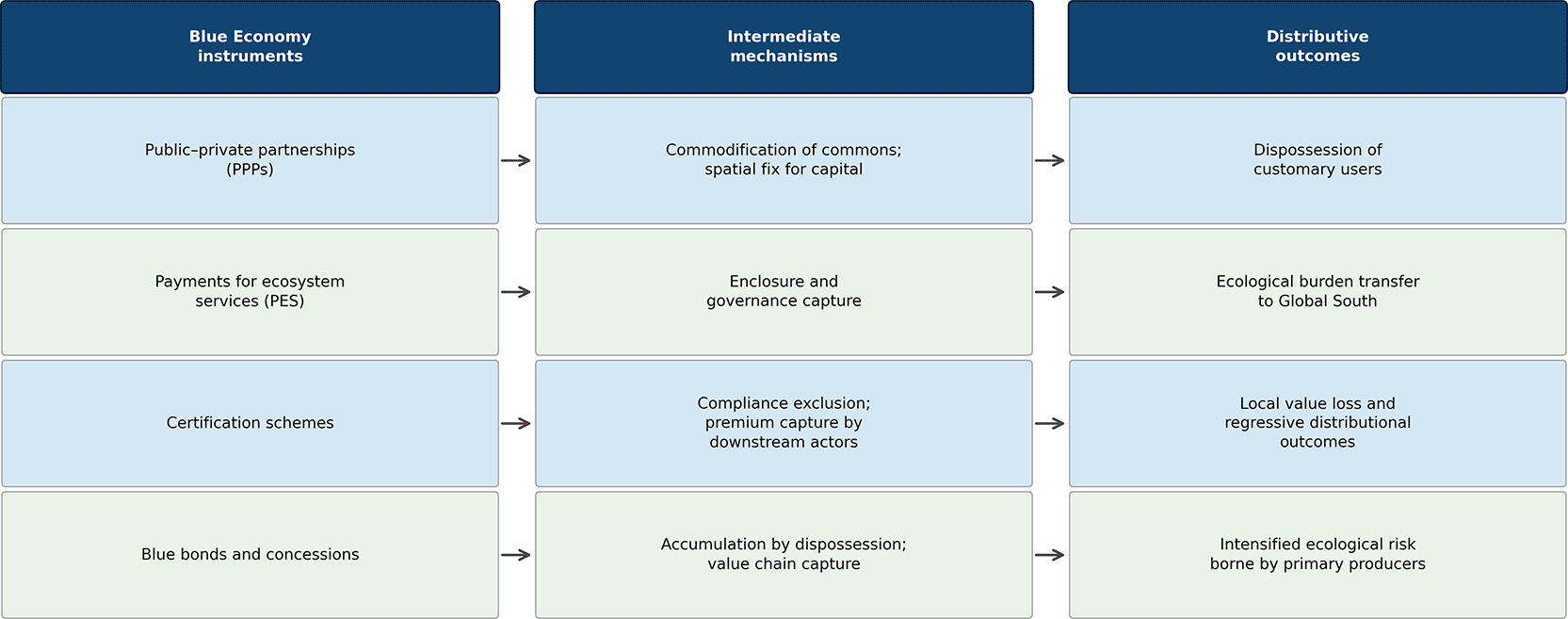
Source: Author’s own synthesis from the reviewed literature.
The Blue Economy’s epistemic framing privileges techno-managerial universalism and market valuation. Techno-managerial universalism, as used here, refers to the assumption that market-compatible technical and administrative solutions — ecosystem service pricing, carbon quantification, marine spatial zoning according to economic potential — can be designed centrally and applied across diverse governance contexts as if local conditions, power relations, and knowledge systems were interchangeable variables. Policy documents and institutional narratives consistently treat the ocean as a resource base amenable to optimisation along these lines (World Bank & UN DESA, 2017; OECD, 2016). This epistemic stance carries two problematic consequences. It reduces complex socio-ecological relations to exchange values, rendering invisible non-market forms of value — cultural, spiritual, and subsistence uses — central to many coastal communities. It also legitimates universal policy templates that assume scalability and transferability across diverse contexts, foreclosing alternative ways of knowing and governing marine commons (Midlen, 2021; Voyer et al., 2018). Degrowth and political ecology critique this universalism: knowledge about marine systems is socially produced, historically situated, and embedded in power relations; ignoring this plurality risks maladaptive interventions that undermine local governance and livelihoods (Escobar, 1995; Latouche, 2009).
The decoupling assumption — the idea that economic growth can be separated from environmental pressures through efficiency and technological innovation — is theoretically and empirically fragile. The degrowth literature, supported by comprehensive reviews, identifies multiple mechanisms (rebound effects, problem-shifting, limits of recycling and circularity, cost-shifting) that undermine absolute decoupling. Rebound effects are pervasive: efficiency gains lower the effective cost of resource use and can stimulate additional consumption or structural shifts that increase overall throughput (Parrique et al., 2019). Rising energy expenditures for marginal extraction mean that as easy resources are depleted, extraction becomes more energy-intensive, offsetting efficiency gains. Problem-shifting occurs when technological solutions to one problem create new pressures elsewhere (for example, biofuel expansion driving land-use change). Recycling and circularity have limits: material cycles are imperfect and cannot indefinitely substitute for virgin extraction in a growing economy. Finally, cost-shifting through trade allows high-consumption countries to externalise environmental burdens to lower-consumption regions, masking the true global footprint of growth (Hornborg, 2011; Hickel et al., 2021, 2022). For ocean governance, this critique implies that policies premised on decoupling risk postponing necessary downscaling and redistribution.
Market instruments — public-private partnerships, payments for ecosystem services, certification schemes, and blue bonds — commodify marine commons and create pathways for governance capture. Political ecology shows how marketisation can reconfigure property relations and enable rent extraction. Certification regimes, for instance, often impose compliance costs on small producers whilst enabling premium capture by downstream actors; payments for ecosystem services can reframe stewardship as a service to be purchased rather than a collective responsibility; and blue bonds can mobilise capital but also create debt obligations and conditionalities that constrain public policy space (Vandergeest & Unno, 2012). Voyer and van Leeuwen (2019) show that the concept of “social licence to operate” in Blue Economy contexts is frequently deployed in ways that favour growth-based narratives and neglect competing discourses, effectively using legitimacy claims to insulate extractive industries from meaningful community challenge. From a degrowth perspective, market instruments may be useful in narrow, carefully regulated contexts, but they cannot be the primary means of governing ocean commons; instead, democratic, commons-based governance must be prioritised (Fairhead et al., 2012; Gereffi, 1994).
Blue Economy projects frequently function as spatial fixes for capital, reproducing accumulation by dispossession in marine contexts. When land frontiers close or terrestrial investments yield diminishing returns, capital seeks new arenas for accumulation. The ocean — its seabed minerals, its aquaculture potential, its carbon sequestration services — becomes a new frontier. Legal reforms, concessions, and financial instruments can facilitate the transfer of access rights from customary users to private actors, producing ocean grabbing and undermining local stewardship. These processes reproduce historical patterns of colonial extraction and unequal exchange: resources and ecological burdens are shifted to the Global South whilst value is captured in the Global North (Harvey, 2003; Hornborg & Martínez-Alier, 2016; Hickel et al., 2021, 2022). Midlen (2024) documents these dynamics empirically in the Western Indian Ocean context, demonstrating how multilateral promotion of the Blue Economy constructs a form of “collaborative governmentality” that enrols states in a global rationality of ocean development whilst insufficiently accounting for geographic and material constraints and local institutional capacities. The Blue Economy’s promise of inclusive growth thus risks masking a deeper dynamic of dispossession.
Distributional outcomes under Blue Economy regimes are often regressive. Value chains in marine sectors are frequently buyer-driven: processing, branding, and high-value transformation occur in the Global North, whilst primary production and ecological risk remain in the Global South. Producers face price volatility, precarious labour conditions, and exposure to ecological shocks, whilst surplus value is captured upstream. Degrowth reframes the policy objective from maximising GDP to ensuring sufficiency, redistribution, and local value retention. Policies that prioritise cooperative processing, local ownership, and public investment in local infrastructure can help retain value locally and reduce vulnerability (Gereffi, 1994; Martínez-Alier, 2002). This describes a structural tendency documented across multiple empirical contexts, not an inevitable or uniform result. The degree of regressivity varies with local institutional arrangements, governance capacity, and specific policy instruments.
Techno-optimism masks problem-shifting and governance blind spots. The Blue Economy’s faith in technological fixes — intensified aquaculture, carbon sequestration, and market-based conservation — can obscure the potential for new resource demands, novel environmental risks, and lock-in to expansionary pathways. Technological solutions often require inputs (energy, feed, minerals) that create new ecological pressures; they can legitimise further expansion by promising future mitigation; and they can concentrate control in the hands of firms that own the technologies. Midlen (2026b) analyses the Blue Economy as a “dispositif” — a heterogeneous ensemble of discourses, institutions, regulations, and material arrangements — whose strategic function is to make ocean resources legible and productive for capital, thereby systematically displacing non-market governance approaches and marginalising place-based knowledge systems. Degrowth advocates for precaution, low-tech place-based solutions, and policies that prioritise sufficiency over scale (Parrique et al., 2019; Demaria et al., 2013).
These findings point to causal mechanisms: market integration drives intensification and specialisation, which in turn produce ecological simplification and social precarity (a Jevons-like treadmill); certification and buyer-driven chains enable value capture by downstream actors; and legal and financial instruments reconfigure access rights to favour capital. Conceptualising these mechanisms clarifies how the Blue Economy’s theoretical assumptions translate into material outcomes and where policy interventions might interrupt harmful pathways. The remainder of the article translates these critiques into a normative and policy programme: Blue Degrowth.
If the Blue Economy’s central claims are problematic, what alternative should be proposed? Blue Degrowth is not a single policy package but a set of interlocking principles and modalities that reorient ocean governance towards sufficiency, justice, and local sovereignty. The following sections articulate core principles and translate them into institutional and policy proposals. The framework is oriented primarily towards Global South contexts where the dynamics of ecologically unequal exchange, accumulation by dispossession, and the erosion of customary governance are most pronounced. This does not mean that Blue Degrowth is without relevance to Global North settings — where high-consumption ocean industries carry disproportionate ecological footprints and where redistribution of ecological space is a necessary condition for global justice — but the policy modalities proposed reflect the priorities and constraints of postcolonial governance environments.
At the normative level, Blue Degrowth rests on five principles. These are advanced as normative propositions derived from the degrowth and political ecology literatures synthesised above; they are not empirically verified outcomes but theoretical commitments about how ocean governance ought to be organised. First, limits and sufficiency: policy must recognise ecological ceilings and prioritise reductions in material throughput in high-consumption contexts. This does not mean denying development to the Global South; rather, it means redistributing access to resources and prioritising well-being over aggregate growth. Second, anti-colonial delinking: Global South states and communities should have the capacity to refuse extractive projects and to pursue selective delinking strategies that protect local sovereignty and ecological integrity. Third, commons governance: legal recognition of customary marine tenure and support for collective stewardship institutions are central to preventing enclosure and enabling sustainable provisioning. Fourth, local value retention and redistribution: policies should prioritise cooperative ownership, local processing, and public investment that capture more value locally. Fifth, precaution and democratic deliberation: governance must be precautionary, participatory, and accountable, resisting technocratic impositions that marginalise local voices.
Translating these principles into policy modalities requires institutional creativity and political will. Legal recognition of customary marine tenure is a foundational step: many coastal communities manage marine resources through customary rules that are not recognised by formal law. Recognising these rights — through co-management arrangements, community concessions, or legal pluralism — can prevent enclosure and support local stewardship (Ostrom, 1990; Peluso, 1992; Peluso & Lund, 2011). Co-management should be accompanied by capacity building and resources to enable communities to monitor and enforce rules. The importance of contextual sensitivity in translating any Blue Economy or Blue Degrowth framework into practice cannot be overstated: Voyer et al. (2021) demonstrate that mismatches between national policy instruments and local governance arrangements are a primary source of implementation failure.
Economic instruments should be reoriented to retain value locally. Cooperative processing facilities, community-owned enterprises, and public procurement policies that favour local producers can shift value capture away from distant intermediaries. Public financing — grants, low-interest loans, and technical assistance — can support small producers to move up the value chain without ceding control to external capital. Midlen (2026a) provides empirical grounding for these alternatives in Kenyan coastal communities, where diverse economies frameworks — centred on multiple enterprise forms, reciprocal labour arrangements, and community-led nature-based enterprises — demonstrate the practical viability of socially embedded, non-market provisioning systems in the blue economy context. Preferential tax regimes and local content rules can also be used strategically to ensure that processing and value addition occur locally.
Limits on export-oriented expansion are politically sensitive but sometimes necessary. Where expansion threatens ecological integrity or undermines local provisioning, moratoria and export limits can be justified as precautionary measures. Such limits must be accompanied by social protection and transition support — basic incomes, employment guarantees, and retraining programmes — to ensure that livelihoods are not sacrificed in the name of ecological protection. Phased transitions, with clear timelines and participatory planning, can reduce social disruption.
Alternative metrics and policy evaluation are essential. GDP is a poor measure of well-being and ecological sustainability. Blue Degrowth advocates for indicators that combine ecological ceilings and social foundations — measures of sufficiency, distributional equity, and local provisioning. Whilst the precise metrics are contested within degrowth scholarship, the principle is clear: policy success should be measured by ecological and distributive outcomes, not by sectoral growth.
Participatory marine spatial planning is a practical governance modality that can put plural knowledge systems and democratic deliberation into practice. Rather than top-down zoning driven by external investors, spatial planning should be co-designed with local communities, fishers, and customary authorities. Participatory processes can identify areas for conservation, areas for subsistence use, and areas where limited, community-led economic activity is appropriate.
At the international level, trade and finance reforms are necessary to prevent cost-shifting and to support delinking strategies. Trade rules should be reformed to prevent ecological dumping and to allow policy space for local value retention. Debt relief tied to ecological restoration and public investment in local processing infrastructure can free fiscal space for Blue Degrowth transitions. International climate finance should prioritise community-led restoration and adaptation rather than marketised offsets that enable continued emissions in wealthy countries.
These modalities are not exhaustive, and they will look different across contexts. Blue Degrowth is a plural, place-based programme: it requires local experimentation, pilot projects, and iterative learning. It is not anti-technology per se; rather, it is sceptical of techno-optimism as a substitute for political choices about limits and distribution. Low-tech, appropriate technologies that support local provisioning and reduce ecological footprints are often preferable to high-tech solutions that concentrate control and create new dependencies.
The following composite illustration draws on documented patterns from Indonesian coastal fisheries and aquaculture to show how the causal mechanisms identified above play out in practice. The vignette draws on ethnographic, policy, and political ecology studies of customary marine tenure, market integration, and value chain dynamics in Indonesian coastal communities (Halim et al., 2019, 2020; Adhuri et al., 2016; Thorburn, 2000, 2001; Mantjoro, 1996; Zerner, 1994; Bailey & Zerner, 1992), and is anonymised to avoid identifying any single location.
In a coastal district of Indonesia, small-scale fishers and seaweed producers historically managed nearshore areas through customary rules that regulated access, seasonal closures, and gear types (Adhuri et al., 2016; Thorburn, 2000, 2001; Bailey & Zerner, 1992; Zerner, 1994; Mantjoro, 1996). These customary institutions were embedded in social relations: elders mediated disputes, seasonal rituals governed harvest timing, and reciprocal labour arrangements distributed risk (Thorburn, 2000; Mantjoro, 1996). Local provisioning — food for households, barter exchanges, and small-scale sales at local markets — was the backbone of livelihoods (Bailey, 1988; Mantjoro, 1996). Ecological knowledge was place-based: fishers read currents, seasonal patterns, and local species behaviour to manage harvests adaptively (Thorburn, 2000, 2001; Bailey & Zerner, 1992; Zerner, 1994).
Over the past decade, a national Blue Economy strategy promoted aquaculture intensification and export-oriented processing (Bappenas, 2023; World Bank, 2021; Trenggono, 2025), effectively reframing these nearshore areas as zones of economic potential and a development pathway. Investment incentives, tax breaks, and public-private partnership models were offered to attract capital (World Bank, 2021; Bappenas, 2023). Certification schemes that favoured larger producers able to meet compliance costs (Vandergeest & Unno, 2012; Bush et al., 2013) were introduced to access premium markets, and a processing plant was financed in the regional capital to aggregate and process raw material for export (World Bank, 2021).
The transition unfolded unevenly. Some producers — those with capital or social connections — were able to scale up, adopt new gear, and meet certification requirements (Bush et al., 2013). Many small producers, however, faced barriers: the upfront costs of inputs and certification, the need to access processing facilities located in the regional centre, and the loss of customary access as nearshore areas were reclassified for commercial use (Bush et al., 2013; Vandergeest & Unno, 2012; Halim et al., 2019). This pattern exemplifies the accumulation by dispossession mechanism theorised by Harvey (2003), where legal reforms reconfigure property relations to favour capital accumulation. Market integration created new incentives: higher short-term prices encouraged intensification and monoculture practices that simplified habitats and increased vulnerability to pests and disease (Bush et al., 2013; World Bank, 2021). Inputs (seed stock, feed, and chemical treatments) were increasingly purchased from outside, creating new dependencies and cash outflows (MicroSave Consulting, 2025).
Initially, incomes rose for some households, and local employment in processing expanded (World Bank, 2021). But as production scaled, per-unit prices fell and competition increased (Purcell et al., 2017; Garlock et al., 2020; Dahl & Oglend, 2014), creating the Jevons paradox. Certification compliance costs and transport expenses eroded margins for small producers (Bush et al., 2013; Tsantiris et al., 2018). When a regional climate shock (anomalous sea temperatures and storm events) reduced yields, small producers faced price collapses and limited social protection (Iskandar et al., 2022; MicroSave Consulting, 2025). The processing firm, integrated into global value chains, shifted sourcing to other regions with lower costs while retaining capital and profits in the national centre (Purcell et al., 2017). This illustrates the buyer-driven value chain dynamics theorised by Gereffi (1994), where downstream actors capture surplus value whilst externalising risk to primary producers. As a result, local employment was precarious: casual labour, seasonal contracts, and limited labour protections meant that households had little buffer against shocks (Statista, 2024; MicroSave Consulting, 2025).
Institutional changes compounded these dynamics. Formal concessions and zoning regulations, designed to attract investment, often failed to recognise customary tenure (Halim et al., 2019, 2020; World Bank, 2021). Where co-management arrangements were nominally established, they lacked resources and enforcement capacity (Halim et al., 2020; Adhuri et al., 2016). Certification schemes, whilst marketed as inclusive, required documentation and investments that excluded many small producers (Vandergeest & Unno, 2012). Financial instruments (credit lines tied to production targets) encouraged expansion but also indebtedness (MicroSave Consulting, 2025). These institutional reconfigurations exemplify the enclosure mechanisms described in the political ecology literature (Peluso & Lund, 2011; Fairhead et al., 2012). The net effect was a reconfiguration of access and value: ecological burdens (habitat simplification, pollution, and increased vulnerability to climate variability) were concentrated locally, whilst value was captured by processors and exporters upstream (Purcell et al., 2017; Garlock et al., 2020).
This vignette illustrates several mechanisms identified in the theoretical analysis: market integration producing a production treadmill (a Jevons-like effect), value capture by downstream actors, and the externalisation of ecological and climate risks onto precarious producers. It also shows how legal and institutional changes (formalisation of concessions, certification regimes, and investment incentives) can reconfigure access and governance in ways that disadvantage customary users. The vignette is intentionally composite and anonymised; it is offered as an illustrative anchor for the causal pathways discussed above rather than as empirical proof.
The degrowth political ecology critique shifts the terms of the Blue Economy debate in three related directions: from growth-compatibility towards limits and sufficiency; from technocratic optimisation towards justice — anti-colonial delinking, reparative redistribution, and commons governance; and from marketisation and financialisation towards plural, participatory governance. Each of these shifts has practical implications and involves trade-offs that cannot be wished away.
Putting sufficiency and limits at the centre of policy evaluation requires new metrics and political strategies. Metrics that combine ecological ceilings with social foundations can guide policy, but they also require political negotiation: who sets the ceilings, and how are social foundations defined and financed? Degrowth scholars emphasise redistribution: wealthy countries must reduce consumption and provide material and financial support to enable sustainable development in the Global South (Kallis, 2018; Hickel, 2020). This raises geopolitical questions about responsibility, reparations, and the redistribution of ecological space that cannot be resolved by technocratic fixes alone.
Anti-colonial delinking is politically fraught but, this article argues, a necessary principle for any framework that takes postcolonial justice seriously. Delinking does not mean isolation; it means strategic autonomy and the capacity to refuse extractive projects that reproduce dispossession. Practically, delinking can take the form of selective import substitution for critical inputs, legal protections for customary tenure, and trade policies that prioritise local value retention. These measures will face resistance from powerful economic interests and from international institutions that promote liberalised trade. Building political coalitions among social movements, local communities, progressive policymakers, and sympathetic international actors is essential. Historical precedents show that policy shifts are possible when social movements and political entrepreneurs align to create institutional openings (Demaria et al., 2013).
Commons governance and cooperative economic models offer practical alternatives to marketisation, but they require institutional support. Legal recognition of customary rights, access to finance, technical assistance, and supportive procurement policies are necessary to make commons governance viable. Public investment in local processing and infrastructure can reduce dependency on buyer-driven chains, but such investments require fiscal space and political commitment. Debt relief and international climate finance can help create that space, but they must be structured to avoid new conditionalities that undermine sovereignty.
Addressing trade-offs around livelihoods and food security is critical. Phased transitions, social protection measures (basic incomes, employment guarantees), and retraining programmes can mitigate social disruption. Pilot projects and place-based experiments can demonstrate viable pathways and build political support. Most importantly, transitions must be co-designed with affected communities to ensure legitimacy and effectiveness. The vignette above illustrates how top-down Blue Economy strategies can produce short-term gains but long-term vulnerabilities; Blue Degrowth insists that transitions be designed to enhance resilience and local provisioning rather than to maximise export earnings.
Political feasibility depends on strategy. Degrowth proposals are often dismissed as utopian or politically unrealistic. Yet history shows that major policy shifts — welfare states, land reforms, environmental regulations — have been achieved through coalition building, social movements, and institutional entrepreneurship. Blue Degrowth requires similar strategies: building alliances across labour, environmental, and community groups; leveraging legal avenues to secure rights; and using pilot successes to scale up reforms. International solidarity and normative pressure, through transnational networks and progressive institutions, can also create enabling conditions.
Finally, research and practice must be iterative. Comparative empirical studies can test the causal mechanisms identified here and refine policy modalities. Interdisciplinary collaborations, combining political ecology, ecological economics, law, and development studies, are essential to design context-sensitive Blue Degrowth interventions. Metrics and monitoring systems must be developed in partnership with communities to ensure they reflect local priorities and ecological realities.
Several limitations of this framework warrant explicit acknowledgement. First, Blue Degrowth as developed here is a theoretical framework derived from literature synthesis rather than an empirically tested programme. The causal mechanisms identified are drawn from documented patterns in the literature, but the specific conditions under which each mechanism operates, and the degree to which Blue Degrowth policy modalities can interrupt them, remain to be tested through comparative empirical research. The Indonesian vignette is illustrative, not probative.
Second, the Global South framing, whilst deliberate, risks homogenising highly diverse governance contexts. The structural inequalities of ecologically unequal exchange and accumulation by dispossession manifest differently across small island developing states, large archipelagic nations, continental coastal states, and landlocked developing countries with marine interests through regional bodies. The five Blue Degrowth principles should be understood as a general orientation rather than a context-agnostic template; their translation into specific policy modalities will require engagement with local institutional arrangements, legal traditions, and political economies. Voyer et al. (2021) make a similar point about contextual sensitivity in Blue Economy design, and the argument applies equally to critical alternatives.
Third, political feasibility constraints are significant. Anti-colonial delinking and precautionary moratoria on export-oriented expansion will face resistance from both domestic economic interests and international development finance institutions that condition lending on liberalisation and growth targets. The framework does not resolve these tensions; it identifies them as the political terrain on which Blue Degrowth must operate. Building the coalitions and creating the institutional openings necessary for implementation is a long-term project.
Fourth, the article’s primary engagement is with critical degrowth and political ecology scholarship. Whilst representative mainstream Blue Economy frameworks (World Bank & UN DESA, 2017; OECD, 2016) are engaged as explicit objects of critique, and reformist scholarship is addressed in the literature review, the article does not provide a comprehensive review of the full range of mainstream ocean governance and marine spatial planning literature. This is a deliberate methodological choice, as explained in the Methods section, but it means that the article’s engagement with certain applied governance debates — such as specific fisheries management regimes or maritime spatial planning instruments — is necessarily limited.
This article has argued that the Blue Economy’s foundational commitments — absolute decoupling, techno-managerial universalism, and the primacy of market instruments — are not merely governance choices but theoretically precarious assumptions that, when traced through the mechanisms of political ecology, demonstrably reproduce dispossession, value extraction, and ecological burden transfer in Global South contexts. The six critiques developed here are not independent complaints about implementation failures; they form an interlocking structure in which the Blue Economy’s epistemic framing enables its market instruments, which in turn produce the spatial fixes and distributional outcomes the framework then legitimates as the costs of sustainable growth. Blue Degrowth names the departure from this structure: a framework grounded in limits, sufficiency, anti-colonial delinking, commons governance, and democratic deliberation that does not seek to reform the Blue Economy from within but to reorient ocean governance around a different set of foundational questions about value, access, and justice.
Several things remain genuinely open, and intellectual honesty requires naming them. The causal mechanisms identified here are drawn from the literature rather than tested comparatively — the Indonesian vignette illustrates but does not prove them, and the specific conditions under which each mechanism is most operative, or can most effectively be interrupted, will differ across governance contexts (Ostrom, 1990; Voyer et al., 2021). The five Blue Degrowth principles articulate what just ocean governance should pursue; translating them into viable institutional arrangements in settings where state capacity is limited, where international development finance conditions lending on growth targets, and where social movements face asymmetric political constraints is a further project that this article can only sketch (Demaria et al., 2013; Hickel, 2020). There is also an unresolved tension within the framework: anti-colonial delinking requires the strategic autonomy of Global South states and communities, yet commons governance and democratic deliberation require institutional conditions — legal pluralism, enforcement capacity, participatory planning infrastructure — that many of those states currently lack. Building those conditions is itself a political project, not a technical one, and Blue Degrowth has more to say about what it requires normatively than about how to get there from where most Global South coastal states currently stand.
None of this diminishes what the framework offers. Blue Degrowth provides what neither degrowth nor political ecology has fully articulated alone: a coherent theoretical language connecting degrowth’s macroeconomic arguments, political ecology’s mechanisms of dispossession, and postcolonial scholarship’s attention to unequal exchange — and translating that connection into a normative and operational programme grounded in the specific conditions of the Global South. The next tasks are empirical, comparative, and political: testing these causal pathways across diverse coastal contexts; developing operational sufficiency metrics in partnership with communities; and building the coalitions among labour, environmental, and sovereignty movements that give Blue Degrowth political traction beyond the academy. Ocean governance will not become just by accumulating better theory. But theory that names the mechanisms of injustice precisely — and that proposes alternatives grounded in what communities already know and practice — is not a small contribution to that project.
| Views | Downloads | |
|---|---|---|
| F1000Research | - | - |
|
PubMed Central
Data from PMC are received and updated monthly.
|
- | - |
Provide sufficient details of any financial or non-financial competing interests to enable users to assess whether your comments might lead a reasonable person to question your impartiality. Consider the following examples, but note that this is not an exhaustive list:
Sign up for content alerts and receive a weekly or monthly email with all newly published articles
Already registered? Sign in
The email address should be the one you originally registered with F1000.
You registered with F1000 via Google, so we cannot reset your password.
To sign in, please click here.
If you still need help with your Google account password, please click here.
You registered with F1000 via Facebook, so we cannot reset your password.
To sign in, please click here.
If you still need help with your Facebook account password, please click here.
If your email address is registered with us, we will email you instructions to reset your password.
If you think you should have received this email but it has not arrived, please check your spam filters and/or contact for further assistance.

Comments on this article Comments (0)