Keywords
non-zero divisor graph, cut-set, connected, degree, topological graph indices, dominating number

This article is included in the Fallujah Multidisciplinary Science and Innovation gateway.
non-zero divisor graph, cut-set, connected, degree, topological graph indices, dominating number
By transforming algebraic structures into graphs, the algebraic properties can be visualized, hidden symmetries can be uncovered, and intricate relationships can be simplified. By revealing patterns and invariants, graph theory tools facilitate the intuitive study of zero-divisors, ideals, and ring structures. This helps with classification, problem solving, and computational exploration by bridging the gap between abstract algebra and combinatorics. For an example, see Refs. 1–7. For the commutative ring and a proper ideal of , Redmond8 was the first to identify the ideal-based zero divisor graph, designated as which contains a vertex set for some , and two distinct vertices and are adjacent if . Inspired by the preceding definition, we construct a simple graph associated with a ring and a proper ideal of , denoted as , With the exception of the ideal , the multiplicative identity, and its additive inverse, every vertex represents an element of R. Moreover, an edge connects two different vertices only when their product (in either order) is not in the ideal . This type of graph is known as a non-zero divisor graph when = 0; various studies have investigated this instance.9–11 In this study, we assume that all graphs are undirected and that, basic graphs are devoid of many edges or loops. A graph is said to be connected if a path exists between every pair of vertices. The girth of the graph represents the length of the smallest cycle. When a graph does not have any cycles, its girth is considered as infinite. Subset is said to be the dominating set of a graph if every vertex is adjacent to at least one vertex in D. The maximal cardinality of the smallest set that dominates G is represented by the domination number, which is abbreviated as Additional definitions pertaining to graph theory can be found in Ref. 12. In this study, we look at certain essential characteristics of the graphs, illustrating their connectivity, and formulate general equations for the cut sets, vertex degrees, and specific topological degree-based indices. The results delineate cut-Sets, establish generic criteria for connectedness, and formulate expressions for vertex degrees based on divisibility relations in . Moreover, many topological indices have been computed to assess symmetry and structural complexity.
This section first outlines the definition of the ideal-based non-zero divisor graph, followed by an illustration example. The subsequent outcomes of our investigation presented in the graph.
Let be a ring and be a proper ideal for . The ideal-based non-zero divisor graph, denoted by (R), has vertex set V( (R)) = \ { }. Moreover, two different vertices δ and γ in V( (R)) are adjacent if and only if either δγ I or γδ I.
Let R = and let . The following Figure 1 are used to illustrate the graph.
If there is an invertible element α in , then for any proper ideal of a ring , the graph is connected.
Because is invertible then there is , such that . Let , if , then we have , which is a contradiction. Thus is connected.
13 denotes the number of positive integers that are co-prime to , where
13If the integer 1 has prime factorization , then . is the number of invertible elements in the integer ring of module , which is noteworthy.
For n 6, 3.
We shall partition the proof into two distinct cases.
9 The non-zero divisor graph ( ) is connected if and only if n {1, 2, 3, 6}.
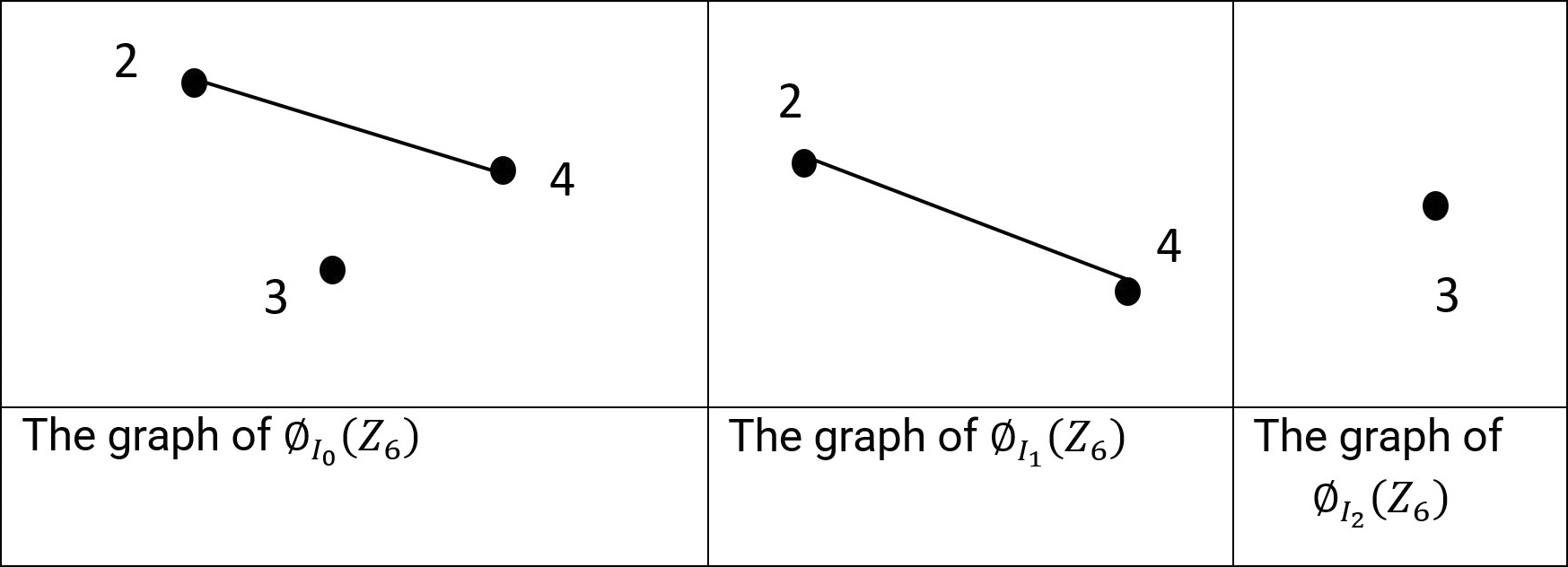
Connectivity of the graph ( ) is examined in this section for two different scenarios: n ≤ 9 and n ≥ 10. With the help of examples, we further explore the idea of a cut-set and how it is calculated for graph ( ). For {1,2,3,6,8}, the Table 1 below provides information about the ideal-based non-zero divisor graph of
For any prime number , ( ) represents a completely connected graph.
Given that is a prime number, the only proper ideal for Z n is the zero ideal. According to Theorem 2.7, ( ) is connected. Assume that with ; therefore, either , leading to a contradiction. This indicated that the graph was complete.
For any prime number , the graph ( ) is connected.
The proper ideal of the ring are and which is maximal ideal of .
• Case 1: ( ) is connected by Theorem 2.7
• Case 2: Assume that ( ) disconnected graph, there exist in different connected component meaning: There is no path between equivalently, for all V( ( )) = either , consider the ideal generated by and since , then , contradiction.
For the integer module and the ideal for some integer . Since , we can now develop a method to calculate the order of the graph (Zn) as following: , where .
Let be an odd, non-prime number then, the non-zero ideal of Zn with the greatest order is the ideal generated by the prime number , where , for some integer r such that .
If is odd number (not prime), then the ideal has the largest of order is the ideal generated by prime number that divides n, we will provide several cases and present a general formula to determine the largest prime number that divides n. we know that , where . Therefor if , then . Then, the general formula for is for some integer that makes .
If take then is the greatest order of ideal such that = .
For any integer , the graph is connected for every non-zero proper ideal of .
The proof will be divided into two cases.
Case 1: I is a prime ideal; let V ( ( )), with I, then either I or I, contradiction. Thus ( ) connected (complete).
Case 2: not prime ideal. Therefore, we have the following subcases.
• If is even number, then the ideal has the largest of order is the ideal generated by 2, , that means when , then ≥ 3. By Lemma 2.6, then 3, and our result follows immediately by Lemma 2.3.
• If is an odd number (not prime), then by Lemma 3.3, the ideal with the largest order is the ideal generated by prime number p that divides n, where , for some integer r such that . If and is an odd number, then the greatest order of ideal I guarantees , By Lemma 2.6, then 3, and our result follows immediately by Lemma 2.3.
For any integer n ≥ 10, then = 1 and
For any integer , from the previous proof of the theorem 3.3 then for any ideal , and by Lemma 2.6 we have )) = 1 and gr ( ) .
14A cut-set is defined as a set of vertices in a connected graph G, where G can be represented as the union of two subgraphs and , such that
1. (the edges set of and are not empty)
2. and
3.
4. and . Moreover, no proper subset of also acts as a cut set for any choice of and .
Here, an example that illustrates the definition of the cut-set in graph
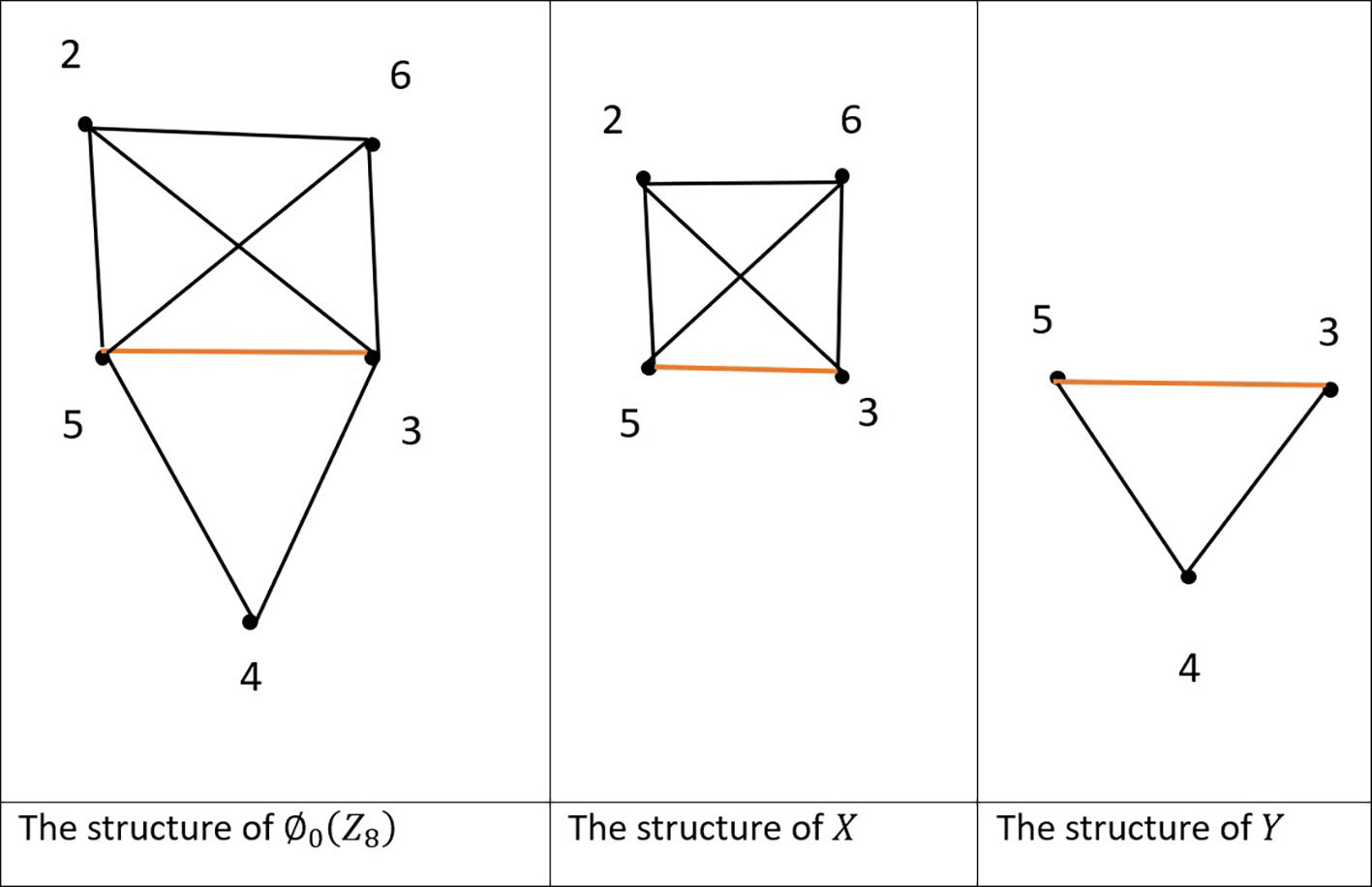
In the graph of ring , the set represents the cut set. As shown Figure 2. .
= , for and in , then and , for some and , it follows that is not connected with . The graph that excludes the vertices of set is unconnected. This is minimal because any proper subset of C. C preserves the pathways between zero-divisors via units by leaving some units intact.
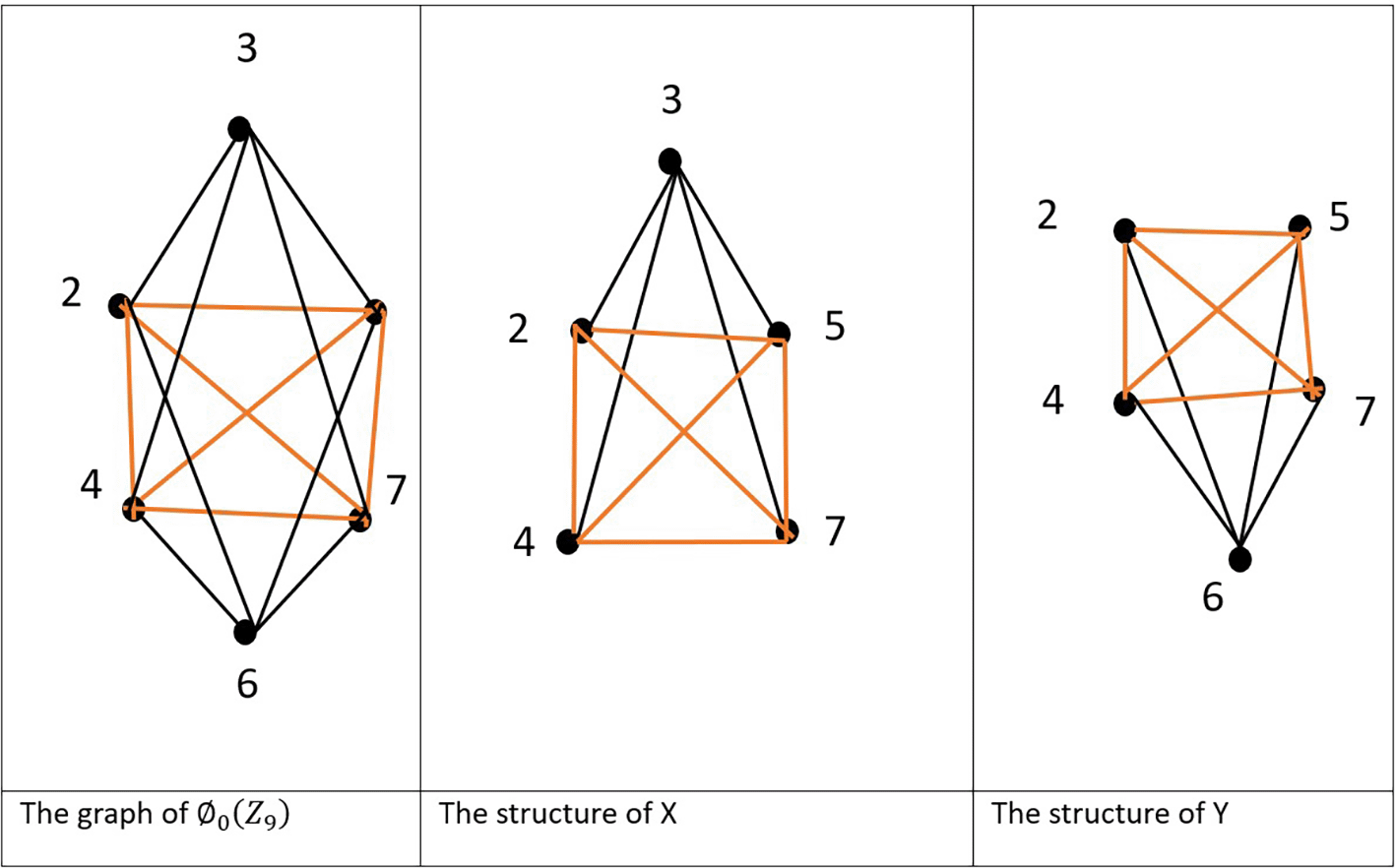
The cut set in the graph of the ring is the set C = {2,4,5,7}, as illustrated in Figure 3.
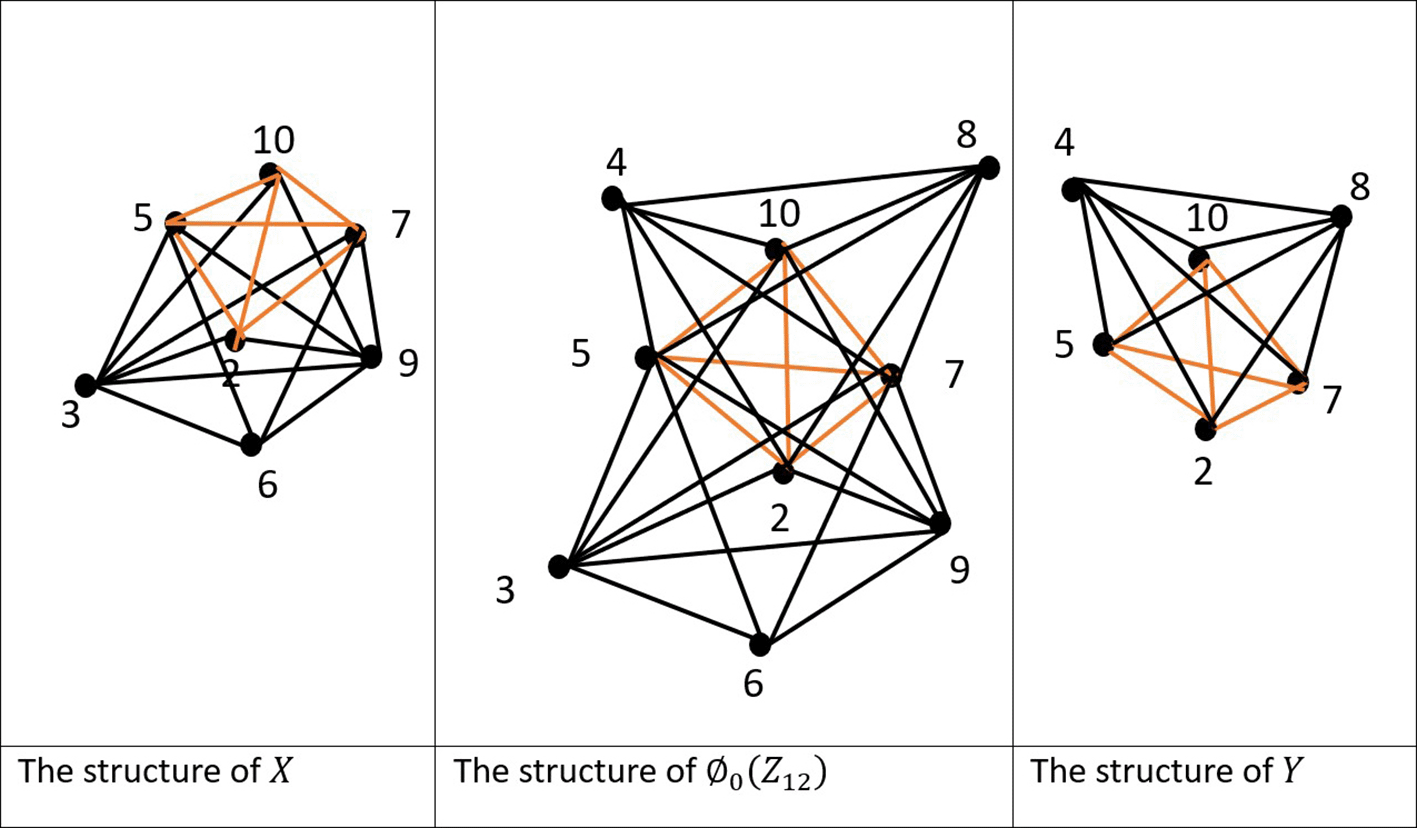
Consider the subgraphs and , which are generated by the ideal and , respectively. Consequently, subgraphs and have no edges between them if then, , Consequently, subgraphs and Y have no edges between them. Now, if = C {a}, then either , which means that is invertible, and by Lemma 2.3, a connect all vertices of contradiction, or a , then there exists path from to by , since if then , thus , therefore , a contradiction.
For the ring , , then the cut set of , for , corresponds to the set C = = {3,7,210}, as illustrated in the Figure 4, where .
Let be a vertex of any graph; the degree of is represented as , and the degree of is defined as follows: , length of the short path).
From the above definition, it is clear that =
Let be the ring of integers module, and let ( ) denoted the ideal based non-zero divisor graph of . Suppose is ideal of, where . for any vertex ( (R)) and . Then, the degree of is given by
Case 1: if , assume that for all y ∈ V( (R)), , thus , but , therefore, , that means , a contradiction. Then, by the definition of an ideal-based non-zero divisor, y must be a universal vertex, so
Case 2: if , let and , so we need to exclude the ideal generated by , when want an account for deg ( x). But .
Applying Theorem 5.2, we will present a Table 2, illustrating examples of calculating the degree of a vertex in certain ( .
| n | I = ⟨d⟩ | d | x | gcd(x,d) = g | deg(x) |
|---|---|---|---|---|---|
| 12 | 4 | 5 | 1 | ||
| 12 | 4 | 10 | 2 | ||
| 18 | 9 | 15 | 3 | ||
| 18 | 9 | 10 | 1 | ||
| 30 | 2 | 7 | 1 | ||
| 30 | 6 | 21 | 3 |
Let , , prime number, for any vertex ∈ V ( (R)). The degree of is then given by .
Let , , prime number, for any vertex x ∈ V ( (R)), For any non-zero ideal of R, then
Let R = be the ring of integers module , and let ( ) be a non-zero divisor graph of R. Then, for any vertex set = ( ). Thus, the degree of is given by:
To prove the result, we should consider the following subcases:
Case 1: if , assume that for all y ∈ , , but is invertible thus, , which is a contradiction. Therefore .
Case 2: Let , representing the non-neighbors of , then ,which contains exactly elements if , and elements when
Let then the following Table 3, representing the degree of every vertex of the graph .
Let then the following Table 4, representing the degree of every vertex of the graph .
This study calculates the essential topological indices, including the Zagreb and Randić,15 indices, to assess connectedness, symmetry, and complexity. These calculations illustrate the intricate relationship between the ring-theoretic features and graph invariants.
1. First Zagreb Index: For any non-zero ideal of , and according to Theorem 5.2, we obtain
If , then according to Theorem 5.6, we have
2. Second Zagreb Index: For any non-zero ideal I of , let , let , and according to Theorem 5.2, we obtain
In this study, we examined the ideal-based non-zero divisor graph , emphasizing the relationship between the algebraic structure of and the combinatorial characteristics of its corresponding graph. We developed general formulas for vertex degrees, cut sets, and domination parameters as well as the conditions for graph connectedness. Topological degree-based indices were calculated to measure symmetry and structural complexity. The results show that is a useful way to observe and study ideal-related characteristics in modular rings, which connects algebraic and graph-theoretical points of view.
| Views | Downloads | |
|---|---|---|
| F1000Research | - | - |
|
PubMed Central
Data from PMC are received and updated monthly.
|
- | - |
Provide sufficient details of any financial or non-financial competing interests to enable users to assess whether your comments might lead a reasonable person to question your impartiality. Consider the following examples, but note that this is not an exhaustive list:
Sign up for content alerts and receive a weekly or monthly email with all newly published articles
Already registered? Sign in
The email address should be the one you originally registered with F1000.
You registered with F1000 via Google, so we cannot reset your password.
To sign in, please click here.
If you still need help with your Google account password, please click here.
You registered with F1000 via Facebook, so we cannot reset your password.
To sign in, please click here.
If you still need help with your Facebook account password, please click here.
If your email address is registered with us, we will email you instructions to reset your password.
If you think you should have received this email but it has not arrived, please check your spam filters and/or contact for further assistance.
 need to rewrite because the largest ideal in Zn is generated by the smallest prime divisor, not via this formula.
Comments on this article Comments (0)