Keywords
Research capacity strengthening; Research systems; Global research ecosystem; Digital infrastructure; Science of science; Research lifecycle; Lifecycle Coherence; Ecosystem Stewardship.

Research capacity strengthening; Research systems; Global research ecosystem; Digital infrastructure; Science of science; Research lifecycle; Lifecycle Coherence; Ecosystem Stewardship.
Research has been recognized as a fundamental foundation upon which economic development, economic growth, and health innovation are achieved. Consequently, there has been a significant increase in global investments geared towards capacity strengthening in research, with a focus on science as a strategic approach to achieving various developmental milestones, including the Sustainable Development Goals (SDGs) and the African Union’s Agenda 2063 (UNESCO, 2021; World Bank, 2022). Despite this, however, there are concerns that the “efficiency” of knowledge generation in many resource-constrained settings remains low. Global assessments consistently report recurring systemic failures: weak methodological rigor, irreproducible data, and a “know-do” gap where findings fail to translate into policy (Ioannidis, 2016; Dean et al., 2019; UNESCO, 2021).
These persistent gaps suggest that the barrier is no longer solely a lack of resources, but a failure of design. A growing body of “science of science” scholarship indicates that current deficits cannot be explained by individual lack of skill or motivation. Rather, they reflect deep, structural weaknesses in how research is organized, governed, and digitally enabled (Cooke et al., 2018; Bennett et al., 2021). Researchers today operate within fragmented workflows where funding, ethics, data management, and dissemination exist in silos—a situation we describe as “lifecycle fragmentation”.
Traditional RCS paradigms have largely failed to address this fragmentation. By adopting linear or component-based models—focusing on discrete interventions such as grant writing workshops or statistical training—they neglect the interdependencies that shape research practice (Mormina & Istratii, 2021). Furthermore , the rapid introduction of Artificial Intelligence (AI) and digital tools has, paradoxically, often exacerbated this fragmentation, adding layers of technical complexity without ensuring lifecycle coherence (Borgman, 2019; Wilkinson et al., 2022).
In this paper, we introduce the Global Research Lifecycle Ecosystem (GRLE). We propose the GRLE not merely as a theoretical construct, but as a diagnostic framework to identify where and why research systems fail. We posit that research capacity is best understood as an ecosystem performance challenge determined by the dynamic interaction of actors, tools, and institutional incentives (Fraser et al., 2017; Bennett et al., 2021). Drawing on systems analysis and literature synthesis, we: (1) diagnose the limitations of current linear RCS models; (2) define the core components of the GRLE; (3) analyze common research challenges as “ecosystem failures”; and (4) propose a pathway for integrating digital infrastructure to create sustainable, high-performance research ecosystems.
Research capacity strengthening (RCS) has become a central pillar of global science and development policy. Over the past two decades, initiatives have expanded in scope and scale, encompassing postgraduate training, mentorship schemes, and North-South collaborations. Despite this growth, evidence of sustained, system-wide improvement in research performance remains inconsistent (Dean et al., 2019; Bennett et al., 2021). We identify three fundamental structural limitations in prevailing paradigms that explain this persistence of underperformance.
A defining flaw of current RCS approaches is their fragmented and modular design. Interventions typically target discrete stages of the research process—such as proposal writing, biostatistics, or manuscript preparation—in isolation from the broader workflow (Cooke, 2005). This “module trap” assumes that equipping individual researchers with technical skills will automatically yield high-quality outputs. However, empirical studies demonstrate that gains from short-term training frequently decay when not reinforced by institutional systems or aligned incentives (Mormina & Istratii, 2021). Furthermore, this human-capital-centric model underestimates the structural constraints—such as unstable funding, fragmented supervision, and administrative burdens—that prevent even highly trained researchers from applying their skills effectively (Fraser et al., 2017; UNESCO, 2021).
Prevailing frameworks often conceptualize research as a linear pipeline, progressing sequentially from training to knowledge production and finally to impact. This perspective emphasizes inputs (e.g., number of workshops conducted) rather than the dynamic interactions that determine research quality (Dean et al., 2019). Such linear models fail to capture the critical feedback loops and cross-stage dependencies of real-world research. For example, weaknesses in upstream problem formulation or study design inevitably propagated downstream, rendering later-stage interventions in analysis or writing ineffective (Ioannidis, 2016). By treating research as a pipeline rather than a cycle, current models miss the opportunity to diagnose and correct these cascading failures.
Perhaps the most critical systemic failure lies in the misalignment between institutional incentives and research quality. Academic reward systems in many settings prioritize publication counts and grant acquisition over methodological rigor, data stewardship, or societal relevance (Bouter, 2018; Moher et al., 2020). These structures incentivize “superficial compliance”—where researchers prioritize speed and volume over integrity—and discourage the time-intensive practices required for robust, reproducible science (International Science Council, 2023; Moher et al., 2020). Unless RCS interventions explicitly address these institutional drivers, technical capacity building risks reinforcing a system designed for quantity rather than quality (Wilkinson et al., 2022).
To address the structural limitations of prevailing capacity paradigms, we propose the Global Research Lifecycle Ecosystem (GRLE) as a unifying conceptual framework. The GRLE reframes research capacity not as a linear sequence of tasks or an aggregation of individual skills, but as the emergent performance of an interconnected system operating across the full research lifecycle.
We define the GRLE as the “dynamic interaction of actors, competencies, tools, institutional arrangements, incentives, and contextual factors that collectively shape research practice and outcomes across all stages of the research lifecycle”.
Within this framework, research outcomes are understood to arise from relationships and dependencies among ecosystem components rather than from isolated interventions. Performance at any given stage, such as data analysis, is contingent upon upstream design choices and downstream reporting requirements, as well as the enabling conditions of the surrounding institutional environment.
The GRLE comprises six interdependent components that must align for the system to function effectively. At the center are Human Actors—including researchers, mentors, data managers, and reviewers, whose decisions and interactions drive the research process (Bennett et al., 2021). These actors operate through specific Competencies and Practices, encompassing the methodological skills, ethical norms, and data stewardship standards required to execute high-quality science (Cooke, 2005). Their work is increasingly mediated by Digital and Methodological Tools, which include the software platforms, analytical algorithms, and data systems that define modern research workflows and determine data reproducibility (Borgman, 2019; Wilkinson et al., 2022). These operational layers function within Institutional Structures, such as governance bodies, ethics review boards, and administrative support units that enable or constrain research activity through resource allocation and oversight (Fraser et al., 2017). Researcher behavior is further directed by Incentives and Norms, particularly the academic reward systems and promotion criteria that often prioritize publication quantity over methodological rigor (Moher et al., 2020; Bouter, 2018). Finally, the entire ecosystem is embedded within broader Contextual Factors, reflecting the specific socio-economic conditions, infrastructure stability, and national development priorities that shape the feasibility of research in any given setting (UNESCO, 2021).
The term “global” in the GRLE does not imply a monolithic model. Rather, it reflects three critical realities. First, structural challenges such as workflow fragmentation and misaligned incentives are shared across geographic regions and income settings, albeit with varying intensity (UNESCO, 2021; Moher et al., 2020). Second, contemporary science is inherently transnational; multi-country collaborations require interoperable systems and shared standards as illustrated in the layered interactions of the GRLE framework (see Figure 1). (Bennett et al., 2021). Third, the framework explicitly links research capacity to global development agendas, emphasizing that research ecosystems must be comparable and connected to drive collective progress.
The GRLE advances beyond traditional “pipeline” models by explicitly recognizing the non-linearity and iteration inherent in scientific discovery. While prior ecosystem-oriented models have been proposed in areas such as innovation systems and health research (Fraser et al., 2017; Cooke et al., 2018), the GRLE uniquely integrates lifecycle-wide analysis with digital infrastructure, providing a specific lens for diagnosing why research investments fail to translate into development outcomes.
Across disciplines and geographic contexts, researchers consistently report a recurring set of obstacles during the research process. While commonly categorized as isolated technical, administrative, or methodological difficulties, the GRLE framework reinterprets these issues as system-level failures emerging from misalignment and fragmentation across ecosystem components.
Challenges related to data collection, such as managing participant retention, ensuring data security, and handling inconsistent variables, are frequently treated as logistical or procedural hurdles. However, within the GRLE, these reflect deeper infrastructure and governance constraints. For example, inadequate integration between study design protocols and data management infrastructure often results in data collection tools that are poorly aligned with downstream analytical requirements. Furthermore, the lack of institutional support for secure, version-controlled databases exposes researchers to significant data integrity risks, particularly in multi-center collaborations where ecosystem heterogeneity amplifies coordination costs.
Difficulties in statistical analysis and interpretation are often attributed to deficits in individual researcher training. From an ecosystem perspective, however, these challenges signal a discontinuity between lifecycle stages. Statistical uncertainty frequently arises not from a lack of effort, but from design choices made months earlier that did not account for analytical limitations. This disconnect is exacerbated by fragmented supervisory structures where methodological mentorship is often disconnected from the active research workflow (Ioannidis, 2016). Consequently, researchers are often left to attempt retrospective statistical corrections for upstream design flaws, compromising reproducibility.
Writing and dissemination challenges are commonly framed as a lack of “academic writing skills.” Yet, the GRLE identifies these as downstream manifestations of earlier ecosystem failures. Poorly articulated research questions or inconsistent analytical outputs inevitably increase the cognitive burden during manuscript preparation. Moreover, institutional reward systems that prioritize publication quantity over quality incentivize rushed reporting, often discouraging the comprehensive literature synthesis and rigorous peer review response required for high-impact science (Bouter, 2018; Moher et al., 2020).
Administrative burdens, including grant management, ethical approvals, and inter-institutional coordination, act as significant impediments to research productivity. These are not merely bureaucratic annoyances; they represent operational friction caused by a lack of interoperability between governance structures and research workflows. When digital systems for ethics review, grant reporting, and data management do not “speak” to one another, researchers are forced to duplicate efforts, eroding the time available for core scientific work and straining collaborative trust in global partnerships (Bennett et al., 2021).
A critical insight of the GRLE is that these challenges rarely occur in isolation. Instead, they interact via a cascade effect across the lifecycle. Weaknesses in data management complicate analysis; compromised analysis obscures interpretation; and rushed interpretation leads to low-quality dissemination. This cumulative causality explains why isolated interventions—such as a standalone workshop on “scientific writing”—often yield limited returns: they attempt to fix a downstream symptom without addressing the upstream ecosystem failure that caused it.
To break this cascade, we propose a shift from “Project-Based Funding” to “Ecosystem Stewardship.” This approach, supported by the GRLE framework, allows major agencies to move beyond fragmented capacity building toward integrated systemic health.
Practical Use Cases for the GRLE Framework
Case 1: Diagnostic Audit for Global Health Funders (EDCTP & Global Fund)
Major funders like the European and Developing Countries Clinical Trials Partnership (EDCTP) and the Global Fund invest heavily in clinical trial infrastructure in LMICs. However, these investments often vanish once a specific trial ends ( European Commission [EC], 2023).
a) Implementation: Using the GRLE, these funders can audit the “Lifecycle Coherence” of their grants. Instead of monitoring only “Trial Results,” they apply a DRI (Digital Research Infrastructure) mandate that requires the preservation of the “digital exhaust” (raw data, protocols, and negative results) in a shared ecosystem.
b) Expected Outcome: By identifying “Methodological Discontinuity” early, these agencies can transition from being mere “payors” to “stewards” of a permanent research infrastructure, ensuring that a trial for Malaria today leaves behind a digital ecosystem ready for the next pandemic.
Case 2: Strategic Investment Alignment (Bill & Melinda Gates Foundation)
Large-scale philanthropic organizations like the Bill & Melinda Gates Foundation often fund multi-country consortia. The GRLE serves as a blueprint for ensuring these consortia do not operate in silos.
a) Implementation: The Foundation can use the Ecosystem Failure Matrix to evaluate potential grantees not just on scientific merit, but on “Ecosystem Integration.” This involves assessing how the proposed project will bridge the “Discovery-to-Policy” gap using the GRLE’s AI-driven knowledge integration layers.
b) Expected Outcome: This prevents the “Double-Edged Sword” of digital tools, ensuring that high-tech solutions (like AI-driven diagnostics) are integrated into local data governance structures rather than creating new “digital dependencies.”
Case 3: Institutional Capacity Mapping and Incentive Reform
University research offices (e.g., University of Rwanda) and national bodies (e.g., the National Council for Science and Technology, NCST in Rwanda; Tertiary Education Trust Fund, TETFUND in Nigeria) can use the GRLE to identify “Perverse Incentives” within their promotion systems.
a) Implementation: Institutions map their current promotion criteria against the GRLE lifecycle stages. They identify where current policies (e.g., rewarding only “First Author” status in high-impact journals) discourage the collaborative data-sharing and mentorship necessary for ecosystem health.
b) Expected Outcome: The institution redesigns its incentive structures to reward “Ecosystem Stewardship”, such as the maintenance of institutional repositories or participation in South-South data consortia, and thereby strengthening the local research culture and aligning with Agenda 2063 goals.
Digital tools now mediate nearly every stage of contemporary research, from study design and data collection to analysis, writing, and post-publication engagement. Advances in data science, artificial intelligence (AI), and cloud computing have expanded the technical boundaries of what is possible. However, the proliferation of digital tools has not consistently translated into improved research quality or efficiency. Within the GRLE framework, we argue that digital infrastructure must be re-evaluated: it should serve not merely as a collection of utilities, but as the primary integrative mechanism that creates coherence across the ecosystem.
Most digital research tools are designed to address specific functions or isolated lifecycle stages—such as survey deployment, statistical analysis, or reference management. While often powerful within their narrow scope, these tools are rarely interoperable. As a result, researchers are forced to navigate a “patchwork” of platforms, formats, and interfaces, significantly increasing cognitive load and the risk of error (Borgman, 2019). This fragmentation is particularly detrimental in resource-constrained settings, where researchers may lack the institutional technical support to bridge the gaps between disparate systems. Studies in open science demonstrate that such fragmented environments undermine data quality and long-term reproducibility, even when individual tools are technically robust (Wilkinson et al., 2016; Wilkinson et al., 2022).
The rapid emergence of AI tools for literature synthesis, code generation, and writing assistance presents a critical juncture for research capacity. Within the GRLE, AI is understood as an amplifier of existing ecosystem dynamics. When embedded within a coherent, well-governed ecosystem, AI can enhance methodological rigor and democratize access to advanced analytical capabilities. Conversely, when introduced into a fragmented system, AI risks amplifying existing weaknesses, such as poor study design or data bias, by automating flawed processes at scale (Bender et al., 2021; OECD, 2023). Evidence suggests that AI adoption is most effective when integrated into workflows that prioritize transparency, human oversight, and reproducibility, rather than serving as a “black box” shortcut (Borgman, 2019). Emerging platforms, such as SnapGenius, are beginning to operationalize this principle by consolidating the full research lifecycle, from design to dissemination, into a single, integrated workstation. While such tools are still evolving, they represent a necessary shift away from fragmented “point solutions” toward unified ecosystem enablers.
To overcome the “module trap” of fragmented tools, we propose Lifecycle Coherence as the central architectural requirement for next-generation Digital Research Infrastructure (DRI). Lifecycle coherence refers to the extent to which digital platforms support continuity, consistency, and data integrity across transition points, such as the handoff from study design to data collection, or from analysis to reporting. By embedding methodological guidance and standardization directly into the workflow, coherent infrastructure shifts the burden of quality control from retrospective correction to real-time support (Moher et al., 2020).
Technically, achieving this coherence requires three specific “integrator” mechanisms:
1. Unified Metadata Schemas: Instead of disparate data formats for different stages, a coherent DRI utilizes a single metadata “backbone.” This ensures that variables defined during the Problem Formulation and Design stage (Layer 1) are automatically mapped to data collection forms and analytical scripts, eliminating manual re-entry errors and ensuring adherence to FAIR (Findable, Accessible, Interoperable, and Reusable) data principles (Wilkinson et al., 2016).
2. Automated Audit Trails (Digital Exhaust): Rather than relying on researchers to manually document their process, a coherent DRI captures “digital exhaust”- the real-time, version-controlled record of every change made to a protocol or dataset. This provides an immutable record for Ethics and Regulation (Layer 3) and ensures reproducibility, addressing the “reproducibility crisis” identified in global scholarship (Baker, 2016).
3. API-First Interoperability: To reduce Operational Friction, the DRI must use open Application Programming Interfaces (APIs). These allow institutional systems- such as ethics review boards (RECs), grant management portals, and national health registries- to “speak” to one another. This enables “real-time support” where the system can flag a methodological error (e.g., insufficient sample size or missing ethical clearance) before data collection begins.
The proliferation of standalone AI tools often exacerbates fragmentation. Within the GRLE, the role of AI must shift from a “black box” shortcut to a system integrator.
1. Integrated Workstations: These represent a new class of DRI that consolidates the full research lifecycle into a single environment. By hosting literature synthesis, data management, and manuscript drafting within one secure workstation (e.g., platforms like SnapGenius), AI can “see” the entire lifecycle. This bird’s-eye view allows for automated checking of consistency between a study’s initial hypotheses and its final reported results.
2. The “Knowledge Bridge”: Technically, AI can be used to scan the “Discovery” and “Design” phases of ongoing projects to automatically flag potential policy translation opportunities. This transforms AI into a bridge that ensures research findings are integrated into Development Agendas (SDGs and AU Agenda 2063) in real-time (African Union, 2015).
Digital infrastructure is a primary determinant of equity within the global research ecosystem. Disparities in access to computational resources and high-cost proprietary systems contribute to persistent inequalities in research output between high-income and low-income settings (UNESCO, 2021). Fragmented digital environments exacerbate these gaps by requiring multiple expensive subscriptions, which often exceed the budgetary constraints of institutions in LMICs.
Conversely, ecosystem-aligned digital solutions—those that are open, interoperable, and specifically designed for low-resource environments—can democratize access to high-quality research practices. By lowering the technical barrier to entry for rigorous science, coherent DRI empowers early-career researchers and institutions in the Global South to lead globally competitive research (Bezuidenhout et al., 2017). This alignment ensures that the transition to digital-first research does not create new forms of “digital colonialism,” but instead fosters a truly inclusive global scientific community.
Research capacity is increasingly recognized not merely as an academic pursuit, but as a critical determinant of national development, innovation, and evidence-informed decision-making. Governments and multilateral institutions have emphasized the role of science in achieving global frameworks, including the Sustainable Development Goals (SDGs) and the African Union’s Agenda 2063. However, the persistence of weak research outputs suggests a disconnect between these high-level agendas and the operational reality of research systems.
Within the GRLE perspective, research systems are conceptualized as development infrastructure, analogous to health systems or transport networks. Their performance determines the reliability of the evidence base used for public policy. Fragmented research ecosystems undermine this infrastructure, reducing the return on investment from research funding and limiting societal impact. Evidence from global health and agriculture demonstrates that poorly coordinated research systems struggle to translate findings into scalable interventions, even when individual studies are well-funded. Therefore, strengthening the ecosystem is a prerequisite for achieving the targets set out in Agenda 2063 and the SDGs.
As global research funding expands, there is growing demand for accountability and value for money. Traditional evaluation indicators—such as the number of individuals trained or grants awarded—provide limited insight into the functional health of a research system. The GRLE enables a shift toward performance-oriented evaluation, focusing on how effectively research ecosystems convert inputs into high-quality, usable knowledge. By identifying systemic bottlenecks (such as data governance gaps or administrative friction), the framework supports a more strategic allocation of resources, reducing the risk of duplicative or low-impact interventions.
Adopting an ecosystem-oriented perspective requires a fundamental shift in strategy for key stakeholders. We summarize these required shifts in Table 1.
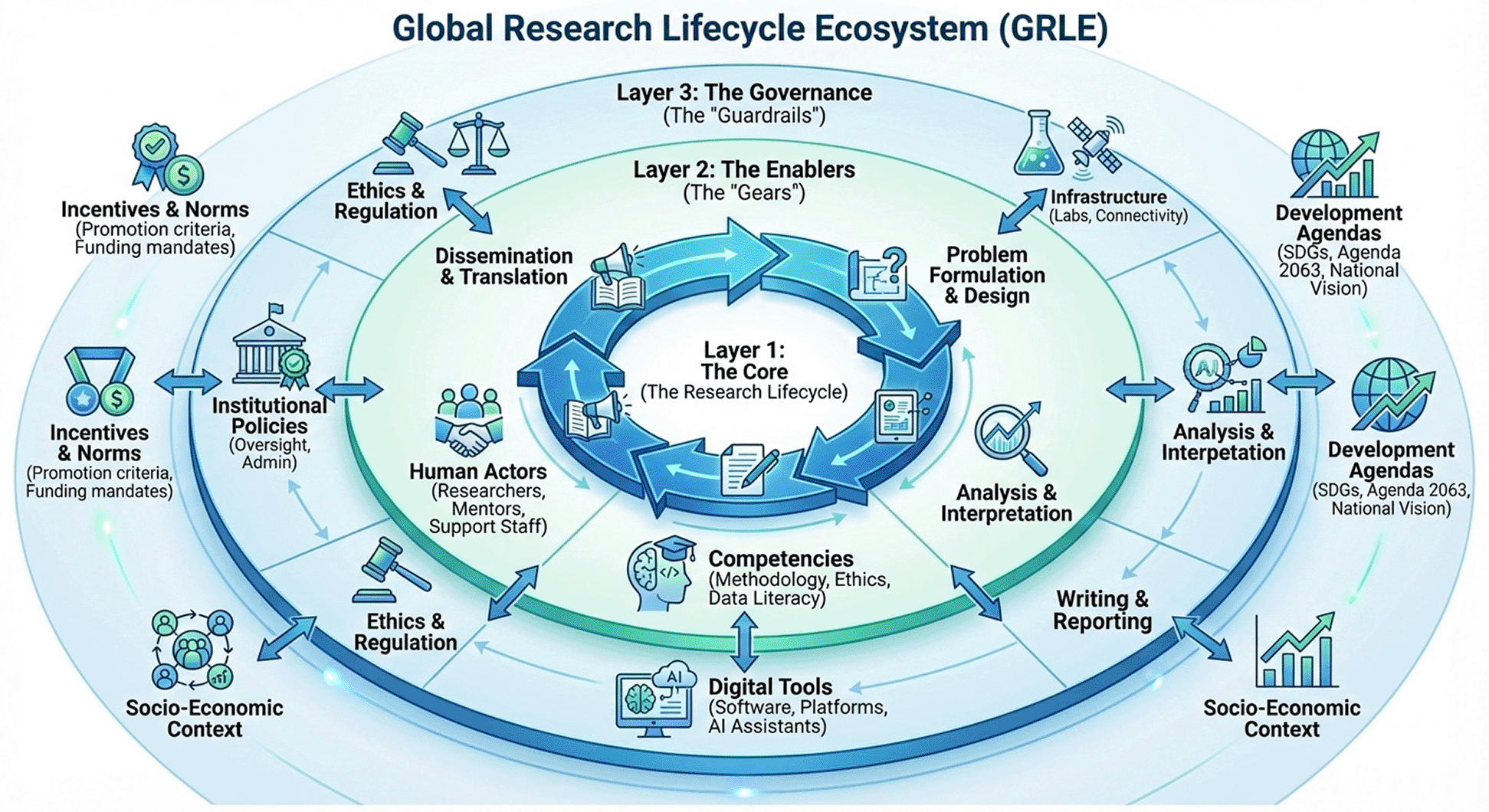
The model places the iterative research lifecycle (center) within nested layers of influence. Unlike linear “pipeline” models, the GRLE illustrates how research performance is determined by the dynamic interaction between human actors and digital tools (inner orbit), institutional governance (middle orbit), and broader incentives and development agendas (outer orbit). Bi-directional arrows indicate the critical feedback loops necessary for system sustainability.
The challenges facing global research systems are unlikely to be resolved through incremental reforms. Achieving the ambitions of global development agendas requires integrated, adaptive ecosystems that can respond to evolving scientific and social demands. By reframing research capacity strengthening as an ecosystem challenge, the GRLE provides a pathway for aligning research practice with development priorities, ensuring that investments in science translate into measurable societal benefits.
Persistent weaknesses in research quality and impact reflect systemic challenges that cannot be resolved through isolated trainings, discrete tools, or sporadic funding mechanisms alone. This article has argued for a fundamental paradigm shift: moving away from linear, input-focused “pipeline” models of research capacity toward an ecosystem-oriented framework.
The Global Research Lifecycle Ecosystem (GRLE) provides the necessary conceptual lens and diagnostic methodology to identify the root causes of research inefficiency—specifically, the fragmentation of digital workflows and the misalignment of institutional incentives. By recognizing research as a dynamic interaction of actors, competencies, institutions, and digital infrastructure, stakeholders can move beyond addressing symptoms to strengthening the underlying system.
As digital technologies and artificial intelligence increasingly mediate the scientific process, the stakes for “Lifecycle Coherence” have never been higher. The transition to AI-driven research risks exacerbating existing disparities if implemented through fragmented, proprietary silos. However, as demonstrated in our technical framework and use cases, if guided by the principles of unified metadata, API-first interoperability, and integrated workstations, these technologies offer an unprecedented opportunity to democratize access to high-quality research practices and enhance methodological rigor at scale.
To realize this vision, we call upon major global health and development agencies- such as the EDCTP, the Global Fund, and the Bill & Melinda Gates Foundation- to evolve from project-based funders into “Ecosystem Stewards.” This involves mandating the use of coherent Digital Research Infrastructures (DRI) that preserve the “digital exhaust” of research, thereby ensuring that every investment contributes to a permanent, reusable knowledge base in the Global South.
Ultimately, strengthening research ecosystems is not just an academic imperative but a developmental one. By reframing research capacity as critical development infrastructure, the GRLE aligns scientific production with the urgent demands of the Sustainable Development Goals and AU Agenda 2063. The future of global research depends on our collective ability to steward these ecosystems, ensuring that investments in science translate into reliable, reproducible knowledge for societal good.
| Views | Downloads | |
|---|---|---|
| F1000Research | - | - |
|
PubMed Central
Data from PMC are received and updated monthly.
|
- | - |
Provide sufficient details of any financial or non-financial competing interests to enable users to assess whether your comments might lead a reasonable person to question your impartiality. Consider the following examples, but note that this is not an exhaustive list:
Sign up for content alerts and receive a weekly or monthly email with all newly published articles
Already registered? Sign in
The email address should be the one you originally registered with F1000.
You registered with F1000 via Google, so we cannot reset your password.
To sign in, please click here.
If you still need help with your Google account password, please click here.
You registered with F1000 via Facebook, so we cannot reset your password.
To sign in, please click here.
If you still need help with your Facebook account password, please click here.
If your email address is registered with us, we will email you instructions to reset your password.
If you think you should have received this email but it has not arrived, please check your spam filters and/or contact for further assistance.

Comments on this article Comments (0)