Keywords
Health Literacy, Multidrug-resistant, Systematic Review, Treatment, Tuberculosis

Health Literacy, Multidrug-resistant, Systematic Review, Treatment, Tuberculosis
Tuberculosis (TB) remains one of the leading causes of death from infectious disease globally, despite major advances in diagnosis and treatment.1 According to the World Health Organization (WHO) Global Tuberculosis Report 2024,1 an estimated 10.3 million people developed TB in 2023, with 1.3 million deaths among HIV-negative individuals and 167,000 deaths among those living with HIV. Among all forms of TB, multidrug-resistant and rifampicin-resistant tuberculosis (MDR/RR-TB) represents one of the most critical public health threats.2 In 2023, approximately 410,000 people developed MDR/RR-TB, but treatment success remained at only around 50%, far below the End TB Strategy target of 90%.3 The low success rate reflects the persistent challenges of long treatment duration, severe drug-related side effects, and high loss-to-follow-up rates, especially in low- and middle-income countries (LMICs) where TB burden is highest.4
Treatment adherence is the cornerstone of successful MDR-TB management.5 Patients are required to complete months of multidrug regimens with strict dosing schedules and frequent clinical monitoring.6 Non-adherence contributes to treatment failure, relapse, and the emergence of multidrug-resistant TB (XDR-TB), which further complicates control efforts.7 While structural and programmatic barriers such as drug stock-outs, limited healthcare access, and inadequate supervision are well documented, behavioral and cognitive determinants of adherence are increasingly recognized as critical but underexplored.8 Patients’ understanding of their disease, their ability to follow medical instructions, and their confidence in communicating with healthcare providers are essential components of long-term treatment success. These elements are collectively influenced by health literacy.9
Health literacy, as defined by the WHO and Nutbeam’s conceptual model, is the ability of individuals to access, understand, evaluate, and apply health-related information to make informed decisions regarding their health.1 It encompasses three progressive domains, functional, communicative, and critical literacywhich collectively determine how effectively individuals can engage with the healthcare system.10 Evidence from chronic diseases such as diabetes, hypertension, and HIV demonstrates that higher health literacy is associated with better treatment adherence, improved self-management, and reduced hospitalization rates.11 Conversely, low health literacy has been linked to poor medication compliance, misunderstanding of instructions, delayed care-seeking, and increased morbidity.12 In the context of TB, patients with limited literacy may struggle to comprehend complex treatment regimens, recognize side effects, or maintain consistent communication with health professionals, thereby increasing the risk of poor outcomes.13
Previous studies on TB adherence have primarily focused on pharmacological, structural, or technological interventions rather than literacy-related factors.14 For instance, research on directly observed therapy (DOTS) emphasized supervision and logistical support, while more recent digital adherence technologies such as electronic medication monitors and mobile phone reminders have improved monitoring capacity but do not always address the underlying issue of comprehension and empowerment.15 Moreover, patient education and counseling interventions have shown promise in enhancing adherence, yet these initiatives often lack a standardized framework for assessing or improving health literacy levels.16 Systematic reviews on TB adherence have largely evaluated intervention effectiveness or digital innovations, but few have specifically examined health literacy as a determinant of treatment success in MDR-TB. Consequently, there remains a critical gap in understanding how literacy shapes adherence behaviors, patient–provider communication, and long-term outcomes within MDR-TB programs.
This study aimed to summary the evidence on health literacy as a determinant of treatment success in MDR-TB and describe intervention approaches targeting literacy-related domains.
This systematic review was conducted to synthesize existing evidence on the relationship between health literacy and treatment success in patients with multidrug-resistant tuberculosis (MDR-TB) between January 1, 2015, and October 11, 2025. This review follows the Preferred Reporting Items for Systematic Reviews and Meta-Analyses (PRISMA 2020) guidelines. All identified records were imported into Zotero (https://www.zotero.org/accessed on 11 October 2025) for reference management and automatic duplicate removal.
A comprehensive literature search was performed in PubMed and Scopus databases on October 11, 2025. The search strategy combined Medical Subject Headings (MeSH) and free-text terms related to tuberculosis, health literacy, and treatment outcomes. The search key included a combination of keywords: “multidrug-resistant tuberculosis” OR “MDR-TB” OR “rifampicin-resistant tuberculosis” AND “health literacy” OR “health education” OR “health information” OR “self-care behavior” AND “treatment outcome” OR “treatment success” OR “adherence” OR “completion.”. Additional articles were identified by manually screening the reference lists of relevant studies and grey literature in WHO and World Bank repositories, as well as Google Scholar.
Studies were considered eligible if they investigated health literacy, patient knowledge, or educational interventions as determinants, mediators, or predictors of treatment adherence or treatment success among patients diagnosed with multidrug-resistant or rifampicin-resistant tuberculosis (MDR/RR-TB). Eligible studies included those employing quantitative, qualitative, or mixed-methods designs, published as peer-reviewed full-text articles in English between January 2015 and October 2025. Studies were excluded if they focused exclusively on drug-susceptible tuberculosis, lacked original outcome data (such as review articles, commentaries, editorials, or study protocols), or were conference abstracts without peer review.
Two independent reviewers screened the titles and abstracts of all retrieved records using predefined eligibility criteria in Rayyan AI software.17 Discrepancies were resolved through discussion and consensus. Full texts of potentially relevant articles were then reviewed to confirm eligibility. A third reviewer verified the inclusion list to ensure completeness.
For each included study, the following data were extracted into a standardized Excel template: author, year, country, study design, study type, evaluation method, and outcomes ( Table 1). Data synthesis was performed through descriptive summary and thematic analysis of relationships between health literacy dimensions and MDR-TB treatment outcomes. This systematic review was not prospectively registered in the PROSPERO database.
| Author (year) | Country | Design | Study type | Duration of intervention | Evaluation | Outcome |
|---|---|---|---|---|---|---|
| Charalambous et al. (2024)18 | South Africa | Cluster RCT | Digital adherence system (Wisepill EvriMED + tiered feedback) vs standard care | 45 months | Adherence (≥80%), clinical outcomes | Adherence improved (81% vs 51%), but no significant difference in treatment outcomes. |
| Dilas et al. (2023)19 | Peru | Cross-sectional | Nurse-led health education mediating social support–adherence link | 10 months | SEM mediation model | Health education significantly improved adherence and mediated social support effects. |
| Peresu et al. (2022)20 | Eswatini | Cross-sectional | KAP of community supporters delivering MDR-TB injections | 1 months | Questionnaire & observation | KAP satisfactory, but 35% held stigma; highlights need for literacy-oriented MDR-TB training. |
| Thomas et al. (2021)21 | India | Qualitative | Medication Event Reminder Monitor (digital pillbox for MDR-TB) | 11 months | Thematic analysis (UTAUT framework) | Highly acceptable; improved organization and HCP relations; barriers: stigma, device issues. |
| Horter et al. (2020)22 | Uzbekistan | Qualitative | Person-centred MDR-TB care (short-course regimen) | 2 months | In-depth interviews with patients & HCWs | Dialogue and education built trust and motivation; improved adherence through engagement. |
| Deshmukh et al. (2018)23 | India | Qualitative (Grounded Theory) | Social, family, and counselling support (PSG model) | 7 months | Thematic analysis (Social Cognitive Theory) | Key adherence drivers: awareness, counselling, family/social support, nutrition. |
| Leeka et al. (2025)24 | Thailand | Case–control | Determinants of MDR-TB (health literacy, attitudes, self-care, income) | 6 months | Multivariable logistic regression | Low HL (AOR = 2.11) independently predicted MDR-TB; poor attitude/self-care also significant. |
The systematic search yielded a total of 231 records, consisting of 42 from PubMed and 189 from Scopus. Following the removal of 68 duplicates, 163 unique records were screened for eligibility based on titles and abstracts. During this phase, 152 records were excluded for not meeting the predefined inclusion criteria due to factors such as inappropriate study design (n = 48), publication type (n = 39), study population (n = 24), or reported outcomes (n = 41). The remaining 11 full-text articles were retrieved for comprehensive evaluation. After detailed assessment, four articles were excluded two that did not contain a specific health-literacy-related intervention and two that were not available in open access format. Ultimately, seven studies satisfied all inclusion criteria and were incorporated into the final synthesis, as illustrated in ( Figure 1).
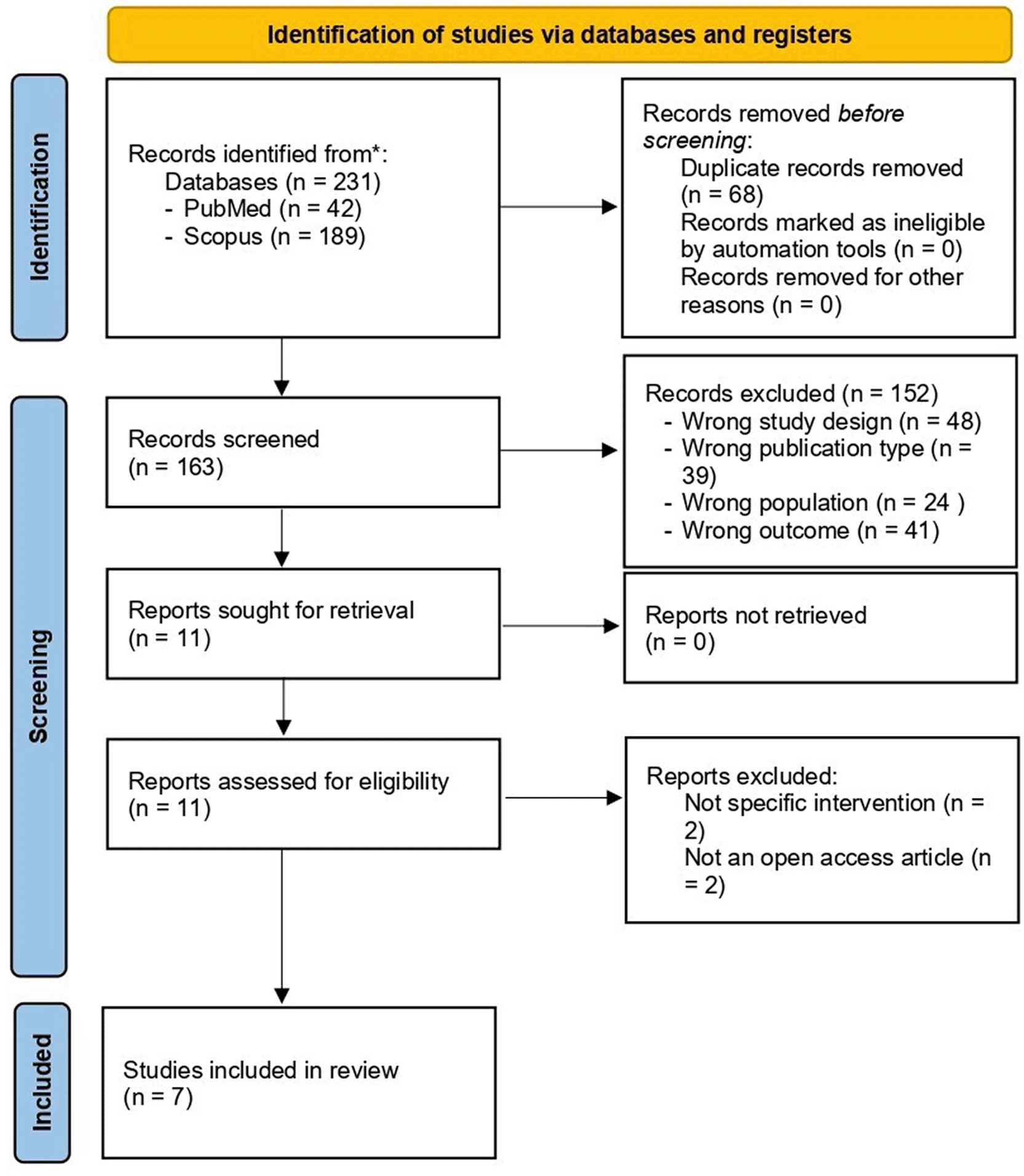
Figure 1 illustrates the identification, screening, eligibility assessment, and inclusion of studies following the PRISMA guidelines.
A total of seven studies published between 2018 and 2025 met the inclusion criteria and were incorporated into the final synthesis ( Table 1). These studies were conducted across six low- and middle-income countries: India (n = 2), Uzbekistan (n = 1), Thailand (n = 1), Eswatini (n = 1), Peru (n = 1), and South Africa (n = 1) (see Table 1). Collectively, they represent diverse regional contexts of multidrug-resistant tuberculosis (MDR-TB) management and various methodological approaches, including one cluster randomized controlled trial, one case–control study, two cross-sectional analytical studies, and three qualitative investigations.
The interventions examined were heterogeneous in design and focus, reflecting multiple operationalizations of health literacy. Quantitative studies primarily assessed patient education, health literacy levels, self-care behaviours, and determinants of adherence using standardized questionnaires and statistical modelling. Qualitative research explored communication, counselling, and patient provider relationships through thematic and grounded theory approaches. Duration of interventions ranged from one month to forty-five months, indicating variability in the depth and sustainability of implementation across settings.
In South Africa,18 a cluster randomized trial evaluated a digital adherence support system using Wisepill EvriMED with tiered feedback, demonstrating improved adherence rates compared to standard care. Cross-sectional studies in Peru19 and Eswatini20 investigated nurse-led health education and the knowledge, attitudes, and practices of community treatment supporters, respectively. In India21 and Uzbekistan,22 qualitative studies assessed patient experiences with digital pillboxes and person-centered care models, emphasizing engagement and communication in MDR-TB management. A grounded theory study23 further highlighted the role of family and social support in adherence. Finally, a case–control study in Thailand24 identified limited health literacy as an independent predictor of MDR-TB occurrence, underscoring literacy’s influence on patient outcomes. Overall, the included studies captured a broad spectrum of literacy-related interventions, ranging from digital tools and educational counselling to person-centered frameworks, evaluated through both behavioural and clinical indicators of adherence and treatment success.
To the best of our knowledge, this is the first systematic review to critically synthesize the evidence on the role of health literacy in determining treatment success for multidrug-resistant tuberculosis (MDR-TB). Our analysis of seven geographically diverse studies confirms that health literacy is a pivotal, yet complex, factor in MDR-TB care. However, it also reveals a field in its infancy, characterized by conceptual fragmentation and methodological challenges that must be addressed to translate potential into practice.
A primary finding of this review is the striking conceptual inconsistency in how health literacy is operationalized across the MDR-TB literature. We observed a conceptual blurring where “health literacy” was interchangeably used to describe patient knowledge, educational interventions, self-care behaviors, and communication skills. This conflation treats health literacy as both an input and an outcome, thereby complicating the synthesis of evidence and obscuring the true mechanistic role it plays. For instance, Study in Eswatini20 measured literacy via knowledge and attitudes,20 study in Peru19 framed it as an educational intervention mediating social support. To advance this field, it is imperative to adopt a unified theoretical framework, such as Sørensen’s Integrated Model, which distinguishes between functional (accessing and understanding information), interactive (communicating and applying information), and critical (critically appraising information for informed decision-making) health literacy dimensions.25 The critical gap highlighted by our review is the complete absence of studies using validated, multidomain health literacy instruments tailored to the MDR-TB context. Without such tools, we cannot pinpoint which specific literacy dimension understanding drug side-effects (functional) or negotiating treatment with a provider (interactive) is most predictive of treatment success, thereby hindering the development of targeted interventions.
Beyond mere association, our synthesis elucidates the complex, multi-faceted mechanistic pathways through which health literacy influences MDR-TB outcomes. The evidence demonstrates that its role is not monolithic but context-dependent. It functions as a direct predictor, as shown study in Thailand24 where low health literacy independently doubled the odds of MDR-TB. More subtly, it acts as a mediator, exemplified study in Peru,19 where health literacy was the crucial cognitive and skills-based mechanism that translated external social support into internalized motivation and actionable self-care behaviors, ultimately improving adherence. Furthermore, health literacy serves as a critical enabler for digital health technologies. The studies in India21 and South Africa18 demonstrate that the efficacy of digital pillboxes and adherence monitors is contingent upon a patient’s baseline literacy to interpret device alerts, understand their significance, and problem-solve technical issues. This novel insight moves the field beyond a simple linear correlation and positions health literacy as a dynamic competency that interacts with and amplifies other therapeutic factors.
The included studies evaluated a spectrum of intervention modalities, from digital pillboxes to person-centred counselling. Our analysis suggests that while technology-driven tools show promise for objective monitoring, the most profound impacts on long-term adherence likely stem from interactive, dialogue-based models. The Study in Uzbekistan22 on person-centred care is paradigmatic; its effectiveness lies in its direct cultivation of interactive health literacy. By fostering open dialogue between patients and healthcare workers,26 it builds trust, mutual understanding, and shared decision-making, which in turn enhances intrinsic motivation and the problem-solving skills necessary to navigate a lengthy27 and arduous treatment course.28,29 A critical synthesis of these findings leads us to highlight that the most successful interventions are inherently multi-component. They do not seek to improve literacy in a vacuum but integrate literacy support within a broader framework that simultaneously addresses structural barriers such as stigma,23 nutritional support, and socioeconomic constraints, creating a holistic ecosystem for patient success.
The exclusive derivation of evidence from low- and middle-income countries (LMICs)18,23 underscores the global health equity dimensions of the MDR-TB challenge and rightly focuses attention on the settings where the burden is greatest. Our review clearly indicates that local context acts as a powerful effect modifier. The impact of a health literacy intervention is not determined solely by its design but is profoundly shaped by local health system structures, cultural beliefs about illness and medication, and the pervasive level of TB-related stigma, which varied significantly between the settings in Eswatini,20 Peru,19 and India.21 This necessitates a fundamental rejection of the “one-size-fits-all” approach.30 Strategies must be locally adapted and co-designed with communities to ensure cultural resonance31 and address context-specific barriers.24 In this endeavour, the dual role of community health workers and peer supporters, as highlighted across multiple studies,32 becomes indispensable. They act not only as literacy facilitators but also as cultural translators, effectively bridging the chasm between the formal health system and the patient’s lived experience.33
This review consolidates compelling evidence that strengthening health literacy is a viable and patient-centric strategy to improve MDR-TB treatment outcomes. It is a modifiable determinant that operates through direct, mediated, and enabling pathways and is most effectively bolstered through multi-component, person-centred interventions. However, these conclusions must be interpreted in the context of this review’s limitations. The small number of included studies (n = 7), their significant methodological heterogeneity (encompassing RCTs, cross-sectional, and qualitative designs), and the restriction to English-language publications may introduce selection bias and limit the generalizability of our findings. Furthermore, the conceptual fragmentation discussed earlier inherently constrains the robustness of any cross-study synthesis. These limitations, however, clearly chart the course for future research. There is an urgent need for prospective cohort studies that employ validated, multidimensional health literacy instruments to establish causal relationships and quantify the effect size of specific literacy dimensions. Concurrently, the field requires the development and rigorous evaluation of complex interventions specifically designed to target functional, interactive, and critical health literacy within MDR-TB care programs. Translating this evidence into practice demands that national TB programs move beyond passive information dissemination and instead integrate routine health literacy assessments and train healthcare providers in literacy-sensitive communication techniques. By doing so, we can leverage health literacy not just as a concept, but as a powerful, evidence-based tool to combat the global threat of MDR-TB.
This systematic review establishes health literacy as a critical and modifiable determinant of treatment success in multidrug-resistant tuberculosis (MDR-TB), functioning through direct, mediated, and enabling pathways. The findings advocate for the integration of structured, multidimensional health literacy assessments into MDR-TB programs and highlight the superior efficacy of interactive, person-centred interventions over passive education. These insights position enhanced health literacy as a viable, patient-centric strategy to improve adherence and outcomes in MDR-TB care. However, the current evidence base is limited by conceptual inconsistencies and methodological heterogeneity. Therefore, future research must employ validated health literacy instruments to precisely quantify its impact and develop targeted interventions, which is essential for optimizing MDR-TB treatment and curbing the global threat of drug resistance.
| Views | Downloads | |
|---|---|---|
| F1000Research | - | - |
|
PubMed Central
Data from PMC are received and updated monthly.
|
- | - |
Provide sufficient details of any financial or non-financial competing interests to enable users to assess whether your comments might lead a reasonable person to question your impartiality. Consider the following examples, but note that this is not an exhaustive list:
Sign up for content alerts and receive a weekly or monthly email with all newly published articles
Already registered? Sign in
The email address should be the one you originally registered with F1000.
You registered with F1000 via Google, so we cannot reset your password.
To sign in, please click here.
If you still need help with your Google account password, please click here.
You registered with F1000 via Facebook, so we cannot reset your password.
To sign in, please click here.
If you still need help with your Facebook account password, please click here.
If your email address is registered with us, we will email you instructions to reset your password.
If you think you should have received this email but it has not arrived, please check your spam filters and/or contact for further assistance.

Comments on this article Comments (0)