Keywords
Dao-De Jing, Tanakh, Hebrew Bible, Hyperarchetype, Masoretic Text, Samaritan Pentateuch, Septuagint, Philology

Dao-De Jing, Tanakh, Hebrew Bible, Hyperarchetype, Masoretic Text, Samaritan Pentateuch, Septuagint, Philology
The 道德經 (Dao-De Jing), literally the “Way-Virtue Classic” or the “Morality Classic”, is a Chinese classic traditionally attributed to 老子 (Lao-Zi) and supposedly written between the 5th and 3rd centuries BC. Most of the editions of the Dao-De Jing contain around 5,400 characters. For instance, the first electronic edition that I found on the internet is composed of exactly 5,362 characters, which is a very ordinary number. However, numerous Dao-De Jing manuscripts discovered in Dunhuang are composed of exactly 4,999 characters, and an historical source of the 7th century affirms that there existed a version of the Dao-De Jing composed of exactly 5,000 characters. This same Chinese source tells that 葛玄 (Ge Xuan), an alchemist of the 2nd–3rd century, one day shortened the text of the Dao-De Jing so as to fit the “magical” number of 5,000.1
Genesis 1–3 is an account of Primeval History from the creation of the world unto the fall of Adam and Eve. According to the Hebrew tradition, Genesis 1–3, as a passage of the Torah, would have been indited by Moses in the wilderness of Sinai, and would date from the 13th–14th century BC. However, according to the Supplementary Model; model presently prevailing in historico-critical exegesis of the Enneateuch; a first literary layer called D, for Deuteronomist, would have foremost been written by a first author (or group of authors) in Jerusalem during the second half of the 7th century BC, thus producing the earliest form of Deuteronomy; then, a second literary layer called DtrH, for Deuteronomistic History, would have subsequently been added by a second author (or group of authors) in Babylonia during the early exilic period, thus producing the earliest form of “Deuteronomy-Joshua-Judges-Samuel-Kings”; then, a third literary layer called J, for Jahwist, would have subsequently been added by a third author (or group of authors) in Babylonia during the late exilic period, thus producing the earliest form of the Enneateuch; finally, a fourth and last literary layer called P, for Priestly, would have subsequently been added by a fourth author (or group of authors) in Jerusalem during the Second Temple period, thus producing the final form of the Enneateuch (with the exception of some late additions such as Genesis 14, which would date from the Hellenistic period); this is why Genesis 2:4–3:24, as type J literature, would have been written by a first author (or group of authors) in Babylonia around 540 BC, before being edited by a second author (or group of authors) in Jerusalem around 400 BC, while Genesis 1:1–2:3, as type P literature, would have directly been written by the same second author (or group of authors) in Jerusalem around 400 BC.2 By the way, there exist established affinities between J and Deutero-Isaiah.3
Jeremiah 50–51 is an oracle against Babylon known for to be the only passage of the Tanakh (with the sole exception of Jeremiah 25:26) to use a cipher, in this instance the Atbash cipher, the which consists in substituting each letter of the message with its opposite in the alphabet. Indeed, לב קמי (Leb-Qamai ) in Jeremiah 51:1 is a cryptogram for כשדים (Chaldea), while ששך (Šešak) in Jeremiah 51:41 is a cryptogram for בבל (Babylon). By the way, Jeremiah 50–51 is composed of Jeremiah 50:1–51:58, which is a writing in verse interspersed with manifold passages in prose, followed by Jeremiah 51:59–64, which is an appendix in prose interspersed with no passages in verse; and according to the superscription of Jeremiah 51:59–64 (Jer. 51:59), Jeremiah 50–51 would have been indited by Jeremiah, and would date from 594/593 BC. However, according to numerous exegetes, the final form of the Jeremian Oracles Against the Nations (OANs) would date from the Persian period (between 539 and 330 BC).4 Therebeside, there exist established parallels between Jeremiah 50–51 and Deutero-Isaiah.5
As passages of the Tanakh, Genesis 1–3 and Jeremiah 50–51 reached us through different textual witnesses divided into three large families respectively centred around the Masoretic Text, which is the text of the Tanakh such that it has been preserved by the Jewish community, the Samaritan Pentateuch, which is the text of the Torah such that it has been preserved by the Samaritan community, and the Septuagint, which is the text of the Tanakh such that it was translated into Greek during the 2nd–3rd century BC from a now lost Hebrew Vorlage. There exist two main models explaining the textual development of the Tanakh: the so-called Model a and the so-called Model b. According to the Model a, deemed more reasonable, the different textual witnesses attesting unto the Tanakh would be descended from a single last common ancestor called archetype (Urtext), itself descended from a single first common ancestor called autograph (original).6 (See Figure 1.) However, according to the Model b, deemed less reasonable, the different textual witnesses would never have had a single common ancestor, and would be descended from several early parallel texts; this is why the most fundamental differences observed between the main families of manuscripts might result from oral variants rather than subsequent “mutations”.7
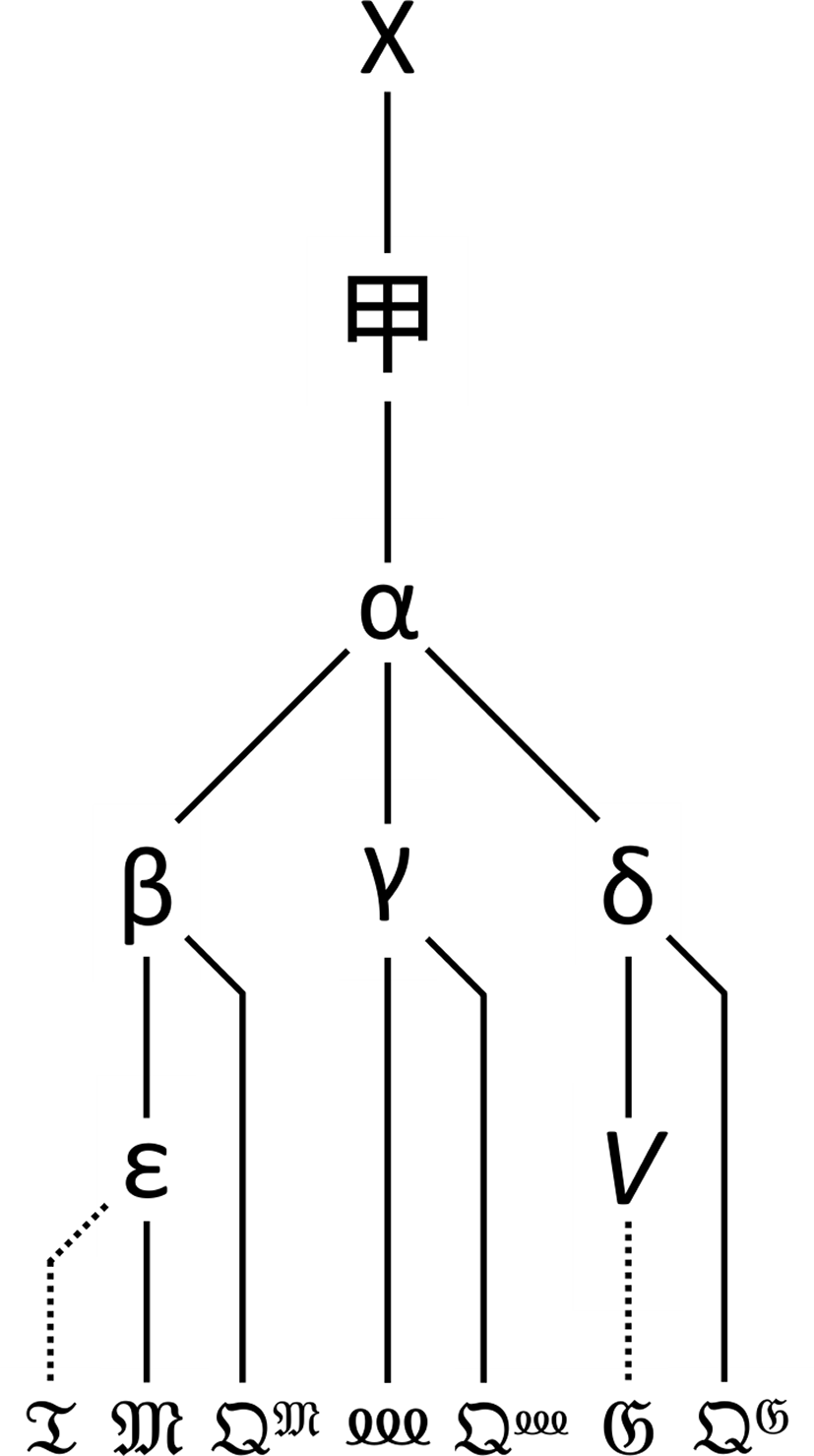
Through the Septuagint, the Book of Jeremiah reached us in a form about 1/7th shorter, lacking certain passages in prose (such as the end of Jeremiah 50:28) as well as certain passages in verse (such as Jeremiah 51:45–48) and placing the Jeremian OANs (Jer. 45–51) just between Jeremiah 25:14 and Jeremiah 25:15, thus shifting a large part of the book by seven chapters. According to a majority of scholars relying on the principle of Lectio Brevior, the long form of the Book of Jeremiah would be an extended edition of the short form; this is why the archetype would be better attested by the short form than by the long form.8 However, according to a minority of scholars going against the principle of Lectio Brevior, the short form of the Book of Jeremiah would be an abridged edition of the long form; this is why the archetype would be better attested by the long form than by the short form.9 Well, we shall see that the majority is not always right.
If ye have read the first chapters of the Book of Genesis, then there are two things which have probably jumped out at you:
• Firstly, it has probably jumped out at you that God is named אלהים (Elohim) from Genesis 1:1 unto Genesis 2:3, then יהוה אלהים (YHWH Elohim) from Genesis 2:4 unto Genesis 3:24, and finally יהוה (YHWH) alone from Genesis 4:1; which shows that Genesis 1:1–2:3 and Genesis 2:4–3:24 are two unambiguously delineated literary units;
• Secondly, it has probably jumped out at you that a totally irrelevant passage comes to interrupt the account of creation and the story of Adam and Eve, right in the middle, for to tell us of a river which would flow out of the Garden of Eden for to divide into four branches: I speak here of Genesis 2:10–14, the which is furthermore written in the perfect tense, whereas the surrounding text is in the imperfect tense; which strongly suggests that it is an interpolation.10
Having these two observations in mind, let us now take a good edition of the Masoretic Text such as the Koren Tanakh, and count the number of letters which compose Genesis 2:4–3:24. (The Koren Tanakh is the most widespread eclectic edition of the Masoretic Text, and can be consulted at fourmilab.ch/etexts/www/hebrew/Bible.) Thus, we obtain a sum of exactly 2,398 letters, which is a very ordinary number.
At present, let us retake the same edition of the Masoretic Text, and recount the number of letters which compose Genesis 2:4–3:24, but this time without Genesis 2:10–14. Thus, we obtain a new sum of exactly 2,200 letters, which is exactly the number of letters in the Hebrew alphabet multiplied by 100; which brings to light the existence of a nonrandom choice of the number of letters in Genesis 2:4–3:24, and confirms the absence of Genesis 2:10–14 from an earlier version of Genesis 2:4–3:24.
Given that the probability that a number be a multiple of 100 is 1 in 100, that the probability that a number be a multiple of 22 given that it is a multiple of 100 is 1 in 11, and that we have performed 2 “drawings” for 1 positive result, the p-value can therefore be approximated as p = 2/(11*100) ≈ 1.8 × 10⁻³ ⇒ Z > 3σ; this is why this single result would be widely accounted statistically significant by a “hard” science such as biology. (Even if it had been ambiguous that the boundary between the “Elohim passage” and the “YHWH Elohim passage” were situated just before or just after Genesis 2:4a, the p-value could, even so, be approximated as p = 4/(11*100) ≈ 3.6 × 10⁻³ ⇒ Z > 2σ; this is why this single result would, even so, be accounted statistically significant by a “hard” science such as biology.)
Now, let us retake the same good edition of the Masoretic Text, and count the number of letters which compose the appendix in prose of Jeremiah 50–51 (Jer. 51:59–64). Thus, we obtain a sum of exactly 391 letters, which is a very ordinary number.
At present, let us retake the same edition of the Masoretic Text, and recount the number of letters which compose this appendix in prose, but this time without its superscription (Jer. 51:59). Thus, we obtain a new sum of exactly 300 letters, which is exactly a multiple of 100; which brings to light the existence of a nonrandom choice of the number of letters in Jeremiah 51:59–64, and strongly suggests the absence of the superscriptions from an earlier version of Jeremiah 50–51.
Given that the probability that a number be a multiple of 100 is 1 in 100, and that we have performed 2 “drawings” for 1 positive result, the p-value can therefore be approximated as p = 2/100 = 2 × 10⁻² ⇒ Z > 2σ; this is why this single result would be accounted statistically significant by a “hard” science such as biology. (Even if it had been ambiguous whether Jeremiah 51:64b belonged or belonged not unto the appendix in prose of Jeremiah 50–51, the p-value could, even so, be approximated as p = 4/100 = 4 × 10⁻² ⇒ Z > 2σ; this is why this single result would, even so, be accounted statistically significant by a “hard” science such as biology.)
Now, let us retake the same good edition of the Masoretic Text, and count the number of letters which compose “Genesis 1–3 minus Genesis 2:10–14”. Thus, we obtain a sum of exactly 4,015 letters, which is a very ordinary number but quite nigh to 4,000. Let us therefore try to see if there exists in Genesis 1:1–2:3 a passage of exactly 15 letters which would seem to have been interpolated; which would therefore make of Genesis 1:1–2:3 a whole of exactly 1,800 letters. Thence, we note that it is written
ויברא אלהים את האדם בצלמו
בצלם אלהים ברא אתו
זכר ונקבה ברא אתם
(And Elohim createth the man in his image;
in the image of Elohim, he created him.
A male and a female, he created them.)
in Genesis 1:27. Yet Genesis 1:27b is composed of exactly 15 letters and seems to be an interpolatory gloss added so as to clear up the fact that God creates man in the image of God and not in the image of man; whereunto is added that there seems to exist in Genesis 1:1–2:3 no other passage of exactly 15 letters which would seem to have been interpolated; which suggests that Genesis 1:27b was absent from an earlier version of Genesis 1:1–2:3, and that the nonrandom choice of the number of letters in Genesis 2:4–3:24 extends to Genesis 1:1–2:3.
Given that the probability that a number be a multiple of 1,000 ± 15 is 31 in 1,000, the p-value can therefore be approximated as p = 31/1000 = 3.1 × 10⁻² ⇒ Z > 2σ; this is why this single result would be accounted statistically significant by a “hard” science such as biology.
Now, let us retake the same good edition of the Masoretic Text, and count the number of letters which compose Jeremiah 50:1–51:58, obviously (in view of result 2) without its superscription (Jer. 50:1). Thus, we obtain a sum of exactly 5,645 letters, which is a very ordinary number.
At present, let us retake the same edition of the Masoretic Text, and recount the number of letters which compose “Jeremiah 50:2–51:58”, but this time without the passages in prose such that they are delineated within the NRSVUE (New Revised Standard Version Updated Edition), and without Jeremiah 51:20–23, which, just as Genesis 2:10–14, is written in the perfect tense, whereas the surrounding text is in the imperfect tense; this is probably why it constitutes a separate section within the NRSVUE. (The NRSVUE is the reference academic translation within the anglophone world, and can be consulted at biblegateway.com/passage/?search=Jeremiah%20&version=NRSVUE.) Thus, we obtain a new sum of exactly 3,943 letters, which is still a very ordinary number.
At present, let us retake the same edition of the Masoretic Text, and recount the number of letters which compose “Jeremiah 50:2–51:58 minus Jeremiah 51:20–23 and the passages in prose”, but this time with Jeremiah 51:24, which is the shortest passage in prose and the only one to be found in the second half of the text. Thus, we obtain a new sum of exactly 4,000 letters, which is exactly the same number as in Genesis 1–3; which brings to light the existence of a nonrandom choice of the number of letters in Jeremiah 50:1–51:58, and shows the absence of Jeremiah 50:3–10, Jeremiah 50:17–20, Jeremiah 50:28–30, Jeremiah 50:33–34, Jeremiah 50:39–40, Jeremiah 50:44–46, Jeremiah 51:11c, and Jeremiah 51:20–23 from an earlier version of Jeremiah 50:1–51:58.
Given (1) that the probability that a number be a multiple of 4,000 ± 57 is 115 in 4,000, (2) that the number of possible combinations between “to count the number of letters with or without Jeremiah 51:20–23” and “to count the number of letters with or without the passages in prose” is 4, and (3) that, assuming that the set of the passages in prose is a set of N letters randomly and uniformly partitioned into n subsets, the probability P that at least 1 passage in prose be composed of exactly 57 letters can therefore be determined by means of the hypergeometric distribution; the p-value can therefore be approximated as
⇒ Z > 2σ; this is why this result, in view of the preceding result, would be accounted statistically significant by a “hard” science such as biology.
In the introduction, I reported the fact that there exist established parallels between Jeremiah 50–51 and Deutero-Isaiah. Indeed, among the passages which compose “Jeremiah 50:2–51:58 minus interpolations”, Jeremiah 51:5–10, Jeremiah 51:15–19, Jeremiah 51:45–46, and Jeremiah 51:50–51 are written in an extremely recognisable “comfort/consolation style” characteristic of Deutero-Isaiah. However, Jeremiah 51:51, though its style seems to agree well with the general style of “Jeremiah 50:2–51:58 minus interpolations”, seems not to be in its proper place, as attested by the fact that it is put in dashes within the Segond 1910. (The Segond 1910 is the most widespread academic translation within the francophone world, and can be consulted at info-bible.org/lsg.) Therebeside, it appears, in view of the preceding result, that Jeremiah 50:1–51:58 is clearly divided into a first section containing manifold interpolations (Jeremiah 50:1–51:24), followed by a second section containing no interpolation (Jeremiah 51:25–51:58); which suggests that Jeremiah 50:1–51:24 and Jeremiah 51:25–51:58 are two unambiguously delineated literary subunits.
Having these observations in mind, let us now retake the same good edition of the Masoretic Text, and count the number of letters which respectively compose Jeremiah 50:1–51:24 and Jeremiah 51:25–51:58. Thus, we respectively obtain two sums of exactly 2,149 and 1,851 letters, which are very ordinary numbers.
At present, let us retake the same edition of the Masoretic Text, and recount the number of letters which respectively compose Jeremiah 50:1–51:24 and Jeremiah 51:25–51:58, but this time with Jeremiah 51:51 in Jeremiah 50:1–51:24, and without Jeremiah 51:51 in Jeremiah 51:25–51:58. Thus, we respectively obtain two new sums of exactly 2,200 and 1,800 letters, which are exactly the same numbers as in each of the two subsections which compose Genesis 1–3, but in the reverse order; which confirms the existence of a nonrandom choice of the number of letters in Genesis 1–3 and Jeremiah 50–51, and shows the presence of Jeremiah 51:51 in an earlier version of Jeremiah 50:1–51:24 as well as the absence of Jeremiah 51:51 from the same earlier version of Jeremiah 51:25–51:58.
Given that the probability that a number be a multiple of 2,200 is 1 in 2,200, and that we have performed 2 “drawings” for 1 positive result, the p-value can therefore be approximated as p = 2/2200 ≈ 9.1 × 10⁻⁴ ⇒ Z > 3σ; this is why this result, in view of the very first result, would be widely accounted statistically significant by a “hard” science such as biology. (Even if it had been ambiguous that the boundary between the “manifold interpolations section” and the “no interpolation section” be situated just before or just after Jeremiah 51:24, the p-value could, even so, be approximated as p = 4/2200 ≈ 1.8 × 10⁻³ ⇒ Z > 3σ; this is why this result, in view of the very first result, would, even so, be widely accounted statistically significant by a “hard” science such as biology.)
In view of the preceding result, let us now retake the same good edition of the Masoretic Text, and count the number of letters which compose Jeremiah 51:5–10 ⊔ 51:15–19 ⊔ 51:51. Thus, we obtain a sum of exactly 600 letters, which is exactly a multiple of 100; which confirms the existence of a nonrandom choice of the number of letters in Jeremiah 50–51, and shows that Jeremiah 51:5–10, Jeremiah 51:15–19, and Jeremiah 51:51 formed in one and the same literary set within an earlier version of Jeremiah 50–51 (which suggests, at first sight, that there was a reversal between Jeremiah 51:5–10 and Jeremiah 51:11–14).
Given that the probability that a number be a multiple of 100 is 1 in 100, the p-value can therefore be approximated as p = 1/100 = 1 × 10⁻² ⇒ Z > 2σ; this is why this result would be accounted statistically significant by a “hard” science such as biology.
In view of result 5, let us now retake the same good edition of the Masoretic Text, and count the number of words which compose the second section of “Jeremiah 50:2–51:58 minus interpolations” up to the second Atbash cryptogram (Jeremiah 51:25–40). Thus, we obtain a sum of exactly 220 words, which is exactly the number of letters in the Hebrew alphabet multiplied by 10; which brings to light the existence of a nonrandom choice of the number of words in Jeremiah 51:25–40.
Given that the probability that a number be a multiple of 10 is 1 in 10, and that the probability that a number be a multiple of 22 given that it is a multiple of 10 is 1 in 11, the p-value can therefore be approximated as p = 1/(11*10) ≈ 9.1 × 10⁻³ ⇒ Z > 2σ; this is why this result would be accounted statistically significant by a “hard” science such as biology.
The style of Jeremiah 50:35–38 seems to agree well with the general style of “Jeremiah 50:2–51:58 minus interpolations”, but evidently and undeniably differs from that of “Jeremiah 50:2–32 minus interpolations”; which shows that “Jeremiah 50:2–32 minus interpolations” is an unambiguously delineated literary unit.
Having this observation in mind, let us now retake the same good edition of the Masoretic Text, and count the number of words which compose the first section of “Jeremiah 50:2–51:58 minus interpolations” up to the first Atbash cryptogram (“Jeremiah 50:2–43 minus interpolations”). Thus, we obtain a sum of exactly 309 words, which is a very ordinary number.
At present, let us retake the same edition of the Masoretic Text, and, this time, count the number of words which compose “Jeremiah 50:2–32 minus interpolations”. Thus, we obtain a sum of exactly 222 words, which is still a very ordinary number but quite nigh to 220. Let us therefore try to see if there exists in “Jeremiah 50:2–32 minus interpolations” a passage of exactly two words which would seem to have been displaced. Thence, we note that Jeremiah 50:21e is doubly recessed within the NRSVUE. Yet Jeremiah 50:21e is composed of exactly two words; whereunto is added that there seems to exist in “Jeremiah 50:2–32 minus interpolations” no other passage of exactly two words which would seem to have been displaced; which strongly suggests that Jeremiah 50:21e was absent from an earlier version of Jeremiah 50:2–32, and that there also exists in Jeremiah 50:2–32 a nonrandom choice of the number of words. Furthermore, this result strongly suggests that Jeremiah 50:2–32 directly preceded Jeremiah 51:1, and therefore that Jeremiah 50:35–38 and Jeremiah 50:41–43 were absent from an earlier version of Jeremiah 50:2–43.
Given that the probability that a number be a multiple of 220 ± 2 is 5 in 220, and that we have performed 2 “drawings” for 1 positive result, the p-value can therefore be approximated as p = (2*5)/220 ≈ 4.5 × 10⁻² ⇒ Z > 2σ; this is why this result, in view of the preceding result, would be accounted statistically significant by a “hard” science such as biology.
In view of results 6 and 8, let us now retake the same good edition of the Masoretic Text, and count the number of letters which compose “Jeremiah 50:2–32 minus interpolations, minus Jeremiah 50:21e” ⊔ Jeremiah 51:1–4 ⊔ Jeremiah 51:11–14. Thus, we obtain a sum of exactly 1,200 letters, which is a multiple of 100; which confirms the identification of Jeremiah 50:21e as a displaced passage, confirms the existence of a nonrandom choice of the number of letters in Jeremiah 50–51, and shows that Jeremiah 50:2–32, Jeremiah 51:1–4, and Jeremiah 51:11–14 formed one and the same literary set within an earlier version of Jeremiah 50–51.
Given that the probability that a number be a multiple of 100 is 1 in 100, the p-value can therefore be approximated as p = 1/100 = 1 × 10⁻² ⇒ Z > 2σ; this is why this result would be accounted statistically significant by a “hard” science such as biology.
It appears, in view of results 5, 6, and 9, that an earlier version of Jeremiah 50:1–51:58 was composed of a first set of exactly 1,200 letters, preceding a second set of exactly 600 letters, preceding a third set of exactly 400 letters, preceding a fourth set of exactly 1,800 letters; the set of 400 letters being composed of Jeremiah 50:21e, Jeremiah 50:35–38, Jeremiah 50:41–43, and Jeremiah 51:24. Let us therefore try to see if there exists a combination between Jeremiah 50:21e, Jeremiah 50:35–38, Jeremiah 50:41–43, and Jeremiah 51:24 which would divide Jeremiah 50:21e ⊔ 50:35–38 ⊔ 50:41–43 ⊔ 51:24 into a subset of exactly 220 letters, accompanied by a smaller subset of exactly 180 letters. Thence, we note that Jeremiah 50:41–43 ⊔ 51:24 is composed of exactly 220 letters (and therefore that Jeremiah 50:21e ⊔ 50:35–38 is composed of exactly 180 letters); which confirms the existence of a nonrandom choice of the number of letters in Jeremiah 50–51, and shows that Jeremiah 50:41–43 and Jeremiah 51:24 formed one and the same literary subset, while Jeremiah 50:21e and Jeremiah 50:35–38 also formed one and the same literary subset, within an earlier version of Jeremiah 50–51.
Given that the probability that a number be a multiple of 220 is 1 in 220, and that the number of partitions of a set of 4 elements into 2 subsets is given by the Stirling number of the second kind S(4, 2) = 7, the p-value can therefore be approximated as p = 7/220 ≈ 3.2 × 10⁻² ⇒ Z > 2σ; this is why this result, in view of results 7 and 8, would be accounted statistically significant by a “hard” science such as biology.
In view of results 7 and 8, let us now count the number of stichs which respectively compose “Jeremiah 50:2–32 minus interpolations, minus Jeremiah 50:21e” and Jeremiah 51:25–40 according to the NRSVUE. Thus, we respectively obtain two sums of exactly 71 and 69 stichs, which are very ordinary numbers but very nigh to 70; which suggests the existence of a nonrandom choice of the number of stichs in Jeremiah 50:2–32 and Jeremiah 51:25–40. (220 words/70 stichs = 22/7 words per stich, and 22/7 is the first fractional approximation of π.)
Nevertheless, given (1) that the probability P(70|220) that a passage be composed of exactly 70 stichs given that it is composed of exactly 220 words can be determined by means of Bayes’ theorem, (2) that, assuming that the lengths of stich are i.i.d. (independent and identically distributed) discrete random variables, the probability P(220|70) can therefore be determined by means the Poisson distribution, and (3) that “Jeremiah 50:2–51:58 minus interpolations, minus passages in prose” is composed of exactly 1,021 words for 318 stichs according to the NRSVUE; the p-value can therefore be approximated as
⇒ Z < 2σ; this is why this result would not be accounted statistically significant by a “hard” science such as biology.
The foregoing results were obtained on the Koren Tanakh (1962), which is an eclectic edition of the Masoretic Text. (Contrary to a widespread belief, the Koren Tanakh is not a diplomatic edition of the Leningrad Codex, but an eclectic edition whose reference text is the Ḥumaš of Wolf Heidenheim for the Torah and the Miqra’ot Gedolot of Yaʿaqob ben Ḥayyim for the rest of the Tanakh.) Thence, let us therefore try to see if these results can be reproduced on any diplomatic edition of the Leningrad Codex (1008) and the Aleppo Codex (c. 920), which are accounted the two best manuscripts of the Masoretic Text. (The Leningrad Codex and the Aleppo Codex can both be consulted on stepbible.org. The first diplomatic edition of the Leningrad Codex is the BH3, and dates from 1937.) Thus, we may see that the 10 statistically significant results are all perfectly reproducible on both the Leningrad Codex and the Aleppo Codex, with the exception of two results which both vary by one letter in the Aleppo Codex. (See Table 1.) However, this variation by one letter being due to the presence of an additional mater lectionis within the word ויצא (wayyoṣe’) in Jeremiah 51:16, it can therefore be entirely ignored by virtue of the principle of Lectio Brevior; this is why the foregoing results are fully confirmed here.
Now, let us try to see if the foregoing results can be reproduced on any good edition of the Samaritan Pentateuch as well as on a reconstructed Hebrew Vorlage of the Septuagint.11 (The SP can be consulted on stepbible.org, and the Vorlage at ccat.sas.upenn.edu/gopher/text/religion/biblical/parallel.) Thus, we may see that the foregoing results are reproducible neither on the Samaritan Pentateuch nor on the Hebrew Vorlage of the Septuagint. (See Table 2.)
Given that the combined p-value can be calculated here as the product of the 10 statistically significant individual p-values, it can therefore be approximated here as p ≈ 5 × 10⁻²¹ ⇒ Z > 9σ; this is why the overall results would be very very very widely accounted statistically significant by a “hard” science such as particle physics.
Nevertheless, philology is not an exact science, and it may be that this p-value and the Z-score which is associated with it be overestimated. However, even assuming that monstrous biases have led unto a 25-fold overestimation of each individual p-value, the combined Z-score would, even so, be higher than 5σ; this is why the overall results would, even so, be accounted statistically significant in particle physics. And even assuming that even more monstrous biases have led unto a 78-fold overestimation of each individual p-value, the combined Z-score would, even so, be higher than 2σ; this is why the overall results would, even so, be accounted statistically significant in biology.
Accordingly, the nonrandom choice of the number of letters and words in certain passages of the Tanakh cannot be accounted a mere hypothesis, but an unfeigned phenomenon.
Firstly, the foregoing results demonstrate that the Masoretic version of Genesis 1–3 is descended from an ancestor of exactly 4,000 letters, about 1/20th shorter than its descendant, while the Masoretic version of Jeremiah 50:2–51:58 is also descended from an ancestor of exactly 4,000 letters, but about 1/3rd shorter than its descendant.
Secondly, inasmuch as the foregoing results show that the Masoretic version of Genesis 1–3 and that of Jeremiah 50:2–51:58 are both descended from a written ancestor whose size and architecture differ radically from those of all the textual witnesses presently available, and inasmuch as the Model b cannot explain the existence of such a written ancestor unless far-fetched hypotheses be resorted to, whereas the Model a can explain it very well, the foregoing results therefore disprove the Model b, in favour of the Model a, and therefore demonstrate that the different textual witnesses attesting unto Genesis 1–3 and Jeremiah 50–51 are descended from a single last common ancestor called archetype, itself descended from a single first common ancestor called autograph.
Thirdly, inasmuch as the foregoing results prove the Model a, and inasmuch as the size and architecture of the ancestor of 4,000 letters differ radically from those of every reconstructed archetype reconstructible from the various textual witnesses presently available, the foregoing results therefore demonstrate that the archetype, also, is descended from this ancestor of 4,000 letters, and therefore that the ancestor of 4,000 letters is what is called an hyperarchetype.
Fourthly, inasmuch as the foregoing results show that an hyperarchetype can be reconstructed from the Masoretic Text alone, and inasmuch as such results are not reproducible on a reconstructed Hebrew Vorlage of the Septuagint, the foregoing results therefore demonstrate that the archetype is better attested by the Masoretic Text than by the Septuagint, and therefore that the long form of the Book of Jeremiah is not an extended edition of the short form, but that the short form is an abridged edition of the long form; which proves the limits of the principle of Lectio Brevior. LECTIO MASORETICA, POTIOR.
Fifthly, inasmuch as the Supplementary Model be true, inasmuch as, according to the Supplementary Model, P might be unique or divided into a first layer called Pg (P Grundschrift) extended by a second layer called Ps (P supplements), and inasmuch as the Hebrew Vorlage of the Alexandrian version of Genesis 1–3 was translated into Greek during the reign of Ptolemy II Philadelphus, Genesis 1:27b and Genesis 2:10–14 are therefore either post-P additions or type Ps passages, and the “4,000 letters version of Genesis 1–3” can therefore date neither from before the beginning of the Second Temple period (515 BC) nor from after the end of the reign of Ptolemy II Philadelphus (246 BC).
Sixthly, inasmuch as the superscription of the appendix in prose of Jeremiah 50–51 have a basis of truth, and inasmuch as the grandson of ben Sira’ knew the Greek translation of the Torah and the Nebi’im, the “4,000 letters version of Jeremiah 50–51” can therefore date neither from before 594 BC nor from after the presumed date of the inditing of the preface of the Book of Sirach (132 BC).
What is truly miraculous here is not so much that the number of letters and words in certain passages of the Tanakh is not the work of chance; for such a thing can be fully explained by the hand of man; but that no one ever noted anything for more than 2,100 years, whereas the Tanakh is a sacred text for more than 2.5 billion people at this time, and whereas very good editions of the Masoretic Text have been printed en masse at least since the BH3 in 1937. Such an idea is a priori so unthinkable that the fact that it is yet true potentially constitutes a mighty argument in favour of the existence of God.
Nevertheless, it is necessary to mention that Langlamet and Nodet well and truly documented in 1990 that the “Book of Jonathan” (1 Samuel 16,14—2 Samuel 2,7) comprises exactly 4,201 words, while the second את of 1 Samuel 24,19 is usually considered faulty.12 However, their discovery has since then remained largely unknown, probably for it was published in French in a closed access journal and for it is announced neither in the title nor in the abstract of the article wherein it figures. (42 is the number of letters in the 42-fold cabalistic שם המפרש [shem hameforash]. In fact, most of the numbers here are the number of letters in a cabalistic שם מפרש [shem meforash] [2, 3, 4, 12, 22, 42, 216] multiplied by a power of the number of the ספירות [sefirot] [10].)
In conclusion, at present that I have brought to light the fact that the number of letters and words in Genesis 1–3 and Jeremiah 50–51 is not the work of chance, but of a wilful choice, we may therefore from now forth explore the rest of the Tanakh in research of other passages presenting the same feature, and, with a bit of luck, discover further hyperarchetypes woven within the biblical text.
Thus we give signs of our might to those who understand them. (Quran 13:4).
The foregoing results show that an hyperarchetype of exactly n letters can be reconstructed from the Masoretic Text alone. However, nothing indicates that the “letter sequence” of this hyperarchetype be exactly that of the Masoretic Text, for certain letters, words, or groups of words may have been replaced or displaced as demonstrated by results 8 to 10. Accordingly, in this appendix, we shall try, in light of the Samaritan Pentateuch and the Septuagint, to reconstruct what the present hyperarchetype might have been. Nevertheless, it is to note that there exists no proof that the following conjectural emendations date from the same time as the hyperarchetype of exactly n letters; this is why the reconstructed text proposed at the end of each of the following two subsections is perhaps purely artificial.
First of all, it appears, in view of the foregoing results, that an earlier architecture of Jeremiah 50:1–51:58 was Jeremiah 50:2–32 (220 words) ⊔ 51:1–4 ⊔ 51:11–14 (1,200 letters) ≺ Jeremiah 51:5–10 ⊔ 51:15–19 ⊔ 51:51 (600 letters) ≺ Jeremiah 50:21e ⊔ 50:35–38 (180 letters) ≺ Jeremiah 50:41–43 ⊔ 51:24 (220 letters) ≺ Jeremiah 51:25–40 (220 words) ⊔ 51:41–58 (1,200 letters).
Thence, we note that, contrary to the NRSVUE, the Bible Segond lays the beginning of Jeremiah 50:2 out as,
“Annoncez-le parmi les nations, publiez-le, élevez une bannière !
Publiez-le, ne cachez rien !”;
which suggests that Jeremiah 50:2–32 did be composed of 70 stichs and not 71, and, by the way, that Jeremiah 50:2–32 began with a stich of exactly 23 letters, whereas the stichs of more than 21 letters are extremely rare here according to the NRSVUE; which in turn suggests that the inditer constrained himself to use less than 22 letters per stich, with the exception of particular stichs.
Thence, we note (1) that Jeremiah 50:2–32 seems to be divided by a “caesura” just between Jeremiah 50:21 and Jeremiah 50:22, (2) that Jeremiah 50:2–21 and Jeremiah 50:22–32 are respectively composed of 122 and 98 words, (3) that Jeremiah 50:14–15d and Jeremiah 50:26–27 both seem not to be in their proper place, (4) that Jeremiah 50:14–15d and Jeremiah 50:26–27 are both octastichs worded on a “imperative, imperative, imperative, neuter” tone, (5) that Jeremiah 50:14–15d describes warlike actions unfolding out of Babylon (therefore prior to the taking hereof ), whereas Jeremiah 50:26–27 describes warlike actions unfolding in Babylon (therefore subsequent to the taking hereof ), (6) that “Jeremiah 50:2–21 minus Jeremiah 50:14–15d” and Jeremiah 50:22–32 ⊔ 50:14–15d are respectively composed of 100 and 120 words, and (7) that Jeremiah 50:14–15d ⊔ 50:26–27 seems to fit well in the very beginning of Jeremiah 50:22–32 ⊔ 50:14–15d; which suggests that Jeremiah 50:14–15d followed by Jeremiah 50:26–27 was found just between Jeremiah 50:21 and Jeremiah 50:22, and, by the way, that Jeremiah 50:2–32 was divided into a first literary subset of exactly 100 words followed by a second literary subset of exactly 120 words.
Thence, we note (1) that Jeremiah 51:5 seems to fit very ill between Jeremiah 51:14 and Jeremiah 51:6, (2) that Jeremiah 51:6 seems to fit well just after Jeremiah 51:14, and (3) that Jeremiah 51:5 seems to fit well just between Jeremiah 51:6 and Jeremiah 51:7; which suggests that Jeremiah 51:5 was found just between Jeremiah 51:6 and Jeremiah 51:7.
Thence, we note (1) that there seems to be no logical link between Jeremiah 51:12c–d and Jeremiah 51:12e–f, (2) that the imperative tone of Jeremiah 51:3 seems to agree well with that of Jeremiah 51:11–12d, while Jeremiah 51:4 would seem to introduce Jeremiah 51:12e–f well, and (3) that Jeremiah 51:3–4 is found just before Jeremiah 51:5 and therefore in an unstable part of the text; which suggests that Jeremiah 51:3–4 was found just between Jeremiah 51:12d and Jeremiah 51:12e.
Thence, we note (1) that the first-person plural wording of Jeremiah 51:51 seems to agree well with that of Jeremiah 51:9a–b, (2) that Jeremiah 51:51 seems to fit well just between Jeremiah 51:8d and Jeremiah 51:9a, and (3) that Jeremiah 51:5–10 ⊔ 51:51 is composed of exactly 100 words; which suggests that Jeremiah 51:51 was found just between Jeremiah 51:8d and Jeremiah 51:9a, and, by the way, that Jeremiah 51:5–10 ⊔ 51:15–19 ⊔ 51:51 began with a literary subset of exactly 100 words.
Thence, we note (1) that Jeremiah 50:37a, contrary to Jeremiah 50:35a, ends not with נאם יהוה (word of YHWH), whereas Jeremiah 50:35–38 seems to follow a scheme ABABC, and (2) that Jeremiah 50:37a ⊔ 50:21e and Jeremiah 50:35a are respectively composed of exactly 24 and 17 letters; which suggests that Jeremiah 50:21e was found in the very end of Jeremiah 50:37a, that Jeremiah 50:37a–c was found in the very beginning of Jeremiah 50:35–38, while Jeremiah 50:35–38 followed a scheme AABBC, and, by the way, that Jeremiah 50:21e ⊔ 50:35–38 began with a stich of exactly 24 letters.
Thence, we note that the third-person singular genitive wording of Jeremiah 50:35c seems to agree well with that of Jeremiah 50:37a–b, while the third-person plural ו-consecutive perfect wording of Jeremiah 50:37c seems to agree well with that of Jeremiah 50:36; which suggests that there was a reversal between Jeremiah 50:35c and Jeremiah 50:37c.
Thence, we note (1) that even the NASB (New American Standard Bible) accounts Jeremiah 51:24 as a passage in prose, whereas the NASB accounts in verse many more passages than the NRSVUE does, and (2) that to displace לעיניכם (before your eyes) just between ושלמתי (And I have [already] rendered) and לבבל (unto Babel ) would allow the formation of a quatrain; which suggests that לעיניכם was found just between ושלמתי and לבבל, and that Jeremiah 51:24 did be a passage in verse.
Thence, we note (1) that it is written
קדשו עליה גוים
את מלכי מדי את פחותיה ואת כל סגניה
ואת כל ארץ ממשלתו
(Consecrate against her [the] nations,
[the] kings of Maday, her governors and her magistrates,
and all [the] land under their lordship.)
in Jeremiah 51:28, whereas we do see that the kings of Media are anything but a single woman, (2) that Jeremiah 51:27–28 follows a scheme ABAB obliging Jeremiah 51:28b to measure 24 letters, and (3) that Jeremiah 51:27c seems to fit well just between את מלכי מדי ([the] kings of Maday) and את פחותיה ואת כל סגניה (her governors and her magistrates); which suggests that Jeremiah 51:27c was found just between את מלכי מדי and את פחותיה ואת כל סגניה, while Jeremiah 51:27–28 followed a scheme AABB, and, by the way, that Jeremiah 51:27–28 was composed of 11 stichs and not 10.
Thence, we note (1) that Jeremiah 51:25a and Jeremiah 51:25b can be united into one stich, (2) that Jeremiah 51:25a–b is composed of exactly 23 letters, and (3) that Jeremiah 51:33a can be divided into two stichs; which suggests that, just as Jeremiah 50:2–32, Jeremiah 51:25–40 did be composed of 70 stichs and not 69, and that, just as Jeremiah 50:2–32, Jeremiah 51:25–40 began with a stich of exactly 23 letters.
Thence, we note (1) that Jeremiah 51:25–30 is composed of exactly 100 words, while Jeremiah 51:31–40 is composed of exactly 120 words, (2) that Jeremiah 51:30e–f and Jeremiah 51:38–40 both use a pronominal wording not preceded by the noun whereunto they relate, and (3) that Jeremiah 51:30e–f seems to fit well just between Jeremiah 51:29 and Jeremiah 51:30, while Jeremiah 51:38–40 seems to fit well in the very beginning of Jeremiah 51:31–40; which suggests that, just as Jeremiah 50:2–32, Jeremiah 51:25–40 was divided in a first literary subset of exactly 100 words followed by a second literary subset of exactly 120 words, and that Jeremiah 51:30e–f was found just between Jeremiah 51:29 and Jeremiah 51:30, while Jeremiah 51:38–40 was found just between Jeremiah 51:30 and Jeremiah 51:31.
Thence, we note (1) that, just as Jeremiah 51:5–10 ⊔ 51:15–19 ⊔ 51:51, Jeremiah 51:45–46 and Jeremiah 50:50 are both written in an extremely recognisable “comfort/consolation style” characteristic of Deutero-Isaiah, (2) that Jeremiah 51:50 is found just before Jeremiah 51:51 and therefore in an unstable part of the text, (3) that Jeremiah 51:50 adds a note of hope (the hope to see Jerusalem again), (4) that Jeremiah 51:45–46 followed by Jeremiah 50:50 seems to fit better just between Jeremiah 51:57 and Jeremiah 51:58; which suggests that Jeremiah 51:45–46 followed by Jeremiah 50:50 was found just between Jeremiah 51:57 and Jeremiah 51:58.
Thence, we note (1) that the theme of Jeremiah 51:47–48 (the chastisement of the graven images of Babylon) seems to agree neither with that of Jeremiah 51:44d (the fall of the wall of Babylon) nor with that of Jeremiah 51:49 (the fall of Babylon), (2) that Jeremiah 51:47–48 is found just after Jeremiah 51:45–46 and therefore in an unstable part of the text, (3) that Jeremiah 51:47–48 and Jeremiah 51:52–53 seem to agree so well with each other that it could be said that they are two versions of the same text, (4) that Jeremiah 51:52–53 merely indicates that destroyers shall come, whereas Jeremiah 51:47–48 specifies that the destroyers shall come from the septentrion, (5) that the theme of Jeremiah 51:47–48 ⊔ 51:52–53 (the chastisement of the graven images of Babylon) seems to agree well with that of Jeremiah 51:44a–c (the chastisement of the idol Bel), and (6) that Jeremiah 51:52–53 followed by Jeremiah 51:47–48 seems to fit well just between Jeremiah 51:43 and Jeremiah 51:44; which suggests that Jeremiah 51:52–53 followed by Jeremiah 51:47–48 was found just between Jeremiah 51:43 and Jeremiah 51:44.
Thence, we note that it is written
אל ידרך ידרך הדרך קשתו
ואל יתעל בסרינו
(Let the bender bend bend not his bow,
and stand not up in his armour.)
in Jeremiah 51:3a–b; which makes almost no sense; this is why I propose the following reconstruction,
דרכו אל הדרך ידרך קשתו
ואל יתעל בסרינו
(Bend against the bender “bendeth his bow”,
And against “standeth up in his armour”.),
reconstruction which changes neither the number of letters nor the number of words.
Thence, we note that it is written
כי גם זמם יהוה גם עשה
את אשר דבר אל ישבי בבל
(For also hath designed YHWH also hath done
what he said against [the] dwellers of Babel.)
in Jeremiah 51:12e–f; which is quite strange, for, though ancient Hebrew is a VSO language, the Tetragrammaton should be found either before or after גם זמם גם עשה (hath both designed and done), but not right in the middle. Yet the Septuagint translates Jeremiah 51:12e–f as,
Οτι ενεχειρησεν και ποιησει Κυριος
α ελαλησεν επι τους κατοικουντας Βαβυλωνα.
(For hath undertaken and will do Lord
what he said on the dwellers of Babylon.);
which is not natural for an SVO dialect such as Koine, and thereby suggests that there was a reversal between גם עשה and יהוה within the Masoretic Text.
Thence, we note (1) that Jeremiah 50:25c measures 24 letters, whereas it is a very ordinary stich, and (2) that to reverse לאדני יהוה צבאות (for [the] Lord YHWH of the armies) and Jeremiah 50:25d would allow the disappearance of every stich of more than 18 letters in Jeremiah 50:25c–d; which suggests that there was a reversal between לאדני יהוה צבאות and Jeremiah 50:25d.
Thence, we note that Jeremiah 50:25c and Jeremiah 50:31 both refer unto God under the appellation of אדני יהוה צבאות ([the] Lord YHWH of the armies), whereas a wording such as יהוה אדני צבאות (YHWH [the] Lord of the armies) would seem more logical; which suggests that there was a reversal between יהוה (YHWH) and אדני ([the] Lord), and, by the way, that the locution יהוה צבאות (YHWH of the armies) was originally אדני צבאות ([the] Lord of the armies); which changes neither the number of letters nor the number of words.
Thence, an online critical edition resuming the preceding conjectural emendations can be consulted at doi.org/10.6084/m9.figshare.15087762.13
First of all, we note that Genesis 1:1–2:3 is composed of a prologue (Gen. 1:1–2) followed by seven days of divine creation containing a good number of distinctive locutions.
Thence, we note (1) that each of the seven days, with the exception of the last, begins with ויאמר אלהים (and Elohim saith), whereas this locution occurs nine times, (2) that ויהי כן (and so is [it]), including the variant ויהי אור (and [the] light is) within the first day, occurs exactly seven times, (3) that וירא אלהים כי טוב (and Elohim seeth, that [it is] good), respectively including the variants וירא אלהים את האור כי טוב (and Elohim seeth the light, that [it is] good) and מאד טוב והנה עשה אשר כל את אלהים וירא (and Elohim seeth all that he hath made, and, behold, [it is] very good) within the first and sixth days, also occurs exactly seven times, (4) that each of the seven days, with the exception of the last, ends with ויהי ערב ויהי בקר יום (and an evening is and a morning is, [it is the nth] day), the which occurs six times, (5) that the fourth day is the only one to contain exactly ויהי כן and וירא אלהים כי טוב in one and only one copy each, and (6) that the fourth day is of the form “(a) Elohim says something, (b) so is it, (c) […], (d) Elohim sees that it is good, and (e) there is an evening and there is a morning: this is the nth day”; which suggests that each of the seven days was of the form “a, b, c, d, e” (with the exception of the last, which was of the form “a, b, c, d”), and, by the way, that וירא אלהים את כל אשר עשה והנה טוב מאד was found within the seventh day and not the sixth.
Thence, we note that the text describes the creation of vegetation (Gen. 1:11–13) as unfolding before that of the sun (Gen. 1:14–19), whereas even the last illiterate of the Bronze Age must already know that such a thing is manifestly impossible, inasmuch as it is known, since the invention of agriculture, that the plants need sun and water to live and grow; which suggests that Genesis 1:11–13 was found downstream from Genesis 1:14–19, even though it must break whatsoever symmetry it may be.
Thence, we note (1) that the theme of Genesis 1:6–8 (the separation of the Heaven from the Earth-Sea confusion) and that of Genesis 1:9–10 (the separation of the Earth from the Sea) seem to agree well with each other, and (2) that Genesis 1:9–10 seems too short for to constitute by itself a day within an homogeneous whole; which suggests that Genesis 1:6–8 and Genesis 1:9–10 together constituted the second day.
Thence, we note (1) that the text presents man as being the only creature made in the image of God, representing in himself the completion of the whole creation, but places the creation hereof within the sixth day (Gen. 1:24–30) just between the creation of the animals (Gen. 1:24–25) and a concluding speech (Gen. 1:29–30), (2) that the sixth day seems quite long in relation to the other days, and (3) that Genesis 1:29–30 begins with ויאמר אלהים; which suggests that Genesis 1:26–28 constituted by itself the sixth day, while Genesis 1:29–30 constituted the beginning of the seventh day.
Thence, we note (1) that the theme of Genesis 1:11–13 (the creation of “terrestrial” vegetation) seems to agree well with that of Genesis 1:24–25 (the creation of the terrestrial animals), and (2) that Genesis 1:11–13 can obviously not be found downstream from Genesis 1:24–25; which suggests that Genesis 1:11–13 followed by Genesis 1:24–25 constituted the fifth day.
Thence, we note that Genesis 1:1–2 uses the locution תהו ובהו (devastation and void) for to qualify the primordial Earth, whereas ב is the first letter of the word בראשית (in the beginning [that]) as well as the second letter of the Hebrew alphabet, and whereas ת is the last letter of the Hebrew alphabet; which suggests that there was a reversal between תהו and בהו.
Thence, we note (1) that it is written
בהמה ורמש וחיתו ארץ
(beastry and creepery and livery of Earth)
in Genesis 1:24, whereas it is written
את חית הארץ למינה ואת הבהמה למינה ואת כל רמש האדמה למינהו
(livery of the Earth according to her gender, and the beastry according to her gender, and all creepery of the ground according to his gender)
in Genesis 1:25. More precisely, we note (1) that the first passage is of the form “(a) beastry, (b) creepery, and (c) livery”, whereas the second passage is of the form “(c) livery, (a) beastry, and (b) creepery”, (2) that each of the two passages constitutes what resembles an ascending gradation, (3) that a gradation of the form “a, b, c” seems more ascending than a gradation of the form “c, a, b”, and (4) that an ascending gradation ending with כל חית האדמה (all livery of the Earth) would be more intense than an ascending gradation ending only with חית האדמה (livery of the Earth); which suggests that the second passage was of the form “a, b, c”, and ended with ואת כל חית האדמה (and all livery of the Earth according to her gender).
Thence, we note that it is written
וירדו בדגת הים ובעוף השמים ובבהמה ובכל הארץ ובכל הרמש הרמש על הארץ
(And he shall dominate over fishry of the Sea and over fowlry of the Heaven, and over beastry and over all the Earth, and over all the creepery, creeping upon the Earth.)
in Genesis 1:26, whereas it is written
ורדו בדגת הים ובעוף השמים ובכל חיה הרמשת על הארץ
(And dominate over fishry of the Sea, and over fowlry of the Heaven, and over all livery, creeping upon the Earth.)
in Genesis 1:28. More precisely, we note (1) that, in all the other cases, in Genesis 1:1–2:3, where the collective noun בהמה (beastry) occurs, this one is always immediately followed by the collective noun רמש (creepery), and (2) that ובכל הארץ (and over all the Earth) seems to fit well in the very end of the second passage; which suggests that ובכל הארץ was found in the very end of Genesis 1:28.
Thence, we note that it is now written
את הבהמה למינה ואת רמש האדמה למינהו
(the beastry according to her gender, and creepery of the ground according to his gender)
in Genesis 1:25, whereas it is now written
ובבהמה ובכל הרמש
(and over beastry, and over all the creepery)
in Genesis 1:26. More precisely, we note (1) that the first passage is of the form “(a) the beastry, (b′) creepery”, whereas the second passage is of the form “(a′) beastry, (b) the creepery”, (2) that the first רמש (creepery) is in the construct state, and (3) that, in Hebrew, a noun in the construct state can in no wise receive a definite article; which suggests that the second passage was of the form “a, b′”.
Thence, we note that it is written
עשב מזריע זרע עץ פרי עשה פרי למינו אשר זרעו בו על הארץ
(herb yielding seed, fruit tree making fruit according to his gender, that his seed [is] in him upon the Earth)
in Genesis 1:11, whereas it is written
עשב מזריע זרע למינהו ועץ עשה פרי אשר זרעו בו למינהו
(herb yielding seed according to his gender, and tree making fruit that his seed [is] in him, according to his gender)
in Genesis 1:12. More precisely, we note (1) that the first passage is of the form “(a) according to its gender, (b) bearing its seed in it”, whereas the second passage is of the form “(b) bearing its seed in, (a) according to its gender”, and (2) that, in all the other cases, in the Tanakh, where the word למינו (according to his gender), or one of its variants, occurs in conjunction with a relative clause, this one always precedes it (See, for instance, Genesis 7:14.); which suggests that the first passage was of the form “b, a”.
Thence, we note (1) that the adverbial phrase הארץ על (upon the Earth) in Genesis 1:11 seems not to be in its proper place, (2) that, in all the other cases, in Genesis 1:1–2:3, where הארץ על (upon the Earth) occurs, this one is always immediately preceded by an intransitive verb, and (3) that הרמשת (creeping) in Genesis 1:21 is the only intransitive verb, in Genesis 1:1–2:3, to be found downstream from the creation of the Earth, and not to be followed by a phrase; which suggests that על הארץ in Genesis 1:11 was found just after הרמשת in Genesis 1:21.
Thence, an online critical edition resuming the preceding conjectural emendations can be consulted at doi.org/10.6084/m9.figshare.15087756.14
| Views | Downloads | |
|---|---|---|
| F1000Research | - | - |
|
PubMed Central
Data from PMC are received and updated monthly.
|
- | - |
Provide sufficient details of any financial or non-financial competing interests to enable users to assess whether your comments might lead a reasonable person to question your impartiality. Consider the following examples, but note that this is not an exhaustive list:
Sign up for content alerts and receive a weekly or monthly email with all newly published articles
Already registered? Sign in
The email address should be the one you originally registered with F1000.
You registered with F1000 via Google, so we cannot reset your password.
To sign in, please click here.
If you still need help with your Google account password, please click here.
You registered with F1000 via Facebook, so we cannot reset your password.
To sign in, please click here.
If you still need help with your Facebook account password, please click here.
If your email address is registered with us, we will email you instructions to reset your password.
If you think you should have received this email but it has not arrived, please check your spam filters and/or contact for further assistance.

Comments on this article Comments (1)