Keywords
Artificial Intelligence, Engineering Design, Machine Learning, Simulation

This article is included in the Artificial Intelligence and Machine Learning gateway.
Artificial Intelligence, Engineering Design, Machine Learning, Simulation
Traditional approaches to Engineering Design (ED) processes are based on intuition involving scientific, experimental, creative methods, and expert knowledge of the process. For instance, traditional process planning is executed primarily based on experience in creating products using machine tools.1,2
Recent advancements and the rapid adoption of artificial intelligence approaches have simplified and revolutionized engineering design.3 Artificial Intelligence (AI) is known as “using computer algorithms to imitate biotic mental processes or activities”4 to execute tasks such as learning about processes, understanding, estimating, problem-solving and decision-making in several areas of engineering applications that cut across all disciplines.
The adoption of this novel methodology transforms how processes are designed and executed in the shortest possible time, with the least cost, precise solutions and further completion rates than generic human approaches.5
The desire for better solutions to challenging world problems has led engineers to push for optimal solutions using modern technologies to conceptualize, evaluate, and compare many candidate solutions without the need for physical prototypes,6 using computational tools and Computer-Aided Design (CAD) systems.7 These systems have evolved significantly with their sophisticated modelling, simulation and analysis capabilities.8 AI has further transformed these systems by introducing automation, decision-making support and advanced analytic support through Machine Learning (ML), Neural Networks (NN), and Generic Algorithms (GA), which are now integrated into CAD systems, making it possible to explore and execute complex and data-driven tasks.9,10
This study provides a comprehensive review of the development and applications of AI in Engineering Design over three broad clusters of application: AI technologies in the ED, Engineering Design Methodologies and their practical applications across engineering.
To highlight the impact of AI, this study reviewed several studies using AI techniques approximately 1653 studies were found between 1970–2025, a filter was used to narrow the review to between 2010–2025 which reduced the number to 142, on subject areas limited to engineering, energy and chemical engineering showed 763 results from articles, conference papers, reviews, conference reviews etc, and the keyword search showed 5962 with a minimum of five occurrences resulting in over 316 keywords:- engineering design, artificial intelligence, deep learning, machine learning, product design, design, optimization, decision support systems etc., as shown in Figure 1.
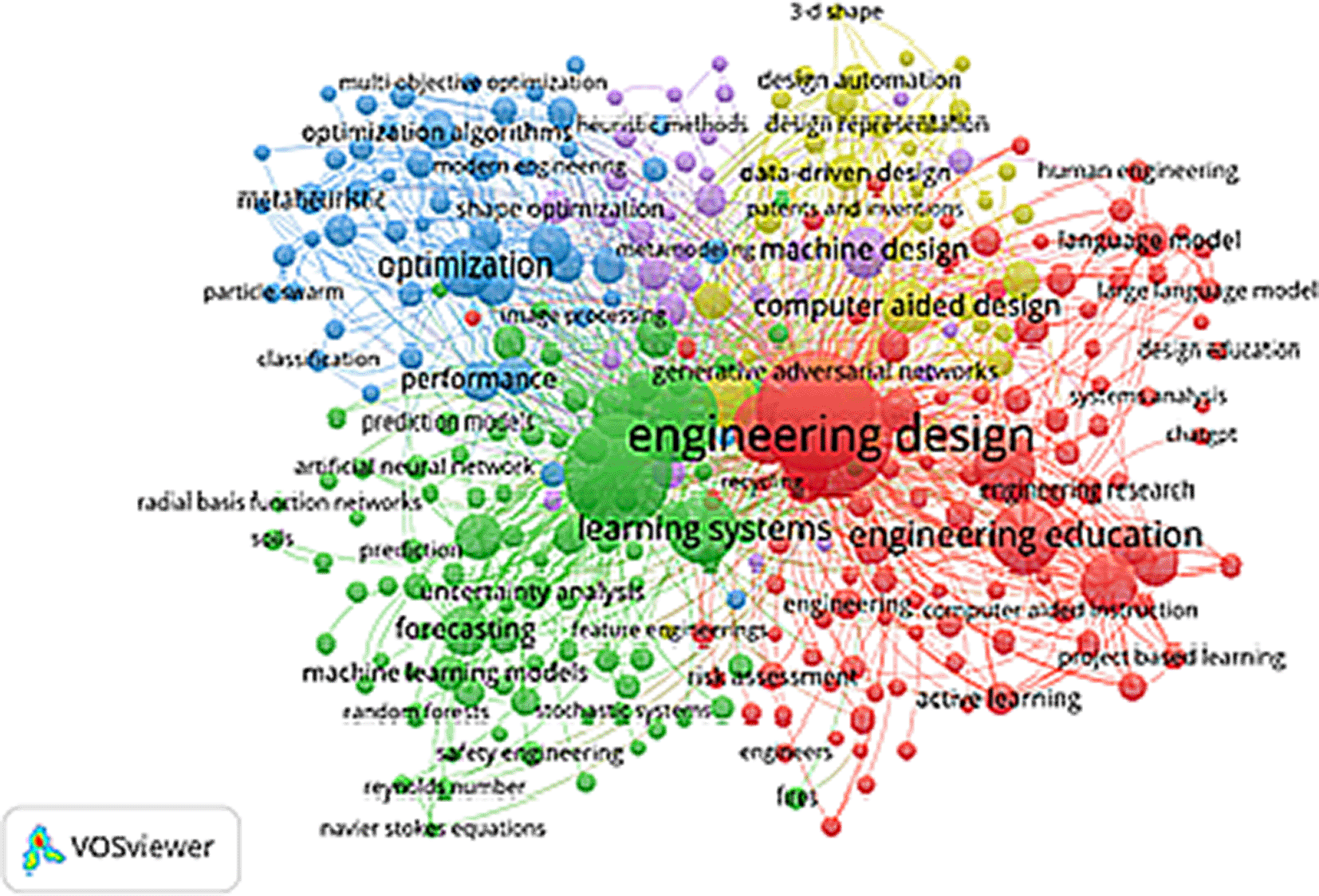
In Figure 1, the magnified red circumference denotes the dominance of the 'engineering design' search index, substantively outperforming concurrent keywords such as computer-aided design and machine learning frameworks.
An in-depth bibliometric examination was conducted, focusing on AI within the engineering design framework. The current research and development landscape in AI and Engineering Design has been analyzed through a wide range of articles and reviews. This approach allows researchers to examine trends, interconnections and trends among scholarly publications, providing a deeper exploration of research themes and collaborative networks within the field. Through analysis of citation patterns, co-authorship relations and keyword frequencies, among others.
In this study, co-citation, co-authorship, and co-author maps are used as methods to highlight the relationships between studies, authors and topics. The VOS viewer software was utilized to automatically generate occurrences and co-occurrence matrices, clustering of related research and similarity measures, offering a detailed map of how AI is integrated into engineering design.11
This step involved the identification of relevant search terms and keywords to search for relevant literature related to the chosen subject area. The selection of relevant publications within AI and Engineering design from the Scopus database is due to its distinction in comprehensive coverage of wide academic articles and publications with high quality, accessibility and global reach among other features. This search was achieved through set of keywords “Artificial Intelligence”, “Machine Learning” and “Engineering Design” with a focus on title, abstract and keyword search, resulting in the compilation of 1653 papers between 1976–2025.
A search filter was applied, which reduced the number of papers compiled to 1142 and publication year from to 2010–2025.
Table 1 presents the breakdown of the top searches, average publication year, citations and occurrence of keywords.
Table 1 presents the breakdown of the top searches, average publication year, citations and occurrence of keywords. The Table was extracted from the VOS Viewer software. It shows the keyword search and the research output in the field.
Figure 2 shows the research output on engineering design and AI by country, showing that the United States is the leading country, followed by China and the United Kingdom in research output based on engineering design-induced AI.
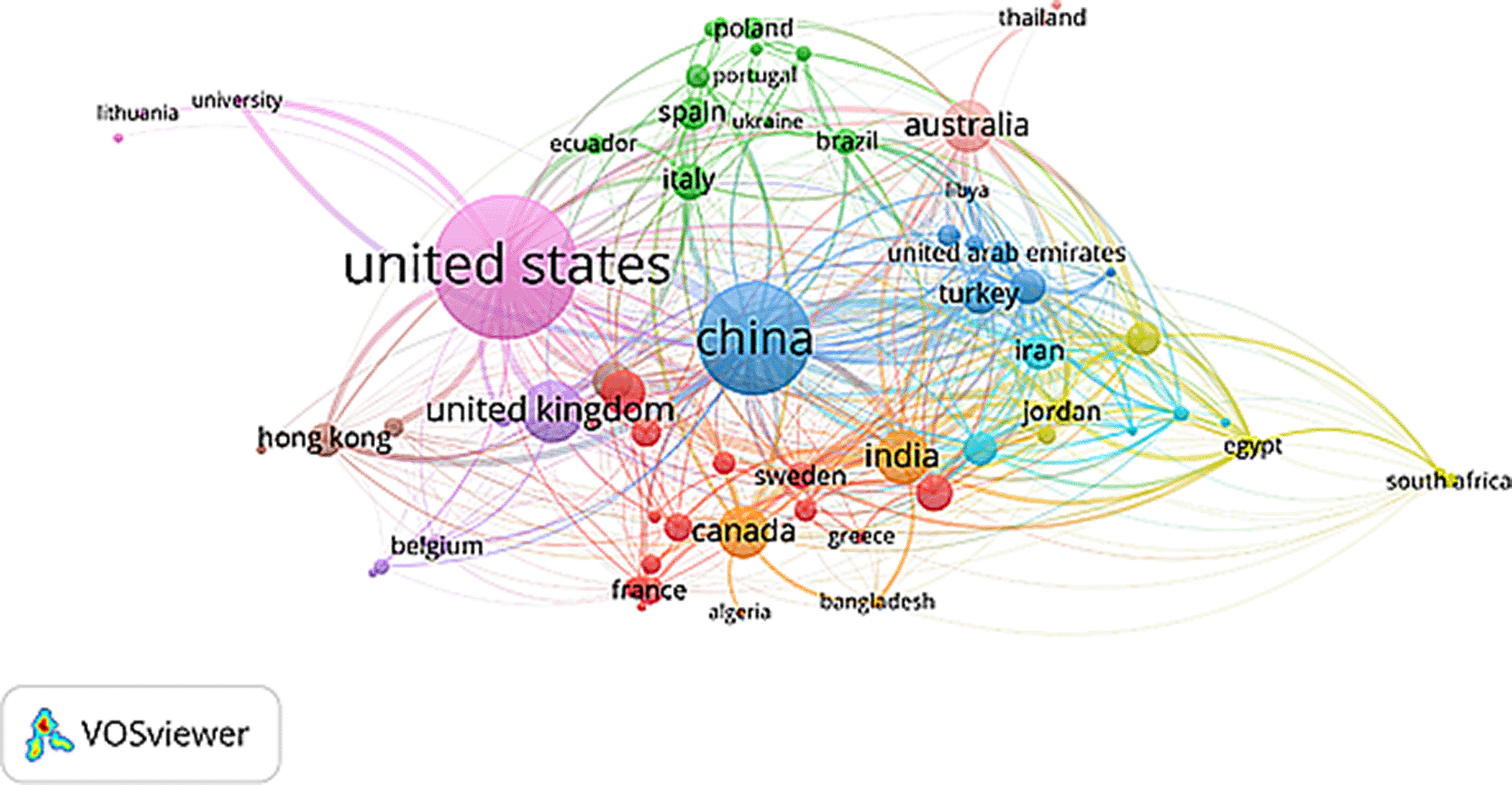
The analysis identifies the United States (represented by the pink node) and China (represented by the blue node) as the leading contributors to the global literature on engineering design and AI frameworks.
From Table 2, there are over 200 documents from the United States with China having 141 output per annum and the United Kingdom as the third largest in research projects on AI-based Engineering Design.
Figure 3 and Table 3. the study identifies key disciplinary specializations and institutional adopters of AI-based engineering design. The visualization confirms the MIT Department of Mechanical Engineering as the preeminent institution in this field. Supporting data in Table 3 shows the scholarly impact through metrics such as document frequency, citation impact, and inter-institutional link strengths.
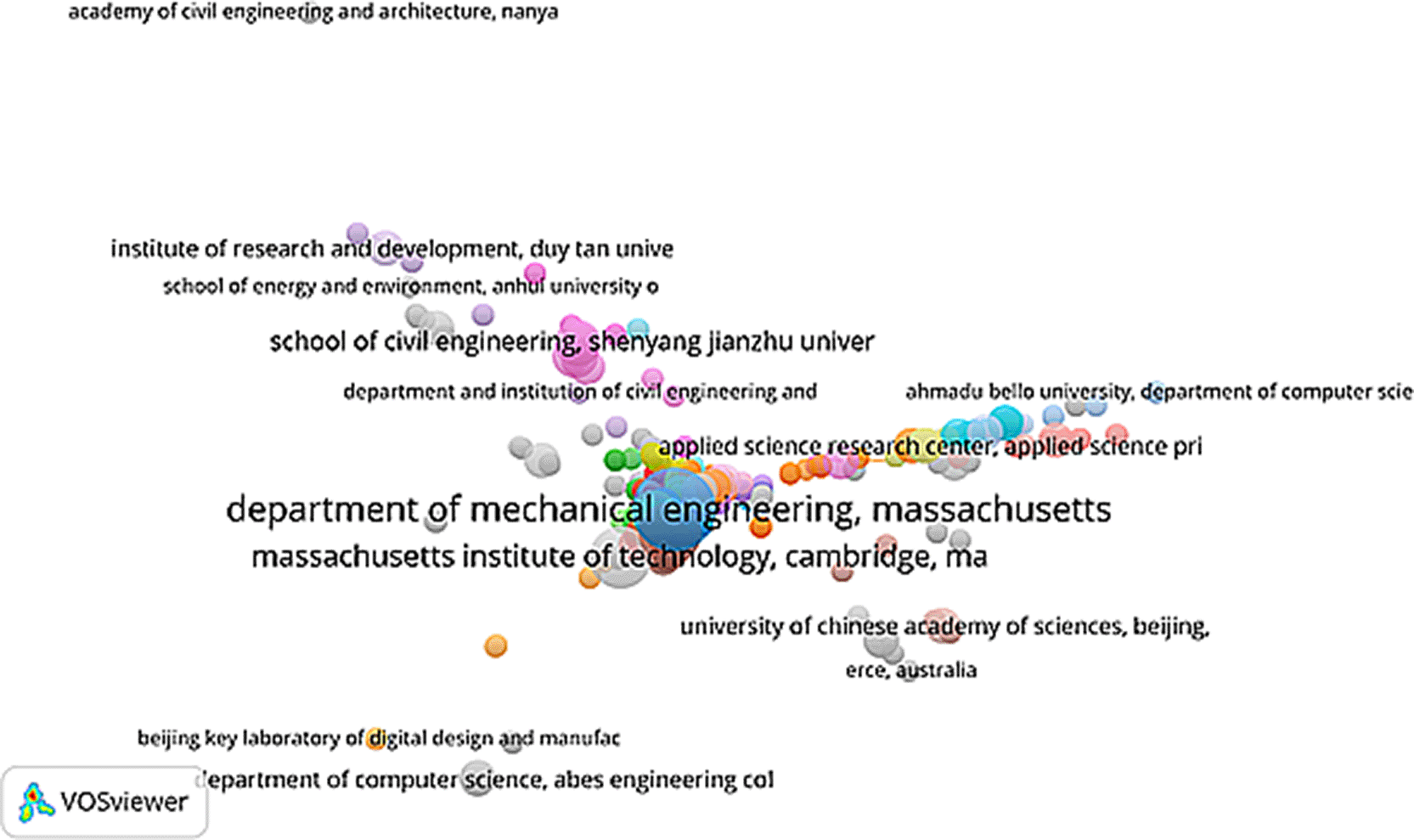
The visualization highlights the departmental origins of the research data, where the MIT Department of Mechanical Engineering is identified as a dominant cluster. The magnitude of its index reflects the institution's significant volume of scholarly contributions to the analyzed domain.
Table 3 shows the institutional distribution of research papers, highlighting the specific thematic focus of various organizations on the application of AI methodologies within the engineering design domain.
Machine learning is one of the most prominent AI technologies used in ED, and it helps with the optimization of designs and analysis of large datasets and patterns through a systematic framework to manage all engineering design activities, thereby increasing operations efficiency.12 “Engineering design is a broad field encompassing domains of Government, Industry, technology, education, social science and practical use”.13 The current capabilities of AI with large language models (LLM) such as Generative Pre-trained Transform Models (GPT) have demonstrated ways of sharing knowledge through conversations. For example, OpenAI’s ChatGPT, which explores a vast repository of information and interactive response format, is now enhancing traditional design processes.5,14–16
This branch of AI mimics the human brain and enhances its ability to handle complex design tasks through in-depth data training.17 It also plays a crucial role in generating design solutions, predictions and performance analysis, which are achieved through computer vision from images and videos, text, and sound, which enables designers to identify and solve problems with high efficiency and quality.18
Deep learning algorithms process and analyze a large amount of data using the neural network structure of the human brain with high accuracy and efficiency.19,20 These features enable deep learning to be robust in navigating through large datasets, offering a transformative advantage to designers and engineers to improve designs through a pre-emptive approach in the design process.13
In manufacturing processes, deep learning is essential for identifying usability issues or designing defects in manufactured products. Deep learning uses historical data on similar products, customer feedback, claims and production ledgers to identify products that are likely to cause customer dissatisfaction or increase production costs.21
Deep learning also offers an innovative and dynamic approach to design by analyzing datasets to produce novel designs that may not be obvious, thus inspiring designers to adopt new concepts and solutions.13,22
The integration of AI-driven techniques into the design process has paved the way for a collaborative and iterative approach to development where all stakeholders exploit the deep learning methodology to make data-driven decisions that optimize performance, user experience, and ease of manufacturing.
Moreover, as these technologies evolve, their impact in engineering design will eventually grow, guiding the development of more intelligent, reactive and robust designs.15 The evolution of AI into design has provided powerful tools for analyzing data, identifying hitches and providing innovative solutions to solve challenging problems.
AI-driven simulation techniques are shaping the way engineering design is performed, from manufacturing processes to product design and systems that are transforming the world. These tools have become the latest norm as they provide dynamic solutions to fluid dynamics through computational fluid dynamics (CFD), finite element analysis (FEA) and manufacturing process simulation.20 The CFD technology can simulate the flow of gases and liquids in the design, and FEA predict the reactions of materials under forces, while manufacturing process simulators showcase the manufacturing processes, supply chain and other process models. Simulation forecasts the behaviors of systems and optimizes parameters to look for desired outcomes before embarking on real plant production and design to save costs, time, and resources.11,23,24
To showcase the application domains of AI techniques to ED, the following section provides several situations backed by the research conducted:
Mechanical Engineering: One of the main areas that has revolutionised traditional design is Computer-Aided Design (CAD) systems. Since its introduction in the sixties (1960) the use of computer technology has helped designers to enhance their work.25 From traditional two-dimensional drawing tools to complex three-dimensional modelling, simulation and optimization systems.26 CAD technology has become essential in various fields such as engineering, mechanical design, automotive, and industrial design.27
AI has transformed CAD systems with tools for automation, decision-making support and advanced analytical capabilities through machine learning, neural networks and generic algorithms, which are integrated into CAD software to handle complex and data-driven tasks.28
AI technology has improved CAD systems and predicted possible problems during design and proffer solutions, which subsequently reduces the uncertainties in the design processes, and increases reliability and efficiency.27,29 AI algorithms have also boosted the capabilities of CAD systems to generate generative design, offering multiple design solutions that suits different situations. Through this approach, numerous design possibilities, optimizations of functionalities and visual appeals have become achievable.7,30
Another challenging task is the design of mechanical mechanisms subjected to complex physical constraints.26 Understanding the relationship between motion and mechanism design is essential because of the non-linear characteristics between the mechanism classes and boundary conditions.26 When solved analytically, an in-depth knowledge of the mechanism is required. AI has helped designers to optimize these designs through simulations and data-driven methods to train data that will provide new designs with little calculation.31 Several AI techniques, such as conditional adversarial networks, natural-language models and autoencoder networks are used for the synthesis of mechanisms, creation of multibody simulation codes or models for rapid prototyping, and representation of target paths in a compressed lower-dimensional feature space.28,31–37
The evolution of AI and its applications is finding ground in various fields, and is not limited to engineering design. In engineering design, AI is utilized for several purposes, such as CAD systems to automate tasks based on predefined rules, integrating advanced techniques that integrate graphical, verbal and gestural inputs into refined design concepts, predictive analytics and real-time monitoring to enhance systems.
Data transformation is also an area that is critical in engineering design, because of its scarcity, high cost of acquisition and limited access during operations. AI techniques help in developing minimal datasets that can address such issues showcasing significant variations in system responses with small parameter changes making simulations practical, and to setting benchmarks to predict system performance and requirements of data-driven models.
The integration of AI techniques also enhances design optimization, as it offers sophisticated tools to aid in rapid design concepts and reduced lead times to produce new products in the market. These techniques have demonstrated their versatility in all aspects of business, manufacturing, design and life, particularly in engineering design where AI is transforming computer software to make data-driven decisions, and simulate intelligent behaviors to enhance efficiency and product quality.
In conclusion, the rapid evolution of digital ecosystem AI in engineering design has the potential to drive the engineering industry and provide systematic and dynamic capabilities to transform traditional engineering design processes into enhanced capabilities.
| Views | Downloads | |
|---|---|---|
| F1000Research | - | - |
|
PubMed Central
Data from PMC are received and updated monthly.
|
- | - |
Provide sufficient details of any financial or non-financial competing interests to enable users to assess whether your comments might lead a reasonable person to question your impartiality. Consider the following examples, but note that this is not an exhaustive list:
Sign up for content alerts and receive a weekly or monthly email with all newly published articles
Already registered? Sign in
The email address should be the one you originally registered with F1000.
You registered with F1000 via Google, so we cannot reset your password.
To sign in, please click here.
If you still need help with your Google account password, please click here.
You registered with F1000 via Facebook, so we cannot reset your password.
To sign in, please click here.
If you still need help with your Facebook account password, please click here.
If your email address is registered with us, we will email you instructions to reset your password.
If you think you should have received this email but it has not arrived, please check your spam filters and/or contact for further assistance.

Comments on this article Comments (0)