Keywords
Sustainability, financial performance, environmental performance, manufacturing industry, emerging markets

Sustainability, financial performance, environmental performance, manufacturing industry, emerging markets
In recent decades, sustainability has emerged as a fundamental axis in the corporate strategy of firms at a global level, especially in those industries with a high impact on the economy such as manufacturing (Gerged, 2021). Aspects such as growing consumer pressure, more demanding regulatory frameworks, and greater environmental awareness have motivated companies to rethink their production systems and models, incorporating responsible practices that not only seek economic profitability, but also the protection of the natural environment and social well-being (García & Orsato, 2020).
The adoption of sustainable practices by companies in emerging economies is crucial not only from an ethical and environmental perspective, but also as a smart and long-term financial strategy (Meneses et al., 2023). In contexts where natural resources are intensely exploited and environmental regulations are still being consolidated, those firms that integrate Environmental, Social and Governance (ESG) criteria into their operations can anticipate regulatory risks, access more demanding international markets and improve their corporate reputation (Gupta and Gupta, 2020). In addition, integrating ESG practices into the firm’s operations to foster equitable and sustainable economic growth not only benefits investors, but also contributes to the social and environmental development of these growing regions (Tamasiga et al., 2022).
In Latin America, Colombia aims to reduce greenhouse gas (GHG) emissions by 20% by 2030, and industry is critical to achieving this. The transportation and manufacturing sectors are responsible for 22% of total CO2 emissions in the country, mainly due to deficiencies in cargo transport and storage processes. To address these challenges, entities such as the Ministry of Environment and Sustainable Development, the Ministry of Commerce, Industry and Tourism, together with the World Wide Fund for Nature (WWF) and USAID’s Low Emission Development (LCRD) program, have identified key measures in logistics and transportation that, if implemented, would improve the energy performance of the industry. Increasing their competitiveness and contributing to crucial environmental objectives. These include energy savings, sustainable cooling, transport optimisation, efficient route planning, vehicle maintenance and renewal.
In the case of energy saving, two key figures stand out in the Colombian case: Promoting better production practices that reduce the use of non-renewable resources, and investment in self-generation with renewable energies. Self-generation of energy through solar panels stands out for its efficiency, sustainability and competitive rates, being especially attractive for large industries, shopping centers and residential condominiums. Concerns about energy costs, which account for between 13% and 50% of total expenditures in industries, have led to the search for solutions to reduce costs through energy efficiency and self-generation projects. Efizity, an international energy optimization consultancy, suggests that firms can achieve savings of up to 40% in their final tariff through self-generation projects, such as solar, which can sometimes be implemented without investing their own resources. The implementation of self-generation projects depends on factors such as consumption patterns, available space, geographical location and availability of raw fuel materials. By 2019, a large commercial or industrial consumer will pay an average of COP$350 for each kilowatt-hour (kWh) of energy they consume. According to the consultancy's calculations, in the scenario that this average firm has a solar self-generation project, the cost it pays for each kWh can be reduced to COP$260 (Portafolio, 2019).
However, although the benefits of these investments tend to be widely highlighted, the evidence for different countries does not show a clear relationship between investment in sustainable forms of production and the financial and environmental performance of firms. In fact, there are studies that find that the total effect of this type of project is detrimental to financial performance (González-Benito and González-Benito, 2005; Cantele and Zardini, 2018; Chang, 2015), and surprisingly, for the environmental performance of firms due to the intermittency of these sources, which leads to a greater need for fossil fuels that can provide firmness (Baranes et al., 2017). In this paper, we study how sustainability is related to the financial and environmental performance of firms. To our knowledge, no study applied to Colombia has addressed these two dimensions in a unified way. One reason is that data measuring financial and environmental performance are not usually available in a form that can be directly combined into a single source. In this paper, we use two sources of information that allow us to examine both dimensions: the Annual Manufacturing Survey (EAM) and the Industrial Environmental Survey (EAI), both produced by the National Administrative Department of Statistics of Colombia (DANE, 2024a, 2024b). We are not aware of any previous study that has combined both datasets for this purpose. Although the EAM provides information for a longer period, the main empirical analysis focuses on 2018–2019, when detailed information on investment in sustainable forms of production is available in the EAI.
In this paper we find that investments in sustainable forms of production by Colombian manufacturing firms imply positive and negative aspects in relation to financial performance. In addition, we find that there is a heterogeneity of the effect according to the size of the investments. Firms that invest little do not reap as much return on their financial performance as firms that have high investment. Finally, we find that investment in sustainable forms of production implies greater energy needs for firms, and this translates into higher levels of emissions, on average, which does not favor the environmental performance of firms.
This document is organized into 5 sections. The second section comprises a brief review of the literature that relates sustainability to firm performance. The third section presents the data and the empirical strategy we follow. The fourth section presents the results, and the fifth the conclusions.
The relationship between Sustainability and the performance of firms is not clear. Some sustainability research has found evidence that firms that invest in sustainability had better economic performance (Buallay, 2020). However, other studies have identified an inverse relationship or an insignificant relationship between performance and sustainability (Landi and Sciarelli, 2018; Atan et al., 2018). There are factors specific to firms and economic sectors that explain why Sustainability can be beneficial for some firms and not represent a better performance for others (Al Hawaj and Buallay, 2022). This indicates that there are important heterogeneities in the relationship between economic performance and sustainability.
In relation to the industrial sector, sustainability can be associated with a competitive advantage derived from better environmental performance that is the result of better waste management, lower energy consumption, and lower transport needs for products and inputs (Gutowski et al., 2009; Mani et al., 2014). Hermawan et al. (2023), using data from Indonesian manufacturing firms, finds that sustainable manufacturing has a positive relationship with firm performance, and that environmental regulation further strengthens this relationship. Another relevant aspect of sustainability is its social impact, since it improves the work environment, the health of employees, and the public image of the firm due to its environmental management (Huang et al., 2013; Meneses Cerón et al., 2021). In particular, for studies applied to the manufacturing sector, there is a growing debate on issues related to sustainability (Buallay, 2019). There are several reasons why it is difficult to develop, implement, and report on sustainability in the manufacturing sector. First, the manufacturing industry consists of several divisions, such as sportswear, luxury goods, and electronics. Consequently, the challenges associated with the concept of sustainability within these divisions differ, so there is no one-size-fits-all solution for sustainable manufacturing (Searcy and Buslovich, 2014). Secondly, the aspects related to logistics, due to the complexity of the processes in the manufacturing sector, and the coordination of activities of the network of suppliers, distributors and retailers (Fletcher and Grose, 2012). Such complexity challenges sustainability monitoring and reporting. Third, the manufacturing sector is changing rapidly and firms need to periodically change their business model to incorporate sustainability strategies (Farrer and Fraser, 2009).
Industrial firms are making great efforts to carry out projects that increase their sustainability. The publication of sustainability reports and reports by firms is the most popular way to carry out the socialization of projects. These show the advances in environmental, social and governance performance, which improve the image of the firm in society (Caniato et al., 2012). However, the academic literature has not made notable efforts to study the real effects on performance of these investments in Sustainability. One factor is the significant variation in results, mentioned at the beginning of this section.
In this sense, we highlight several works of literature. An example of how contradictory the results can be are the work of Fauzi and Idris (2009) and Lin et al. (2009), both applied to East Asian countries. While Fauzi and Idris (2009) found a positive relationship between corporate social responsibility and the financial performance of Indonesian industrial firms, Lin et al. (2009) concluded that investments in corporate social responsibility do not have a positive effect on the performance of industrial firms in Taiwan. Evidence that investments in Sustainability do not imply better financial performance has been found by González-Benito and González-Benito (2005) for industry firms in Spain, Cantele and Zardini (2018) for industry firms in Italy, and Chang (2015) for industry firms in China. On the other hand, positive effects of investment in cleaner and more environmentally friendly forms of production have been found by Zeng et al. (2010) for China, and Tomsic et al. (2015) for industry firms in Slovenia. Additionally, Gotschol et al. (2014) show an interesting heterogeneity related to the degree of intensity in investment in sustainable forms of production. Their results show that firms that invest intensively obtain positive and significant results in their performance, while firms that invest relatively little do not obtain good results. However, some authors suggest that these positive relationships may be driven by internal aspects of the firms' operation, rather than by their own efforts related to sustainability (Clarkson et al., 2011; Nawrocka and Parker, 2009). In this sense, it is important to control for unobservable attributes of the firms to obtain good estimates of the relationship of interest.In an effort to make the relationship between firm performance and Sustainability clearer, Al Hawaj and Buallay (2022) collected data from 3000 firms from more than 80 countries, spanning seven economic sectors, between 2008 and 2017. Their results show that there are differences in the impact of sustainability reporting on firms’ operational performance, financial performance, and market performance among the seven sectors. The authors do not find a relevant effect of sustainability on the performance of firms in the agricultural and food sector, but a positive effect on the performance of firms in the manufacturing sector, retail distributors, the tourism sector, and less strongly in the energy sector. In the case of firms in the financial sector, and in the technology and telecommunications sector, the effect of sustainability is negative.
In the case of Colombia, we highlight the work of Meneses Cerón et al. (2021). The authors study the relationship between the quality of environmental, social and governance practices and the financial performance of Colombian companies listed on the stock exchange, during the period 2008-2018. The results show that the good environmental, social and governance practices adopted by firms imply better financial performance, and greater social recognition in the eyes of public opinion. Second, the research of Mora-Contreras et al. (2024) provides key empirical evidence on how eco-innovation characteristics, barriers, and information sources influence the circular economy performance, sustainability, and economic results of manufacturing firms in Colombia. The findings indicate that incremental innovations can limit advances in sustainability, while radical ones require further analysis to understand their impact. In addition, they confirm that improving environmental and circular economy performance has a positive impact on business economic results, which reinforces the importance of integrating sustainable innovation strategies in industrial contexts of emerging economies.
In this paper we use two sources of information. The first source of information is data from the Annual Manufacturing Survey (EAM) of the National Administrative Department of Statistics of Colombia (DANE, 2024a). This database includes information at the establishment level, which is a subdivision within the firms, which are part of the manufacturing industry in Colombia. The EAM surveyed all industrial establishments with 10 or more workers and that are recognized under the ISIC system. We use data for the period 2013 to 2019 (DANE, 2024b). We have information on the 4-digit ISIC sector to which the firm belongs, the total sales of the establishment, the number of permanent and temporary workers, the total fixed assets, the salaries and benefits paid for the workers, the gross investment in capital, the consumption of raw materials and electricity.
The second source of information is data from the Industrial Environmental Survey (EAI) of the National Administrative Department of Statistics of Colombia (DANE). This database includes information at the establishment level, which is a subdivision within the firms that are part of the manufacturing industry in Colombia. A subset of EAM establishments are surveyed in the EAI, randomly selected by defined strata based on regional and sectoral characteristics. This source of information includes data on the environmental management of a sample of Colombian manufacturing firms. In particular, we use data on investment in self-generation with renewable energy sources, along with investment in forms of production that reduce the consumption of non-renewable energy sources. We work with data for the years 2018 and 2019. For previous years, there is no detailed information on the two particular aspects that interest us. For the year 2018 we have information on 3052 establishments, and for 2019 we have 2969.
Therefore, although the Annual Manufacturing Survey provides information for the period 2013–2019, the empirical analysis in this study focuses on 2018–2019, the period for which detailed information on sustainable investment is available in the Industrial Environmental Survey.
To study the relationship between firms' financial and environmental performance and sustainability, we propose a set of regression equations that allow us to characterize the differences between firms that invest in sustainable forms of production and those that do not. First, as measures of firms' financial performance, we use return on assets (ROA), sales per worker, and value added per worker. These measures tell us the degree to which the firm has generated a reasonable return based on its size, measured by the number of fixed assets in the case of ROA, or by the number of workers in the case of sales and value added. Other measures that characterize the firm's performance are the average salary per worker, fixed assets per worker, raw materials used per worker, and investment per worker.
Following Balat and Casas (2018), we estimate the productivity of firms using the production function estimation methodology of Levinsohn and Petrin (2003). In the Appendix of this work we explain how the estimation process is carried out. Productivity measures the relative efficiency with which a firm uses its inputs to produce a good. More productive firms are those that can generate more output with the same amount of inputs as a less productive firm. Therefore, it measures the way in which firms are organized internally, the quality of their managers, and the technological advantages that they have relative to others. These are aspects of firms that are not observable in the data, so it is a reasonable way to capture the extent to which a firm that is committed to Sustainability can have better unobservable aspects for production than a firm that is not committed to Sustainability.
We propose the following regression equation, where y is the dependent variable to be explained, such as financial performance or another of the proposed measures that characterize performance, including productivity, for firm i in year t:
Following Gotschol et al. (2014), it is possible that there is a degree of heterogeneity in the relationship between performance measures and Sustainability. Firms that invest little may not experience benefits, but those that invest intensively can experience the benefits of Sustainability. To test this idea, we modified the expression 1, and constructed three categories for the indicator s of signatures. Given that we have the magnitude of the investment made by the establishments in self-generation with RE and reduction in consumption of non-RE, the establishments whose inverted magnitude is equal to or less than the 25th percentile are s1 = 1, the establishments whose inverted magnitude is between the 25th and 75th percentiles are s2 = 1, and establishments whose inverted magnitude is greater than or equal to the 75th percentile are s3 = 1. Otherwise, s1 corresponds to establishments with low investment, s2 are establishments with medium investment, and s3 are establishments with high investment. We propose the following equation to contrast the degree of heterogeneity in the relationship between Sustainability and performance measures:
Finally, we evaluate how the consumption of energy resources and the level of CO2 emissions of the establishments are related to Sustainability. We estimate equation 1 but swap the dependent variable, which are performance measures, for the level of energy consumption (electricity, liquid fuels, gas, and coal) or the CO2 emissions constructed from the conversion factors of each energy resource. In Table 2 we present the energy resources reported in the EAM data together with the conversion factors estimated by the Mining-Energy Planning Unit (UPME, 2023). From the consumption of each energy resource of the establishments, together with the conversion factors, measurements of the level of CO2 emissions of the firms that appear in the EAM can be constructed.
In this section we present the results of this research. To this end, we present a set of tables that characterize the relationship between different relevant measures of the financial and environmental performance of firms with the sustainability efforts they make.
Table 1 presents some descriptions of the characteristics of the firms along with the two aspects related to Sustainability, investment in reducing the consumption of non-renewable energy and in self-generation with alternative energies. Panel A shows how the proportion of firms that make use of energy resources, i.e. electricity, coal, liquid fuels (diesel, gasoline, petroleum, fuel oil, kerosene), and natural gas and LPG, is related to Sustainability. We note that, to a large extent, all firms use electricity as an energy source, followed by natural gas, liquid fuels and, to a lesser extent, carbon. In relation to the role of Sustainability, we highlight that firms that invest in sustainable forms of production tend to be the ones that consume the most energy sources other than electricity. This seems reasonable to us, given that it is the firms that use these sources that make the greatest efforts to invest in sustainable ways of producing.
Panel B of Table 1 shows a summary of the characteristics of the firms, such as ROA, number of workers, total fixed assets, salary per worker, intensity in the use of raw materials, and aspects related to foreign trade (export of products and import of inputs). We highlight that the average ROA value tends to be higher for those firms that do not invest in sustainable forms of production. In addition, firms that invest in sustainable forms of production tend to be larger, in terms of number of workers and total fixed assets, and tend to pay better wages to their employees. On the other hand, firms that invest in sustainable forms of production tend to be more intensive in the use of raw materials as a percentage of their sales, and tend to participate more in foreign markets, since they export more of their production and import more inputs from abroad. Additionally, for both panels A and B, we did not find significant changes between 2018 and 2019 in relation to the variables of interest.
In relation to sectoral differences in investment in sustainable forms of production, we present Figure 1. This figure shows the 22 sectors for which we have information according to the junction of the EAM and the EIA, and their relationship with sustainable forms of production. It should be noted that the sectors in which a higher proportion of firms investing in reducing the consumption of non-renewable energy are Beverages, Paper and cardboard, Chemical substances and products, and computer, electronic and optical products. In these sectors, sustainable firms account for more than 20%, with Beverages reaching almost 50% by 2019. In relation to investment in self-generation with alternative sources, we highlight the sectors of Food Products, Textile Products, Wood and Cork Products, and the Production of Motor Vehicles. In these sectors, sustainable firms represent more than 5%.
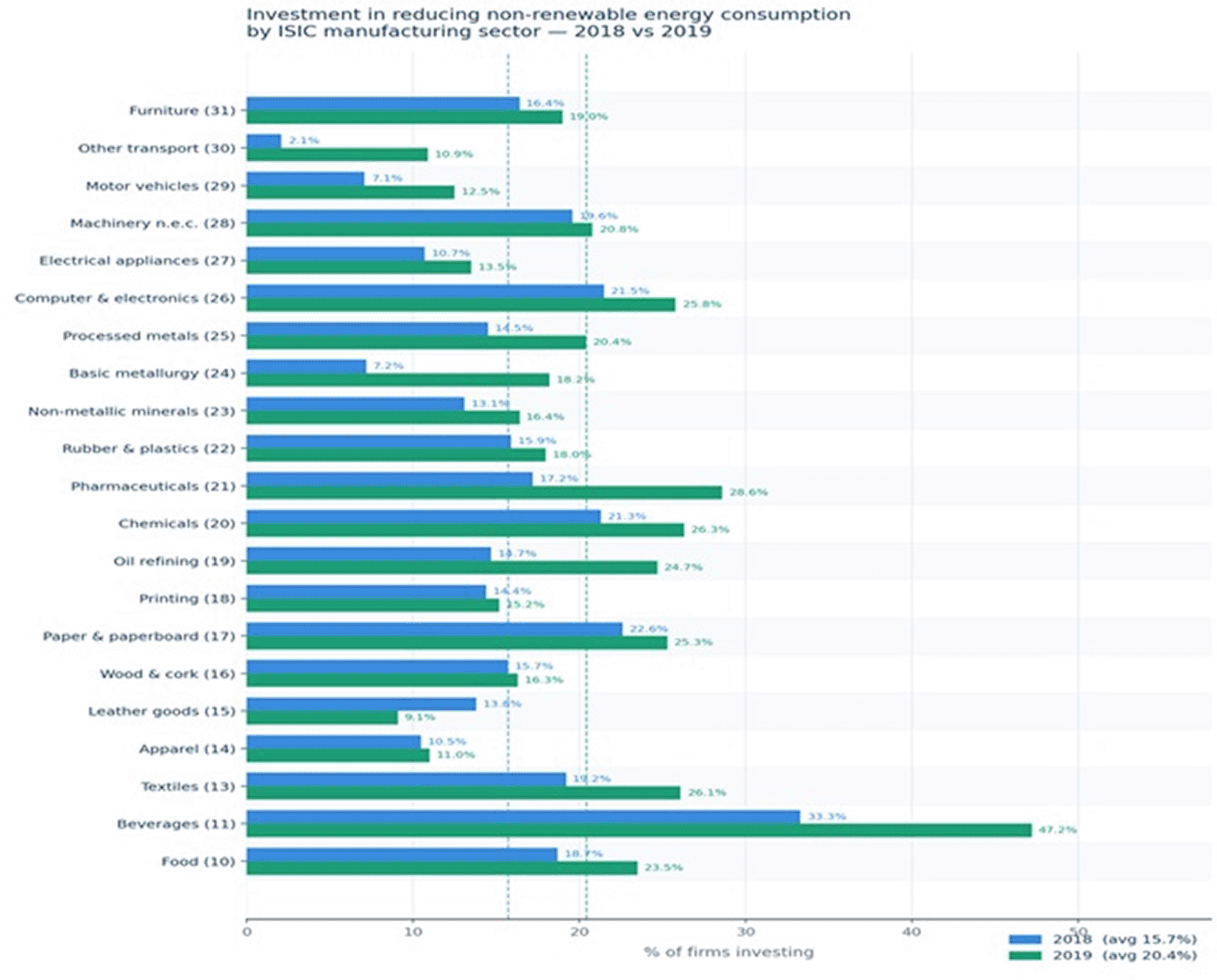
Source: Authors’ own elaboration based on data from the Annual Manufacturing Survey (EAM) and the Industrial Environmental Survey (EAI), National Administrative Department of Statistics of Colombia (DANE).
Table 2 presents the standard conversion factors used to estimate carbon dioxide (CO2) emissions associated with the consumption of different energy sources in the industrial sector, according to the Mining and Energy Planning Unit (UPME) of Colombia for 2023. The table includes nine types of energy sources —charcoal, natural gas, petroleum, diesel, fuel oil, petrol, kerosene, LPG, and electricity— each expressed in its usual unit of measurement (tons, cubic meters, gallons, kilograms, or kilowatt-hours). The conversion factors reveal substantial differences in carbon intensity: charcoal has the highest factor (2,534.81 kg CO2 per ton), followed by liquid petroleum derivatives (between 8.8 and 11.6 kg CO2 per gallon), while electricity shows the lowest factor (0.166 kg CO2 per kWh), with natural gas (1.98 kg CO2 per m3) and LPG (3.05 kg CO2 per kg) in intermediate positions. These factors are fundamental to the study's empirical strategy, as they allow constructing the CO2 emissions variable from the energy consumption reported by establishments in the Annual Manufacturing Survey (EAM), thus enabling the analysis of the relationship between sustainability, financial performance, and environmental performance.
In Table 3 we study the simplest case in which we study how firms that invest and do not invest in Sustainability differ in performance. In Table 4 we analyze how the size of the investment plays a role in the relationship between sustainability and performance, following the working hypotheses of Gotschol et al. (2014). Finally, we study the environmental impact of firms' efforts in the field of Sustainability in Tables 5 and 6, where we study how the use of energy and the level of emissions of firms that invest in Sustainability differ and those that do not. Table 3 shows how different aspects of firms' financial performance relate to investment in sustainable forms of production. Among the performance measures we use ROA, sales per worker, value added per worker, average worker wage, assets per worker, raw materials per worker, and productivity. To measure investment in sustainable forms of production, we use a dummy variable that measures when the firm invests in reducing non-RE consumption, and zero otherwise; another way when the firm invests in self-generation with RE, and zero otherwise. We conducted this exercise exclusively with data from fossil fuel-consuming firms, and with all firms in the industry.
| (1) | (2) | (3) | (4) | (5) | (6) | (7) | (8) | |
|---|---|---|---|---|---|---|---|---|
| ROA | Sales value | Aggregate | Wages | Assets | Raw materials | Investment | Productivity | |
| Panel A: Only establishments that consume fossil fuels | ||||||||
| Reduction in non-RE consumption | −1.882 ** | 17.50 | 10.28 | 3.703 *** | 65.21 | 7.118 | 15.68 | 0.00638 |
| (0.925) | (68.30) | (12.51) | (0.846) | (116.6) | (59.91) | (10.49) | (0.0134) | |
| Investment in self-generation with RE | −0.483 | 38.13 | 65.36 ** | 6.161 *** | −51.88 | −39.61 | 10.14 | 0.0462 * |
| (0.557) | (116.3) | (27.34) | (2.104) | (136.3) | (103.4) | (8.580) | (0.0265) | |
| Remarks | 4,005 | 4,005 | 4,005 | 4,005 | 4,005 | 4,005 | 4,005 | 3,954 |
| R-square | 0.009 | 0.149 | 0.174 | 0.290 | 0.093 | 0.152 | 0.049 | 0.318 |
| Panel B: All Establishments | ||||||||
| Reduction in non-RE consumption | −1.460 ** | −224.9 * | −20.78 | 3.293 *** | 74.19 | −198.5 * | 10.90 | 0.0100 |
| (0.726) | (117.7) | (16.10) | (0.759) | (90.79) | (107.6) | (8.853) | (0.0139) | |
| Investment in self-generation with RE | −0.925 * | −81.58 | 46.55 | 4.733 ** | 14.31 | −137.5 | 12.75 * | 0.0445 * |
| (0.542) | (269.1) | (36.86) | (1.978) | (91.55) | (244.3) | (6.988) | (0.0265) | |
| Remarks | 5,836 | 5,836 | 5,836 | 5,836 | 5,836 | 5,836 | 5,836 | 5,750 |
| R-square | 0.010 | 0.611 | 0.439 | 0.295 | 0.075 | 0.628 | 0.038 | 0.293 |
| (1) | (2) | (3) | (4) | (5) | (6) | (7) | (8) | |
|---|---|---|---|---|---|---|---|---|
| ROA | Sales | Added value | Wages | Assets | Raw materials | Investment | Productivity | |
| Panel A: Only establishments that consume fossil fuels | ||||||||
| Low - Reduction in non-RE consumption | −1.808 | −167.4 ** | −41.29*** | −1.722 | −129.3 | −121.7 * | −10.10 ** | −0.0423 |
| (1.342) | (71.08) | (15.99) | (1.067) | (90.56) | (62.74) | (4.688) | (0.0292) | |
| Medium - Reduction in non-RE consumption | −1.716 ** | −32.56 | 0.946 | 3.929*** | −16.80 | −20.82 | 16.03 | −0.0168 |
| (0.764) | (52.75) | (12.74) | (1.384) | (65.43) | (47.35) | (10.47) | (0.0169) | |
| High - Reduction in non-RE consumption | −2.261 ** | 266.2 | 70.89 ** | 7.760*** | 382.8 | 167.1 | 36.35 | 0.0894*** |
| (1.087) | (191.3) | (28.77) | (1.261) | (353.6) | (169.7) | (29.62) | (0.0219) | |
| Low - Investment in self-generation with RE | −0.531 | −117.4 | −14.50 | 0.267 | −128.0 | −144.7 * | −17.87 * | 0.00619 |
| (0.935) | (94.08) | (27.24) | (3.536) | (141.7) | (73.96) | (10.50) | (0.0480) | |
| Medium - Investment in self-generation with RE | −0.593 | 10.34 | 56.90 | 5.032 * | −125.2 | −52.73 | 9.555 | 0.0263 |
| (0.766) | (202.5) | (41.49) | (2.770) | (220.3) | (182.5) | (13.54) | (0.0378) | |
| High - Investment in self-generation with RE | −0.175 | 129.0 | 124.1 ** | 10.91*** | 40.82 | 11.45 | 24.04 | 0.0906 ** |
| (0.949) | (154.1) | (55.37) | (4.134) | (213.1) | (129.7) | (15.02) | (0.0462) | |
| Remarks | 4,005 | 4,005 | 4,005 | 4,005 | 4,005 | 4,005 | 4,005 | 3,954 |
| R-square | 0.009 | 0.150 | 0.176 | 0.295 | 0.093 | 0.153 | 0.051 | 0.322 |
| Panel B: All Establishments | ||||||||
| Low - Reduction in non-RE consumption | 0.981 | −491.4*** | −79.17*** | −2.352 ** | −99.18 * | −405.2 ** | −13.57*** | −0.0368 |
| (1.820) | (189.9) | (24.11) | (0.922) | (54.32) | (174.3) | (4.494) | (0.0267) | |
| Medium - Reduction in non-RE consumption | −2.247*** | −198.8 | −16.65 | 4.011*** | 25.42 | −160.2 | 13.36 | −0.00431 |
| (0.554) | (166.5) | (20.34) | (1.258) | (44.54) | (156.4) | (9.137) | (0.0196) | |
| High - Reduction in non-RE consumption | −2.430*** | 12.05 | 34.60 | 7.924*** | 359.9 | −51.47 | 32.06 | 0.0893*** |
| (0.801) | (231.5) | (34.77) | (1.181) | (311.4) | (203.9) | (26.35) | (0.0212) | |
| Low - Investment in self-generation with RE | −0.601 | −962.9 | −120.5 | −2.870 | −81.82 | −879.8 | −15.24 | 0.0189 |
| (0.736) | (919.5) | (104.3) | (3.251) | (103.6) | (836.4) | (9.537) | (0.0465) | |
| Medium - Investment in self-generation with RE | −0.734 | 167.1 | 73.70 ** | 3.877 | −37.58 | 95.33 | 15.99 | 0.0193 |
| (0.755) | (168.1) | (34.96) | (2.598) | (153.6) | (154.6) | (10.93) | (0.0393) | |
| High - Investment in self-generation with RE | −0.628 | 230.4 * | 138.6*** | 11.46*** | 93.88 | 98.54 | 23.30 * | 0.0846 * |
| (0.770) | (122.2) | (51.55) | (3.856) | (155.7) | (101.9) | (13.20) | (0.0446) | |
| Remarks | 5,836 | 5,836 | 5,836 | 5,836 | 5,836 | 5,836 | 5,836 | 5,750 |
| R-square | 0.010 | 0.611 | 0.441 | 0.300 | 0.075 | 0.628 | 0.039 | 0.295 |
| (1) Electricity | (2) Liquid fuels | (3) Gas | (4) Charcoal | |
|---|---|---|---|---|
| Reduction in non-RE consumption | 4,786 | 56.90 | 1,440 | 0.838 |
| (4,422) | (71.81) | (1,603) | (1.362) | |
| Investment in self-generation with RE | 20,963 ** | 282.5 | −292.4 | 13.06 ** |
| (8,507) | (265.7) | (2,395) | (5.865) | |
| Remarks | 4,005 | 4,005 | 4,005 | 4,005 |
| R-square | 0.242 | 0.128 | 0.145 | 0.256 |
| (1) Only establishments that consume fossil fuels | (2) All establishments | |
|---|---|---|
| Emissions | Emissions | |
| Reduction in non-RE consumption | 5.887 | 7.769 * |
| Investment in self-generation with RE | (5.339) 37.66 ** (17.28) | (4.149) 39.28*** (14.99) |
| Remarks | 4,005 | 5,836 |
| R-square | 0.247 | 0.227 |
The results show that firms that invest in sustainable forms of production, and are consumers of fossil fuels, tend to have lower ROA, and higher value added per worker, wages per worker, and higher productivity. When we explore the case including all firms in the manufacturing industry, we find some additional relationships, such as that firms that invest in sustainable forms of production tend to have lower sales per worker, lower consumption of raw materials per worker, and higher investment per worker. These relationships show that investment in sustainable forms of production implies positive and negative aspects to the performance of firms. Firms tend to perform better in relation to value added, wages, consumption of raw materials, capital investment, and productivity. But, we find that firms that invest in sustainable forms of production tend to have lower ROA and lower sales performance.
Since, following Gotschol et al. (2014), it is possible that there is a degree of heterogeneity in relation to investment in sustainable forms of production, we propose specification 2, which is summarized in Table 5, which has the same structure as Table 4. We classified establishments among those whose investment in sustainable forms of production is low, medium or high. Given that we have the magnitude of the investment made by establishments in self-generation with RE and reduction in consumption of non-RE, establishments whose inverted magnitude is equal to or less than the 25th percentile are of low investment, establishments whose inverted magnitude is between the 25th and 75th percentiles are of medium investment, and establishments whose invested magnitude is greater than or equal to the 75th percentile are of high investment.
On the other hand, firms that have a low investment in sustainable forms of production tend to have a lower performance in all ways of measuring performance, except for ROA and productivity where they do not find a significant relationship. In relation to average investment, we found that firms that invest in Sustainability tend to have a lower ROA, and a higher added value and wages per worker. We did not find a significant relationship with the other measures. For firms with high investment, we find that they have a lower performance in ROA, but a higher performance in relation to sales, value added, wages, and investment per worker, and productivity. These results show evidence that is in line with Gotschol et al. (2014), since we find that firms that have a low investment in sustainable forms of production tend to perform poorly in almost all measures, those with medium investment have many relationships that are not significant, and firms that have a high investment show improvements in most measures of performance.
In this section we present how the environmental performance of firms and investment in sustainable forms of production are related. Table 5 shows how the level of energy consumption per worker differs between firms that invest in sustainable forms of production and those that do not. Among the energy sources we take into account are the consumption of electricity, liquid fuels, gas and coal. The results show that firms that invest in self-generation with renewable energies tend to have a higher level of consumption per electricity and coal worker, but we did not find a relationship with liquid fuels and gas. This result is not favorable for the use of sustainable methods, which seek to reduce the energy needs of firms, or make them more environmentally friendly. The explanation for this result is similar to what happened with the energy transition in Germany.
Due to the rapid expansion of non-conventional renewable energies in Germany, the need to strengthen these new intermittent sources increased, which caused energy costs to increase in the medium term and the consumption of fossil fuels such as gas and coal to skyrocket (Botero-García et al., 2019). Similar evidence has been found by Do et al. (2023) in South Korea, in relation to the increase in electricity costs for the final consumer, due to the intermittency after the inclusion of RE. A similar phenomenon may be occurring with manufacturing firms that, by expanding their capacity in self-generation with RE, increase their needs for other sources that give firmness to these new resources, which ends up increasing the consumption of electricity and other energy sources.
Finally, we present how CO2 emissions are related to investment in sustainable forms of production. For the years 2018 and 2019, the total CO2 emissions of the establishments in the EAM were 36.64 and 16.17 megatons of CO2, respectively. According to Datosmacro.com (2023), Colombia emitted a total of 80.35 and 83.44 megatons of CO2 for the years 2018 and 2019. This indicates that the manufacturing industry was responsible for 45% of Colombia's total emissions in 2018 and 20% in 2019. Therefore, the efforts in reducing the use of polluting energy sources in the sector have a relevant impact on the emissions made by the country.
Table 6 shows how the level of emissions per worker differs between firms that invest in sustainable forms of production and those that do not. The results, again, are not favorable for sustainability. Firms that invest in sustainable forms of production tend to have more emissions per worker. This is explained by the results in Table 5, which show that show that these firms experience greater energy needs due to investment in sustainable forms of production.
The main contribution of this study is to empirically demonstrate that the relationship between sustainability and firm performance is not linear but rather depends critically on the intensity of environmental investment, identifying minimum thresholds below which financial benefits do not materialize. This finding aligns with Gotschol et al. (2014), who suggested the existence of heterogeneous effects depending on the level of commitment to sustainable practices. However, the present study differs from the predominant literature, mostly focused on developed economies by revealing a structural tension between economic and environmental performance in an emerging context: Colombian manufacturing firms with high sustainable investment improve financial indicators such as value added, wages, and productivity, but simultaneously increase their CO2 emissions per worker. This result contrasts with the optimistic findings of Friede et al. (2015), who reported a predominantly positive association between ESG criteria and financial performance, and aligns more closely with the warnings of Botero-García et al. (2019) regarding the unintended effects of the energy transition —such as increased consumption of fossil fuels to compensate for the intermittency of renewables— a phenomenon also documented by Do et al. (2023) in South Korea. Thus, the study contributes to the literature by showing that, in emerging economies such as Colombia's, sustainability can generate an eco-efficiency paradox where greener firms end up being more carbon-intensive, which questions the universal validity of the "win-win" thesis and underscores the need for policies that integrate investment thresholds with explicit emissions constraints.
The literature that relates sustainability to firm performance has not found a consensus on the effect of investments in more environmentally friendly forms of production and firm performance. This is due to the remarkable heterogeneity that exists between economic sectors, and the different institutional and organizational aspects of firms in different countries. In this paper we study the case of firms in the manufacturing industry in Colombia, which is an emerging economy with a considerable population, and a great potential for the use of non-conventional renewable energies. We explore two aspects measurable in the data as forms of investment in sustainability: investment in forms of production that reduce the consumption of non-renewable sources (fossil fuels), and investment in self-generation with renewable energy sources. Our results show that investing in sustainability does not have a clear effect on firms' performance. In some measurable aspects, positive relationships are observed, but in others there are negative relationships, or there is no relationship at all.
However, when we explore the possible heterogeneity of the effect according to the size of the investment made, we find that firms that have a low investment in sustainable forms of production tend to perform poorly in almost all measures, those with medium investment have many relationships that are not significant, and firms that have a high investment show improvements in most performance measures. This implies that improvements in firms' performance occur when firms make significant investments in sustainable forms of production, rather than when they are incipient. This result has relevant policy implications such as supporting and motivating firms to make significant investments in forms of production that reduce the consumption of non-RE, and increase self-generation with RE.
Finally, we address issues related to the environmental performance of firms, measured through the level of energy consumption and the level of resulting emissions. Our results show that firms that invest in sustainable forms of production tend to have a higher consumption of energy, including the main energy source that is electricity. This can be explained by the fact that among the attributes of self-generation with RE is the intermittency and lack of firmness of these sources, which can cause an increase in the consumption of a substitute energy that gives firmness. This translates into higher levels of emissions on average, given that there are higher energy needs, on average. These results imply that Sustainability does not favor the environmental performance of firms in the manufacturing industry in Colombia. This result opens the way to future research that allows us to understand what may be causing these harmful results, so that better policies can be designed that allow Sustainability to be associated with better environmental performance.
The study presents three main limitations: (i) a short time window (2013–2019), which restricts the analysis of dynamic and lagged effects; (ii) the use of aggregated data, which limits the identification of more granular causal mechanisms, such as managerial decisions or learning processes; and (iii) a partial ability to explain the finding of higher emissions among firms with sustainable investments, for which the intermittency of renewable energy sources is proposed as a plausible hypothesis, although its empirical verification lies beyond the scope of the available data. In this context, the future research agenda for emerging markets should focus on extending the time horizon of analysis, incorporating qualitative management variables, disaggregating by type of renewable technology and energy substitution patterns, distinguishing between scale effects and inefficiencies associated with intermittency, and conducting cross-country comparisons with similar economies to determine whether the tension between economic and environmental performance is structural or specific to the Colombian case.
| Views | Downloads | |
|---|---|---|
| F1000Research | - | - |
|
PubMed Central
Data from PMC are received and updated monthly.
|
- | - |
Provide sufficient details of any financial or non-financial competing interests to enable users to assess whether your comments might lead a reasonable person to question your impartiality. Consider the following examples, but note that this is not an exhaustive list:
Sign up for content alerts and receive a weekly or monthly email with all newly published articles
Already registered? Sign in
The email address should be the one you originally registered with F1000.
You registered with F1000 via Google, so we cannot reset your password.
To sign in, please click here.
If you still need help with your Google account password, please click here.
You registered with F1000 via Facebook, so we cannot reset your password.
To sign in, please click here.
If you still need help with your Facebook account password, please click here.
If your email address is registered with us, we will email you instructions to reset your password.
If you think you should have received this email but it has not arrived, please check your spam filters and/or contact for further assistance.

Comments on this article Comments (0)