Keywords
Borrowings, core capital, capital fund, loans, nonperforming loans, panel data

Borrowings, core capital, capital fund, loans, nonperforming loans, panel data
The MFIs play an indispensable role in channeling rural savings into productive sectors through microloans for poor people as individual and group loans. The MFIs provide financial services especially for poor people in rural areas and help to reduce poverty through offering credit, improving saving behavior, and reducing risk by buying insurance products (Khanchel et al., 2025). Though MIFs offer reliable financial services to SMEs (Cavallo & Torluccio, 2025) and low-income families, and bring more savers into the formal banking channel, and reduce the size of the informal economy (Mersland & Strøm, 2009; Alber & Takla, 2025). MFIs provide credit and training to individuals and small entrepreneurs, which enhances financial inclusion and reduces poverty (Mengstie, 2024; Zineelabidine et al., 2025). Also, MFIs empower women entrepreneurship by increasing savings habits, offering easy access to credit, and providing training opportunities (Abebe & Kegne, 2023).
The efficiency and stability of MFIs primarily depend on their performance. The microloans can increase transaction and information costs, which decreases cost efficiency. It can hinder both the financial performance and social obligation of MFIs. The function of MFIs is viewed differently from two schools of thought. First, the “Welfarist Paradigm”, which focuses on the well-being of poor individuals, primarily for women and marginalized groups, and its main sources of funds are donor funds and government subsidies. The performance of MFIs is measured by achievement in poverty reduction, empowerment, and increasing living standards rather than profitability (Xu et al., 2016; Toma et al., 2017). Second, the “Institutionalist Paradigm” states that the MFIs must bring about sufficient income to cover both funding and operating costs, which offers financial sustainability to serve poor individuals and micro enterprises (Abdelkader et al., 2012). Under this “Institutionalist Paradigm”, the performance of MFIs is measured by repayment rates, portfolio quality, profitability, and institutional growth. Therefore, this study is motivated by the second paradigm (Institutionalist Paradigm) and investigates possible factors of the efficiency as measured by the profitability of MFIs currently operating in Nepal.
The MFIs’ capital ratio either favorably or unfavorably impacts performance. From one side, it is argued that high capital ratio increase MFIs’ cost of funds, and consequently, it raises the lending rates and increase NPL of MFIs and decrease profitability, on the other side, it is argued that high capital increase savers’ confidence in MFIs, which can attract more saving at lower interest rate (decrease cost of funds), and increase profitability. Previous results also present conflicting outcomes. For instance, Afrifa et al. (2019) and Dabi et al. (2023) found that capital ratio adversely affects profitability, while the study of Khanchel et al. (2025) found that capital favorably impacts performance. Similarly, the borrowing can adversely affect the performance of MFIs because Nepalese MFIs usually borrow from commercial banks and lend it to individuals and group loans without collateral, which can decrease asset quality, increase provision for loan losses, and decrease profitability. Previous studies of Abede (2022) and Fonchamnyo et al. (2023) also supported this argument.
The MFIs’ loans are the main sources of revenue, and they can drive profitable results. However, it casts doubt on how MFIs produce higher revenue from loan portfolios because the MFIs usually charge a higher interest rate to economically poor, illiterate, and underprivileged groups without collateral, which can create a pile of bad loans and decrease profitability. However, offering training and a proper loan monitoring mechanism can reduce NPL and increase profitability. The recent study of Abebe (2022) and Khanchel et al. (2025) found that loans favorably impact the performance of MFIs. In a similar vein, the CRR can adversely affect the performance of MFIs because the required high CRR reduces the lending capacity, which reduces interest income and reduces profitability. The NPL can adversely affect the performance of MFIs. The rise in NPL deteriorates asset quality and increases loan loss provision (LLP), which decreases the profitability of MFIs. The Nepalese MFIs must keep 25% for substandard loans (3 to 6 months), 50% for doubtful (6 to 12 months), and 100% for loss (1 year or more) as provision for loan losses (NBR, 2025). This provision indicates that a low quality of loan portfolio demands a high provision for loan losses, which ultimately reduces profitability. This opinion is supported by the recent empirical findings of Afrifa et al. (2019), Khanchel et al. (2025), and Hussain et al. (2025).
This study to our best knowledge, is the first study at least in the context of Nepalese MFIs, which examine the influence of capital, borrowings, loans, liquidity, and NPL on performance of MFIs. The benefit of the study is threefold. Frist, this study contributes literature on how regulatory capital impact performance of MFIs in Nepal. Second, this study also investigates how borrowings impact the performance of MFIs in Nepal. Third, this study investigates how performance of MFIs affected by loans, liquidity, and NPL.
We presents theoretical underpinning and review of empirical studies under the heading of “Literature Review” in Section 2. We present “Methods” in Section 3. The “Results” and “Discussion” are presented in Section 4 and 5, respectively. We present the “Conclusion” in Section 6.
The nexus between capital and performance can be explained by the “Risk-return trade-off theory”, which states that the MFIs with higher capital can absorb higher losses compared to MFIs with lower capital. This indicates that well-capitalized MFIs take more risk by investing in risky loan portfolios and can generate more profit (Das & Rout, 2020). The recent findings of Rahman et al. (2020) and Humta et al. (2024) supported this theory. Conversely, the “Agency cost theory” describes how the capital ratio adversely affects profitability (Dabi et al., 2023). This theory states that well-capitalized MFIs usually take lower risk and invest in a less risky portfolio, which can produce lower profitability. However, the well-capitalized MFIs can invest in modern technology, which can increase efficiency and reduce operating costs that ultimately increase MFIs’ performance. The “Pecking order theory”, which was developed by Donaldson (1961), can explain the nexus between borrowing and profitability. This theory states that firms give priority to retained earnings (undistributed profit) because it does not bear flotation cost, the second priority for borrowings because it provides lower costs compared to new equity, and then last priority for issue of new equity (Myers, 1984; Myers & Majluf, 1984). This theory further posits that borrowing increases interest, bankruptcy, and financial distress costs. When interest cost plus bankruptcy costs exceeds the tax benefit arising from using debt, then the use of borrowing reduces the MFIs’ profitability.
The link between loans and liquidity with profitability can be rationalized by the “Financial intermediation theory”. The theory asserts that financial intermediaries such as MFIs efficiently mobilize saving into investment by (1) reducing risk through portfolio diversification, and information asymmetries (Leland & Pyle, 1977), (2) reducing transaction and information costs, (3) improving liquidity constrains (Allen & Santomero, 2001), (4) converting liquid deposits into extended loans, (5) reducing loan monitoring costs (Diamond, 1984), and (6) Facilitating for innovation and growth, which increase both efficiency and profitability. Finally, the link between NPL and profitability can be explained by “Adverse selection and moral hazard” hypotheses. The “Adverse selection hypothesis” states that selection of devil borrowers due to asymmetric information (Stiglitz & Weiss, 1981), lack of proper evaluation of loan applications, and accepting substandard collateral increase MFIs’ NPL and decrease profitability. The “moral hazard hypothesis” states that the misuse of borrowed funds by borrowers can increase MIF’s loan default rates, increase provisions for loan losses, and decrease ROA/ROE. Figure 1 displays the following research framework on the basis of the above-reviewed theories.
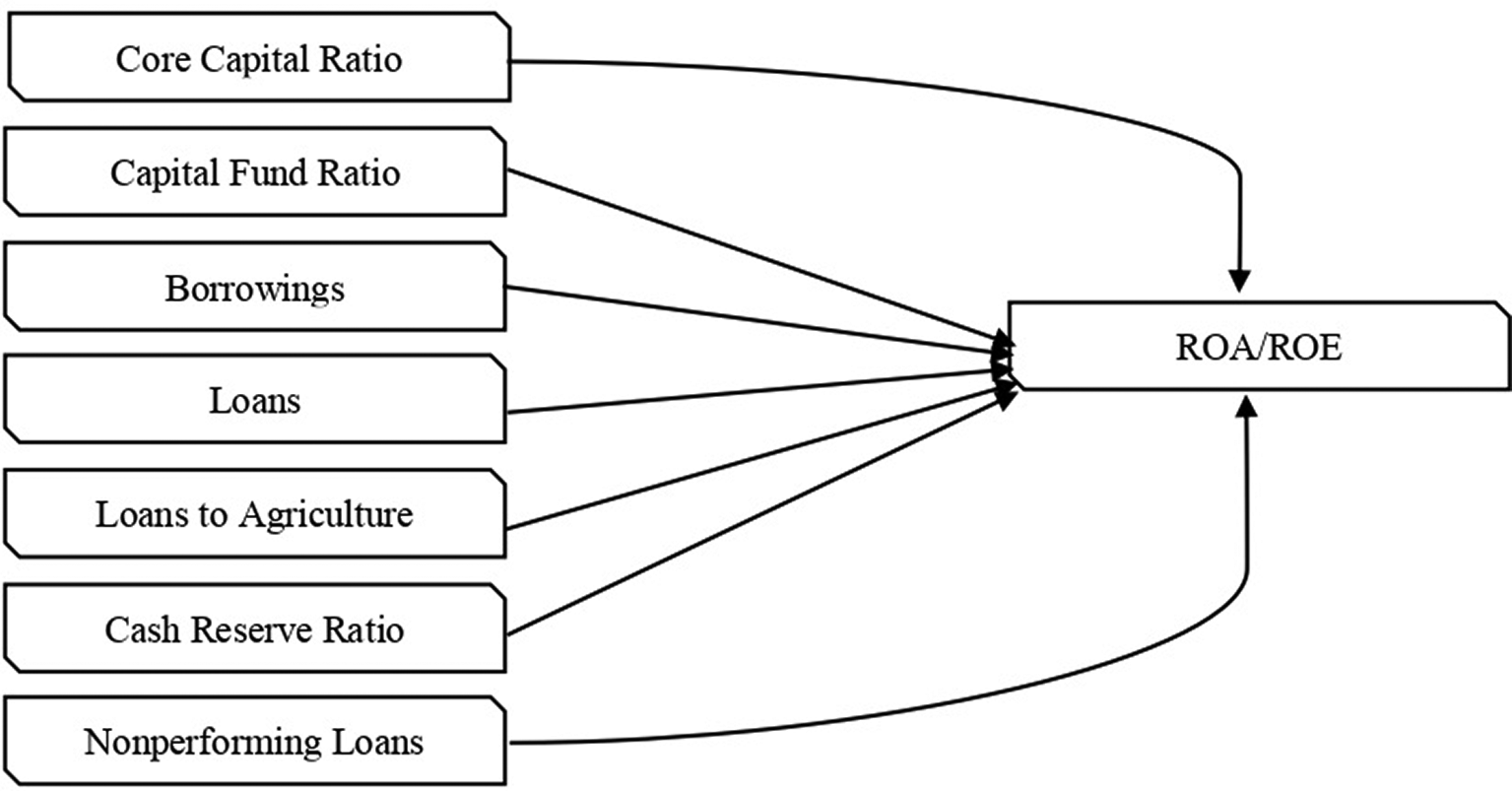
Note: ROA denotes return on assets and ROE denotes return on shareholders’ equity.
2.2.1 Capital and profitability
The nexus between the capital and profitability is still inconclusive. For instance, Afrifa et al. (2019) analyzed the link between excess capital loan quality and performance of MFIs working with a sample of 625 MFIs over the period 2010–2015. The outcome demonstrated that excess amount of capital holding adversely affects the MFIs’ performance. This finding supported the “Trade-off theory”, which states that holding excess capital (Above the minimum regulatory capital) increases the cost of funds. However, it reduces MFIs’ insolvency risk and decreases profitability. Hence, this study emphasized holding optimum capital in order to get maximum return.
Dabi et al. (2023) investigated the effect of the equity-to-assets (E/A) ratio on the performance of MFIs using the sample of 51 MFIs in Ghana for the period 2000–2019. Employing FE and RE, this study found that the equity-to-assets ratio adversely affects the performance of MFIs as measured by ROA. This indicates that injecting higher equity capital raises the cost of funds and can lower the overall profitability. However, Fonchamnyo et al. (2023) found that equity capital did not affect the sustainability of MFIs. However, the undistributed profit (retained earnings) favorably impacts the sustainability of MFIs in Cameroon. Similarly, Annan et al. (2024) analyzed the funding sources and their link with MFIs’ performance, and found that equity finance favorably impacts both “financial performance and sustainability” of MFIs in the maturity stage of the lifecycle. Khanchel et al. (2025) analyzed the influence of FinTech on performance working with a sample of 300 MFIs from 58 countries for the period 2013–2019. Employing 2SLS and 3SLS estimators, findings revealed that the capital-to-assets ratio favorably impacts the performance of MFIs. This study put forward the first hypothesis as:
Core capital ratio favorably affects profitability.
Capital fund ratio favorably affects profitability.
2.2.2 Borrowings and profitability
The borrowing, on the one hand, can favorably affect the performance of MFIs by (1) increasing MFIs’ lending capacity, (2) increasing financial sustainability through diversifying funding resources, (3) increasing operational efficiency through economies of scale, and (4) providing access to the formal credit market. The borrowing, on the other hand, can unfavorably affect performance by (1) increasing the risk of over indebtedness, and (2) increasing NPL. In this context, Abebe (2022) investigated the impact of both assets and liability components on performance using the sample of 106 MFIs for the period 2014–2018 in the context of Africa. Using the fixed-effect estimator, the outcome revealed that borrowing decreases profitability as measured by ROA. This indicates that borrowing cost is higher compared to deposit sources, which increases MFIs’ interest and lowers the overall profitability.
Fonchamnyo et al. (2023) investigated the effect of debt and equity composition on the financial sustainability of MFIs in Cameroon utilizing 15 MFIs as a sample for the period 2014–2020. Using the GLS estimator, the study found that debt adversely affects the “financial sustainability of MFIs”. This indicates that borrowing is a costly source of funding for the MFIs, which can decrease their financial sustainability. Conversely, Dalla Pellegrina et al. (2024) investigated the sustainability factors working with a sample of 159 MFIs over the period 2016–2017. Employing the Tobit and Truncated estimators, findings revealed that the leverage ratio do not affect the sustainability of MFIs in EU countries. Adusei (2022) investigated the influence of liquidity risk on the performance of MFIs using a sample of 532 MFIs from 73 countries for the period 2010–2018 and found that borrowings adversely affect the performance of MFIs. This study put forward the second hypothesis as:
Borrowings adversely affects profitability.
2.2.3 Loans and profitability
The nexus between the loans and profitability is almost clear in banking literature. However, this nexus is not in a mature stage for MFIs. Abebe (2022) examined how the loan portfolios affect performance employing the sample of 106 MFIs covering the period from 2014 to 2018 in Africa. Using a robust FE estimator, the outcome demonstrated that the loans (assets) offer more income for MFIs, and they boost the performance (or profitability) of MFIs. Fonchamnyo et al. (2023) examined how the capital structure affects the financial sustainability of MFIs in Cameroon, working with 15 MFIs as a sample over the period 2014–2020. Using the GLS estimator, the favorable effect of the loan-to-deposit ratio is found by the study on MFIs’ sustainability. Khanchel et al. (2025) examined the effect of FinTech on both “social and financial performance” by deploying a sample of 300 MFIs as a sample from 58 countries for the period 2013–2019. Employing 2SLS and 3SLS estimators, findings revealed that the loan-to-deposit ratio favorably impacts financial performance.
Appiah-Kubi et al. (2026) primarily examined how loans affect sustainability in Ghana, working with 11 MFIs as a sample operating in Ghana for the period 2000–2019. Employing the FMOLS estimator, the result depicted that loan size enhances the sustainability of MFIs in Ghana. Also, this study found that loans to microenterprises stimulate the sustainability of MFIs in Ghana. This indicates that MFIs usually charge high interest rates compared to commercial banks, and the ability to lend more with high interest rates can increase MFIs’ profitability. Naz et al. (2024) reviewed the factors that impact loan delinquency in MFIs and found that loans to agricultural sectors are highly vulnerable due to the fact that agro-products are highly influenced by favorable/unfavorable climate. The natural disaster caused by climate change, high poverty, loans without collateral, health issues, and the sudden death of borrowers can increase loan default and may lead to decreased profitability. Conversely, Mba Fokwa (2024) found that agriculture loans boost the sustainability of MFIs up to a certain threshold point. After the threshold point, it reduces the quality of loan portfolios. This study put forward the third hypothesis as:
Loans favorably affect profitability.
Loans to the agriculture sector adversely affect profitability.
2.2.4 Cash reserve ratio (CRR) and profitability
The MIFs must maintain the prescribed CRR on the basis of deposit volume. By intuition, CRR is a non-earning asset, which reduces the MFIs’ lending capacity and increases the opportunity costs. Therefore, the CRR may adversely affect the performance of MFIs. However, a higher CRR boosts the depositors’ confidence in MFIs, which can attract more deposits at a lower interest rate that decreases MFIs’ cost of funds and can increase profitability. Abebe (2022) examined the impact of “cash and cash equivalents” on performance as measured by ROA for the period 2014–2018 using fixed-effect estimators and found that it did not impact ROA. Similarly, Adusei (2022) investigated the effect of liquidity risk on the efficiency as measured by profitability of MFIs employing the data of 532 MFIs from 73 countries covering the period 2010–2018. This empirical study found that holding more liquidity adversely impacts the performance of MFIs. Yimer (2024) also investigated the impact of liquidity as measured by the deposit-to-loan ratio employing a data of 12 MFIs for the period 2005–2014, and the finding uncovered that liquidity adversely affects the profitability of MFIs. This study put forward the fourth hypothesis as:
CRR adversely affects profitability.
2.2.5 NPL and profitability
The nexus between the NPL and profitability is almost clear in banking literature. However, this nexus is not in a mature stage for MFIs. For instance, Afrifa et al. (2019) investigated how the excess capital and loan quality affect the profitability of MFIs utilizing the data of 625 MFIs from 40 nations covering the period from 2010 to 2015. The result showed that loan portfolios at risk adversely affect the MFI’s performance. Dabi et al. (2023) examined the effect of capital mix on the profitability of MFIs utilizing the data of 51 MFIs in Ghana over the period 2000–2019. Employing FE and RE, this study also found that credit risk decreases the MFIs’ ROA. Khanchel et al. (2025) examined the effect of FinTech on performance by deploying data of 300 MFIs from 58 nations over the period 2013–2019. Employing 2SLS and 3SLS estimators, findings revealed that the credit risk, as measured by “portfolio at risk”, adversely impacts the performance of MFIs. Similarly, Hussain et al. (2025) investigated the connection between “employee well-being and financial performance” in MFIs using a sample of MFIs operating in 139 countries for the period 1999–2019. Employing RE and 2SLS estimators, findings revealed that portfolio risk adversely impacts MFIs’ performance as measured by ROA and ROE. This study put forward the fifth hypothesis as:
NPL adversely affects profitability.
This study used an explanatory research design to examine the impact of capital, borrowings, loan portfolio, CRR, and NPL on the performance of Nepalese MFIs. The secondary data are acquired from the Nepal Rastra Bank (NRB) for the period 2078Q2 to 2081Q4 [Nepali Calendar Date] of 49 MFIs, leading to a total of 735 observations, and excluded two MFIs owing to the unavailability of complete data. However, it covers more than 96% of the total population. This study employs the POLS, FE, and RE estimators to examine the aforementioned nexus. The selection of FE and RE is made based on the Hausman test. Similarly, the choice of POLS and RE is made based on the Breusch-Pagan LM test. The better estimator is for the baseline regression analysis, and the other two estimators are used for a robustness check. Additionally, this study used correlation analysis to check multicollinearity issues that prevail within predictor variables. If we find a correlation between two predictor variables of more than 0.7 (Noortman et al., 2025), we do not put both predictors in the same regression model. This study used two response variables, namely ROA and ROE. The higher values of these indicators indicate the better performance of MFIs. The previous studies of Shkodra (2019) and Chmelíková et al. (2019) used ROA to measure MFIs’ performance. The other major studies that used this indicator are presented in Table 1. The earlier studies of Abrar (2019) and Mia et al. (2022) employed ROE to measure the performance/or profitability of MFIs. This study employed core capital ratio, capital fund ratio, borrowings, loans, loans to the agriculture sector, cash reserve ratio, and NPL as predictor variables, and the details of the predictor variables are presented in Table 1.
| Variables | Symbol | Measurements | Previous studies | Source |
|---|---|---|---|---|
| Return on assets | ROA | Mia et al. (2022), Abebe (2022), Dabi et al. (2023) | Nepal Rastra Bank (NRB) | |
| Return on equity | ROE | Abrar (2019), Mia et al. (2022) | Nepal Rastra Bank (NRB) | |
| Core capital ratio | CCR | Humta et al. (2024) | Nepal Rastra Bank (NRB) | |
| Capital fund ratio | CFR | Duho (2023), Njue (2020), Kwashie et al. (2022) | Nepal Rastra Bank (NRB) | |
| Borrowings | Lnborrowings | Natural logarithm of borrowing | Abebe (2022), Adusei (2022) | Nepal Rastra Bank (NRB) |
| Loans | Lnloans | Natural logarithm of total loans | Abebe (2022) | Nepal Rastra Bank (NRB) |
| Loans to agricultural sector | LAS | Mba Fokwa (2024) | Nepal Rastra Bank (NRB) | |
| Cash reserve ratio | CRR | Abebe (2022), Adusei (2022) | Nepal Rastra Bank (NRB) | |
| Nonperforming loans | NPL | Kwashie et al. (2022), Zamore et al. (2023) | Nepal Rastra Bank (NRB) |
We investigate the major determinants of the profitability of the MFIs for the period 2078Q2 to 2081Q4 [Nepali Calendar Date] utilizing the data of 49 MFIs currently operating in Nepal. The empirical study investigates the effect of core capital ratio, capital fund ratio, borrowings, loans, and loans to the agriculture sector, CRR, and NPL on ROA and ROE. Therefore, we set the following functions to achieve the research objective.
We employed POLS, FE, and RE models to explain the aforementioned effect of these predictor variables on profitability. The POLS estimator does not consider both cross-section and time effect (Gujarati et al., 2009). We propose two POLS models as follows.
On the other hand, the FE estimator considers the heterogeneity issue can handle by FE estimator among 49 MFIs and gives separate intercept for each country, but “it is time-invariant” (Gujarati, 2015). We propose two FE models as follows.
The RE estimator assumes the common (global) intercept for all 49 MFIs, which is denoted by, and each MFI’s intercept is accounted for by . We propose two RE models as follows.
Where, denotes intercept. denotes the set of predictor variables, which includes core capital ratio, capital fund ratio, Lnborrowings, Lnloans, loans to agriculture sector, CRR, and NPL. denotes the coefficients of predictor variables. denotes MFI’s specific effect, and denotes an error term. denotes MFI-specific fixed effect. i denotes MFI, and t denotes quarter.
This section presents the results of descriptive statistics of both response and predictor variables, which are presented in Table 2. The outcome demonstrated that the spread of ROA and ROA are 0.23 and 0.765, respectively. This indicates that some microfinance institutions are operating at a loss during the study period. The SD of ROE and ROA indicates that ROE is more volatile compared to ROA. The min and max of the core capital ratio are 0.028 and 0.217, respectively. The low core capital ratio indicates that some MFIs are not well capitalized. The spread of the capital fund ratio is 0.187, with a min and max values of 0.045 and 0.232, respectively. The spread of borrowing is NPR 19622.9, with a min and max values of NPR 71.97 and NPR 19694.87, respectively. Similarly, the spread of loans and advances is NPR 40872.23, with a min and max value of NPR 360.5 and NPR 41232.73, respectively. The spread of CRR is 0.043, with a min and max values of 0.005 and 0.048, respectively. Finally, the spread of NPL is 0.285, with a min and max values of 0.001 and 0.286, respectively.
Table 3 is especially prepared to check the collinearity issue within the predictor variables, though it shows the link between them. This study detected that the first multicollinearity issue was found between core capital and capital fund ratio (r > 0.7). The second collinearity issue was found between loans and borrowing (r > 0.7). Therefore, we do not include both variables in the same regression model to avoid this issue. However, this correlation matrix also shows the nexus between predictor and response variables. The result showed that the core capital ratio has a direct nexus between profitability measures, ROA, and ROE, and their link is significant. Also, the capital fund ratio has a positive link with both profitability measures, ROA and ROE. However, the borrowing has an insignificant link with ROA and ROE. Conversely, loans have a direct link with ROA and ROE. The loan to the agriculture sector has a positive nexus with both profitability measures, ROA and ROE. Similarly, the CRR has a direct relationship with ROA and ROE, and their link is significant. Finally, the NPL has a negative nexus with ROA and ROE.
| Variable | ROA | ROE | Core capital | Capital fund | Borrowing | Loans | Loan to agriculture | CRR | NPL |
|---|---|---|---|---|---|---|---|---|---|
| ROA | 1 | ||||||||
| ROE | 0.834** (0.000) | 1 | |||||||
| Core capital | 0.396** (0.000) | 0.280** (0.000) | 1 | ||||||
| Capital fund | 0.252** (0.000) | 0.158** (0.000) | 0.838** (0.000) | 1 | |||||
| Borrowing | 0.051 (0.170) | 0.069 (0.063) | −0.0216 (0.559) | −0.001 (0.969) | 1 | ||||
| Loans | 0.159** (0.000) | 0.124** (0.000) | 0.205** (0.000) | 0.253** (0.000) | 0.842** (0.000) | 1 | |||
| Loan to agriculture | 0.139** (0.000) | 0.077* (0.037) | 0.292** (0.000) | 0.157** (0.000) | −0.128** (0.000) | −0.147** (0.000) | 1 | ||
| CRR | 0.100** (0.007) | 0.047** (0.000) | 0.276** (0.000) | 0.305** (0.000) | 0.073* (0.048) | 0.308** (0.000) | −0.086* (0.019) | 1 | |
| NPL | −0.364** (0.000) | −0.354** (0.000) | −0.034 (0.364) | 0.089* (0.015) | −0.202** (0.000) | −0.008 (0.834) | −0.157** (0.000) | −0.062 (0.095) | 1 |
Table 4 reports the outcome of baseline regression results. The selection of the best estimator has been made based on the outcome of the Hausman and Breusch-Pagan LM tests. The outcome of the Hausman test showed that the FE model is superior to the RE model. The result of the Breusch-Pagan LM test showed that RE model is superior to PLOS estimator. Therefore, this study deployed FE models as the baseline regression models. Interestingly, the outcome demonstrated that the core capital ratio positively and significantly impact ROA ( and ROE ( capital fund ratio also positively and significantly impacts ROA and ROE and stimulates the profitability of MFIs operating in Nepal. This indicated that holding more capital increases profitability through more lending opportunities and enhance risk tolerance capacity in MFIs operating in Nepal. However, the borrowing insignificantly impacts ROA ( and ROE . Conversely, the loan portfolio enhances profitability as measured by ROA ( in Nepalese MFIs. The loan to agriculture sector reduces profitability as measured by ROA , and ROE This indicates that the loan to agriculture sector could increase NPL of MFIs and decrease profitability through the channel of rising provision for loan losses. Also, finding revealed that the liquidity measure, CRR insignificantly impact ROA ( and ROE of MFIs. Notably, we found that NPL adversely affect the ROA , and ROE of MFIs. These finding indicated that the capital ratios (core capital and capital fund ratios) and NPL were the major determinants of profitability of Nepalese MFIs.
| Variables | Dependent variable = ROA | Dependent variable = ROE | ||||
|---|---|---|---|---|---|---|
| (1) | (2) | (3) | (4) | (5) | (6) | |
| Core capital | 0.441** | 5.500** | ||||
| Capital fund | 0.124** | 0.123** | 2.189** | 2.179** | ||
| Lnborrowing | −0.174 | −0.185 | −2.759 | −0.988 | ||
| Lnloans | 0.552* | 3.057 | ||||
| Loan to agriculture | −1.081** | −0.129 | −0.273 | −8.132** | −6.879 | −7.681 |
| CRR | 0.141 | 0.111 | 0.137 | 2.502 | −1.725 | 1.868 |
| NPL | −0.227** | −0.287** | −0.287** | −2.511** | −3.247** | −3.245** |
| Constant | −3.141 | 2.444 | 5.814* | 45.649 | 11.782 | 30.775 |
| Observations | 735 | 735 | 735 | 735 | 735 | 735 |
| R-square | 0.282 | 0.189 | 0.109 | 0.170 | 0.160 | 0.138 |
| F-test | 72.19** | 48.32** | 48.63** | 53.07** | 35.70** | 35.75** |
| Hausman-test | 26.84** | 35.31** | ||||
| LM test | 219.33** | 114.34** | ||||
We employed the PLOS and the RE models for the robustness check, which was presented in Table 5. We also compare these results with the baseline regression results. The findings from the POLS estimator revealed that both core capital and capital fund ratio stimulate the profitability of Nepalese MFIs, and these results were consistent with the baseline results. It confirmed that an increase in the capital ratio generates more profit for MFIs. The borrowing from other financial institutions did not impact profitability. Notably, traditional earnings assets—loans—stimulate the profitability of MFIs. Conversely, the impact of loans to the agriculture sector on profitability was inconclusive. But their negative signs and one significant negative coefficient effect within the POLS estimator and two significant negative coefficient effects within the FE estimator indicate the adverse influence of loans to agriculture on profitability in the Nepalese MFIs. This finding is also consistent with the baseline regression results. The result demonstrated that the liquidity measure, CRR, did not significantly impact the profitability of Nepalese MFIs. Notably, the NPL has a significant adverse impact on profitability. We further performed sensitivity analysis by using another estimator, the Random-effect estimator, and the same conclusion mentioned in the PLOS estimator’s results.
| Variables | Panel A: POLS models | |||||
|---|---|---|---|---|---|---|
| Dependent variable = ROA | Dependent variable = ROE | |||||
| (1) | (2) | (3) | (4) | (5) | (6) | |
| Core capital | 0.275** | 2.579** | ||||
| Capital fund | 0.194** | 0.178** | 1.738** | 1.569** | ||
| Lnborrowing | −0.029 | −0.041 | −0.045 | −0.154 | ||
| Lnloans | 0.201** | 2.143* | ||||
| Loan to agriculture | −0.398 | 0.276 | 0.483 | −8.871* | −2.309 | −0.359 |
| CRR | −0.117 | −0.019 | −0.099 | −2.644 | −1.611 | −2.451 |
| NPL | −0.182** | −0.196** | −0.191** | −2.229** | −2.349** | −2.317** |
| Constant | −0.486 | −0.236 | −2.227* | 0.778 | 3.612 | −2.317 |
| Observations | 735 | 735 | 735 | 735 | 735 | 735 |
| R-square | 0.282 | 0.216 | 0.225 | 0.205 | 0.163 | 0.170 |
| F-test | 57.30** | 40.18** | 42.39** | 37.47** | 28.36** | 29.88** |
| Panel B: Random-effect models | ||||||
|---|---|---|---|---|---|---|
| Dependent variable = ROA | Dependent variable = ROE | |||||
| (1) | (2) | (3) | (4) | (5) | (6) | |
| Core capital | 0.351** | 3.167** | ||||
| Capital fund | 0.173** | 0.170** | 1.971** | 1.888** | ||
| Lnborrowing | −0.039 | −0.089 | −0.197 | −0.607 | ||
| Lnloans | 0.159 | 1.635 | ||||
| Loan to agriculture | −0.834** | 0.009 | 0.115 | −13.55** | −5.056 | −3.793 |
| CRR | −0.159 | 0.001 | −0.073 | −3.148 | −1.617 | −2.333 |
| NPL | −0.223** | −0.256** | −0.250** | −2.569** | −2.878** | −2.823** |
| Constant | −0.573 | 0.941 | −1.164 | −2.667 | 9.931 | −8.601 |
| Observations | 735 | 735 | 735 | 735 | 735 | 735 |
| R-square | 0.281 | 0.208 | 0.218 | 0.202 | 0.162 | 0.170 |
| Wald-test | 346.17** | 233.18** | 232.94** | 233.75** | 168.92** | 169.02** |
The next section presents the discussion of empirical findings.
The capital ratio (both core capital and capital fund ratios) favorably impacts the performance of MFIs operating in Nepal, which supports our proposed hypothesis. This result supported the notion of “Risk-return trade-off theory”, which states that well-capitalized banks can take more risk because they have more loss-absorbing capacity. Also, a risk loan portfolio gives higher returns and increases profitability. This finding is similar to the empirical finding of Annan et al. (2024) and Khanchel et al. (2025). However, this result differs from the recent findings of Afrifa et al. (2019), Dabi et al. (2023), and Fonchamnyo et al. (2023). The borrowing has an insignificant impact on performance, which does not support our proposed hypothesis. This result does not support the notion of “Pecking order theory”, which states that borrowing is more costly than retained earnings, and it negatively impacts the performance. This result supports the result of Dalla Pellegrina et al. (2024). This finding does not support the results of Abebe (2022), Adusei (2022), and Fonchamnyo et al. (2023).
The loans favorably impact the performance, which supports our proposed hypothesis. This result supported the notion of the “Financial intermediation theory”, which states that financial institutions such as MFIs efficiently mobilize scarce savings into productive investment by diversifying portfolios, reducing transaction and information costs, balancing maturity mismatch, and properly screening and monitoring, which ultimately increases both efficiency and profitability. This result supports the results of Abebe (2022), Fonchamnyo et al. (2023), and Khanchel et al. (2025). The loan to the agriculture sector adversely affects profitability, which supports our proposed hypothesis. This result does not support the “Financial intermediation theory”, which indicates that agricultural loans are highly vulnerable because the production of agro-products is highly influenced by climate change and natural disasters. The ability of borrowers can be influenced by an economic downturn. This result supports the result of Naz et al. (2024). This finding does not support the results of Mba Fokwa (2024).
The CRR has a negligible impact on profitability, which does not support our hypothesis. This outcome does not support the “Financial intermediation theory”. This result supports the result of Abebe (2022). This finding does not support the results of Adusei (2022) and Yimer (2024). The NPL adversely affects the profitability, which supports our hypothesis. This result supports the “adverse selection and moral hazard” hypotheses, which state that poor asset quality and a weak credit monitoring system increase the NPL. This result support the result of Afrifa et al. (2019), Dabi et al. (2023), Khanchel et al. (2025), and Hussain et al. (2025).
We investigate the determinants of the profitability of MFIs operating in Nepal. We used secondary data extracted from the website of the Nepal Rastra Bank (NRB) covering the period from 2078Q2 to 2081Q4 [Nepali Calendar Date] of 49 MFIs, leading to 735 observations, which covers more than 96% of total MFIs, and excludes two MFIs due to the unavailability of a complete set of data. We employ the FE estimator for the analysis of baseline results and the POLS and RE estimator for the sensitivity analysis. The results exhibit that both capital ratios—core capital and capital fund—stimulate the profitability of the MFIs operating in Nepal. This indicates that strengthening the capital base enhances the profitability of Nepalese MFIs. Conversely, borrowing and CRR do not affect the profitability of Nepalese MFIs. However, as expected, loans positively stimulate profitability, but loans to the agriculture sector adversely affect profitability as measured by ROA and ROE. Notably, it is concluded that, as expected, NPL adversely affects profitability and is robust in all regression models. This study concludes that the capital ratio and NPL significantly affect the profitability of Nepalese MFIs. Both policymakers and MFIs could use these findings to maximize the performance of MFIs. First, policyholders could pay attention to increasing the capital base by increasing equity capital and lowering financial risk. Second, the NRB could reduce interest rates that increase MFIs’ borrowing and lending capacity. Third, the government could run credit guarantee schemes, especially for agriculture loans that protect MFIs from NPLs. Finally, the NRB must regularly supervise and monitor MFIs’ lending activities, which reduces NPL and boosts profitability.
This study has included 49 MFIs covering the period from 2078Q2 to 2081Q4 [Nepali Calendar Date] This study excluded two MFIs due to the unavailability of data. The future study, therefore, can be performed by including all MFIs and taking a long time span, which can enhance the generalizability of the research findings. This study includes only financial performance (ROA and ROE) as the dependent variables. It excludes the social performance (for instance, average loan size, number of credit clients, cost per borrower, operational self-sufficiency) as the dependent variable. Hence, future studies can incorporate social performance as a response variable. Similarly, future studies could include more predictor internal factors such as ownership structure, board of directors, number of independent directors, size, liquidity, cost efficiency, diversification, and others. Also, future study could include institutional quality factors such as rule of laws, control of corruption, and political stability, macroeconomic factors such as GDP growth, inflation, interest rate, unemployment, poverty, and others.
| Views | Downloads | |
|---|---|---|
| F1000Research | - | - |
|
PubMed Central
Data from PMC are received and updated monthly.
|
- | - |
Provide sufficient details of any financial or non-financial competing interests to enable users to assess whether your comments might lead a reasonable person to question your impartiality. Consider the following examples, but note that this is not an exhaustive list:
Sign up for content alerts and receive a weekly or monthly email with all newly published articles
Already registered? Sign in
The email address should be the one you originally registered with F1000.
You registered with F1000 via Google, so we cannot reset your password.
To sign in, please click here.
If you still need help with your Google account password, please click here.
You registered with F1000 via Facebook, so we cannot reset your password.
To sign in, please click here.
If you still need help with your Facebook account password, please click here.
If your email address is registered with us, we will email you instructions to reset your password.
If you think you should have received this email but it has not arrived, please check your spam filters and/or contact for further assistance.

Comments on this article Comments (0)