Keywords
Artificial Intelligence, Human Resource Management, Behavioural HR Competencies, Employee Performance, AI Integration, Competency-Based Theory, Sociotechnical Systems Theory, AI-Enabled Workplaces

Artificial Intelligence, Human Resource Management, Behavioural HR Competencies, Employee Performance, AI Integration, Competency-Based Theory, Sociotechnical Systems Theory, AI-Enabled Workplaces
In today’s digitally driven environment, employee performance is frequently framed as a technological outcome (Jiang et al., 2023; Nguyen et al., 2023; Prentice et al., 2023); yet beneath this polished narrative lies a quieter, more enduring truth: performance does not simply emerge from machines; it is ultimately shaped and brought to life through human judgment, lived interaction, and the behavioural capacities (Bankins et al., 2023; Przegalinska et al., 2025; Xu & Cho, 2025). Despite the expanding body of scholarship on artificial intelligence in human resource management, much of the literature continues to orbit around the technology itself, describing its capabilities while giving less attention to how it is actually used in practice (Madanchian & Taherdoost, 2025). Because of this, the behavioural side of AI and performance is still not clearly addressed in theory, often implied but insufficiently articulated or empirically explored. More importantly, prevailing models of AI-enabled HRM still assume, often implicitly, that technology alone drives outcomes, whereby the adoption of AI is expected to yield performance gains almost automatically (Meijerink & Bondarouk, 2023; Alshahrani et al., 2025). In reality, this assumption is not always convincing in light of organisational evidence showing that AI systems frequently produce uneven, and at times contradictory, outcomes (Gélinas et al., 2022; Basu et al., 2023). This variation cannot be fully explained by technological attributes alone; rather, it points toward a less visible yet more decisive domain: the behavioural competencies through which employees interpret, appropriate, and ultimately enact AI within the flow of everyday work.
From a competency-based perspective, these human capacities represent the primary conduits through which organisational value is realised. Yet, they continue to be treated as peripheral or implicit conditions rather than as core explanatory mechanisms (Somani et al., 2023; Sarangi et al., 2025). Consistent with sociotechnical systems theory, this omission is theoretically problematic, as it disregards the premise that technology acquires meaning and effectiveness only through its situated interaction with social structures, work processes, and human agency (Ruiz et al., 2024; Ang et al., 2025; Tsarouhas & Grigoriadis, 2025). Consequently, existing AI-HRM models offer an incomplete account of how AI translates into performance outcomes, leaving a critical theoretical and empirical gap that warrants systematic investigation. Accordingly, a clear research gap persists in the literature, which is that the current AI-HRM frameworks inadequately explain performance variation because they fail to conceptualise behavioural HR competencies as central mechanisms through which AI integration influences employee performance. Addressing this gap is essential for advancing a more balanced and theoretically grounded understanding of AI-enabled workplaces. In response, this paper develops a conceptual framework that examines the direct effects of key behavioural HR competencies on employee performance, while positioning AI integration as an enabling mechanism that strengthens these relationships. This study contributes to the literature in two important ways. Theoretically, it integrates Competency-Based Theory and Sociotechnical Systems Theory to reconceptualise AI as a contextual enhancer that derives its effectiveness from human behavioural capabilities. Practically, it offers strategic guidance for HR leaders by highlighting the necessity of aligning technological investment with the systematic development of behavioural competencies. The remainder of the paper reviews the relevant literature, presents the proposed conceptual framework and hypotheses, outlines directions for empirical testing, and discusses implications for future research and practice.
This study adopts a structured conceptual analytical approach to develop an explanatory framework for understanding employee performance in AI-enabled HR contexts. Rather than empirically testing relationships, the analysis synthesises insights from competency-based scholarship and sociotechnical systems theory to clarify how behavioural HR competencies are enacted within AI-integrated work practices. In this framing, AI integration is treated as a sociotechnical condition that shapes the context in which behavioural competencies are mobilised, rather than as an autonomous driver of performance. No empirical data are analysed, and the propositions advanced are intended to guide future empirical investigation.
Employee performance has long been rendered in organisational research as a measurable endpoint counted, compared, and optimised through numerical abstractions (Cunha et al., 2025; Elten & Kolk, 2025; Vuong & Nguyen, 2022). Yet beneath these metrics lies a quieter, more fundamental reality: performance is enacted, not merely produced (Aguinis et al., 2024; Wenzel et al., 2025). It unfolds through human behaviour situated within organisational life, emerging from how individuals interpret their roles, exercise judgement, coordinate with others, and navigate the demands of ever-changing contexts (Hernaus et al., 2026; Junça-Silva & Caetano, 2024; Kaffka et al., 2025; Steegh et al., 2025). From this vantage point, performance transcends task completion; it becomes a behavioural accomplishment, shaped by interaction, discretion, and adaptive action, rather than by mechanical compliance or procedural execution alone.
Viewing performance as a behavioural outcome shifts attention toward the conditions under which human agency is exercised, rather than assuming that outcomes are structurally determined. Performance does not reside in structures or technologies themselves but emerges through the ways individuals mobilise their capabilities in practice (Leonidou et al., 2025; Subramaniam et al., 2025). Even within highly standardised or technologically mediated environments, employees retain spaces of discretion, interpreting information, exercising judgement, and coordinating action in ways that cannot be fully prescribed (Zayid et al., 2024).
If performance is enacted through behaviour, then organisational interventions, including the deployment of advanced technologies can shape outcomes only to the extent that they influence how employees think, act, and relate to one another (Zhang et al., 2023). Viewed in this way, analytical attention is redirected away from technological artefacts themselves and toward the human capacities through which organisational value is ultimately brought into being.
Unlike technical skills, which concern the execution of tasks, behavioural competencies govern how work is interpreted, how decisions are formed, and how interactions unfold within organisational space (Muzulon et al., 2025). From a competency-based perspective, employee performance unfolds through the mobilisation of behavioural resources in the face of complexity, ambiguity, and interdependence. Problem-solving competency equips employees with the capacity to diagnose situations, weigh alternatives, and respond constructively to unforeseen challenges (Hajj et al., 2025). Communication competency enables the alignment of understanding, the coordination of effort, and the ongoing negotiation of meaning among organisational actors (Florea & Croitoru, 2025). Managerial and leadership competencies shape the exercise of authority, the setting of direction, and the orchestration of resources (Alwali & Alwali, 2025; Ling et al., 2025; Matsunaga, 2022), while teamwork competency sustains collaboration, mutual adjustment, and collective sense-making (Gafni et al., 2024). Taken together, these competencies form the behavioural infrastructure through which organisational intentions are converted into effective performance (Polakov et al., 2023).
Importantly, behavioural HR competencies do not shape performance in abstraction; they exert their influence through enactment within organisational systems and everyday work processes (Ravi & Sumathi, 2023; Wang et al., 2022). Performance emerges through continuous interaction among individuals, teams, and managerial structures where behavioural competencies guide how information is interpreted, priorities are formed, and action is coordinated (Cristofaro, 2022; Paredes-Saavedra et al., 2024). Variations in employee performance are therefore more convincingly explained by differences in behavioural capability and enactment than by formal job design or technical inputs alone.
Within contemporary organisational environments, the significance of behavioural competencies becomes especially pronounced as work grows increasingly mediated by advanced technologies (Deepa et al., 2024; Zirar et al., 2023). These competencies shape how employees engage with complex systems, interpret information, and incorporate external inputs into decision-making and action (Murire, 2024; Nguyen & Elbanna, 2025). In this sense, behavioural competencies function as antecedents, determining whether organisational interventions including the integration of artificial intelligence can be meaningfully translated into improved performance.
Despite their foundational role, behavioural HR competencies have frequently been relegated to the analytical background of HRM research, assumed rather than examined as core explanatory constructs. This marginalisation is particularly pronounced in technology-oriented studies, where behavioural dimensions are often controlled for, aggregated, or subsumed within broader conceptual categories (Negt & Haunschild, 2024). Re-centring behavioural HR competencies within performance analysis thus constitutes a necessary theoretical correction one that restores human capability to its rightful position as the primary conduit through which organisational value is ultimately realised.
Artificial intelligence integration in human resource management is often narrated as the arrival of sophisticated tool systems engineered to automate processes, compress time, and sharpen decision accuracy (Naoum et al., 2026; Úbeda-García et al., 2025). Within this framing, AI appears as an autonomous force, a self-propelling engine of organisational performance, as though capability alone were sufficient to guarantee outcomes. Yet such accounts smooth over a more intricate reality (Jin et al., 2026; Zheng et al., 2025). AI-enabled work is irreducibly sociotechnical: technology does not act, decide, or perform in isolation. It is woven into organisational structures, animated through social relations, and ultimately brought into effect by human judgement and action.
From a sociotechnical systems perspective, AI integration is not simply the introduction of intelligent machines into organisational life, but also a reconfiguration of work itself emerging through the continuous interaction between technological artefacts and human actors (Herrmann & Pfeiffer, 2023; Thomas, 2024; Yu et al., 2023). AI systems may generate recommendations, predictions, and analytical signals, yet these outputs carry no intrinsic organisational value. Their significance is realised only through human interpretation, evaluative judgement, and situated enactment within specific organisational contexts (Bankins et al., 2023; Hao et al., 2025). In this sense, AI integration operates less as a direct engine of performance and more as a contextual mechanism one that reshapes how work is understood, coordinated, and ultimately performed.
Within AI-integrated environments, employees are required to engage with algorithmic outputs, data-driven insights, and automated decision support as integral elements of everyday work (Jia et al., 2025). Such engagement introduces heightened demands for judgement, sense-making, and coordination particularly in moments where algorithmic recommendations collide with experiential knowledge, organisational norms, or situational constraints. Far from diminishing human involvement, AI integration amplifies the salience of human agency: employees must continuously decide when to rely on, recalibrate, or contest technologically generated information in order to act effectively (Nguyen & Elbanna, 2025).
Crucially, the performance implications of AI integration hinge on the behavioural HR competencies that enable employees to navigate this sociotechnical complexity (Deepa et al., 2024). These competencies shape how AI is enacted in practice whether it operates as a supportive aid to judgement, crystallises into a rigid mechanism of control, or becomes a source of ambiguity and resistance. Where behavioural competencies are well developed, AI integration can extend employees’ capacity to analyse information, coordinate action, and respond adaptively to shifting work demands. Where such competencies are absent or underdeveloped, AI systems risk being underutilised, misapplied, or generating unintended performance effects (Liu et al., 2025).
Accordingly, AI integration does not exert a uniform or deterministic effect on employee performance. Its effects are mediated through human behaviour and enacted through everyday work practices. Variations in performance across AI-enabled organisations therefore cannot be attributed to technological sophistication alone, but to how employees incorporate AI into their judgement, interaction, and decision-making processes. By conceptualising such integration as a sociotechnical enhancing mechanism, this study frames technology not as an autonomous determinant of performance, but as a contextual medium through which behavioural HR competencies are activated and amplified. This framing aligns closely with sociotechnical systems theory and provides the conceptual foundation upon which the proposed behavioural sociotechnical framework is developed.
Taken together, the literature reviewed in the preceding sections converges on a critical insight: employee performance in contemporary organisations cannot be adequately understood through technology-centric explanations alone (Khan et al., 2026; Ramachandran et al., 2022). While prior research has generated substantial knowledge on performance outcomes (Alwali & Alwali, 2025; Eng’airo, 2024), behavioural competencies (Benvenuti et al., 2023; Mikeladze et al., 2024), and AI-enabled systems as separate domains, these strands have largely evolved in parallel rather than in integration. As a result, existing accounts fall short of explaining how performance is actually enacted within AI-integrated work environments, where human judgement, interaction, and technological mediation intersect.
The synthesis of the literature indicates that performance is fundamentally a behavioural phenomenon, enacted through employees’ ongoing interpretation of work demands and coordination of action (Agarwal & Raghav, 2024). Behavioural HR competencies constitute the primary mechanisms through which such performance is achieved, enabling employees to navigate complexity, exercise discretion, and engage adaptively with organisational systems (Ghosh & Kabra, 2025; Kharub et al., 2025). At the same time, artificial intelligence integration reshapes the context within which these competencies are mobilised, introducing new forms of information, decision support, and coordination demands (Amayreh et al., 2025). Yet, prevailing AI-HRM research has tended to privilege technological capability while under-theorising the behavioural processes through which AI is meaningfully integrated into work practices.
What remains absent from the literature is an integrative perspective that conceptualises employee performance as the outcome of an interaction between behavioural HR competencies and AI integration within a sociotechnical context. Rather than treating AI as an autonomous determinant of performance, a behavioural sociotechnical perspective recognises technology as an enabling mechanism whose effects are contingent upon human capability and agency (Alwali & Alwali, 2025). This synthesis underscores the need for a conceptual framework that positions behavioural HR competencies as antecedent drivers of performance and AI integration as a contextual enhancer through which these competencies are translated into performance outcomes.
Accordingly, advancing understanding in this domain requires moving beyond fragmented treatments of technology and behaviour toward a coherent framework that captures their interdependence. The following section responds to this need by developing an integrative conceptual framework that explains how behavioural HR competencies shape employee performance through AI integration, thereby offering a more theoretically grounded and practically meaningful account of performance in AI-enabled workplaces.
Competency-Based Theory explains employee performance as an outcome of individuals’ capacity to mobilise behavioural resources in response to work demands (Freiling, 2004). Rather than attributing performance differences to technological or structural conditions, the theory emphasises that variability in performance arises from how effectively employees deploy their competencies in practice (Kharub et al., 2025). In this study, behavioural HR competencies, which are problem solving, communication, managerial capability, teamwork, and leadership, constitute the key independent variables shaping employee performance. These competencies influence how employees interpret tasks, make decisions, and coordinate action, particularly in environments characterised by complexity and uncertainty (Polakov et al., 2023). Within AI-enabled contexts, this theoretical lens becomes especially relevant, as employees are required to engage with algorithmic outputs and data-driven insights. Competency-Based Theory therefore supports the argument that the effectiveness of AI integration depends on employees’ behavioural capacity to utilise, adapt, and act upon technological inputs (Somani et al., 2023). Accordingly, employee performance is conceptualised as a function of behavioural capability, providing a direct theoretical basis for the relationship between behavioural HR competencies and performance.
Sociotechnical Systems Theory provides a framework for understanding how AI integration conditions the relationship between behavioural HR competencies and employee performance. The theory posits that organisational outcomes emerge from the interaction between social elements such as human skills and behaviour and technical systems, rather than from either dimension in isolation (Trist & Bamforth, 1951). In this study, AI integration is conceptualised as a contextual mechanism that shapes how behavioural competencies are applied within work processes. While AI systems generate analytical outputs and decision-support signals, their impact on performance depends on how employees interpret and incorporate these inputs into action.
From this perspective, AI does not directly determine employee performance. Instead, it alters the conditions under which behavioural competencies operate (Amanollahnejad et al., 2026; Kudina & Poel, 2024). Employees with stronger competencies are more capable of translating technological inputs into effective decisions and coordinated action, thereby enhancing performance. Conversely, limited behavioural capability constrains the realisation of AI’s potential, leading to inconsistent performance outcomes. This theoretical lens therefore justifies positioning AI integration as an enabling factor that strengthens the relationship between behavioural HR competencies and employee performance, reinforcing the sociotechnical nature of performance in AI-enabled environments.
This study adopts a conceptual and theory-driven research design to examine how behavioural HR competencies influence employee performance within AI-enabled organisational environments. A conceptual approach is appropriate because the relationship between these variables remains theoretically fragmented within the existing HRM literature. It examines them in fragmented ways, with limited theoretical integration. Accordingly, the study seeks to develop an integrated conceptual framework that explains this relationship. The study is grounded in Competency-Based Theory and Sociotechnical Systems Theory to provide a multidimensional understanding of human capability and technological integration in contemporary workplaces.
The framework was developed through a critical integration of theoretical and empirical literature and relevant studies were identified from peer-reviewed academic sources discussing AI-enabled HR practices, workplace behavioural competencies, human–technology interaction, and performance outcomes in digital work environments. The analysis focused particularly on behavioural competencies, including problem solving, communication, managerial capability, teamwork, and leadership. The literature was examined comparatively to identify recurring conceptual relationships, theoretical inconsistencies, and gaps in the existing HRM and AI literature. This process enabled the study to synthesise dispersed insights into a unified conceptual explanation of how behavioural competencies interact with AI systems to influence employee performance.
The conceptual framework was developed by integrating the core assumptions of Competency-Based Theory and Sociotechnical Systems Theory. Competency-Based Theory was used to explain the behavioural capabilities associated with effective employee performance, while Sociotechnical Systems Theory provided the foundation for understanding how these competencies operate within technologically mediated organisational environments. Through iterative theoretical synthesis, the study developed a framework that positions AI integration as a sociotechnical context within which behavioural competencies are enacted and shaped. Based on the synthesised literature, a series of conceptual propositions were developed to explain the relationships between them.
As illustrated in Figure 1, the conceptual framework proposes that behavioural HR competencies, problem solving, communication, managerial capability, teamwork, and leadership, have a direct effect on employee performance. Artificial intelligence integration is modelled as a contextual enhancing condition that shapes how these competencies are enacted in practice, thereby influencing their performance outcomes. Employee performance is therefore conceptualised as the result of behavioural competencies operating within AI-mediated work environments, where technological systems condition, but do not independently determine, performance outcomes.
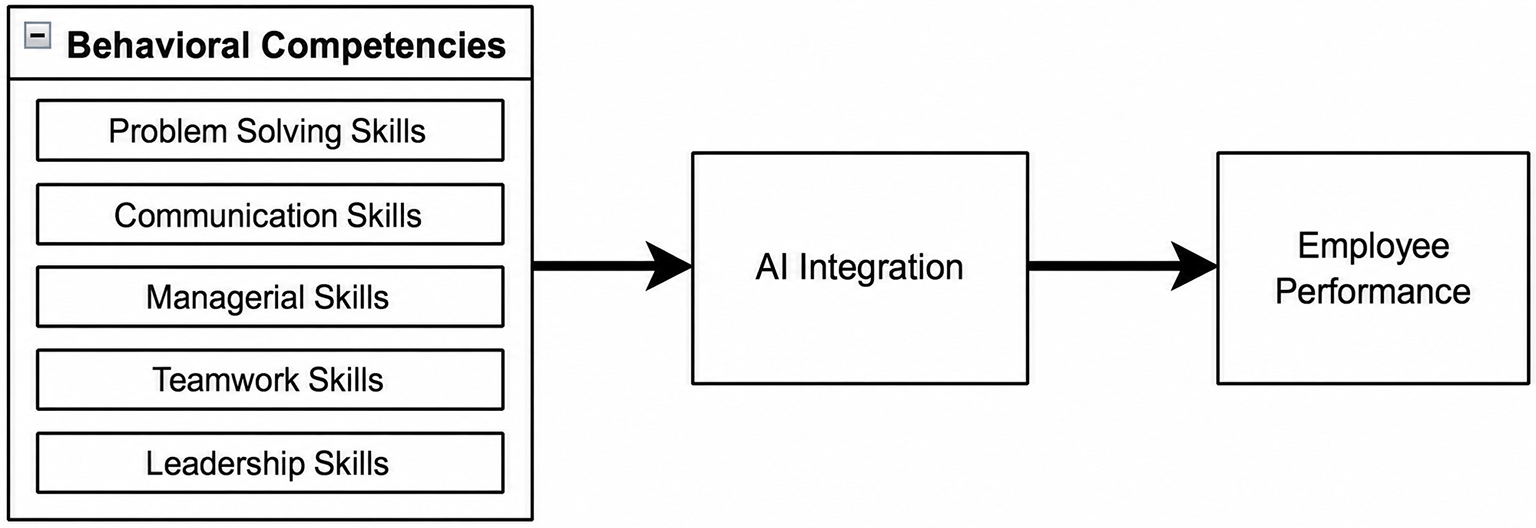
This framework is theoretically grounded in Competency-Based Theory and Sociotechnical Systems Theory. Competency-Based Theory explains the direct relationship between behavioural HR competencies (independent variables) and employee performance (dependent variable), emphasising that performance outcomes are driven by the effective deployment of behavioural capabilities. Sociotechnical Systems Theory explains the role of AI integration as a contextual enhancing mechanism, highlighting that the impact of behavioural competencies on performance is shaped by the interaction between human capabilities and technological systems. Together, these theories provide a coherent explanation of how employee performance is generated within AI-enabled organisational environments.
Drawing on Competency-Based Theory and Sociotechnical Systems Theory, this study advances a set of theoretically grounded propositions that clarify how behavioural HR competencies, AI integration, and employee performance are interrelated within AI-enabled HR contexts. Rather than assuming deterministic effects of technology, the propositions articulate a behavioural sociotechnical logic in which human competencies condition how AI is enacted in practice and how performance outcomes emerge.
AI integration positively influences employee performance within HR work contexts by reshaping how work is coordinated, interpreted, and executed.
AI integration positively influences employee performance.
AI integration mediates the relationship between behavioural HR competencies and employee performance, such that the performance effects of behavioural competencies are realised through their enactment within AI-integrated work environments.
This framework offers a different way of understanding HRM by bringing the human element back into the discussion of performance in AI-enabled workplaces. It unsettles technology-centric narratives that treat performance as something that automatically results from advanced technology and instead views it as something shaped by how people think, interact, and work in practice. It extends competency-based scholarship into the terrain of AI-mediated work by viewing behavioural competencies as abilities that develop within, and are shaped by, technological environments. From this perspective, competencies are not used independently; their impact depends on how AI tools, data, and digital systems are used in organisations in HR practices. By situating competencies within these sociotechnical conditions, the framework provides a clearer explanation of how human capability and technology work together in practice, showing how competencies are used and adjusted in different situations in AI-enabled organisational settings. Weaving together Competency-Based Theory and Sociotechnical Systems Theory, the framework provides an integrated perspective through which performance variation in AI-enabled workplaces can be better understood. This synthesis addresses an important gap in HRM research, where behavioural and technological perspectives have often been studied separately rather than together.
In practice, this framework provides guidance for HR leaders and organisations dealing with the challenges of AI integration. It also highlights that relying only on investment in intelligent systems is insufficient to achieve sustainable performance gains and instead emphasises the importance of developing behavioural HR competencies alongside technological adoption. It also suggests that HR strategies should align technological deployment with the development of behavioural competencies. This means designing training programmes that go beyond simply teaching employees how to use systems, helping employees understand and use AI outputs, work effectively in digital environments, and make decisions in uncertain situations. Finally, the framework offers a strategic lens through which organisations can better evaluate the outcomes of AI implementation. Rather than equating success with efficiency gains or automation metrics alone, it invites attention to how AI integration changes how behavioural competencies are used and, through them, employee performance.
As this is a conceptual study, the framework has not been tested with empirical data. The relationships between behavioural HR competencies, AI integration, and employee performance are based on theory, and still need to be tested in future studies. The framework is not intended to predict outcomes in all contexts, but rather to help explain how performance may develop in AI-enabled workplaces. Moreover, the analysis takes a broad organisational view, and does not fully consider sectoral, institutional, or cultural differences which may affect how behavioural competencies and AI are used in practice. Differences across industries and national contexts may lead to different outcomes that exceed the boundaries of the present conceptualisation, Future research can build on this framework and test it in more specific contexts.
Future research can extend this framework beyond its current conceptual scope and into the varied terrains of organisational life. Future studies can examine how these relationships operate in different contexts across different organisational and cultural contexts, testing the mediating role of AI integration in shaping the link between behavioural HR competencies and employee performance. Quantitative studies can examine patterns in the data, while qualitative work may listen more closely to how these competencies are enacted, negotiated, and sometimes contested within AI-mediated work settings. Comparative research across different industries or regions may help identify the conditions where behavioural sociotechnical dynamics take distinctive forms. Beyond empirical extension, future conceptual work might deepen the framework by attending to ethical and organisational issues of AI integration, helping to better understand how human roles change in these environments as organisations rely more on AI systems.
This conceptual paper set out to move beyond technology-centric accounts of AI-enabled human resource management by focusing again on the human side of performance and how it develops in real work settings. Instead of treating AI as the main driver of performance, the framework presented here views AI integration as something that influences how behavioural HR competencies are used and adjusted in practice. By combining Competency-Based Theory with Sociotechnical Systems Theory, the study helps explain why AI adoption leads to different performance outcomes across organisations. In doing so, the framework contributes to HRM research by showing how human and technological elements work together in practice, and by providing an alternative to purely technology-based explanations of AI-driven performance. Overall, this suggests a need to rethink how performance is understood, cultivated, and sustained in AI-enabled workplaces.
| Views | Downloads | |
|---|---|---|
| F1000Research | - | - |
|
PubMed Central
Data from PMC are received and updated monthly.
|
- | - |
Provide sufficient details of any financial or non-financial competing interests to enable users to assess whether your comments might lead a reasonable person to question your impartiality. Consider the following examples, but note that this is not an exhaustive list:
Sign up for content alerts and receive a weekly or monthly email with all newly published articles
Already registered? Sign in
The email address should be the one you originally registered with F1000.
You registered with F1000 via Google, so we cannot reset your password.
To sign in, please click here.
If you still need help with your Google account password, please click here.
You registered with F1000 via Facebook, so we cannot reset your password.
To sign in, please click here.
If you still need help with your Facebook account password, please click here.
If your email address is registered with us, we will email you instructions to reset your password.
If you think you should have received this email but it has not arrived, please check your spam filters and/or contact for further assistance.

Comments on this article Comments (0)