Keywords
Airflow Energy Harvesting, Micro-Turbine Generator, Adaptive Control Systems, IoT Energy Solutions, Multi-Mode Energy Regulation, Smart Energy Harvesting Systems

This article is included in the Artificial Intelligence and Machine Learning gateway.
Airflow Energy Harvesting, Micro-Turbine Generator, Adaptive Control Systems, IoT Energy Solutions, Multi-Mode Energy Regulation, Smart Energy Harvesting Systems
The rapid expansion of Internet of Things (IoT) networks, wireless sensor networks, and smart infrastructure systems has intensified the demand for autonomous, maintenance-free power solutions. Embedded monitoring systems deployed in industrial ducts, ventilation channels, HVAC systems and pipeline networks often operate in environments where battery replacement is impractical, costly or unsafe. Consequently, micro energy harvesting has emerged as a promising alternative to conventional continuous battery-dependent devices. Among the various ambient energy sources available, airflow represents a continuous and underutilized resource in controlled ducted environments.
Airflow-driven micro energy harvesting systems typically employ micro-turbines, flapping mechanisms or electrostatic conversion structures as illustrated by authors in1–4 to transform kinetic energy from moving air into electrical power. Prior research has demonstrated the feasibility of such systems, particularly in low-to-moderate airflow regimes. However, existing airflow-based harvesters predominantly emphasize mechanical efficiency improvements or maximum power point tracking (MPPT) techniques aimed at optimizing energy extraction.5,6 While these strategies enhance conversion efficiency, they often neglect adaptive electrical regulation, over-voltage protection, and context-aware load management. As a result, most current designs operate as passive harvesting units without embedded intelligence capable of dynamically responding to changing airflow conditions or varying load demands.
In practical deployments, airflow intensity within ducts may fluctuate due to operational cycles, environmental conditions, or even system dynamics. Without adaptive control, micro-turbine systems may experience inefficient loading, unstable output voltage, or excessive electrical stress which results in system inefficiency and unreliable supply. Therefore, there exists a need for an intelligent airflow-driven energy harvesting architecture that integrates real-time sensing, adaptive control logic, and protective load modulation mechanisms within a compact and scalable design framework.
This paper presents the Smart Adaptive Micro-Turbine Energy Harvester (SAMTEH), an intelligent airflow-based micro energy harvesting system designed for ducted and exhaust environments like in HVAC systems. SAMTEH introduces a multi-mode operational architecture that combines real-time voltage and current monitoring with embedded decision-making logic and relay-based load regulation. By enabling dynamic mode switching between energy harvesting, output limiting, and protection states, the proposed system enhances operational safety, reliability, and efficiency beyond conventional static MPPT-based designs.
The remainder of this paper is organized as follows; Section II gives a prior art literature review, Section III describes the overall system design, including the mechanical airflow interface, sensing architecture, and adaptive control framework. Section IV presents the implementation details, covering hardware integration, control logic development, and circuit realization. Section V discusses the experimental setup and results obtained under varying airflow conditions. Finally, Section VI concludes the paper and outlines potential directions for future research and system enhancement.
The increasing need for self-powered embedded and IoT systems has further increased the research in micro energy harvesting technologies. Applications such as wireless sensor networks, structural monitoring, IoT nodes and smart infrastructure require compact, maintenance-free power solutions. Among the available environmental energy sources, airflow-driven harvesting presents a promising opportunity in ducted systems, ventilation channels, exhaust streams and industrial pipelines where a lot of energy is lost as wind energy at high velocities. The foundational concept demonstrated in “Flow to Glow: Innovative Energy from Exhaust Air”1 established the feasibility of extracting electrical energy from exhaust airflow using micro-turbine mechanisms installed within the air flow pathways in the exhaust air ducts in HVAC systems. However, while prior research has focused on mechanical optimization and maximum power extraction techniques, limited attention has been given to adaptive, protection-oriented energy regulation and storage architectures.
This review of prior art focuses on categorizing existing literature into three major groups: (A) airflow and duct-based wind harvesting systems, (B) other micro energy harvesting techniques and (C) supporting power management and optimization studies. Following systematic comparison, a critical research gap is identified, motivating the development of the Smart Adaptive Micro-Turbine Energy Harvester (SAMTEH). Table 1 presents a comparative review of previous airflow-based and micro energy harvesting systems, highlighting their methodologies, limitations, and differences compared to the proposed SAMTEH architecture.
| Group | Related Work | Methodology | Remarks compared to SAMTEH |
|---|---|---|---|
| A | 1Flow to Glow – Innovative Energy from exhaust air 2A High-Efficiency Wind-Flow Energy Harvester Using Micro Turbine 3Airflow-Driven Rotary Electret Energy Harvester 4Flapping Airflow Energy Harvester with Flexible wing sections | Exhaust air driven Mechanical airflow conversion to electrical Electrostatic Induction based Low airflow Electromagnetic induction Flexible wings reduced damping Uses bluff body induced oscillation | Lacks adaptability on electrical regulation No intelligent mode switching No proposed storage techniques No multi = mode adaptive load protection No load isolation strategy No embedded adaptive control No real time decision logic Very low power range No Electrical mode adaptation No intelligent energy management |
| B | 7RF Micro Energy Harvesting 8Micro-Kinetic Harvesting for Wearables 9Biomedical Micro Harvesting 10PERPS Multi-Source Harvester | RF Harvesting Near-Field EM Capture Human Motion Biomedical Harvesting Implant Micro Power Hybrid Harvesting | RF related not Airflow-based but useful for the study of micro energy harvesting Not Airflow based Not Airflow based Very low power Not duct optimized |
| C | 11Micro Energy Management at Maximum Power | Power optimization studies | No adaptive protection logic |
The author in1 demonstrates the feasibility of generating energy from airducts. Thiis successful micro-energy harvesting technique is made meant to operate in HVAC systems and help generate power to power IoT self-powered devices but the authors only realize the feasibility and successful powering of an LED this type of approach has limitations which include no decision-making logic, lack of adaptability on electricity regulation, lack of intelligent mode switching and no storage implementation of excess energy The rest of the authors in group A2,3,4 all focus on mechanical improvement and power efficiency but none address the electrical loading adaptability or the protection logic leaving room for this paper to find its relevance on filling the gap areas.
Micro energy harvesting extends beyond airflow systems into kinetic energy. Other micro energy harvesting sources are addressed for instance Magno et al. (2018) developed a micro kinetic energy harvesting system optimized for low-frequency human motion. The system achieved up to 624 μW with 84% end-to-end efficiency by incorporating a negative voltage converter and optimized rectification architecture.12 While efficient, the harvesting source was human motion rather than airflow. Other micro energy harvesting techniques were studied to understand the methods and also the drawbacks, it was observed that micro energy can also be harvested from RF energy, thermal and biomedical domains as in7–9,13 and multisource harvester.10
Several studies have concentrated on improving maximum power point tracking, impedance matching, and DC–DC converter efficiency. These works enhance energy extraction efficiency but typically operate under fixed-mode optimization. Protection logic, adaptive relay-based load control, and closed-loop system-aware regulation are rarely integrated into airflow-based harvesters.
The literature survey clearly indicates that the previous work focus more on mechanical optimization to improve the efficiency of micro-energy harvesting, while other methods have a single or static operational mode which affects their adaptability to varying airflows and varying loads, therefore this leaves room to develop a protection-oriented adaptive load management as well as closed loop relay-based modulation.
Across Groups A, B, and C, the literature reveals consistent trends:
1. Mechanical optimization dominates airflow harvester research.
2. MPPT is the primary electrical optimization strategy.
3. Most systems operate under static or single-mode regulation.
4. Protection-oriented adaptive load management is underexplored.
5. Closed-loop relay-based modulation is absent in micro airflow turbines.
Existing systems aim to maximize harvested power but do not incorporate context-aware operational modes such as energy limiting, protection isolation, or adaptive electrical damping.
Although micro-energy harvesting is on the rise and helps use reduce maintenance required for our field deployed embedded and IoT systems,14 a research gap still exists in the airflow micro-energy harvesting from ducted environments like HVAC systems.15–18 The current and existing technologies lack adaptability to varying airflow and loads, embedded decision-making logic and real time current and voltage sensing.
Despite advancements in airflow-based micro energy harvesting and power electronics optimization, the literature lacks an integrated architecture that combines:
• Real-time voltage and current sensing
• Embedded decision-making logic
• Multi-mode operational switching
• Relay-based electrical load modulation
• Protection-oriented energy regulation
Current airflow turbine systems either prioritize mechanical efficiency or implement static MPPT strategies without adaptive safety layers. There remains a research gap in designing an intelligent micro-turbine harvester capable of dynamically adjusting its electrical loading based on operating conditions to ensure safe, efficient, and context-aware energy extraction.
The Smart Adaptive Micro-Turbine Energy Harvester (SAMTEH) addresses the identified gap by integrating airflow-driven energy harvesting with an embedded adaptive control architecture. Unlike existing systems, SAMTEH introduces:
1. Multi-mode operation (Harvest Mode, Limit Mode, Protection Mode)
2. Real-time sensing of electrical parameters
3. Microcontroller-based decision logic
4. Relay-driven load modulation
5. Closed-loop regulation for electrical damping and system safety
By combining airflow micro-turbine harvesting with intelligent adaptive regulation, SAMTEH transitions from passive energy extraction to context-aware energy management. This advancement positions SAMTEH beyond conventional micro wind harvesters and static MPPT systems, contributing a novel adaptive framework to the field of micro-scale renewable energy systems.
As shown in Figure 1, the process flow of the designed system starts by simply the capturing of an airflow in the ducted environment, converts this mechanical energy into electrical energy by means of a dc generator. The electrical energy is quantified in terms of voltage and current by the deployed sensors. The electrical energy generated and the load applied to the system will determine the operating mode through signal processing and decision logic loops, triggering any relevant actuation feedbacks.
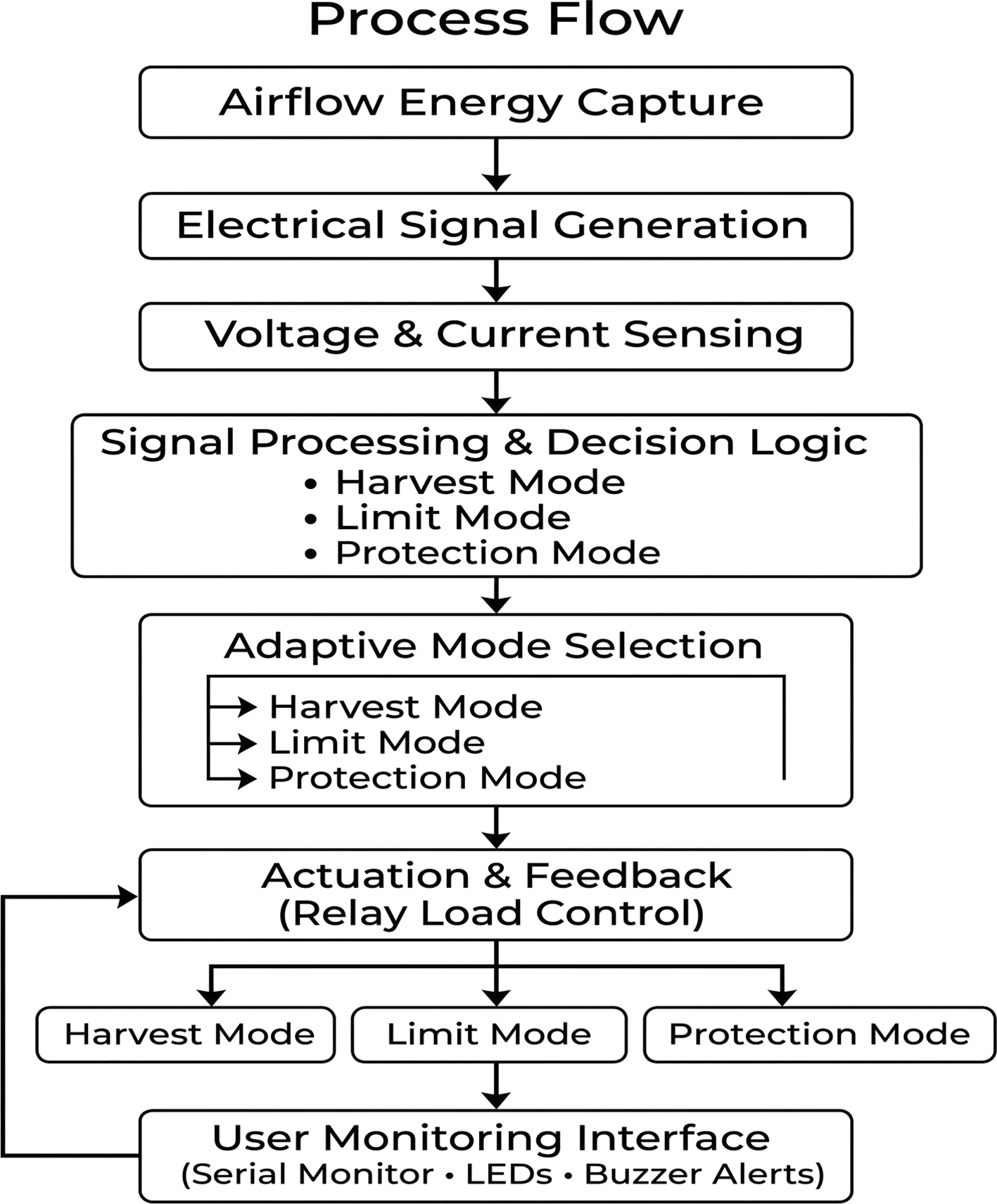
The Smart Adaptive Micro-Turbine Energy Harvester (SAMTEH) is designed as an intelligent airflow-to-electrical energy conversion system optimized for ducted HVAC environments. The system integrates three primary subsystems:
1. Airflow Energy Conversion Subsystem
2. Power Conditioning and Sensing Subsystem
3. Adaptive Control and Load Modulation Subsystem
The airflow conversion system consists of a horizontal axis micro turbine, designed to not obstruct airflow and to operate at even low air velocities. It is directly and efficiently coupled to an electromagnetic generator responsible of converting mechanical/kinetic energy to electrical energy.
The generator output, alternating in nature is rectified using a low-loss full-wave rectification stage. The rectified output is filtered and routed to the power conditioning circuit for regulation and monitoring.
Unlike conventional harvesters that operate as passive sources, SAMTEH integrates a sensing layer that continuously monitors output voltage and current levels consantly. These parameters serve as feedback inputs to the embedded controller, enabling real-time operational decisions.
The mechanical power extracted from airflow can be expressed as:
• rho is air density,
• A is the turbine swept area,
• v is airflow velocity,
• C_p is the power coefficient.
The electrical output power depends on generator efficiency and electrical loading. Unlike static MPPT-based systems, SAMTEH modulates electrical loading dynamically to achieve not only efficiency but also voltage stability and protective regulation.
A defining feature of SAMTEH is its multi-mode operational framework:
3.3.1. Harvest Mode
This is the normal operating mode in normal airflow conditions, perfect loading and voltage within the thresholds. It stays in this condition until state changes.
3.3.2. Limit Mode
It is triggered when voltage approaches the upper bound thresholds. Electrical loading is adjusted to increase damping and regulate voltage rise.
3.3.3. Protection Mode
Activated under abnormal conditions such as excessive voltage or unstable fluctuations. The load is modulated or isolated to prevent electrical overstress.
Mode transitions are determined by threshold-based logic using real-time voltage and current sensing techniques. This architecture enables closed-loop electrical damping control, which is absent in traditional airflow micro-turbine systems. Figure 2 below shows the schematic subsystems that make up the Smart Adaptive Micro Turbine Energy Harvester.
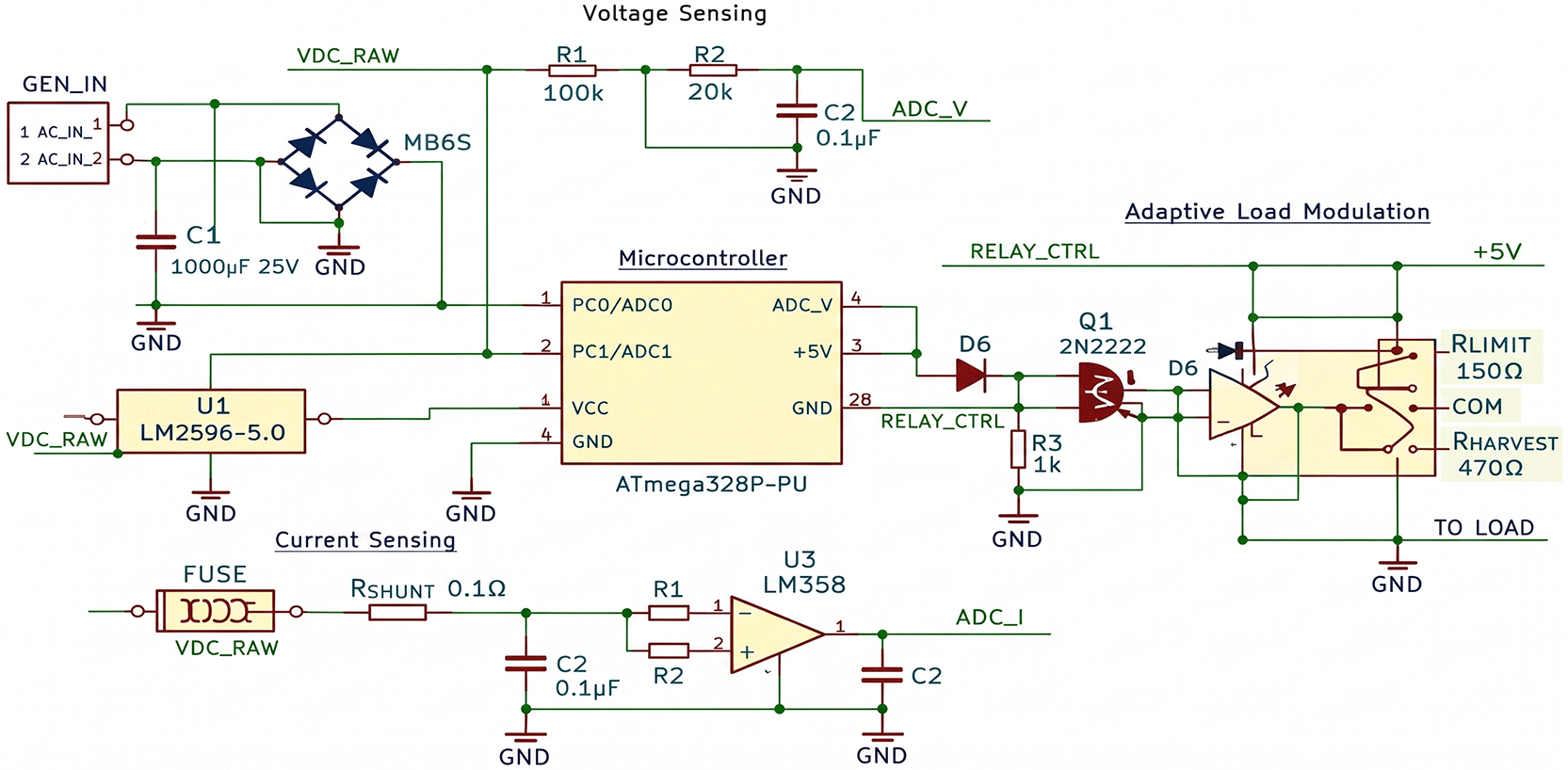
Figure 2, illustrates the complete operational architecture of the Smart Adaptive Micro Turbine Energy Harvester (SAMTEH). The AC output from the micro turbine generator passes through a bridge rectifier first and later is filtered to produce a stable DC voltage (VDC_RAW). This voltage is regulated to 5 V using a buck converter to power the control circuit. A resistive divider network is used for voltage sensing while a low value shunt resistor and a LM358 based amplification stage is used for current sensing. Both signals are feed into the ATmega328P MCU for real-time monitoring.
The microcontroller processes the sensed parameters and dynamically controls a relay-based load modulation system through transistor switching stage. For stable and reliable operation protective components such as diodes and filtering capacitors are used. Therefore, by selectively switching between predefined load resistances, the system adapts to varying load and generating conditions, optimizing energy harvesting efficiency.
The micro-turbine assembly is mounted within a duct-compatible housing designed to minimize airflow obstruction. The generator shaft coupling ensures stable rotational transfer with minimal misalignment losses.
The electrical subsystem consists of:
• Low-drop rectifier stage
• Filtering capacitor network
• DC–DC regulation interface
• Voltage sensing divider network
• Current sensing module
Voltage sensing is implemented using a voltage divider for microcontroller ADC compatibility. Current sensing is achieved through a current sensor ACS70331.
A microcontroller serves as the decision-making core of SAMTEH. The control algorithm operates as follows:
1. Continuously sample voltage and current.
2. Compare measured parameters with predefined operational thresholds.
3. Determine appropriate operational mode.
4. Actuate relay-based load modulation accordingly.
The relay interface enables discrete electrical load switching, allowing dynamic impedance variation. This method provides robust and low-complexity regulation suitable for micro-scale implementations.
Electrical damping is achieved by adjusting load conditions to influence generator torque. Increased electrical loading increases counter-torque, stabilizing rotational speed and preventing excessive voltage rise under high airflow conditions.
This closed-loop regulation enhances system robustness compared to static impedance matching strategies.
The system was tested under controlled airflow conditions using a calibrated duct fan assembly. Airflow velocity was varied across low, medium, and high regimes to evaluate dynamic system response. A digital multimeter, a smartphone to capture rotational stability in slow-motion and a variable resistor is used as a load. For each airflow condition output voltage was recorded across the load, output current was measured in series, rotor behavior was visually observed and mode transitions were noted based on relay switching and voltage behavior. Each reading was averaged over 3 trials of 10 seconds each.
Table 2 below shows the observed and measured experimental results obtained under varying airflow conditions simulated using a household fan-based airflow setup. The system performed stable operations in harvest node at low airflow, producing consistent voltage with minimal fluctuations, while at moderate airflow, relay triggering for adaptive load modulation was observed switching between load conditions to maintain a regulated output and reduce voltage instability. Under high conditions the system immediately transitioned to limit mode, increasing electrical damping and preventing excessive voltage rise, then in protection mode, load was isolated to safeguard the system components. Compared to passive harvesting, SAMTEH showcased reduced voltage spikes, improved transient stability and enhanced operational reliability across varying airflow conditions.
The experimental results demonstrated that increasing airflow velocity produced higher generator output voltage and current levels. The adaptive relay-based load modulation successfully regulated voltage behavior under moderate and high airflow conditions by dynamically altering the electrical loading applied to the generator. Under very high airflow conditions, Protection Mode activation prevented excessive voltage rise and improved overall operational safety.
Measurements recorded included:
The airflow source consisted of a 220 V AC axial fan rated at 45 W with a maximum airflow velocity of approximately 5.5 m/s measured near the turbine inlet region.
Airflow conditions were categorized into four operating regimes based on measured average air velocities:
• Low airflow: 1.2–1.8 m/s
• Moderate airflow: 2.5–3.2 m/s
• High airflow: 4.0–4.8 m/s
• Very high airflow: 5.0–5.5 m/s
The micro-turbine generator output was connected to a bridge rectifier and adaptive load modulation circuit. Variable resistive loading was applied using selectable resistor values of 100 Ω, 220 Ω, 470 Ω, and 1 kΩ to evaluate system response under different electrical loading conditions.
5.2.1. Low Airflow Conditions
Under low airflow, the system operated in Harvest Mode. Stable voltage generation was observed with efficient startup characteristics.
5.2.2. Moderate Airflow Conditions
At moderate airflow levels, the system maintained regulated output through adaptive load modulation. Voltage fluctuations were minimized compared to passive operation.
5.2.3. High Airflow Conditions
Under high airflow, conventional passive systems exhibited rapid voltage rise. In contrast, SAMTEH transitioned to Limit Mode, increasing electrical damping and stabilizing voltage. In extreme conditions, Protection Mode isolated the load to prevent over-voltage stress.
Compared to static harvesting architectures:
• Voltage overshoot was reduced.
• Electrical stress conditions were mitigated.
• System stability improved under transient airflow variation.
The adaptive mode switching demonstrated reliable operation across varying conditions without compromising harvesting capability.
This paper presented SAMTEH, an intelligent airflow-driven micro-turbine energy harvesting system incorporating adaptive multi-mode control and relay-based load modulation. Unlike conventional airflow harvesters that prioritize static maximum power extraction, SAMTEH integrates real-time sensing and closed-loop electrical damping to enable context-aware energy regulation. Experimental validation demonstrated enhanced voltage stability, improved protection capability, and robust operation under variable airflow conditions.
The integration of adaptive control within micro airflow energy harvesting represents a shift from passive energy conversion toward intelligent energy management architectures. By embedding decision-based load modulation directly within the harvester, SAMTEH improves reliability and deployment suitability in industrial duct and exhaust environments.
Future research directions include:
• Integration of predictive airflow modeling for proactive control.
• Replacement of relay-based modulation with solid-state switching for improved longevity.
• Miniaturization for compact IoT node integration.
• Development of self-learning control algorithms for adaptive threshold optimization.
• Long-term field deployment studies in industrial HVAC systems.
SAMTEH establishes a foundation for intelligent airflow-based energy harvesting systems that balance efficiency, safety, and adaptive control within a unified architecture.
| Views | Downloads | |
|---|---|---|
| F1000Research | - | - |
|
PubMed Central
Data from PMC are received and updated monthly.
|
- | - |
Provide sufficient details of any financial or non-financial competing interests to enable users to assess whether your comments might lead a reasonable person to question your impartiality. Consider the following examples, but note that this is not an exhaustive list:
Sign up for content alerts and receive a weekly or monthly email with all newly published articles
Already registered? Sign in
The email address should be the one you originally registered with F1000.
You registered with F1000 via Google, so we cannot reset your password.
To sign in, please click here.
If you still need help with your Google account password, please click here.
You registered with F1000 via Facebook, so we cannot reset your password.
To sign in, please click here.
If you still need help with your Facebook account password, please click here.
If your email address is registered with us, we will email you instructions to reset your password.
If you think you should have received this email but it has not arrived, please check your spam filters and/or contact for further assistance.

Comments on this article Comments (0)