Desai T, Fang X and Ferris M. Introducing the global medical community to the information presented at local scientific conferences through nephrology blogs [version 1; peer review: 2 approved]. F1000Research 2012, 1:66 (https://doi.org/10.12688/f1000research.1-66.v1)
NOTE: If applicable, it is important to ensure the information in square brackets after the title is included in all citations of this article.
1Division of Nephrology and Hypertension, East Carolina University, Greenville, NC, 27834, USA 2Department of Biostatistics, East Carolina University, Greenville, NC, 27834, USA 3Division of Nephrology, University of North Carolina – Chapel Hill, Chapel Hill, NC, 27599, USA
OPEN PEER REVIEW
REVIEWER STATUS
Abstract
An increasing number of healthcare providers author medical blogs (bloggers) to educate the public and fellow physicians. Traditionally, many bloggers have assumed that readers are most interested in information presented at prestigious and popular scientific meetings. As a result, the readers and bloggers often ignore blogs of local scientific meetings. We hypothesize that blog readers will utilize blogs about local scientific meetings less than those about national meetings. We examined nephrology-pertinent blogs from 2010-2012. Blogs were categorized as "local/regional" or "national/international" based on the majority of the audience that attended the live scientific meeting. We tracked the number of pageviews, reading time, and location of use per blog for the first 90-days after its first availability on the website. Wilcoxon testing was performed on all data. There were 9 local/regional and 11 national/international scientific meetings for which blogs were available. The mean number of page views was significantly lower in blogs from local/regional than national/international conferences (84.7 versus 160.3, respectively; p < 0.01). However, the mean difference in total reading time between both categories of blogs was not significant (p = 0.25). Data from this investigation do not fully support the hypothesis that readers utilized local/regional blogs less than national/international blogs. Although local/regional blogs attracted fewer readers (lower pageviews), the content in these blogs was compelling enough to keep the reader equally engaged as with national/international blogs.
Corresponding author:
Tejas Desai
Competing interests:
Tejas Desai is the creator of Nephrology On-Demand (<a href="http://www.nephrologyondemand.org">http://www.nephrologyondemand.org</a>) though receives no funding from the website. Xiangming Fang and Maria Ferris have no competing interests to disclose.
Grant information:
The author(s) declared that no grants were involved in supporting this work.
An increasing number of healthcare providers author medical blogs (bloggers) to educate the public and fellow physicians1–3. Bloggers use this medium to report the events, discussions, and controversies that occur at scientific conferences. As a result, the blog is a valuable tool for the reader who may otherwise not have access to this information. Traditionally, many bloggers have assumed that readers are most interested in information presented at prestigious and popular scientific meetings4. Thus, they have focused their blogging efforts on large national and international conferences and have ignored smaller, local meetings5. Historically, local scientific meetings attract a smaller live audience, have a geographically restricted educational impact, and do not present much novel medical information. Nevertheless, the value of blogs that pertain to local conferences has not been studied. Given these limitations, we hypothesize that blog readers will utilize blogs about local scientific meetings less than those about national meetings.
Methods
We examined nephrology-pertinent blogs authored by the editors or administrators of Nephrology On-Demand (http://www.mynod.org). These blogs were text-based narrative reports of scientific meetings that occurred between 2010–2012. Blogs were categorized as “local/regional” or “national/international” based on the majority of the audience that primarily attended the live scientific meeting. All of the meetings were based in the United States. The only blogs analyzed were firsthand accounts written by individuals who attended live conferences and not those created from second- or third-party sources. Blogs were posted on Nephrology On-Demand and were freely available to all users at http://goo.gl/28zza. We used Google Analytics to track the number of pageviews, reading time, and location of use per blog for the first 90-days after its availability on the website. Wilcoxon tests were used to compare pageviews and reading time for each blog from different continents. JMP Pro 10 and Microsoft Excel 2007 were used for all statistical analyses.
Results
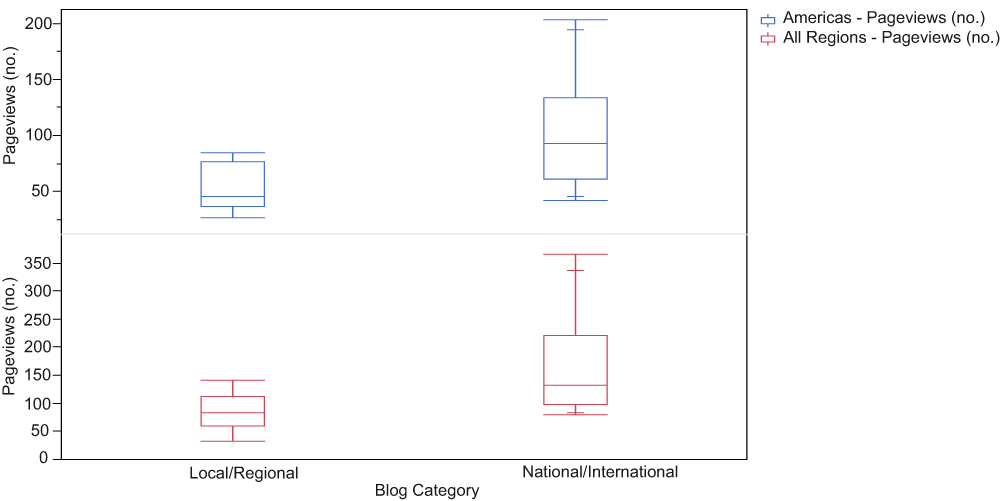
There were 9 local/regional and 11 national/international scientific meetings for which a blog was available on Nephrology On-Demand (Table 1). The most popular blogs in each category were “Guest Lecture Series: The Cardiorenal Syndrome” (local/regional; 143 pageviews) and “American Society of Nephrology Renal Week” (national/international; 365 pageviews). Overall, the mean number of pageviews was significantly lower in blogs from local/regional than national/international conferences (84.7 versus 160.3, respectively; p < 0.01) (Figure 1). For both groups of blogs, the greatest number of pageviews came from the Americas, but there was a significantly lower number of views in local/regional blogs than national/international blogs across all regions (Table 2).
Table 1. Regional category and analysis period of blogs posted on Nephrology On-Demand between 2010–2012.
Standard box plot of pageviews of local/regional and national/international nephrology blog posts by readers from all regions (red) and the Americas only (blue) with lines representing minimum value, 25th percentile, median, 75th percentile, and maximum value within each data set. Where present, inner lines represent 10th and 90th percentile values.
Table 2. Pageviews and reading time by region and blog type (local/regional vs. national/international).
Pageviews (number)
Time (seconds)
Local/Regional
National/International
Local/Regional
National/International
All Regions
Cumulative
762
1764
189407
492973
Mean
84.7
160
21045
44816
Std Dev
34.7
83.6
21994
71934
p
0.0098
0.2545
Americas
Cumulative
490
1123
131460
333918
Mean
54.4
102
14607
30356
Std Dev
21.3
48.9
14752
46586
p
0.0166
0.2545
Asia
Cumulative
132
312
28200
112914
Mean
14.7
28.4
3133
10265
Std Dev
9.6
20.0
2718
21422
p
0.0332
0.3619
Europe
Cumulative
111
217
33082
30186
Mean
12.3
19.7
3676
2744
Std Dev
8.8
18.9
5672
2699
p
0.4243
0.4941
Oceania
Cumulative
7.0
17.0
1754
3495
Mean
0.8
1.5
195
318
Std Dev
0.8
1.9
455
835
p
0.4485
0.5292
Africa
Cumulative
19.0
66.0
1449
34321
Mean
2.1
6.0
161
3120
Std Dev
2.0
3.3
217
5518
p
0.0084
0.0049
Table 2 also indicates the total time spent reading local/regional and national/international blogs. Readers spent a cumulative total of 2.5 times more hours reading national/international than local/regional blogs. However, the mean difference in total reading time between both categories of blogs was not significant (p = 0.25) (Figure 2). Readers from the Americas spent the greatest amount of total time reading the blogs than from any other region, but there was no statistical difference in the time spent reading either category (p = 0.25).
Figure 2. Box Plot of reading time by blog category.
Standard box plot of reading time of local/regional and national/international nephrology blog posts by readers from all regions (red) and the Americas only (blue) with lines representing minimum value, 25th percentile, median, 75th percentile, and maximum value within each data set. Where present, inner lines represent 10th and 90th percentile values.
Discussion and conclusions
Data from this investigation do not fully support the hypothesis that readers utilized local/regional blogs less than national/international blogs. Although local/regional blogs attracted fewer readers (lower pageviews), the content in these blogs was compelling enough to keep the reader equally engaged as with national/international blogs (as there were statistically similar reading times). The latter finding is surprising because it suggests that information presented at local conferences can keep the attention of the reader as effectively as national conferences. Blogs open local conferences to the global community6. In addition, local conferences are conducted at a greater frequency and held at a wider variety of institutions than national/international conferences. The information presented through blogs would be more frequent and present a greater diversity of ideas than blogs of just national/international meetings7.
Further investigations are needed to determine what features local/regional blogs need to have in order to be viewed by a similar number of readers as the national/international blogs. Such features, if identified and incorporated, would greatly increase the value of local/regional scientific conferences. This exploratory investigation suggests that once these readers view a blog, the content within that blog will keep them engaged, no matter where it was presented.
Author contributions
TD devised the experiment, collected the data, and wrote the manuscript. XF assisted in all statistical analyses. MF provided guidance in the experiment and manuscript composition. All authors agreed to the final manuscript.
Competing interests
Tejas Desai is the creator of Nephrology On-Demand (http://www.nephrologyondemand.org) though receives no funding from the website. Xiangming Fang and Maria Ferris have no competing interests to disclose.
Grant information
The author(s) declared that no grants were involved in supporting this work.
Acknowledgements
I would like to thank Pooja Desai for her critical review of the manuscript, and the faculty and fellows of the Division of Nephrology at East Carolina University for their authorship of the blogs. A portion of the data in this manuscript was presented at the American Society of Nephrology Kidney Week 2011 meetings in Philadelphia, PA, USA.
Faculty Opinions recommended
References
1.
Sparks MA, O’Seaghdha CM, Sethi SK, et al.:
Embracing the Internet as a means of enhancing medical education in nephrology.
Am J Kidney Dis.
2011; 58(4): 512–518. PubMed Abstract
| Publisher Full Text
2.
eAJKDNephrology Blogs.
Am J Kidney Dis.
2011. Reference Source
3.
Kovic I, Lulic I, Brumini G, et al.:
Examining the medical blogosphere: an online survey of medical bloggers.
J Med Internet Res.
2008; 10(3): e28. PubMed Abstract
| Publisher Full Text
| Free Full Text
1
Division of Nephrology and Hypertension, East Carolina University, Greenville, NC, 27834, USA 2
Department of Biostatistics, East Carolina University, Greenville, NC, 27834, USA 3
Division of Nephrology, University of North Carolina – Chapel Hill, Chapel Hill, NC, 27599, USA
Tejas Desai is the creator of Nephrology On-Demand (<a href="http://www.nephrologyondemand.org">http://www.nephrologyondemand.org</a>) though receives no funding from the website. Xiangming Fang and Maria Ferris have no competing interests to disclose.
Desai T, Fang X and Ferris M. Introducing the global medical community to the information presented at local scientific conferences through nephrology blogs [version 1; peer review: 2 approved]. F1000Research 2012, 1:66 (https://doi.org/10.12688/f1000research.1-66.v1)
NOTE: If applicable, it is important to ensure the information in square brackets after the title is included in all citations of this article.
track
receive updates on this article
Track an article to receive email alerts on any updates to this article.
Share
Open Peer Review
Current Reviewer Status:
?
Key to Reviewer Statuses
VIEWHIDE
ApprovedThe paper is scientifically sound in its current form and only minor, if any, improvements are suggested
Approved with reservations
A number of small changes, sometimes more significant revisions are required to address specific details and improve the papers academic merit.
Not approvedFundamental flaws in the paper seriously undermine the findings and conclusions
Ponda M. Reviewer Report For: Introducing the global medical community to the information presented at local scientific conferences through nephrology blogs [version 1; peer review: 2 approved]. F1000Research 2012, 1:66 (https://doi.org/10.5256/f1000research.235.r550)
I confirm that I have read this submission and believe that I have an
... Continue reading
Competing Interests: No competing interests were disclosed.
I confirm that I have read this submission and believe that I have an appropriate level of expertise to confirm that it is of an acceptable scientific standard.
Ponda M. Reviewer Report For: Introducing the global medical community to the information presented at local scientific conferences through nephrology blogs [version 1; peer review: 2 approved]. F1000Research 2012, 1:66 (https://doi.org/10.5256/f1000research.235.r550)
Vachharajani T. Reviewer Report For: Introducing the global medical community to the information presented at local scientific conferences through nephrology blogs [version 1; peer review: 2 approved]. F1000Research 2012, 1:66 (https://doi.org/10.5256/f1000research.235.r400)
A very important and relevant analysis of the use of modern day technology in education. The education tools utilized in medicine in general has to adapt to the needs and interests of the students in the millennium era. I would
... Continue reading
A very important and relevant analysis of the use of modern day technology in education. The education tools utilized in medicine in general has to adapt to the needs and interests of the students in the millennium era. I would suggest that the discussion needs to include a few sentences on how best the authors feel the “millennium multi-tasking student” can be kept engaged and focused so the “take home message” is delivered. Will keeping the blogs short and concise help with delivering the right message?
Competing Interests: No competing interests were disclosed.
I confirm that I have read this submission and believe that I have an appropriate level of expertise to confirm that it is of an acceptable scientific standard.
Vachharajani T. Reviewer Report For: Introducing the global medical community to the information presented at local scientific conferences through nephrology blogs [version 1; peer review: 2 approved]. F1000Research 2012, 1:66 (https://doi.org/10.5256/f1000research.235.r400)
Alongside their report, reviewers assign a status to the article:
Approved - the paper is scientifically sound in its current form and only minor, if any, improvements are suggested
Approved with reservations -
A number of small changes, sometimes more significant revisions are required to address specific details and improve the papers academic merit.
Not approved - fundamental flaws in the paper seriously undermine the findings and conclusions
Adjust parameters to alter display
View on desktop for interactive features
Includes Interactive Elements
View on desktop for interactive features
Competing Interests Policy
Provide sufficient details of any financial or non-financial competing interests to enable users to assess whether your comments might lead a reasonable person to question your impartiality. Consider the following examples, but note that this is not an exhaustive list:
Examples of 'Non-Financial Competing Interests'
Within the past 4 years, you have held joint grants, published or collaborated with any of the authors of the selected paper.
You have a close personal relationship (e.g. parent, spouse, sibling, or domestic partner) with any of the authors.
You are a close professional associate of any of the authors (e.g. scientific mentor, recent student).
You work at the same institute as any of the authors.
You hope/expect to benefit (e.g. favour or employment) as a result of your submission.
You are an Editor for the journal in which the article is published.
Examples of 'Financial Competing Interests'
You expect to receive, or in the past 4 years have received, any of the following from any commercial organisation that may gain financially from your submission: a salary, fees, funding, reimbursements.
You expect to receive, or in the past 4 years have received, shared grant support or other funding with any of the authors.
You hold, or are currently applying for, any patents or significant stocks/shares relating to the subject matter of the paper you are commenting on.
Stay Updated
Sign up for content alerts and receive a weekly or monthly email with all newly published articles



Comments on this article Comments (0)