Keywords
STEM education, gender equity, Mbeya city of Tanzania, Private schools

STEM education, gender equity, Mbeya city of Tanzania, Private schools
This third iteration of the paper includes modifications based on reviewer feedback aimed at enhancing clarity, methodological consistency, and discussion of results interpretation.
Significant language editing has been undertaken to enhance the quality of language. The research questions have been reworded in line with their analytical nature, and there is more consistency between the goals of the research, its questions, hypotheses, tests, and results. Furthermore, to avoid suggesting that the findings indicate causality, it has been clearly stated that the results merely describe associations between independent and dependent variables without implying a causal relationship.
Moreover, additional clarification was added with respect to the operational definition of gender equity employed in the analysis, as it relies exclusively on school type and data on gender differences in enrollment and academic performance using only the examination dataset that was available for use.
The sections Results and Discussion have been reorganized in order to clearly delineate between statistics and interpretation of results. Both sections of Discussion and Recommendations have been extended by providing relevant cases of cooperation between private and public schools as well as policy implications. Lastly, the manuscript contains an additional discussion about contextual factors and limitations of the research such as influence of socioeconomic factors, availability of resources, parents' involvement, educational environment, and gender issues in relation to engagement in STEM and academic performance.
See the author's detailed response to the review by Maria F Vieira
See the author's detailed response to the review by María Goretti Alonso de Castro
See the author's detailed response to the review by Uchenna Kingsley Okeke
The adoption of Sustainable Development Goals (SDGs) by the United Nations (UN) in September 2015 placed the world to ensure gender equity in science, technology, engineering and mathematics (STEM) education (Koehler, 2016; Leal Filho et al., 2022; Zorzano, 2020). Gender is commonly representing female or male, however, in this study, added to that describes the socio-cultural characters of masculinity and femininity according to practices by individual based on their culture, while sex describes the biological characteristics of women and men (Unicef & others, 2020). The findings demonstrate that, gender may change with time and place depending on roles taken by women and men, whereas sex never change. Before 2016, sub-Saharan Africa had a substantial number of secondary schools whose quality of education was questionable according to United Nations, this being one of the reasons to launch the fourth Sustainable Development Goal (SDG4) (Unterhalter, 2019).
Some regions of the world are closing STEM gender gaps like USA, and Europe (Kamberidou & Pascall, 2019), but gender inequity in STEM education is substantial in sub-Saharan Africa, the Arab states, and south and west Asia (Ismail, 2018; Loyalka et al., 2021). Emphasis to enhance STEM education in literature has centered resolution on pedagogical skills, low teacher student ratio, incompetent teachers, and education facility availability (Allen et al., 2016; Huang et al., 2022; Teo & Ke, 2014). Moreover, girls’ poor participation in science subjects in secondary schools especially in sub-Saharan Africa are more associated with cultural practices and other reasons associated with masculinity (Adams & Baddianaah, 2023; Lewin, 2009).
Education policy makers in Tanzania engaged private sectors to run private schools along with public schools (Komba, 2017). This has contributed not only to addressing enrollment challenges in STEM education but also to improving gender equity (Weaver, 2011). Evaluation of private schools’ contribution is indispensable, this fact holds following the reality that graduates from private education sectors become part of the nation decent and future human resource capital (Achoui, 2009; Budhwar & Sparrow, 2002; Sebola, 2023). Table 1 presents the performance of students from 32 private schools in Mbeya city. Majority of students in privates’ schools passed in first and second division. Unlike in private schools, candidates in public schools’ majority were in the fourth division Table 2.
| Divisions | Total | Girls | Boys |
|---|---|---|---|
| Div I | 715 | 359 | 356 |
| Div II | 569 | 270 | 299 |
| Div III | 406 | 206 | 200 |
| Div IV | 480 | 267 | 213 |
| Div 0 | 62 | 34 | 28 |
| All students | 2232 | 1136 | 1096 |
| Divisions | Total | Girls | Boys |
|---|---|---|---|
| Div I | 280 | 83 | 197 |
| Div II | 775 | 372 | 403 |
| Div III | 926 | 457 | 117 |
| Div IV | 2896 | 1711 | 1185 |
| Div 0 | 827 | 370 | 457 |
| All students | 5704 | 2993 | 2711 |
Notably, in the context of this study, gender equity was assessed using observable indicators available from the CSEE dataset, specifically female enrollment and performance outcomes in STEM subjects. These indicators provide useful evidence regarding academic participation and achievement and were analyzed in relation to school ownership as an institutional factor associated with broader educational conditions. However, gender equity in STEM education may also involve additional dimensions such as persistence, confidence, access to learning resources, classroom experiences, and transitions into higher education and STEM careers. These broader contextual and experiential dimensions were beyond the scope of the present study.
In Tanzania, efforts to solve gender issues in STEM education have a long history (Samoff, 1987). Several bodies like United States Agency for International Development (USAID) have supported to ease the tension of gender inequity in STEM education (Stromquist, 2006; Swainson, 2000).
This research paper illustrates how private schools play a significant role in gender equality in STEM education through Tanzania’s educational policies and underscores the need for greater cooperation between public and private institutions. This study illustrated by concrete examples the association of private schools in STEM education. Thus, the findings indicate an association between private school attendance, higher STEM participation, and reduced gender disparities in STEM subjects.
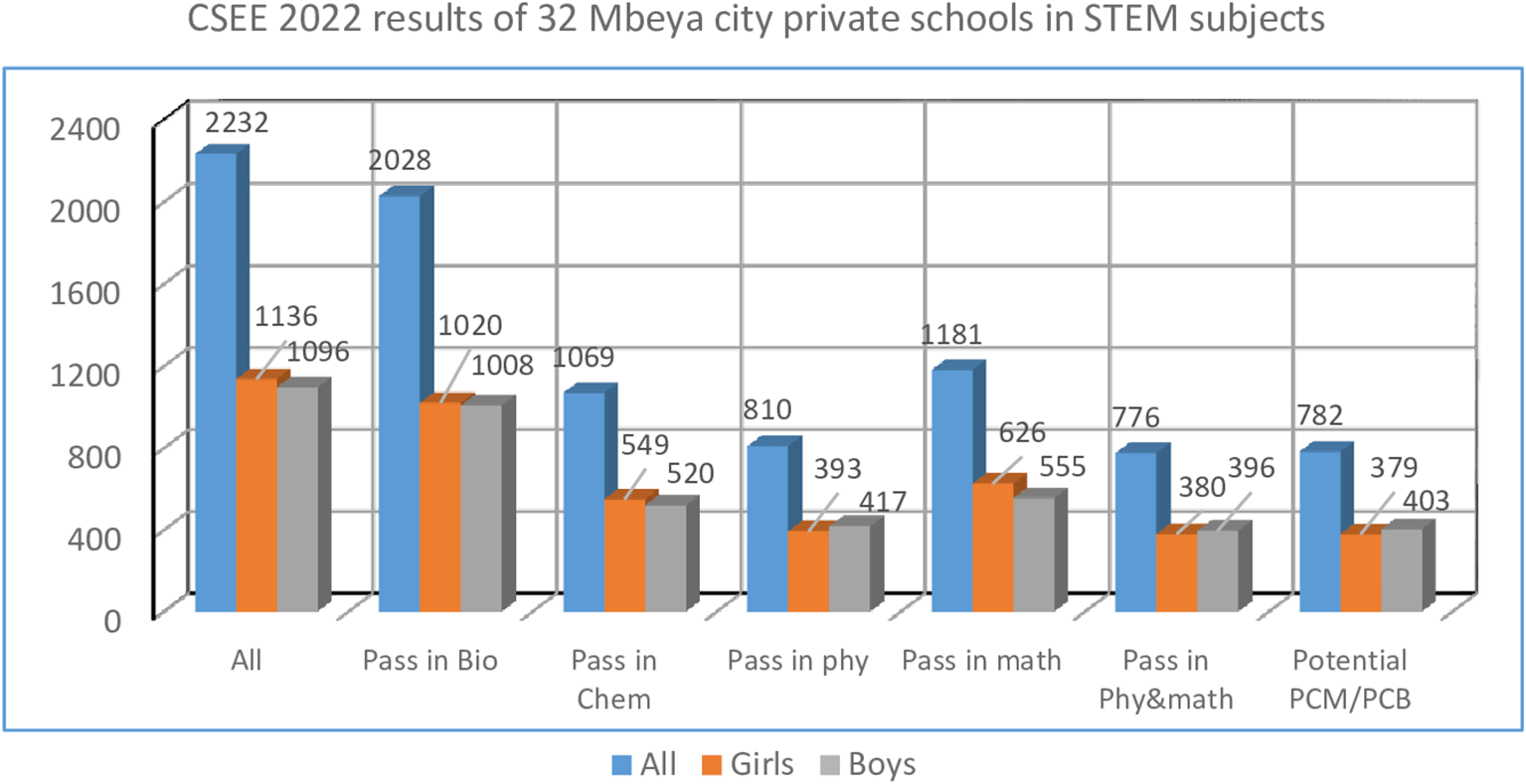
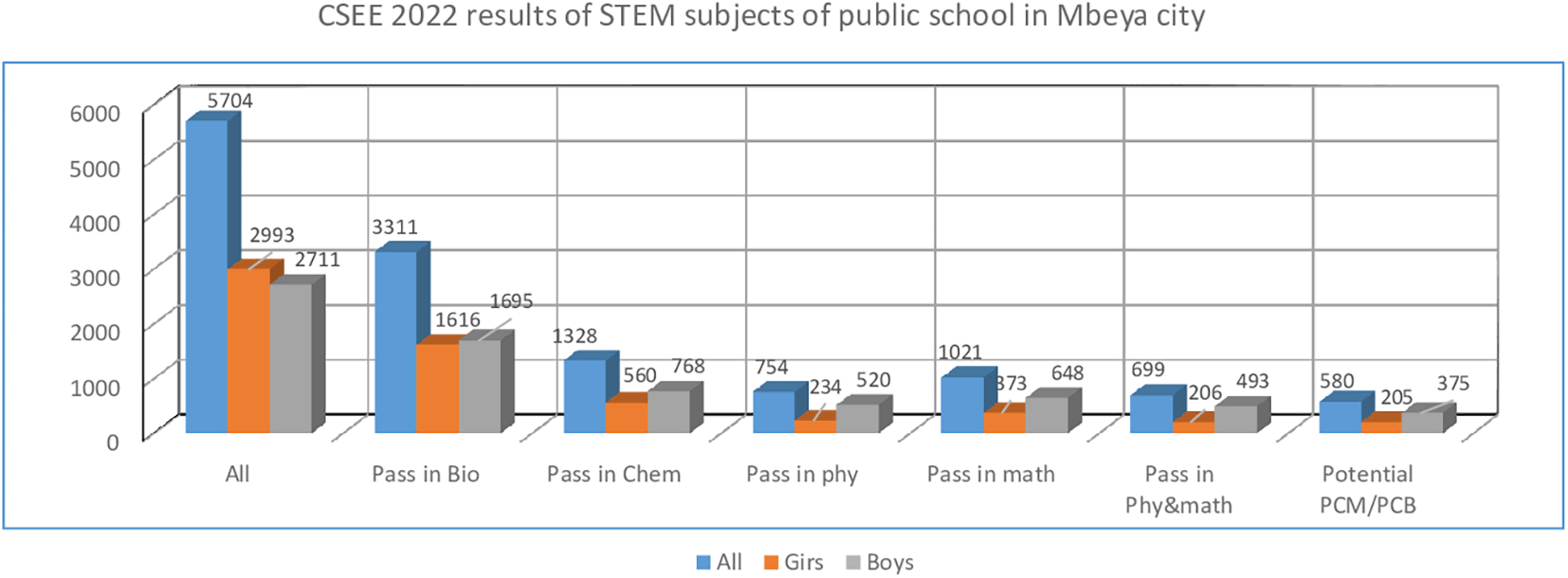
Figure 1 depicts performance in STEM subjects of biology, chemistry, physics and basic mathematics of 2232 candidates from 32 private secondary schools in Mbeya city. Comparable performance of 5704 candidates from 26 public schools Figure 1 indicated deprived performance in STEM subjects. In private schools, female enrollment exceeded male enrollment, and girls outperformed boys in all STEM subjects except physics. However, despite higher female enrollment in public schools, boys outperformed girls in all STEM subjects except biology.
This study employed a quantitative comparative research design to examine the impact of school ownership on female enrolment and performance in STEM disciplines in Mbeya City, Tanzania. The study utilized secondary data obtained from the 2022 Certificate of Secondary Education Examination (CSEE) results available on the National Examinations Council of Tanzania (NECTA) website. The data comprised examination results of Form Four students from 58 secondary schools, including 32 private and 26 public schools, with a total of 7,936 candidates, of whom 2,232 were from private schools.
In order to answer the research questions above, the following null and alternative hypotheses were developed:
H0: Gender is not significantly related to performance in STEM courses for private/public secondary school students.
H1: Gender is significantly related to performance in STEM courses for private/public secondary school students.
Data analysis focused on the observed performance outcomes in STEM subjects and female enrollment patterns. Two statistical methods were employed: chi-square tests to assess associations between school ownership and gendered performance, and graphical analysis to visualize enrollment and performance trends. This study did not examine classroom instruction, teaching strategies, or other qualitative factors influencing results; rather, it concentrated solely on exam performance as recorded by NECTA. The scope is therefore limited to determining whether school ownership influences gender equity and female participation in STEM education.
The use of a comparative observation design in this research, based on secondary examination data, indicates that the results generated should not be taken as an indication of causality, but as descriptive correlations between variables under investigation.
The data were obtained from the NECTA of CSEE for the year 2022 report by selecting all secondary schools in Mbeya City that participated in the Form Four national examinations. The schools were categorized into private and public groups, as presented in Table 3 and Table 4 showing the numbers of girls and boys in each STEM subject.
| Gender | Pass in Biology | Pass in Chemistry | Pass in Physics | Pass in Mathematics | Total |
|---|---|---|---|---|---|
| Girls | 1020 (1032) | 549 (544) | 393 (412) | 626 (601) | 1136 |
| Boys | 1008 (996) | 520 (525) | 417 (398) | 555 (580) | 1096 |
| Total | 2028 | 1069 | 810 | 1181 | 2232 |
| Gender | Pass in Biology | Pass in Chemistry | Pass in Physics | Pass in Mathematics | Total |
|---|---|---|---|---|---|
| Girls | 1616 (1737) | 560 (697) | 234 (396) | 373 (536) | 2993 |
| Boys | 1695 (1574) | 768 (631) | 520 (358) | 648 (485) | 2711 |
| Total | 3311 | 1328 | 754 | 1021 | 5704 |
The researcher extracted, processed, and analyzed the data using chi-square tests, and further examined subject-wise performance trends through bar charts presented in Figure 1 and Figure 2.
The chi-square test of independence was employed to examine whether gender and STEM subject performance were significantly associated within private and public secondary schools. The focus of the STEM subjects was biology, chemistry, physics and basic mathematics. The degree of freedom evaluated leads to a critical value (p) from statistical tables, a test statistic computed for each group of students separately, and the decision made based 95% confidence interval. Records of number of passes in STEM subject are as listed in Table 3 and Table 4. No software was involved and all computations conducted manually, aided by Casio scientific calculator.
Calculation of Chi-square , :
Numbers in parentheses of Table 3 are theoretical expectations of gender equity. The author went through five steps to justify whether gender has an effect in the performance of STEM subjects.
Step 1: Define Null ( ) and Alternative Hypotheses ( ):
: Among students in private secondary schools in Mbeya City, there is no significant association between gender and performance in STEM subjects.
: Among students in private secondary schools in Mbeya City, there is a significant association between gender and performance in STEM subjects.
Step 2: State the confidence interval:
Step 3: Calculate degree of freedom (df ) and state the critical value (p):
, so critical value, p = 7.81.
That is if chi-square ( ) is greater than 7.81, reject .
Step 4: Calculation of test statistic , where and , ,
Step 5: Calculation of theoretical pass expectations: Girls expected to pass biology in first cell of Table 3,
. Therefore, the null hypothesis is true.
The author applied a similar testing to candidates of public schools.
With similar calculations as Table 3 of private schools, for Table 4. However, . Therefore, we reject the null hypothesis.
The author further identified students who obtained at least a grade D pass (minimum pass) in both physics and basic mathematics and classified this group as minimum pass in STEM. Moreover, students with at least two C grades and one D pass grade in any of three subjects: physics, chemistry and biology (PCB) or same passes in any of three: physics, chemistry and mathematics (PCM) classified as potential PCM or PCB candidates. A collection of students with minimum passes in STEM and/or potential PCM or PCB candidates grouped as potential STEM candidates.
The chi-square test results revealed variations in gender-based STEM achievement between private and public institutions. In the case of private institutions, the calculated value of chi-square was χ2 = 4.28, which was lower than the critical value of 7.81 at the 0.05 significance level. In public institutions, the calculated value of chi-square was χ2 = 318.33, which was higher than the critical value. It implies that the extent of gender-based differences in STEM achievement was significantly higher in public schools than private schools.
Furthermore, the descriptive test results revealed that private schools exhibited relatively higher female participation and better performance in STEM subjects than public schools. In addition to chi-square testing of the data, student performance in STEM subjects were listed in tabular ( Table 3, Table 4) form along with plotting the bar charts ( Figure 1, Figure 2).
Performance in STEM subjects determines number of candidate placements in high school PCB or PCM combinations and prospects of STEM career candidates in higher education institutions. Out of 2232 candidates, private schools contributed 783 (35%) candidates of which 380 were girls able to further studies in STEM education ( Table 5). On the other hand, out of 5704 candidates, public schools contributed 699 (12%) candidates of which 206 were girls with potential to advance in STEM careers in higher education ( Table 6).
| Gender | Pass in mathematics | Pass in physics and mathematics | Potential PCM or PCB | Potential STEM candidates | Total |
|---|---|---|---|---|---|
| Girls | 626 | 380 | 379 | 380 | 1136 |
| Boys | 555 | 396 | 403 | 403 | 1096 |
| Total | 1181 | 776 | 782 | 783 | 2232 |
According to the research results, the private institutions showed less significant gender differences in terms of STEM academic success than the public institutions. The reasons why such gender differences were observed might involve various differences in educational environment, access to resources, institutions’ practices, etc. These research results correspond with the previous studies that underline the importance of institutional factors for STEM participation.
It is important to note that since the research design used was that of an observation comparison, the results obtained should not be regarded as a cause-effect relationship.
Therefore, private schools in Mbeya city demonstrated smaller gender disparities in STEM performance compared to public schools. On the other hand, equitable STEM participation are unresolved between girls and boys performance for public schools. This pattern may contribute to future female participation in STEM career pathways.
This study provides evidence that may inform education policy and collaboration between public and private schools. Furthermore, the findings suggest an association between private school ownership and improved gender equity outcomes in STEM subjects This pattern may contribute to future gender disparities in STEM career pathways. The findings suggest an association between private school ownership and improved gender equity outcomes in STEM subjects. This pattern may contribute to future gender disparities in STEM career pathways. This study provides evidence that may inform education policy and collaboration between public and private schools through collaborative engagements. The findings indicate that performance in physics and basic mathematics is strongly associated with STEM career prospects further analyzed improved substantial The findings indicate, this study aims to encourage policymakers to strengthen collaborative policy mechanisms and support privately owned schools in expanding STEM enrollment opportunities. This is in parallel with the implementation of SDG4 realization in 2030. The findings indicate that performance in physics and basic mathematics is strongly associated with STEM career prospects ( Table 5, Table 6).
According to the findings obtained from this study, private institutions demonstrated comparatively more strength than public institutions in female participation and achievements in STEM. It is, therefore, evident that collaboration among policymakers, public institutions, and private institutions could be employed to bridge the gender gap in STEM education and towards the attainment of the SDG4. Collaborative activities that could be employed include training of teachers through joint training workshops, use of laboratories and other learning resources by the two institutions, mentoring of girls, and exchange of academic practices. Besides, there needs to be intervention activities that would enhance girls' performance in mathematics and physics. Furthermore, it is necessary for all parties involved in STEM education to acknowledge the increasing importance of STEM careers in the 21st-century economy and the need for studies in physics and fundamental mathematics. It should be noted that basic mathematics alone does not prepare individuals for STEM careers.
This study highlights the need for further investigation into the contextual factors associated with differences in STEM enrollment and performance outcomes between private and public schools within the same regional setting. While school ownership was examined as an institutional factor, the observed outcomes may also reflect broader contextual influences such as learning environments, resource availability, parental support, academic support systems, socioeconomic conditions, and prevailing gender norms. Future research employing qualitative or mixed-method approaches may provide deeper understanding of how these contextual factors interact with school ownership to influence gender-related STEM outcomes. Such investigations may generate valuable insights to inform evidence-based strategies for improving STEM education outcomes and reducing gender disparities in public schools.
This study examined school ownership as an institutional factor associated with gender-related enrollment and performance outcomes in STEM subjects. The observed differences between private and public schools may reflect broader contextual conditions commonly associated with school ownership, including variation in learning environments, resource availability, parental support, socioeconomic background, academic support systems, and prevailing gender norms. However, because the analysis was based on secondary examination data, these contextual variables were not independently measured or statistically controlled. Consequently, the findings should be interpreted as descriptive associations between school ownership and STEM-related outcomes rather than direct causal effects of school ownership itself. Future studies employing qualitative, longitudinal, or mixed-method approaches may provide deeper understanding of the contextual mechanisms influencing gender equity in STEM education.
| Views | Downloads | |
|---|---|---|
| F1000Research | - | - |
|
PubMed Central
Data from PMC are received and updated monthly.
|
- | - |
Provide sufficient details of any financial or non-financial competing interests to enable users to assess whether your comments might lead a reasonable person to question your impartiality. Consider the following examples, but note that this is not an exhaustive list:
Sign up for content alerts and receive a weekly or monthly email with all newly published articles
Already registered? Sign in
The email address should be the one you originally registered with F1000.
You registered with F1000 via Google, so we cannot reset your password.
To sign in, please click here.
If you still need help with your Google account password, please click here.
You registered with F1000 via Facebook, so we cannot reset your password.
To sign in, please click here.
If you still need help with your Facebook account password, please click here.
If your email address is registered with us, we will email you instructions to reset your password.
If you think you should have received this email but it has not arrived, please check your spam filters and/or contact for further assistance.

Comments on this article Comments (0)