Keywords
Set Theory; Binary Relator; Binary Operator; Optimization Method; Natural Selection; Intelligence; Memory; Technology

Set Theory; Binary Relator; Binary Operator; Optimization Method; Natural Selection; Intelligence; Memory; Technology
This Version 2 of my paper advances the same thesis as Version 1. The Reviewers offered insightful comments. In response I revised the paper in the following manner:
--Towards the end of the paper, I mention two neuroscientific findings that support the proposed distinction between binary operator (technology and cognitive faculties), on the one hand, and binary relator (rational choice), on the other hand. The first is Nicolelis’ dual computation theory of the brain. The second is the Bayesian brain hypothesis or, more generally, to Friston’s free-energy principle.
In addition, the revision includes three new sections:
-- Standard Rationality versus Simon/Gigerenzer Rationality
--Why Ignore Dual Process Theory?
--Are Binary Operators and Binary Relators Opposite of Each Other?
I also linked the proposed distinction between binary operator (regarding technology and cognitive capacity) and binary relator (regarding rational choice) to neuroscientific findings.
See the author's detailed response to the review by Sergio Alejandro Rodríguez Jerez
See the author's detailed response to the review by Piotr Kozak
The literature in the biological sciences generally shies away from the concept of rational choice. When the literature alludes to rational choice, it considers it a cognitive faculty similar to memory, intelligence, linguistic ability, and mathematical skill that form the basis of expertise (e.g., Hambrick et al., 2018). There are a few exceptions that do not treat rational choice as another cognitive skill (e.g., Burgoyne et al., 2023).
Once a biologist treats rationality as a cognitive faculty, she continues to conceive it as the subject of natural selection akin to any other cognitive faculties. Even some economists, whose discipline canonizes rationality as about optimization, concur with and treat rationality as a cognitive faculty and, hence, the product of natural selection (e.g., Robson, 2001; Robson & Samuelson, 2010).
This paper questions this literature. Rationality, as understood in the standard sense, cannot be another cognitive faculty. It is rather, similar to natural selection, an optimization method:
Core Thesis: Rationality in the standard sense is about optimization radically differing from cognitive abilities such as memory, intelligence, language faculty, and mathematical skills. As understood by standard researchers, rationality is rather an optimization method for determining the best choice or fit trait.
This core thesis stands irrespective of the many detractors and critics of standard rational choice theory in the social and behavioral sciences.1
Indeed, the proposed distinction between rational choice, on the one hand, and cognitive capacity, on the other hand, finds support in neuroscientific findings regarding cortical operations. For example, in his effort to revise Freud’s foundation of psychoanalysis in light of neuroscientific findings, Solms (2017) highlights experimental results that demonstrate that rational evaluation and consciousness are emergent properties of subcortical affective systems. That is, rationality and consciousness are not dependent on inputs from the environment (see also Casanova, 2010). In contrast, cognition operates almost entirely on the basis of inputs, which produce perception and memory that can be unconscious (see Dall’Aglio, 2024).
This paper does not take a stand, and it does not need to consider whether there is a necessary link between rationality and consciousness. This paper does not delve into the neuro foundations of the proposed distinction between rationality and cognition, to mention consciousness. It only briefly, in the last section of the paper, connects the proposed distinction to Nicolelis’ dual computation theory of the brain. It also briefly connects rationality to the Bayesian brain hypothesis or, more generally, to Friston’s free-energy principle.
This paper advances its core thesis via a distinction borrowed from set theory (Rai et al., 2012). The distinction is between “binary relators” and “binary operators”. Rationality in the standard sense—or, for short, “rationality”—acts as a binary relator, i.e., as an optimization method. In contrast, any cognitive faculty acts as a binary operator, i.e., as a transformational function. Rationality as an optimization method (binary relator) does not differ from the neo-Darwinian notion of natural selection (see Khalil, 1993): either method defines the best choice or fit trait given the constraints. A cognitive faculty as a transformational function (binary operator) simply translates inputs into outputs.
The proposed distinction between rationality and cognitive faculties has great ramifications for the theory of evolution. Primarily, the distinction is that rationality cannot be the subject of evolutionary change. Rather, it is a constant feature of any organism, i.e., simply what makes an entity a living entity. This implication can be called the “Organismus economicus hypothesis”. In contrast, organisms do not make decisions but rather behave according to rules selected by natural selection. This view can be called the “Organismus automaton hypothesis”, which is at the core of neo-Darwinism (see Khalil & Marciano, 2010).
The proposed distinction between rationality and cognitive faculties raises a question. While researchers make statements regarding cognitive faculties that are “descriptive,” statements regarding rationality need not be so. Indeed, researchers across disciplines largely distinguish between two different arguments about rationality: is the argument “descriptive” as opposed to “normative”? Baron (2023) goes one step further and refines the “normative” category into two. Therefore, for Baron, we have three kinds of statements: i) “descriptive statements” empirically inform us of “what is”; ii) “prescriptive statements” advance arguments of “what decisions should be”; and iii) “evaluative statements” assess the damage that occurs when an actual decision, as captured by descriptive statements, deviates from what the decision should be, as captured by prescriptive statements.
As a reminder, in our evaluative statements, we should consider the element of luck or probability. A decision maker could violate what rational choice theory prescribes but ends up with a result that is even better than what would have been the case if one had chosen the prescriptive action. This outcome usually occurs because of shock, which is simply the actual state of nature that is highly unlikely to occur.
The question that this paper poses sidesteps Baron’s descriptive/prescriptive/evaluative distinction—or, more generally, the descriptive/normative distinction. This paper is not about what decision makers actually decide. It is also not about what decision makers should decide. It simply proceeds to ask a question: given that a researcher believes that rationality is relevant to how people behave or should behave, does such rationality amount to a cognitive capacity?
This paper commences with the juxtaposition of this paper’s question, first, vis-à-vis Simon/Gigerenzer’s non-standard definition of rationality and, second, vis-à-vis dual process theory. This paper proceeds to draw a sharp distinction between the two hypotheses via the distinction between the optimization method, which specifies the best outcome, and the transformation function, which translates inputs to outputs. The neo-Darwinian approach, as a result of treating rationality as a trait selected by the optimization method, then commits a self-reference paradox (akin to the Russell Paradox (Russell, 1956)). The self-reference paradox highlights a problem with the neo-Darwinian approach. While the theorist must admit that rationality is not a trait to avoid the self-reference paradox, the theorist opens the gate wide open to metaphysics. However, as this paper registers, there is no need for the specter of metaphysics, and hence, we should welcome the Organismus economicus hypothesis.
Upon reading the title of this paper—namely, whether rationality is a cognitive faculty—it is probably clear to the reader what is “cognitive faculty.” However, it is probably less clear what is “rationality.” As the exposition of the Organismus economicus hypothesis below shows, this paper defines rationality à la standard economics. Specifically, rationality is about the coherence of preferences: the decision maker knows what bundles of goods they prefer over other bundles and, hence, is ready to select the best bundle allowed given the budget constraint, beliefs, and general circumstances (Gilboa, 2012; Khalil, 2025a). This paper focuses on this notion of rationality and asks whether such a standard notion is a cognitive faculty.
If some researchers deny the existence of this standard notion of rationality and proceed to offer non-standard definitions, this paper is not written to advance arguments to convince them otherwise. Specifically, this paper neither critiques Gigerenzer’s (2023) non-standard notion, which he calls “ecological rationality,” nor critiques Simon’s (1976) notion, which he calls “procedural rationality.” Simon and Gigerenzer basically argue, although in different ways, that the standard notion of rationality is fundamentally flawed. For them, decision makers cannot undertake decisions on the basis of optimization for a simple reason. The mechanism of optimization is based on beliefs about facts that also involve optimization, which leads to endless regression. That is, for Simon and Gigerenzer, the issue is not the fact that the cognitive processing of information is costly and hence rationality is bounded, what the neoclassical (standard) definition of rationality acknowledges.2 Simon and Gigerenzer maintain that the entry point of standard economics is untenable even when cognitive costs are zero.
Instead, Simon and Gigerenzer propose a different entry point: “habits”, routines, or “intuitions” conceived as primordial, and hence, theorists need not explain them. Habits at the personal and collective levels are “norms” of behavior that explain behavior—which Kahneman and Miller (1986) also argue. The decision maker continues to use default habits, norms, or intuitions as long as they are useful in attaining some predetermined level of satisfaction—which Simon (1957) calls “satisficing”.
Other papers discuss the limitations of the Simon/Gigerenzer non-standard definition of rationality (Khalil, 2013a, b; Khalil, 2022). This paper does not discuss these limitations because the aim of this paper is not to advocate the importance of the standard definition of rationality. This paper poses a different question: given that research subscribes to the standard notion of rationality, is such a notion a cognitive faculty?
This paper also does not discuss dual process theory, but for a different reason. While Evans (1978) is usually credited with formally introducing dual process theory in the psychology literature, Stanovich (2010a) and Kahneman (2011) link dual process theory to the study of heuristics in relation to rationality. Dual process theory amounts to the proposition that thinking and deciding involves two systems. The first system, called “System 1”, amounts to deciding regarding a case according to ready-made beliefs, heuristics, and first impressions that are fast and spontaneous. The second system, called “System 2”, amounts to deciding by examining the case under focus with all its details. While System 1 is fast and spontaneous, System 2 is slow and deliberate.
As shown elsewhere (Khalil, 2025c; Khalil & Amin, 2023), dual process theory is fruitful not only in understanding heuristics and how decision makers suspend them but also in understanding routines, i.e., the physiological functions of organisms and their organs. However, this paper does not discuss dual process theory because it proposes that spontaneous System 1 is non-rational, whereas deliberative System 2 is rational. As argued elsewhere (Khalil, 2022, 2025c), System 1 and System 2 are rather organically linked: the logic of rational choice underpins the operation of both systems. We need a rational choice to explain why some actions become habitual and hence become part of spontaneous System 1. We also need a rational choice to explain why some habitual actions become suspended; hence, the decision is sent back to deliberative System 2.
Even if we salvage dual process theory from the connotation that spontaneous System 1 is non-rational, the question posed by this paper does not gain from refining thinking into two systems. Given that the two systems are organically linked, we can ask questions about the standard notion of rationality per se, namely, how it is related to cognitive faculty, without refining thinking and deciding into two systems. Indeed, the refinement of thinking and deciding amounts to a digression that takes us away from the question posed by this paper.
The need to avoid such unnecessary digression becomes even more poignant in light of the further refinement of System 2 undertaken by Stanovich (2010a). The impetus behind his refinement is to solve what he calls the “Great Rationality Debate”. The Great Rationality Debate is about a long-running question in the philosophical and psychological literature: how far human behavior is from the standard notion of rationality (the coherence of preferences and the efficiency of actions in light of probability theory and logical thinking). To answer this question, Stanovich argues that we should examine individual differences. This examination shows, to the surprise of the literature (but not to this paper), that people with high IQs need not make significantly more rational choices than people with normal IQs do.
While this paper welcomes Stanovich’s rationality/intelligence distinction (see also Stanovich, 2010b), he grounds the distinction on refining System 2 into two sub-processes: i) the reflective process that allows the decision maker to suspend the operation of spontaneous System 1 and ii) the algorithmic process that, once a task is decoupled from spontaneous System 1, undertakes the processing of information specific to the case under focus. For Stanovich, while the reflective process expresses rationality (which varies across individuals), the algorithmic process expresses intelligence.
While one may accept that the algorithmic process hinges on intelligence, Stanovich’s refinement implies that System 1 is non-rational, as he reserves rationality to the reflective process (part of deliberative System 2). As stated above, System 1 and System 2 are rather organically linked by the logic of rational choice. Given that the focus is on rational choice per se—namely, whether it is a cognitive faculty similar to memory or intelligence—it would be unnecessary to digress and refine the operation of rational choice.
The Organismus automaton hypothesis involves the treatment of rationality as a trait, specifically as a cognitive faculty. It is based on the fundamental thesis that the organism operates according to rules, where such rules are the products, ultimately, of natural selection. These rules are the operational functions of faculties, such as memory, intelligence, and supposed rationality. In this picture, the organism follows rules in the final analysis as an automaton.
This paper ignores sophisticated versions of the Organismus automaton hypothesis (e.g., Godfrey–Smith, 1996, 2009). This allows us to focus, as shown in Figure 1, on the basic minimal schemata of the optimization structure of the Organismus automaton:
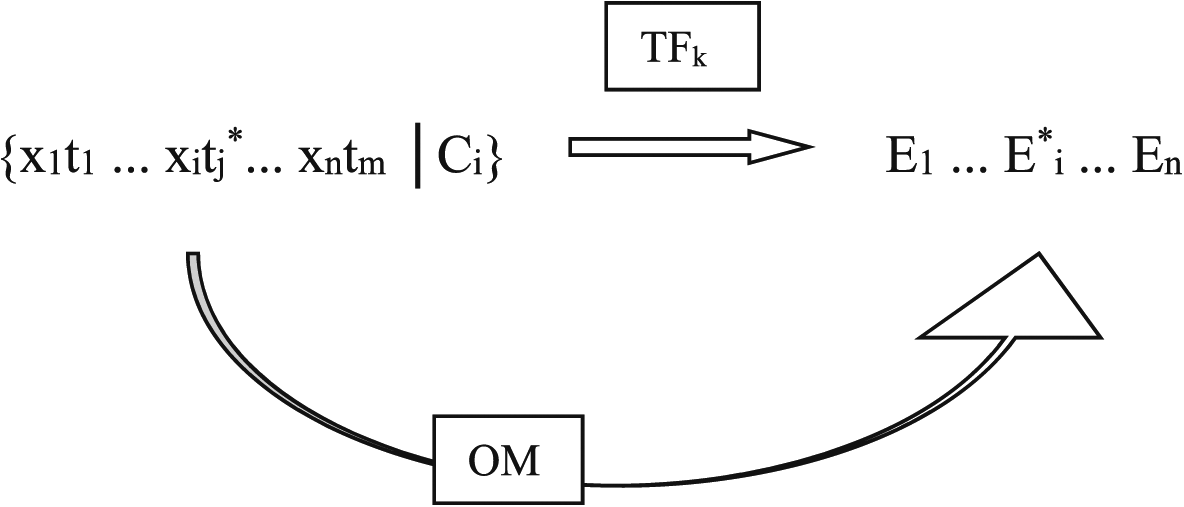
where E = a set of fitness ends such as the flight speed of zebra (too much flight speed weakens other abilities and too little undermines the survival fitness of the organism); xitj = the particular trait (t) and the instinctual behavior requiring a certain set of goods (x) (different organisms are characterized by different combinations of t and x); TFk = the transformational function of level or type k that transforms inputs into outputs; and OM = the optimization method that ensures that the optimum E (Ei*) is selected or chosen.
It is crucial to distinguish among three entities in the above schemata: i) the trait-as-input, which is an element of the input set on the left-hand side; ii) the trait-as-technology, which acts as the binary operator of level k (TFk) between the input set and the output set; and iii) the optimization method (OM), which acts as a binary relator.
To use a distinction borrowed from set theory, the OM is the “binary relator”, whereas TFk is the “binary operator” (see Rai et al., 2012). The binary relator that acts as the OM performs two roles. The first role works within each set, as it ranks the different outputs in a consistent fashion; that is, it specifies which output is better than the other while abstracting from the constraints. For example, it can rank different flight speeds without considering constraints. The OM also ranks the different inputs correspondingly. However, the optimal solution cannot be determined without specifying the environmental constraints. This highlights the second role; once the constraints are specified, the OM relates the input with the output sets in a certain way that shows what is the appropriate input that produces the optimum output (Ei*).
In contrast, the binary operator (TFk) transforms inputs into outputs according to k-level trait-as-technology. As such, TFk is neither the optimization method (OM) nor the trait-as-input (xitj) that makes up the left-hand input set. TFk is merely the technical listing of outcomes that TFk can produce from the given set of inputs.
The structure of the Organismus automaton hypothesis is almost identical to the structure of Organismus oeconomicus hypothesis. The input in the former is the population of individuals where each individual is characterized by an input set, whereas each gives rise to a different end, called a phenotype. The input in the latter is the bundle of goods, whereas each gives origin to a different end, called utility.
The Organismus oeconomicus hypothesis, based on standard rational choice, also consists of the binary relator assuring us the production of the optimum, i.e., the employment of OM, and the binary operator that expresses the transformational function, say, at k-level, i.e., the employment of TF k. Again here, the binary relator (OM) has two roles. As for the first role, the theory of rationality assures us the ends, that is, the utility values, are consistent and, correspondingly, that the inputs are consistently ranked. Consistency depends on many axioms, the most important are two: transitivity and completeness (see Gilboa, 2012; Khalil, 2023). As for the second role, once constraints are determined, the binary relator identifies the optimum end, that is, the optimum utility, and its corresponding set of inputs.
As for the binary operator at k-level (TF k), there is a set of technologies, institutions, and beliefs transforming each set of inputs into output. As in the case of the Organismus automaton hypothesis, the binary operator merely lists the technical aspect of what is the outcome of each set of inputs if the given TF k is employed in their transformation. It neither assures any internal consistency nor determines the optimum outcome.
Once an optimum is selected by nature or by choice, the optimum is stable as long as shocks disturb neither the set of inputs nor the set of environmental constraints. The stable decision equilibrium, not to be confused with market equilibrium, can be upset if at least one of the following two conditions changes: (i) a mutation of traits-as-inputs (t) or goods (x) takes place; or (ii) a change in the set of environmental constraints.
The set of environmental constraints is implicit in the above schemata. Specifically, the binary relator can select only the optimum end while considering such a set. Let us consider the consequences of the change in such a set of environmental constraints (C) from Ci to Cc. Nature should select or the decision maker should choose, as Figure 2 shows, a new set of inputs, xctd*, corresponding to the new optimum end, E*c:
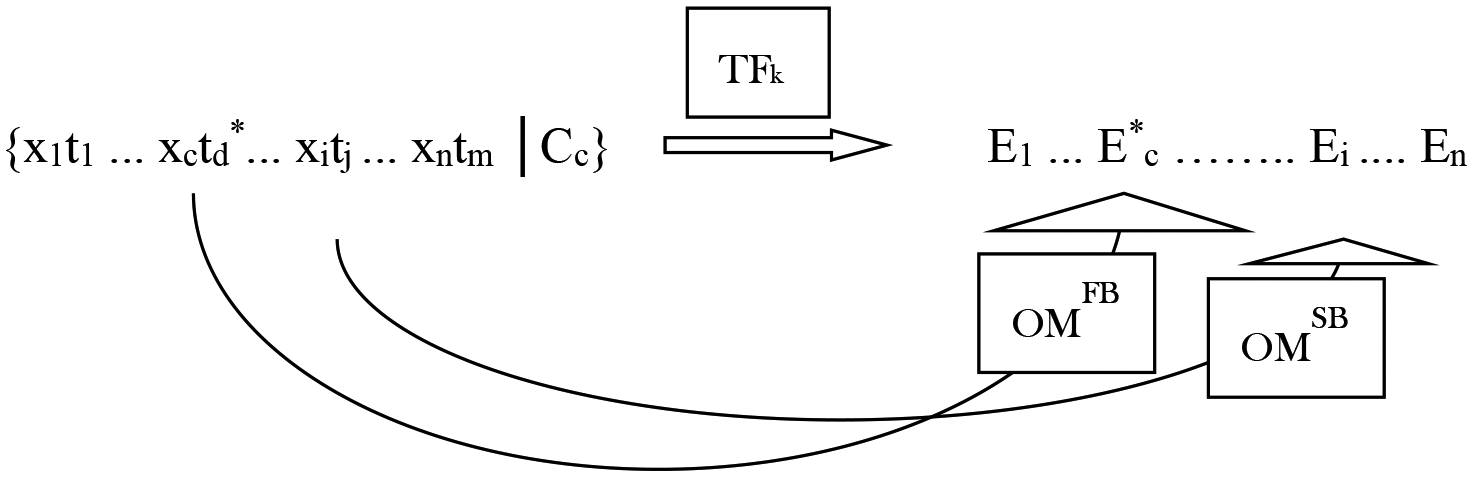
However, both nature and the decision maker may face hurdles, mainly arising from transitional costs (Marciano & Khalil, 2012; Khalil, 2013a), as they attempt to adjust. Hence, there can be an adjustment period or, worse, a lock-in arrangement where the status quo dominates. Natural selection or rational choice may opt for the status quo—i.e., the old end, Ei. In this case, natural selection or rational choice (OM) would still select the old inputs, xitj. If nothing happens, Ei will continue forever as the “second best” actual outcome, where the OM is denoted as second-best (OMSB). In contrast, E*c continues to be the ideal or “first-best”, where the OM is denoted as first-best (OMFB). However, what matters, the first-best (E*c) is suboptimal, whereas the second-best (Ei) is optimal—given the transitional cost that secures the lock-in arrangement.
This gap between E*c (first-best) and Ei (second-best) may shed light on the controversy between the “hard” and “soft” neo-Darwinian approaches. For the “hard” approach (for example, Dawkins, 1989; Dennett, 1984), the OM should surely generate the E*j. For the “soft” approach (for example, Gould & Lewontin, 1979), the binary relator is rather OMSB, generating the seemingly suboptimal outcome Ei. However, as Marciano and Khalil (2012) explain, Ei is actually optimal if we (as we should) consider lock-in arrangements, such as the body plan of the organism or the technological/institutional/legal makeup of the community. E*c is optimal in the “ideal” sense, in a world that forcefully ignores transitional cost as if we live in an arrangement-free world.
In the given optimization problem above, the binary operator at the k-level (TF) cannot be the subject of the optimization method (OM). However, what guarantees that the binary operator is fit or efficient? In the above representation, there is no guarantee. It is taken as a given and, hence, cannot be assessed at this level of selection or choice. It can, however, be the subject of selection or choice when it is the object of rational choice or evolutionary selection. This could be the case, as Figure 3 demonstrates, if the binary operator is acting at a deeper level, such as at the k+1 level:
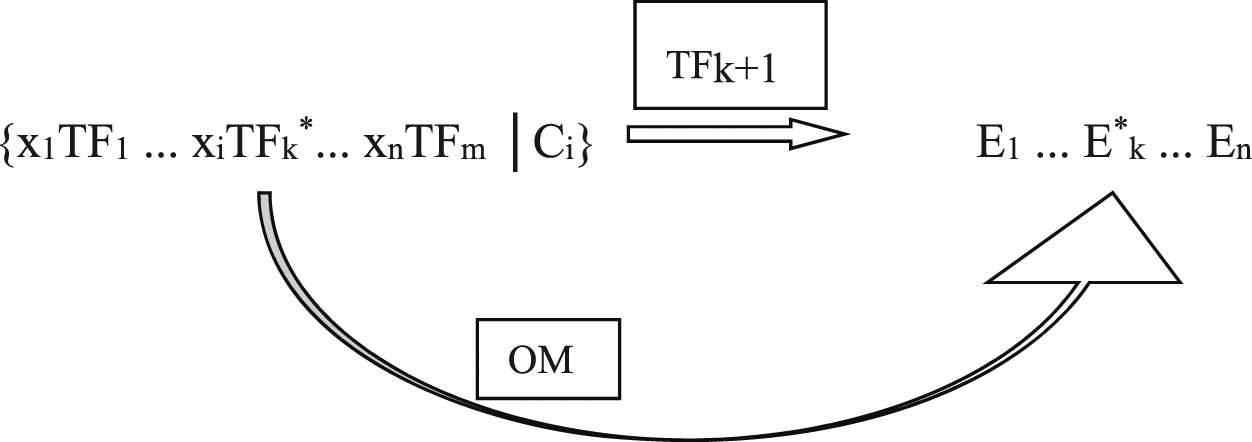
The binary operator, which consists of technology, rules/instructions, or body plans, involves a hierarchy. It can be at the k-level or deeper, such as the k+1 level. We do not find such a hierarchy with respect to the binary relator (OM) specifying the optimum.
While the elements of the input set and the corollary of the output set are different, the binary relator (OM) does not change, performing the same function irrespective of the level of hierarchy of the binary operator, i.e., whether it is TFk or TFk+1. In the above schemata, the OM selects or chooses xiTFk* as the optimum input that corresponds to the optimum end, E*k. While the binary operator (TFk) cannot play the role of natural selection (binary relator), it is the product of natural selection at a deeper level, i.e., at the k+1 level. However, when the binary relator functions, i.e., as the OM, it must take the binary operator, whether TFk or TFk+1, as given. Such a limited optimization function should not be taken, à la “soft” neo-Darwinians or à la the critics of standard economists (see Khalil, 2013a), as a shortcoming that undermines or repudiates the notion of optimization per se. To wit, the raison d’être of optimization is the existence of limits taken as given. Therefore, the term “limited optimization” is pleonasm.
There are other nuances, which this paper ignores, of the common structure that underpins the Organismus automaton and Organismus economicus hypothesis. Importantly, the structure of each hypothesis is the same and can handle different kinds of complications and qualifications at secondary and tertiary approximations. Most importantly, in this proposed structure, the trait-as-technology, i.e., the binary operator, functions as a transformation function that varies according to the level of the hierarchy. In contrast, the binary relator (OM) remains constant, i.e., irrespective of the level of hierarchy.
While binary operators (cognitive capacity or technology) and binary relators (rational choice) are different, this does not mean that they are opposite of each other. While this paper argues that both binary linkages are analytically different, they are functionally linked. Indeed, it is impossible for the decision maker to make rational decisions—i.e., undertake binary relator actions—without relying on cognitive capacities, traits, physiological organs, or transformative technologies, i.e., binary operators.
For instance, Varian (1992) commences his influential graduate-level economics textbook with the binary operator. He dedicates Chapter 1 to discussing the capability of a firm—as expressed by the available technology, machines, buildings, space, and workers—to transform inputs into outputs. Varian then proceeds in Chapter 2 to discuss how the firm uses such capability, i.e., the binary operator, in different ways depending on the environment and other constraints. The firm’s objective is the maximization of profit, which prescribes a choice that amounts to a binary relator (rationality).
The fact that the binary relator (rational choice) relies on a binary operator (technology or capacity) should not lead us to conflate the two. Rationality cannot be both a binary relator and a binary operator. As a binary relator, rationality involves a binary operator. However, the opposite is not the case: Once a technology or a capacity (binary operator) is set up, its operation does not involve a binary relator (rationality).
The proposed distinction between the OM, which acts as a binary relator, and the transformational function (TFk), which functions as a binary operator, entails the incoherence of what can be called “Rationality-qua-Trait Thesis”.
OM (the binary relator) can be either the standard rational choice or, equivalently, the neo-Darwinian natural selection. In contrast, TFk (the binary operator) is the given technology or cognitive faculty, such as intelligence and memory. OM cannot be TFk, as OM is not about transforming inputs to outputs in the technical sense.
More importantly, rational choice or OM cannot be trait-as-input, that is, an element of the left-hand input set. The OM (binary relator) cannot be a member of the set—when its function is about ensuring that the elements are consistently ranked. Treating the OM as a member of itself leads to self-contradiction, i.e., incoherence.
As shown above, TFk—such as intelligence, memory, or other cognitive faculties—can be an element of the left-hand input set—but then the transformation takes place at a deeper level. There is a hierarchy of technology or body plans. The transformation function (TF) cannot apply to the OM, as the OM cannot become a member of the left-hand input set. There is no hierarchy of rationality, as in the case with TF. What applies to TF cannot apply to OM. If we conceive of the OM as a member of the input set, this leads to a self-reference paradox à la Russell Paradox.
If we accept two theses, neo-Darwinian theory involves a serious self-reference paradox. The first thesis is that a standard sense of rationality exists. The second thesis is that such rationality is a trait. Therefore, standard rationality is a trait that changes and evolves depending on the optimization mechanism, i.e., the natural selection process. However, given the argument above, rationality is an optimization mechanism. Thus, it would be a contradiction, i.e., a self-reference paradox, to state that an optimization process selects the optimization process. If this conclusion is tenable, it is akin to the Russell Paradox (Russell, 1956).
To be clear, the Russell Paradox is not a proof of the argument of this paper. That is, the Russell Paradox does not substantiate this paper’s conclusion. Specifically, once we accept the two theses mentioned above, the neo-Darwinian approach invites the self-reference paradox. This paper employs only the Russell Paradox to illustrate the claimed self-reference paradox.
One helpful example of the Russell Paradox is the well-known Cretan liar paradox and, better, the Barber Paradox (Irvine & Deutsch, 2021). The only barber in a village has a sign posted in his shop that states, “I cut the hair of everyone in the village that does not cut his own hair.” However, who cuts the hair of the barber? If he cuts his own hair, then the barber cannot cut it. If he does not cut his own hair, then the barber cuts it. Such self-contradiction arises from treating the set, which is the barber’s statement, as a member of itself. Such treatment entails that the barber is an element of the set of people who do not cut their own hair, on the one hand, and the barber is the set itself as the one who cuts the hair of such people, on the other.
The Russell Paradox arises from what philosophers recognize as the problem of self-reference. In the case of the Rationality-qua-Trait Thesis, it treats rationality both as an OM and as an element of the set that is the subject of the OM. This self-reference is best illustrated by some of the drawings of M.C. Escher (see Hofstadter, 1980). The first role of the binary relator (OM) is to ensure that the output is consistently ranked and, corollary, that the corresponding inputs are also consistently ranked. Such an organization of inputs also cannot include OMs: how could the OM call for the substitution of one input in favor of another when the OM itself is one such input?
The implication of the above analysis is that rationality cannot be selected or chosen. Rationality cannot be a trait such as musical skill, intelligence, or any cognitive faculty. As an OM, it is analytically akin to natural selection.
It is obvious that some species, such as Homo sapiens, behave rationally. A difficulty arises when a researcher draws a line between such species and supposedly species deemed to be non-rational. This line, most obviously, leads to the creation of a fictitious dichotomy that juxtaposes “rational species” and “non-rational species.” This dichotomy is fictitious, as it supposes a natural set that includes species such as bacteria and, say, lower primates as having a common trait that sets them apart from another set that includes only upper primates. To avoid such fictitious sets, researchers need to first examine whether rationality is a trait. The Organismus economicus hypothesis certainly avoids such pitfalls, as it ascribes rationality to all living entities (Khalil, 2025b).
However, if we treat rationality as OM and hence cannot be seen as a trait, this gives rise to questions about the status of rationality with respect to living entities, if not to questions that conjure the specter of metaphysics—the specter of conceiving rationality as existing separately from living entities.
Biologists need not fear the Organismus economicus hypothesis for at least five reasons.
1. The rationality concept, at least as used by economists (e.g., Becker, 1978; Gilboa, 2012; Khalil, 2025a), amounts to a rule or a method that does not specify any particular content—not to mention free will, imagination, creative action, or ambition. Rational choice means that organisms generally make the best decision possible given the environmental constraints and their technological capacities, which include cognitive faculties, physiological traits, technologies, and institutions.
2. Biologists and psychologists usually restrict rationality to mental or cognitive processes (e.g., Chater et al., 2018; Felin et al., 2017). They concluded that organisms with limited cognitive processes, especially plants and other brainless organisms, cannot be rational. However, once one understands rationality properly, one cannot conflate it with cognitive faculties (see Khalil, 2010).
3. Biologists (e.g., Gardner, 2009) are afraid of what philosophers call “reification”—that is, the thinking of an idea such as rationality and suppose that it is true, i.e., choices made by organisms express rational choice. This raises the specter of metaphysics (see Winn, 1939)—the belief in an “uncaused cause” (Dennett, 1995). For example, the supposed reification of rationality may conjure up uncaused cause and, hence, uphold creationism, that is, the idea that there must be an external agent (e.g., a god) who creates rationality. However, the specter of reification need not arise if one can trace rationality to a defining feature of being a living being. However, this task is outside the scope of this paper.
4. Biologists who use the foraging theory pioneered by Eric Charnov (e.g., 1976; see Stephens & Krebs, 1986) or who employ the tools of “bioeconomics” (e.g., Ghiselin, 1974; see also Tullock, 1971, 1994; Khalil & Marciano, 2010) already use cost–benefit calculations, that is, rational choice. A few biologists have recently taken the first step in recognizing openly the relevance of rationality to the understanding of behavior or organisms (e.g., Vermeij, 2004; Hurley & Nudds, 2006).
5. New models of brain computation highlight that Shannon-like computations, i.e., information inputs to produce signal outputs, capture only one mode of neural computation. For example, Nicolelis’ (2020) theory registers that neural computation processes consists of two modes. The first is Shannon-like computation, which, similar to engineers, treats information as communication—corresponding to a binary operator (cognitive capacity or technology). The second is Gödelian/Boolean-like computation, which assembles networks of cells to organize structures to solve problems or make decisions—corresponding to a binary relator. While the two modes differ, Nicolelis and collaborators find that they intermingle as they are complementary (see also Lebedev & Nicolelis, 2017; Pais-Vieira et al., 2015). This dual brain computation theory substantiates the proposed binary operator/relator distinction. More importantly, the two modes of computation are not limited to human brains. Insofar as non-human organisms are also motivated to evaluate and make decisions, their neural processes must also encompass the Gödelian/Boolean-like computation mode.
6. Many neuroscientists model the brain as an optimization mechanism (OM) that must formulate models (beliefs) about the world in the face of uncertainty. This effort, generally called the “Bayesian brain hypothesis”, assumes that the brain uses new information à la Bayes’ rule—namely, to update its priors (ex ante beliefs) to formulate more accurate posteriors (ex post beliefs) (e.g., Knill & Pouget, 2004; Rao & Ballard, 1999). Friston (2010) generalizes such OM, calling it “the free-energy principle”, highlighting that the organism wants to minimize the surprise, i.e., the gap between what to expect on the basis of ex ante available information and what it actually finds ex post, i.e., after executing the pertinent action. The minimization of surprise amounts to learning and adopting more accurate beliefs. The higher the accuracy of the belief is, the higher the probability of successful action. These Bayesian brain models are about the rationality of belief formation, which somewhat differs from models regarding the rationality of action, the focus of this paper. Nevertheless, they are models of rationality that do not portray rationality as a cognitive mechanism but rather are propelled by the desire of the organism to possess accurate beliefs or minimize free energy. Such models of rationality are generalizable to any organism—i.e., not restricted to upper primates or, worse, to humans.
7. Biologists implicitly employ the rational choice approach when they explain behavior as elastic, that is, as responsive to changes in environmental constraints. They call such elasticity “phenotypic plasticity” (Gould, 1977, 2002; Stanley, 1979; Matsuda, 1987; West-Eberhard, 1989; Raff, 1996; Müller & Newman, 2003; Hall et al., 2004; DeWitt & Scheiner, 2004). They are making great strides in showing how even invertebrate organisms make decisions in light of uncertainty (e.g., Oberhauser & Czaczkes, 2018). They document how animals generally make decisions in reaction to the so-called “contrast effect” (e.g., McNamara et al., 2013).
Regarding phenotypic plasticity, that is, this paper calls upon evolutionary biologists, irrespective of their diverse approaches and schools (see Khalil, 1993), to recognize what they already are doing. When they study phenotypic plasticity, they explain plasticity as the outcome of an organism’s response to changes in the environment. This is precisely the definition of rational choice. As shown elsewhere (Khalil, 2009, 2010), standard rational choice theory is simply the proposition that the organism’s choice changes in light of changes in environmental constraints, i.e., the set of incentives. With each choice, the organism maximizes its benefit (i.e., fitness) given the set of constraints or, similarly, minimizes the cost of a given benefit.
1. There is an incongruent gap in the natural sciences. On the one hand, the sciences that focus on the study of non-human organisms do not largely give weight to rationality (i.e., a standard sense of rationality). On the other hand, the sciences, especially economics, that focus on the study of human organisms pay great attention to rationality.
2. The sciences that focus on non-human organisms do not need to appeal to rationality, as they largely appeal to natural selection as the optimization method. Nevertheless, they have to explain rationality if they are natural sciences, i.e., sciences that cannot exclude humans from nature. Such sciences, if pushed, tend to explain rationality as a trait—i.e., similar to intelligence and other cognitive faculties. However, such an explanation leads to the self-reference paradox: how could rationality, which is an optimization method, be a trait, i.e., the subject of natural selection, which is an optimization method?
3. We can easily avoid the self-reference paradox regarding rational choice or any optimization method if we employ a distinction from set theory, namely, the difference between “binary relators” and “binary operators”.
4. Rationality cannot be a trait given that it is a binary relator that allows us to identify the optimum. Hence, it cannot be the subject of evolution. There is no need to appeal to another optimization mechanism (OM) to explain its origin.
5. The cognitive faculties are traits, as they are binary operators that transform the set of inputs into outputs. Hence, cognitive faculties can be the subject of evolution.
| Views | Downloads | |
|---|---|---|
| F1000Research | - | - |
|
PubMed Central
Data from PMC are received and updated monthly.
|
- | - |
Provide sufficient details of any financial or non-financial competing interests to enable users to assess whether your comments might lead a reasonable person to question your impartiality. Consider the following examples, but note that this is not an exhaustive list:
Sign up for content alerts and receive a weekly or monthly email with all newly published articles
Already registered? Sign in
The email address should be the one you originally registered with F1000.
You registered with F1000 via Google, so we cannot reset your password.
To sign in, please click here.
If you still need help with your Google account password, please click here.
You registered with F1000 via Facebook, so we cannot reset your password.
To sign in, please click here.
If you still need help with your Facebook account password, please click here.
If your email address is registered with us, we will email you instructions to reset your password.
If you think you should have received this email but it has not arrived, please check your spam filters and/or contact for further assistance.

Comments on this article Comments (0)