1. Introduction
Over the past decades, fractional calculus has emerged as a powerful generalization of classical differentiation and integration. It has found applications across a wide spectrum of disciplines. Its origins trace back to a 1695 correspondence, in which Leibniz proposed the concept of a half-order derivative in his letter to L’Hôpital. Since that seminal insight, fractional operators have attracted the interest of mathematicians, physicists, biologists, engineers, and economists.
One of the earliest celebrated applications appears in Abel’s resolution of the tautochrone problem.1 In modern research, fractional models play a central role in various fields. These include biophysics, quantum mechanics, wave propagation, polymer dynamics, continuum mechanics, Lie group analysis, field theory, and spectroscopy.2–8 For a comprehensive treatment of these developments, see Samko et al.9
Over time, many formulations of the fractional derivative have been introduced. These include the Riemann–Liouville, Caputo, Hadamard, Erdélyi–Kober, Grünwald–Letnikov, Machado, and Riesz definitions. Each formulation addresses distinct theoretical and practical challenges.8–12
In fractional calculus, derivatives of non-integer order are most often introduced via fractional integrals.10,11 The Riemann–Liouville operator and its associated integral occupy a foundational role in the theory.13 The widely used Caputo derivative is itself defined through the Riemann–Liouville integral.9
In parallel, Butzer and colleagues have conducted extensive studies on the Hadamard fractional integral and derivative.10,11,14–18 They derived, in particular, the Mellin transform representation of these operators.15
More recently, Pooseh et al. established expansion formulas that express Hadamard operators in terms of standard integer-order derivatives.19 For further developments and a comprehensive survey of related results, see Samko et al.,10 Srivastava et al.,11 and the references therein.
In Ref. 12, a new fractional integral was introduced. It unifies the Riemann–Liouville and Hadamard integrals within a single formulation. This α-generalized operator has been the subject of numerous recent studies and monographs.18,20–24
The first part of this paper reviews the essential concepts and definitions of fractional calculus that underpin our framework. The second part presents rigorous proofs of existence and uniqueness for the generalized α-operator. In the third part, we develop a detailed analysis of the Daftardar-Jafari iterative method when combined with this operator. The fourth part illustrates the applicability of both the operator and the method through several example problems in fractional differential equations.
Finally, we draw conclusions and compile a complete list of references.
2. Preliminaries
Definition 1.
9 The Riemann Liouville fractional integral operator of order
of function
is defined as
(1)
where
is the well-known Gamma function
Definition 2.
9 The Liouville-Caputo operator (c) with order
of
is defined as follows:
(2)
Definition 3.
11 The Hadamard fractional integral introduced by J. Hadamard,11 and is given by,
(3)
For
while the Hadamard fractional derivative of order
is given by,
(4)
Definition 4.
13 The α‐generalized fractional derivative operator of order
is constant of function
is defined as
(5)
while the α‐generalized fractional integral operator
25 of order
is constant of function
is defined as
(6)
Theorem 1.
26 Let
(7)
(8)
(9)
(10)
Proof.
This result was originally established in Ref. 26, to which we refer the reader for the full proof. This result was originally established in Ref. 26, to which we refer the reader for the full proof.
Theorem 2.
Let
. Then
(11)
Proof.
(12)
By using Fubini’s theorem, the equation will become as follows,
(13)
By employing an appropriate substitution of variables,
(14)
(15)
(16)
(17)
(18)
Substitution Eq. (16) and Eq. (18) in Eq. (13):
(19)
(20)
Using the Beta function, we have
(21)
(22)
Applying Leibniz’s rule
(23)
Theorem 3.
Let
such that
and
If
and
, then, for
(24)
Proof.
This result was originally established in Ref. 27, to which we refer the reader for the full proof.
Theorem 4.
Let
(25)
It is easy to prove this theorem, which is called the linear property theorem.
Proposition 1.
For
and
then
(26)
in which
denotes a constant of arbitrary value.
Proof.
By using definition of α-generalized fractional derivative operator, we get
(27)
Let
(28)
Proposition 2.
For
and
then:
(29)
in which
denotes a constant of arbitrary value
Proof.
By using definition of α‐generalized fractional integral operator, we get
(30)
Let
(31)
3. The α‐Generalized Fractional Daftardar-Jafari Method (α-DJM)
Consider the following form of a fractional differential equation,
(32)
with respect to the initial conditions
(33)
where
α‐generalized fractional operator of order α,
linear operator,
non linear operator, and
known source function.
The method is based on applying
on both sides of (43), to have
(34)
(35)
Now, represent solution as an infinite series given below:
(36)
Substituting (36) into both sides of (35) gives.
(37)
The nonlinear term is decomposed as in
(38)
Substituting (38) into (37) gives
(39)
Define the recurrence relation:
(40)
(41)
(42)
Substituting Eq. (40), Eq. (41), and Eq. (42) into Eq. (39) gives
(43)
Where
(44)
And
(45)
Moreover, the relation is defined with recuence, so that
(46)
And
(47)
Thus, the approximate solution of (32) is
(48)
Theorem 3.1
Let us consider the fractional differential equation of the form
(49)
where
α‐generalized fractional operator of order α,
linear operator,
non linear operator, satisfying the Lipschitz condition
for some constant
Then the approximate solution obtained by the α‐Generalized Fractional Daftardar-Jafari Method (α-DJM), defined by the series
(50)
with the recurrence relations
(51)
(52)
(53)
is convergent for all
provided that
Proof.
Assume
Using the boundedness of
we estimate:
(54)
(55)
(56)
(57)
where
By recursion:
(58)
Therefore, the total norm of the series is bounded by
(59)
Hence, the method converges absolutely and uniformly for
under the given condition.
4. Applications
Example 1.
Assume heat-like equation with the NFD and
,
(60)
where
,
By using the α‐Generalized Fractional Daftardar-Jafari Method (α-DJM), we get,
(61)
(62)
(63)
(64)
Let
(65)
Substituting Equation (38) into Equation (37) to obtain,
(66)
(67)
(68)
As a result, this formulation serves as the approximate solution to the problem.
(69)
Therefore, the exact solution corresponding to Eq. (60) can be expressed as follows:
(70)
Table 1 and
Figure 1, show the convergence of the approximate solution to the exact solution for different
values. It seems that the closer
is to 1, the closer the approximate solution is to the exact solution.
Figure 2 shows the comparison between the convergence of solutions individually for all different
values between the exact solution and the approximate solution.
Note 1: When using the Adomian method with the same operator, we will get the same approximate solution and exact solution. But the advantage of the proposed method appears in nonlinear examples, as we will explain in the second example.
Example 2.
Suppose that
and Burger’s equation,
(71)
where
,
By using the α‐Generalized Fractional Daftardar-Jafari Method (α-DJM).
(72)
(73)
(74)
Table 1. Numerical values of the approximate solution
(Eq. 69) for
at fixed
.
|
|
|
|
|
|
|
|
|
|---|
| 0.00000 | 0.04204 | 0.04204 | 0.04204 | 0.04204 | 0.00000 | 0.00000 | 0.00000 |
| 0.05556 | 0.03886 | 0.04083 | 0.04131 | 0.03761 | 0.00125 | 0.00321 | 0.00369 |
| 0.11111 | 0.03586 | 0.03904 | 0.04001 | 0.03366 | 0.00220 | 0.00538 | 0.00635 |
| 0.16667 | 0.03320 | 0.03702 | 0.03839 | 0.03012 | 0.00308 | 0.00690 | 0.00828 |
| 0.22222 | 0.03094 | 0.03490 | 0.03657 | 0.02695 | 0.00398 | 0.00795 | 0.00962 |
| 0.27778 | 0.02909 | 0.03279 | 0.03463 | 0.02412 | 0.00498 | 0.00867 | 0.01051 |
| 0.33333 | 0.02769 | 0.03075 | 0.03263 | 0.02158 | 0.00611 | 0.00917 | 0.01105 |
| 0.38889 | 0.02675 | 0.02885 | 0.03064 | 0.01931 | 0.00744 | 0.00954 | 0.01133 |
| 0.44444 | 0.02628 | 0.02714 | 0.02871 | 0.01728 | 0.00900 | 0.00986 | 0.01143 |
| 0.50000 | 0.02629 | 0.02567 | 0.02689 | 0.01546 | 0.01083 | 0.01020 | 0.01143 |
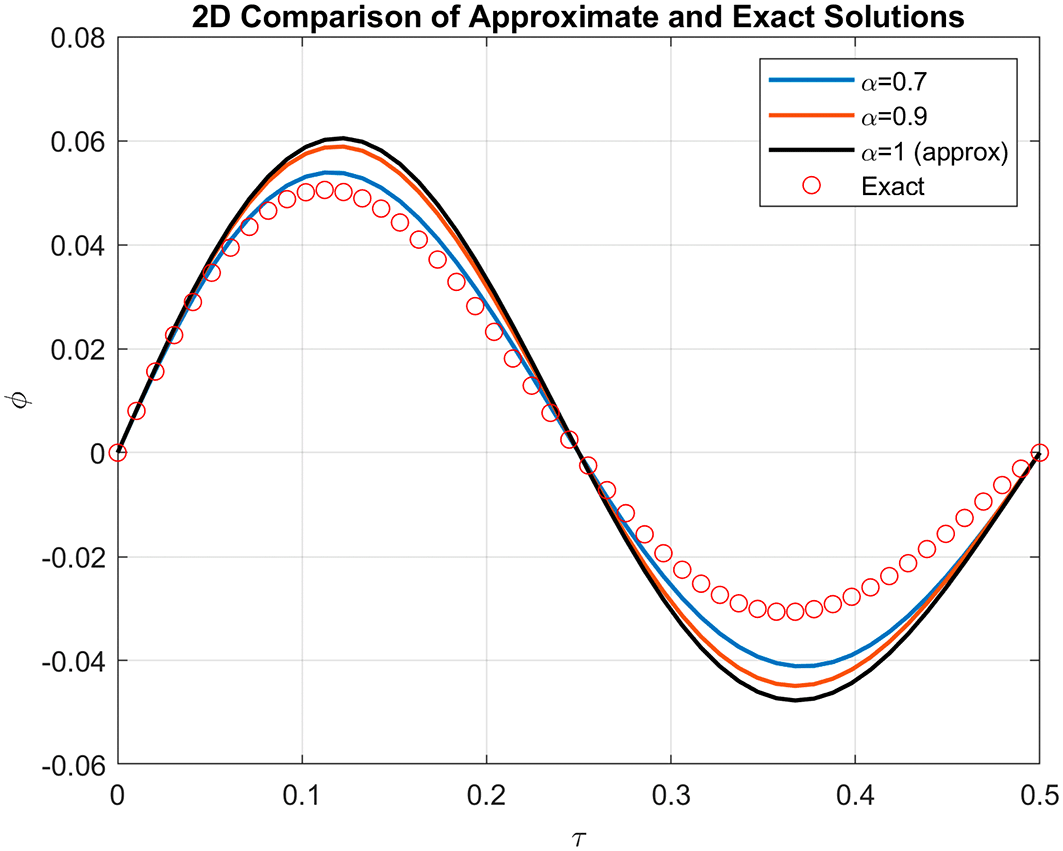
Figure 1. 2D comparison of the approximate (Eq. 69) and exact solution
(Eq. 70) for
at fixed
.
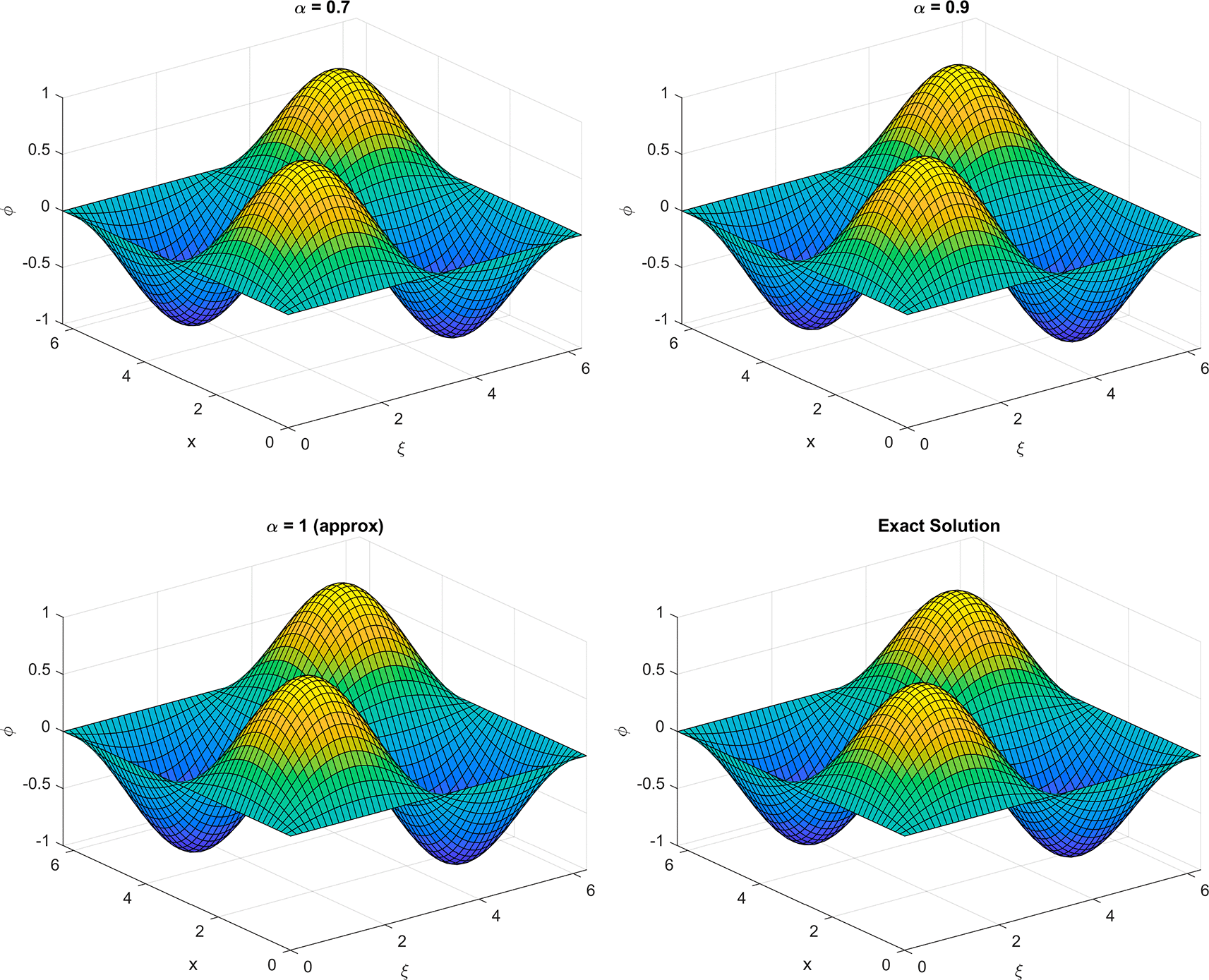
Figure 2. 3D comparison of the approximate (Eq. 69) and exact solution
(Eq. 70) for
at fixed
.
Let
(75)
(76)
(77)
(78)
The nonlinear terms are
(79)
(80)
The remaining terms can be obtained using the following recurrence relation
(81)
(82)
(83)
As a result, this formulation serves as the approximate solution to the problem,
(84)
To compare the advantage of the solution, we find the solution of
Equation (71) using the Adomian decomposition method with the same operator. We will solve the following approximate solution:
(85)
Therefore, the exact solution corresponding to Eq. (95) can be expressed as follows:
(86)
Table 2, which presents the results using the Daftardar-Jafari Method.
Table 3 shows the results using the Adomian decomposition Method. Both tables illustrate the convergence of the approximate solution toward the exact solution for different values of α. By comparing the two tables, we observe that the Daftardar-Jafari Method performs better than the Adomian Method when applied with the same operator.
Table 2. Numerical values of the approximate solution
(Eq. 84) for
at fixed ξ,
.
|
|
|
|
|
|
|
|
|
|---|
| 0 | 5 | 5 | 5 | 5 | 0 | 0 | 0 |
| 0.05556 | 4.40524 | 4.64654 | 4.73748 | 4.73684 | 0.3316 | 0.0903 | 0.00063 |
| 0.11111 | 4.15553 | 4.39042 | 4.50475 | 4.5 | 0.34447 | 0.10958 | 0.00475 |
| 0.16667 | 4.00586 | 4.18785 | 4.30076 | 4.28571 | 0.27985 | 0.09786 | 0.01505 |
| 0.22222 | 3.91465 | 4.0274 | 4.12444 | 4.09091 | 0.17626 | 0.06351 | 0.03353 |
| 0.27778 | 3.86255 | 3.90251 | 3.97473 | 3.91304 | 0.0505 | 0.01053 | 0.06168 |
| 0.33333 | 3.83813 | 3.80856 | 3.85055 | 3.75 | 0.08813 | 0.05856 | 0.10055 |
| 0.38889 | 3.83379 | 3.74195 | 3.75085 | 3.6 | 0.23379 | 0.14195 | 0.15085 |
| 0.44444 | 3.84405 | 3.69969 | 3.67456 | 3.46154 | 0.38252 | 0.23816 | 0.21302 |
| 0.5 | 3.86475 | 3.67924 | 3.62061 | 3.33333 | 0.53142 | 0.34591 | 0.28727 |
Table 3. Numerical values of the approximate solution
(Eq. 85) for
at fixed ξ,
.
|
|
|
|
|
|
|
|
|
|---|
| 0 | 5 | 5 | 5 | 5 | 0 | 0 | 0 |
| 0.05556 | 4.41315 | 4.6472 | 4.73765 | 4.73684 | 0.32369 | 0.08964 | 0.00081 |
| 0.11111 | 4.18946 | 4.39469 | 4.50617 | 4.5 | 0.31054 | 0.10531 | 0.00617 |
| 0.16667 | 4.08535 | 4.20061 | 4.30556 | 4.28571 | 0.20037 | 0.08511 | 0.01984 |
| 0.22222 | 4.06009 | 4.05514 | 4.1358 | 4.09091 | 0.03082 | 0.03576 | 0.04489 |
| 0.27778 | 4.09492 | 3.95319 | 3.99691 | 3.91304 | 0.18187 | 0.04014 | 0.08387 |
| 0.33333 | 4.1789 | 3.89146 | 3.88889 | 3.75 | 0.4289 | 0.14146 | 0.13889 |
| 0.38889 | 4.30482 | 3.86765 | 3.81173 | 3.6 | 0.70482 | 0.26765 | 0.21173 |
| 0.44444 | 4.46755 | 3.87996 | 3.76543 | 3.46154 | 1.00601 | 0.41842 | 0.30389 |
| 0.5 | 4.66321 | 3.927 | 3.75 | 3.33333 | 1.32988 | 0.59367 | 0.41667 |
Figure 3 displays the convergence behavior of the approximate solution as α approaches 1, using the Daftardar-Jafari Method.
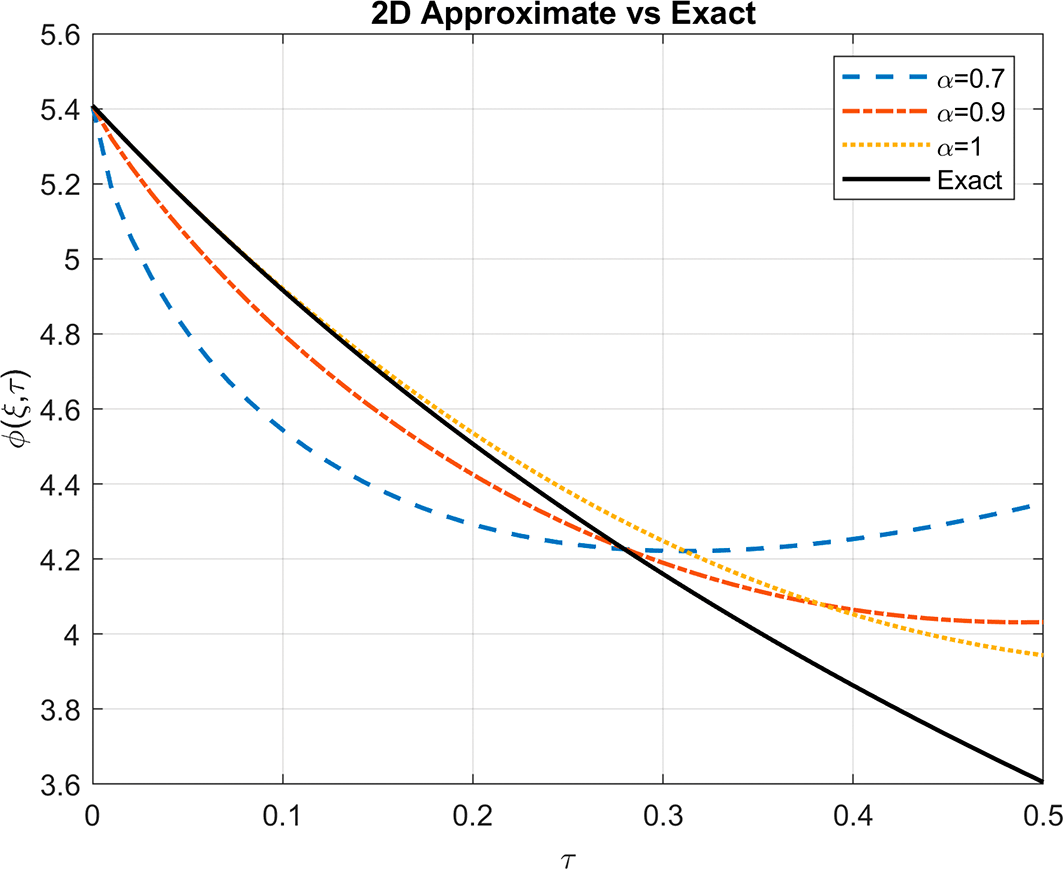
Figure 3. 2D comparison of the approximate (Eq.84) and exact solution
(Eq.86) for
at fixed
.
Figure 4 presents a comparison of the convergence between the exact and approximate solutions for the Daftardar-Jafari Method across all tested values of α.
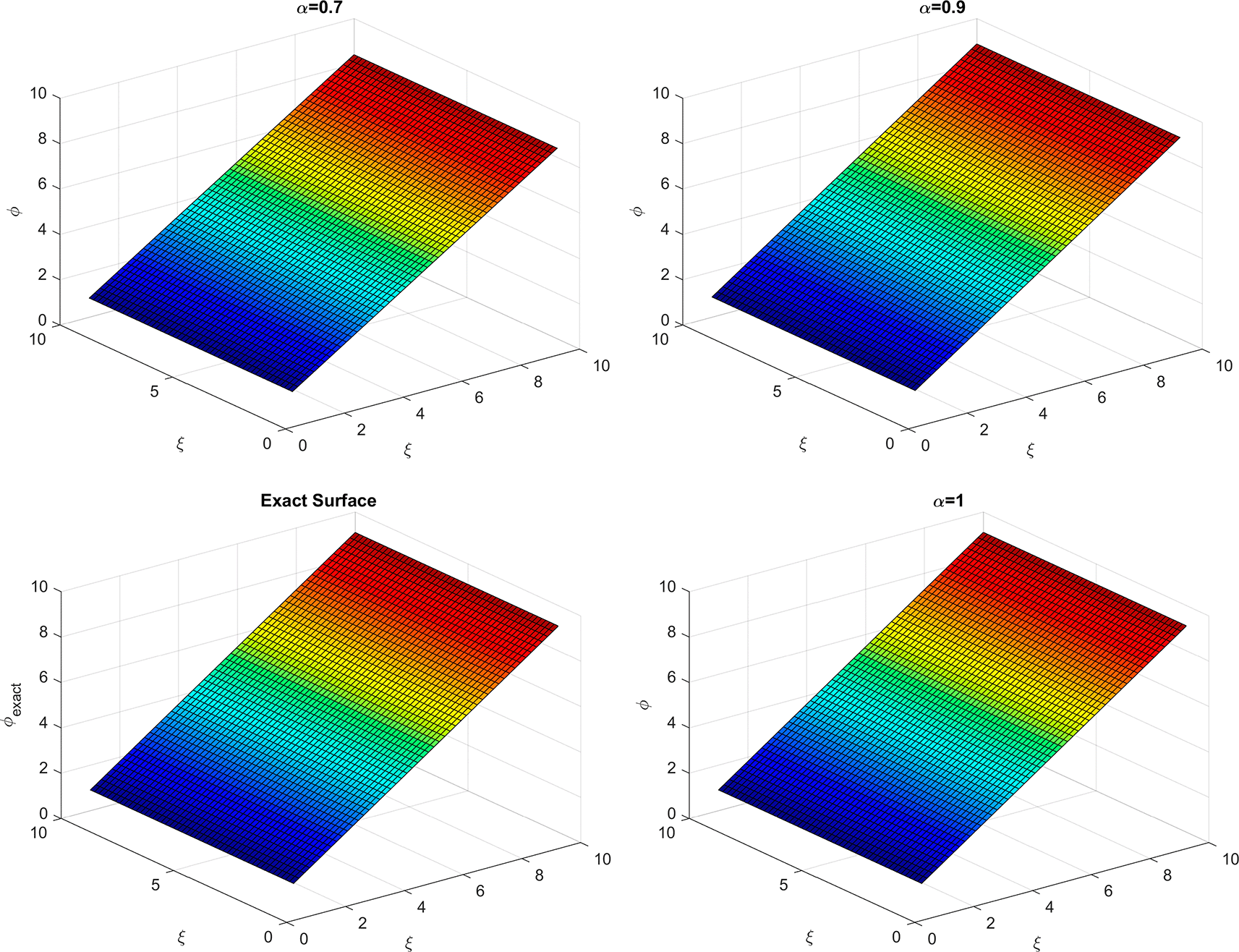
Figure 4. 3D comparison of the approximate and exact solution
(Eq.84) for
at fixed
.
5. Discussion
This study presented two illustrative examples to evaluate the performance of the proposed α-generalized Daftardar-Jafari method both analytically and numerically.
In the first example, which involves a linear fractional partial differential equation, the numerical results obtained using the proposed method were comparable to those produced by the Adomian decomposition method. Both approaches yielded identical outcomes. However, from an analytical standpoint, the α-DJM framework offers a simpler and more direct formulation than many existing methods. Furthermore, the approximate solution was observed to converge toward the exact solution as the value of α approached 1. This behavior is clearly demonstrated in
Figure 1 and
Figure 2.
In contrast, the second example, which involves a nonlinear equation, revealed a distinct advantage of the proposed method. The numerical results obtained using
α-DJM were more accurate than those produced by the Adomian method. This is evident from the comparative data presented in
Table 2 and
Table 3, respectively. Similar to the first example, the convergence of the approximate solution toward the exact solution improved as α approached 1, as illustrated in
Figure 3 and
Figure 4.
These findings confirm the effectiveness of the α-DJM method, particularly in handling nonlinear fractional models with improved accuracy and convergence behavior.
6. Conclusions
In this work, we introduced a new method for solving both linear and nonlinear fractional partial differential equations. The approach combines the α-generalized fractional differential operator with the Daftardar-Jafari method (DJM). The properties of the α-generalized operator, as presented in this article, demonstrate its generality. In particular cases, it reduces to well-known operators such as Caputo and Hadamard.
We applied the (α-DJM) framework to formulate a detailed solution scheme. This included deriving recurrence relations for both linear and nonlinear equations, and establishing convergence based on Lipschitz conditions through optimization techniques.
Our results show that solving a linear equation using different methods yields similar outcomes. This is clearly illustrated in the first example involving the linear heat equation. The analytical and numerical solutions are identical when substituting the parameters
for various values of
The second example addresses a nonlinear case involving the Berger equation. Upon solving and comparing with the Adomian decomposition method, we observed noticeable differences in both analytical and numerical results. In this case, we used
for both tables. From the comparative analysis, it is evident that the (α-DJM) method outperforms the Adomian method. It offers better accuracy and consistency.
Overall, the (α-DJM) combines analytical simplicity with numerical efficiency. It provides a unified framework for solving a wide range of fractional models with varying orders.
Future research may extend this framework to incorporate alternative methods and broader comparative studies.
Data citation
Sachit SA, Jassim HK (2025). Dataset for “An Iterative Approach for Solving Fractional Differential Equations Using the α-Generalized Daftardar–Jafari Method”. Zenodo. https://doi.org/10.5281/zenodo.17560489.
Ethics statement
This research does not involve human participants, animal subjects, or sensitive personal data. Therefore, ethical approval was not required.
Acknowledgments
The authors would like to express their sincere gratitude to the reviewers for their valuable comments and constructive suggestions, which have significantly enhanced the scientific quality of this article. We also extend our heartfelt thanks to the faculty members of the Department of Mathematics at our university for their continuous support and guidance throughout this research.
References
- 1.
Diethelm K, Kiryakova V, Luchko Y, et al.:
Trends, Directions for Further Research, and Some Open Problems of Fractional Calculus.2021. Publisher Full Text
- 2.
Jafari H, Jassim HK, Ünlü C, et al.:
Laplace Decomposition Method for Solving the Two-Dimensional Diffusion Problem in Fractal Heat Transfer.
Fractals.
2024; 32(4): 1–6. Publisher Full Text
- 3.
Jafari H, Jassim HK, Ansari A, et al.:
Local Fractional Variational Iteration Transform Method: A Tool For Solving Local Fractional Partial Differential Equations.
Fractals.
2024; 32(4): 1–8. Publisher Full Text
- 4.
Jassim H, Ahmad A, Shamaoon CC:
An Efficient Hybrid Technique for the Solution of Fractional-Order Partial Differential Equations.
Carpathian Math. Publ.
2021; 13: 790–804. Publisher Full Text
- 5.
Cui P, Jassim HK:
Local Fractional Sumudu Decomposition Method to Solve Fractal PDEs Arising in Mathematical Physics.
Fractals.
2024; 32(4): 1–6. Publisher Full Text
- 6.
Hussein MA, Jassim HK, Jassim AK:
An Innovative Iterative Approach to Solving Volterra Integral Equations of Second Kind.
Acta Polytechnica.
2024; 64(2): 87–102. Publisher Full Text
- 7.
Jassim HK, Hussein MA:
A Novel Formulation of the Fractional Derivative with the Order α≥ 0 and without the Singular Kernel.
Mathematics.
2022; 10(21): 4123. Publisher Full Text
- 8.
Khaled Abdeljawad A, et al.:
Analysis of a class of fractal hybrid fractional differential equations under Atangana–Baleanu–Caputo derivative.
Sci. Rep.
2024; 14. PubMed Abstract
| Publisher Full Text
| Free Full Text
- 9.
Luchko Y:
General fractional integrals and derivatives with the Sonine kernels.
arXiv preprint arXiv:2102.04059.
Feb. 2021. Publisher Full Text
- 10.
Jafari H, Zayir MY, Jassim HK:
Analysis of fractional Navier-Stokes equations.
Heat Transfer.
2023; 52(3): 2859–2877. Publisher Full Text
- 11.
Srivastava HM, Baleanu D, Agarwal RP, et al.:
Solutions of general fractional-order differential equations by using the spectral Tau method.
Fractal Fractional.
2022 Jan.; 6(1): 1–20. art. 7. Publisher Full Text
- 12.
Khalil R, Al Horani M, Yousef A, et al.:
A new definition of fractional derivative.
J. Comput. Appl. Math.
Mar. 2020; 264: 65–70. Publisher Full Text
- 13.
Abdel Latif MS, Abdel Kader AH, Baleanu D:
The invariant subspace method for solving nonlinear fractional partial differential equations with generalized fractional derivatives.
Adv. Differ. Equ.
2020; 2020(1): 119. Publisher Full Text
- 14.
Sahebi HR, Kazemi M:
On the existence of solutions for Hadamard-type fractional integral equations.
Bound. Value Probl.
2025; 2025: art. no. 128. Publisher Full Text
- 15.
Taher HG, Ahmad H, Singh J, et al.:
solving fractional PDEs by using Daftardar-Jafari method.
AIP Conf. Proc.
2022; 2386(060002): 1–10.
- 16.
Balachandran K, Matar M, Annapoorani N, et al.:
Hadamard functional fractional integrals and derivatives and fractional differential equations.
Filomat.
2024; 38(3): 779–792. Publisher Full Text
- 17.
Guan K, Ou C, Wang Z:
Mathematical analysis and a second-order compact scheme for nonlinear Caputo–Hadamard fractional sub-diffusion equations.
Mediterr. J. Math.
2024; 21(77): 1–23. Publisher Full Text
- 18.
Sachit SA, Jassim HK:
A Modified Iterative Approach Using YJ Transform for Solving Fractional PDEs.
Prog. Fract. Differ. Appl.
Jan 2015; 1(1): 1–16. Publisher Full Text
- 19.
Jassim HK:
A new approach to find approximate solutions of Burger’s and coupled Burger’s equations of fractional order.
TWMS J. Appl. Eng. Math.
2021; 11(2): 415–423.
- 20.
Fernandez E, Huilcapi V, Cajo R:
The role of fractional calculus in modern optimization: A survey of algorithms, applications, and open challenges.
Mathematics.
2023; 13(19): 1–26. Publisher Full Text
- 21.
Guariglia E:
Fractional calculus of the Lerch zeta function.
Mediterr. J. Math.
2022; 19: 1–18. article no. 109. Publisher Full Text
- 22.
Herrmann R:
Fractional Calculus: An Introduction for Physicists.
4th ed.Singapore:
World Scientific;
2023. Publisher Full Text
- 23.
Hussain S, Iqbal M, Abbas M:
New inequalities for generalized convex functions via fractional integrals.
J. Inequal. Appl.
2022; 2022(1): 1–14. article 189. Publisher Full Text
- 24.
Liu W, Liu L:
Properties of Hadamard fractional integral and its application.
Fractal Fractional.
2022; 6(11): 1–18. article 670. Publisher Full Text
- 25.
Jassim HK, Mohammed MG:
Natural homotopy perturbation method for solving nonlinear fractional gas dynamics equations.
Int. J. Nonlinear Anal. Appl.
2021; 12(1): 813–821. Publisher Full Text
- 26.
Sweilam NH, Nagy AM, Al-Ajami TM:
Numerical solutions of fractional optimal control with Caputo–Katugampola derivative.
Adv. Contin. Discret. Models.
2021; 2021: 1–20. article 425. Publisher Full Text
- 27.
Almutairi O, Kılıçman A:
New generalized Hermite–Hadamard inequality and related integral inequalities involving Katugampola-type fractional integrals.
Symmetry.
2020; 12(4): 1–15. article 568. Publisher Full Text
- 28.
Sachit SA, Jassim HK:
Dataset for “An Iterative Approach for Solving Fractional Differential Equations Using the α-Generalized Daftardar–Jafari Method”.
Zenodo.
2025. Publisher Full Text


Comments on this article Comments (0)