Keywords
Otorhinolaryngology; Bibliometrics; Research Collaboration; Citation Analysis; Global Contributions

Otorhinolaryngology; Bibliometrics; Research Collaboration; Citation Analysis; Global Contributions
Global otolaryngology research has grown substantially over the past decade, with advances in surgical technology, hearing devices, and interdisciplinary approaches transforming care for ear, nose, and throat (ENT) disorders. Despite this expansion, the field has lacked a comprehensive bibliometric analysis to identify its key contributors and trends. Previous studies in otolaryngology have typically been narrow in scope and have not mapped the broader global research landscape.1–8
This study aims to fill that gap by analyzing otolaryngology publications from 2015 to 2024. We conducted a bibliometric analysis to quantify the top contributors across countries, institutions, journals, funding agencies, and individual researchers. By examining publication output and impact indicators, this analysis provides a benchmark of the leading performers and insights into the global distribution of research activity. The findings are intended to inform future collaborations, funding strategies, and efforts to support emerging research centers in otolaryngology.
This cross sectional bibliometric analysis utilized Clarivate Analytics’ InCites platform to gather publication data from the Web of Science (WoS) Core Collection. The dataset was accessed on April 2025, and was based on the InCites dataset last updated on March 28, 2025.
All bibliographic records were filtered by the Research Area of “Otorhinolaryngology” within the WoS classification schema, restricting the scope to literature in the otorhinolaryngology domain. The time period was set to 2015–2024 (inclusive), capturing a decade of research output. All publication types indexed in WoS were included to encompass the full range of scholarly output. Importantly, records from the Emerging Sources Citation Index (ESCI) were retained in the dataset to ensure comprehensive coverage of the field. The primary objective was to quantify research productivity and impact within otorhinolaryngology and to identify leading contributors. In addition to InCites, we utilized the latest version of Journal Citation Reports (JCR), JCR 2023 for journal-specific metrics.
Five key analytical dimensions were examined to characterize the otorhinolaryngology research landscape: countries, publication sources (journals), funding agencies, organizations (institutional affiliations), and individual researchers. For each of these dimensions, relevant bibliometric indicators were extracted from InCites or derived from the data to evaluate research productivity, impact, and collaboration. InCites’ standard metrics were used as the basis for analysis. Detailed information on dataset composition, baseline calculations, and indicator definitions is available from Clarivate’s InCites Knowledge Base.9
All data retrieved from InCites were downloaded in spreadsheet format (CSV and Excel), and basic processing was performed to enable these analyses. The InCites platform directly provided many of the indicators, which we used as reported. Additional computations were carried out using spreadsheet functions to ensure consistent comparisons across the five dimensions.
Data processing and analysis were conducted using a combination of Python scripting and manual cross-verification with spreadsheet software, ensuring both efficiency and precision. Datasets exported from InCites and JCR in CSV and Excel formats were loaded into Python. This step addressed minor inconsistencies, such as encoding errors or truncated text fields, to ensure uniformity across all records.
For data validation and analysis, Python scripting was employed. Datasets obtained from InCites and JCR were first loaded into Python using pandas, where they were cleaned and cross-checked for inconsistencies, such as encoding issues or truncated text. Aggregated metrics were computed for each entity, and the results were verified against the Excel outputs from InCites. This dual approach of programmatic and manual verification ensured accuracy in the final dataset, preventing errors and discrepancies.
Applying the criteria yielded a final dataset of 95,435 documents in the field of otorhinolaryngology (2015–2024). These publications were authored by a total of 186,199 distinct researchers, affiliated with 5,640 organizations (86,679 documents), and were disseminated across 441 different journals/publication sources (95,435 documents). Collectively, the research was contributed by authors from 178 countries/territories (93,063 documents) and acknowledged support from 694 distinct funding agencies (15,143 documents).
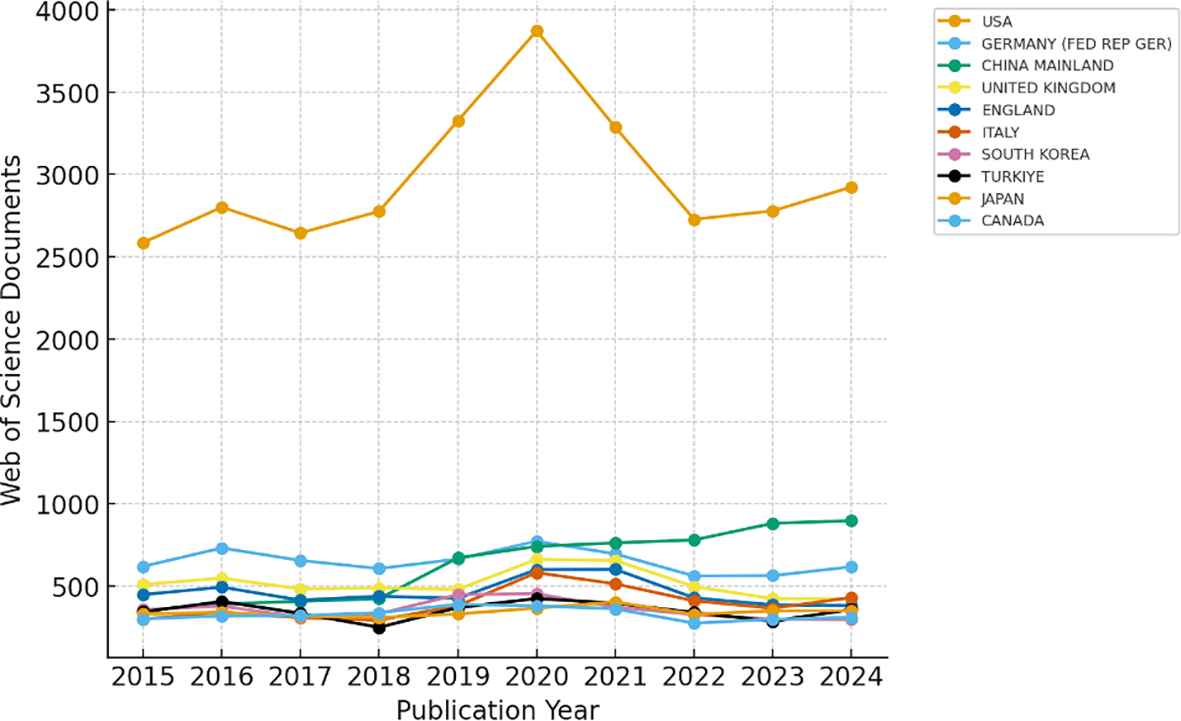
The United States contributed the largest share (~31,600, about one-third of global output) and the most total citations (~342,700). Germany (~7,000 publications, 7.6%), China (~6,450, 6.9%), and the United Kingdom (~5,550, 6.0%) were the next most prolific, collectively accounting for over half of output (Note: In Web of Science, the UK’s constituent countries are listed separately, but combined they total about 11,000 papers, placing the UK as #2 overall, though we report them individually as provided.) These four countries alone accounted for over half of the world’s otorhinolaryngology papers. The United States’ volume was nearly four times that of the second-ranked country. Notably, the UK published fewer papers than Germany but garnered more citations (~73,000 vs 63,500), reflecting higher average impact ( Figures 1 and 2, Table 1).
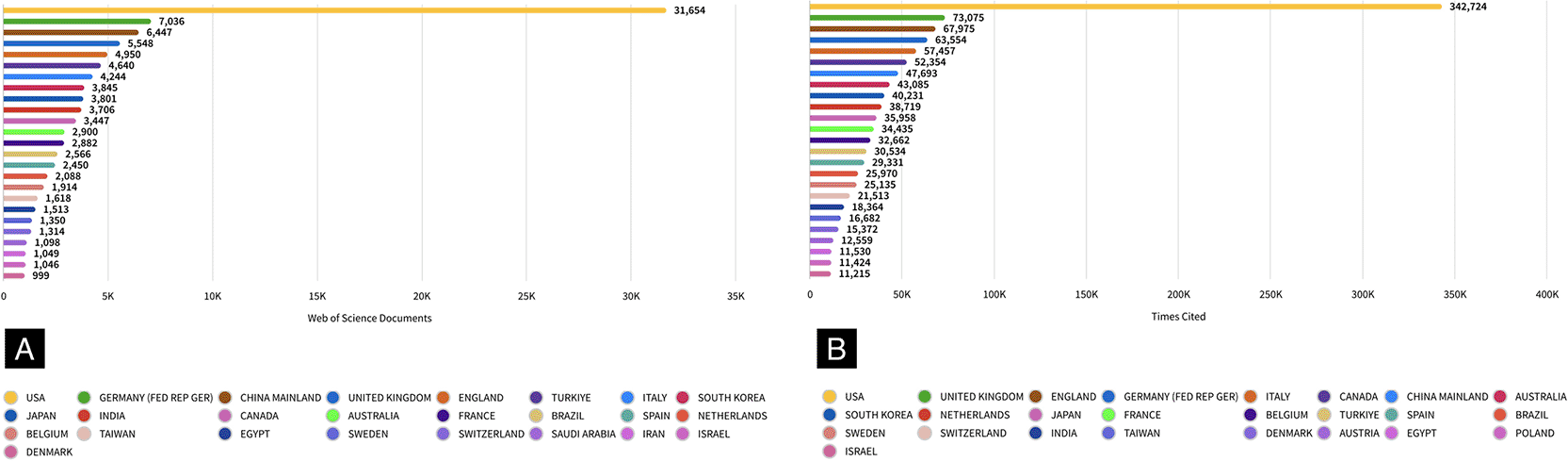
(A) Horizontal bar graph illustrating the total number of citations received by the top 25 countries. (B) Horizontal bar graph depicting the number of Web of Science documents published by the top 25 countries. Data were sourced from the InCites Dataset, updated March 28, 2025. Countries are color-coded as indicated in the legends below each graph.
| Rank | Name | Web of Science Documents | Times Cited | CNCI* | Citation Impact | Documents in Q1 Journals | Documents in Top 1% | Documents in Top 10% | Highly Cited Papers | Domestic Collaborations | International Collaborations | Industry Collaborations | % Open Access Documents |
|---|---|---|---|---|---|---|---|---|---|---|---|---|---|
| 1 | USA | 31654 | 342724 | 1.15 | 10.83 | 10638 (40.70%) | 496 (1.57%) | 4003 (12.65%) | 83 (0.26%) | 14463 (45.69%) | 5700 (18.01%) | 292 (0.92%) | 37.76 |
| 2 | GERMANY | 7036 | 63554 | 1.04 | 9.03 | 994 (17.28%) | 118 (1.68%) | 648 (9.21%) | 27 (0.38%) | 1910 (27.15%) | 1772 (25.18%) | 146 (2.08%) | 33.40 |
| 3 | CHINA | 6447 | 47693 | 0.96 | 7.40 | 1218 (22.64%) | 46 (0.71%) | 449 (6.96%) | 12 (0.19%) | 2467 (38.27%) | 1041 (16.15%) | 37 (0.57%) | 37.32 |
| 4 | UK | 5548 | 73075 | 1.50 | 13.17 | 1421 (30.45%) | 155 (2.79%) | 769 (13.86%) | 35 (0.63%) | 1703 (30.70%) | 2272 (40.95%) | 102 (1.84%) | 50.11 |
| 5 | ENGLAND | 4950 | 67975 | 1.57 | 13.73 | 1304 (31.42%) | 149 (3.01%) | 721 (14.57%) | 34 (0.69%) | 1560 (31.52%) | 2100 (42.42%) | 93 (1.88%) | 51.15 |
| 6 | TURKIYE | 4640 | 30534 | 0.77 | 6.58 | 277 (8.59%) | 31 (0.67%) | 220 (4.74%) | 7 (0.15%) | 2255 (48.60%) | 456 (9.83%) | 7 (0.15%) | 47.41 |
| 7 | ITALY | 4244 | 57457 | 1.77 | 13.54 | 779 (22.40%) | 127 (2.99%) | 661 (15.57%) | 33 (0.78%) | 1724 (40.62%) | 1462 (34.45%) | 36 (0.85%) | 49.39 |
| 8 | SOUTH KOREA | 3845 | 40231 | 1.08 | 10.46 | 1072 (32.59%) | 37 (0.96%) | 341 (8.87%) | 11 (0.29%) | 1694 (44.06%) | 456 (11.86%) | 32 (0.83%) | 46.09 |
| 9 | JAPAN | 3801 | 35958 | 1.00 | 9.46 | 579 (19.07%) | 38 (1.00%) | 272 (7.16%) | 17 (0.45%) | 1721 (45.28%) | 444 (11.68%) | 48 (1.26%) | 37.12 |
| 10 | INDIA | 3706 | 18364 | 0.65 | 4.96 | 275 (15.80%) | 25 (0.67%) | 163 (4.40%) | 8 (0.22%) | 666 (17.97%) | 502 (13.55%) | 5 (0.13%) | 54.86 |
| 11 | CANADA | 3447 | 52354 | 1.50 | 15.19 | 1227 (41.55%) | 67 (1.94%) | 501 (14.53%) | 28 (0.81%) | 937 (27.18%) | 1717 (49.81%) | 36 (1.04%) | 45.60 |
| 12 | AUSTRALIA | 2900 | 43085 | 1.56 | 14.86 | 853 (35.87%) | 76 (2.62%) | 457 (15.76%) | 19 (0.66%) | 1050 (36.21%) | 1522 (52.48%) | 114 (3.93%) | 45.00 |
| 13 | FRANCE | 2882 | 34435 | 1.66 | 11.95 | 557 (22.62%) | 93 (3.23%) | 390 (13.53%) | 20 (0.69%) | 1223 (42.44%) | 1138 (39.49%) | 54 (1.87%) | 53.05 |
| 14 | BRAZIL | 2566 | 25970 | 1.13 | 10.12 | 318 (17.35%) | 42 (1.64%) | 215 (8.38%) | 15 (0.58%) | 1074 (41.86%) | 602 (23.46%) | 5 (0.19%) | 59.86 |
| 15 | SPAIN | 2450 | 29331 | 1.59 | 11.97 | 409 (30.75%) | 75 (3.06%) | 275 (11.22%) | 23 (0.94%) | 831 (33.92%) | 753 (30.73%) | 65 (2.65%) | 42.33 |
| 16 | NETHERLANDS | 2088 | 38719 | 1.99 | 18.54 | 768 (42.38%) | 75 (3.59%) | 412 (19.73%) | 18 (0.86%) | 544 (26.05%) | 945 (45.26%) | 91 (4.36%) | 63.98 |
| 17 | BELGIUM | 1914 | 32662 | 2.25 | 17.06 | 474 (29.70%) | 108 (5.64%) | 406 (21.21%) | 25 (1.31%) | 384 (20.06%) | 1169 (61.08%) | 48 (2.51%) | 51.10 |
| 18 | TAIWAN | 1618 | 16682 | 1.17 | 10.31 | 518 (36.74%) | 19 (1.17%) | 174 (10.75%) | 6 (0.37%) | 1068 (66.01%) | 364 (22.50%) | 4 (0.25%) | 39.37 |
| 19 | EGYPT | 1513 | 11530 | 0.88 | 7.62 | 98 (12.60%) | 13 (0.86%) | 78 (5.16%) | 5 (0.33%) | 348 (23.00%) | 458 (30.27%) | 2 (0.13%) | 62.13 |
| 20 | SWEDEN | 1350 | 25135 | 1.94 | 18.62 | 333 (28.63%) | 49 (3.63%) | 243 (18.00%) | 15 (1.11%) | 398 (29.48%) | 765 (56.67%) | 119 (8.81%) | 59.78 |
| 21 | SWITZERLAND | 1314 | 21513 | 1.82 | 16.37 | 344 (32.24%) | 44 (3.35%) | 216 (16.44%) | 13 (0.99%) | 238 (18.11%) | 824 (62.71%) | 35 (2.66%) | 50.76 |
| 22 | SAUDI ARABIA | 1098 | 8264 | 1.02 | 7.53 | 93 (14.44%) | 11 (1.00%) | 64 (5.83%) | 3 (0.27%) | 383 (34.88%) | 517 (47.09%) | 2 (0.18%) | 64.30 |
| 23 | IRAN | 1049 | 8986 | 1.06 | 8.57 | 68 (9.76%) | 10 (0.95%) | 52 (4.96%) | 3 (0.29%) | 416 (39.66%) | 181 (17.25%) | 2 (0.19%) | 42.71 |
| 24 | ISRAEL | 1046 | 11215 | 1.22 | 10.72 | 244 (27.54%) | 19 (1.82%) | 90 (8.60%) | 5 (0.48%) | 538 (51.43%) | 321 (30.69%) | 8 (0.76%) | 31.36 |
| 25 | DENMARK | 999 | 15372 | 1.77 | 15.39 | 269 (31.65%) | 29 (2.90%) | 148 (14.81%) | 9 (0.90%) | 384 (38.44%) | 433 (43.34%) | 82 (8.21%) | 50.15 |
The United States achieved a Category Normalized Citation Impact (CNCI) of 1.15 (i.e. 15% above the world baseline of 1.0), with 12.7% of its papers ranked in the top 10% globally by citations and 1.57% in the top 1% most-cited. The United Kingdom’s output had even higher influence (CNCI ~1.50). Several smaller European countries achieved the highest citation indices (e.g., Italy CNCI ~1.8, Netherlands ~2.0). In contrast, some major producers had below-average impact: China’s CNCI ~0.96, and Turkey and India ~0.7–0.8. International collaboration rates ranged from over 40% of papers with cross-country coauthors (in the UK, Netherlands) to only ~16–18% in China and the US, mirroring these impact differences ( Figure 2, Table 1).
The otorhinolaryngology publications were dispersed across 441 journals ( Table 2), and output was moderately concentrated in a core set of specialty titles. The top 10 journals accounted for ~43% of all papers (top 5 for ~27%). The Laryngoscope was the most prolific journal (~6,757 papers). Next were European Archives of Oto-Rhino-Laryngology (~6,122) and International J. of Pediatric Otorhinolaryngology (~4,253), followed by Head & Neck (~4,145) and Otolaryngology–Head & Neck Surgery (~3,944) ( Figure 3, Table 2).
| Rank | Name | Publication Source Country/Region | Web of Science Documents | Times Cited | Citation Impact | CNCI* | Eigenfactor | All Open Access Documents | Documents in Top 1% | Documents in Top 10% | Highly Cited Papers | Domestic Collaborations | International Collaborations |
|---|---|---|---|---|---|---|---|---|---|---|---|---|---|
| 1 | LARYNGOSCOPE | USA | 6757 | 78421 | 11.61 | 0.91 | 0.0193 | 1773 (26.24%) | 67 (0.99%) | 869 (12.86%) | 5 (0.07%) | 3358 (49.70%) | 913 (13.51%) |
| 2 | EUROPEAN ARCHIVES OF OTO-RHINO-LARYNGOLOGY | GERMANY (FED REP GER) | 6122 | 55419 | 9.05 | 1.14 | 0.0127 | 1601 (26.15%) | 57 (0.93%) | 533 (8.71%) | 8 (0.13%) | 2774 (45.31%) | 1010 (16.50%) |
| 3 | INTERNATIONAL JOURNAL OF PEDIATRIC OTORHINOLARYNGOLOGY | NETHERLANDS | 4253 | 33417 | 7.86 | 0.70 | 0.0078 | 473 (11.12%) | 2 (0.05%) | 174 (4.09%) | 0 (0.00%) | 2224 (52.29%) | 500 (11.76%) |
| 4 | HEAD AND NECK-JOURNAL FOR THE SCIENCES AND SPECIALTIES OF THE HEAD AND NECK | USA | 4145 | 56963 | 13.74 | 1.18 | 0.0124 | 1070 (25.81%) | 44 (1.06%) | 591 (14.26%) | 6 (0.14%) | 2045 (49.34%) | 690 (16.65%) |
| 5 | OTOLARYNGOLOGY-HEAD AND NECK SURGERY | USA | 3944 | 50193 | 12.73 | 1.41 | 0.0130 | 911 (23.10%) | 89 (2.26%) | 590 (14.96%) | 17 (0.43%) | 2050 (51.98%) | 424 (10.75%) |
| 6 | OTOLOGY & NEUROTOLOGY | USA | 3776 | 38386 | 10.17 | 0.86 | 0.0088 | 837 (22.17%) | 29 (0.77%) | 430 (11.39%) | 0 (0.00%) | 1676 (44.39%) | 525 (13.90%) |
| 7 | ENT-EAR NOSE & THROAT JOURNAL | USA | 3274 | 8845 | 2.70 | 0.51 | 0.0041 | 2885 (88.12%) | 8 (0.24%) | 83 (2.54%) | 1 (0.03%) | 1406 (42.94%) | 225 (6.87%) |
| 8 | AMERICAN JOURNAL OF OTOLARYNGOLOGY | USA | 2739 | 16840 | 6.15 | 0.89 | 0.0057 | 455 (16.61%) | 16 (0.58%) | 177 (6.46%) | 2 (0.07%) | 1321 (48.23%) | 203 (7.41%) |
| 9 | JAMA OTOLARYNGOLOGY-HEAD & NECK SURGERY | USA | 2601 | 32865 | 12.64 | 1.91 | 0.0103 | 1088 (41.83%) | 101 (3.88%) | 641 (24.64%) | 8 (0.31%) | 1219 (46.87%) | 259 (9.96%) |
| 10 | JOURNAL OF LARYNGOLOGY AND OTOLOGY | ENGLAND | 2478 | 15817 | 6.38 | 0.69 | 0.0032 | 582 (23.49%) | 15 (0.61%) | 76 (3.07%) | 3 (0.12%) | 969 (39.10%) | 245 (9.89%) |
| 11 | JOURNAL OF VOICE | USA | 2295 | 19920 | 8.68 | 1.37 | 0.0038 | 378 (16.47%) | 44 (1.92%) | 293 (12.77%) | 12 (0.52%) | 1061 (46.23%) | 436 (19.00%) |
| 12 | LARYNGO-RHINO-OTOLOGIE | GERMANY (FED REP GER) | 2178 | 2559 | 1.17 | 0.30 | 0.0004 | 150 (6.89%) | 2 (0.09%) | 38 (1.74%) | 0 (0.00%) | 368 (16.90%) | 84 (3.86%) |
| 13 | INTERNATIONAL FORUM OF ALLERGY & RHINOLOGY | USA | 1938 | 29724 | 15.34 | 1.90 | 0.0066 | 609 (31.42%) | 54 (2.79%) | 393 (20.28%) | 16 (0.83%) | 936 (48.30%) | 323 (16.67%) |
| 14 | ACTA OTO-LARYNGOLOGICA | NORWAY | 1869 | 13223 | 7.07 | 0.71 | 0.0025 | 246 (13.16%) | 4 (0.21%) | 63 (3.37%) | 0 (0.00%) | 867 (46.39%) | 214 (11.45%) |
| 15 | CLINICAL OTOLARYNGOLOGY | ENGLAND | 1820 | 14555 | 8.00 | 1.23 | 0.0033 | 503 (27.64%) | 14 (0.77%) | 201 (11.04%) | 0 (0.00%) | 855 (46.98%) | 249 (13.68%) |
| 16 | ANNALS OF OTOLOGY RHINOLOGY AND LARYNGOLOGY | USA | 1787 | 12992 | 7.27 | 0.73 | 0.0038 | 260 (14.55%) | 3 (0.17%) | 86 (4.81%) | 0 (0.00%) | 869 (48.63%) | 190 (10.63%) |
| 17 | HNO | GERMANY (FED REP GER) | 1730 | 5261 | 3.04 | 0.38 | 0.0008 | 441 (25.49%) | 3 (0.17%) | 37 (2.14%) | 1 (0.06%) | 485 (28.03%) | 119 (6.88%) |
| 18 | HEARING RESEARCH | NETHERLANDS | 1705 | 29133 | 17.09 | 1.21 | 0.0062 | 959 (56.25%) | 45 (2.64%) | 306 (17.95%) | 6 (0.35%) | 644 (37.77%) | 501 (29.38%) |
| 19 | AURIS NASUS LARYNX | JAPAN | 1532 | 11490 | 7.50 | 0.90 | 0.0029 | 242 (15.80%) | 7 (0.46%) | 107 (6.98%) | 1 (0.07%) | 776 (50.65%) | 95 (6.20%) |
| 20 | INTERNATIONAL JOURNAL OF AUDIOLOGY | CANADA | 1479 | 15773 | 10.66 | 1.02 | 0.0038 | 655 (44.29%) | 15 (1.01%) | 130 (8.79%) | 0 (0.00%) | 584 (39.49%) | 485 (32.79%) |
| 21 | EAR AND HEARING | USA | 1443 | 23563 | 16.33 | 1.84 | 0.0061 | 795 (55.09%) | 49 (3.40%) | 349 (24.19%) | 4 (0.28%) | 672 (46.57%) | 381 (26.40%) |
| 22 | BRAZILIAN JOURNAL OF OTORHINOLARYNGOLOGY | BRAZIL | 1377 | 8849 | 6.43 | 0.90 | 0.0022 | 1342 (97.46%) | 2 (0.15%) | 97 (7.04%) | 0 (0.00%) | 630 (45.75%) | 91 (6.61%) |
| 23 | LARYNGOSCOPE INVESTIGATIVE OTOLARYNGOLOGY | ENGLAND | 1280 | 9322 | 7.28 | 0.92 | 0.0039 | 1280 (100.00%) | 5 (0.39%) | 94 (7.34%) | 2 (0.16%) | 630 (49.22%) | 172 (13.44%) |
| 24 | DYSPHAGIA | USA | 1199 | 15492 | 12.92 | 1.51 | 0.0036 | 397 (33.11%) | 17 (1.42%) | 186 (15.51%) | 4 (0.33%) | 603 (50.29%) | 208 (17.35%) |
| 25 | EUROPEAN ANNALS OF OTORHINOLARYNGOLOGY-HEAD AND NECK DISEASES | FRANCE | 1192 | 6908 | 5.80 | 0.97 | 0.0014 | 960 (80.54%) | 12 (1.01%) | 95 (7.97%) | 2 (0.17%) | 557 (46.73%) | 121 (10.15%) |
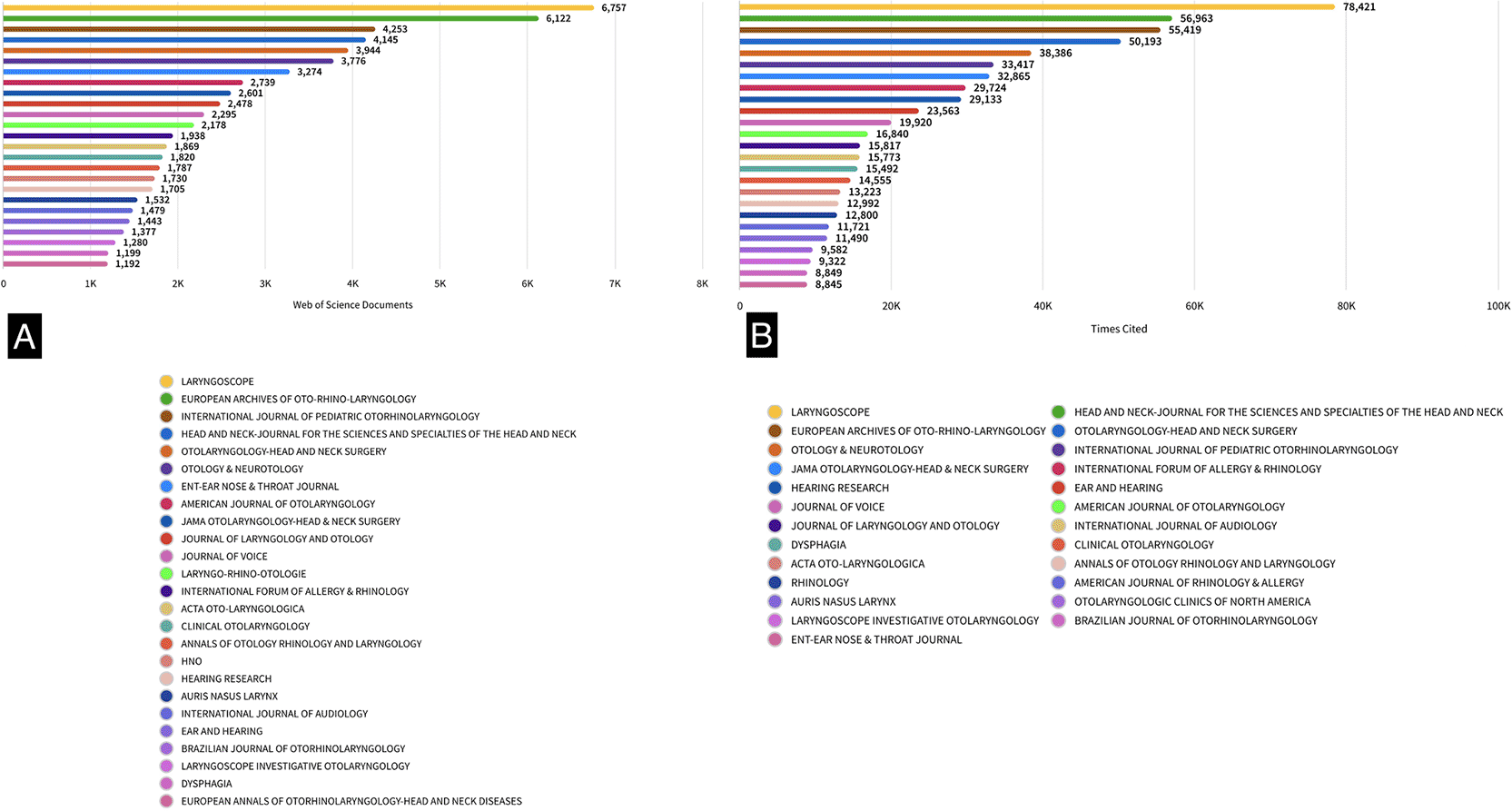
(A) Horizontal bar graph illustrating the total number of citations received by the top 25 journals. (B) Horizontal bar graph depicting the number of Web of Science documents published by the top 25 journals. Data were sourced from the InCites Dataset, updated March 28, 2025. Journals are color-coded as indicated in the legends below each graph.
Integration of InCites and JCR 2023 metrics highlights the influence of journal quality on citation performance. Notably, journal impact did not strictly align with volume. Several high-output journals had only modest impact metrics (IF ~1–2, CNCI well below 1), while a few had outstanding impact. For example, International Forum of Allergy & Rhinology and JAMA Otolaryngology—both top-tier outlets—each achieved CNCI ~1.9. Also, 24.6% of JAMA Otolaryngology papers and 20.3% of Int. Forum Allergy Rhinology papers fell in the top 10% most-cited globally – far above the 10% expected baseline. By contrast, some popular venues with IF ~1 had CNCI ~0.5–0.7. Thus, although a substantial portion of the field’s work appears in high-impact journals, a significant share is published in lower-tier outlets ( Figure 3, Table 2).
Out of 694 funding agencies ( Table 3), a few major sponsors dominated. The U.S. NIH was by far the top funder, acknowledged in ~5,063 publications (~5.4% of all papers). The largest non-U.S. funder was China’s NSFC (1,761 papers), followed by Japan’s MEXT (~1,320) and JSPS (~1,257). Combined, the NIH (including its institute NIDCD) supported about twice as many papers as the top Chinese and Japanese agencies combined. Leading European funders like UKRI and DFG each supported only ~435 papers (~0.5%) ( Figure 4, Table 3).
| Rank | Name | Country or Region | Web of Science Documents | Times Cited | Citation Impact | CNCI* | Impact Relative to World | All Open Access Documents | Documents in Q1 Journals | Highly Cited Papers | Documents in Top 1% | Documents in Top 10% | Domestic Documents | International Documents | Domestic Collaborations | International Collaborations |
|---|---|---|---|---|---|---|---|---|---|---|---|---|---|---|---|---|
| 1 | United States Department of Health & Human Services | USA | 5135 | 81724 | 15.92 | 1.53 | 1.92 | 4057 (79.01%) | 2439 (54.28%) | 17 (0.33%) | 133 (2.59%) | 1007 (19.61%) | 4245 (82.67%) | 884 (17.22%) | 2470 (48.10%) | 882 (17.18%) |
| 2 | National Institutes of Health (NIH) - USA | USA | 5063 | 80341 | 15.87 | 1.53 | 1.91 | 4015 (79.30%) | 2405 (54.31%) | 17 (0.34%) | 131 (2.59%) | 993 (19.61%) | 4182 (82.60%) | 875 (17.28%) | 2420 (47.80%) | 873 (17.24%) |
| 3 | NIH National Institute on Deafness & Other Communication Disorders (NIDCD) | USA | 2339 | 38850 | 16.61 | 1.47 | 2.00 | 1975 (84.44%) | 1085 (52.52%) | 4 (0.17%) | 64 (2.74%) | 493 (21.08%) | 1902 (81.32%) | 434 (18.55%) | 1122 (47.97%) | 433 (18.51%) |
| 4 | National Natural Science Foundation of China (NSFC) | CHINA | 1761 | 13890 | 7.89 | 0.99 | 0.95 | 545 (30.95%) | 450 (30.06%) | 1 (0.06%) | 10 (0.57%) | 126 (7.16%) | 1478 (83.93%) | 281 (15.96%) | 820 (46.56%) | 280 (15.90%) |
| 5 | Ministry of Education, Culture, Sports, Science and Technology, Japan (MEXT) | JAPAN | 1320 | 11535 | 8.74 | 1.02 | 1.05 | 448 (33.94%) | 263 (22.99%) | 5 (0.38%) | 11 (0.83%) | 107 (8.11%) | 1192 (90.30%) | 128 (9.70%) | 665 (50.38%) | 128 (9.70%) |
| 6 | Japan Society for the Promotion of Science | JAPAN | 1257 | 10884 | 8.66 | 1.02 | 1.04 | 422 (33.57%) | 253 (23.19%) | 5 (0.40%) | 11 (0.88%) | 100 (7.96%) | 1139 (90.61%) | 118 (9.39%) | 635 (50.52%) | 118 (9.39%) |
| 7 | Grants-in-Aid for Scientific Research (KAKENHI) | JAPAN | 1205 | 10581 | 8.78 | 1.02 | 1.06 | 399 (33.11%) | 244 (23.22%) | 5 (0.41%) | 11 (0.91%) | 94 (7.80%) | 1091 (90.54%) | 114 (9.46%) | 607 (50.37%) | 114 (9.46%) |
| 8 | National Research Foundation of Korea | SOUTH KOREA | 678 | 5115 | 7.54 | 1.07 | 0.91 | 352 (51.92%) | 216 (38.85%) | 0 (0.00%) | 7 (1.03%) | 68 (10.03%) | 595 (87.76%) | 82 (12.09%) | 352 (51.92%) | 82 (12.09%) |
| 9 | NIH National Center for Advancing Translational Sciences (NCATS) | USA | 575 | 7690 | 13.37 | 1.49 | 1.61 | 439 (76.35%) | 214 (41.80%) | 1 (0.17%) | 13 (2.26%) | 114 (19.83%) | 535 (93.04%) | 39 (6.78%) | 260 (45.22%) | 39 (6.78%) |
| 10 | German Research Foundation (DFG) | GERMANY | 435 | 6590 | 15.15 | 1.53 | 1.83 | 253 (58.16%) | 198 (54.55%) | 2 (0.46%) | 9 (2.07%) | 72 (16.55%) | 274 (62.99%) | 161 (37.01%) | 166 (38.16%) | 160 (36.78%) |
| 11 | UK Research & Innovation (UKRI) | UK | 435 | 8030 | 18.46 | 1.61 | 2.22 | 359 (82.53%) | 234 (59.54%) | 3 (0.69%) | 19 (4.37%) | 90 (20.69%) | 241 (55.40%) | 193 (44.37%) | 171 (39.31%) | 192 (44.14%) |
| 12 | NIH National Cancer Institute (NCI) | USA | 423 | 7556 | 17.86 | 1.91 | 2.15 | 339 (80.14%) | 256 (67.72%) | 3 (0.71%) | 14 (3.31%) | 96 (22.70%) | 348 (82.27%) | 75 (17.73%) | 213 (50.35%) | 75 (17.73%) |
| 13 | National Institutes of Health Research (NIHR) | UK | 401 | 8827 | 22.01 | 1.88 | 2.65 | 330 (82.29%) | 192 (52.03%) | 1 (0.25%) | 13 (3.24%) | 104 (25.94%) | 197 (49.13%) | 203 (50.62%) | 161 (40.15%) | 203 (50.62%) |
| 14 | Medical Research Council UK (MRC) | UK | 337 | 7021 | 20.83 | 1.79 | 2.51 | 274 (81.31%) | 184 (58.97%) | 3 (0.89%) | 17 (5.04%) | 82 (24.33%) | 188 (55.79%) | 148 (43.92%) | 133 (39.47%) | 147 (43.62%) |
| 15 | European Union (EU) | BELGIUM | 242 | 4095 | 16.92 | 1.81 | 2.04 | 161 (66.53%) | 131 (60.37%) | 2 (0.83%) | 10 (4.13%) | 54 (22.31%) | 130 (53.72%) | 112 (46.28%) | 81 (33.47%) | 111 (45.87%) |
| 16 | Coordenacao de Aperfeicoamento de Pessoal de Nivel Superior (CAPES) | BRAZIL | 236 | 1320 | 5.59 | 0.77 | 0.67 | 99 (41.95%) | 34 (18.89%) | 0 (0.00%) | 3 (1.27%) | 17 (7.20%) | 177 (75.00%) | 59 (25.00%) | 109 (46.19%) | 59 (25.00%) |
| 17 | Spanish Government | SPAIN | 207 | 2757 | 13.32 | 1.41 | 1.61 | 102 (49.28%) | 115 (62.16%) | 0 (0.00%) | 5 (2.42%) | 33 (15.94%) | 146 (70.53%) | 60 (28.99%) | 124 (59.90%) | 60 (28.99%) |
| 18 | Ministry of Science and Technology, Taiwan | TAIWAN | 205 | 2195 | 10.71 | 1.10 | 1.29 | 59 (28.78%) | 80 (41.67%) | 0 (0.00%) | 0 (0.00%) | 24 (11.71%) | 178 (86.83%) | 27 (13.17%) | 150 (73.17%) | 27 (13.17%) |
| 19 | NIH National Institute on Aging (NIA) | USA | 199 | 3237 | 16.27 | 1.91 | 1.96 | 142 (71.36%) | 90 (54.55%) | 0 (0.00%) | 11 (5.53%) | 47 (23.62%) | 176 (88.44%) | 23 (11.56%) | 119 (59.80%) | 23 (11.56%) |
| 19 | Canadian Institutes of Health Research (CIHR) | CANADA | 199 | 3219 | 16.18 | 1.34 | 1.95 | 90 (45.23%) | 120 (64.17%) | 0 (0.00%) | 1 (0.50%) | 44 (22.11%) | 105 (52.76%) | 92 (46.23%) | 73 (36.68%) | 92 (46.23%) |
| 21 | NIH National Heart Lung & Blood Institute (NHLBI) | USA | 198 | 2554 | 12.90 | 1.64 | 1.55 | 150 (75.76%) | 106 (62.72%) | 1 (0.51%) | 3 (1.52%) | 34 (17.17%) | 176 (88.89%) | 22 (11.11%) | 125 (63.13%) | 22 (11.11%) |
| 22 | National Health & Medical Research Council (NHMRC) of Australia | AUSTRALIA | 191 | 3106 | 16.26 | 1.43 | 1.96 | 76 (39.79%) | 94 (52.51%) | 0 (0.00%) | 7 (3.66%) | 36 (18.85%) | 99 (51.83%) | 92 (48.17%) | 84 (43.98%) | 92 (48.17%) |
| 23 | Ministry of Science, ICT & Future Planning, Republic of Korea | SOUTH KOREA | 190 | 1168 | 6.15 | 1.11 | 0.74 | 95 (50.00%) | 65 (42.21%) | 0 (0.00%) | 1 (0.53%) | 20 (10.53%) | 164 (86.32%) | 24 (12.63%) | 86 (45.26%) | 24 (12.63%) |
| 24 | United States Department of Defense | USA | 187 | 3218 | 17.21 | 1.82 | 2.07 | 128 (68.45%) | 97 (60.62%) | 3 (1.60%) | 7 (3.74%) | 35 (18.72%) | 154 (82.35%) | 33 (17.65%) | 106 (56.68%) | 33 (17.65%) |
| 25 | Ministry of Science & ICT (MSIT), Republic of Korea | SOUTH KOREA | 181 | 777 | 4.29 | 1.09 | 0.52 | 119 (65.75%) | 57 (45.24%) | 0 (0.00%) | 1 (0.55%) | 23 (12.71%) | 153 (84.53%) | 27 (14.92%) | 87 (48.07%) | 27 (14.92%) |
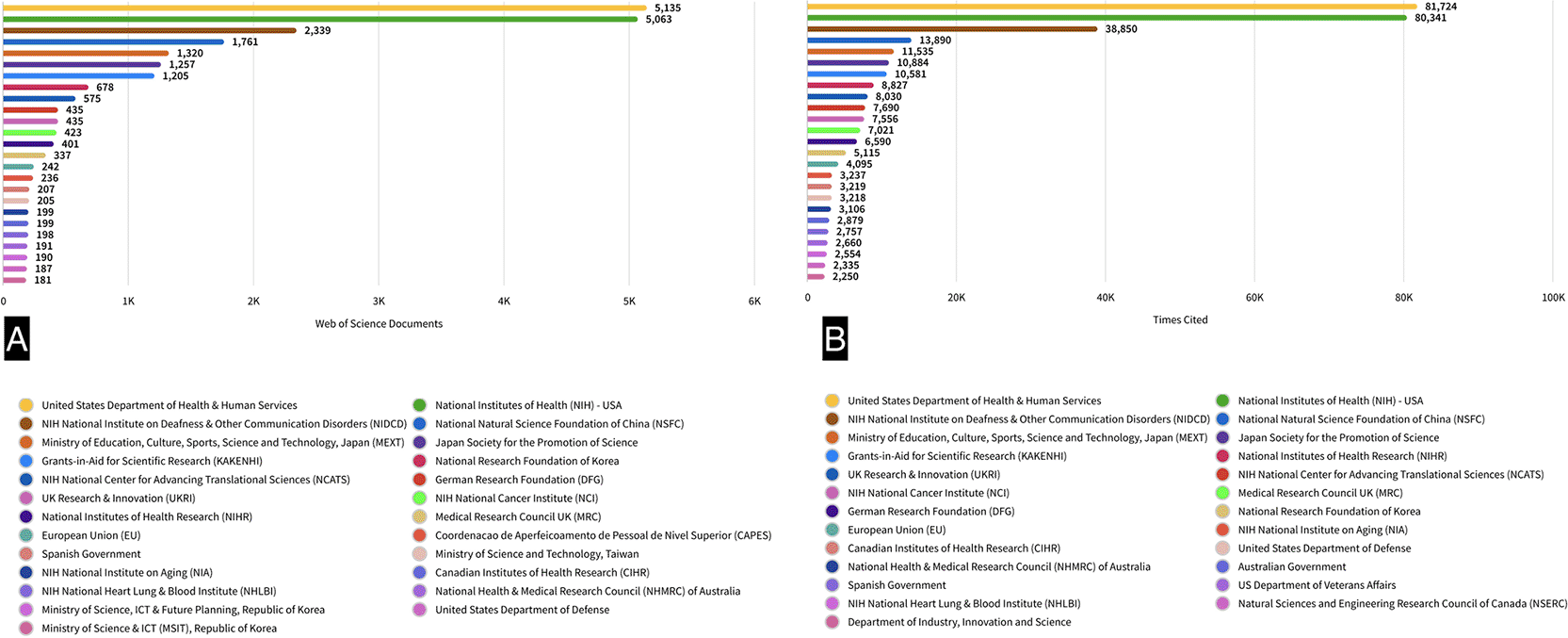
(A) Horizontal bar graph illustrating the total number of citations received by the top 25 funding agencies. (B) Horizontal bar graph depicting the number of Web of Science documents published by the top 25 funding agencies. Data were sourced from the InCites Dataset, updated March 28, 2025. Funding agencies are color-coded as indicated in the legends below each graph.
Funding source also correlated with citation impact ( Table 3). Papers funded by major U.S. or U.K. agencies generally had above-average citation rates (aggregate CNCI often ~1.5 or higher), whereas those funded by China’s NSFC were around the world average (CNCI ~1.0). Moreover, targeted programs in certain areas produced especially high-impact work: for example, research supported by NIH’s National Cancer Institute or the UK’s NIHR achieved CNCI ~1.8–1.9 (roughly 80–90% above average). Overall, a few U.S. agencies (notably NIH) and some Asian agencies led funding in the field, and the highest-impact outputs were often linked to these specialized funding streams ( Figure 4, Table 3).
Large U.S. academic centers dominated output: the University of California system (2,634 publications) and Harvard University (2,606, plus ~2,300 from affiliated hospitals) ranked highest, followed by the Ohio State University system (~2,133). Other major U.S. contributors included the University of Texas system (~1,610), Pennsylvania’s state system (~1,578), Johns Hopkins (~1,516), and Massachusetts Eye & Ear (~1,561). Outside the U.S., the Egyptian Knowledge Bank (1,496) and University of Toronto (1,090) were the top producers. No single European university surpassed 1,000 papers, though the combined University of London network had ~1,014 ( Figure 5, Table 4).
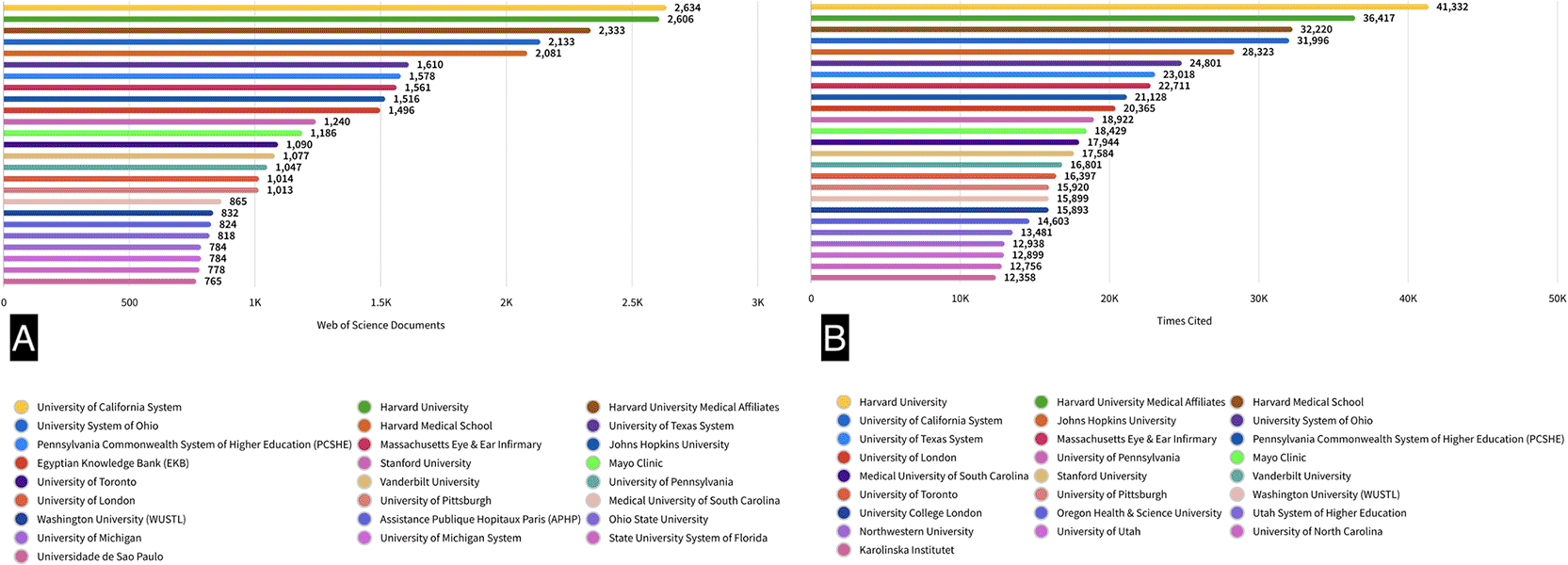
(A) Horizontal bar graph illustrating the total number of citations received by the top 25 organizations. (B) Horizontal bar graph depicting the number of Web of Science documents published by the top 25 organizations. Data were sourced from the InCites Dataset, updated March 28, 2025. Organizations are color-coded as indicated in the legends below each graph.
| Rank | Name | Country or Region | Web of Science Documents | Times Cited | Citation Impact | CNCI* | Impact Relative to World | Domestic Documents | International Documents | Documents in Top 1% | Documents in Top 10% | Highly Cited Papers | Documents in Q1 Journals | Industry Collaborations | Domestic Collaborations | International Collaborations |
|---|---|---|---|---|---|---|---|---|---|---|---|---|---|---|---|---|
| 1 | University of California System | USA | 2634 | 31996 | 12.15 | 1.37 | 1.46 | 2168 (82.31%) | 466 (17.69%) | 60 (2.28%) | 370 (14.05%) | 19 (0.72%) | 960 (44.12%) | 22 | 1458 (55.35%) | 465 (17.65%) |
| 2 | Harvard University | USA | 2606 | 41332 | 15.86 | 1.69 | 1.91 | 1875 (71.95%) | 731 (28.05%) | 78 (2.99%) | 487 (18.69%) | 26 (1.00%) | 1086 (48.77%) | 37 | 1644 (63.09%) | 723 (27.74%) |
| 3 | Harvard University Medical Affiliates | USA | 2333 | 36417 | 15.61 | 1.67 | 1.88 | 1682 (72.10%) | 651 (27.90%) | 70 (3.00%) | 439 (18.82%) | 21 (0.90%) | 969 (48.26%) | 31 | 1483 (63.57%) | 644 (27.60%) |
| 4 | University System of Ohio | USA | 2133 | 24801 | 11.63 | 1.39 | 1.40 | 1671 (78.34%) | 462 (21.66%) | 55 (2.58%) | 313 (14.67%) | 11 (0.52%) | 733 (41.51%) | 16 | 1370 (64.23%) | 462 (21.66%) |
| 5 | Harvard Medical School | USA | 2081 | 32220 | 15.48 | 1.67 | 1.87 | 1499 (72.03%) | 582 (27.97%) | 62 (2.98%) | 401 (19.27%) | 19 (0.91%) | 869 (48.74%) | 28 | 1337 (64.25%) | 574 (27.58%) |
| 6 | University of Texas System | USA | 1610 | 23018 | 14.30 | 1.58 | 1.72 | 1275 (79.19%) | 335 (20.81%) | 56 (3.48%) | 261 (16.21%) | 12 (0.75%) | 611 (46.29%) | 17 | 903 (56.09%) | 335 (20.81%) |
| 7 | Pennsylvania Commonwealth System of Higher Education (PCSHE) | USA | 1578 | 21128 | 13.39 | 1.43 | 1.61 | 1297 (82.19%) | 281 (17.81%) | 41 (2.60%) | 241 (15.27%) | 10 (0.63%) | 530 (39.67%) | 19 | 800 (50.70%) | 281 (17.81%) |
| 8 | Massachusetts Eye & Ear Infirmary | USA | 1561 | 22711 | 14.55 | 1.50 | 1.75 | 1134 (72.65%) | 427 (27.35%) | 41 (2.63%) | 290 (18.58%) | 10 (0.64%) | 649 (48.83%) | 10 | 997 (63.87%) | 420 (26.91%) |
| 9 | Johns Hopkins University | USA | 1516 | 28323 | 18.68 | 2.04 | 2.25 | 1124 (74.14%) | 392 (25.86%) | 73 (4.82%) | 347 (22.89%) | 23 (1.52%) | 697 (54.45%) | 21 | 809 (53.36%) | 392 (25.86%) |
| 10 | Egyptian Knowledge Bank (EKB) | EGYPT | 1496 | 11437 | 7.65 | 0.88 | 0.92 | 1033 (69.05%) | 463 (30.95%) | 13 (0.87%) | 77 (5.15%) | 5 (0.33%) | 98 (12.69%) | 2 | 347 (23.20%) | 452 (30.21%) |
| 11 | Stanford University | USA | 1240 | 17584 | 14.18 | 1.77 | 1.71 | 781 (62.98%) | 459 (37.02%) | 40 (3.23%) | 236 (19.03%) | 15 (1.21%) | 476 (46.76%) | 12 | 503 (40.56%) | 459 (37.02%) |
| 12 | Mayo Clinic | USA | 1186 | 18429 | 15.54 | 1.83 | 1.87 | 963 (81.20%) | 223 (18.80%) | 41 (3.46%) | 225 (18.97%) | 13 (1.10%) | 345 (36.35%) | 17 | 538 (45.36%) | 223 (18.80%) |
| 13 | University of Toronto | CANADA | 1090 | 16397 | 15.04 | 1.52 | 1.81 | 549 (50.37%) | 541 (49.63%) | 22 (2.02%) | 188 (17.25%) | 7 (0.64%) | 482 (50.52%) | 12 | 409 (37.52%) | 537 (49.27%) |
| 14 | Vanderbilt University | USA | 1077 | 16801 | 15.60 | 1.54 | 1.88 | 910 (84.49%) | 167 (15.51%) | 34 (3.16%) | 198 (18.38%) | 7 (0.65%) | 330 (36.63%) | 16 | 547 (50.79%) | 166 (15.41%) |
| 15 | University of Pennsylvania | USA | 1047 | 18922 | 18.07 | 2.14 | 2.18 | 862 (82.33%) | 185 (17.67%) | 47 (4.49%) | 214 (20.44%) | 16 (1.53%) | 419 (50.06%) | 10 | 648 (61.89%) | 185 (17.67%) |
| 16 | University of London | ENGLAND | 1014 | 20365 | 20.08 | 2.47 | 2.42 | 485 (47.83%) | 529 (52.17%) | 56 (5.52%) | 208 (20.51%) | 18 (1.78%) | 348 (40.51%) | 27 | 381 (37.57%) | 527 (51.97%) |
| 17 | University of Pittsburgh | USA | 1013 | 15920 | 15.72 | 1.64 | 1.89 | 787 (77.69%) | 226 (22.31%) | 32 (3.16%) | 187 (18.46%) | 9 (0.89%) | 370 (43.53%) | 8 | 524 (51.73%) | 226 (22.31%) |
| 18 | Medical University of South Carolina | USA | 865 | 17944 | 20.74 | 2.20 | 2.50 | 745 (86.13%) | 120 (13.87%) | 31 (3.58%) | 198 (22.89%) | 12 (1.39%) | 378 (52.50%) | 5 | 494 (57.11%) | 120 (13.87%) |
| 19 | Washington University (WUSTL) | USA | 832 | 15899 | 19.11 | 2.01 | 2.30 | 729 (87.62%) | 103 (12.38%) | 34 (4.09%) | 201 (24.16%) | 12 (1.44%) | 423 (58.91%) | 16 | 483 (58.05%) | 103 (12.38%) |
| 20 | Assistance Publique Hopitaux Paris (APHP) | FRANCE | 824 | 9466 | 11.49 | 1.50 | 1.38 | 585 (71.00%) | 239 (29.00%) | 15 (1.82%) | 105 (12.74%) | 2 (0.24%) | 119 (16.76%) | 4 | 451 (54.73%) | 239 (29.00%) |
| 21 | Ohio State University | USA | 818 | 9978 | 12.20 | 1.39 | 1.47 | 624 (76.28%) | 194 (23.72%) | 19 (2.32%) | 138 (16.87%) | 3 (0.37%) | 279 (40.38%) | 4 | 483 (59.05%) | 194 (23.72%) |
| 22 | University of Michigan | USA | 784 | 12187 | 15.54 | 1.88 | 1.87 | 599 (76.40%) | 185 (23.60%) | 32 (4.08%) | 157 (20.03%) | 10 (1.28%) | 351 (54.08%) | 13 | 409 (52.17%) | 185 (23.60%) |
| 22 | University of Michigan System | USA | 784 | 12187 | 15.54 | 1.88 | 1.87 | 599 (76.40%) | 185 (23.60%) | 32 (4.08%) | 157 (20.03%) | 10 (1.28%) | 351 (54.08%) | 13 | 409 (52.17%) | 185 (23.60%) |
| 24 | State University System of Florida | USA | 778 | 11113 | 14.28 | 1.56 | 1.72 | 608 (78.15%) | 170 (21.85%) | 19 (2.44%) | 104 (13.37%) | 7 (0.90%) | 256 (41.29%) | 7 | 448 (57.58%) | 170 (21.85%) |
| 25 | Universidade de Sao Paulo | BRAZIL | 765 | 10979 | 14.35 | 1.50 | 1.73 | 592 (77.39%) | 173 (22.61%) | 16 (2.09%) | 70 (9.15%) | 8 (1.05%) | 116 (20.94%) | 3 | 334 (43.66%) | 173 (22.61%) |
Many top institutions also achieved high citation impact ( Figure 5, Table 4). For instance, Johns Hopkins University (1,516 papers) achieved a CNCI of 2.04, with 16.2% of its output in the top 10% most-cited and 3.0% in the top 1%. The University of London–affiliated medical colleges (1,014 papers combined) had one of the highest citation performances, with a CNCI of approximately 2.47. Specialized centers like the Medical University of South Carolina (CNCI ~2.2) and Mayo Clinic (~1.8) similarly combined moderate volume with exceptional impact. In contrast, some high-volume contributors had only average impact (e.g., Egyptian Knowledge Bank, CNCI ~0.9). Overall, the leading institutions tended to be both prolific and highly cited.
Authorship followed a long-tail distribution: a few authors were extremely prolific, while most contributed relatively few papers. The most prolific was Jerome R. Lechien (387 publications). The next were Daniel J. Eloy (236) and Shaun A. Nguyen (230), and several others exceeded 200 publications ( Figure 6, Table 5).
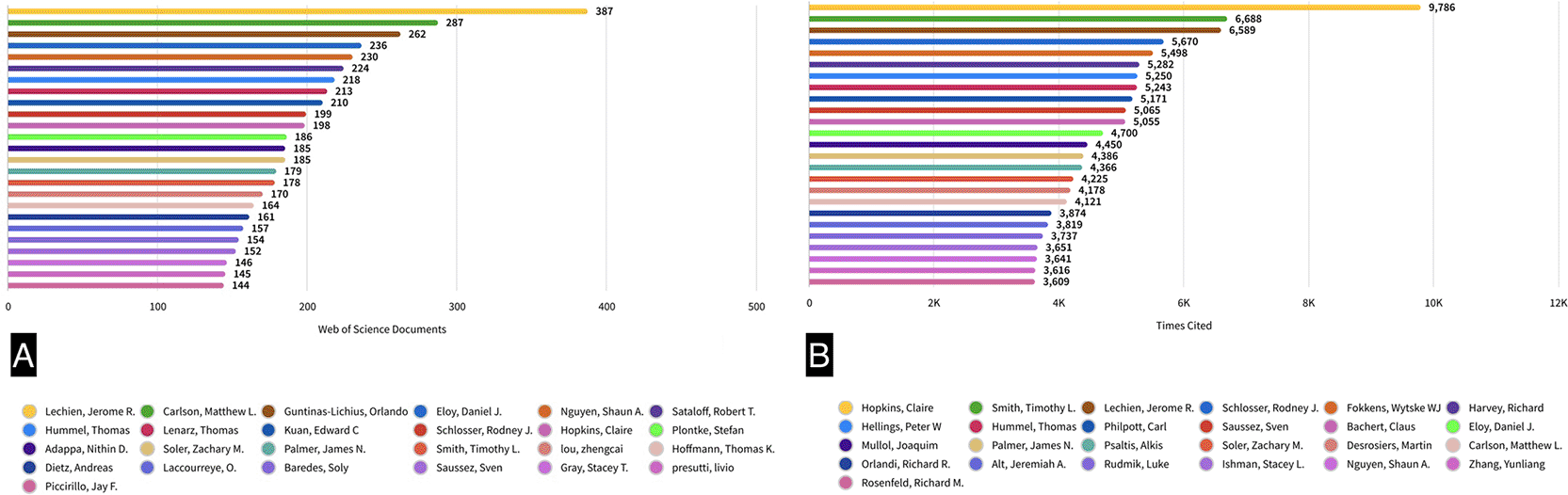
(A) Horizontal bar graph illustrating the total number of citations received by the top 25 researchers. (B) Horizontal bar graph depicting the number of Web of Science documents published by the top 25 researchers. Data were sourced from the InCites Dataset, updated March 28, 2025. Researchers are color-coded as indicated in the legends below each graph.
Citation impact varied among prolific authors ( Table 5). Lechien’s work had an exceptionally high influence (CNCI ~3.6), with nearly 10% of his papers in the top 1% by citations, likely bolstered by extensive international collaboration (~86% of his papers). Eloy and Nguyen, by contrast, showed more modest impact (CNCI ~1.3–1.7, under 3% of their papers in the top 1%) with mostly domestic collaborators. A few individuals combined high volume with remarkable impact. For instance, Claire Hopkins (UK) achieved the highest CNCI (~7.1) among authors with over 100 publications, and Thomas Hummel (Germany) reached CNCI ~3.0. Both had over two-thirds of their papers with international coauthors ( Figure 6, Table 5).
When combining these perspectives, clear relationships emerge between collaboration, venue quality, and citation impact. Across the 30 most productive countries, the percentage of internationally co-authored papers showed a strong positive correlation with citation impact metrics. For instance, countries with the highest international collaboration rates – the Netherlands and Switzerland (≈45% of papers with international co-authors) – also had among the highest CNCI values (1.99 and 1.82, respectively) and top 10% paper shares (19.7% and 16.4%). By contrast, countries with more domestic-focused research profiles such as China (16.2% international) and India (12.5%) had below-average CNCI (0.96 and 0.65) and smaller top 10% shares. The Pearson correlation between international collaboration percentage and CNCI across these top countries was approximately r = 0.82, with a similarly strong correlation for collaboration vs. top 10% share (r ~0.78; see Table 1). A parallel trend was observed at the institutional level: many of the organizations with the highest citation impact (CNCI >2) were those engaged in extensive cross-national collaboration and publishing in top-tier journals. Individual researchers followed suit – for example, the contrast between Lechien (86% international, CNCI 3.6) and Nguyen (3% international, CNCI 1.3) exemplifies this pattern – though individual-level correlations were not computed, the qualitative trend is evident. These findings reinforce the link between collaborative breadth and research influence in global otorhinolaryngology.
Publishing in higher-impact journals also correlated with greater citation success. Countries that published a greater share of their work in first-quartile (Q1) journals tended to attain higher CNCI than those publishing heavily in lower-tier venues. Overall, roughly one-third of the field’s papers appeared in Q1 journals (vs ~9% in Q4; see Table 2). Many of the most-cited studies were published in top-quartile or high-impact general medical journals, highlighting the visibility conferred by quality venues.
Only four papers (~0.004% of the dataset) qualified as ESI-designated “Hot Papers” (in the top 0.1% of citations for their year of publication).10–13 All were large international collaborations on timely topics.10–13 These rare outliers demonstrate the potential of global teamwork but also underscore that the field’s impact is driven mostly by the cumulative contribution of many moderately cited studies rather than a few breakthroughs.
The present bibliometric analysis reveals a clear hierarchy in global otolaryngology research output over 2015–2024. The United States emerged as the overwhelmingly dominant contributor, producing far more publications than any other country and accruing by far the most total citations. Italy, despite a smaller publication volume, exhibited the highest CNCI, indicating that Italian ENT publications were cited well above the world average for the field. Notably, The Laryngoscope was the most prolific journal by output, whereas JAMA Otolaryngology–Head & Neck Surgery stood out for its high impact, reflecting a more selective publication profile with greater citations per article. International collaboration was strikingly low, with only ~13.5% of publications involving authors from multiple countries, and the analysis of funding acknowledgments suggested that specific mission-focused funding agencies achieved greater research impact than broad, general-purpose funders. These core findings carry important implications for the future of otolaryngology research.
The fact that the US produced roughly four times more ENT publications than the next-leading country and nearly five times the citations underlines a heavy reliance on American research activity. U.S. dominance in this field is propelled by robust funding and infrastructure, as exemplified by the National Institutes of Health’s outsized budget (about $47–48 billion annually).14–17 This leadership has positive effects – for instance, many countries benefit from US-led partnerships and advancements – but it also signals vulnerability.1 Should U.S. support for otolaryngology research falter, the global ENT community would likely suffer a significant slowdown.7,14,18 In analogous contexts, experts have warned that decreased US funding can stall partnered research efforts and even threaten America’s scientific leadership.15–17,19 By extension, a reduction in U.S. ENT research investment could create a void that other countries may struggle to fill quickly.17,19 It is therefore critical for other nations to bolster their own otolaryngology research investment, both to complement U.S. efforts and to ensure the field’s resilience. Broader international investment would distribute research capacity more evenly and mitigate the risk of a single-country dependency. Indeed, this analysis found that some smaller countries can punch above their weight in impact, suggesting that strategic investments by more countries can yield high-quality research that elevates the field globally.
The low rate of international co-authorship (~13.5%) indicates that otolaryngology research remains largely siloed within national boundaries. This is notably lower than collaboration rates seen in many other scientific disciplines.8,16,20–22 Increasing international collaboration is a clear opportunity going forward – cross-border partnerships often synergize expertise and resources, leading to higher-impact work.8,14,16,18 Collaborative studies tap into diverse patient populations and ideas, which can accelerate innovation and improve generalizability of findings.1,7 Moreover, collaboration is a conduit for mentorship and capacity-building, particularly for researchers in low- and middle-income countries (LMICs). The need to broaden participation is further highlighted by evidence outside our dataset: women and LMIC-based authors remain underrepresented in otolaryngology literature.5,14,20 Recent analyses of high-impact ENT journals found that only about 31% of first authors (and <20% of senior authors) were female, and that 94% of first authors were from high-income countries.5,14 In fact, not a single paper in one 2011–2020 sample had first authors from low-income economies.5,14 Although our bibliometric dataset did not capture author demographics, it is important to recognize and address these disparities.
Our findings on funding agencies suggest that targeted, mission-focused funding bodies tend to drive higher-impact research outcomes in otolaryngology. Agencies dedicated to specific ENT-related missions likely concentrate resources on high-priority topics, yielding influential results.18,23 In contrast, broad or general funding sources may dilute resources across many fields. This aligns with the broader observation that funded research in general attains higher citation rates and appears in more prestigious journals than unfunded research.24 A targeted funding strategy ensures that critical research questions in the specialty receive adequate support. Funding bodies can also foster collaboration by incentivizing multinational projects and by supporting underrepresented groups.
This study’s strengths include its comprehensive scope covering a decade of global ENT research across multiple dimensions and the use of robust citation metrics like CNCI to normalize for field and year, enabling fair impact comparisons. The large dataset and analytical approach provide a macro-level perspective on how various contributors have shaped the otolaryngology literature. However, several limitations merit consideration. First, bibliometric data have inherent biases. Our analysis relied on indexed literature and citation counts, which may undervalue contributions published in non-indexed local journals or in languages other than English. Citation-based impact also cannot distinguish why papers are cited; a work may be frequently referenced due to genuine influence on practice or merely as routine background.25 Similarly, citation counts accumulate over time, so newer publications (especially from the later part of 2015–2024) have had less time to accrue citations – although using CNCI helped mitigate this by benchmarking against expected citation rates. Finally, the low measured international collaboration rate might partially reflect how author affiliations were counted; multi-national team science could be under-identified if authors from different countries share a single institutional affiliation in publications. Despite these limitations, the bibliometric approach offers valuable objective insights and highlights clear areas for improvement.
To build on these findings, we recommend a concerted effort to diversify and globalize otolaryngology research. Countries other than the U.S. should increase funding and infrastructure for ENT research, thereby sharing the responsibility of advancing the field and cushioning against potential downturns in any single country’s support. International collaborations should be actively encouraged by institutions and funding agencies. Furthermore, funding agencies can take note of the outsized returns from focused funding: strategic investments in key thematic areas of otolaryngology are likely to yield high-impact discoveries.
In conclusion, the global otolaryngology research landscape over the past decade has been highly productive yet imbalanced. By expanding international participation, ensuring inclusive representation, and aligning funding with the field’s priorities, the worldwide ENT community can secure more robust and equitable growth. Such steps will help safeguard the field’s future, ensuring that advances in otolaryngology continue unabated even as the global scientific ecosystem.
| Views | Downloads | |
|---|---|---|
| F1000Research | - | - |
|
PubMed Central
Data from PMC are received and updated monthly.
|
- | - |
Provide sufficient details of any financial or non-financial competing interests to enable users to assess whether your comments might lead a reasonable person to question your impartiality. Consider the following examples, but note that this is not an exhaustive list:
Sign up for content alerts and receive a weekly or monthly email with all newly published articles
Already registered? Sign in
The email address should be the one you originally registered with F1000.
You registered with F1000 via Google, so we cannot reset your password.
To sign in, please click here.
If you still need help with your Google account password, please click here.
You registered with F1000 via Facebook, so we cannot reset your password.
To sign in, please click here.
If you still need help with your Facebook account password, please click here.
If your email address is registered with us, we will email you instructions to reset your password.
If you think you should have received this email but it has not arrived, please check your spam filters and/or contact for further assistance.

Comments on this article Comments (0)