ALL Metrics
-
Views
-
Downloads
Get PDF
Get XML
Cite
Export
Track
Research Article

Statistical Properties of Second Iteration of Logistic Map

[version 1; peer review: awaiting peer review]
PUBLISHED 30 Dec 2025
Author details Author details
OPEN PEER REVIEW
REVIEWER STATUS AWAITING PEER REVIEW

This article is included in the Fallujah Multidisciplinary Science and Innovation gateway.

Abstract

This paper introduces a novel non-classical probability distribution, termed the Logistic Map distribution, which is constructed by transforming a polynomial function derived from the second iteration of the logistic map. The logistic map a well-known discrete-time dynamical system has been extensively employed in diverse scientific domains, including population dynamics (to model bounded growth under environmental constraints), physics (to study nonlinear dynamics and deterministic chaos), and economics (to represent complex, nonlinear patterns in financial and economic time series).

The proposed distribution is fully characterized by two parameters: a scale parameter and a shape parameter, with the constraint ensuring the non-negativity and integrability of the density. Within this valid parameter space, we rigorously derive and establish a comprehensive suite of statistical properties. These include the probability density function, cumulative distribution function, reliability (survival) function, and hazard (failure rate) function. Furthermore, we obtain analytical expressions for key descriptive measures such as the mode and median, as well as for higher-order characteristics including the moment generating function, factorial moment generating function, and characteristic function. The proposed distribution most closely application field in materials science specifically, the statistical modeling of particle or grain size distributions in industrial powder processing, metallurgy, and pharmaceutical manufacturing.

The primary objective of this study is to formalize a new family of probability distributions grounded in the mathematical framework of dynamical systems, specifically leveraging the logistic function commonly encountered in differential and difference equations. By doing so, we bridge concepts from nonlinear dynamics and classical statistical theory. The secondary aim is to conduct a thorough investigation of the distribution’s mathematical structure and statistical behavior, thereby establishing its potential utility for modeling bounded, non-negative random phenomena in applied fields such as reliability engineering, survival analysis, and environmental statistics.

Keywords

Cumulative Function, Hazard Function, Logistic function, Median, Mode, Probability Density Function, Reliability Function.

1. Introduction

One of the well-known functions that used in studying the differential equations or dynamical systems in biology, ecology epidemic, economic, etc. is the logistic functions and its iterator.1

The first mathematical study the logistic function were Verhulst a Belgian mathematician, considered one of the first to study logistic growth where in (1838) used the Logistic Map in the law of population growth,2 James Yorke an American mathematician, studied the map of logistics, chaos (1975) and Robert Mayer, an Australian ecologist, studied logistic mapping and its applications in ecology (1976). Mitchell Feigenbaum, an American physicist, studied the chaotic behavior of logistic models (1978).

This logistic equation can exhibit chaotic or periodic behavior, and the Poincaré map can be used to study this behavior and identify critical points and chaotic regions. By applying the Poincaré map, which implies that the pendulum's behavior is demonstrated by the difference equations,3 to logistic equations, one can gain deeper insights into the dynamical behavior of these systems and understand how they change with varying parameters.

The aim of this research is to find a new distribution based on a function used in differential equations, which is the logistic function, and to study the statistical properties of this distribution. In the next section, fall details of the logistic function will be given:

Any statistical distribution must satisfy and approximate all the statistical concepts, such as pdf, cdf, reliability function,1 hazard function,4 mode,5 median, moment generating function (MGF),6 factorial moment-generating function (FMGF), characteristic function,7 coefficient of variation (C.V), coefficient of kurtosis (C.K)8 …etc.

The study is divided into five sections: the second one, “Basic Definitions,” is followed by the “structure of building the logistic distribution” in section three, is followed by “results and discussion” in section four, and “conclusion” rounds off the study in section five.

2. Structure of building the logistic distribution

Logistic map is a first-order difference equation discovered which by mathematical biologist Robert May. It's defined by the equation: Qμ(x)=μx(1xk) , where x is any population of nth generation, μ ≥ 0 the intrinsic growth rate and k is the carrying capacity.

This model is commonly used in the study of biological populations, including genetics (change in gene frequency), epidemiology (proportion of infected population), economics (relationship between commodity quantity and price), and social sciences.

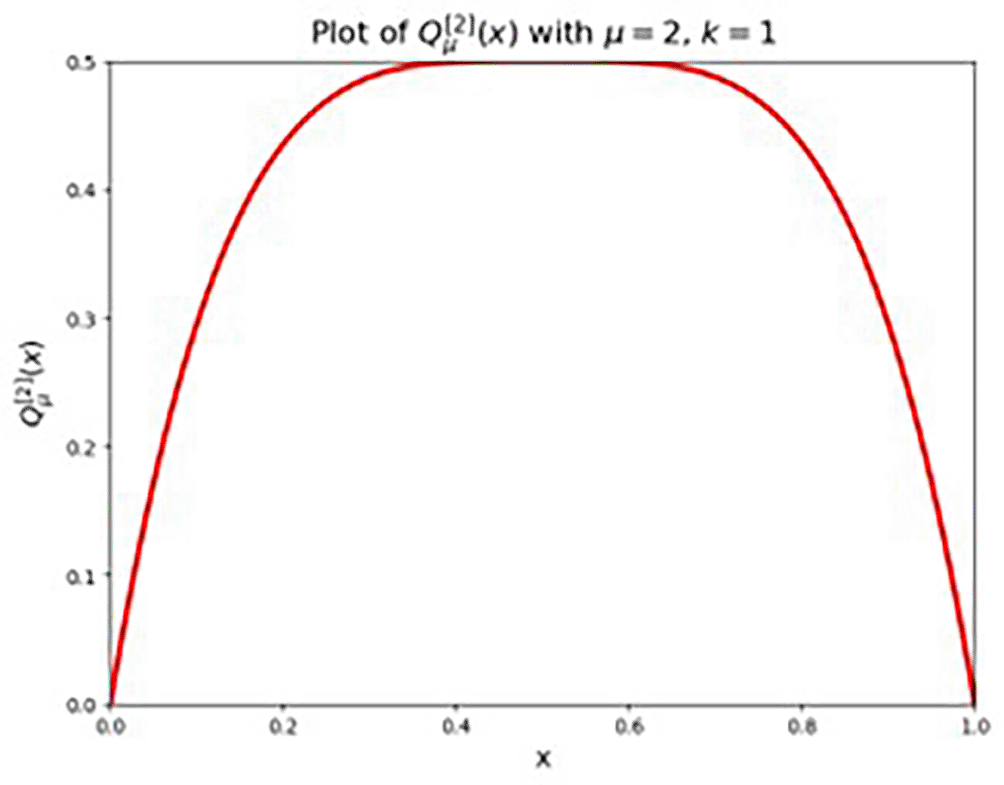
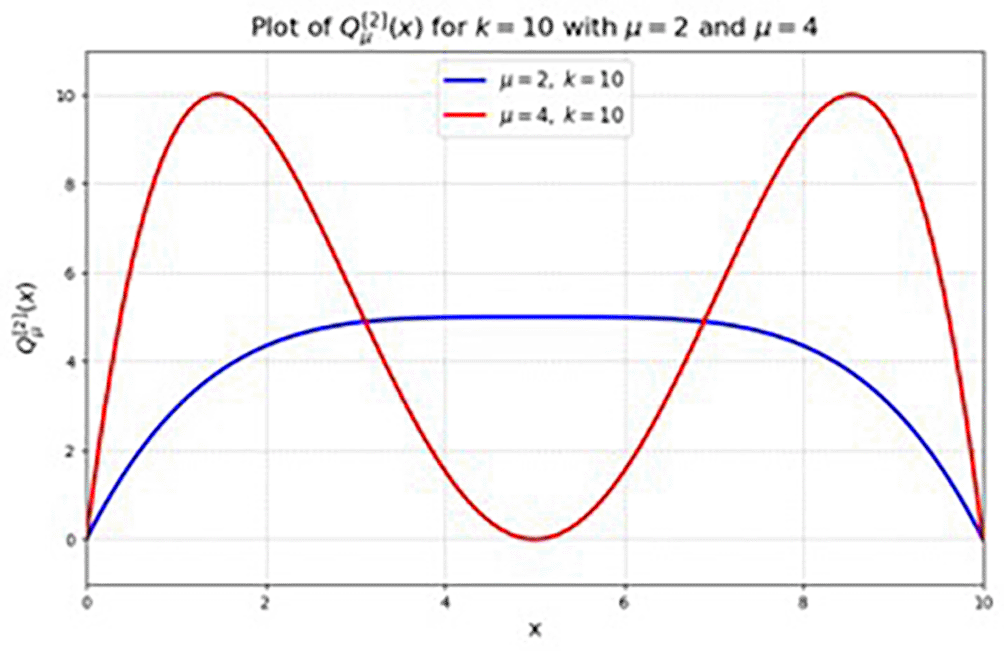
An item that works well at first, but after a period of time it breaks down. Although it can be repaired, after repair it works less efficiently than before. That is, the item goes through a repeated cycle of failure and repair, but with efficiency that decreases with each repetition as shown in Figures 1 and 2. This type of behavior can be classified under the second iteration of the logistic function and can be written as:
Qμ[2](x)=μQμ(x)[1Qμ(x)]Qμ[2](x)=μ[μx(1xk)][1μx(1xk)k]
4f05d27e-2b6b-4f5a-87cc-7667a76db809_figure1.gif

Figure 1. logistic map system where μ=2,k=1 .

4f05d27e-2b6b-4f5a-87cc-7667a76db809_figure2.gif

Figure 2. Different dynamical behaviors observed in the logistic map system when k = 10 with μ = 2 and μ = 4.

When we integral the second iteration of the logistic function Qμ[2](x) for lower value zero and upper value k to determine A's value, let presume:

A=0kQμ[2](x)dx=0kμ[μx(1xk)][1μx(1xk)k]dxA=(5μ)μ2k230

Now, it well be transferred to differential equation (the second iteration of the logistic function) to the statistical distribution.

2.1 Probability density function (PDF ) for logistic map distribution

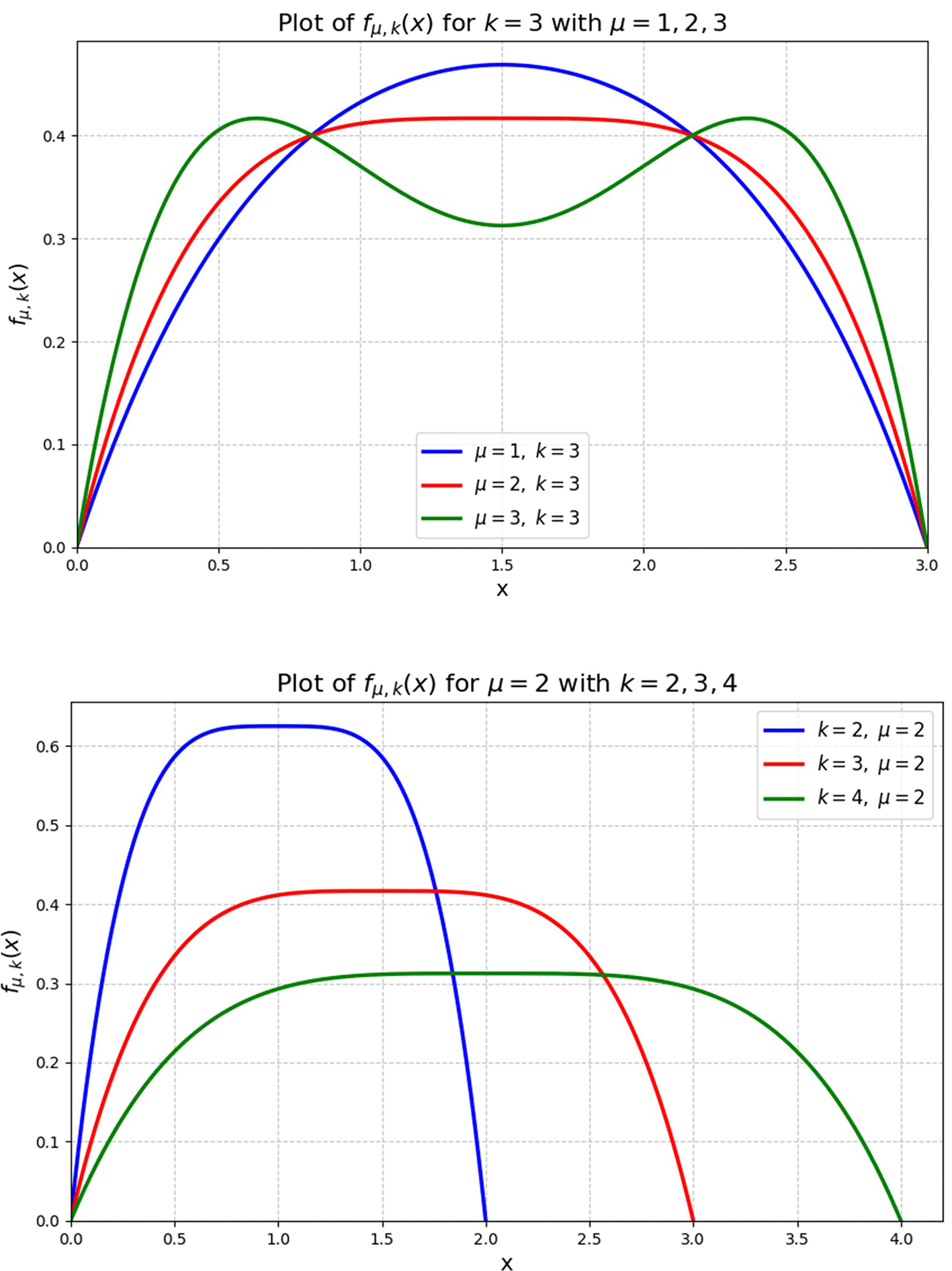
The function fμ,k(x;μ,k) is obtained by multiplying the function Qμ[2](x)by1A in order to obtain the probability density function for logistic map distribution, as shown in Figure 3 the form:

(1)
fμ,k(x;μ,k)={1AQμ[2](x),x(0,k)0,OWfμk(x;μ,k)={30x(xk)(μx(xk)+k2))(k5(μ5)),x(0,k)0,OW
Lemma 1:

fμk(x;μ,k) is a pdf

Proof:

allxf(x)dx=10k30x(xk)(μx(xk)+k2)k5(μ5)dx=1[x2(6μx315x2+10k2(μ+1)x15k3)k5(μ5)]k0=k5(μ5)k5(μ5)=1

4f05d27e-2b6b-4f5a-87cc-7667a76db809_figure3.gif

Figure 3. The probability density function logistic map distribution.

2.2 Cumulative Distribution Function (CDF ) for logistic map distribution

Lemma 2:

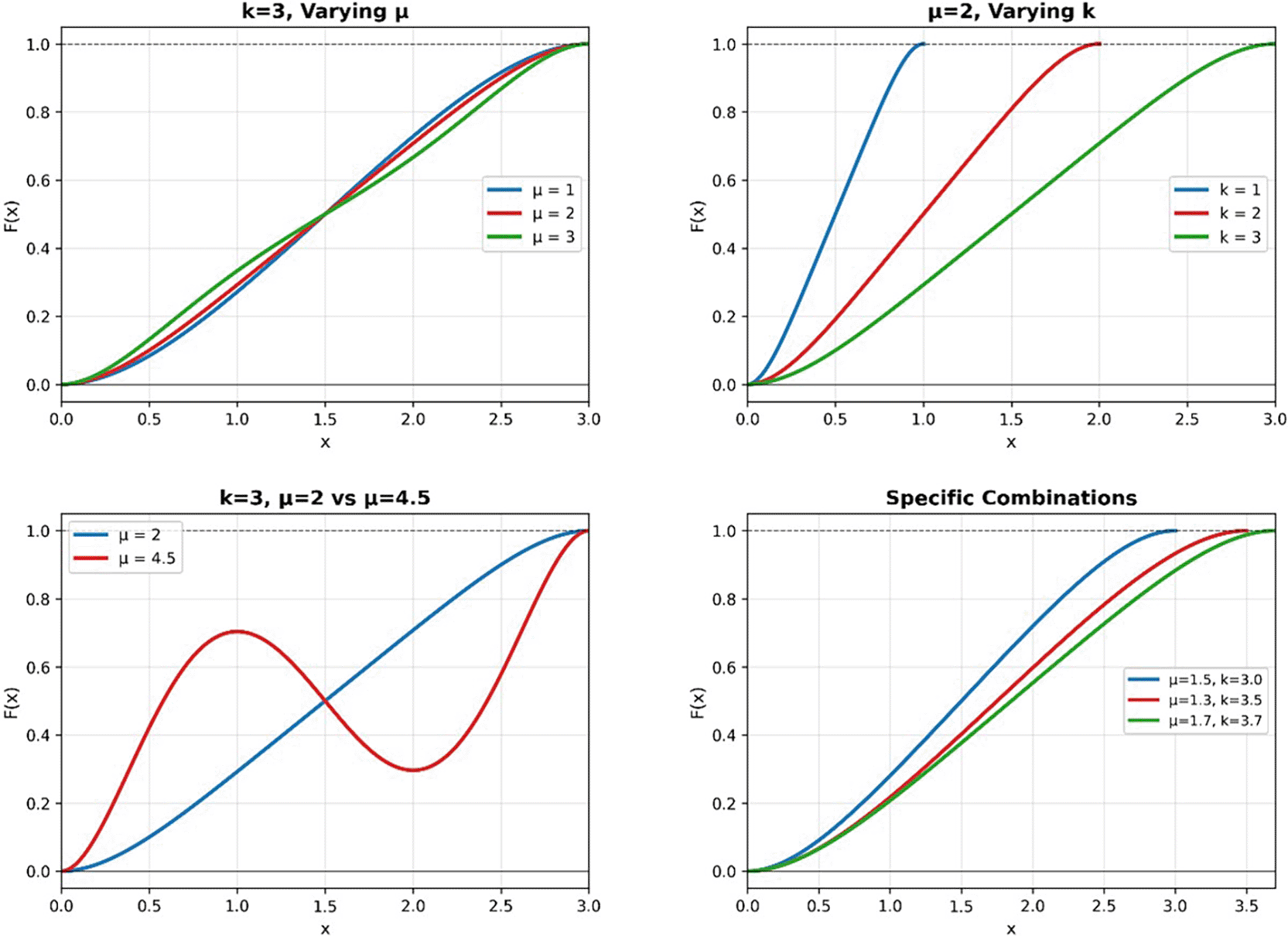
Let x be a continuous non-negative random variable (r.v.). The Cumulative Distribution Function (CDF) of x is given by the following equation Fμk(x;μ,k) as in Figure 4

Fμk(x;μ,k)=x2(μx(6x215kx+10k2)+10k2x15k3)k5(μ5)

Proof:

F(x)=0xf(u)du
F(x)=0x30u(1uk)(1μu(1uk)k)k2(5μ)du=x(30μu4k5(5μ)+60μu3k4(5μ)30μu2k3(5μ)30μu2k2(5μ)+30μuk2(5μ))du=[6μu5k5(5μ)+15μu4k4(5μ)10(k2μ+k2)u3k5(5μ)+15u2k2(5μ)]|x0=(6x515kx4+10k2x3)μ+10k2x315k3x2k5(5μ)=x2(x(6x215kx+10k2)μ+10k2x15k3)k5(μ5)

Then Fμk(x;μ,k)=x2(μx(6x215kx+10k2)+10k2x15k3)k5(μ5)

4f05d27e-2b6b-4f5a-87cc-7667a76db809_figure4.gif

Figure 4. The Cumulative Distribution Function (CDF ) for logistic map distribution.

2.3 Reliability function for logistic map distribution

Lemma 3:

Assuming that x is a continuous non-negative random variable following a Logistic map distribution, the reliability function as in Figure 5 of x is given by:
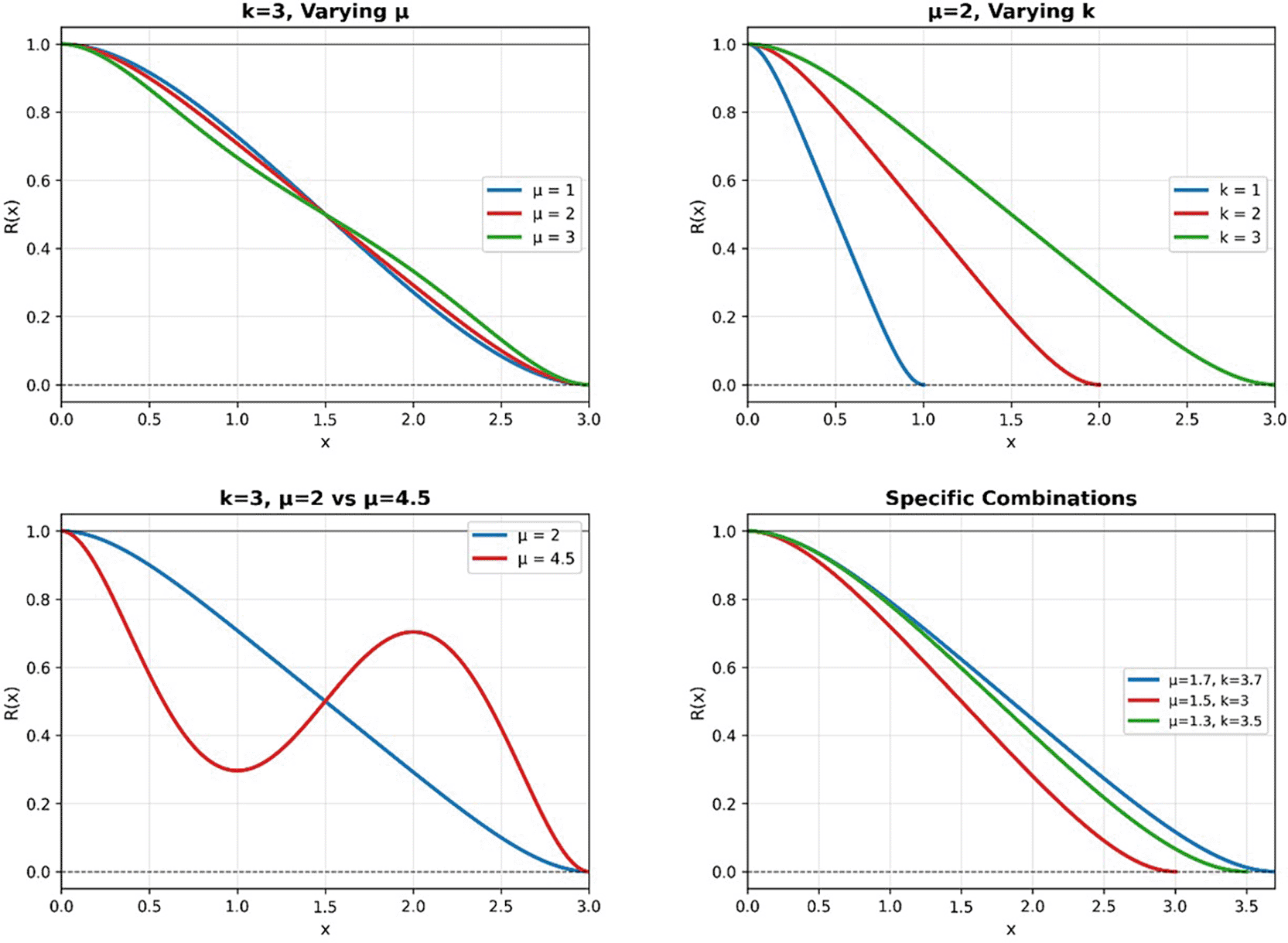
Rμk(x)=1x2(μx(6x215kx+10k2)+10k2x15k3)k5(μ5)

Proof:

Rμk(x)=1Fμ(x)=1x2(μx(6x215kx+10k2)+10k2x15k3)k5(μ5)

4f05d27e-2b6b-4f5a-87cc-7667a76db809_figure5.gif

Figure 5. The Reliability function for logistic map distribution.

2.4 Hazard rate function for logistic map distribution

Lemma 4:

The hazard function for x is as follows, assuming that x is a continuous positive r.v. distributed with logistic map distribution as in Figure 6:
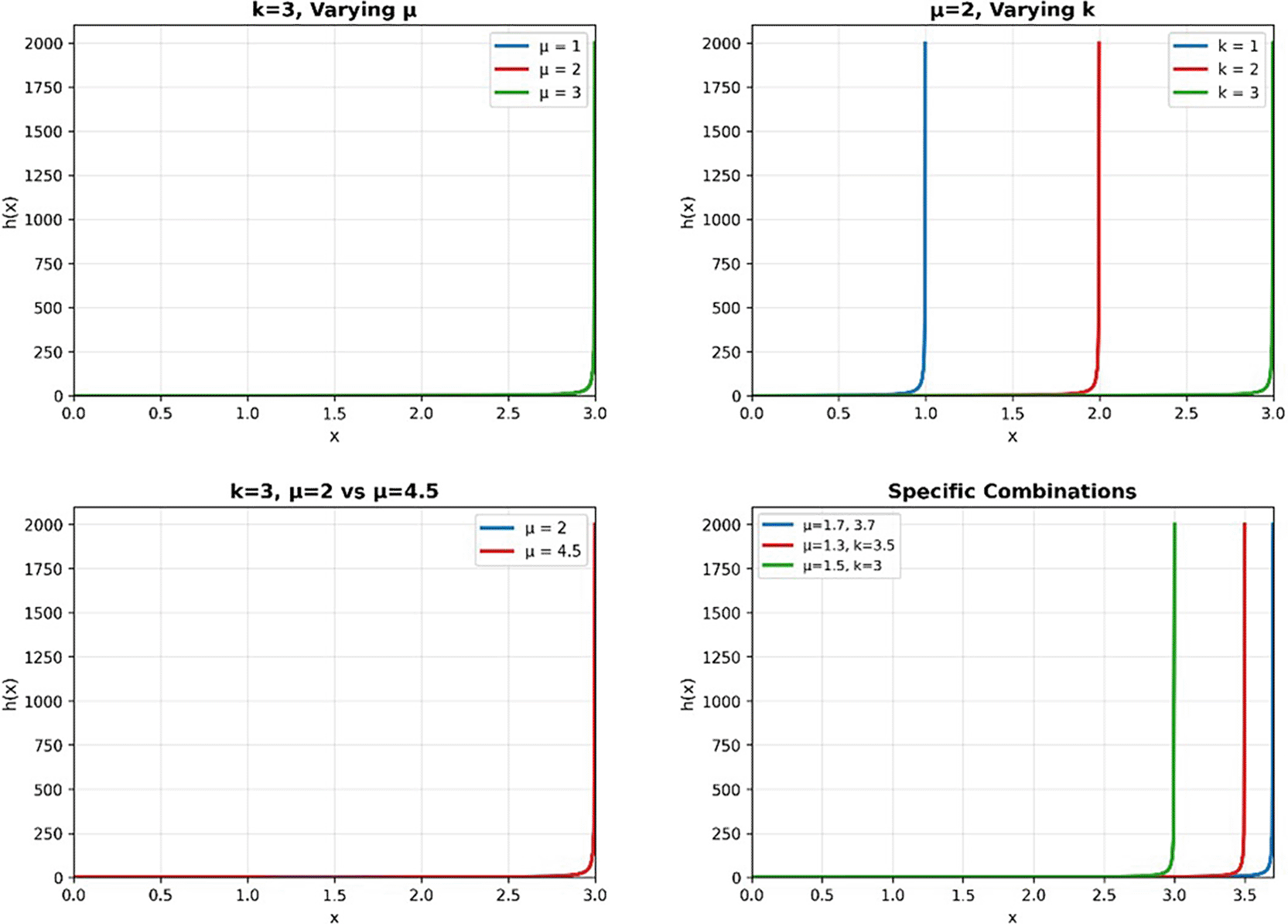
hμk(x)=(30x(xk)(μx(xk)+k2))(k5(μ5)x2(μx(6x215kx+10k2)+10k2x15k3))

Proof:

hμk(x)=fμk(x)Rμk(x)=(30x(xk)(μx(xk)+k2))(k5(μ5))1x2(μx(6x215kx+10k2)+10k2x15k3)k5(μ5)=(30x(xk)(μx(xk)+k2))(k5(μ5))(1x2(μx(6x215kx+10k2)+10k2x15k3)k5(μ5))=(30x(xk)(μx(xk)+k2))(k5(μ5)x2(μx(6x215kx+10k2)+10k2x15k3))

4f05d27e-2b6b-4f5a-87cc-7667a76db809_figure6.gif

Figure 6. The Hazard function for logistic map distribution.

3. Results and Discussion

This section aims to present a novel logistic map distribution for a discrete dynamical system that is specified by second iteration of the logistic function.

3.1 Mode

Lemma 5:

The mode of f(x) is x=2μk+μk(μk3)3μ

Proof:

fμk(x;μ,k)=(30x(xk)(μx(xk)+k2))(k5(μ5)),x(0,k)
fμk(x;μ,k)=30(4μx36x2+(2k2μ+2k2)xk3)k5(μ5)

For the random variable X, the density function's first derivative equals zero (fμk(x)=0) we discover:

(2)
30(4μx36x2+(2k2μ+2k2)xk3)k5(μ5)=0,

Both sides are multiplied by 30k5(5μ) the following equation is obtained:

4μx36x2+(2k2μ+2k2)xk3=0

Since this equation is a polynomial of degrees 3, we obtain:

xc=k2,kμ22μ+2μ,kμ22μ2μ

There are many roots for Equation (2), as observed in the shape of the density function Equation (1). So, if x=xc is a root of Equation (2), this root's depends on the second derivative of the equation. That means if the second derivative of the root is less than zero, then the point or the root is a local maximum. Or if the second derivative of the root is greater than zero, then it is a minimum point.

(3)
fμk(x;μ,k)=60(6μx26kμx+k2μ+k2)k5(μ5)

The value of xc1=k2 is compensated for in Equation (3), we obtain:

fμk(xc1;μ,k)=60(k2k2μ2)k5(μ5)>0

When the value of xc2=2μk+μk(μk3)3μ is compensated for in Equation (3), we obtain:

fμk(xc2;μ,k)=60μ(3μ(μ(μ2μ1)+(μ1)(μ2)μ(μ+1)+1)+1)k3(μ5)>0
fμk(xc2;μ,k)=60μ(3μ(μ(μ2μ1)+(μ1)(μ2)μ(μ+1)1)1)k3(μ5)<0

Then, the mode is (2μk+μk(μk3)3μ)

3.2 Median

Lemma 6:

Let x be a continuous non-negative r.v. distributed according to the logistic map distribution, then the median of x is derived as in the form9:

Proof:

F(x)=oxf(u)du=12x2(μx(6x215kx+10k2)+10k2x15k3)k5(μ5)=122x2(μx(6x215kx+10k2)+10k2x15k3)=k5(μ5)2x2(μx(6x215kx+10k2)+10k2x15k3)k5(μ5)=0x1=k2x2=k2+2k2(5μ2+4μ+52(2μ+5))3μ+3k22x2=k22k2(5μ2+4μ+52(2μ+5))3μ+3k22x3=k2+2k2(5μ2+4μ+5+2(2μ+5))3μ+3k22x3=k22k2(5μ2+4μ+5+2(2μ+5))3μ+3k22

Since 2k2(5μ2+4μ+5+2(2μ+5))3μ>0and2k2(5μ2+4μ+52(2μ+5))3μ>0 because μ(0,4),k>2

3.3 The rth moment

Lemma 7:

The rth moment function for x is as follows, assuming that x is a positive r.v. distributed as the logistic map distribution9: E(xr)=30kr((2r+4)μr29r20)(r4+14r3+71r2+154r+120)(μ5)

Proof:

E(xr)=allxxrfμk(x;μ,k)dxE(xr)=0kxr30x(xk)(μx(xk)+k2))(k5(μ5))dxE(xr)=0k(30μxr+4k5(5μ)60μxr+3k4(5μ)+30μxr+2k3(5μ)+30xr+2k3(5μ)30xr+1k2(5μ))dxE(xr)=30kr((2r+4)μr29r20)(r4+14r3+71r2+154r+120)(μ5)

If r = 1,2 is substituted in the rth moment function, Lemma 7 may be used to obtain the mean and variance for the logistic map distribution.

E(x)=k(6μ30)12(μ5)

And if r = 2 we obtain:

E(x2)=k2(8μ42)28(5μ)

Now find var( x) so we can get it through: var(x)=E(x2)[E(x)]2

var(x)=k2(8μ42)28(5μ)[k(6μ30)12(μ5)]2var(x)=k2(8μ42)28(5μ)k2(6μ30)2144(μ5)2var(x)=k2(μ7)28(5μ)

3.4 Moment generating function (MGF )

Lemma 8:

The Moment generating function (MGF) for x is given by, assuming that x is a positive r.v. distributed according to the logistic map distribution10:

Mx(t)=30((2k2t212kt+24)ekt2k2t212kt24)μ+(2k2t2k3t3)ektk3t32k2t2k5t5(μ5)

Proof:

Mx(t)=E(etx)=allxetxfμk(x;μ,k)dxMx(t)=E(etx)=0k30x(xk)(μx(xk)+k2))etx(k5(μ5))dx=30(k5(μ5))0k30x(xk)(μx(xk)+k2))etxdx=30((2k2t212kt+24)ekt2k2t212kt24)μ+(2k2t2k3t3)ektk3t32k2t2k5t5(μ5)

3.5 Characteristic function

Lemma 9:

Let X be r.v. with density function fEW(x;λ,α) , the expected value of eitx is defined to be characteristic function of X. where i=1 and tis a real number.

Фx(it)=E(eitx)=allxeitxfμk(x;μ,k)dxФx(it)=E(eitx)=0k30x(xk)(μx(xk)+k2))eitx(k5(μ5))dxФx(it)=E(eitx)=30(k5(μ5))0k30x(xk)(μx(xk)+k2))eitxdx=[30(it4μx42t3(ikt+2)μx3+t2(ik2t2μ+6ktμ12+ik2t2)x2t(2(kt(kt6i)12)μ+k2t2(ikt+2))x2(kt(ikt+6)12i)μ+k3t32ik2t2)eitx]k5t5(μ5)|0k=30((2ik2t212kt24i)eikt2ik2t212kt+24i)μ+(k3t3+2ik2t2)eikt+k3t32ik2t2k5t5(μ5)

3.6 Factorial moment generating function (FMGF )

Lemma 10:

Let x be a non-negative continuous r.v. has the logistic map distribution then the Factorial moments generating function of x is in the form:

Gx(t)=30((2k2(lnt)212k(lnt)+24)eklnt2k2(lnt)212k(lnt)24)μ+(2k2(lnt)2k3(lnt)3)eklntk3(ln)32k2(lnt)2k5(lnt)5(μ5)

Proof:

Gx(t)=E(tx)=E(elntx)=E(exlnt)=Ϻx(lnt)

That’s mean found relationship between a (mgf ) and (Fmgf ) where Mx(t)=Ϻx(lnt) From Lemma 8 we obtain:

Ϻx(lnt)=30((2k2(lnt)212k(lnt)+24)eklnt2k2(lnt)212k(lnt)24)μ+(2k2(lnt)2k3(lnt)3)eklntk3(ln)32k2(lnt)2k5(lnt)5(μ5)

3.7 Coefficient of Variation (C.V)

Lemma 11:

Let x be a non-negative continuous r.v. has the logistic map distribution then the Coefficient of Variation of x is in the form7: C.V=6(μ7)(μ5)7(5μ)(6μ30)

Proof:

The Coefficient of Variation is given by: C.V=σM

M=E(x)=k(6μ30)12(μ5)

var(x)=σ2(x)=k2(μ7)28(5μ)
σ(x)=k(μ7)28(5μ)
C.V=σM=k(μ7)28(5μ)×12(μ5)k(6μ30)
C.V=6(μ7)(μ5)7(5μ)(6μ30)

3.8 Coefficient of Skewness (C.S)

Lemma 12:

Let x be a non-negative continuous r.v. has the logistic map distribution then The Coefficient of Skewness of x is in the form:

C.S=127(5μ)32(4μ21)(μ7)32(μ5)

Proof:

The Coefficient of Skewness is given by: C.S=M3σ3

M3=E(xM)3=E(xk(6μ30)12(μ5))3=E(x3)3(k(6μ30)12(μ5))E(x2)+3(k(6μ30)12(μ5))2E(x)(k(6μ30)12(μ5))3

If r = 3 is substituted in the rth moment function, Lemma 7 may be used to obtain the E(x3) .

E(x3)=k3(10μ56)56(μ5)

Then

M3=E(xM)3=k3(10μ56)56(μ5)3(k(6μ30)12(μ5))(k2(8μ42)28(5μ))+3(k(6μ30)12(μ5))2(k(6μ30)12(μ5))(k(6μ30)12(μ5))3=k3(10μ56)56(μ5)3(k(6μ30)12(μ5))(k2(8μ42)28(5μ))+3(k(6μ30)12(μ5))3(k(6μ30)12(μ5))3=k3(10μ56)56(μ5)3(k(6μ30)12(μ5))(k2(8μ42)28(5μ))+2(k(6μ30)12(μ5))3=k3(6μ30)3864(μ5)3+k3(10μ56)56(μ5)k3(6μ30)(8μ42)112(5μ)(μ5)
M3=3k3(4μ21)14(μ5)
var(x)=σ2(x)=k2(μ7)28(5μ)
σ(x)=(k2(μ7)28(5μ))12
σ3(x)=k3(μ7)32(28(5μ))32
C.S=M3σ3=3k3(4μ21)(14(μ5))×(28(5μ))32(k3(μ7)32)=127(5μ)32(4μ21)(μ7)32(μ5)

3.9 The rth central moment about mean

Lemma 13:

Let x be a non-negative continuous r.v. has the logistic map distribution then The rth central moment about mean of x is in the form:

E(xM)r=30(1M)r(k5(μ5))[kj+5((2j+4)μj29j20)j4+14j3+71j2+154j+120]

Proof:

The rth central moment about mean is given by: -

E(xM)r=allx(xM)rfμk(x;μ,k)dx
E(xM)r=0k(xM)r[30x(xk)(μx(xk)+k2))(k5(μ5))]dx
E(xM)r=0k(x+(M))[30x(xk)(μx(xk)+k2))(k5(μ5))]dx

Recall that:

(a+b)n=j=0nCjnajbnj
(xM)r=j=0rCjrxj(M)rj,AndM=E(x)
E(xM)r=0k30j=0rCjrxj(M)rj(k5(μ5))[x(xk)(μx(xk)+k2))]dx
E(xM)r=0k30j=0rCjr(M)rj(k5(μ5))[xj+1(xk)(μx(xk)+k2))]dx
E(xM)r=30j=0rCjr(M)rj(k5(μ5))[μ0kxj+4dx20kxj+3dx+(k2μ+k2)0kxj+2dxk30kxj+1dx]
E(xM)r=30j=0rCjr(M)rj(k5(μ5))[μxj+5j+52xj+4j+4+k2μxj+3j+3+k2xj+3j+3k3xj+2j+2]|0k
E(xM)r=30j=0rCjr(M)rj(k5(μ5))[kj+5((2j+4)μj29j20)j4+14j3+71j2+154j+120]
E(xM)r=30(1M)r(k5(μ5))[kj+5((2j+4)μj29j20)j4+14j3+71j2+154j+120]

4. Maximum likelihood estimation method (MLEM)

This method is one of the most important and most used method for estimating parameters for all distribution.11 The idea of this method is to find the estimate parameters for any distribution which maximize the likelihood function.12

Suppose that x1,x2,,xn are (i.i.d) random variable with joint pdf f(xi;μ,k) .

The likelihood function for two parameters for logistic map distribution

L(μ,k;x1,x2,,xn)=i=1nf(xi;μ,k)=i=1n30xi(xik)(μxi(xik)+k2))(k5(μ5))=(30(k5(μ5)))ni=1n(xi(xik)(μxi(xik)+k2)))

Taking log-likelihood function is:

lnL=nln(30(k5(μ5)))+i=1nln(xi(xik)(μxi(xik)+k2))=nln305nlnknln(μ5)+i=1nln(xi(xik)(μxi(xik)+k2))

Following are the partial derivatives of the log-likelihood function with respect to the unidentified parameters μ,k.

lnlμ=nμ5+i=1nxi(xik)xi(xik)μ+k2lnlk=5nk+i=1n3k2+(2xiμ2xi)k+2xi2μ(kxi)(k2xiμk+xi2μ)

The partial derivatives of the log-likelihood function with respect to unknown parameters μ,k are:

lnlμ=nμ5+i=1nxi(xik)xi(xik)μ+k2=Q(μ)lnlk=5nk+i=1n3k2+(2xiμ2xi)k+2xi2μ(kxi)(k2xiμk+xi2μ)=Q(k)

Then the formula of the Newton-Raphson method is as follows:

[μj+1kj+1]=[μjkj]J1[Q(μ)Q(k)],such thatJ=[Q(μ)μQ(μ)kQ(k)μQ(k)k]
Q(μ)μ=n(μ5)2i=1nxi2(xik)2(xi(xik)μ+k2)2
Q(μ)k=i=1nxik(k2xi)(xi(xik)μ+k2)2
Q(k)μ=i=1nxik(k2xi)(xi(xik)μ+k2)2
Q(k)k=5nk2i=1n3k44xi(μ+1)k3+2xi2(μ+1)2k22xi3μ(2μ1)k+2xi4μ22xi4μ(kxi)2(k2xiμk+xi2μ)2

Then the error term is formulated as:

[εk+1(μ)εk+1(k)]=|[μj+1kj+1][μjkj]|

Where μjandkjarethe initial parameter values whichareassumed . Tables 1 and 2 represent the results of the MLE estimation method for the distribution parameters.

Table 1. Sample size and replicate 1000 with μ = 1.5, k = 3.5 displayed.

Size μ μ̂ MSEμ k k̂ MSE k PDF PDF̂ CDF̂ R(x) R(x)̂
101.51.78230.15673.53.32450.45670.482150.456780.342150.687540.6578
201.51.84560.11233.53.24560.31240.482150.46780.331240.687540.6687
301.51.88900.08763.53.18760.23450.482150.473450.324560.687540.6754
501.51.92340.06543.53.12340.15670.482150.47780.319870.687540.6801
751.51.94560.04873.53.08760.10980.482150.480120.316540.687540.6834
1001.51.95670.03873.53.06540.08760.482150.481230.314980.687540.6850

Table 2. Sample size and replicate 1000 with μ = 2.5, k = 4 displayed.

Size μ μ̂ MSEμ k k̂ MSE k PDF PDF̂ CDF CDF̂ R(x) R(x)̂
102.51.8120.1454.03.29870.42340.482160.459880.312460.339880.687540.66012
202.51.8670.1044.03.22340.29870.482160.469880.312460.328770.687540.67124
302.51.8980.0824.03.17650.22340.482160.474570.312460.323460.687540.67654
502.51.9340.0614.03.11230.14560.482160.478770.312460.318770.687540.68124
752.51.9490.0454.03.08230.09870.482160.480460.312460.315680.687540.68432
1002.51.9590.0364.03.06230.07980.482160.481460.312460.314320.687540.68568

5. Simulation results

The results from the simulation in different sample size and replicate 1000 with μ=1.5,k=3.5 displayed in Table 1.

The results from the simulation in different sample size and replicate 1000 with μ=2.5,k=4 displayed in Table 2.

6. Conclusion

The proposed Logistic Map distribution, with its bounded support on and flexible shape governed by the parameter, offers a theoretically grounded and practically relevant tool for modeling non-negative random variables with a finite upper limit. Its derivation from a well-established dynamical system provides a unique link between nonlinear dynamics and statistical modeling.

Given its structural properties particularly its ability to accommodate various hazard rate shapes (increasing, decreasing, or bathtub - shaped), the distribution is especially well-suited for applications in reliability engineering and survival analysis, where it can effectively model the lifetimes of components or systems with a known maximum operational lifespan. Furthermore, its bounded nature makes it appropriate for quality control in manufacturing processes, (e.g., Additive Manufacturing: Powder bed fusion requires tight control over metal powder size), the PDF can model batches with varying spread where measurements are constrained within physical or specification limits.

Beyond engineering contexts, the distribution holds promise in environmental sciences for modeling durations or intensities of bounded natural phenomena (e.g., drought periods, pollutant decay times), and in actuarial science for risk assessment of events with finite horizons. The explicit forms of its reliability and hazard functions further enhance its applicability in predictive maintenance and risk management frameworks. The Logistic Map distribution constitutes a valuable addition to the family of bounded probability models, with significant potential for adoption in any discipline requiring flexible, mathematically tractable models for finite-domain data. Thereby offering a valuable alternative to classical distributions such as the Beta or Kumaraswamy in contexts where physical or operational constraints impose a hard upper limit on the variable of interest.

Author’s declaration

No animal studies are present in the manuscript.

No human studies are present in the manuscript.

Ethical Clearance: The project was approved by the local ethical committee in University of Baghdad.

Comments on this article Comments (0)

Version 1
VERSION 1 PUBLISHED 30 Dec 2025
Comment
Author details Author details
Competing interests
Grant information
Copyright
Download
 
Export To
metrics
Views Downloads
F1000Research - -
PubMed Central
Data from PMC are received and updated monthly.
- -
Citations
CITE
how to cite this article
A. Shamran M, Naji S, Haitham Shakir G and Hassan I. Statistical Properties of Second Iteration of Logistic Map [version 1; peer review: awaiting peer review]. F1000Research 2025, 14:1469 (https://doi.org/10.12688/f1000research.172880.1)
NOTE: If applicable, it is important to ensure the information in square brackets after the title is included in all citations of this article.
track
receive updates on this article
Track an article to receive email alerts on any updates to this article.

Open Peer Review

Current Reviewer Status:
AWAITING PEER REVIEW
?
Key to Reviewer Statuses VIEW
ApprovedThe paper is scientifically sound in its current form and only minor, if any, improvements are suggested
Approved with reservations A number of small changes, sometimes more significant revisions are required to address specific details and improve the papers academic merit.
Not approvedFundamental flaws in the paper seriously undermine the findings and conclusions

Comments on this article Comments (0)

Version 1
VERSION 1 PUBLISHED 30 Dec 2025
Comment
Alongside their report, reviewers assign a status to the article:
Approved - the paper is scientifically sound in its current form and only minor, if any, improvements are suggested
Approved with reservations - A number of small changes, sometimes more significant revisions are required to address specific details and improve the papers academic merit.
Not approved - fundamental flaws in the paper seriously undermine the findings and conclusions
Sign In
If you've forgotten your password, please enter your email address below and we'll send you instructions on how to reset your password.

The email address should be the one you originally registered with F1000.

Email address not valid, please try again

You registered with F1000 via Google, so we cannot reset your password.

To sign in, please click here.

If you still need help with your Google account password, please click here.

You registered with F1000 via Facebook, so we cannot reset your password.

To sign in, please click here.

If you still need help with your Facebook account password, please click here.

Code not correct, please try again
Email us for further assistance.
Server error, please try again.