Keywords
Thinking process, field independent-field dependent cognitive style, polyhedron, information processing theory.

Thinking process, field independent-field dependent cognitive style, polyhedron, information processing theory.
Each student has a different learning style in responding to stimuli and in processing information obtained from the surrounding environments. Students process information through the ways they receive information from their learning environment (Ahmadzade & Shojae, 2013). Differences in students’ learning styles in processing information are referred as cognitive styles (Katoch & Thakur, 2016; Saleh & Nur, 2023). Cognitive styles related to the learning environment influence the learning process (Onyekuru, 2015; Sa’dijah et al., 2020). In the learning process, it is commonly observed that some students respond more quickly and some students respond more slowly. Students with different cognitive styles therefore demonstrate different thinking processes in solving problems, as problem-solving thinking processes are closely related to cognitive styles (Jena, 2014; Katoch & Thakur, 2016).
Cognitive styles are generally divided into field-independent and field-dependent types (Ahmadzade & Shojae, 2013; Rozencwajg & Corroyer, 2005). Field-independent cognitive styles are characterized by analytical ability, initiative, responsibility, control, independent thinking, detachment from others, and minimal environmental influence. In contrast, field-dependent cognitive styles emphasize wholistic perception, effective group interactions, and prioritization of social relationships (Kozhevnikov, 2007; Spagnolo & Di Paola, 2010). Students’ with field-independent cognitive styles tend to be ‘free’ from organized perceptions and can quickly separate a part from its whole, whereas students’ with field-dependent cognitive styles tend to accept information as a whole (Ngilawajan, 2013). These differences can be categorized as ways of processing information, evaluating information, and selecting problem-solving strategies.
Field-independent and field-dependent cognitive styles are closely related to students’ thinking process in solving mathematical problems. Thinking is a mental process involving the brain’s work in processing information (Demirel et al., 2015; Siregar et al., 2018). Mental processes occur when individuals process or manipulate information from the environment using mathematical symbols stored in memory (Utami et al., 2018; Walgito, 2010). In mathematics learning, students develop their thinking skills through problem solving (Sapti et al., 2019). When students are faced with a problem, they are required to think and attempt to find a solution about how the given problem can be solved (Solso et al., 2008). However, insufficient attention to students’ thinking processes in problem solving may negatively affect learning outcomes (Sukoriyanto, et al., 2016).
Several previous studies have examined students’ thinking processes based on their field-independent and field-dependent cognitive styles (Amamah & Sa’dijah, 2016; Men et al., 2020; Mutlu & Temiz, 2013; Rum & Juandi, 2023; Sabet & Mohammadi, 2013). These studies suggest that students with a field-independent cognitive style tend to demonstrate more thorough thinking stages than those with a field-dependent cognitive style. The findings also indicate that field-independent students are more likely to succeed in problem solving than field-dependent students. One distinguishing aspect of the present study lies in the type of problem examined. Previous studies primarily focused on mathematical problems that required students to apply existing ideas to solve problems. Students’ ability to solve mathematical problems is important to investigate because it reflects how their thinking processes operate (Ersoy, 2016; Habsyi et al., 2023; Puran et al., 2017).
This study aligns with the research by Bintoro et al., (2021) which focuses on field-independent and field-dependent students’ thinking processes in solving polyhedron problems. However, several differences distinguish the two studies. The previous study involved two sophomore students of Mathematics Education Department at Muria Kudus University, whereas the present study involves two eighth grade junior high school students from Nurulhasan Integrated Islamic School, Ternate. Another difference lies in the analytical framework. The previous study employed APOS theory, which consists of action, process, object, and schema, while the present study applies information processing theory, which includes attention, perception, rehearsal, retrieval, and encoding.
Based on these differences, this study examines students’ thinking processes in solving geometry problems, particularly polyhedron problems (Alex & Mammen, 2016; Kania et al., 2022). Polyhedron problems are taught in schools because their applications are often encountered in everyday life (Arıcı & Tutak, 2015). Solving polyhedron problems requires an in-depth examination of students’ thinking processes (Kania et al., 2022). Understanding these processes also makes it possible to identify the students’ errors in problem solving. It is important to explore students’ thinking processes in polyhedron problems through the components of information processing theory that deals with the activities of processing, storing and recalling information obtained from the brain (Hidajat et al., 2019; Lutz & Huitt, 2003).
Information processing theory provides a framework for understanding complex brain functions involved in thinking and acting (Slavin, 2006). This theory can also serve as an analytical tool for examining students’ thinking processes through the components of attention, perception, rehearsal, retrieval, and encoding (Gurbin, 2015; Hooda & Devi, 2017; Kusaeri et al., 2018). Attention refers to focusing on relevant information while filtering out irrelevant information. Perception involves interpreting received information. Rehearsal is the repetition of information to strengthen memory storage. Retrieval refers to recalling information from memory, and encoding is the process of storing information in memory. Describing students’ thinking processes based on information processing theory is essential for understanding how these processes occur during polyhedron problem solvings. Therefore, this study aims to determine the thinking processes of field-independent and field-dependent students in solving polyhedron problems based on the components of information processing theory.
This study aims to reveal the thinking process of field independent and field dependent student in solving polyhedron problems based on information processing theory. The data collected in this study consist of verbal data derived from the problem-solving process, which reflect students’ thinking processes. This study focusses in-depth exploration of the students’ thinking processes and therefore adopts a qualitative approach with a descriptive exploratory design. This study was conducted on February 10–21, 2025.
This study follows the characteristics of qualitative research as proposed by Creswell (2014), which are: (1) researchers collect data from various sources, such as interviews, observations, and documentation, then review and interpret the data by assigning, meaning, and organizing them into categories or themes across data sources; (2) researchers build patterns, categories or themes inductively, by processing data into more abstract units of information; (3) researchers try to create a complex picture of the problem being studied; and (4) the data obtained in this study are primarily verbal in nature.
The study was conducted with 22 eight-grade students of SMP IT Nurul Hasan, Ternate. The selection of research subjects was based on the consideration that the research subjects had already studied the topic of polyhedron. In addition, participants were classified by administering the Group Embedded Figure Test (GEFT), which had been validated for the purpose of grouping field independent and field dependent cognitive styles.
The criteria used for the classification were as follows: students who correctly answered 10–18 items were categorized as field independent cognitive style, while those who correctly answered 0–9 items were categorized as having field dependent cognitive style (Oh & Lim, 2005). The results of the classification of students’ cognitive styles are presented in Table 1.
| Class | Cognitive style | Total | |
|---|---|---|---|
| Field Independent (FI) | Field Dependent (FD) | ||
| VIII | 11 | 11 | 22 |
| Percentage (%) | 50 | 50 | 100 |
Based on the results of the Group Embedded Figure Test, 11 (50%) students were classified as having a field independent cognitive style and 11 (50%) students were classified as having field dependent cognitive style. Subsequently, one subject from each cognitive style group was selected. The selection process involved consultation with the mathematics teacher who taught the eight-grade students, with consideration given to students’ communication skills, both oral and written. Finally, one student from the field independent category, referred to as CB and one student from the field dependent category, referred to as the CL, were selected. The distribution of students according to field-independent and field-dependent cognitive style categories is presented in Table 2.
| No | Number of subjects in cognitive style category | |||
|---|---|---|---|---|
| Cognitive style | Total score | Percentage (%) | Subject code | |
| 1 | Field independent | 14 | 70 | CB |
| 2 | Field dependent | 9 | 45 | CL |
After the two subjects were selected, a problem-solving test on the topic of polyhedron was administered, followed by interviews aimed at identifying the students’ thinking process based on the components of information processing theory. The interview procedures for the two subjects varied depending on the communication dynamics between the researcher and each subject.
The instruments used in this study were the Group Embedded Figured Test (GEFT), polyhedrons problem-solving tests, and interview guidelines. The GEFT served as an initial mathematics test consisting of 20 multiple-choice questions covering basic mathematical concepts. The polyhedron problem-solving tests was a written assesment consisting of one essay question designed to address the research objective of this study. The test instrument was developed and modified by the researcher through a supervision process and subsequently validated by expert validators in mathematics and mathematics education. The interview guidelines were designed to collect in-depth information regarding students’ thinking processes in solving polyhedron problems. These guidelines were developed by the researcher through a supervision process and were also validated by expert validators in mathematics and mathematics education.
The stages of data analysis in this study consisted of the following steps: (1) collecting interview data, problem-solving test data, and GEFT data; (2) transcribing the data; (3) organizing data into meaningful units which and categorizing them through coding; (4) checking the data validity; (5) analyzing the thinking structures of field-independent and field-dependent subjects; (6) constructing representations of the thinking structures; (7) analyzing the findings obtained from each subject; (8) drawing conclusions based on the research questions. The data analysis stages are illustrated in Figure 1.
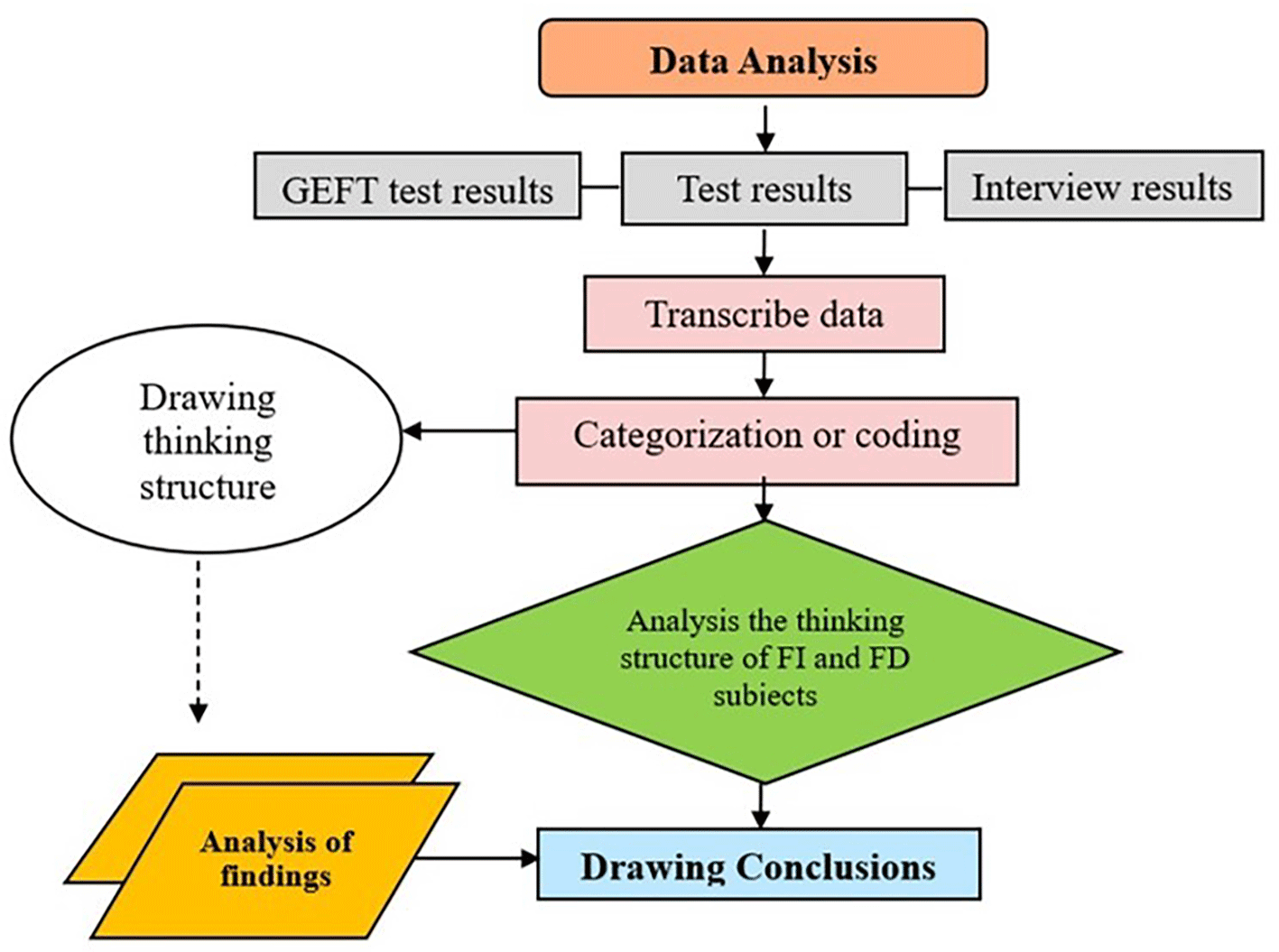
This figure illustrates the qualitative data analysis procedures applied in the study consisted of the following steps; collecting data, transcribing data, categorizing data through coding, analyzing the thinking structure and drawing conclusions. The analysis integrates data from GEFT test result, problem-solving test result and interview, which are coded and categorized based on information-processing theory.
Furthermore, to examine the thinking process of field-independent and field-dependent students in solving polyhedron problems, the data were analyzed using the components of information processing theory, namely attention, perception, retrieval, rehearsal, and encoding. In the attention component, students focus on reading the problem carefully and thoroughly to identify, understand and retain relevant information. In the perception component, students interpret the information and formulate a problem-solving plan. In the rehearsal component, the information presented in the question was repeated to strengthen memory retention. In the retrieval component, information stored in long-term memory is recalled into short-term memory to support problem solving. Finally, in the encoding component, students write down each step of problem-solving process and draw conclusions based on the obtained solutions.
The determination of the research subjects began with the administration of the Group Embedded Figured Test (GEFT) to 22 eighth-grade students. The GEFT was used to classify students into field-independent and field-dependent cognitive styles. The test consisted of 20 questions covering basic geometry concepts presented in the form of word problems. These basic geometry questions were included because the students had previously studied geometry in both the elementary and junior high school levels, providing them with relevant prior learning experiences. The results of the GEFT are presented in Table 3.
Students who obtained test scores of 50% or higher were categorized as having a field independent cognitive style, whereas students who obtained test scores of less than 50% were categorized as having a field dependent cognitive style. The results of the GEFT showed that 11 students were classified as field independent and 11 students as field dependent.
After grouping students according to cognitive styles, the researcher selected the research subjects by considering their thinking potential and communication skills. Consequently, two students were selected as the subjects of this study; one student from the field independent cognitive style category, referred to as CB, and one student from the field dependent cognitive style category, referred to as CL. Following the selection of the two subjects, a problem-solving test on the polyhedron topics was administered, followed by interviews to identify students’ thinking processes based on the components of information processing theory. The selection of these subjects also received written consent from their parents and the research subjects.
Analysis of the thinking processes to two subjects resulted in two distinct categories: the locality category, demonstrated by the field independent subject, and the globality category demonstrated by the field dependent subject. The locality category emerged in the retrieval component, in which information retrieved from long-term memory was partitioned into separate parts, enabling the identification of relationships among the parts. In contrast, the globality category also emerged in the retrieval component; however, information retrieved from long-term memory was integrated into a complete (comprehensive) whole, making it difficult to identify relationships among individual components. The categories of subjects’ thinking processes are shown in Table 4.
The first finding, namely the locality process, was observed in the field-independent subject (CB) during the solution of the polyhedron problem. Accordingly, CB was categorized under the locality thinking process. The second finding, namely the globality process, was observed in the field-dependent subject (CL) during problem solving and was therefore categorized under the globality thinking process. These categorizations were not coincidental but were derived from triangulated data, including interview data, field notes and the written work produced by each subjects during problem solving. The categories of students’ thinking processes in solving polyhedron problems are illustrated in Figure 2.
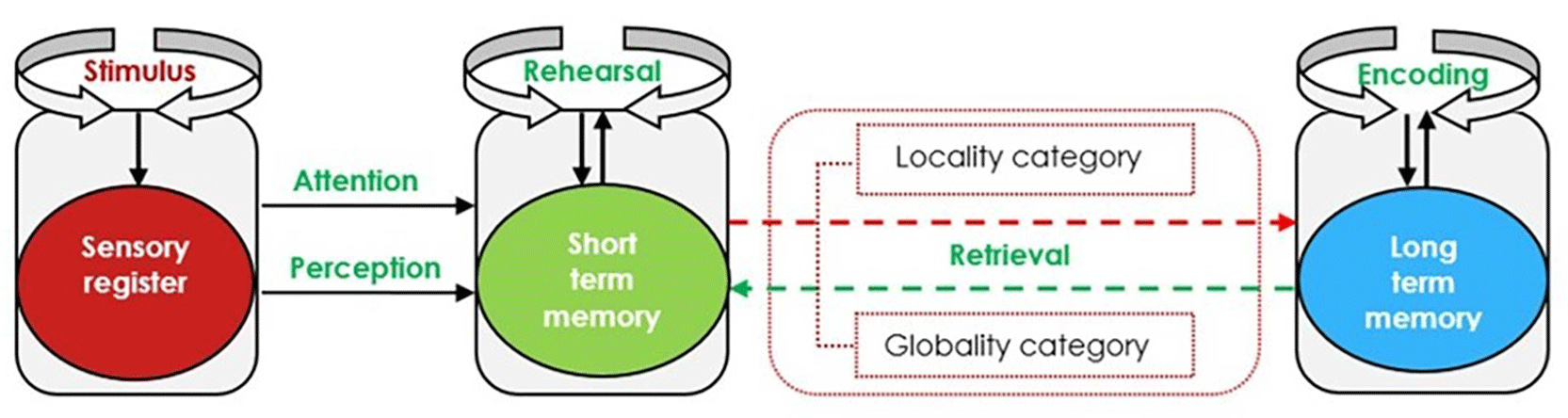
This figure illustrates the categories of students’ thinking processes in solving polyhedron problems based on information processing theory stages. Solid arrows depict the flow of students’ thinking processes involving sensory register memory, short-term memory, and long-term memory. Dotted arrows depict the occurrence of the locality thinking process demonstrated by field-independent subjects (CB) and the globality thinking process demonstrated by field-dependent subjects (CL) at the retrieval stage.
The description of the locality thinking process by CB subject was analyzed based on the components of attention, perception, retrieval, and encoding. When given the following polyhedron problem:
“Students will be camping in the forest not far from residential areas. For camping purposes, they need a tent for a resting place. The number of students participating is sextuple more than the number of teachers, the number of teachers participating is five. They ordered a tent with the shape and dimensions shown in the picture (a tent without a base). What is the minimum amount of fabric required if one tent can accommodate a maximum of four people?”.
The problem-solving process of CB subject is illustrated in Figure 3.
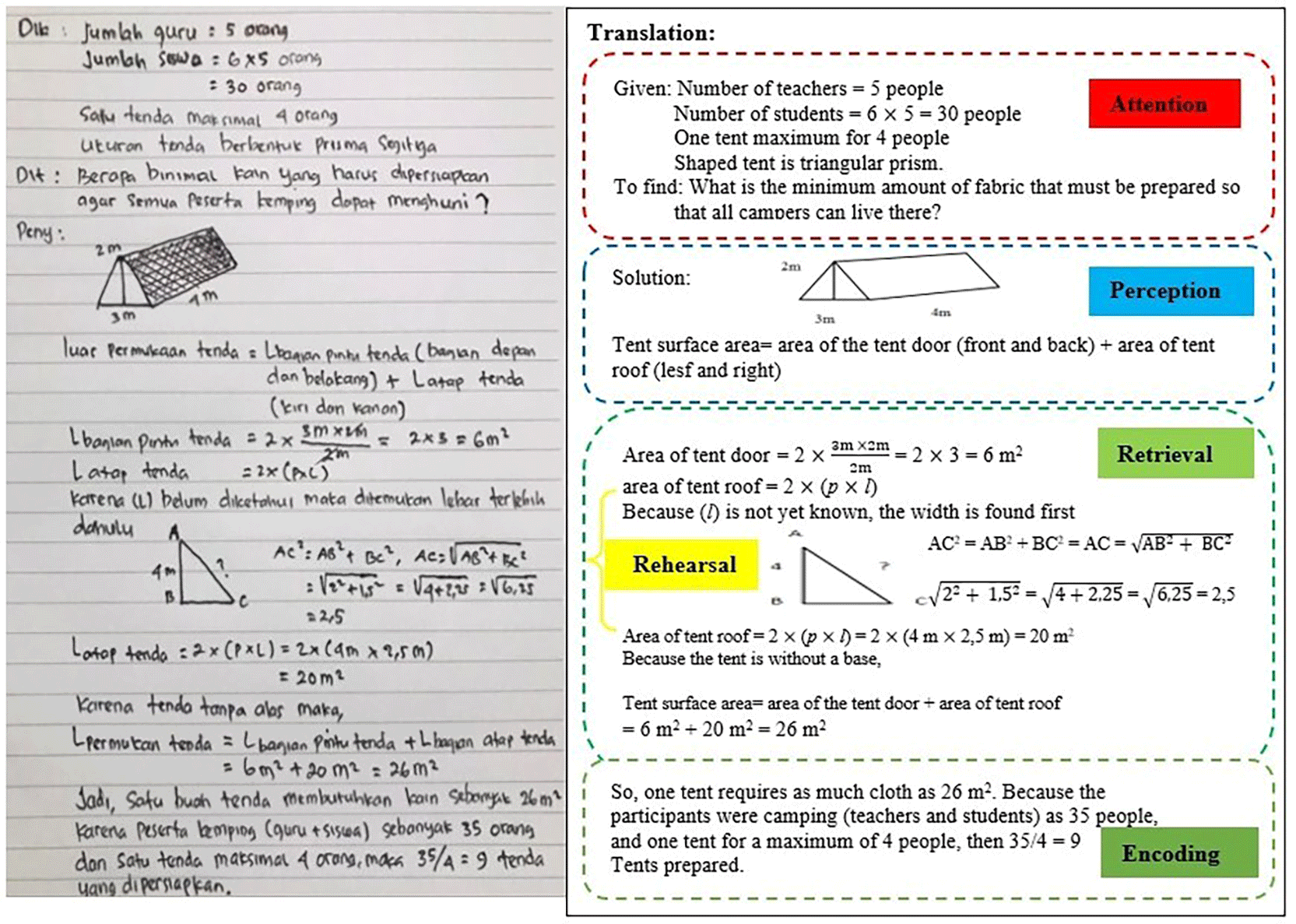
This figure shows the problem-solving process of CB subjects, highlighting the sequence of cognitive activities from receiving stimulus to obtaining solution. This image also shows where the thinking process occurs based on information processing theory. In the problem-solving test, CB subjects performed all stages of the thinking process, namely attention, perception, retrieval, rehearsal, and encoding.
After the polyhedron test question was given, at the attention stage, CB subject observed and read the problem. Attention refers to the process of focusing on the information provided in order to solve the problem and determine what is known and what is being asked. The attention demonstrated by CB subject is presented in the following interview excerpts.
Researcher: In your opinion, what is the question you are reading about?
CB Subject: I think, this question is about polyhedron.
Researcher: Okay, then what is known and what is being asked in this question?
CB Subject: The givens in this problem are that there are five teachers and six times as many students, so there are 30 students. One tent can accommodate a maximum of four people. The tent is shaped like a triangular prism.
Researcher: Then, what is asked in that question?
CB Subject: The question asks how much minimum fabric must be prepared so that all campers can stay there.
Subject CB demonstrated an understanding that the given problem involved a polyhedron. Next, CB directed attention to the information received by reading the question carefully and thoroughly. Through this attention process, CB was able to state what was known and what was asked in the problem. CB identified that the number of teachers was five, the number of students was six times the number of teachers and that the tent was shaped like a triangular prism with a maximum capacity of four people. CB also stated that the problem asked for minimum amount of fabric required to accommodate all campers.
Perception emerged after the attention process. CB subject perception of the information received serves as an initial plan for determining the formula that can be used. CB subject’s perception is illustrated in the following excerpts.
Researcher: Before solving the problem, do you have an idea how to solve it? If you do, explain.
CB Subject: The surface area of the tent is equal to the area of the tent door. In other words, the front of the tent is equal to the back of the tent. Then, add the areas of the left and right tent roofs.
Researcher: Next, how do you solve this problem?
CB Subject: First, the width must be determined using the Pythagorean theorem, because the width (l ) of tent is unknown.
Based on these statements, CB subject planned to calculate the front and back areas of the tent, and then add the area of the left and right sides of the tent roof. Then, he would use the Pythagorean theorem formula to find the value of l (the width of the tent). To do so, CB used the concepts of the triangle area, rectangle area, and the Pythagorean theorem. This perception was realized in short-term memory, where the perceived information was processed simultaneously.
During the realization, CB subject performed retrieval by recalling relevant concepts from long-term memory. CB subject’s explanation is shown in the following excerpts.
Researcher: Then, what is the next step?
CB Subject: To find the front area of the tent, I calculated 2 meters multiplied by 3 meters multiplied by 2 meters, and divided by 2 meters, and obtained .
Researcher: Ok, what is the next step after that?
CB Subject: Next, I find the area of the tent roof using multiplication operations: 2 (p l ).
Researcher: What does 2 (p l ) mean?
CB Subject: It means two times the tent door section, the length of the tent (p) is 4 meters, while the width of the tent (l ) is unknown.
Researcher: How do you determine the value of (l )?
CB Subject: By using the Pythagorean theorem formula AC2 = AB2 + BC2
Researcher: How do you apply the formula?
CB Subject: I substitute the values The square root of 6.2 is 2.5.
Researcher: Where does the value 1.5 come from?
CB Subject: It comes from half of the tent base, because the total tent base length is 3 meters.
The statements show that CB subject correctly performed retrieval. CB calculated the front area of the tent as and then determined the roof area using the expression 2 (p l ). To find the unknown width, CB recalled and applied the Pythagorean theorem, obtaining a width of 2.5 meters. The CB subject then performed rehearsal by rewriting the expression 2 (p l ). This is shown in the following excerpt.
Researcher: Why, did you rewrite 2 (p l )?
CB Subject: To find the area of the tent roof
Researcher: What is the next step?
CB Subject: Since the width of the tent is already known to be 2.5 meters, I substitute it into 2 (4 m 2.5 m) and get 20 m2.
Through rehearsal, CB reinforced the retrieved information and correctly calculated the roof area as 20 m2. Next, CB performed retrieval again to determine the total surface area of the tent by adding the front area (6 m2) and the roof area (20 m2), resulting 26 m2.
At the encoding stage, CB subject provided a complete solution. CB concluded that one tent requires 26 m2 of fabric. Since the total number of campers (teachers + students) was 35 and one tent could accommodate a maximum of four people, CB concluded that 35/4 = 9 tents were required.
The description of the globality thinking process demonstrated by CL subject was analyzed based on the components of attention, perception, retrieval, and encoding. When CL was presented with the same polyhedron problem, the problem-solving process is shown in Figure 4.
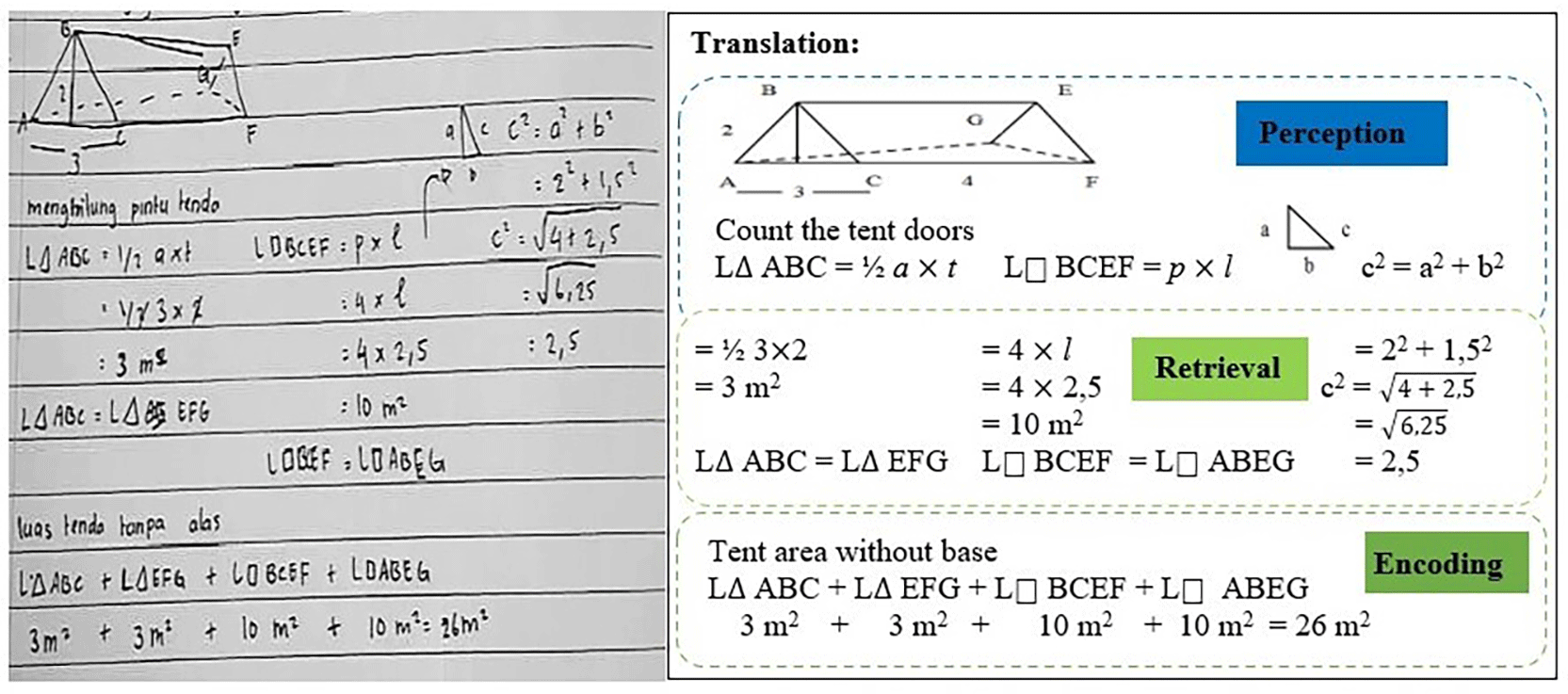
This figure shows the problem-solving process of CL subjects. This image also shows where the thinking process occurs based on information processing theory. In the problem-solving test, CL subjects performed perception, retrieval, and encoding stages.
At the attention stage, subject CL read and observed the problem. Attention is the process of focusing on the information provided to determine what is known and what is asked. Subject CL’s attention is reflected in the following interview excepts.
Researcher: What do you understand from this question?
CL Subject: The question is about polyhedron problem.
Researcher: What is known from the question?
CL Subject: It is known that there are five teachers, 30 students, and one tent can accomodate a maximum of four people.
Researcher: What is asked in the question?
CL Subject: What is the minimum amount of fabric needed, if one tent is for a maximum of four people.
Although CL subject did not write down what was known and what was asked in the problem, the interview revealed that CL understood the information correctly. Perception emerged after attention. CL subject perceived that the problem could be solved using the formulas for triangle area, rectangle area, and the Pythagorean theorem. This is shown in the following excerpts.
Researcher: What do you understand from this question? Try to explain.
CL Subject: To solve this problem, I used the formula for the area of triangle, the area of rectangle and the Pythagorean theorem.
Researcher: How do you solve this problem? Please explain in more detail.
CL Subject: To solve this problem, I used the formula for the area of triangle L ABC = ½ a t, the formula for the area of rectangle L BCEF = p l and Pyithagorean theorem c2 = a2 + b2
Researcher: Why should you use the Pythagorean theorem?
CL Subject: Because the width of the tent is unknown, I search it using the Pythagorean theorem.
This excerpt shows that the CL subject recalled the relevant formulas as a complete set, without explicity identifying relationships among individual geometric components. When this perception was realized in short-term memory, CL subject performed retrieval by recalling mathematical concepts from long-term memory. The retrieval process is shown in the following interview excerpt.
Researcher: Why did you write ½ 3 2 and 4 l?
CL Subject: Because, the area of triangle ABC is ½ base (a) height (t). The base is 3 meters and the height is 2 meters, so the result is 3 m2.
Researcher: What’s the next step?
CL Subject: To find the area of rectangle BCEF, we can multiply the length (p) and width (l ). The length is 4 meters but the width is unknown.
Researcher: How do you determine the width (l ) value?
CL Subject: I used Pythagorean theorem. The value of a is 2 meters and b is half of the tent surface, which is 1.5 m.
Researcher: Next, how do you get the value 2.5 meters?
CL Subject: The values are substituted into the formula c2 = a2 + b2, so it becomes c2 = 22 + 1.52 = 6.25 and the square root of 6.25 is 2.5.
Researcher: Does this result provide the area of rectangle BCEF?
CL Subject: Not yet, it only gives the width of the tent width. Then, 4 meters multiplied by the tent width 2.5 meters equals 10 m2.
Based on this excerpt, CL subject retrieved mathematical information globally by applying formulas sequentially without decomposing the problem into explicitly related subcomponents. The subject proceeded to calculate the surface area of the tent by summing the areas of two triangular faces and two rectangular faces, resulting in a total area of 26 m2.
At the encoding stage, CL subject did not provide a complete conclusion regarding the number of tents required based on the total number of campers. This indicates that the information processed in short-term memory was not fully encoded back into long-term memory. Therefore, CL subject thinking process is categorized as globality, particularly at the retrieval and encoding stages. The similarities and differences between these thinking processes are presented in Table 5.
The difference between the thinking processes of field-independent and field-dependent subjects in solving polyhedron problems lie in three components: (1) attention, where field-independent subject explicitly identified what is known and asked, while field-dependent subject did not; (2) rehearsal, where the field independent subject performed repetition and reinforcements, while the field-dependent did not; (3) encoding, where the field-independent subject provided a complete conclusion, while field-dependent subjects did not.
The researcher selected the research subjects after classifying the students’ cognitive styles and consulting the mathematics teachers who teach grade VIII to consider students’ oral and written communication skills. Based on this process, two students were selected as research subjects; one student in the field-independent category, referred to as subject CB, and one student in the field-dependent category, referred to as subject CL. After the subjects were selected, they were given problem-solving tasks, and their thinking processes were analyzed based on the components of information processing theory, namely attention, perception, retrieval, rehearsal, and encoding.
Field-independent and field-dependent cognitive styles are closely related to problem solving in terms of information processing. This study describes students’ thinking processes in solving polyhedron problems. The findings reveal two categories of thinking processes: the locality thinking process, demonstrated by the field-independent subject (CB), and the globality thinking process, demonstrated by the field-dependent subject (CL).
The locality thinking process category was exhibited by field-independent subject (C B). In this category, information retrieved from long-term memory is broken down into separate parts, and the relationships between these parts are identified. When a polyhedrons problem was presented, CB subject received information by reading the questions, after which the information entered the sensory register. Information was obtained from the sensory register through reading activities, as reading indicates that students use their sense of sight to record the information (Nur et al., 2024; Ngilawajan, 2013). The information obtained from the sensory register was then attended to by CB subject. Reading the questions carefully and thoroughly indicate that the student paid attention to the information received (Amamah & Sa’dijah, 2016; Ngilawajan, 2013). Through attention, CB subject was able to write down what was known and asked in the problem.
In solving mathematical problems, students are influenced by their ability to identify known information and problem demands as a basis for determining strategies and initial plans (Weber, 2001). CB subject identified the available information to determine problem-solving strategies. This strategy selection process is referred to as perception. Perception of the information received serves as an initial plan for determining strategies that can be used to solve problems (Nur et al., 2024). CB subject perceived the problems by using the concepts of triangle area and rectangle area to calculate the areas of the front and the back of the tent, which were then added to the areas of the left and right tent roofs. Prior to this, subject CB determined the value of l (the width of the tent) using the Pythagorean theorem. This perception was then realized in short-term memory once the information had been simultaneously perceived. Information that receives attention and perception is transferred to short-term memory (Sukoriyanto et al., 2016).
CB subject then recalled information stored in long-term memory after it had been transferred to short-term memory. This process is referred to as retrieval. Retrieval occurs when information stored in long-term memory is recalled to short-term memory or vice versa (Saleh & Nur, 2023). CB subject performed retrieval by recalling information from long-term memory in separate parts and identifying relationships among those parts. CB subject calculated the area of the front of the tent and tent roof using multiplication and division operations. Because the width of the tent (l ) is unknown, CB subject applied the Pythagorean theorem to determine the value of AC. During the retrieval process in short-term memory, CB subject also performed rehearsal by rewriting the expression 2 (p l ). Rehearsal referes to the repetition of information or concepts previously applied in short-term memory (Gurbin, 2015). This finding is consistent with Slavin (2006), who stated that rehearsal is a process of maintaining information in short-term memory through repetition, which can enhance storage.
Furthermore, CB subject performed retrieval to calculate the total surface area of the tent by adding the area of the tent doors and the area of the tent roof. The concepts required to solve the problem were well stored in CB subject’s long-term memory. CB subject was able to explain the solution fluently and logically, indicating that the retrieved information was stored back in the long-term memory. This process is known as encoding. Encoding occurs when processed information from short-term memory is stored in long-term memory, whether the information is newly received or recalled (Solso et al., 2008). Encoding allows new information to be integrated into existing memory structures (Gurbin 2015).
In this study, the field-independent subject (CB) is considered to have performed encoding because he was able to explain the solution steps comprehensively, from the initial stage to the final conclusion. Field-independent students are more effective in utilizing available information (Amamah & Sa’dijah, 2016). They also experience less difficulty in separating the relevant information from its context and are more selective in processing the information received (Guisande et al., 2007).
The globality thinking process category was exhibited by field-independent subject (C L). In this category, information retrieved from long-term memory is treated as a unified whole, and relationships between parts are not explicity identified. When polyhedron problem was presented, CL subject received information by reading the question, after which the information entered the sensory register. The sensory register functions to receive large amounts of information through the senses and store it for a very brief period (Slavin, 2006). If the information does not receive attention, it is quickly lost. The sensory register serves as the initial storage that directly captures information from sensory input (Ngilawajan, 2013).
After information entered the sensory register, CL subject engaged in attention. Attention involves focusing on relevant information to identify what is known and what is being asked in a problem (Nur et al., 2024). In the attention component, CL subject did not write down the known information and the problem demands. However, after clarification through interviews, CL subject was able to explain them correctly. Forgetting previously learned information or having weak memory can hinder students’ thinking processes in problem solving (Cheng, 2016). As a field-dependent learner, CL subject was able to identify information but was less able to utilize it effectively. Field-dependent students tend to receive information passively and experience difficulty reorganizing it, which limits their ability to analyze problems independently.
After attention, CL subject performed perception. Perception refers to a student’s interpretation of information as an initial plan for problem solving. CL subject formulated a solution plan using formulas for the area of a triangle, the area of a rectangle, and the Pythagorean theorem, without considering alternative strategies. Once information was perceived, it was transformed into input for short-term memory through retrieval of relevant information from long-term memory. Short-term memory enables students to connect new information with existing knowledge stored in long-term memory (Gurbin, 2015).
CL subject performed retrieval by recalling information from long-term memory as a complete unit without identifying relationships among its components. CL subject used multiplication and division operations to calculate the area of the rectangle BCEF by multiplying the length (p) and the width (l ). Because the width (l ) was unknown, the Pythagorean theorem was applied. CL subject then retrieved information to determine the total area of the tent without a base by calculating the areas of triangles ABC and EFG, and the rectangles BCEF and ABEG. These concepts were well stored in CL subject’s long-term memory, enabling successful retrieval. However, at the encoding stage, CL subject provided incomplete conclusions. The information processed in short-term memory was not stored back into the long-term memory, indicating that encoding did not occur. Errors in drawing conclusions often arise because relevant concepts and experiences are not well stored in memory (Amamah & Sa’dijah, 2016), or because students’ conceptual understanding is not firmly embedded in long-term memory (Jones, 2000).
This study assumes that field-dependent subject (CL) did not perform encoding, even though he was able to explain the solution steps. Field-dependent students tend to have difficulty utilizing information to formulate conclusions and may experience confusion in applying concepts consistently. Not all information processed by field-independent and field-dependent students is stored in memory. Therefore, differences between these cognitive styles are particularly evident in the encoding process. Such differences become more apparent when larger amounts of information are analyzed. (Kozhevnikov, 2007).
The conclusions of this study on the thinking processes of field-independent and field-dependent students in solving polyhedron problems based on information processing theory reveal two categories of thinking process: locality and globality. The locality thinking process was demonstrated by field independent subject (CB). In the attention component, the CB subject write down what was known and what was asked in the problem. In the perception component, CB subject formulated a solution plan using the concept of triangle area, rectangle area, and the Pythagorean theorem. In the rehearsal component, CB subject repeated information by rewriting previously written information. In the retrieval component, information was retrieved from long-term memory in separate parts and CB subject was able to identify relationships among these parts. In the encoding component, CB subject early explained the steps taken and drew an appropriate conclusion based on the solution obtained.
The globality thinking process was demonstrated by field dependent subject (CL). In the attention component, CL subject did not write down what was known and what was asked; however, after clarification through interviews, CL subject was able to explain the information correctly. In the perception component, CL subject expressed a problem-solving plan using the concepts of triangle area, rectangle area, and the Pythagorean theorem. In the retrieval component, information was retrieved from short-term memory as a complete unit, and the relationship among parts were not identified. In the encoding component, CL subject did not fully explain each step of the solution and did not provide a complete conclusion based on the results obtained.
This study has been approved by the Faculty of Mathematics and Science Education, Universitas Pendidikan Indonesia, Bandung, Indonesia, based on Research Permit Letter number: 1757/UN.40.A4.1/PK.03.03/2025 in February 2025, taking into account the importance of ethics and principles of scientific integrity in research, namely:
• the research has obtained verbal consent from all subjects involved, based on the consideration that the research is non-invasive, very low risk, supports a participatory and emphatic approach, and consent can change the subject’s behaviour;
• the research guarantees the confidentiality of the data used and treats it with great care in accordance with scientific research principles;
• this research was conducted based on the basic principles of the ‘Ethical Clearance’ involving humans and stated in the minister of Lembaga Ilmu Pengetahuan Indonesia (Indonesian Institute of Sciences) regulation No. 19 of 2019 concerning research ethical clearance, namely respecting humans, benefit and fairness;
• the research does not require a specific research ethical clearance letter because there is no potential ethical risk to any particular individual or group involved in this research.
| Views | Downloads | |
|---|---|---|
| F1000Research | - | - |
|
PubMed Central
Data from PMC are received and updated monthly.
|
- | - |
Provide sufficient details of any financial or non-financial competing interests to enable users to assess whether your comments might lead a reasonable person to question your impartiality. Consider the following examples, but note that this is not an exhaustive list:
Sign up for content alerts and receive a weekly or monthly email with all newly published articles
Already registered? Sign in
The email address should be the one you originally registered with F1000.
You registered with F1000 via Google, so we cannot reset your password.
To sign in, please click here.
If you still need help with your Google account password, please click here.
You registered with F1000 via Facebook, so we cannot reset your password.
To sign in, please click here.
If you still need help with your Facebook account password, please click here.
If your email address is registered with us, we will email you instructions to reset your password.
If you think you should have received this email but it has not arrived, please check your spam filters and/or contact for further assistance.

Comments on this article Comments (0)