Keywords
ESG, sustainability disclosure, ESG ratings, rating divergence, corporate financial performance, legitimacy theory, institutional theory, greenwashing.

ESG, sustainability disclosure, ESG ratings, rating divergence, corporate financial performance, legitimacy theory, institutional theory, greenwashing.
Sustainable investing is no longer a niche concern. The Global Sustainable Investment Alliance (GSIA, 2022) reported about US$30.3 trillion held in sustainable investing assets across the major markets it surveys. Capital at that scale now sits alongside disclosure rules that compel companies to report on environmental and social matters, and alongside a rating industry that scores firms on the same matters for investors who cannot read every report themselves. The three pieces, regulation, ratings, and the financial consequences of both, have grown together. They are rarely analysed together.
The timing gives the question urgency. ESG reporting requirements expanded quickly after 2015, and the rules now reach companies that never reported before, so the supply of ESG information is changing faster than the literature can absorb (Christensen et al., 2021; European Parliament and Council of the European Union, 2022). At the same time, the rating industry that interprets this information for investors remains contested, with providers disagreeing about which firms are responsible and by how much (Berg et al., 2022). When the inputs and the interpreters are both in flux, the question of what ESG information does to firms and markets cannot be answered one piece at a time. It needs a structure that holds the pieces together long enough to see how a change in one moves through the others.
The separation is partly disciplinary. Accounting and legal scholars examine the design and effects of mandatory reporting (Christensen et al., 2021; MacNeil & Esser, 2022). Finance scholars document why ESG ratings from different agencies disagree and what that disagreement does to prices (Berg et al., 2022; Gibson Brandon et al., 2021). A third stream, spanning finance and management, asks whether ESG performance pays, and answers with a large and uneven body of evidence (Friede et al., 2015; Gillan et al., 2021). Each stream is mature on its own terms. What is missing is an account that treats them as connected, so that a finding about rating divergence can be read against a claim about disclosure regulation, and both can be read against the performance question they are meant to inform.
The gap has a practical cost. A regulator who mandates disclosure usually intends to improve the information that reaches investors, on the assumption that better information supports better pricing and, in time, better corporate conduct (Christensen et al., 2021). That logic moves through the rating layer, where raw disclosure is condensed into scores. If those scores diverge for reasons unrelated to underlying conduct, the chain from mandate to market breaks in the middle, and the policy may not achieve what its design assumes (Berg et al., 2022; Chatterji et al., 2016). Seeing the chain as a whole is the first step to understanding where it holds and where it fails.
The aim of this review is to integrate the three literatures into one framework and to identify the theoretical mechanisms that connect their parts. Three objectives follow. The first is to map how ESG regulation, ratings, and performance have been studied and what each literature establishes. The second is to assign established organisational and financial theories to the specific relationships they explain, rather than asking one theory to carry the whole field. The third is to state the connections as propositions that later empirical work can test. The guiding question is this: what theoretical mechanisms connect ESG regulation, ESG ratings, and firm performance, and where in that chain do the mechanisms weaken?
The review makes three contributions. It integrates literatures that are usually kept apart, which lets a common thread, the problem of credible information, become visible. It specifies the theoretical work each link in the chain requires. And it positions greenwashing not as a side topic but as the boundary condition that governs whether the chain transmits a real signal (Delmas & Burbano, 2011; Lyon & Montgomery, 2015).
This is a structured, integrative literature review. An integrative review gathers work across boundaries and recombines it into a new account rather than summarising a single field, which suits a question that sits across law, accounting, finance, and management; Parmar et al. (2010) model this kind of synthesis for stakeholder theory. The output is conceptual: a framework and a set of propositions. The method is therefore an argument built from prior evidence, and its credibility rests on a transparent and reproducible procedure for selecting and coding that evidence, which this section describes. Screening and reporting followed the principles of the PRISMA statement for transparent evidence synthesis, adapted to a conceptual review.
The evidence base was a curated corpus of 236 records assembled around the topic of ESG regulation, ratings, and performance. The corpus combined peer-reviewed journal articles, foundational theory papers, and primary regulatory and institutional documents, including the United Nations Global Compact (2004) report, the European Union Corporate Sustainability Reporting Directive ( European Parliament and Council of the European Union, 2022), the International Integrated Reporting Council (2021) framework, and the Global Sustainable Investment Alliance (GSIA, 2022) review. Records were drawn from the major management, accounting, and finance outlets in which this literature is published.
Each record was screened for ESG relevance. Relevance was judged by the density of ESG, regulation, ratings, performance, and theory terms in the title and opening pages, and a transparent threshold separated relevant from non-relevant records. From the 236 records identified, 5 exact duplicates were removed before screening, which left 231 records screened. Of these, 157 met the ESG-relevance threshold and 74 were excluded as not relevant, comprising 15 records outside the ESG scope (for example, machine learning, agriculture, human-resource management, or methods-only papers) and 59 below the relevance threshold. From the 157 relevant reports, 55 were selected for in-depth synthesis on the basis of citation weight, topical centrality, and coverage of the three themes, and 102 were set aside as overlapping or redundant with the selected sources. The full record-level decisions, including relevance scores and exclusion reasons, are available in the deposited screening log (see Data availability). The selection process is shown in Figure 1, and the composition of the corpus is summarised in Table 1.
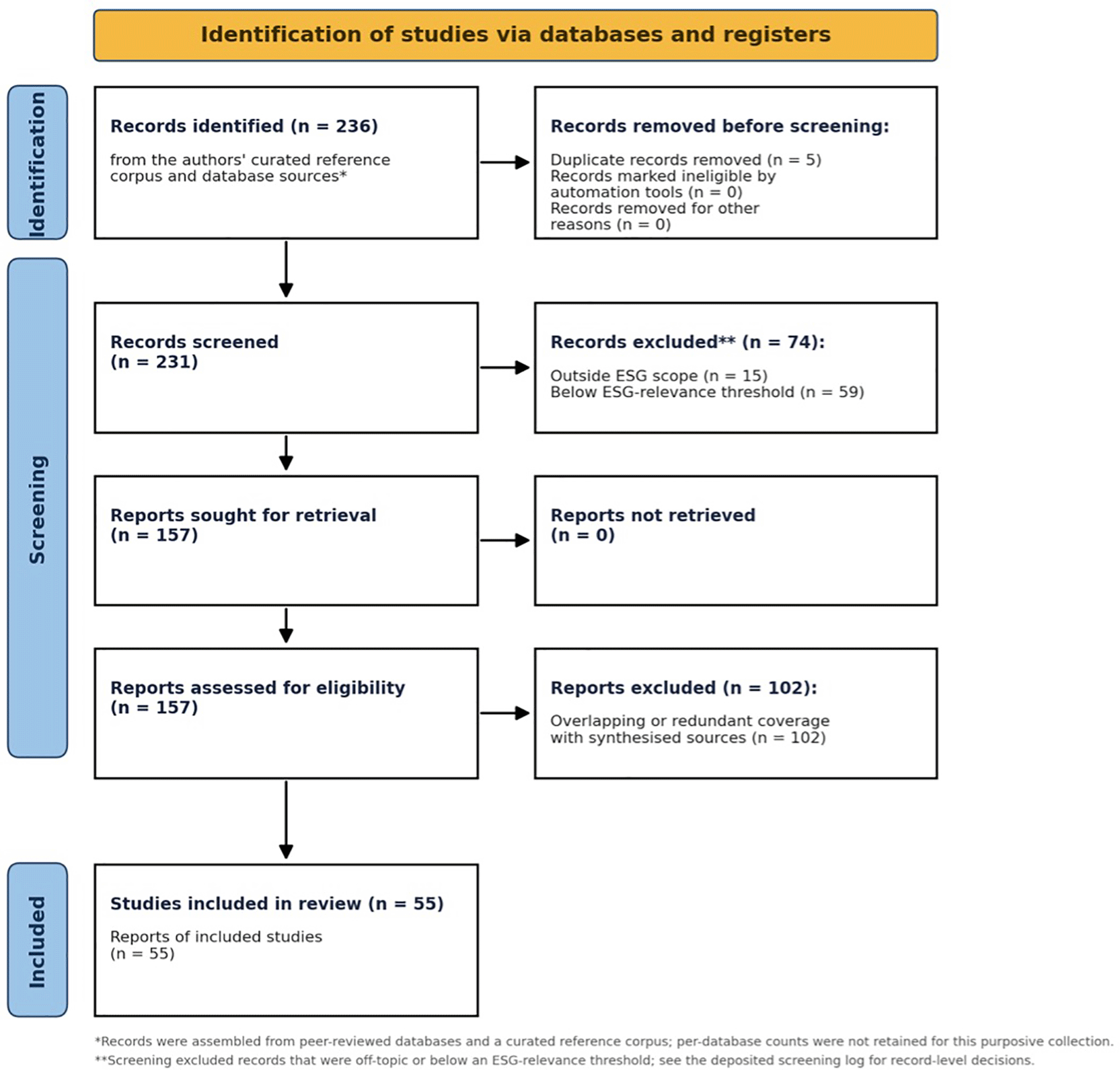
Source: Author, 2026.
Five theories anchor the synthesis. They were selected because each already does explanatory work in more than one of the three literatures being joined, which is the appropriate test for a conceptual integration. Agency and signaling theory recur in the finance work on disclosure and ratings (Connelly et al., 2011; Gibson Brandon et al., 2021). Legitimacy and institutional theory recur in the accounting and governance work on why firms report and why practice varies across countries (Deegan, 2002; Marquis et al., 2016). Stakeholder theory sits underneath the whole field as the account of whose interests the firm is answering to (Mitchell et al., 1997). A theory was admitted to the framework only when it explained a relationship that the evidence had already documented.
For each synthesised source we recorded bibliographic details, the theme it addressed, the theory or theories it invoked, and its central claim. Bibliographic fields were extracted directly from the source documents to avoid transcription error. Coding proceeded in two passes. The first assigned each source to one of the three themes. The second assigned each source to the theory it used and to the chain link it informed, so that the same source could appear under more than one construct where the text warranted it. The coding matrices and the proposition-evidence map are openly deposited. Synthesis was thematic and then integrative: we first summarised what each theme establishes, then read the themes against the five theories, and finally combined the result into a chain model expressed as seven propositions and one figure. The mapping of propositions to their supporting sources is reported in Table 4.
The coding scheme was kept deliberately simple so that it could be applied consistently and checked by others. Theme codes were treated as mutually exclusive at the level of a source’s primary contribution, while theory codes and chain-link codes were allowed to overlap, because a single study often speaks to more than one mechanism. For each proposition, a source was recorded as supporting evidence when it provided either a direct empirical test or an explicit theoretical argument for the stated relationship, and that distinction between empirical and theoretical support was preserved in the underlying matrix. Ambiguous cases were resolved by returning to the full source text rather than to its abstract. The resulting matrices are descriptive rather than quantitative; they record where the literature speaks to each link, not a pooled effect size, which would require a homogeneity of measures that this body of work does not have (Berg et al., 2022; Friede et al., 2015).
The corpus was deliberately heterogeneous in source type. It combined empirical studies, review articles, and conceptual pieces, so that the synthesis could draw on both primary evidence and earlier attempts to organise the field, and it included primary legal and standard-setting texts rather than only commentary on them, because a review of regulation that never reads the regulation risks repeating second-hand summaries. Where a work existed in more than one version, for example a working paper later published in a journal, the most authoritative version was used for coding and the others were marked as duplicates in the screening log. This breadth suits an integrative review, whose purpose is to connect findings produced under different methods and assumptions, but it also means the corpus is a purposive collection rather than a probability sample, so the counts in Table 1 describe this collection and not the population of all ESG research.
Three limits of the method should be stated at the outset rather than reserved for the discussion. First, a conceptual framework cannot prove the relationships it proposes; the propositions are claims to be tested, not findings. Second, any synthesis reflects the corpus it draws on, and this corpus leans toward European and North American regulation and toward large listed firms, so the framework travels less well to small firms and to jurisdictions with thinner enforcement. Third, source selection and coding involve judgement; we mitigated this by recording decisions at the record level and by depositing the screening log and coding matrices so that others can inspect, reproduce, and challenge them. No primary data were collected, and the study involved no human or animal participants.
The screened corpus concentrates on three topics, and the distribution itself is a finding. Of the 157 records that met the relevance threshold, the largest group concerns regulation and disclosure, a second sizeable group concerns ESG ratings and their measurement, and a third concerns the link between ESG and financial performance, with a smaller set devoted to underlying theory. The clustering shows that the field has matured into three semi-independent conversations, which supports the premise of this review: the literature is large enough to be specialised and specialised enough to have lost sight of the connections between its parts. Most of the synthesised work is recent, with the bulk published after 2015, the period in which voluntary ESG reporting began to harden into regulation. The thematic composition of the synthesised evidence base is shown in Figure 2, and the screening counts are summarised in Table 1.
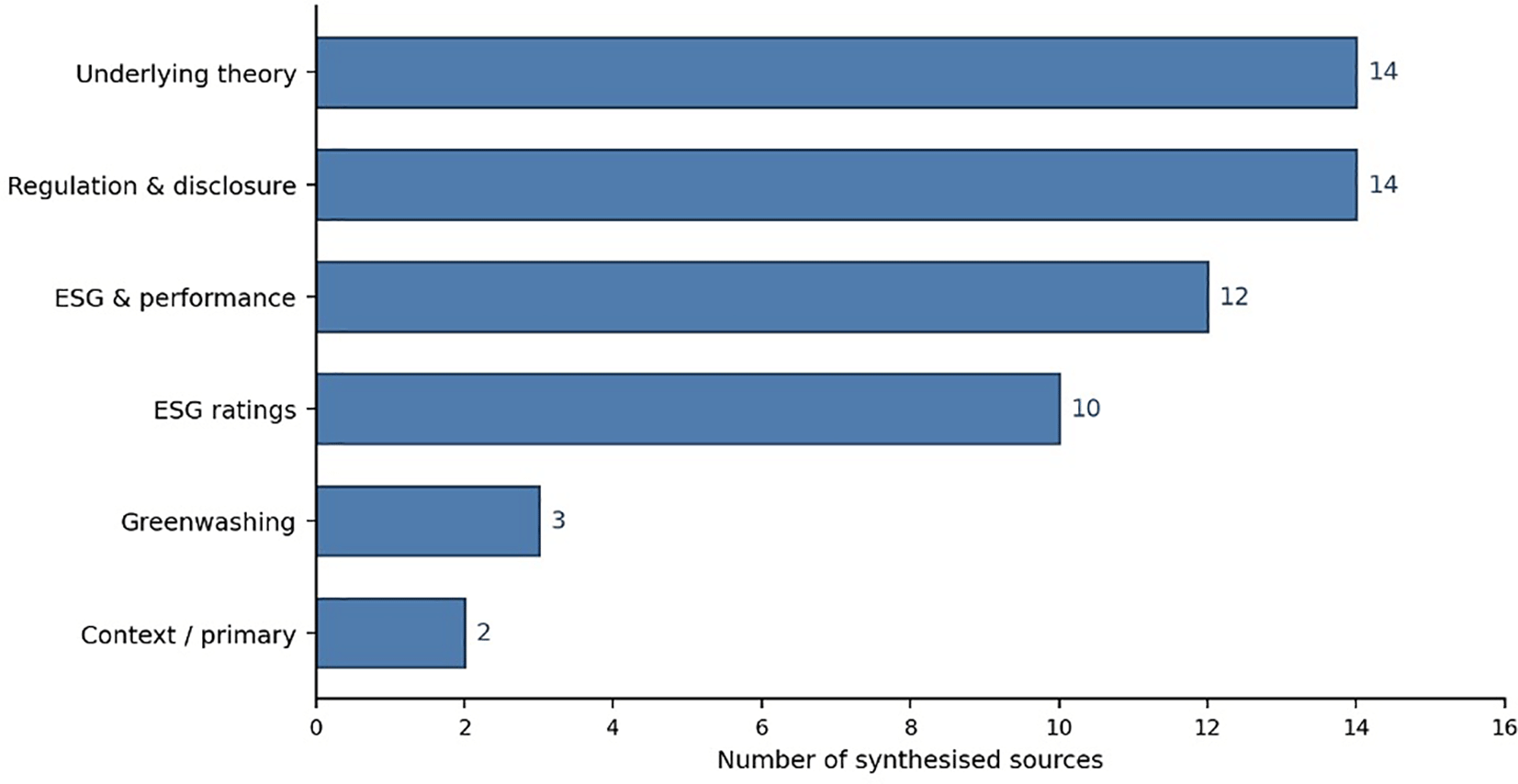
Source: Author, 2026.
Sources are grouped by the primary theme assigned in the review’s coding. The distribution mirrors the three substantive conversations in the field, with underlying theory forming a fifth, cross-cutting group. ESG, environmental, social, and governance.
The same overview exposes a gap. Few records cross more than one theme. Papers on rating divergence rarely connect their findings to the disclosure rules that produce the underlying data, and papers on the ESG-performance relationship rarely condition their results on the quality of the ratings they use as inputs. This is the gap the present synthesis addresses, and the three thematic subsections below are written so that each closes with the link to the next.
Two further features of the corpus shape how its evidence should be read. First, it is recent and fast-moving: most synthesised work appeared after 2015, and several of the regulatory sources postdate 2020, so the field is documenting a system still being built rather than one in steady state. Conclusions about regulation in particular should be read as describing a trajectory, not a settled regime. Second, the corpus is methodologically mixed, combining large-sample empirical studies, focused case and survey work, and conceptual and legal analysis. These traditions ask different questions and accept different kinds of evidence. An integrative synthesis treats that mix as an asset, because a mechanism that appears in both an empirical finding and an independent theoretical argument is better supported than one that rests on either alone, but it also means the review reports a convergence of reasoning rather than a single pooled statistic.
ESG began as a voluntary argument to investors and only later became law, and that trajectory explains why regulation now sits at the head of the chain. The term entered circulation through a 2004 report convened by the United Nations Global Compact, which urged the financial industry to integrate environmental, social, and governance issues into analysis, asset management, and brokerage (United Nations Global Compact, 2004). The framing was deliberate: ESG was offered as a matter of long-term value rather than ethics added on top of finance, and that investor-facing sense still shapes how the field defines what is material today (Amel-Zadeh & Serafeim, 2018). The point to carry forward is that ESG started as persuasion addressed to markets, so its later movement into binding rules is a change in kind, not only in degree.
ESG also overlaps with older ideas, and the overlap introduces definitional noise that any framework must absorb. Corporate social responsibility predates ESG by decades and supplies much of its content, yet the two are not identical: corporate social responsibility is a construct about a firm’s obligations to society, while ESG is closer to a measurement scheme for investors (Carroll, 1999; Gillan et al., 2021). Treating them as interchangeable, which both practice and scholarship often do, imports the normative weight of one into what is presented as a neutral metric of the other.
The decisive development of the last decade is that ESG disclosure stopped being only voluntary. Voluntary frameworks built the vocabulary first, through reporting guidelines and integrated reporting that firms could adopt at will, and those frameworks later widened to track the United Nations Sustainable Development Goals (International Integrated Reporting Council, 2021; Tsalis et al., 2020). Regulation then converted parts of that vocabulary into obligation. The European Union’s Corporate Sustainability Reporting Directive is the clearest case, extending sustainability reporting to a large population of companies and requiring assurance of what they report ( European Parliament and Council of the European Union, 2022). This matters because a mandate changes the supply of information at its source: it sets who must report, on what, and with what verification, and everything downstream depends on those choices.
A mandate does not settle the question it appears to settle, which is why regulation begins the chain rather than completing it. The most careful review of the economics of mandated reporting concludes that requirements can raise the quantity and consistency of disclosure while leaving real effects on firm behaviour and capital allocation uncertain, because disclosure rules interact with enforcement, incentives, and the way information is used (Christensen et al., 2021). Legal scholarship makes a parallel point: ESG regulation has been shifting from a financial, investor-protection model toward an entity model that asks firms to account for their impact on the world, and the two models pull disclosure in different directions (MacNeil & Esser, 2022).
ESG regulation is also not one instrument but several, and separating its forms is necessary because each enters the chain at a different point. At least five types appear in the corpus. Disclosure mandates require firms to report and set the supply of information ( European Parliament and Council of the European Union, 2022). Classification rules, of which the European Union taxonomy of sustainable activities is the leading case, define what counts as green and discipline the labels that disclosure and ratings rely on (Dumrose et al., 2022). Due-diligence duties go beyond reporting and ask firms to identify and address harms in their operations and supply chains, the entity model that legal scholarship describes (MacNeil & Esser, 2022). Assurance requirements demand that what is reported be independently checked (Channuntapipat et al., 2020; Krasodomska et al., 2021). Stewardship arrangements work through investors rather than firms, using ownership to push portfolio companies toward stronger conduct (Dyck et al., 2019). These five types are summarised in Table 2, which records the instrument, its bindingness, and the point at which it enters the chain.
The history behind these types also explains a structural problem the rest of the chain inherits. The vocabulary of ESG disclosure was built by many bodies at once rather than by a single authority, and competing voluntary frameworks each defined their own metrics. Even after consolidation efforts, the result is a reporting environment in which the same underlying activity can be described in several non-comparable ways (International Integrated Reporting Council, 2021; Tsalis et al., 2020). Regulation inherits this fragmentation when it codifies parts of the existing vocabulary, which is one reason a mandate can raise the amount of reporting without making reports comparable across firms (Christensen et al., 2021). The supply of disclosure, however shaped, is only the first link; what happens to that disclosure in the rating market is the next.
Rating agencies convert disclosure into scores, and the conversion is where comparable information is meant to emerge and frequently does not. The central, well-documented fact is that ESG ratings from major providers diverge, correlating far less than credit ratings do, and the divergence arises mainly from differences in what raters measure and how they measure it rather than from differences in how categories are weighted (Berg et al., 2022; Chatterji et al., 2016). Because raters read the same disclosures differently, more disclosure does not converge into one signal; it can feed several inconsistent ones. Detailed studies of rating construction show how scope and indicator choices are built into each provider’s model, so disagreement is structural rather than incidental (Escrig-Olmedo et al., 2019; Eccles & Stroehle, 2018).
The divergence is not random, and its structure carries consequences. Scores are shaped by firm characteristics that are not ESG conduct, most clearly firm size, since larger firms have the resources to disclose more and tend to receive higher scores partly for that reason (Drempetic et al., 2020; Gregory, 2022). The way agencies translate indicators into organisational goals can also push firms toward selective rather than holistic improvement (Veenstra & Ellemers, 2020). Disagreement among raters then feeds markets directly: when raters disagree more about a firm, that disagreement is associated with higher return volatility and a measurable effect on prices (Gibson Brandon et al., 2021; Billio et al., 2021). The implication is that the rating layer adds noise of its own, so the information reaching investors is a function of both what firms disclose and how intermediaries process it.
Divergence also changes what a rating means, not only how precise it is. If two reputable providers disagree about a firm by a wide margin, a single score cannot be read as a measurement of an underlying quality in the way a credit rating approximates default risk; it is better understood as one provider’s model of a contested construct (Eccles & Stroehle, 2018; Escrig-Olmedo et al., 2019). Efforts to discipline the construct from the regulatory side, such as classification rules that define which activities count as sustainable, interact with ratings in complex ways and do not by themselves remove disagreement (Dumrose et al., 2022). The rating layer therefore cannot be treated as a neutral pass-through from disclosure to investor; it is an active site where the signal is shaped, degraded, or amplified. That noise sets up the third theme, because it conditions whether ESG information can move performance at all.
ESG information can affect firm performance, but the effect is conditional, and stating the condition is more useful than restating the average. The largest evidence base, which aggregates thousands of studies, finds that the relationship between ESG and financial performance is non-negative far more often than not, which rules out the claim that ESG systematically destroys value (Friede et al., 2015; Gillan et al., 2021). Firm-level studies in single markets echo the pattern, linking stronger ESG performance to higher accounting and market performance (Velte, 2017; Alareeni & Hamdan, 2020). The mechanism that makes the relationship positive is selective: it is material ESG information, the issues that matter for a given industry, that is priced and predicts performance, while immaterial disclosure adds little (Khan et al., 2016; Grewal et al., 2021).
The performance link also runs through risk, which gives it a different and more stable shape than a simple returns story. ESG strengths are associated with lower risk exposure and greater resilience, visible most sharply when firms with stronger environmental and social profiles held up better during the COVID-19 market shock (Albuquerque et al., 2020; Ferriani & Natoli, 2021). Theory connects this to value through the cost of capital: credible ESG conduct lowers perceived risk, and lower perceived risk lowers the cost of capital, consistent with both the agency and signaling accounts of why information about conduct is priced (Albuquerque et al., 2019; Krueger et al., 2020). Portfolio theory makes the conditional nature explicit, since ESG information can raise or lower risk-adjusted returns depending on whether the market has already priced it, which is the logic of the ESG-efficient frontier (Pedersen et al., 2021).
The channel matters for interpretation as much as for the size of any effect. A risk-based effect implies that ESG information helps mainly by revealing exposures that would otherwise be mispriced, which is consistent with the resilience observed under stress and with survey evidence that investors treat climate and regulatory risk as financially material (Krueger et al., 2020; Ferriani & Natoli, 2021). A returns-based effect, by contrast, would require that the market persistently underprices responsible firms, a stronger claim that the aggregate evidence supports only weakly and conditionally (Friede et al., 2015). Distinguishing the two channels is therefore not a technicality; it determines whether ESG is best understood as risk management, as a source of excess return, or as neither, and the answer plausibly differs across firms and periods. Read together, the three themes form a sequence: regulation supplies disclosure, ratings process it into a noisy signal, and the market prices that signal through risk and valuation. The theories reviewed next explain why each step behaves as it does.
The synthesised evidence is not uniform, and reading the disagreements carefully is more useful than averaging over them. Within the performance theme, estimated ESG-performance relationships vary with the rating used, the period studied, the region, and the dependent variable. A chain model predicts exactly this pattern: if the rating input is noisy and the effect runs through specific channels, then pooling across noisy inputs and mixed channels will produce a scattered average (Friede et al., 2015; Berg et al., 2022). Much of the long-running debate over whether ESG pays has therefore compared studies that were not measuring the same construct. The more tractable questions are narrower, namely which ESG issues are material for which industries, whether the disclosed information was credible, and through which channel, risk or returns, any effect is supposed to travel (Khan et al., 2016; Pedersen et al., 2021).
The same caution applies to the ratings theme. Disagreement among providers is not a sign that one rater is right and the others wrong; it reflects genuine differences in scope and measurement that are built into each provider’s model of a contested construct (Eccles & Stroehle, 2018; Escrig-Olmedo et al., 2019). Studies that treat a single commercial score as ground truth therefore inherit one provider’s choices without acknowledging them, which is a source of fragility in the empirical literature that the chain framework makes visible. Recognising heterogeneity as structural, rather than as noise to be averaged away, is part of what an integrative reading contributes: it reframes scattered results as evidence about where in the chain measurement is happening, not as a failure of the field to reach consensus.
Five theories recur across the three themes, and each explains a different link in the chain rather than the whole of it. Table 3 maps each theory to the link it governs and the sources that carry it, and the paragraphs below set out the reasoning.
| Theory | Core idea | Link it governs | Key sources |
|---|---|---|---|
| Stakeholder | Firms answer to salient stakeholders, ranked by power, legitimacy, and urgency | Why ESG matters; demand for disclosure | Mitchell et al. (1997); Donaldson & Preston (1995) |
| Legitimacy | Firms disclose to protect social standing, which can also produce façades | Supply of disclosure; greenwashing | Suchman (1995); Deegan (2002); Cho et al. (2015) |
| Institutional | Isomorphic pressures and local enforcement shape practice | Regulation to disclosure; cross-country variation | DiMaggio & Powell (1983); Marquis et al. (2016) |
| Agency | Owner-manager conflict; disclosure as a monitoring device | Demand for ESG information; governance | Jensen & Meckling (1976); Naciti et al. (2022) |
| Signaling | A credible signal must be costly to imitate | Disclosure and ratings to market response | Spence (1973); Connelly et al. (2011); Khan et al. (2016) |
Stakeholder theory explains why ESG matters to the firm at all. The firm is a set of relationships with groups that affect or are affected by its conduct, and managing those relationships is part of management (Donaldson & Preston, 1995). The theory becomes analytically useful once stakeholders are ranked, and the salience model ranks them by power, legitimacy, and urgency, which predicts which ESG issues a firm attends to first (Mitchell et al., 1997). Powerful institutional owners have been shown to push firms toward stronger social and environmental conduct across countries, which is salience operating through ownership (Dyck et al., 2019). The same logic implies that where salient stakeholders are indifferent, pressure produces disclosure without substance.
Legitimacy theory explains why firms disclose, locating the motive outside the firm’s own preferences. Legitimacy is a generalised perception that an organisation’s actions are proper within a socially constructed system of norms, and firms manage it because losing it is costly (Suchman, 1995). Applied to reporting, the theory predicts that firms disclose to protect or repair standing, a prediction supported by the classic finding that firms increase environmental disclosure after events that threaten their legitimacy (Patten, 1992; Deegan, 2002). The theory also predicts the field’s central pathology, because disclosure that manages perception can be produced without changing conduct, yielding reports that function as a façade (Cho et al., 2015).
Institutional theory explains why ESG practice looks similar within a setting and different across settings. Organisations in a shared field come to resemble one another through coercive, mimetic, and normative pressures, a convergence the theory calls isomorphism (DiMaggio & Powell, 1983). This accounts for adoption that spreads faster than evidence of benefit would justify. The same theory explains cross-country variation, because the meaning and enforcement of ESG vary with the local legal and normative environment, and firms calibrate disclosure to the scrutiny they actually face (Marquis et al., 2016). Evidence that a firm’s responsibility rating is strongly associated with its country’s legal origin makes the point from the data side (Liang & Renneboog, 2017), as does the broader governance literature linking national institutions to sustainability outcomes (Naciti et al., 2022).
Agency theory returns the synthesis to the classic problem of separated ownership and control. Managers act as agents for owners, their interests do not align by default, and the resulting costs are reduced through monitoring and disclosure (Jensen & Meckling, 1976). ESG disclosure is therefore partly an instrument of governance, which is why governance quality and ESG reporting tend to move together (Naciti et al., 2022). The same discretion that lets managers disclose, however, lets them use ESG spending to build reputation or pursue private goals, so ESG is not automatically value-creating from a governance standpoint.
Signaling theory explains how ESG information moves a market. When one party knows more than another, the informed party can communicate quality through costly, hard-to-imitate signals, and the signal works only to the extent that imitation is expensive (Spence, 1973; Connelly et al., 2011). ESG disclosure and strong ratings can act as such signals, which is the mechanism behind evidence that material ESG information is priced and that disclosure can lower the cost of capital (Khan et al., 2016; Grewal et al., 2021). The theory carries the hinge of the whole framework: a signal separates good firms from bad ones only when it is costly to fake, so if disclosure is cheap to produce and hard to verify, low-quality firms can send the same signal as high-quality firms and the signal stops being informative. This is why assurance occupies a specific place in the model (Channuntapipat et al., 2020).
Reading the three themes against the five theories brings several tensions into focus that no single study resolves. The first is comparability against flexibility. Regulators and standard-setters want disclosure that is comparable across firms, yet the same materiality logic that makes ESG information useful is industry-specific, so a rule rigid enough to force comparability may suppress the very detail that makes a disclosure decision-relevant (Khan et al., 2016; Christensen et al., 2021). The literature has not settled where that balance should sit.
The second tension concerns the object of measurement itself. Financial materiality asks what sustainability does to the firm, while double materiality also asks what the firm does to society and the environment, and the two lenses imply different metrics, different audiences, and different thresholds for what must be reported (Adams & Abhayawansa, 2022; MacNeil & Esser, 2022). A rating or a rule built for one lens will look incomplete from the other, which is part of why providers disagree and why harmonisation efforts are contested.
The third tension is whether ESG ratings should converge at all. Credit ratings converge because they approximate a single, eventually observable outcome, default. ESG has no equivalent single outcome, so persistent divergence may be the honest reflection of a multidimensional construct rather than a defect to be engineered away (Berg et al., 2022; Chatterji et al., 2016). If that is correct, then calls for a single authoritative ESG score may be asking the measurement system to deliver a certainty the underlying concept does not support.
The fourth tension is ambition against burden, and it has become openly political. Each added reporting requirement raises the cost of compliance, and as mandates have widened, the question of how much disclosure is proportionate has moved from a technical debate into a contested policy choice (Christensen et al., 2021). The behavioural responses sit on both sides of this tension: firms can over-claim, which is greenwashing, or deliberately under-report genuine practice to avoid scrutiny and liability, which has been termed greenhushing (Delmas & Burbano, 2011; Lyon & Montgomery, 2015; Font et al., 2017). Both responses break the link between what is disclosed and what is done, and both are rational for a firm facing high legitimacy pressure and uncertain rules. A framework that treats greenwashing as a moderator on every link, rather than as a discrete topic, is one way to keep these unresolved tensions in view while still saying something testable about how the system behaves.
The synthesis can be stated as one model with three links and one moderator. The propositions below name each connection where theory and evidence support a testable claim; their supporting sources are listed in Table 4.
| Proposition | Chain link | Governing theory | Selected supporting sources |
|---|---|---|---|
| P1 | Regulation → disclosure (volume) | Institutional | Christensen et al. (2021); DiMaggio & Powell (1983); European Parliament and Council (2022) |
| P2 | Regulation → disclosure (quality) | Legitimacy; signaling | Cho et al. (2015); Michelon et al. (2015); Channuntapipat et al. (2020) |
| P3 | Disclosure → ratings (divergence) | Measurement | Berg et al. (2022); Chatterji et al. (2016); Escrig-Olmedo et al. (2019) |
| P4 | Disclosure → ratings (noise to market) | Signaling | Drempetic et al. (2020); Gibson Brandon et al. (2021); Billio et al. (2021) |
| P5 | Ratings/disclosure → performance (materiality) | Signaling; materiality | Khan et al. (2016); Grewal et al. (2021); Friede et al. (2015) |
| P6 | Ratings/disclosure → performance (risk channel) | Agency; signaling | Albuquerque et al. (2019); Krueger et al. (2020); Pedersen et al. (2021) |
| P7 | Greenwashing moderates all links | Legitimacy | Delmas & Burbano (2011); Lyon & Montgomery (2015); Maroun (2022) |
Regulation sets the supply of disclosure through coercive institutional pressure, so a mandate raises the baseline across the field rather than only among willing adopters (DiMaggio & Powell, 1983; Christensen et al., 2021). Yet higher volume is not higher quality, because firms facing a mandate can meet its letter while managing what the disclosure conveys (Cho et al., 2015; Michelon et al., 2015).
Mandatory ESG disclosure regimes increase the quantity and cross-firm consistency of ESG information relative to voluntary regimes, through coercive institutional pressure.
Mandatory disclosure raises the volume of ESG information more reliably than its quality; the quality effect depends on assurance and enforcement rather than on the mandate alone.
More disclosure does not produce convergent ratings, because divergence originates in measurement and scope, which more disclosure does not resolve (Berg et al., 2022; Chatterji et al., 2016). That divergence is partly driven by non-ESG characteristics such as size and is transmitted to markets as volatility (Drempetic et al., 2020; Gibson Brandon et al., 2021).
Greater disclosure does not produce convergent ESG ratings; divergence persists because it originates in measurement and scope.
ESG rating divergence introduces measurement noise that is partly driven by non-ESG firm characteristics such as size, and this noise is transmitted to market outcomes.
ESG relates to performance primarily where the information is material and credibly signalled, and more consistently through risk than through excess returns (Khan et al., 2016; Albuquerque et al., 2019; Pedersen et al., 2021).
ESG performance relates positively to firm financial performance primarily when the underlying information is material and credibly signalled; the relationship is weak or absent for immaterial or unverified disclosure.
The ESG-performance link is stronger and more consistent through the risk and cost-of-capital channel than through the excess-returns channel.
Greenwashing is the condition under which the whole chain fails to transmit a real signal, since selective disclosure decouples reports from conduct and ratings built on that disclosure inherit the distortion (Delmas & Burbano, 2011; Lyon & Montgomery, 2015). Verification is the countervailing force that raises the cost of a false signal (Channuntapipat et al., 2020; Maroun, 2022).
Greenwashing moderates the entire chain: as the gap between disclosed and actual ESG conduct widens, the regulation-to-disclosure, disclosure-to-rating, and rating-to-performance links each weaken, and assurance attenuates this effect.
The seven propositions describe a single model, and stating it whole reveals what the parts cannot. Regulation sets the supply of disclosure (Propositions 1 and 2); disclosure is processed by rating intermediaries whose divergence adds noise (Propositions 3 and 4); disclosure and ratings together reach the market, where they relate to performance mainly through risk and the cost of capital (Propositions 5 and 6); and greenwashing moderates every link, with assurance as the check (Proposition 7). Each link is governed by a specific theory: institutional pressure converts regulation into disclosure, legitimacy and agency motives shape what firms disclose, measurement and scope decisions drive rating divergence, and signaling governs whether the market reads the result as credible. Figure 3 presents the framework.
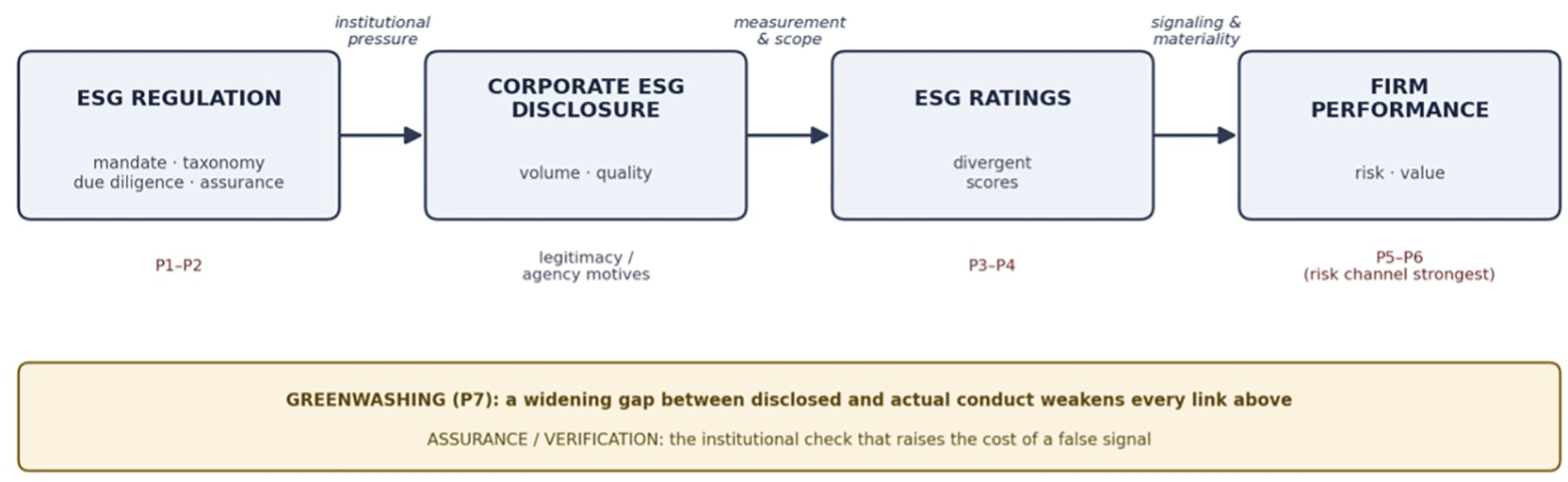
Source: Author, 2026.
The framework yields one claim that none of the contributing literatures states on its own. Because greenwashing moderates every link, the chain transmits a real signal only when its weakest defence against decoupling holds, which means a policy that strengthens one link while leaving another exposed will underperform its design. A disclosure mandate without assurance strengthens supply but leaves the signal forgeable. A rating market without agreed measurement strengthens coverage while fragmenting the signal. The integrated view makes these failure modes visible as properties of the system rather than as separate problems.
The figure shows the causal chain from regulation to market outcome. Reading from left to right, ESG regulation sets the supply of corporate ESG disclosure, rating intermediaries convert that disclosure into divergent scores, and disclosure and ratings together relate to firm performance through risk and valuation. Labels above each arrow name the governing mechanism: institutional pressure, measurement and scope, and signaling and materiality. The band beneath the chain shows greenwashing as a moderator that weakens every link, with assurance and verification as the institutional check that raises the cost of a false signal. ESG, environmental, social, and governance.
The framework is a description of how the chain tends to behave, not a law that holds with equal force everywhere, and naming its boundary conditions is part of stating it honestly. Three conditions matter most. The first is enforcement. The whole chain assumes that a disclosure rule is actually monitored and that a false signal carries some cost; where enforcement is nominal, the regulation-to-disclosure link weakens and the moderating effect of greenwashing grows (Christensen et al., 2021; Marquis et al., 2016). The second is the maturity of the assurance market. Verification is the mechanism that turns disclosure quantity into quality, so in settings where independent assurance is scarce or shallow, the chain carries a weaker signal regardless of how demanding the disclosure rule looks on paper (Channuntapipat et al., 2020; Krasodomska et al., 2021). The third is investor attention. The performance link runs through investors who price the signal, so it is strongest where owners are large, long-horizon, and ESG-oriented, and weaker where ownership is fragmented or indifferent (Dyck et al., 2019; Krueger et al., 2020).
These conditions also bound the framework’s external validity. The corpus that informs it is weighted toward large, listed firms in European and North American markets, so the chain is best understood as calibrated to that setting. In private firms, the disclosure and rating links are thinner because reporting obligations and rating coverage are sparser. In emerging markets, mandates are newer and verification is developing, so the same rule should be expected to transmit a weaker signal until the surrounding infrastructure matures (Liang & Renneboog, 2017). Stating these limits is not a concession that the framework is wrong; it is a specification of where its links should be strong, where they should be weak, and therefore where the propositions are most worth testing.
The review establishes that three literatures usually read in isolation describe one connected process. Regulation determines the supply of ESG disclosure, rating intermediaries turn that disclosure into divergent scores, and the market prices the result mainly through risk and the cost of capital. The unifying problem across all three links is the credibility of information rather than its quantity. This reframing matters because it shows that the parts constrain one another: a gain at one link can be undone by a weakness at another, which is invisible when each literature is read alone.
A second principal finding follows: credibility, not quantity, is the binding constraint on the whole system. Each link can be expanded on its own, more disclosure, more ratings, more studies, without improving the signal that reaches a decision-maker, because expansion at one link does nothing for credibility at another. This is why the review keeps returning to verification, since assurance is the only element in the chain that directly raises the cost of a false signal and is therefore the lever with the most influence over the system as a whole (Christensen et al., 2021; Maroun, 2022). The finding reframes a decade of growth in ESG reporting and rating as necessary but not sufficient, and it locates the next gains in verification rather than in volume.
The synthesis also clarifies an apparent contradiction in the evidence. Studies that find weak or mixed performance effects and studies that find positive ones can both be correct if they sit at different points in the chain or under different moderating conditions, because a positive materiality effect (Khan et al., 2016) and a noisy rating layer (Berg et al., 2022) coexist by construction in this model. Reading the literature as one chain rather than as competing claims turns the contradiction into a question about where measurement occurs and whether the signal was credible.
The first theoretical implication is that no single theory explains ESG, and the habit of reaching for one is part of why the field’s findings look inconsistent. Legitimacy theory explains the supply of disclosure but predicts façades as readily as substance (Suchman, 1995; Cho et al., 2015). Signaling theory explains market response but only conditional on credibility (Connelly et al., 2011). Institutional theory explains cross-country variation but says little about a single firm’s value (Marquis et al., 2016). Assigning each theory to the link it explains, rather than asking one theory to carry the whole chain, lets the framework hold competing mechanisms together without forcing a choice among them.
The second implication concerns where future theory should concentrate. Because the moderator, greenwashing, acts on every link, the most consequential theoretical work is on the conditions that keep disclosure tied to conduct. The same legitimacy pressure that drives reporting also creates the incentive to decouple it from action, and firms can manage this in two directions: by over-claiming, which is greenwashing, or by deliberately under-reporting genuine practice to avoid scrutiny, which has been termed greenhushing (Font et al., 2017). A theory of credible ESG signalling has to account for both.
There is also a constructive implication for theory-building. The field has tended to import one theory at a time and test it in isolation, which produces parallel literatures that rarely speak to each other. Treating the theories as complementary, each governing a different link, suggests a different programme: specify the full chain, attach the appropriate mechanism to each transition, and examine the links jointly rather than singly. That approach would let a finding about signaling at the market link be read in light of institutional pressure at the disclosure link, which is closer to how the system actually operates than any single-theory test can be (Connelly et al., 2011; DiMaggio & Powell, 1983).
For regulators, the practical message is that a disclosure mandate is necessary but not sufficient, and the sufficiency condition is verification. The economics of mandated reporting already warns that requirements do not guarantee real effects (Christensen et al., 2021), and the framework specifies why: without assurance, a mandate raises volume while leaving the signal forgeable, so greenwashing can absorb the policy’s intent. The actionable reading is that the assurance requirement attached to a regime such as the European directive is not a secondary detail but the part that determines whether the rest works ( European Parliament and Council of the European Union, 2022; Maroun, 2022).
For investors and managers, the framework reframes ESG ratings as inputs to interpret rather than verdicts to accept. Because divergence is structural and partly driven by firm size and measurement choices, a single score should be read as one rater’s contestable model, and disagreement across raters carries information of its own about uncertainty (Gibson Brandon et al., 2021; Drempetic et al., 2020). For managers, the same logic implies that chasing a higher score is not the same as improving conduct, and that the durable value of ESG runs through material risk reduction rather than through the rating itself (Khan et al., 2016; Albuquerque et al., 2019). The broader market context reinforces the stakes, since the growth of green finance has outpaced the evidence on what it delivers, and survey work shows that the limits of the field are recognised by practitioners as well as scholars (Gilchrist et al., 2021).
A further practical implication concerns how organisations set internal targets. When firms manage to a rating rather than to the underlying conduct the rating is meant to capture, they can improve the score while leaving real impact unchanged, and the design of rating systems can encourage exactly this narrowing of attention (Veenstra & Ellemers, 2020). The framework suggests a corrective: tie internal goals to the material issues that drive risk in the firm’s own industry, and treat external scores as one noisy check rather than the objective. For boards, this reframes ESG oversight as a question about the credibility and materiality of what the firm discloses and does, not about the level of any single agency’s score.
The framework is a template, not a constant, and its links vary in strength across institutional settings. Institutional theory predicts as much, since the meaning and enforcement of ESG depend on the local environment, and firms calibrate disclosure to the scrutiny they face (DiMaggio & Powell, 1983; Marquis et al., 2016). The data agree: a firm’s responsibility rating is strongly associated with the legal origin of its country, so national institutions explain a large share of ESG outcomes that the firm itself does not (Liang & Renneboog, 2017). In jurisdictions with weaker assurance markets, the disclosure-to-rating and rating-to-performance links are more exposed to the greenwashing moderator, because the institutional check that raises the cost of a false signal is itself underdeveloped. At the macro level, the relationship between ESG performance and economic outcomes also appears to depend on context rather than holding uniformly (Diaye et al., 2022). The framework does not predict that ESG regulation fails in these settings; it predicts that the same rule carries a weaker signal until the verification infrastructure around it matures.
The framework speaks to the present push for a global baseline of sustainability disclosure. The appeal of a single standard is that it would reduce the fragmentation described in the regulatory theme and give rating providers a common input. The framework suggests where such an effort can and cannot help. Standardising what must be disclosed addresses the supply link and can raise comparability at the point of reporting (Christensen et al., 2021). It does less for the ratings link, because divergence there originates in how providers measure and weight what is disclosed, not only in what is available to them; harmonising inputs narrows but does not close the gap between scores (Berg et al., 2022; Chatterji et al., 2016). A realistic expectation, then, is that convergence on disclosure standards improves the raw material while leaving room for legitimate disagreement in its interpretation, which argues for transparency about rating methods rather than for the expectation of a single correct score.
Assurance is the part of standard-setting the framework elevates. Because the chain transmits a credible signal only when disclosure stays tied to conduct, the requirement that reports be independently checked is not an administrative detail but the mechanism that makes a mandate effective (Channuntapipat et al., 2020; Krasodomska et al., 2021; Maroun, 2022). Standard-setters that mandate disclosure without building the assurance market to verify it should expect the supply of reports to rise faster than their reliability, with greenwashing absorbing part of the intended effect. The entity model of regulation, which extends obligations from reporting toward due diligence over a firm’s actual impacts, can be read as an attempt to close this gap by regulating conduct and not only its disclosure (MacNeil & Esser, 2022). Whether that approach narrows the disclosure-to-conduct gap in practice is an open empirical question that the framework helps to pose.
The review’s strength is integrative scope combined with a transparent, deposited evidence base, which lets readers trace every claim to a coded source and reproduce the screening. Its limitations follow from its design. A conceptual framework cannot prove the relationships it proposes, so the seven propositions are testable claims rather than findings. The corpus leans toward European and North American regulation and large listed firms, which bounds the framework’s reach into small firms, private firms, and lower-enforcement jurisdictions. Coding involved judgement, mitigated but not removed by recording decisions at the record level. Finally, the regulatory landscape is moving while this is written, so the supply side of the chain should be treated as a moving target rather than a settled description.
Three directions follow. The first is to test the propositions empirically, beginning with the moderating role of assurance on the disclosure-to-rating link, where the data increasingly exist; the deposited codebook specifies the variables and providers for such a study. The second is to extend the framework to emerging-market and small-firm settings, where mandates are newer and verification thinner, to see which links hold and which break. The third is to track how the regulatory turn evolves as standards consolidate and as political support for ESG rules proves contested. The framework is offered as a structure for those questions: a way to keep regulation, ratings, and returns in one view, so that progress on any one of them can be read against the others.
Two methodological priorities cut across these directions. One is to report results against named ratings rather than a generic ESG score, since the synthesis shows that the choice of rating is itself a research-design decision with consequences for the estimate (Berg et al., 2022). The other is to measure assurance explicitly, because it is the moderator the framework identifies as decisive and the one most often missing from empirical models; datasets that record whether and how a firm’s disclosures were verified would allow direct tests of Propositions 2 and 7 (Channuntapipat et al., 2020). Building these two features into study designs would let future work adjudicate the framework rather than merely illustrate it.
The value of viewing ESG regulation, ratings, and performance as one chain is that it turns a set of separate debates into a single, testable account of how sustainability information is produced, interpreted, and priced. The account is deliberately modest about what it proves and specific about what it claims, and its propositions are written to be falsified. Its main use is to make the next generation of empirical work sharper about where in the chain it is looking, and to remind regulators that the weakest link, not the loudest one, sets how much a disclosure regime can achieve.
| Views | Downloads | |
|---|---|---|
| F1000Research | - | - |
|
PubMed Central
Data from PMC are received and updated monthly.
|
- | - |
Provide sufficient details of any financial or non-financial competing interests to enable users to assess whether your comments might lead a reasonable person to question your impartiality. Consider the following examples, but note that this is not an exhaustive list:
Sign up for content alerts and receive a weekly or monthly email with all newly published articles
Already registered? Sign in
The email address should be the one you originally registered with F1000.
You registered with F1000 via Google, so we cannot reset your password.
To sign in, please click here.
If you still need help with your Google account password, please click here.
You registered with F1000 via Facebook, so we cannot reset your password.
To sign in, please click here.
If you still need help with your Facebook account password, please click here.
If your email address is registered with us, we will email you instructions to reset your password.
If you think you should have received this email but it has not arrived, please check your spam filters and/or contact for further assistance.

Comments on this article Comments (0)