Keywords
Polyominoes, Class, Enumeration, Succession-rule, Abacus diagram

This article is included in the Fallujah Multidisciplinary Science and Innovation gateway.
Polyominoes, Class, Enumeration, Succession-rule, Abacus diagram
In this revised version, we have substantially improved the manuscript in response to the reviewers’ comments. Several definitions have been clarified, and all variables are now consistently defined and used throughout the paper.
The statements and proofs of Lemma 11 and Theorem 12 have been revised to explicitly include all necessary assumptions and to ensure that the arguments are self-contained. In addition, Corollary 13 and Theorem 14 have been rewritten with unified notation and clearer combinatorial reasoning.
The application of the ECO method has been reconstructed in greater detail, including a clearer description of the generating tree and the associated succession rule. Furthermore, the derivation of the generating function has been completely rewritten from first principles, with a more detailed and rigorous presentation.
Finally, the overall language, structure, and readability of the manuscript have been carefully improved to enhance clarity and coherence. We believe that these revisions significantly strengthen the mathematical rigor and presentation of the work.
See the authors' detailed response to the review by Hayder R. Hashim
Polyominoes are finite configurations composed of unit squares, known as ominoes, that are joined edge to edge to form a connected interior, as illustrated in Figure 1.
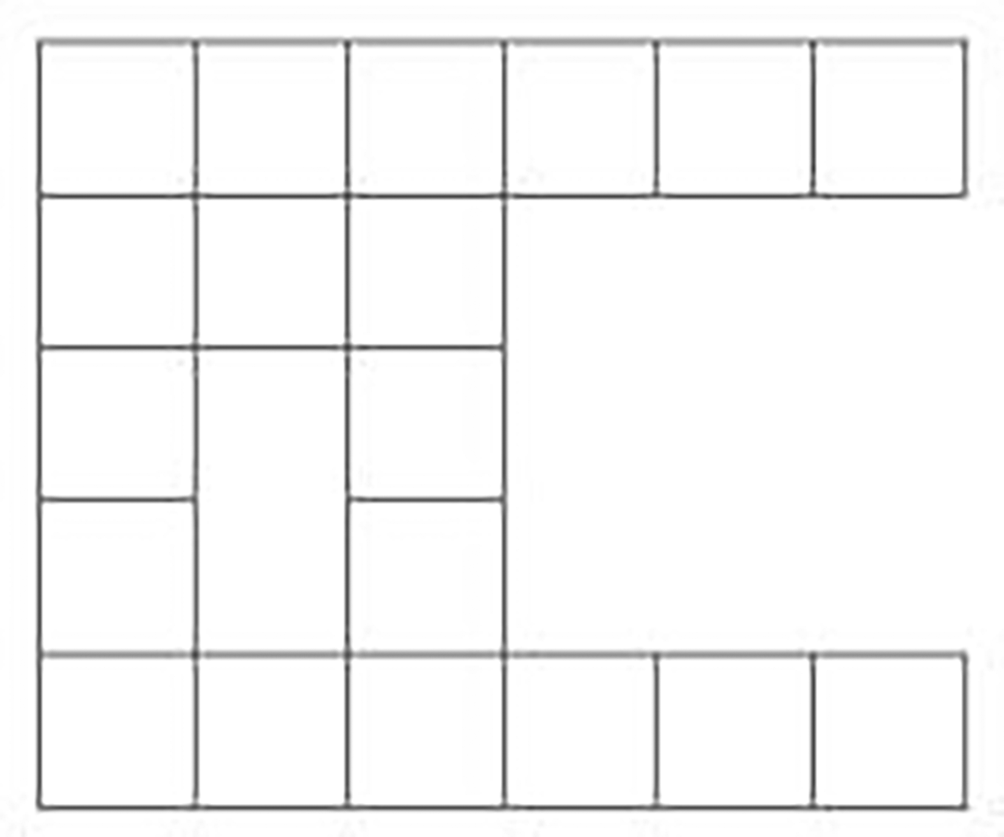
An -polyomino (a polyomino consisting of ominoes) is defined up to translation, and the concept is commonly attributed to Golomb.1 In contemporary research, n-polyominoes have attracted significant attention from computer scientists, physicists, mathematicians, and biologists. Despite extensive studies, enumerating n-polyominoes remains a challenging and unresolved problem in combinatorial geometry, representing one of its most fundamental open questions.2–5 There is no closed-form equation for n-polyominoes, and the problem has been solved up to n < 56.3 No closed-form expression for the enumeration of -polyominoes is currently known. Due to the complexity of this problem, several simpler subclasses of -polyominoes have been formulated and extensively examined in the literature.6–8 E.F. provide a new representation of n-polyominoes (Plyominoes with n ominoe) using one of the graphical representations of partition (James-diagram) called nested chain abacus (N.C.A.) with -columns and -rows.9 The Nested Chain Abacus (N.C.A.) offers a novel framework for representing any connected omino, including empty ones (holes), through the use of a beta number. In this new representation, -polyominoes are organised into a series of nested chains.10 A Nested Chain Abacus (N.C.A.) is an -polyomino inscribed within a James diagram, consisting of both outer and inner chains. The inner chains are numbered from 1 to , where is a positive integer, and chain 1 is the innermost chain. No intersections occur among any of the chains. Through this new representation, and for the first time, each n-polyomino has been systematically associated with a unique code. Next Figure 2 illustrates an example of an N.C.A. with six columns, five rows, and three chains.
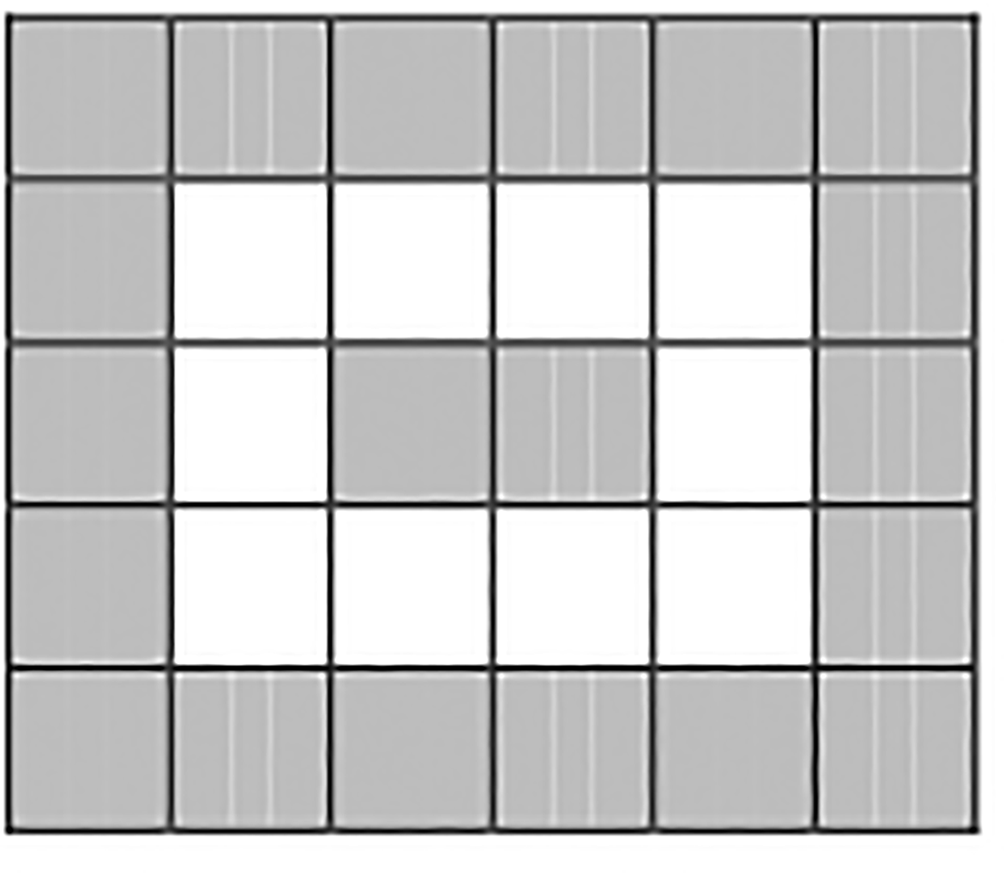
This section introduced some importuned definitions:
4A partition of a positive integer, , is a sequence of integers such that and .
is a partition of 19
4A sequence of positive numbers { called beta number such that and .
4James Abacus is a graphical representation of a partition of any integer number using beta numbers.
Consider Example 1, the James Abacus with 1,2,3,4,6,7,10,11 beta position as show in next Figure 3.
9A new representation of n-polyominoes (Plyominoes with n ominoe) using one of the graphical representations of partition (James-diagram) called nested chain abacus (N.C.A.) with b-columns and d-rows.
Next Figure 4 gives an example of N.C.A. with 3 chains represented of 94, where the beta number sequence is {0,5,6,7,8,9,10,11,14,15,16,19,20,21,24}.
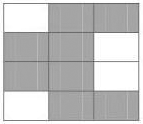
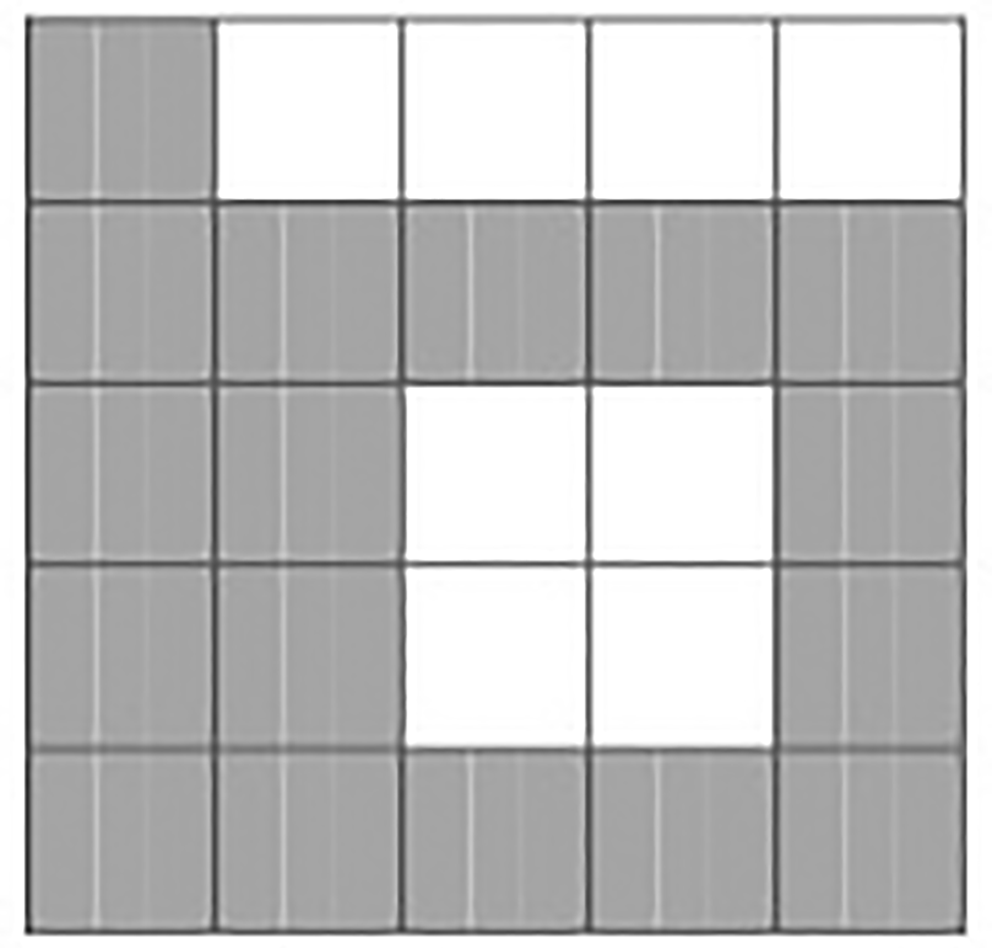
A connected chain is a chain with only beta positions.
Next Figure 5 gives an example of N.C.A. represented by a beta sequence {0,1,2,3,4,5,7,8,9,10,12,14,15,19,20,21,22,23,24} with one connected chain (chain 1).
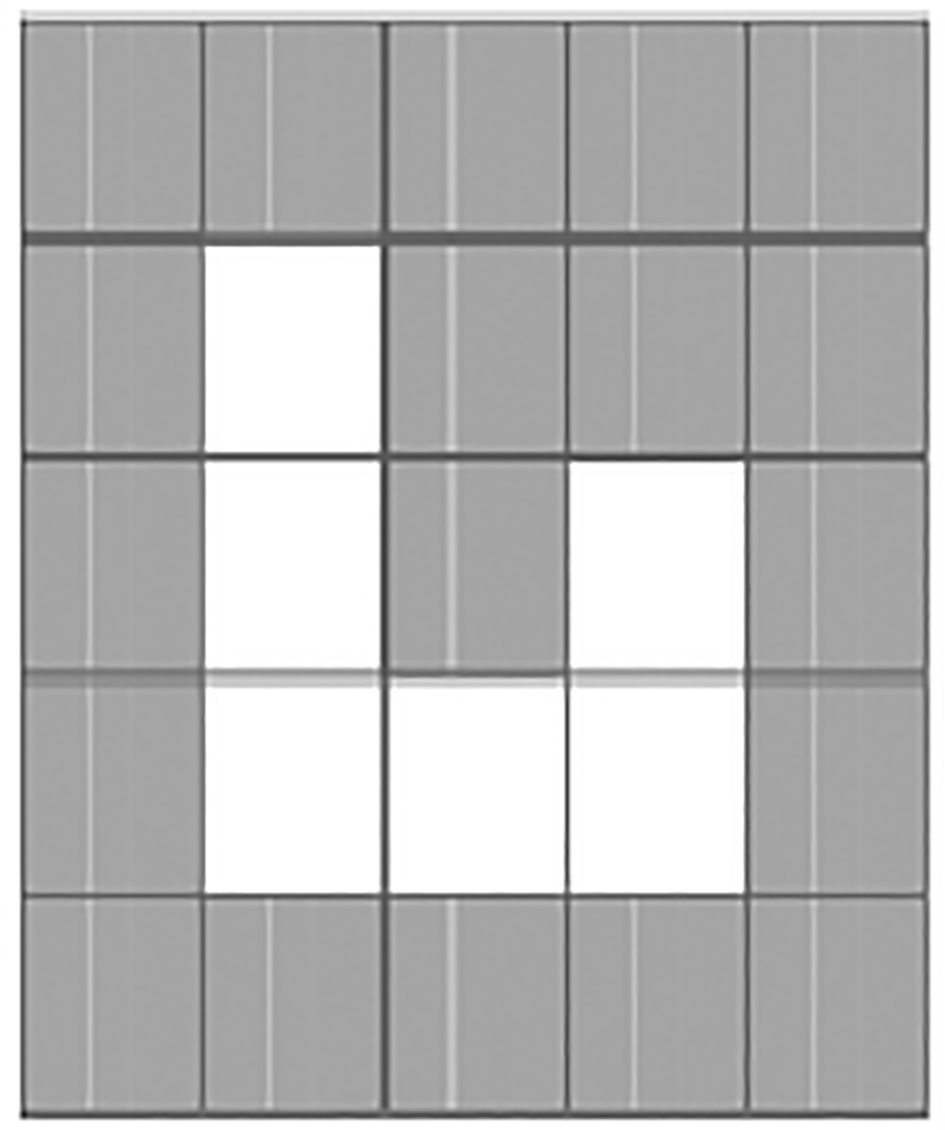
Each nested chain abacus (N.C.A.) with columns and b rows is called a polyamines if every two beta numbers are connected.
Let N.C.A. be a nested chain abacus consist of column and rows, and let be its chains, order from the innermost chain to the outermost chain. The NCA is called an -nested Abacus if the following condition are satisfied
1- First chain (initial chain) which consist exactly one position.
2- Every even chain ( may contain both beta position and empty beta position.
3- Every odd chain ( forms a connected chain.
Any polyomino represented by such a configuration is called an -nested Abacus polyomino.
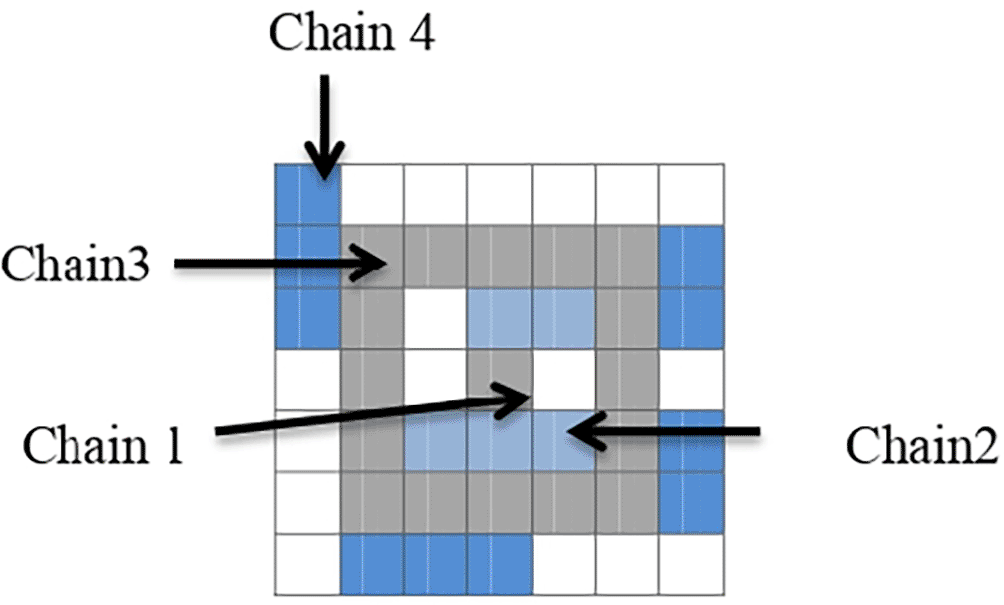
Figure 6 gives an example of -nested Abacus with four chains, where
Not Every polyamines inscribed in a nested chain-abacus is -nested Abacus.
Figure 4 given an example of N.C.A. but not -nested Abacus, while Figure 6 given an example of -nested Abacus.
Not. Throughout our result the underlying new family ( -nested Abacus) assumed where is odd number. Since every odd chain is completely filled, so only even chain well be contribute to the generating process.
The algorithm construct to generate classes of new family depended on the following transformation.
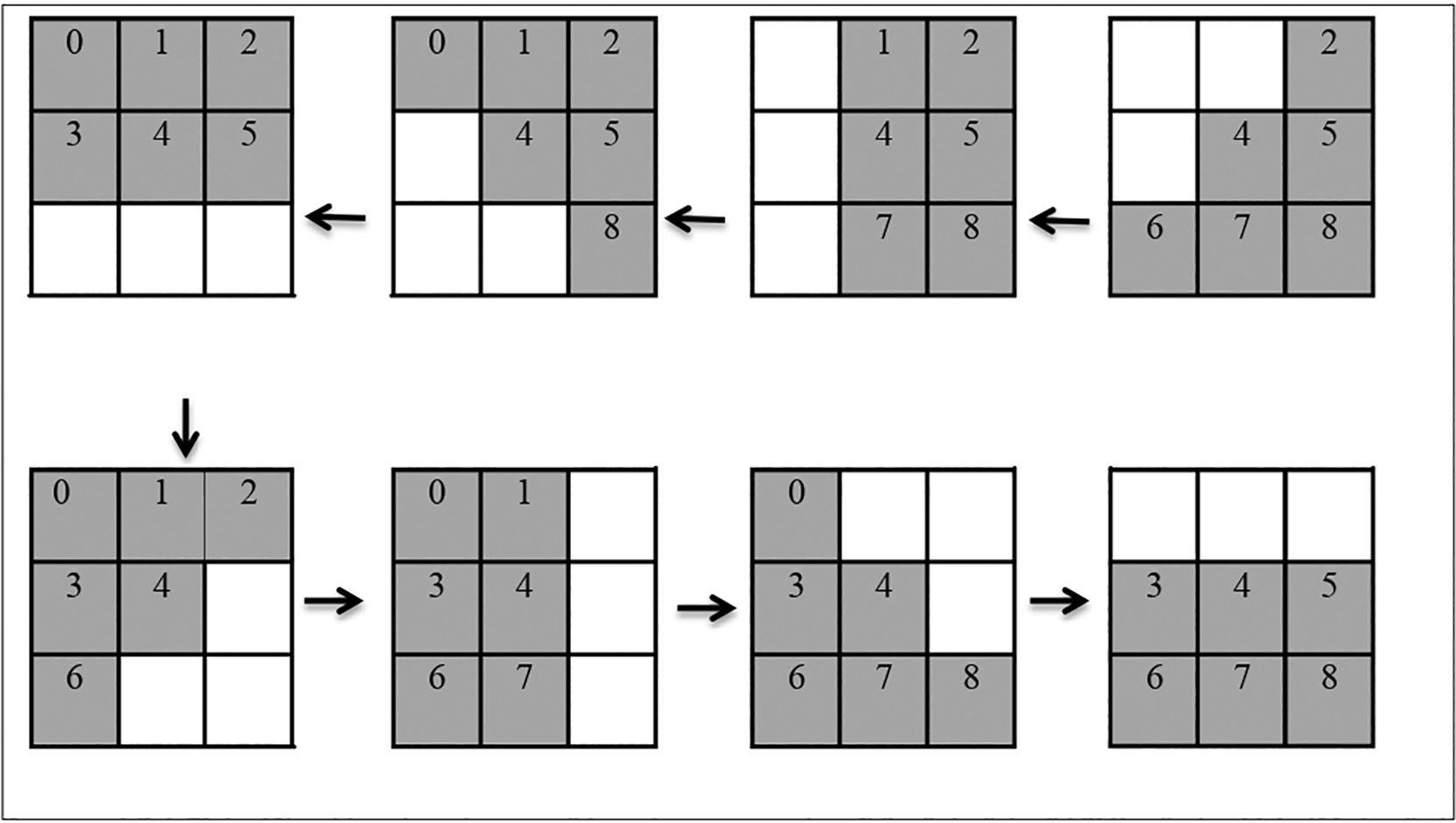
Single – beta transformation (SPT)
Let an -nested Abacus with column, rows and chains. Suppose that a beta number in chain is located in row and column such that , and . A single beta transformation (SPT) in chain is local transformation ( ) within the same chain where
The maximal number of transformations in chain is equal to the number of positions in the chain, where .
Figure 7 illustrates Single – beta transformation (SPT)
Not.
Next, the enumeration of Ω-nested Abacus with b columns and d rows is presented.
Let an -nested Abacus with column, rows and chains then, the number of position in any chains is
Based on Definition 9 consists of a single position. Then, the successive chain form a discrete ring around the single position with four side increments and four corner position. Then , thus where . Thus
Where .
Based on Remark 10 and Lemma 11, the number of (SSPT) transformation in chain is equal to .
Let Ω-nested Abacus be a polyomino intercept in N.C.A. with columns and rows such that and is odd. Then the total number of chain is .
Based on Ω-nested Abacus structure is symmetric with respect to a central column (central chain ) then for all i-th chains, the boundary columns must satisfy , thus
. Then every Ω-nested Abacus with chains.
Let Ω-nested Abacus be a polyomino intercept in NCA with columns and rows such that and is odd. Then the number of even chain is .
Provided that
Based on Lemma 13 the number of chain in Ω-nested Abacus is . The even chains among are . Since is even then is even since the first chain is odd and fixed. Then there are Since is even then , then the number of even chain is .
Next we found the number of Ω-nested Abacus if we application SSPT-Transformation in chain .
Let Ω-nested Abacus be a polyomino intercept in NCA with columns and rows such that , is odd and let be even number. Then the number of Ω-nested Abacus generating by employ SSPT-Transformation exactly chain is
By Lemma 11 the number of admissible positions in chains is . Since move each beta position yields a distinct Ω-nested Abacus under SSPT-transformation obtain in chain n with position is .
Let Ω-nested Abacus be a polyomino intercept in N.C.A. with columns and rows such that , is odd and let be even number. Then the number of Ω-nested Abacus generating by employ SSPT-Transformation is
Where ,
Based on Lemma 10, the number of positions in chain n is by Lemma 11 and Definition 8, there are chain with beta and empty beta position in Ω-nested Abacus. The maximal number of transformations in chain is equal to . Since each move generates a new Abacus (polyominoes), thus there are of Ω-nested Abacus generated by employing SSPt transformation. As a result of this, there are
Ω-nested Abacus.
Let Ω-nested Abacus be a polyomino intercept in N.C.A. with columns and rows such that , is odd and let be even number. Then the number of Ω-nested Abacus generating by employ SSPT-Transformation exactly one even chain.
Where
Based on Lemma 11 the number of positions in chain is 8(n−1), any position in the chain will be determines one distinct SSPT in that chain. Thus all even chain gives .
Let Ω-nested Abacus be a polyomino intercept in N.C.A. with columns and rows such that , is odd and let be even number. Then the number of Ω-nested Abacus generating by employ MSPT-Transformation exactly chain is
Where and
Based on Lemma 11, the number of admissible beta and empty eta position in chain n is . Since the odd chain are completely filled, the remain fixed and do not contribute to the transformation. By Lemma 15 the number of Ω-nested Abacus generating by employ SSPT-Transformation exactly chain is Since the MSPT-transformation acts simultaneous on all even chain. A generated Ω-nested Abacus is obtain by selecting one admissible position in each chain. The choice in one even chain does not restrict the admissible choices in any other even chain. Then the number of Ω-nested Abacus can be generated after application SSPT-Transformation is .
In this section, the method described in11,12 is employed to enumerate the Ω-nested Abacus class, representing polyominoes inscribed within a James diagram. The ECO (Enumerating Combinatorial Objects) method has previously been applied to the enumeration of various polyomino classes.12 This approach is based on a succession rule.
Let be even chain of Ω-nested Abacus, based on Lemma 11 the number of positions in any chain is
We application SSPT-Transformation inside this chains such that no previously select position may be chose again. Thus, in initial stage there are choices ( of Ω-nested Abacus), after one insertion we have only position ( of Ω-nested Abacus), after two distinct insertion there are only position ( of Ω-nested Abacus as shown in Figure 8), and so on. Thus, there are
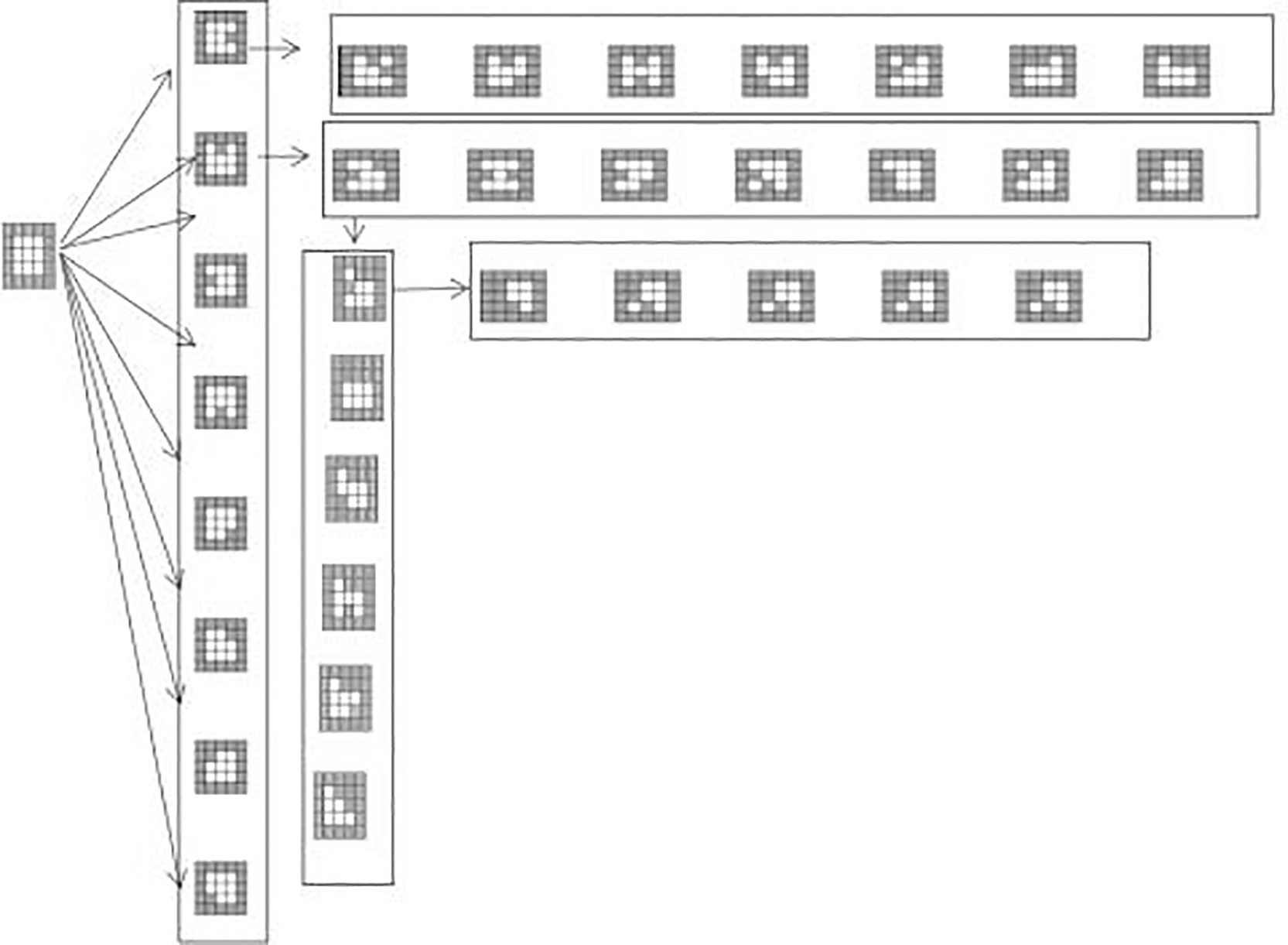
Above process is encoded by a generating tree. The root labeled by , each node will be produces children, every one of children will be product . Thus the local succession rule is
Assume that denoted the number of nodes at level yield the recurrence
Using the ordinary level-generating polynomial of the even chain
Where
is generating function to enumerated the number of Ω-nested Abacus.
This study examines a class of polyominoes known as the Ω-nested Abacus. Initially, we provide a characterization of a new class based on specific geometric constraints defined by rows, columns, and chains. A series of operations on polyominoes is then introduced using a partition-theoretic construct known as the beta number. Furthermore, a set of operations on polyominoes is developed using a partition-theoretic construct known as the beta number, allowing for localized transformation of the structure. Furthermore, A succession rule is formulated based on generating tree techniques to describe the growth of these object. Based on this framework a recursive method is established for the systematic generation of Ω-nested Abacus configuration of a given size through the use of generating trees.
| Views | Downloads | |
|---|---|---|
| F1000Research | - | - |
|
PubMed Central
Data from PMC are received and updated monthly.
|
- | - |
Provide sufficient details of any financial or non-financial competing interests to enable users to assess whether your comments might lead a reasonable person to question your impartiality. Consider the following examples, but note that this is not an exhaustive list:
Sign up for content alerts and receive a weekly or monthly email with all newly published articles
Already registered? Sign in
The email address should be the one you originally registered with F1000.
You registered with F1000 via Google, so we cannot reset your password.
To sign in, please click here.
If you still need help with your Google account password, please click here.
You registered with F1000 via Facebook, so we cannot reset your password.
To sign in, please click here.
If you still need help with your Facebook account password, please click here.
If your email address is registered with us, we will email you instructions to reset your password.
If you think you should have received this email but it has not arrived, please check your spam filters and/or contact for further assistance.

Comments on this article Comments (0)