Keywords
clinical supervision; peer consultation; severe mental illness; patient reactions; PAD-S; CSA; psychotherapy process; data governance

This article is included in the Health Services gateway.
clinical supervision; peer consultation; severe mental illness; patient reactions; PAD-S; CSA; psychotherapy process; data governance
Clinical supervision is often sought when a treatment becomes tense, uncertain, or clinically risky. In severe mental illness (SMI), that tension may become concrete: a patient becomes silent after an interpretation, looks away after a supportive comment, becomes suspicious when a plan is proposed, cancels after an apparently useful session, or destabilises after progress is named. These moments are easy to discuss in broad case language, yet their clinical meaning often lies in the immediate sequence: what the therapist did, what the patient did next, what else may have shaped the reaction, and what step is now safest.
SMI is used here as a pragmatic, transdiagnostic, functional and service-relevant term. It includes psychosis-spectrum, bipolar, severe depressive, personality-related, trauma-related, substance-related, gerontopsychiatric, and mixed presentations when they involve substantial impairment, recurrent destabilisation, safety concerns, participation restrictions, or complex service use. The term is therefore anchored less in a single diagnosis than in the combination of ICD-11 diagnostic context, ICF/Mini-ICF-APP functional impact, and real-world treatment complexity.1,2,3,4
The opinion advanced here is that patient reactions should be treated as supervisory data. This phrase is deliberately modest. It does not mean that reactions are simple read-outs of therapist error, patient resistance, diagnosis, risk, or treatment outcome. It means that reactions can become clinically useful material when supervisors and peer consultation groups examine them as situated, multiply determined, and ethically sensitive signals.
The article therefore proposes a middle position. Patient reactions should be held through several lenses and then translated into one safer next step. The manuscript is an Opinion Article. It does not report new data, validate a measure, or claim intervention effectiveness. Its aim is to clarify a supervision stance and a teachable sequence for clinicians who work with complex SMI presentations.
This article sits within a broader PAD-S/CSA publication programme but should not be read as another general PAD-S/CSA theory paper. The basic Perceive-Assess-Dose-Safeguard (PAD-S) grammar, the Conflict-Square Algorithm (CSA), the candidate shared representation layer, an SMI-focused documentation bridge, and a within-subject heuristic for apparent flat affect and withdrawal have been described elsewhere.5,6,7,8,9 The present contribution is translational: it asks how these ideas can be used sparingly in supervision and peer consultation when the starting point is a concrete patient reaction.
The distinct contribution is didactic. The paper asks how patient reactions can be used in supervision and peer consultation as learning and corrective material, and how PAD-S/CSA can support selected decision points without dominating the supervisory conversation. This novelty boundary reduces the risk of self-overlap: PAD-S/CSA provides a background vocabulary, whereas patient reactions, SMI-specific ambiguity, supervisory dialogue, and governance are the present article’s primary concerns.
The stance is transtheoretical. Psychodynamic concepts such as countertransference, containment, and parallel process remain relevant.10,11,12 Core supervision theory, the supervision alliance, supervisee nondisclosure, cultural humility, antiracist supervision, and the broader evidence on supervision and patient outcomes also matter.13,14,15,16 Alliance research and SMI-specific alliance literature support the idea that relational events are clinically consequential.17,18 SMI-specific work on metacognition, social cognition, syndemic complexity, allostatic load, temporal links between therapist adherence and patient outcomes, and within-subject interpretations of apparent flat affect strengthens the argument for cautious, contextualised interpretation.19,20,21,22,23
Table 1 clarifies the novelty boundary. It is placed early because it protects the reader from mistaking the article for a repetition of the prior PAD-S/CSA architecture.
Novelty positioning relative to existing PAD-S/CSA publications. The table clarifies that the present Opinion article extends the application into supervision and peer consultation rather than reintroducing the general PAD-S/CSA architecture. Abbreviations: SMI, severe mental illness; PAD-S, Perceive-Assess-Dose-Safeguard; CSA, Conflict-Square Algorithm.
Patient reactions include more than explicit feedback. They include verbal, paraverbal, embodied, relational, behavioural, functional, and service-use signals. A reaction may be a sentence, a pause, a gaze shift, a somatic change, a cancellation, an escalation, an unexpected improvement, a return to crisis services, or a new willingness to reflect. In this article, the term refers to observable or reportable change after a therapeutic move, not to hidden mental states inferred without context.
The phrase supervisory data should not be confused with research data, raw measurement, or automatically interpretable evidence. It refers to clinical material that a supervision or peer consultation group can examine, triangulate, and use for a next-step decision. It may be reported verbally, reconstructed from notes, or, where consent and governance permit, supported by short excerpts. It should remain data-minimised, anonymised where possible, and subordinated to clinical responsibility.
In supervision, these reactions are useful only when the group remains close to the sequence. The basic sequence is: what was the therapist move, what happened next, what else might explain it, and what is the next safe step? A reaction should not be stripped of meaning by reducing it to a code. It also should not be overinterpreted without checking timing, context, risk, and the patient perspective.
Figure 1 provides the reader with the minimal loop used throughout the manuscript. The figure is intentionally simple. It is a navigation aid, not a comprehensive model, and it should reduce rather than increase cognitive load.
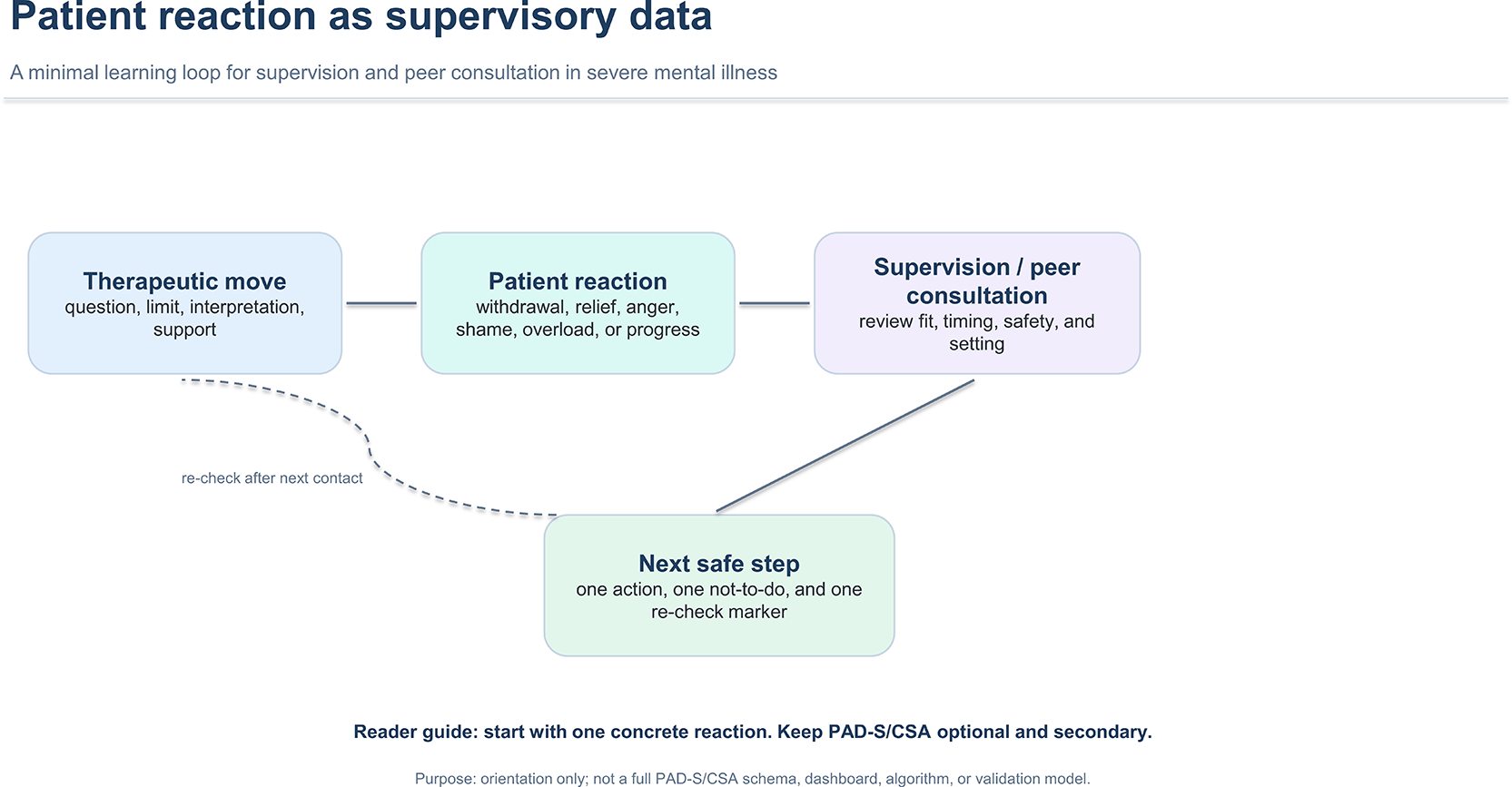
Patient reaction as supervisory data.
The diagram shows a deliberately simple feedback loop: a therapeutic move is followed by a patient reaction, which is then reviewed in supervision or peer consultation for fit, timing, safety, and setting before a next safe step is chosen. The figure is a reader-orientation device rather than a full PAD-S/CSA schema, dashboard, algorithm, or validation model. Abbreviations: PAD-S, Perceive-Assess-Dose-Safeguard; CSA, Conflict-Square Algorithm.
A useful supervisory discussion of patient reactions in SMI usually requires at least four lenses. These lenses are not a diagnostic algorithm and should not be applied mechanically. Their didactic purpose is to slow down premature single-cause explanations and to keep the group from reducing complex reactions to either therapist error or patient pathology.
First, the relational and psychodynamic lens asks what is happening in the dyad, the team, and the supervision field. Countertransference, enactment, containment, and parallel process remain useful when reactions evoke rescue, irritation, blankness, fear, omnipotence, resignation, or polarisation. The question is not whether the reaction proves a dynamic, but whether the supervisory field is repeating, correcting, or avoiding something clinically relevant.
Second, the psychological and developmental lens asks what level of mentalising, metacognition, affect labelling, and collaborative reflection is available. In psychosis-spectrum, trauma-related, personality-related, and severe depressive presentations, the patient may move rapidly between workable reflection and overload. A technically correct intervention may be too implicit, abstract, interpersonal, or demanding for the current state.
Third, the affective and neurobiological lens asks how much arousal, threat load, shame, dissociation, cognitive-perceptual disruption, fatigue, and allostatic strain are present. This lens does not prescribe technique, but it sharpens the question of dose. It protects supervisors from the error of equating conceptual insight with momentary capacity.
Fourth, the social and service-context lens asks what real conditions shape the reaction: poverty, housing insecurity, coercion history, migration, racism, stigma, isolation, family violence, institutional mistrust, service fragmentation, legal pressure, or disability. This lens prevents psychologising real constraints and helps supervisors distinguish intrapsychic, dyadic, and structural levels.
The proposed practical tool is a five-question heuristic for ordinary supervision and peer consultation. Its purpose is didactic: it gives the group a sequence that is easy to hold in working memory, even when the case is emotionally charged. Figure 2 visualises the sequence. The figure deliberately avoids PAD-S/CSA codes, dashboards, and assessment rubrics because the first learning task is orientation, not formal notation.
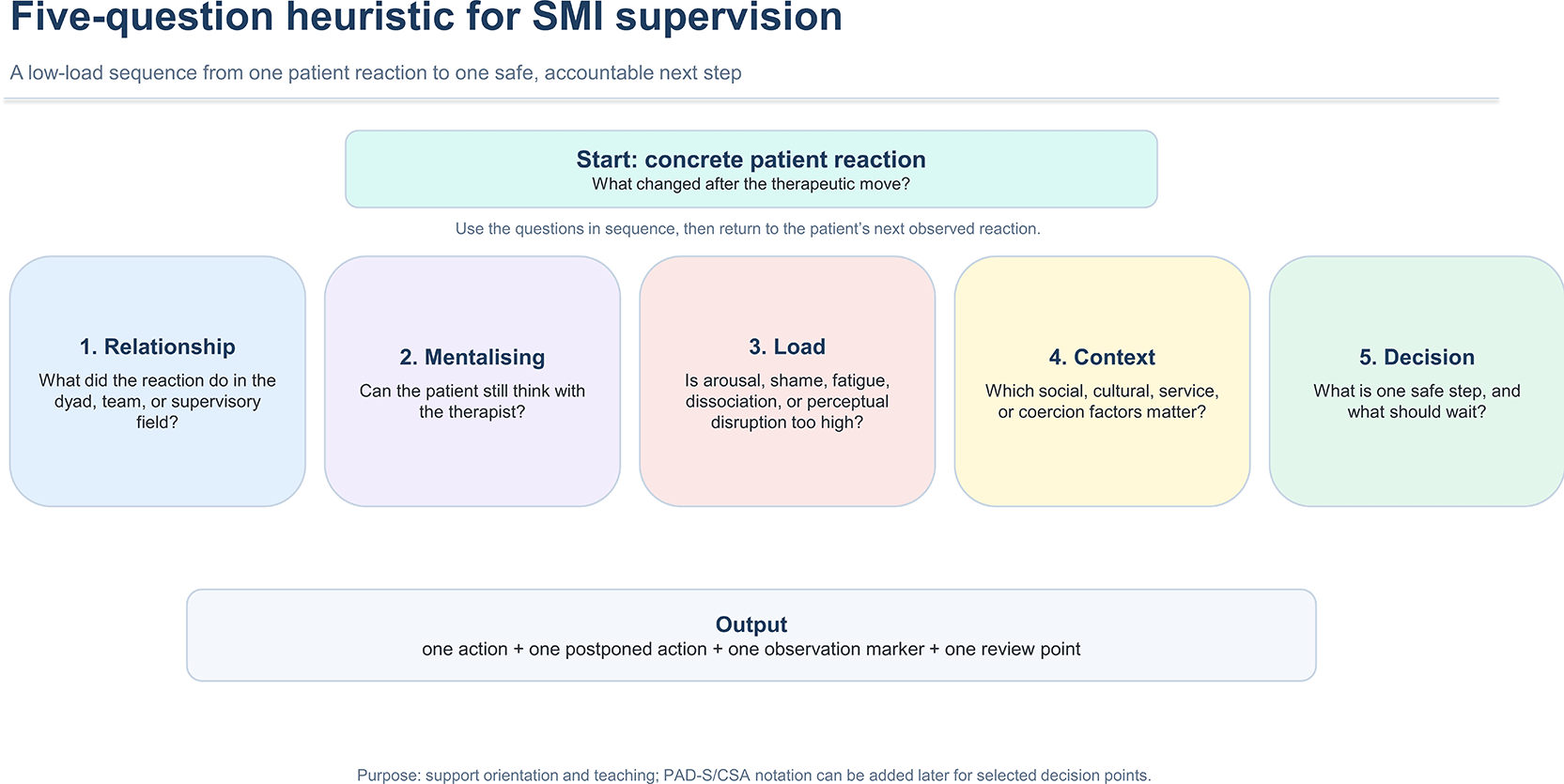
Five-question heuristic for SMI supervision.
The figure presents the article’s teaching sequence: relationship, mentalising/metacognition, affective and neurobiological load, social/service context, and the next safe accountable step. Each box contains only one didactic task to avoid overloading the reader. PAD-S/CSA notation can be added later for selected decision points. Abbreviations: SMI, severe mental illness; PAD-S, Perceive-Assess-Dose-Safeguard; CSA, Conflict-Square Algorithm.
Question 1: What is happening relationally and countertransferentially? The supervisor asks what the therapist, team, and supervision group felt or wanted to do. Did the reaction evoke rescue, irritation, withdrawal, over-explanation, control, helplessness, or shame?
Question 2: What level of mentalising or metacognition is available? The group asks whether the patient could still think with the therapist. Was the intervention too implicit, too abstract, too interpersonal, or too rapid for the current capacity?
Question 3: What affective and neurobiological load is present? The group checks arousal, sleep, medication, substance use, shame, fatigue, trauma triggers, cognitive-perceptual disruption, psychotic salience, and dissociation before intensifying clinical work.
Question 4: What social reality and service context are shaping the reaction? The group asks whether coercion, poverty, housing, stigma, migration, racism, family threat, institutional mistrust, or fragmented care may be part of the reaction.
Question 5: What is the next safe and accountable step? The group chooses one action and one thing not to do for now. The next step might be repair, slowing down, simplified language, risk assessment, setting clarification, team communication, medication review, social support, or postponement of deeper work.
The heuristic should end with observable markers. What would tell us next session that the step helped, harmed, or needs revision? This re-check is what turns supervision from advice into a learning loop.
PAD-S/CSA can strengthen the heuristic when supervisors need a compact language for selected decision points. It is not necessary to use PAD-S/CSA terminology in every supervision. When it is used, the notation should follow the clinical discussion rather than replace it.
In the present application, PAD-S/CSA offers three functions. First, it can name a momentary process hypothesis: progression (PRO), anxiety/arousal and tolerance (ANX), defence/avoidance (DEF), or superego/shame attack (SUP). Second, it can locate tolerance using a simple threshold logic: workable, strained, or unsafe/overloaded. Third, it can document a calibrated next step: what changed, why this dose was chosen, and what should be re-checked.
This notation is potentially useful precisely because it is sparse. It does not describe the whole therapy, the whole relationship, the whole diagnosis, or the full social context. It records a narrow decision-relevant layer: a process hypothesis, a tolerance threshold, a next move, a safeguard, and a re-check. In SMI supervision, this narrowness can support shared attention without pretending to replace richer formulation.
The limits must be explicit. PAD-S/CSA does not replace diagnosis-specific treatment, evidence-based interventions, crisis protocols, medication review, cultural formulation, legal duties, patient preference, or local governance. It should never be used as an autonomous decision system.
The following constellations are didactic composites, not research data, clinical vignettes, or evidence of effectiveness. They are included to show how the supervisory stance changes when patient reactions are treated as situated data for reflection rather than as fixed meanings.
Psychosis-spectrum vulnerability, mistrust, and low expressivity. A patient with repeated admissions appears affectively flat. After a therapist says, “maybe part of you is angry with me”, the patient looks away and becomes silent. Supervision should not immediately code this as resistance. It should ask whether the intervention was too interpersonal, whether threat attribution or cognitive-perceptual disruption increased, whether medication or negative symptoms are relevant, and whether a more concrete and predictable next step is safer.
Complex trauma and dissociation. A patient smiles while describing violence, then becomes sleepy and forgets the next question. Supervision should first check load and dissociation, not search for the deepest meaning. The next step may be shorter phrasing, orientation, consent, and a planned pause rather than further exploration.
Severe persistent depression with shame collapse. A patient reports completing a small self-care action. When the therapist names the success, the patient says, “a normal person would do more”, looks down, and stops speaking. Supervision should protect the progress before adding demands. PAD-S/CSA could note SUP at a strained threshold, but the clinical decision is to de-shame, slow down, assess risk where relevant, and set a small functional target.
Chronic suicidality and team splitting. A patient makes repeated crisis contacts after boundaries are clarified. Therapists may oscillate between rescue and resentment. Here the reaction is relational, risk-relevant, and organisational. Supervision should clarify crisis plan, team language, responsibility, and the patient-facing rationale before further individual technique is discussed.
Social exclusion, coercion history, and institutional mistrust. A patient reacts angrily to a service rule. Supervision should not rush to pathologise the anger. It should ask whether the rule repeats earlier experiences of coercion, whether the patient had a real choice, and whether a transparent, dignity-preserving explanation is needed.
Table 2 translates these constellations into a compact user-facing heuristic. It is designed to help supervisors move from observable reaction to first safe response without implying a fixed interpretation.
Patient reactions as supervisory data. The table is a heuristic for supervision and peer consultation; it does not replace case formulation, risk assessment, diagnosis-specific treatment planning, or local clinical governance. Abbreviations: SMI, severe mental illness.
The framework can be used in low-technology formats. A peer consultation group can begin with one concrete patient reaction rather than the whole case history. The group can then assign simple roles: one person tracks the relational field, one tracks load and safety, one tracks social context, and one summarises the next step and re-check marker.
For formal supervision, the same structure can be used with richer material: short transcript excerpts, anonymised process notes, audio or video clips, patient feedback, outcome-monitoring data, or team observations, but only when consent, confidentiality, and local governance permit. The point is not to increase surveillance. The point is to compare intention, intervention, reaction, and next-step decision in a way that remains teachable and proportionate.
The user benefit is practical. A 10- to 15-minute application should end with four outputs: one plausible working hypothesis, one proportionate action, one action to postpone, and one observable marker for the next contact. This structure may support novices who might otherwise hide uncertainty, and it may help experienced teams prevent theory overload, premature certainty, and drift from safety planning.
Future evaluation can draw on supervision-measurement work, but the present article remains an Opinion article rather than a scale-development or competence-assessment study.24 Table 3 summarises minimum implementation safeguards. These safeguards protect the central premise of the article: patient reactions can become learning data only when the supervisory environment is safe, transparent, data-minimised, and human-final.
Minimum implementation safeguards. The table lists practical safeguards for using patient reactions and optional PAD-S/CSA notation in supervision without turning observation into surveillance, automated decision-making, or uncontrolled documentation. Abbreviations: GDPR, General Data Protection Regulation; DSGVO, Datenschutz-Grundverordnung; PAD-S, Perceive-Assess-Dose-Safeguard; CSA, Conflict-Square Algorithm.
This Opinion article is not based on identifiable patient records, recordings, or local documentation materials. The governance discussion is included because supervision and peer consultation can easily create secondary documentation that is more sensitive than it first appears.
For local implementation, the author emphasises GDPR/DSGVO compliance, purpose limitation, data minimisation, and clear role responsibility.25 This is particularly important when supervision-related documentation is generated in private or secondary practice locations outside the submitting author’s physical access and direct workflow oversight. In such settings, local governance arrangements must define responsibility for storage, access, retention, transfer, destruction, and documentation quality.
A software-first, access-controlled documentation workflow is preferable because controlled software can support role-based access, versioning, retention rules, and audit trails. Paper-based notes may be acceptable as a local accommodation, but only if custody, storage, transfer, access, retention, and destruction are explicitly governed. Paper should remain an exception, not an informal workaround.
Patient reactions should not be transformed into uncontrolled datasets. The safest default is to use the shortest adequate sequence, remove identifying details, avoid unnecessary verbatim material, document only what serves the supervisory question, and keep human clinical responsibility explicit.
Several boundaries are essential. The manuscript does not claim that patient reactions prove the correctness or incorrectness of a therapist intervention. It does not claim that PAD-S/CSA is a validated supervision intervention. It does not replace diagnostic assessment, evidence-based treatment, suicide-risk assessment, medication review, safeguarding duties, cultural formulation, legal standards, patient preference, or local policies. It does not propose automated treatment recommendations.
The heuristic should not be used to blame therapists for complex reactions, reduce patients to process labels, rank supervisees, or convert supervision into surveillance. Its appropriate use is reflective, collaborative, safety-oriented, and accountable. The proposed approach may be particularly helpful when a group must choose a safer next step despite uncertainty, but it remains subordinate to clinical judgement, patient preference, legal duties, local policy, and diagnosis-specific care.
The evidence base is therefore intentionally bounded. The article draws on supervision theory, alliance research, psychosis and SMI literature, process theory, social psychiatry, and prior PAD-S/CSA work. It does not present new empirical validation. The next scientific step is feasibility testing: Can supervisors use the heuristic consistently, find it acceptable, avoid common misreadings, and identify clinically useful next steps? Subsequent work should test reliability, equity, implementation burden, clinical utility, and potential harms before any stronger claims are made.
For immediate use, the article can be translated into the following practice sequence:
1. Start supervision with a concrete patient reaction rather than the whole case history.
2. Ask what therapeutic move immediately preceded the reaction.
3. Hold several plausible readings before choosing an interpretation.
4. Use the five-question heuristic to prevent theory overload and dyadic narrowing.
5. Use PAD-S/CSA only for selected moments where a sparse notation helps clarify node, threshold, move, safeguard, and re-check.
6. End with one action, one action to postpone, and one observable re-check marker.
7. Treat observation materials as sensitive data; minimise, anonymise, and govern them carefully.
8. Use dashboards, digital tools, or AI only downstream of human-final clinical judgement and documented consent.
The didactic aim is deliberately modest. A good supervision tool should make the next conversation clearer without making the clinical situation look simpler than it is.
Patient reactions in SMI are not merely symptoms, resistance, or outcomes. They are also potential supervisory data when they are interpreted cautiously, contextualised clinically, and translated into a proportionate next step. They can show whether the therapist, team, intervention, timing, dose, safety frame, and service context currently fit the patient’s capacity and situation. A reaction should not be overinterpreted, but it should be taken seriously enough to guide accountable reflection.
The proposed contribution is intentionally modest. A five-question heuristic helps supervisors move from concrete reaction to one safer next step. PAD-S/CSA can then support selected moments by providing a sparse, optional, human-final notation for process hypothesis, tolerance threshold, action, safeguard, and re-check. The value of the approach lies not in claiming superiority, but in making supervision more observable, teachable, ethically bounded, and practically useful for complex SMI care.
The next scientific step is not to claim effectiveness. It is to test feasibility, reliability, equity, and clinical utility.
This Opinion article does not report human-subjects research. The illustrative constellations are didactic composites and do not contain identifiable patient information. Ethics approval was therefore not required. The article does not rely on local paper records, recordings, or materials generated in private or ancillary practice rooms. Any future empirical use of patient, supervisee, recording, or documentation material would require appropriate consent, GDPR/DSGVO-compliant data governance,25 and institutional or local ethical review where applicable.
During the preparation of this manuscript, the author used ChatGPT 5 Plus (OpenAI; last accessed June 2026) to assist with literature exploration and English copy-editing. The author reviewed, verified, and edited the content and takes full responsibility for the final manuscript.
| Views | Downloads | |
|---|---|---|
| F1000Research | - | - |
|
PubMed Central
Data from PMC are received and updated monthly.
|
- | - |
Provide sufficient details of any financial or non-financial competing interests to enable users to assess whether your comments might lead a reasonable person to question your impartiality. Consider the following examples, but note that this is not an exhaustive list:
Sign up for content alerts and receive a weekly or monthly email with all newly published articles
Already registered? Sign in
The email address should be the one you originally registered with F1000.
You registered with F1000 via Google, so we cannot reset your password.
To sign in, please click here.
If you still need help with your Google account password, please click here.
You registered with F1000 via Facebook, so we cannot reset your password.
To sign in, please click here.
If you still need help with your Facebook account password, please click here.
If your email address is registered with us, we will email you instructions to reset your password.
If you think you should have received this email but it has not arrived, please check your spam filters and/or contact for further assistance.

Comments on this article Comments (0)