Keywords
Representationalism, mental representation, hierarchical representation, knowledge representation, language of thought, epistemology, cognitive architecture, artificial intelligence

Representationalism, mental representation, hierarchical representation, knowledge representation, language of thought, epistemology, cognitive architecture, artificial intelligence
We consider this note as a representationalist’s manifesto and its main contribution is an attempt to introduce a purely abstract framework that metaphorically constitutes a kind of “digital (virtual) world”—a conceptual space for the rational representation of physical reality. The framework aims to formalize the way intelligence may become conceptually aware of external reality through structured internal representation.
We conceive this representational system in the form akin to an “existential graph” (also see1), though we prefer the notion of a “hierarchical binary tree” (or “existential binary tree”). The heart idea is that the real, physical world can be mentally mapped onto a rigid, formal, hierarchical, tree-like construction—a system of organized models of things.
What we present is not an implemented or functioning computational system; rather, it represents an abstract, highly formalized invariant structure intended to serve as a rational model for representing the external physicality. We think that the introduced approach might possibly provide a conceptual foundation for those researchers who are interested in the philosophical dimensions of (artificial) intelligence, in particular those who align with the philosophical position known as representational realism (or representationalism) (see also2,3).
The present note seeks—at least in an abstract, perhaps even speculative, manner—to address the following fundamental (rhetorical) questions.
1. How can the real world, physical externality be mentally represented—that is, mapped onto an organized, structured, and rational system?
2. In what ways can such a formal, rigorous structure be (efficiently) implemented (approximated) in practice?
The remainder of the note is organized as follows. Firstly, we introduce the basic definitions and grounding postulates related to the proposed framework. Next, we describe how physical reality can be rationally represented through a logical, abstracted structure, specifically, a hierarchical binary tree. Finally, we conclude with brief remarks reflecting on the philosophical implications and potential applications of this approach.
From the very deep point of view, the physical world—or external reality—fundamentally consists of two essential constituent parts (facets): “things in themselves” and “things for us” (see Figure 1). Rephrasing Schopenhauer,4 the world appears as “will and representation”.
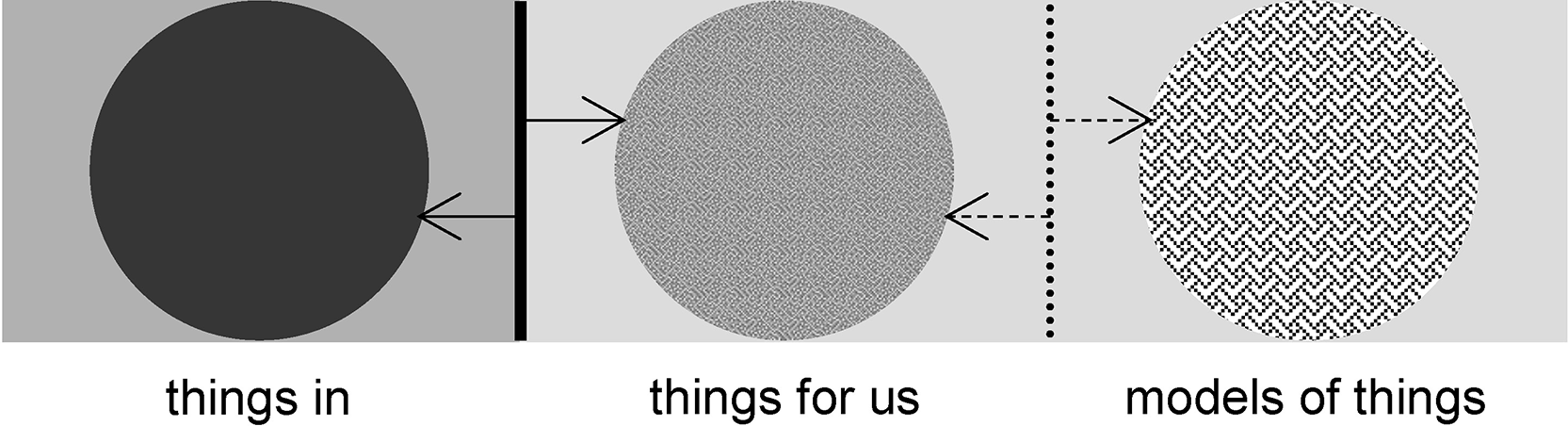
The physical world can be thought of as fundamentally consisting of the following parts (facets): things in themselves, things for us, and models of things.
Things in themselves (also called noumena) can not be sensed by any means. According to the Stoic view, the things in themselves can never be known (unless we ourselves are (identical to) these things).
The things for us (also called phenomena, raw data, “dedomena”, or simply things) can well be sensored, for example, using our five basic sensory inputs1. (In what follows, the terms “things for us”, “physical things”, “things”, “objects” will be used interchangeably).
Intelligence, whether natural or artificial, is essentially based on the act of (conceptually) copying the externality—at minimum, reproducing it across dimensions of space and time. Yet intelligence can never grasp the deepest nature of the externality itself. It only disposes of internal representations—copies of things—rather than direct access to the things in themselves. This, however, does not deny the apparent existence of the physical reality. What matters is how the things are represented.
Very obviously, the mode of representation of the thing is not the thing itself. For example, the same physical thing may exist in different physical states (solid, liquid, gas). Also, the same thing may be represented, expressed in many different forms of appearance (including, for example, the symbols, texts, (colour) graphic images, printed (3D) copies, sounds, gestures, as well as the neural configurations in the human brain, or the contents (digital patterns) in a computer’s memory). In all such cases, between the thing in itself (and also sensible physical thing) and its final representation, there is a lot of extensive processing (respective signal encoding/decoding mechanisms are employed both by storing and retrieving the copies of things).
We will refer to these various representations of things as conceptual copies of the (physical) things. Alternative synonymous terms can be used (like correlates, models of things, concepts, categories, data, information and, finally, notions); some of them will appear interchangeably throughout this note.
It should be stressed that we prefer the term “conceptual copies” and its above mentioned synonyms to the terms “surrogate”, “substitute [of thing]” used by.5 According to those authors, there exist two (parallel) realms (the realm of “things in themselves” and the realm of surrogates, substitutes for things) so that these realms appear strictly non-overlapping and the reasoning about the natural world is wrong (“guaranteed to err”5). In contrast, we assume that there may exist some direct (or indirect) “anchor” between the concepts (categories) and the underlying reality. The models of things and the things in themselves may thus be reciprocal, dependent in certain respects.
Of course, models (copies) of things are not things and, obviously, models of things are not the things in themselves all the more. All representations are inaccurate. No fidelity! Every model (copy) of a physical thing is necessarily different from a physical thing—at least in spatial or temporal position, if not more fundamentally, unless our Universe is continuous in its deepest character. (The author of this note is however skeptical regarding the ultimate continuousness of our Universe.) Hence, a copy (or model) is always “beside the thing” (in space); at the same time, it is also “after the thing” (in time). Roughly speaking, there exists a union with two parts.6 The first part is the physical reality (the domain of the things in themselves and the things for us). The second part is the system of copies, models of things, including the contents and processes of the brain (data, information, internal models). The intellect operates primarily with the second domain. Metaphorically, the intellect is in touch with a map, rather than a territory. It “plays” with plots (charts)—instead of physical objects. Photograph—instead of reality. Model (simulacrum)—instead of the physical world. (Logical) relations (relations between models and/or models of (real) relations between things)—instead of causal processes in nature.
What is the copy of the thing (source) and what is the source of the copy is only the matter of a reference system. The same entity may be both as a source and a copy, depending on context. As an example, some perceptual agent (intelligent entity), say A, may be as a copy (model) for other agent, say B (and vice versa) (see Figure 2).
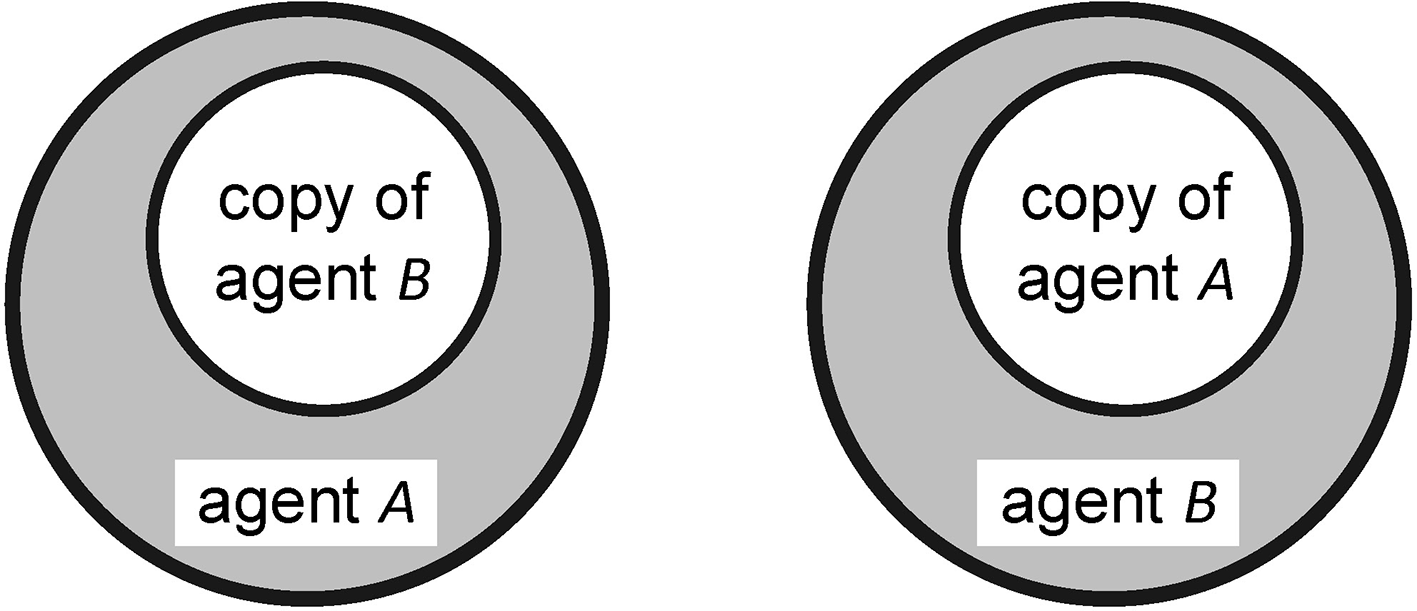
The same entity may be both as a source and a copy (this depends on context). For example, an agent (intelligent entity), say A, may be as a copy (model) for other agent, say B (and vice versa).
Our representational system rests upon several primary foundational dogmas that defines its philosophical and physical basis. The four underlying postulates are as follows.
Postulate 1. Everything rests upon a physical substrate. This holds true both for things as they are in themselves and for their representations. Physical reality is more fundamental than thought. The physical matter and intelligence are bound by a cause-effect relationship in which matter is prior (or, at the very least, parallel) to intelligence. Intelligence emerges as a post-material occurrence (incidence): an effect emerging from the (re) combinations, (inter) connections of physical things/entities (i.e., physical processes).
This is also applies to the models contained in the human brain. The contents of our brain’s memory cells—the notions themselves—are also physical entities. They possess material substrates and can, in principle, be stored, transformed and shared.
Postulate 2. There exist one or more modes of correspondence (or association) between internal notions and external entities—both things for us and other notions. Through these correspondences, conceptual structures within the mind maintain an “anchoring” to physical reality, enabling representation and also cognition (of the things for us).
Postulate 3. The models, i.e., notions are physically interconnected, interrelated. They form a physically mappable structure—an organized system of relations among encoded entities. Such a structure constitutes a network of interconnections within the physical substrate of the mind (i.e., neural configurations).
Postulate 4. The nature, efficiency and advancement of intelligence depend on two main factors/facets: 1) the development of the modes of correspondence between notions and external things; 2) the internal structure, organization, and efficiency of the system of notions and their interconnections. Intelligence thus is a function of both “representational fidelity” and structural organization of the cognitive substrate.
Remind that the things in themselves (noumena) can not be known (directly). This, however, does not mean that the things in themselves and physical things are unreal. Nor this does imply that the physical things cannot be represented. Throughout history, humanity has designed and constructed myriads of things without any direct insight into their ultimate cause/source and/or mode of existence. Competence without comprehension—this is often sufficient for design and construction!
In this sense, man-made representational systems are of far greater importance for the functioning of intelligence than the direct access to the real world. While we have no power over natural systems and the noumenal realm, we can well exercise full control over the structures and logics of our representational systems. This is the cornerstone of the representationalist position. Seen from this perspective, every physical object can be represented in accordance with the logical, conceptual framework chosen by a perceiving or designing agent.
Accordingly, rather than asking where and how things in themselves or physical entities are, we should ask: In what way are the physical things represented and mapped? Which way can then new things be designed (with the help of representational systems)?
In the disciplines of philosophy and logic, the “notion” is the fundamental constituent unit (of representation). It is very well known from these disciplines that each notion can be characterized by its scope (the extent of/the number proportional to included or subordinated (inhered) notions) and its content (the set of respective defining attributes/the number proportional to the amount of “parental” notions). The scope and content are inversely related: as the scope of a notion increases, its content decreases, and vice versa.
All notions are directly or indirectly (inter) connected, inter (related): they form a web of relations. This is our underlying thesis. For every notion, there exists at least one intrinsic relation—its relation to itself. This implies that the minimal number of attributes for any notion is equal to one.
From these considerations, three approaches of representation—each defining a different mode of availability for abstract mental representation—can theoretically be inferred:
- “singleton”-like representation, in which a notion stands alone;
- “chain”-like (one-dimensional) representation, where notions form linear dependencies;
- “tree”-like (hierarchical) representation, where notions are organized according to inclusion, dependency hierarchies.
In the first case, we might naively imagine a fictitious “singleton” representation (see Figure 3), where one all-encompassing conceptual notion (say, notion of ‘EVERYTHING’ (‘UNIVERSE OF DISCOURSE’ or simply ‘ALL’)) corresponds to all things (that is, to every part of ‘EVERYTHING’). In this case, no differentiation of separate things occurs. The scope of the notion of ‘EVERYTHING’ is thus equal to one, since all the constituent notions are directly connected to this universal notion. The world appears as a single, integral state.
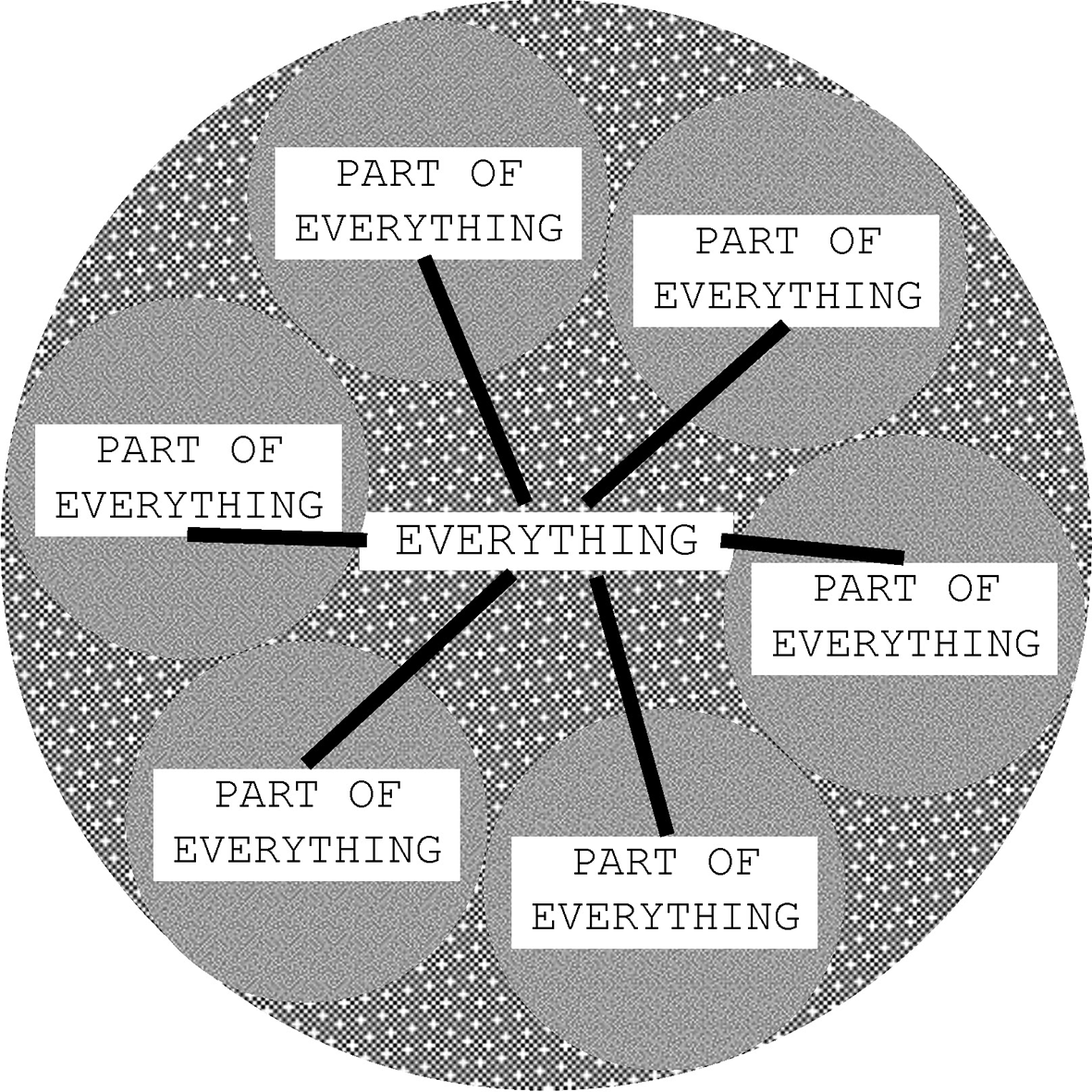
In a fictitious “singleton” representation, one all-encompassing conceptual notion (say, notion of ‘EVERYTHING’) corresponds to all things (that is, to every part of ‘EVERYTHING’).
In the second case, one can imagine some hypothetical “one-dimensional world”. Every notion possesses one and only one “parental” notion; and in turn, each notion has one and only one “successor”. In contrast to the first case, the scope of the notion of ‘EVERYTHING’ extends indefinitely. A graphical interpretation is given in Figure 4.
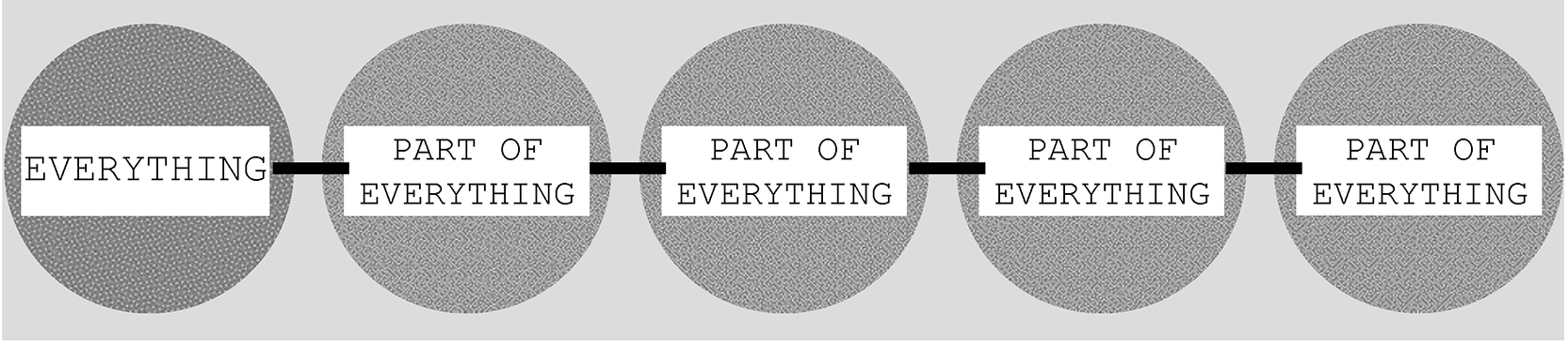
In a hypothetical “one-dimensional world”, every notion possesses one and only one “parental” notion; and in turn, each notion has one and only one “successor”.
In the third case, it is supposed that there exists some kind of a hierarchical tree-like structure. Let us consider this structure in more detail.
The key idea is that every node of the tree (node-notion or simply notion2), except the topmost one, necessarily possesses one and only one related predecessor (parental node (notion)). At the same time, in the present model, the number of successors (inherited nodes (notions)) for each node-notion is limited to exactly two (see Figure 5). Every parental notion (predecessor) inheres in its child notions (successors), while each child notion participates in its parent. In this way, a child notion embodies its parental notion with an added degree of specification (thus, the hierarchical structure reflects a progressive concretization of abstraction).
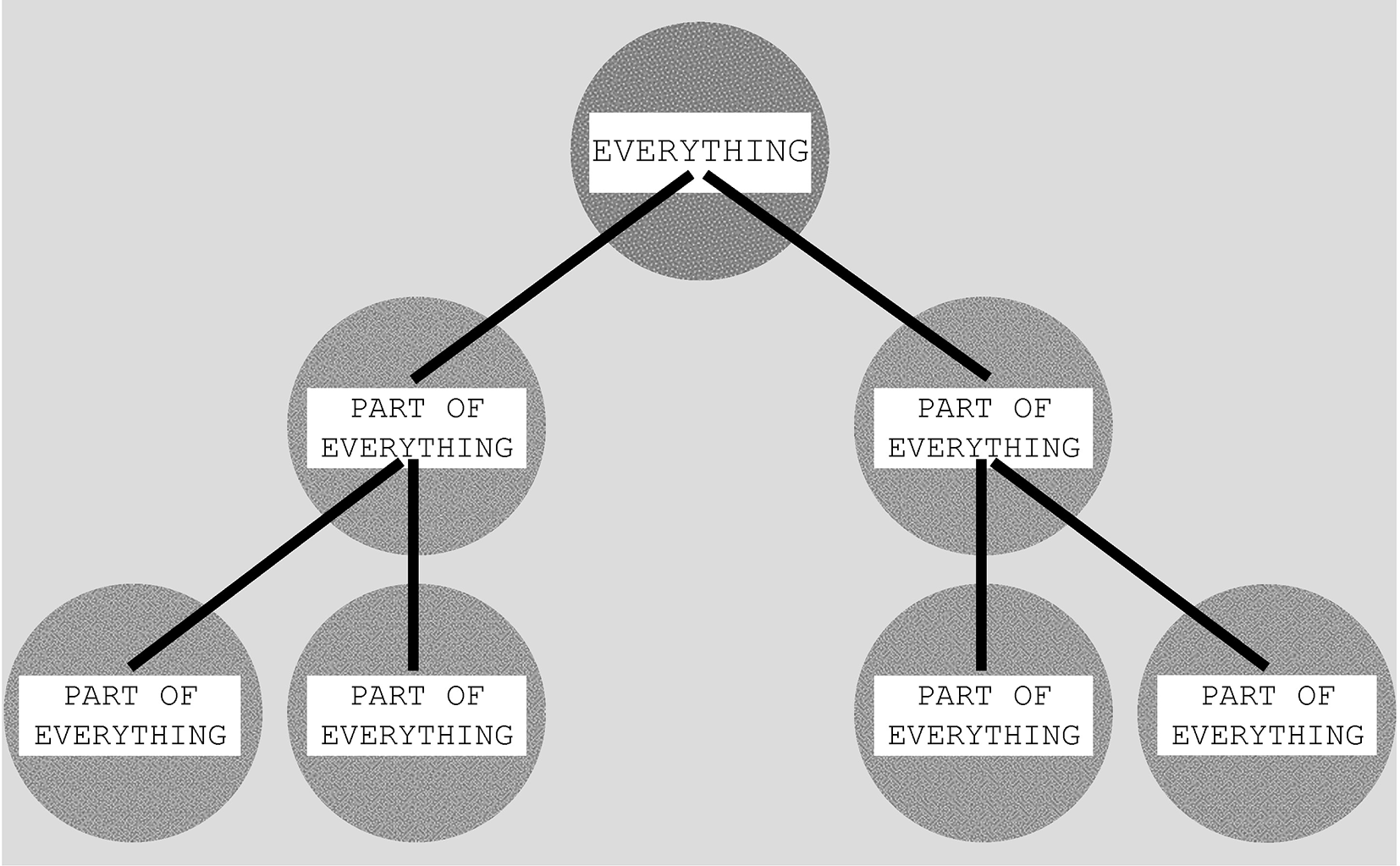
In a tree like representation, every node-notion possesses one and only one related predecessor (parental node (notion)). At the same time, the number of successors (inherited nodes (notions)) for each node-notion is limited to exactly two.
The content of a notion (i.e., the number and richness of its attributes) is associated to the cumulative number of its parental notions all the way up to the root node. On the other hand, the scope of a notion is proportional (or equal) to the number of the “children” all the way down to the lowest-level node. (Obviously, the higher a notion stands in the hierarchy, the broader its scope yet the poorer its content; and vice versa—the lower it stands, the narrower the scope but the richer the content.)
We may consider a “neutralization” of this formal, binary-tree-like representational system. We suppose that there exists an all-encompassing notion—called “EVERYTHING” (or “UNIVERSE OF DISCOURSE”)—which possesses the maximal possible scope and from which, all others may, in principle, be derived through successive differentiations. For the sake of brevity, we can also use a neutral notation symbol ‘✳‘for this notion.
Let Ω = {‘0’, ..., ‘9’, ‘A’, …, ‘Z’, …, ‘ℵ’, …} be some (countable) alphabet. Then, let C = {“0”, ..., “ℵ”, …, “10”, …, “ℵℵ”, …, “100”, …, “ℵℵℵ”, …} be a construct (or an abstraction) defined over this alphabet, indexed by I = {I1, I2, ..., Ij, …}, where Ij ∈ Z+ and I = {0, 1, 2, 3, ...}. We further define the following sub-indices (or branches, “groupoids”) (of I), such that: I0 = {0, 2, 4, 6, 8, 10, 12, 14, ...}, I1 = {1, 3, 5, 7, 9, 11, 13, 15, ...}. Similarly, I00 = {0, 4, 8, 12, ...}, I02 = {2, 6, 10, 14, ...}, I11 = {1, 5, 9, 13, ...}, I13 = {3, 7, 11, 15, ...}, I000 = {0, 8, ...}, I004 = {4, 12, ...}, I022 = {2, 10, ...}, I026 = {6, 14, ...}, I111 = {1, 9, ...}, I115 = {5, 13, ...}, I133 = {3, 11, ...}, I137 = {7, 15, ...}, and so forth.
It can be viewed that I0 ⊂ I, I ⊂ I, I00 ⊂ I0, I02 ⊂ I0, I11 ⊂ I1, I13 ⊂ I1, and so on. It can also be clearly seen that I0 inherits I, I1 inherits I, and so forth.
Let us associate the notions with the above indices according to the following order (rule): “✳“- I, “0✳“- I0, “1✳“- I1, “00✳“- I00, “10✳“- I02, “01✳“- I11, “11✳“- I13, “000✳“- I000, “100✳“- I004, “010✳“- I022, “110✳“- I026, “001✳“- I111, “101✳“- I115, “011✳“- I133, “111✳“- I137, etc.
We have something like an alphabet consisting of ‘0’s and ‘1’s (not counting ‘✳‘) and, on this basis, we can form a limitless number of combinations of classified notions and ideas.
It is easy to observe that, for example, the notion “0✳“inherits the attributes of the notion “✳“(i.e., “✳“inheres in “0✳“(“0✳“participates in “✳“)); the notion “00✳“inherits the attributes of the notion “0✳“, and so on. The resulting system of notions “✳“, “0✳“, “1✳“, “00✳“, “10✳“, “01✳“, “11✳“, “000✳“, ... can with ease be represented in the form of the neutral (logical) hierarchical binary tree, which comes out to be both highly elegant and rigid/rigorous. Each construction (e.g., “01✳“, “10✳“, etc.) can be seen as representing a derived notion, generated through a finite sequence of binary differentiations originating from the all-encompassing notion “✳“. Each successive construction thus corresponds to an additional level of conceptual determination within the overall hierarchical system (see Figure 6).
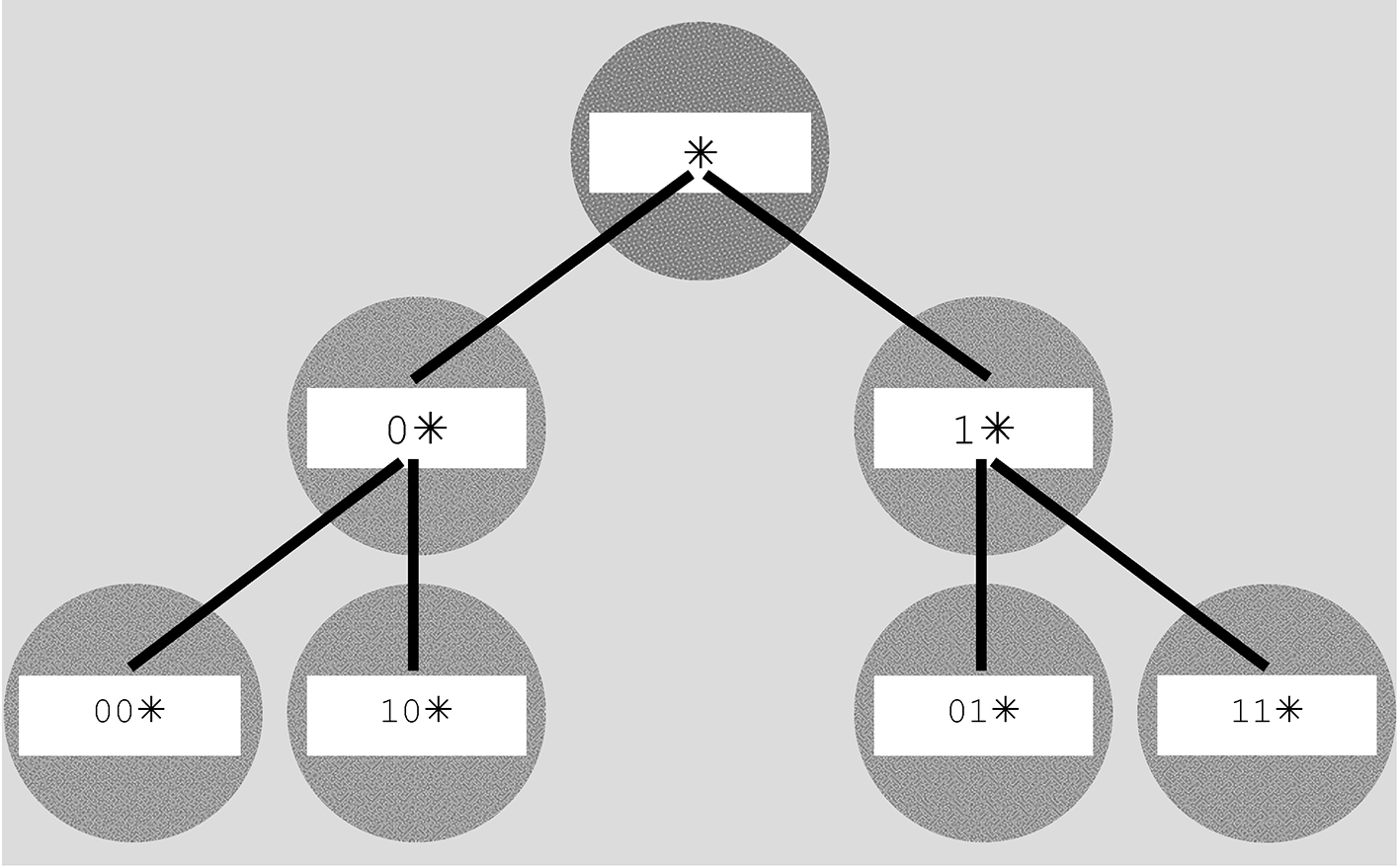
Each construction (e.g., “01✳“, “10✳“, etc.) is representing a derived notion, generated through a finite sequence of binary differentiations originating from the all-encompassing notion “✳“. Each successive construction corresponds to an additional level of conceptual determination within the overall hierarchical system.
In the hierarchical binary-tree-like representational system, it is easy to observe that, for example, there exist two notions, say “0✳“and “1✳“, such that these notions are “child notions” with respect to the notion “✳“. Conversely, “✳“serves as their common parental notion (“generative source”), from which both “0✳“and “1✳“emerge through an elementary act of differentiation. In general, there always exist two notions, “0 … ✳“ and “1 … ✳“, such that these notions are child notions with respect to their parental notion “ … ✳“. Each child notion represents a distinct determination of its parent, while simultaneously inheriting its attributes. The relation between “0✳“and its derivatives thus exemplifies the recursive pattern of conceptual differentiation and inheritance that characterizes the entire representational structure.
We have already mentioned the terms “scope” (of a notion) and “contents”, that is, the number of attributes—which both are fundamental facets (characteristics) of notions within the mental representational system. The former formally represents the extent (range) of applicability of the notion (the domain of subordinate notions); while the latter may be viewed as expressing the richness of a notion, that is, the number (size) of distinct conceptual features the constitute its content. Formally, we denote the size of the scope of a notion by S and the number of its attributes by NA.
More precisely, S = S(L), NA = NA(L), where L simply denotes the hierarchical level (depth) of the notion in the representational tree (and measures how far a notion is descended from the root of the hierarchy). For the root level, L = 0; for its immediate child notions, L = 1, and so on.
It is evident that, as we descend along the branches of the hierarchical structure — that is, as we proceed from parent notions to their children — the number of attributes increases while the corresponding scope decreases. In other words, the process of differentiation enriches the internal content of notions while simultaneously narrowing their range of reference. Thus, for any parental notion “...✳“and its two derived child notions “0...✳“and “1...✳“, the following general qualitative relations (monotonic constraints) hold:
S(“...✳“) > S(“...0✳“), S(“...✳“) > S(“...1✳“);
NA(“...✳“) < NA(“...0✳“), NA(“...✳“) < S(“...1✳“).
S and NA evolve monotonically in opposite directions and are inversely proportional and this inverse relationship reflects the fundamental law of hierarchical conceptual determination: with each act of differentiation, notions become more specific and internally complex. Symbolically, S k + 1 < Sk and NA k + 1 > NAk, where k denotes the current level in the hierarchy (tree). In a simplified formalization, the above relations may be concisely expressed as a rule of “inverse proportionality”, for example: S × NA = const. This could be abstracted even more, for example, we can use a general function like S = f (NA), which expresses the balance between conceptual generality and specificity.
To describe the balance between generality and specificity, we could, for example, consider the following models: i) inverse proportionality, or ii) exponentially decreasing scope. In the first case, S = C ∕ NA, where C is a constant; in the second case, S = Smaxe -α(NA-NAmin ), where α > 0 describes the rate of conceptual narrowing, Smax is a maximal possible scope (it is supposed to be some (large) integer (though its value is unknown (undefined)), and NAmin is a minimal possible number of attributes, which is equal to 1, provided that the self-relation is maintained. Both models express, in different ways, the same fundamental tendency: the progressive enrichment and simultaneous narrowing of meaning within the hierarchical representational system.
The primordial notion “✳“possesses the maximal possible scope Smax. Conversely, the notion “✳“possesses the minimal possible number of attributes NAmin, which is equal to NAmin = NA(“✳“) = 1. (The notion “✳“is a parental notion for both “0✳“and “1✳“, so NA(“0✳“) = NA(“1✳“) = NA(“✳“) + 1 = 2, and so on for successive levels of differentiation.)
In general, for any notion “ℑ”, the following formulas hold: S(“ℑ”) = 2 D - NA(“ℑ”) + 1–1, NA(“ℑ”) = D ∕ (2 D - NA(“ℑ”) + 1–1) = D ∕ S(“ℑ”), where D denotes the depth (the total number of levels) of the tree.
In the binary-tree-like structure, every notion gets unique universal code, which is obtained by combining the symbol “1” and the current notion symbol (expression) in the form “···✳“. For example, the code of “01✳“, is equal to “1″ ⊕ “01✳“= 101.
In our conceptual framework, we can think of each notion as a conceptual state characterized by: i) its generality, and ii) its informational richness. As differentiation proceeds, the system becomes progressively more structured, uncertainty decreases, and conceptual order increases. To express this transformation, one may introduce an entropy-like conceptual measure, H(L), symbolizing how the representational system becomes increasingly determined as it develops hierarchically.
For example, in an illustrative manner, one might define: H(L) = log S(L). And the idea here is that, as the system differentiates and S(L) decreases, the entropy measure H(L) would also decrease monotonically—representing a conceptual movement from indeterminacy toward structured understanding.
The simplicity and universality of the hierarchical binary differentiation suggest that it may serve as a preliminary model of how the mind organizes knowledge about the objective world (reality). At each step, the scope narrows and the content grows, yielding increasingly more determinate notions. To make this visible, we may start with the most general notion—"EVERYTHING” (“BEING”)—and observe how the successive binary differentiations could generate a preliminary schema of conceptual order. The first differentiation is in our case “EVERYTHING EXCEPT NOTHINGNESS” versus “NOTHINGNESS”, where “NOTHINGNESS” functions as a limiting (degenerate) node of the tree with the scope being equal to 1 (remind that the self-relation is maintained). Having excluded “NOTHINGNESS”, the first substantive differentiation separates the “TARGET DOMAIN”—that which is to be known (objects, processes, events)—from the “REPRESENTATIONAL DOMAIN”—that by which it is known (concepts, models, theories, symbols). This split is method-neutral and keeps the system aligned with our core thesis: at each step, both sides evolve under the same hierarchical law, progressively narrowing in scope while enriching in content.
The above two major branches can then be elaborated further. The “TARGET DOMAIN” comprises the totality of objects and processes. Within this domain, the next natural differentiation separates “NON-MENTAL BEING” form “MENTAL BEING” (see Figure 7). This opposition corresponds to the distinction between entities independent of mentality (physical, biological, cosmic) and those that manifest mentality (conscious organisms, cognitive systems).
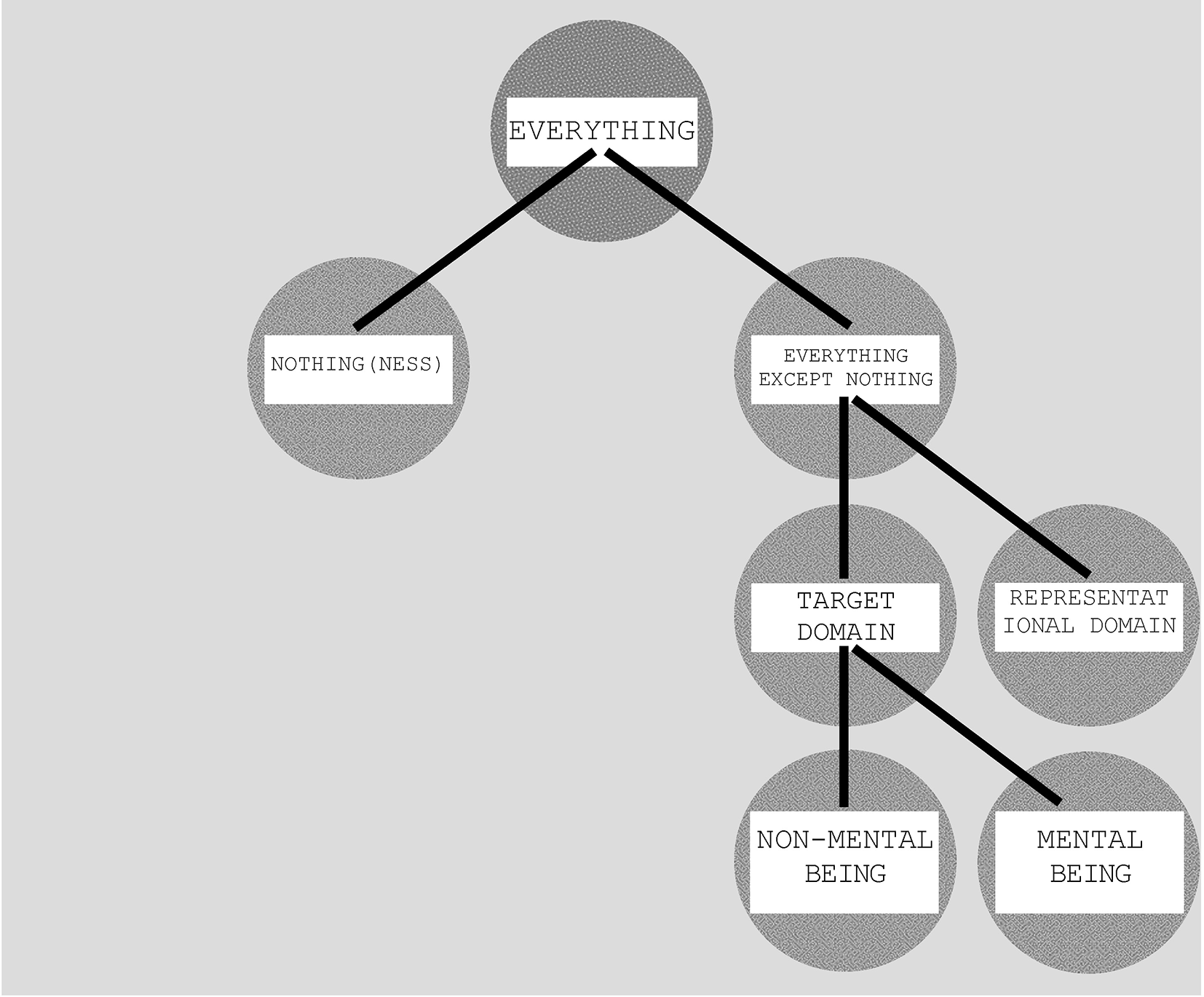
In this fragment, the “TARGET DOMAIN” comprises the totality of objects and processes. Within this domain, the next natural differentiation separates “NON-MENTAL BEING” form “MENTAL BEING”. This opposition corresponds to the distinction between entities independent of mentality and those that manifest mentality.
The “REPRESENTATIONAL DOMAIN”, by contrast, concerns how the target is internally structured, encoded, and made cognitively available. This domain is suggested to be hierarchically divided into two complementary sub-domains: “PROTO-REPRESENTATIONAL (PRE-SYMBOLIC) SUB-DOMAIN ” and “CONCEPTUAL–SYMBOLIC AND META-REPRESENTATIONAL SUB-DOMAIN ”. The “PROTO-REPRESENTATIONAL (PRE-SYMBOLIC) SUB-DOMAIN ” encompasses the most immediate forms of representation: sensory impressions, perceptual primitives, patterns, configurations. The “CONCEPTUAL–SYMBOLIC AND META-REPRESENTATIONAL SUB-DOMAIN ”, on the other hand, includes the more developed structures through which cognition abstracts, organizes, and reflects upon the primitive forms. It contains concepts, categories, labels, formal representations, propositions, statements, and, at its upper limit, theories, models, frameworks, schemata, procedures, and algorithms.
Even in its preliminary form, the introduced system preserves a strict dichotomic progression, while exhibiting internal depth and coherence. Nevertheless, despite its initial theoretical elegance and conceptual power, there still remain several open challenges and a room for the further enhancement. Among them are:
- the issue of multiple inheritance, i.e., how elements might simultaneously belong to more than one branch of the hierarchy,
- computational challenges, concerning the possible translation of the proposed system into computer-based or algorithmic implementations,
- methodological questions related to the practical differentiation and operational definition of notions within such a system.
Addressing these challenges may clarify the deeper relation between abstract representational structures and the processes of cognition and knowledge formation. These issues will be briefly touched in the concluding remarks and may also serve as a basis for subsequent work.
A rational representational system is among the fundamental aspects of intelligence—by which the reality is conceptualized, communicated, and internally replicated. In our view, though subjective, intelligence, whether natural or artificial, will increasingly rely on an efficient, unified language of thought, grounded in a coherent system of notions. One of the essential missions may be what we call “internal experimentation” (or “thought experimentation”), whose goal is to generate new conceptual copies of things and also new recombinations of those copies. From this standpoint, a major strength of the representative realist position lies in its recognition of the “active participation of the mind” in deriving and re-creating representations of reality. New knowledge is continually constructed from successful recombinations of previously validated models. In this sense, intelligence not only reflects the world but may also extend, redesign it—creating new conceptual entities, projections faster than natural evolution itself. Intelligence thus becomes, metaphorically, a “co-worker of nature”, contributing to an ongoing artificial evolution (evolution of concepts), where less fit ideas gradually disappear and more fit ones survive.7
The present note has been written in this spirit. We have outlined a preliminary abstract hierarchical representational system, conceived as a universal and method-neutral schema for the organization of knowledge. Despite its simplicity, such a structure may serve as a legitimate and potentially fruitful abstraction for understanding how cognitive systems can structure their internal representations of the world. Philosophically, the hierarchical principle proposed here is not merely a heuristic device but may represent a foundational structure through which knowledge itself becomes possible. Methodologically, it offers a general abstract framework capable of informing diverse representational/computational paradigms, ranging from symbolic/neural architectures to hybrid hierarchical heuristics.
Looking ahead, several directions appear promising:
- to deepen each branch of the system by exploring further differentiations and sub-hierarchies;
- to examine dynamic relations (feedbacks, transformations) between representational levels;
- to investigate epistemic extensions, such as incorporating the distinction between the “observable” and the “non-observable [Universe]” as a preliminary layer of representation.
Finally, one of the intriguing potential applications of this framework may lie in the development of a “collective brain”, “intelligent network” or “internet of notions” (reminiscent of the “internet of things”). Such a system would constitute a hyper-connected network of uniquely identifiable concepts—an ontological infrastructure enabling human and artificial intelligences alike to reference, manipulate, and co-evolve shared representations of knowledge.
| Views | Downloads | |
|---|---|---|
| F1000Research | - | - |
|
PubMed Central
Data from PMC are received and updated monthly.
|
- | - |
Provide sufficient details of any financial or non-financial competing interests to enable users to assess whether your comments might lead a reasonable person to question your impartiality. Consider the following examples, but note that this is not an exhaustive list:
Sign up for content alerts and receive a weekly or monthly email with all newly published articles
Already registered? Sign in
The email address should be the one you originally registered with F1000.
You registered with F1000 via Google, so we cannot reset your password.
To sign in, please click here.
If you still need help with your Google account password, please click here.
You registered with F1000 via Facebook, so we cannot reset your password.
To sign in, please click here.
If you still need help with your Facebook account password, please click here.
If your email address is registered with us, we will email you instructions to reset your password.
If you think you should have received this email but it has not arrived, please check your spam filters and/or contact for further assistance.

Comments on this article Comments (0)