Keywords
eye health promotion, health systems strengthening, primary health care

This article is included in the Eye Health gateway.
eye health promotion, health systems strengthening, primary health care
South Africa faces systemic challenges in eye health promotion, which mirror a broader weakness in the national healthcare system. Public health interventions targeting eye health remain understated despite the substantial burden of preventable visual impairment (VI) and blindness.1,2 Previous studies have shown that in South Africa, moderate and severe VI are largely caused by uncorrected refractive error (43%), cataract (28%), glaucoma (7%), and diabetic retinopathy (4%).3 Many of the leading causes of visual impairment can be prevented or managed effectively if detected early through routine eye examinations and timely interventions. However, rural and underserved populations face severe challenges with limited access to eye health services, resulting from their many inadequately equipped health facilities.4 The World Health Organisation (WHO) World Report of Vision’s comprehensive eye health initiatives have not been routinely included in primary healthcare, and awareness campaigns are not consistently implemented.1 This highlights a critical missed opportunity to address the substantial burden of eye diseases at the community level through systematic health promotion (HP) interventions.
The consequences of this gap are profound. Without cost-effective interventions such as effective health promotion, conditions such as uncorrected refractive errors, diabetic retinopathy, and cataract-related vision loss, which are responsible for most global VI, remain undetected and untreated.5 These result in avoidable blindness, reduced educational and employment opportunities, and diminished quality of life. In South Africa, VI has far-reaching implications regarding social, economic and quality of life for individuals, families and communities.6,7 Social determinants of health such as poverty, education and food security further influence access to eye care in Sub-Saharan Africa (SSA), significantly necessitating a broader approach that addresses these underlying issues.8 Therefore, strengthening eye health promotion initiatives may have positive health and economic effects, promoting national development goals and enhancing the well-being of marginalised populations.
Recent health sector reforms in South Africa, with the envisaged implementation of the National Health Insurance (NHI) and the integration of preventative services in primary health care (PHC) provide an opportunity to consider the role of eye health promotion.9 However, in South Africa, primary eye care is not delivered to the standards set by the National Department of Health due to a number of issues, including organisation of care, resource availability, and clinical competency compromising the implementation of ocular health system strengthening.10 These gaps highlight the necessity of a coherent framework to guide the planning, implementation, and evaluation of eye health promotion interventions across the province.
This policy brief proposes a multi-level framework for strengthening eye health promotion interventions in Limpopo Province. The framework should drive eye health promotion interventions and potentially explore the development of a digital health platform to support eye health surveillance, community mobilisation, and education. This should be complemented by the training of eye health professionals in eye health promotion, referral pathways, and advocacy skills. Additionally, to expand the reach of eye health promotion outside of the clinical settings, collaborations with non-profits organisations, civil society, schools, and workplaces should be formalised. These interventions should be embedded within the current health care system to ensure sustainability and scalability that can strengthen eye health promotion efforts in South Africa. This proposal will not only reduce the burden of avoidable blindness but also increase uptake of eye care services and contribute to improved health outcomes. Furthermore, it will contribute to achieving access to quality health care services, integrating equitable and comprehensive eye health care services into the broader universal health coverage (UHC) pursued by the NHI and the WHO SPEC 2030 initiative. Additionally, achieving the Sustainable Development Goals (SDGs) related to health, education, and economic development.
Summary of research findings
• There is a significant impact on eye health services where eye health promotion interventions are implemented.11
• A diverse range of HP strategies has shown significant effectiveness across various settings.12
• Common barriers to implementation of HP interventions were limited follow-up compliance, poor referral uptake, lack of awareness, limited parental support and awareness, limited public awareness, limited community engagement, and socioeconomic challenges negatively impacting follow-up care.13
• Facilitators were timely interventions and referral, multidisciplinary collaboration, use of telemedicine and portable devices, community-based and mobile screening and cost-effective interventions.13
• Survey results of eye health professionals on eye health promotion interventions reveals 88.2% with good knowledge, 89.7% with positive attitudes, 95.6% involved in community outreach, 89.7% involved in school outreach and little collaboration with other professionals.14,15
• Human resources in eye health, resource management, policy and governance, eye care services, innovation in eye health, community and patient engagement, and coordination and referral systems are key factors involved in eye health promotion intervention.16
• Evaluation of eye care services indicated that challenges were related to structure and processes significantly influencing patient outcomes.17
A structured approach, such as the framework proposed by the WHO, is needed to address these challenges and ensure a more systematic and effective response. Current health policies in South Africa inadequately address the need for universal eye care and timely screening, prevention and early diagnosis, which are significant to avoid VI and blindness. Inadequate data on eye health accompanied by a lack of eye care services in many health facilities worsen systemic challenges, creating major gaps in disease surveillance and strategic public health interventions. Based on the WHO’s Six Building Blocks framework, the following diagram presents strategic policy recommendations ( Figure 1).
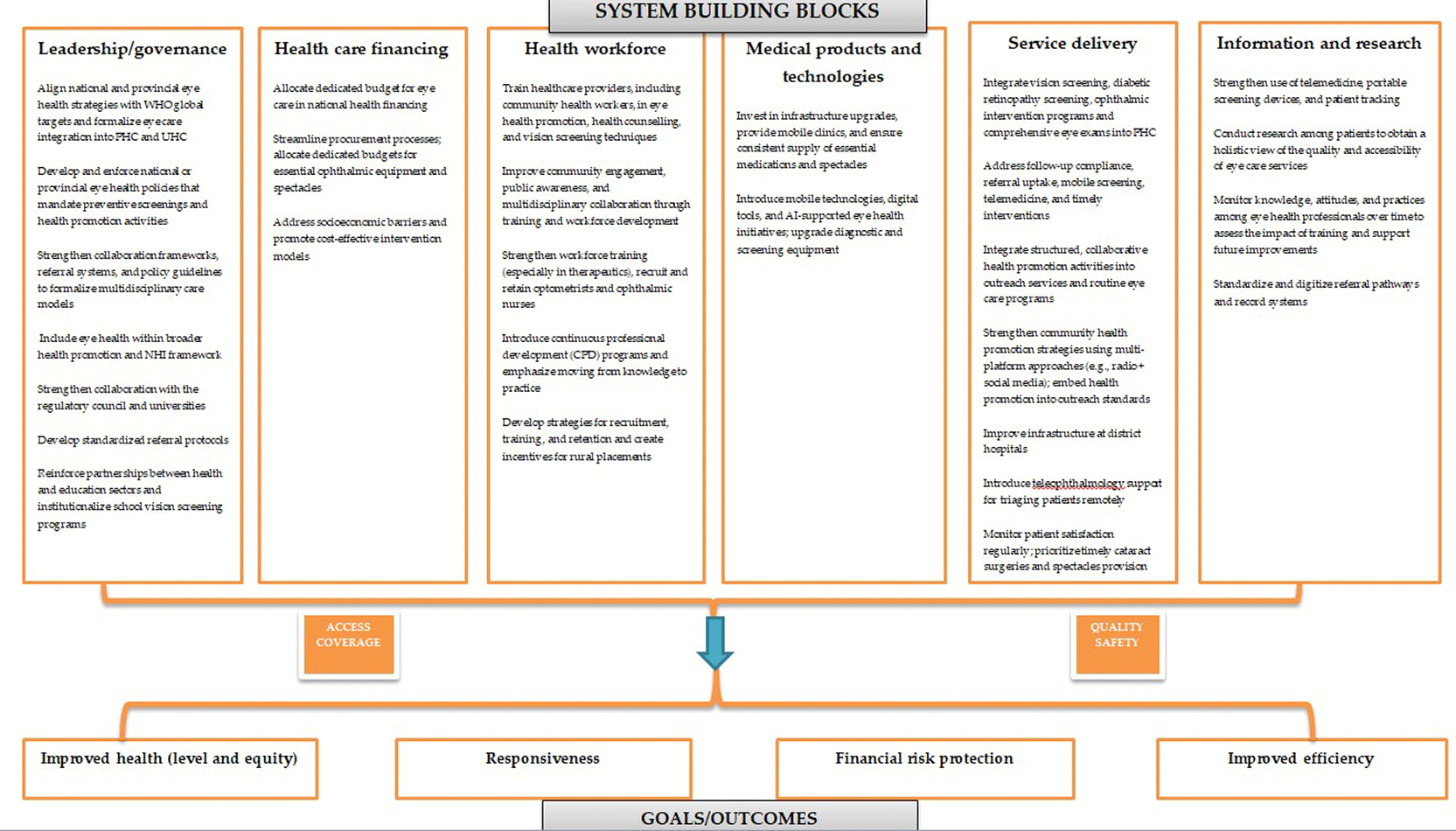
Moreover, there is an urgent need to align national and provincial health strategies with WHO global targets as a result of the burden of avoidable VI. The current national strategic plans underrepresent eye health and often fail to address pertinent issues. This lack of coherent strategies further impedes early detection and preventative management of eye conditions. Community-centred approaches in PHC are recommended to reduce travel costs to district hospitals and improve uptake of eye care services. Addressing these challenges requires optometrists, ophthalmic nurses, and ophthalmologists to work as a coordinated team by strengthening effective referral pathways.
Additionally, a dedicated budget is required at both national and provincial levels, which will streamline the procurement of spectacles and ophthalmic equipment. These will ultimately improve access, coverage, quality, and safety of eye care services in the province. Through prepaid pooled financing such as the NHI, provision of spectacles and surgical services can be achieved, addressing inequalities in access by redistributing resources to underserved areas and vulnerable populations. Scaling up outreaches in communities, schools, workplaces, and radio campaigns will requires recruitment and retention of eye health professionals, especially in rural areas.
Poor maintenance and ageing equipment are two factors that lead to inefficiencies in service delivery. Many clinics lack diagnostic tools for diseases like diabetic retinopathy and continue to use antiquated visual acuity charts. Upgrading diagnostic equipment and infrastructure will improve services. Along with leveraging digital technologies such as radio, WhatsApp, and other social media platforms for public health messaging. This will strengthen the efficiency and resilience of health systems delivering eye care.
The training and provision of the skills, resources, and equipment of eye health professionals in every district to carry out successful eye health promotion initiatives must be a top priority in the national health strategy. Building capacity in vision screening, patient education, community outreach, and the use of digital technology for early detection and referral should be at the centre of this strategy. These initiatives must be supported by a sustained, multi-platform public health campaign that raises awareness about the significance of eye health, the risk of untreated VI, and the necessity for early intervention and regular eye examination.
There is an urgent need for a coordinated, cross-sectoral effort to address the pervasive gaps in awareness, service delivery, and follow-up treatment, as demonstrated by the current status of eye health promotion in Limpopo Province. Strong leadership from healthcare authorities is necessary to increase the effectiveness and reach of eye health promotion, but so is an intentional collaboration with the education sector, community structures, professional bodies, and digital health partners. The country can only enhance population-level vision outcomes, decrease preventable blindness, and guarantee that eye care becomes a fundamental component of responsive, equitable PHC by implementing coordinated and consistent measures.
Creating comprehensive and efficient health policies and frameworks to promote eye health is essential given the high prevalence of preventable vision impairment and its impact on education, employment, and quality of life. Evidence suggests that VI remains a major public health concern in South Africa and is impacted by a complex interplay of interpersonal, intrapersonal, cultural and environmental and organisational factors. This emphasises the necessity of a strategic and focused policy-level intervention.
The integration, execution, and implementation of eye health promotion initiatives should be strengthened by national health policy, with an emphasis on early identification, public awareness, equitable access to services, and better coordination across all levels of care.
First, there should be an integration of eye health promotion into the PHC and NHI Framework. This approach will reduce the burden on district, regional and provincial health facilities and promote early detection and improve uptake of eye care services in rural areas.
Second, dedicated funding and the establishment of an automated procurement system leveraging technology is required for eye care services to ensure the timely provision of spectacles, screening devices, and essential ophthalmic supplies.
Third, considering the shortage and uneven distribution of eye health professionals, strengthen workforce capacity and provide a rural allowance as an incentive to attract and retain optometrists and ophthalmic nurses in rural districts.
Fourth, as health communication is crucial in eye health promotion interventions, proactive public awareness through community outreach and school-based eye health promotion interventions is essential.
Fifth, infrastructure and equipment should be upgraded to enhance accuracy in the screening and diagnosing of eye conditions. This approach will further assist in extending services to hard-to-reach communities using mobile clinics and PHC facilities to improve service delivery.
Although the framework developed in this study is conceptual and supported by evidence, a number of high-level practical considerations are suggested to direct its future application. Adequate human resources (such as trained eye health professionals and community health workers), infrastructure (such as primary health care facilities and equipment), and sustainable financing mechanisms that are in line with PHC and National Health Insurance priorities would all be necessary for successful implementation. Coordination between the Department of Health, educational institutions, non-governmental organisations, and community structures is essential to governance and stakeholder engagement in order to guarantee accountability and alignment.
Measurable metrics such as service use rates, referral completion, treatment adherence, and equity in access across population groups should be used to enhance implementation from the standpoint of monitoring and evaluation (M&E). Strategies for risk mitigation should also be taken into account. These include using capacity-building, resource planning, and system integration to handle potential issues such as workforce shortages, unstable funding, and inadequate referral systems. Additionally, to guarantee that interventions give priority to marginalised and disadvantaged groups, especially in rural and resource-constrained contexts, an explicit focus on equity is necessary.
Linking policy recommendations for enhancing eye health promotion activities in Limpopo Province with the WHO’s Six Building Blocks of Health Systems framework is vital in order to guarantee their coherence and strategic integration.17,18 This organised approach offers a systematic approach and identify key areas for prioritisation from the PHC level and further across all levels of the health system, through various components. Governance, health workforce, service delivery, health system financing, information technology and access to essential medicine are the pivotal areas highlighted in this approach. The impact of proposed interventions can easily be implemented using this enabling framework, making it possible for scaling up eye care services and health promotion to the general population.
| Views | Downloads | |
|---|---|---|
| F1000Research | - | - |
|
PubMed Central
Data from PMC are received and updated monthly.
|
- | - |
Provide sufficient details of any financial or non-financial competing interests to enable users to assess whether your comments might lead a reasonable person to question your impartiality. Consider the following examples, but note that this is not an exhaustive list:
Sign up for content alerts and receive a weekly or monthly email with all newly published articles
Already registered? Sign in
The email address should be the one you originally registered with F1000.
You registered with F1000 via Google, so we cannot reset your password.
To sign in, please click here.
If you still need help with your Google account password, please click here.
You registered with F1000 via Facebook, so we cannot reset your password.
To sign in, please click here.
If you still need help with your Facebook account password, please click here.
If your email address is registered with us, we will email you instructions to reset your password.
If you think you should have received this email but it has not arrived, please check your spam filters and/or contact for further assistance.

Comments on this article Comments (0)