Keywords
Finite difference method, Crank-Nicolson, Tikhonov regularization, Inverse problem, Coefficient problem, Ill-posed problem, Nonlocal conditions, Parabolic equation.

This article is included in the Fallujah Multidisciplinary Science and Innovation gateway.
Finite difference method, Crank-Nicolson, Tikhonov regularization, Inverse problem, Coefficient problem, Ill-posed problem, Nonlocal conditions, Parabolic equation.
Inverse problems (IPs), arise naturally in many scientific and engineering disciplines as they are typically modeled by differential equations. In the context of ordinary differential equations, the direct problem refers to obtaining solutions for a given system, whereas IP focuses on reconstructing the governing system from observed characteristics. Historically, the role of IPs was recognized in celestial mechanics.1 In practical applications, IPs are commonly encountered when one seeks to determine unknown causes from their observed outcomes, in contrast to direct problems where effects are predicted from known causes. Compared with direct problems, IPs, are often more challenging to solve due to their ill-posedness, solutions may fail to exist, may not be unique, or may not change continuously with the input data.2 Such problems appear in almost every scientific and technological domain, particularly in models derived from social and physical systems. Since most of these models are expressed through differential and integral equations, their analysis requires not only solving the equations but also interpreting the system’s behavior under varying conditions, provided that sufficient information is available to fully describe the model. IPs, associated with such equations arise in a wide range of scientific and engineering applications, as well as in the modeling of social processes. Many physical phenomena are described by mathematical models in the form of initial and boundary value problems for partial differential equations (PDEs). Frequently, these models involve differential and integral equations.3 In boundary type IPs, the goal is to recover unknown boundary conditions, which usually leads to classical ill-posedness because the absence of continuous dependence of the solution on the input data. Numerical solution (NS) of direct mathematical physics problems is presently a well-studied matter. In solving multi-dimensional boundary value problems, difference methods and the finite element method are widely used. Partial differential equations give a basis for applied mathematical models, and their solution can be found in mathematical physics equations and some relations, including additional relations, boundary, and initial conditions, among other elements.4 The following reconstruction problems serve as examples of IP applications in daily life, tomography, initial condition estimation of transient problems in conductive heat transfer, detection of non-metallic materials beneath the surface using reflected radiation methods, intensity, position estimation of illuminated radiation from a biological source using experimental radiation measures, and thermal source intensity estimation with functional dependence in space.5–9 On the other side, there are three different kinds of differential equations, Second-order equations are the most crucial for applications, Elliptic, Parabolic, and hyperbolic equations are examples of these equations. Yuldashev and other authors studied elliptic type integrate differential equations in10,11 while hyperbolic and parabolic were studied in12–14 and15–17 respectively. The alternating direction explicit method used for reconstructing solutions is also efficient and unconditionally stable, in18 is restructured into a nonlinear regularized least-square optimization problem, and is effectively resolved using the MATLAB subroutine lsqnonlin from the optimization toolbox. The Crank-Nicolson (C-N) FDM together with the TR was used in19–21 the effectiveness of the computational method was shown together with the proof of the solution’s existence and uniqueness. To find a stable and accurate approximate solution of finite differences. In22–26 the study shows that for the IP with the time-dependent source coefficient in heat equations, there’s a smooth solution pair as extended as a single data point at an observation point and by providing an explicit formula for the time-dependent source coefficient, additional information at the observation point improves our comprehension of the behavior of the problem. This paper’s IP classical solution for a second order parabolic equation has been shown to be exist and unique by Elvin Azizbayov.27 As a result, the main objective of the current work is a numerical realization of such a problem. In this paper, the article is divided into five sections, Section 2, includes a mathematical formulation of the IP under study. Section 3, a numerical method for solving the forward problem using C-N FDM. In Section 4, the IPs mathematical solution is shown with an initial guess, while, in Section 5, discuss the numerical problem and explain the obtained results.
As a mathematical model, we consider be a rectangular region that is defined by and be a fixed number, the one-dimensional IP of determining of unknown functions for the upcoming parabolic equation,
and the overdetermination conditions
Consider the triplet represents a classical solution, to the IP if the functions and satisfies the following conditions:
1) The function and its derivatives are continuous in the domain
2) The functions and are continuous on
3) Equation (1) and conditions are satisfied in the classical (usual) sense.
2.2.1 Theorem 1[28]: Let the assumptions and the condition
The direct problem will be resolved in this section, i.e., when unknown, , and are assumed to be given, in order, to solve this problem, Crank-Nicolson (C-N) FDM scheme had been used for finding the solutions of the nonlocal problem given by Equation (1)–(4) Where the domain had been divided into mesh with spatial step size and the time step size where and are given positive integers. The grid points have been given by
These quantities’ discretized form is given as follows,
Applying the C-N FDM, for the discretizes Equation (1) which approximated as,
The C-N FDM discretizes Equations (2)–(4) which approximated as,
Finally, the trapezoidal rule and C-N discretizes integral condition ( ) as;
From Equation (29) with the nonlocal initial conditions (assuming ), and using Equations (30)–(33), with each time step , we can be described in matrix form as
The adopted C-N finite difference scheme used to solve the direct problem is unconditionally stable and second order accurate in both spatial and temporal discretization. A brief von Neumann stability analysis shows that the amplification factor satisfies , for all mesh ratios, which guarantees the unconditional stability of the scheme. The local truncation error is of order confirming that the method provides second order accuracy and reliable convergence toward the analytical solution as the mesh is refined. Hence, the C-N formulation ensures both numerical stability and accuracy for the present problem.
3.2.1 Example 1: Assume an illustration for the direct problem given by with and the input data are,
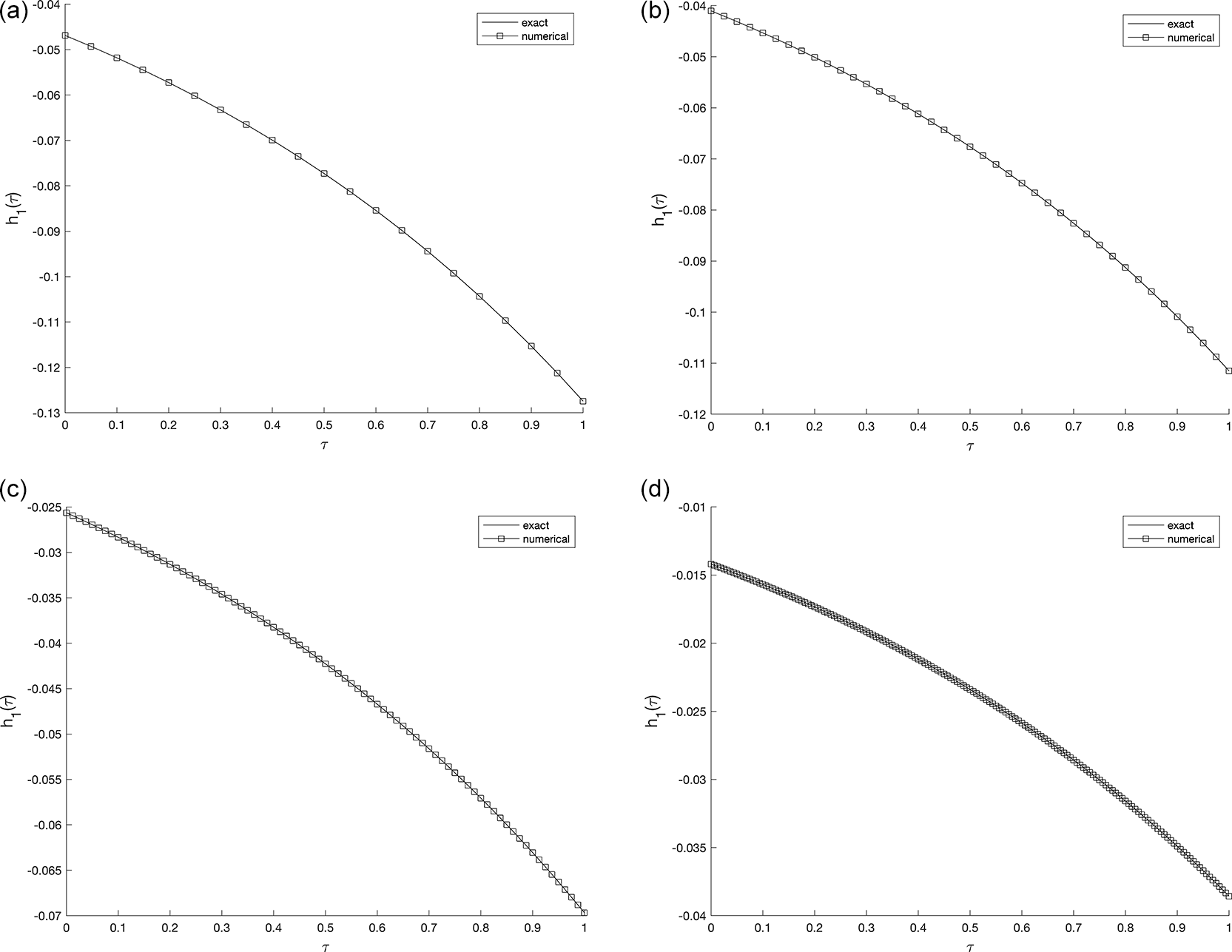
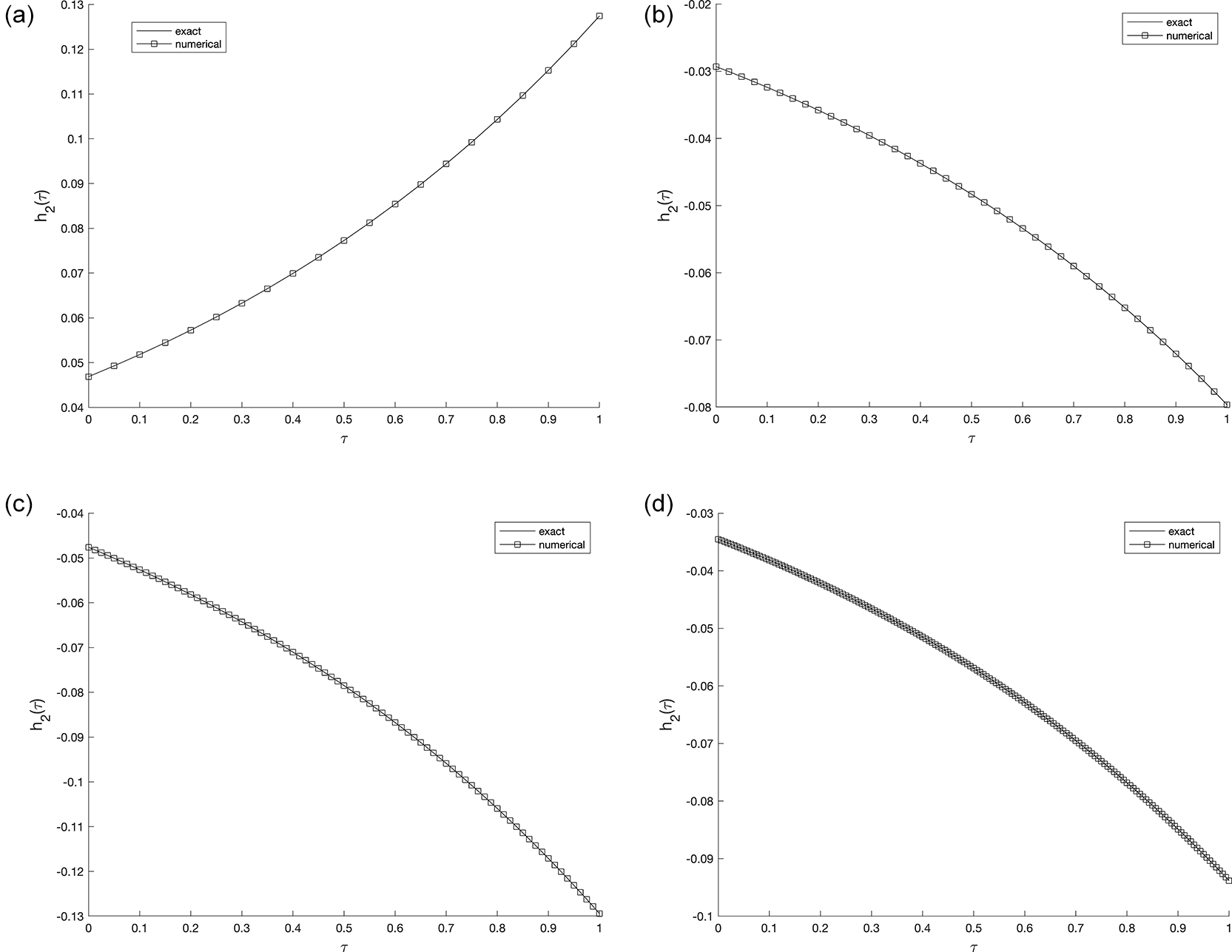
We investigate the accuracy of the solution using diverse mesh grid size, . In Figure 1 (a)–(d), an excellent agreement between the exact and numerical solutions can be clearly observed, indicating high accuracy. It can be noted that as the number of mesh points increases, the accuracy of the obtained solution improves, which reflects the convergence and stability of the proposed numerical scheme. Moreover, the absolute error graph at each mesh shows that the maximum magnitude of error didn’t exceed , as depicted in Figure 1 (a)–(d).
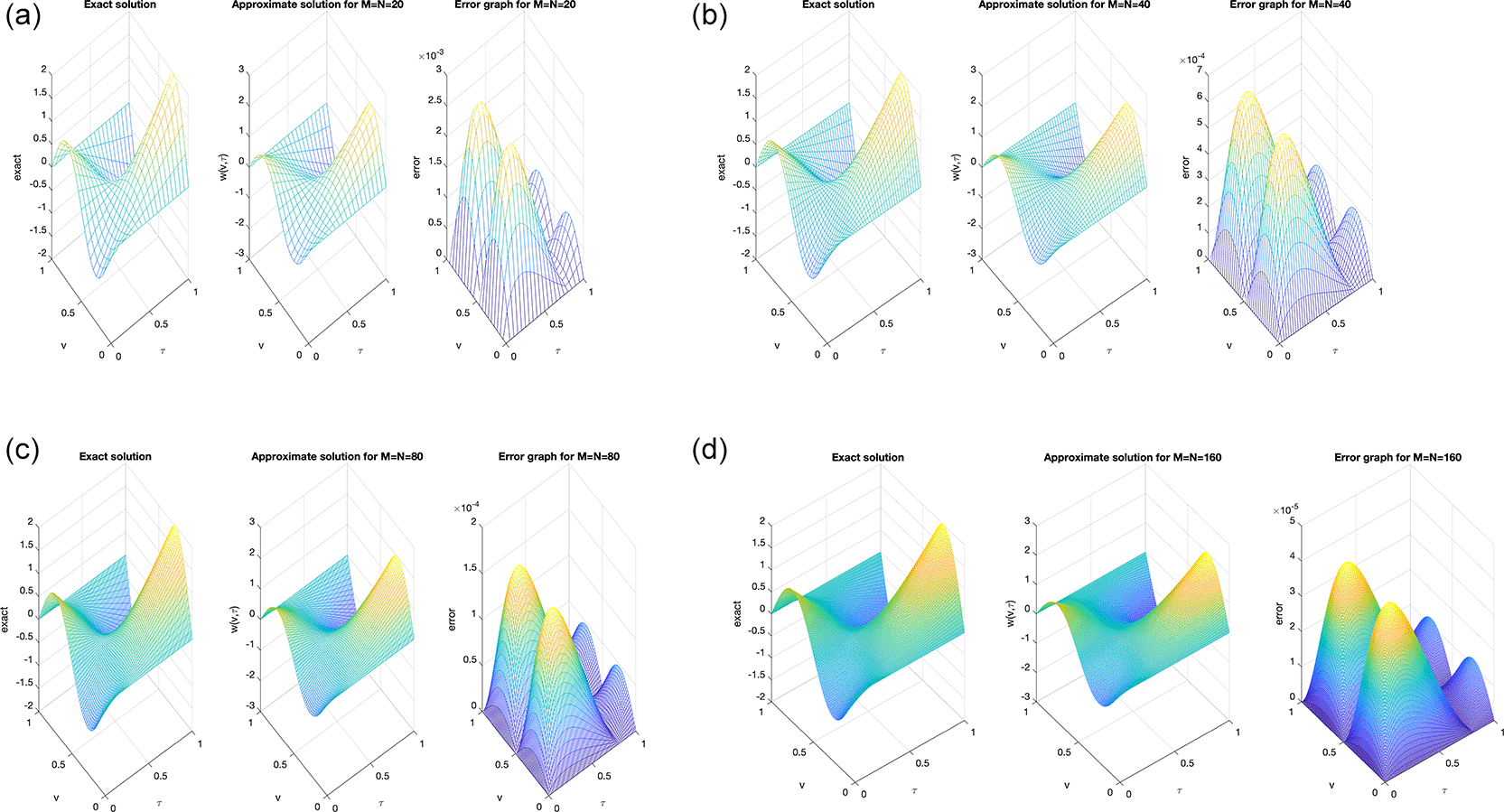
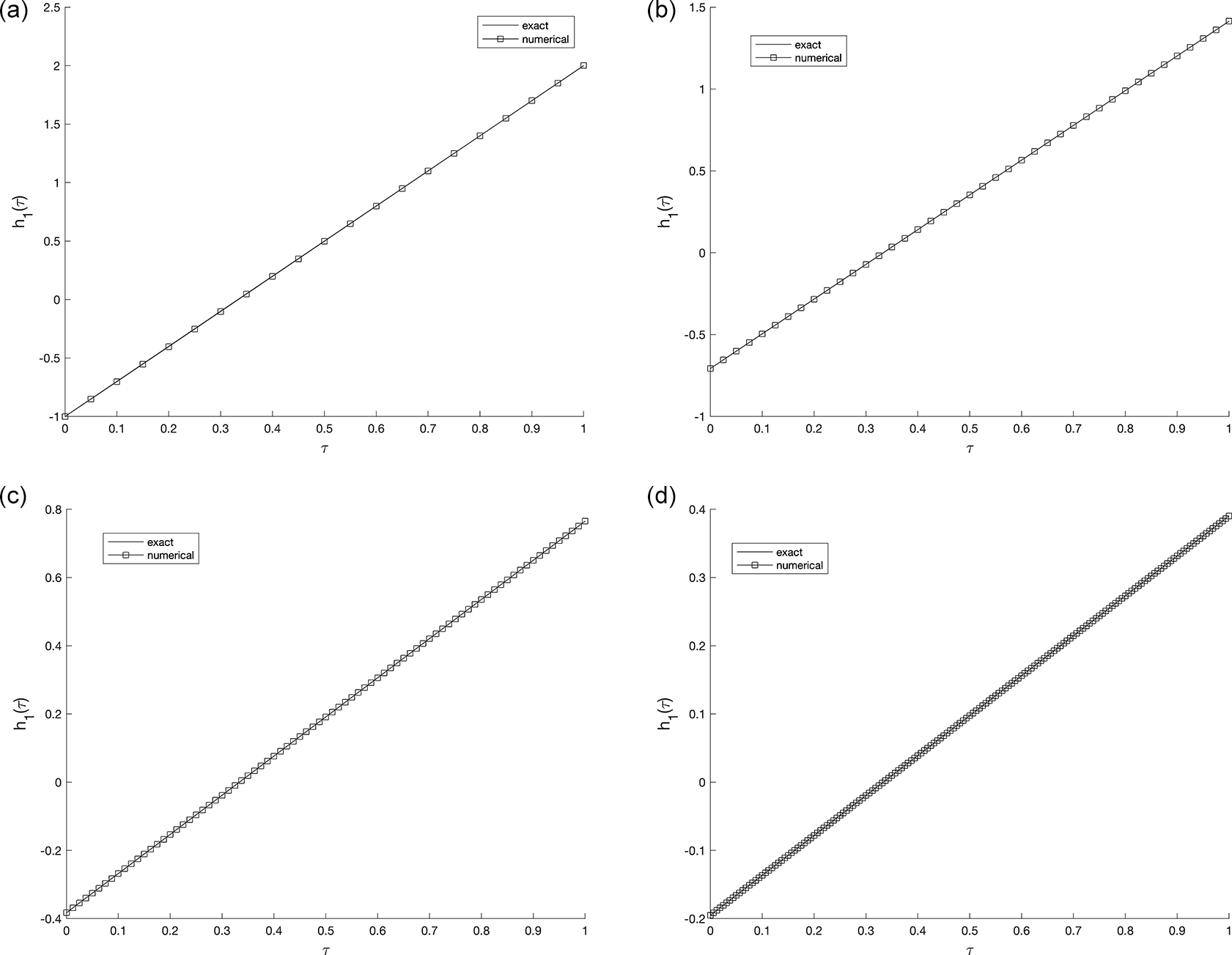
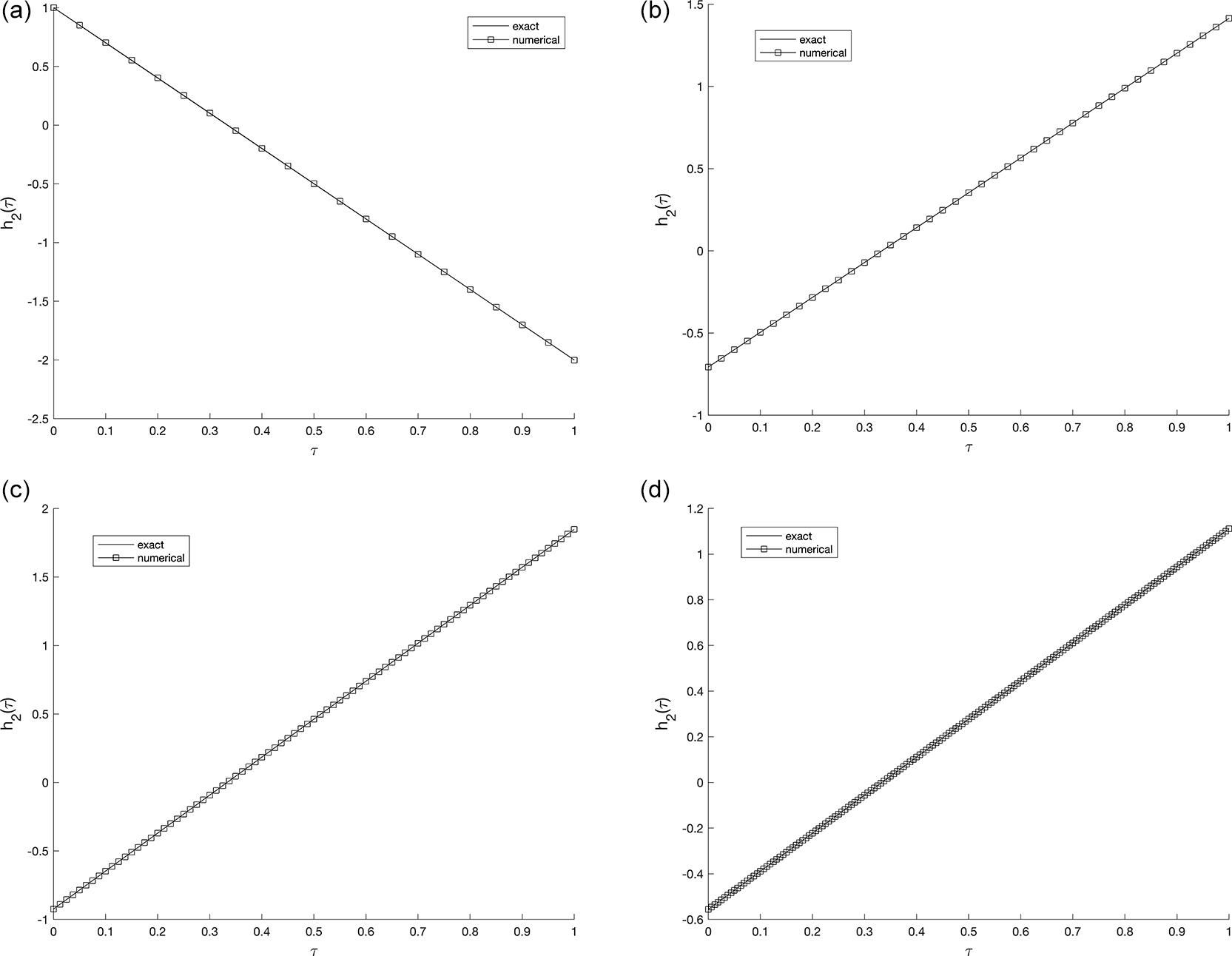
The obtained results clearly indicate that the mesh size has a noticeable influence on the numerical accuracy. As the spatial and temporal mesh are refined (i.e., as and increase), the numerical solution becomes smoother and shows a closer agreement with the analytical one. This behavior confirms the expected second-order convergence of the C-N finite difference scheme in both time and space. Beyond a certain refinement level (e.g., ), further mesh subdivision produces only negligible changes, implying that the proposed schemeis numerically stable and nearly mesh-independent. Whilst, Figure 2 and Figure 3, show the numerical outcomes for the required information evaluated at various mesh sizes such that (s.t.), observed that an excellent agreement is obtained.
3.2.2. Example 2: Assume an illustration for the direct problem given by with and the input data are,
The accuracy of the numerical solution is examined using several mesh grid size, . Figure 4 , clearly demonstrates an excellent agreement between the analytical and numerical solutions, confirming the reliability of the proposed approach. It can be noted that as the number mesh becomes finer, the numerical accuracy improves, indicating the expected convergence and stability of the C-N finite difference scheme. Furthermore, the absolute error plots at different mesh sizes reveal that the maximum error magnitude remains below , as illustrated in Figure 4 .
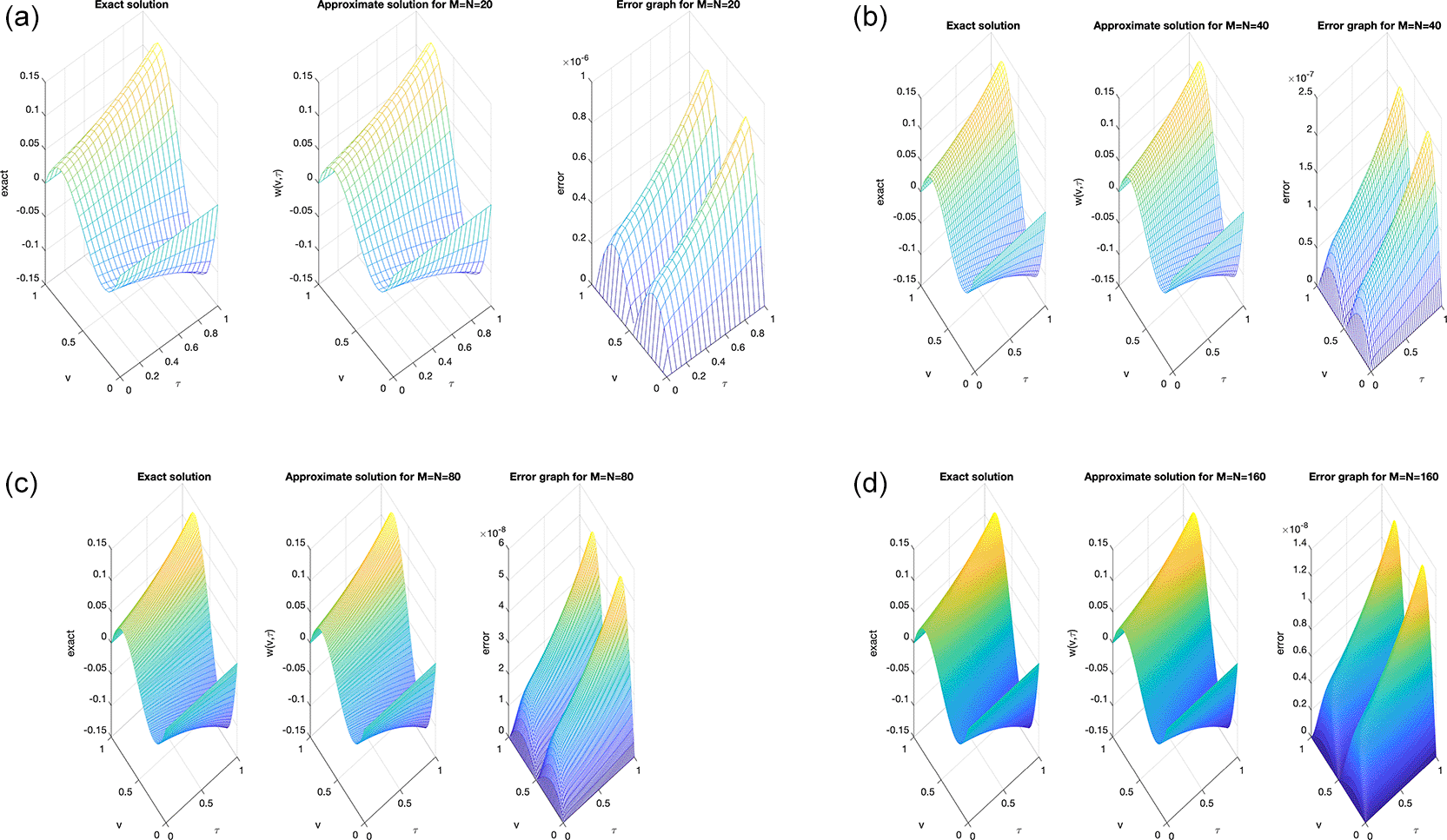
Similarly, in Example 2, the refinement of the spatial and temporal mesh has a direct impact on the numerical accuracy. As the grid is successively refined, the computed solution aligns more closely with the analytical one, and the absolute error distribution becomes smoother across the domain. This confirms that the proposed C-N finite difference formulation maintains its second-order convergence and numerical stability. It can therefore be concluded that the results are consistent and nearly insensitive to further mesh refinement beyond the tested resolutions, indicating satisfactory mesh-independence of the method. Whilst, Figure 5 and Figure 6, show the numerical outcomes for the required information evaluated at various mesh sizes s.t. observed that an excellent agreement is obtained.
For the nonlinear IP we seek precise and stable identification of and , that mean potential term , and is unknown. The one-dimensional second-order parabolic equation together with satisfies the problem given by Equation (1)–(5), the problem is reformulated as a nonlinear least-squares minimization task. The resulting minimization problem is solved numerically using the lsqnonlin routine available in MATLAB’s optimization Toolbox, which implements a trust-region reflective algorithm suitable for nonlinear least squares problems with bound constraints. Due to the ill-posedness of such problems, especially in the presence of noise data, Tikhonov Regularization (TR) is employed to stabilize the solution. The regularization parameter , is selected carefully to balance the trade-off between measured and the numerically computed solution. For this purpose, MATLAB routine lsqnonlin is employed, to minimize the Tikhonov Regularized objective functional, the procedure begins with a suitably selected initial guess. The TR functional is derived based on condition , and the functional error is incorporated as follows:
where is a regularization parameter. The discretization form of is
The unregularized case, i.e., produces the regular a nonlinear least-squares functional, which is inherently unstable when dealing with noisy data. The MATLAB routine lsqnonlins is used to minimize under some physical constraint. The following parameters had been used for the subroutine:
• (Maxlter) maximum number of iterations .
• Solution and Objective function tolerance
• The lower and upper bounds on the component of the vector are and , respectively.
The IP are resolved via both precise and noisy measurement . By including a random error, the noisy data is numerically simulated:
To evaluate the precision and stability of the numerical methods, a set of numerical experiments is conducted. These experiments are designed to evaluate the accuracy of the computed results by simulating realistic measurement conditions, where noise is introduced into the input data. To quantitatively evaluate the discrepancy between the exact and the numerically computed solutions, the root mean squares errors (RMSE) are utilized by the following expression
Consider the IP with the following input data,
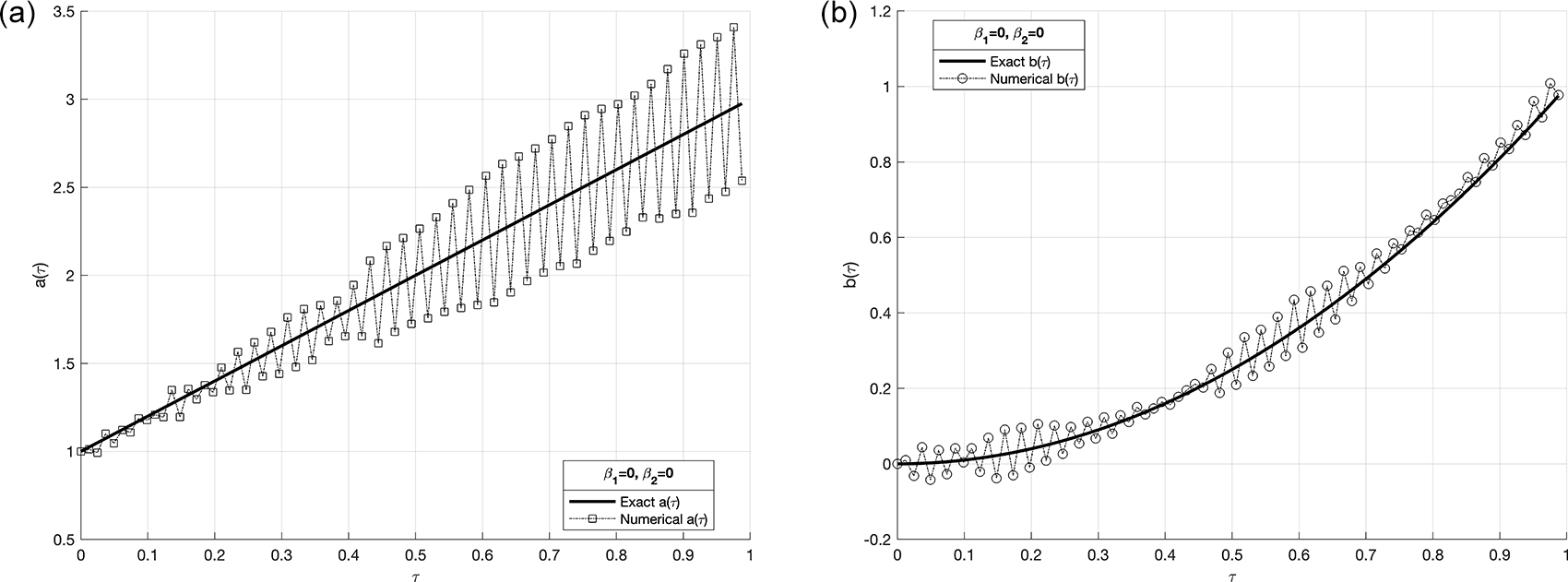
The time-dependent coefficient , and , are then reconstructed (in case, , is taken), and consider the case of noise-free in the measurements, see Table 1, this mean in and, no regularization applied, Figure 7 shows the objective function without regularization i.e. while, in Figure 9, noise without regularization.
| 80 | |
|---|---|
| RMSE a( ) | 0.0241 |
| RMSE b( ) | 2.1592 |
| Computational time | 3594 Sec |
| No. of Iterations | 16 |
| Obj. Function | 1.2221× |
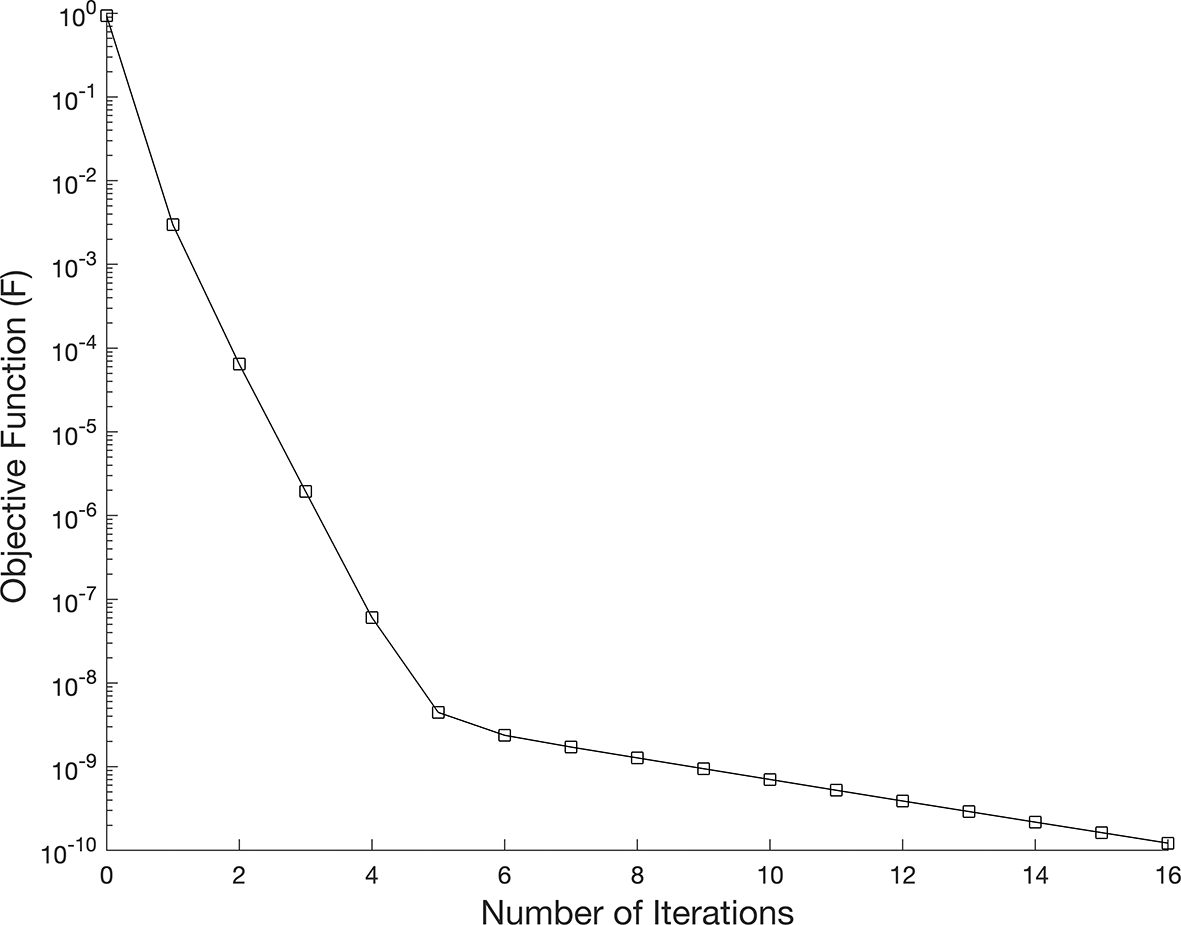
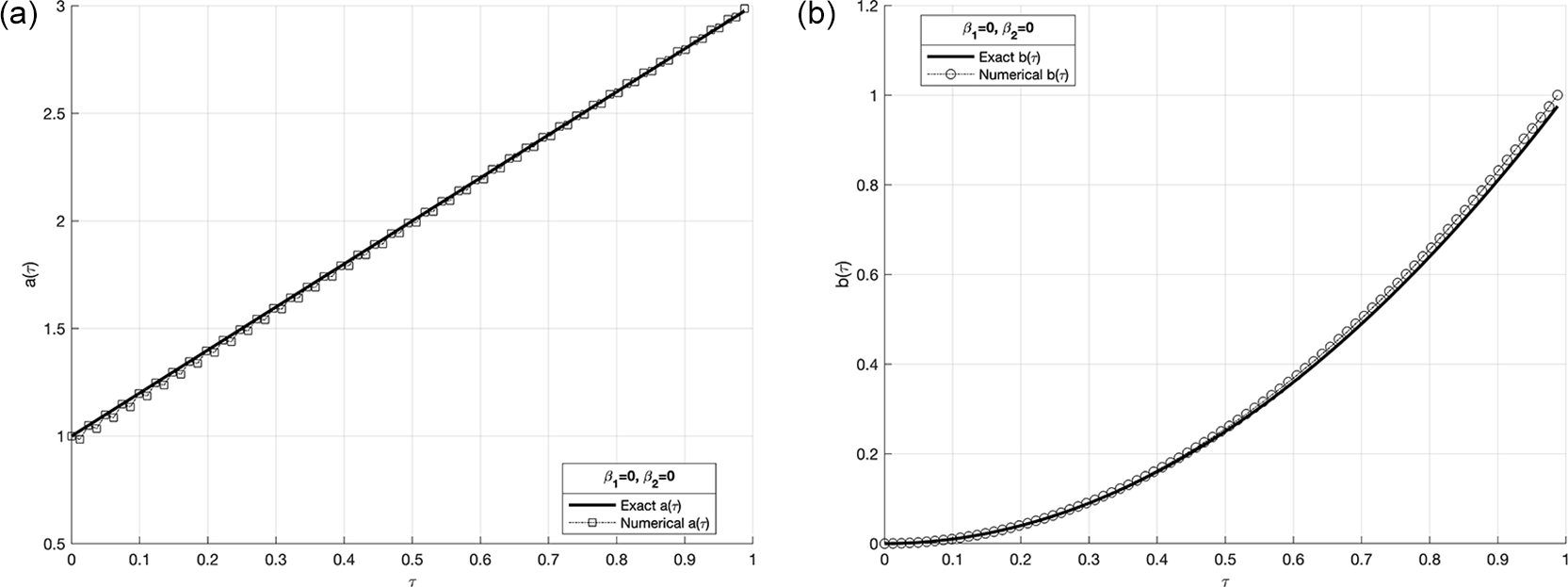
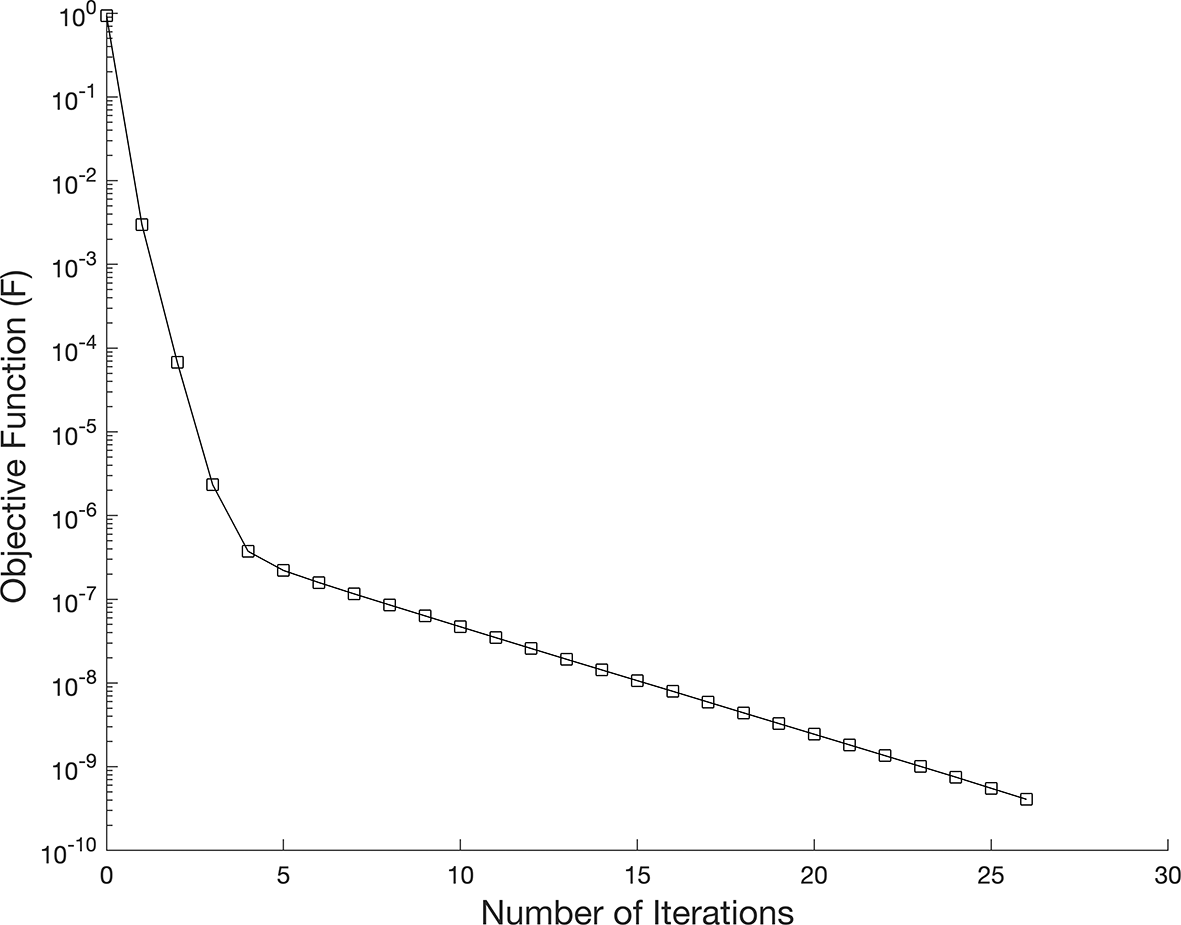
We investigate the time-dependent coefficient and under both exact and perturbed measurements, as demonstrated in Figures 7 12. The associated results are unstable, as illustrated in Figure 9- Figure 10. This reveals that the problem is not properly posed, a noticeable instability appears in the results, which is anticipated due to the ill-posed nature of the investigated IP. The unregularized solutions exhibit noticeable instability even in the noise-free case, demonstrating the sensitivity of the problem to small perturbations in the input data. The TR approach is used by incorporating the penalty term into the classical least-squares formulation, as presented in Equation (37). In Figure 11, noise strategy is employed to enhance the solution’s robustness with regularization parameters, , yielding numerically stable regularized reconstructions of and , as shown in Table 2. These results indicate that smaller values of are effective when the data is not contaminated.
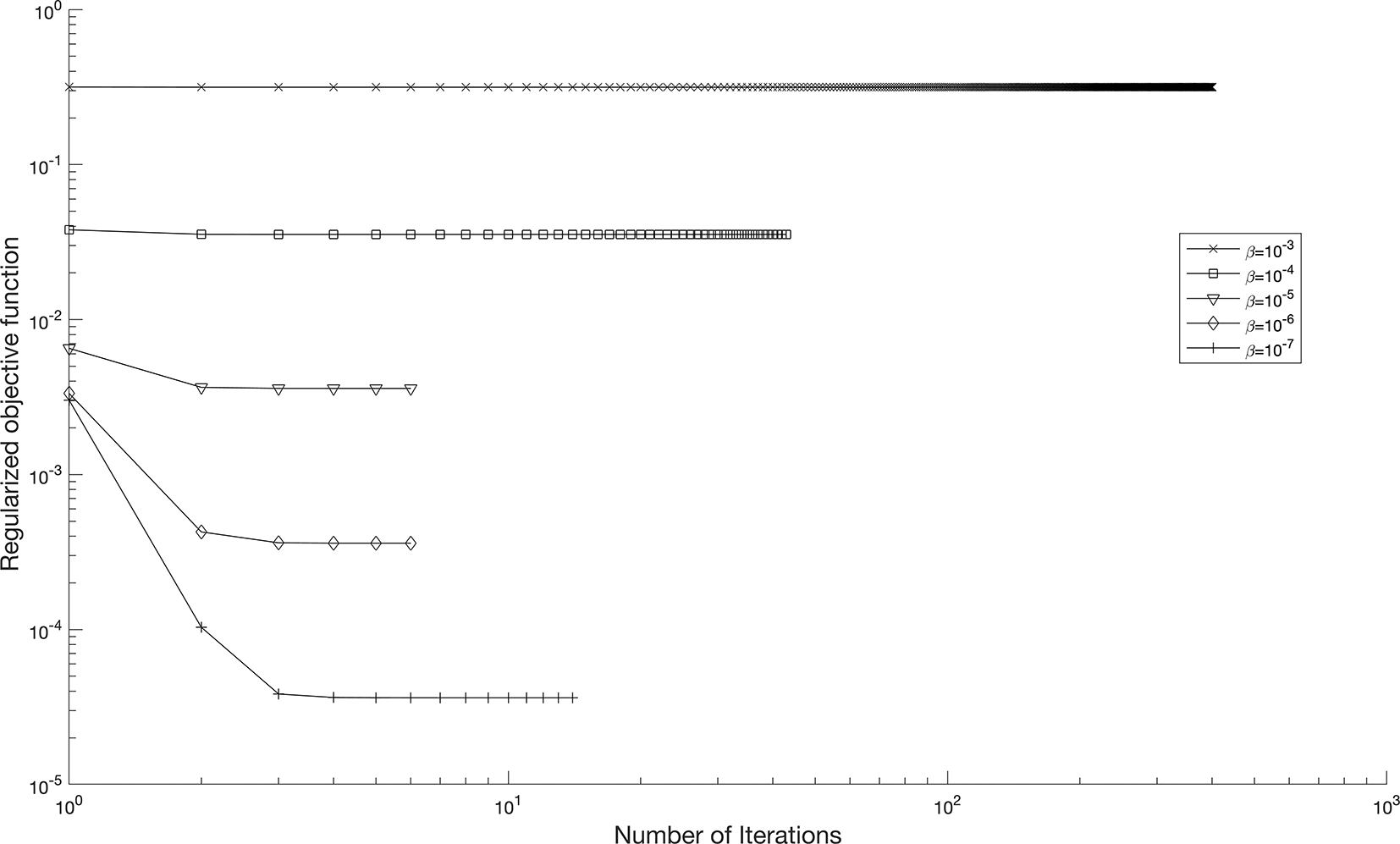
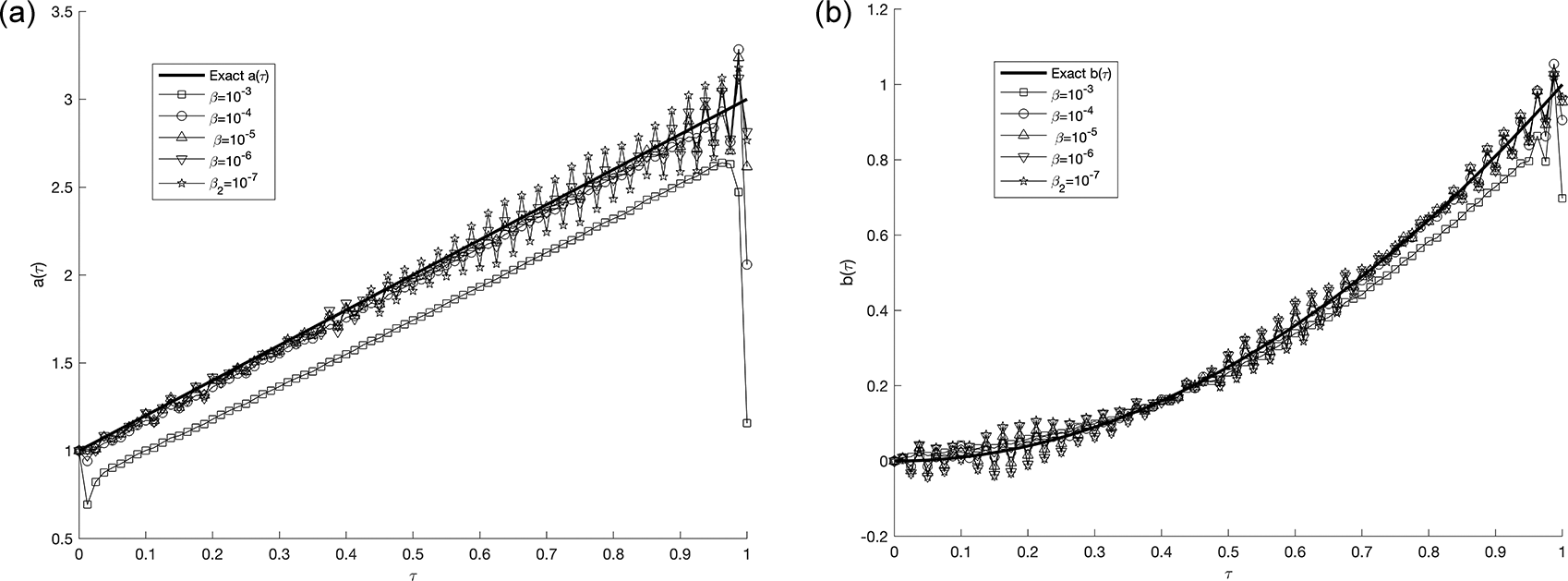
Next, we will study the proportion of noise contamination with a ratio of noise, in via , the associated results are unstable, as illustrated. This reveals that the problem is not properly, posed and small error in the data input cause large errors in the output solution, thus, the problem needs to be regularized. As a consequence, for the situation of noise, the best selection for the regularization parameters is for and for as in Table 2, which results in the lowest RMSE values.
In this study, the identification of the unknown time-dependent coefficient and in a one-dimensional parabolic PDE are investigated. The problem is formulated from a numerically evaluated nonlocal integral subjected to initial and boundary conditions. The direct problem is solved using the Crank-Nicolson (C-N) scheme, while the IP is transformed into a nonlinear least squares optimization problem using the lsqnonlin routine in MATLAB. An example test cases are employed in numerical experiments to evaluate the accuracy and stability of the proposed method. According to the results, using TR significantly enhances the solution’s stability. When the root-mean square error (RMSE) numbers are their lowest, the most effective approach is identified. Furthermore, numerical results have been provided to illustrate the accuracy and stability of the numerical method. It found that applying TR method stabilizes the solution. Cases of numerical results exist with noise (with and without) regularization. In the first case, consider when noise and without regularization as in Figure 9- Figure 10 in example 3, the results are unstable and highly oscillated, on the contrary. Other case, when noise introduced with regularization, obtain are stable and accurate results for the reconstructed coefficient and , which are (stable) numerical solutions. As for the remaining cases, we observe that the results are stable and steady when regularization values are for and, for in example 3, as shown in Table 2.
| Views | Downloads | |
|---|---|---|
| F1000Research | - | - |
|
PubMed Central
Data from PMC are received and updated monthly.
|
- | - |
Provide sufficient details of any financial or non-financial competing interests to enable users to assess whether your comments might lead a reasonable person to question your impartiality. Consider the following examples, but note that this is not an exhaustive list:
Sign up for content alerts and receive a weekly or monthly email with all newly published articles
Already registered? Sign in
The email address should be the one you originally registered with F1000.
You registered with F1000 via Google, so we cannot reset your password.
To sign in, please click here.
If you still need help with your Google account password, please click here.
You registered with F1000 via Facebook, so we cannot reset your password.
To sign in, please click here.
If you still need help with your Facebook account password, please click here.
If your email address is registered with us, we will email you instructions to reset your password.
If you think you should have received this email but it has not arrived, please check your spam filters and/or contact for further assistance.
 ,
,
Comments on this article Comments (0)