Keywords
Radiology; Software; Machine Learning; Artificial Intelligence; Diagnostic Imaging

This article is included in the Artificial Intelligence and Machine Learning gateway.
This article is included in the NEUBIAS - the Bioimage Analysts Network gateway.
This article is included in the Software and Hardware Engineering gateway.
Radiology; Software; Machine Learning; Artificial Intelligence; Diagnostic Imaging
In recent years, interest in artificial intelligence (AI) in radiology has increased.1,2 Improvements in algorithms and technological progress have enabled this rapid evolution, generating significant interest due to its revolutionary potential in the field of radiology.3 AI in radiology is currently applied in many different ways, from clinical tasks (lesion detection and characterization, segmentation, diagnosis, risk prediction, treatment response etc.) to image and workflow optimization (image reconstruction, report generation, integrated diagnostics, patient prioritization, etc.).4
Image classification AI algorithms in particular are used for clinical tasks in radiology, which is a specialty fundamentally based on human image interpretation.
Recent algorithmic advances have primarily focused on deep learning and the use of CNNs (Convolutional Neural Networks).5 These algorithms are predominantly used for any task requiring image analysis, with numerous applications such as lung cancer screening, liver lesion characterization, or breast cancer detection.6–8 However, image classification is complex and often requires specialized algorithms that are computationally intensive, costly in time and money, and require expertise, with increasingly complex algorithms needed to achieve high performance.9
Not all image classification tasks are necessarily complex or require complex algorithms. For example, when classifying easily distinguishable images, where good performance can be achieved after training with as few as 100 images per class.10
As the potential applications of simple classification tasks in radiology increase, many remain largely unexplored to date. For example, image modality classification (CT or MRI images), radiography incidence classification (frontal or lateral radiographs), acquisition phase classification (non-contrast, arterial or venous phase), or MRI sequence type classification (T1, T2, Flair) are applications that could be explored in an AI data labelling context, particularly for quality control or research purposes.
For such simple classifications, complex algorithms are not necessary. There is value in having simple, fast, resource-efficient classification algorithms that don’t require advanced expertise and can be implemented and used locally.
Several classification models exist for simple classification tasks. One popular and easy-to-use algorithm is EfficientNet.11 EfficientNet is a CNN designed to be both lightweight and high performing. Unlike classical architectures like ResNet, it uses balanced scaling of depth, width and resolution, enabling high performance with compact models.
Although EfficientNet offers an efficient architecture, it is not optimized for radiological images out of the box. This is because radiological image characteristics (artifacts, contrast, low variability) differ from classical datasets like ImageNet.
Therefore, we present in this paper a simple and efficient classification model for easily distinguishable radiological images based on EfficientNet, with parameter optimization to achieve highly accurate, fast, resource-efficient classification that doesn’t require advanced expertise to operate. The model, named EffiRadNet, is available open-source under a MIT licence, with source code and pre-trained models for the three specific tasks described in this paper available at https://github.com/gfahrni/effiradnet.
All images used for training datasets were collected on the Open Access Biomedical Image Search Engine (https://openi.nlm.nih.gov/), an open-access biomedical image search engine developed by the U.S. National Library of Medicine (NLM) that enables retrieval of annotated medical images from scientific literature and clinical datasets.12
Three task-specific image datasets were created ( Figure 1 and Table 1) to train and assess the performance of three task-specific models using EffiRadNet.
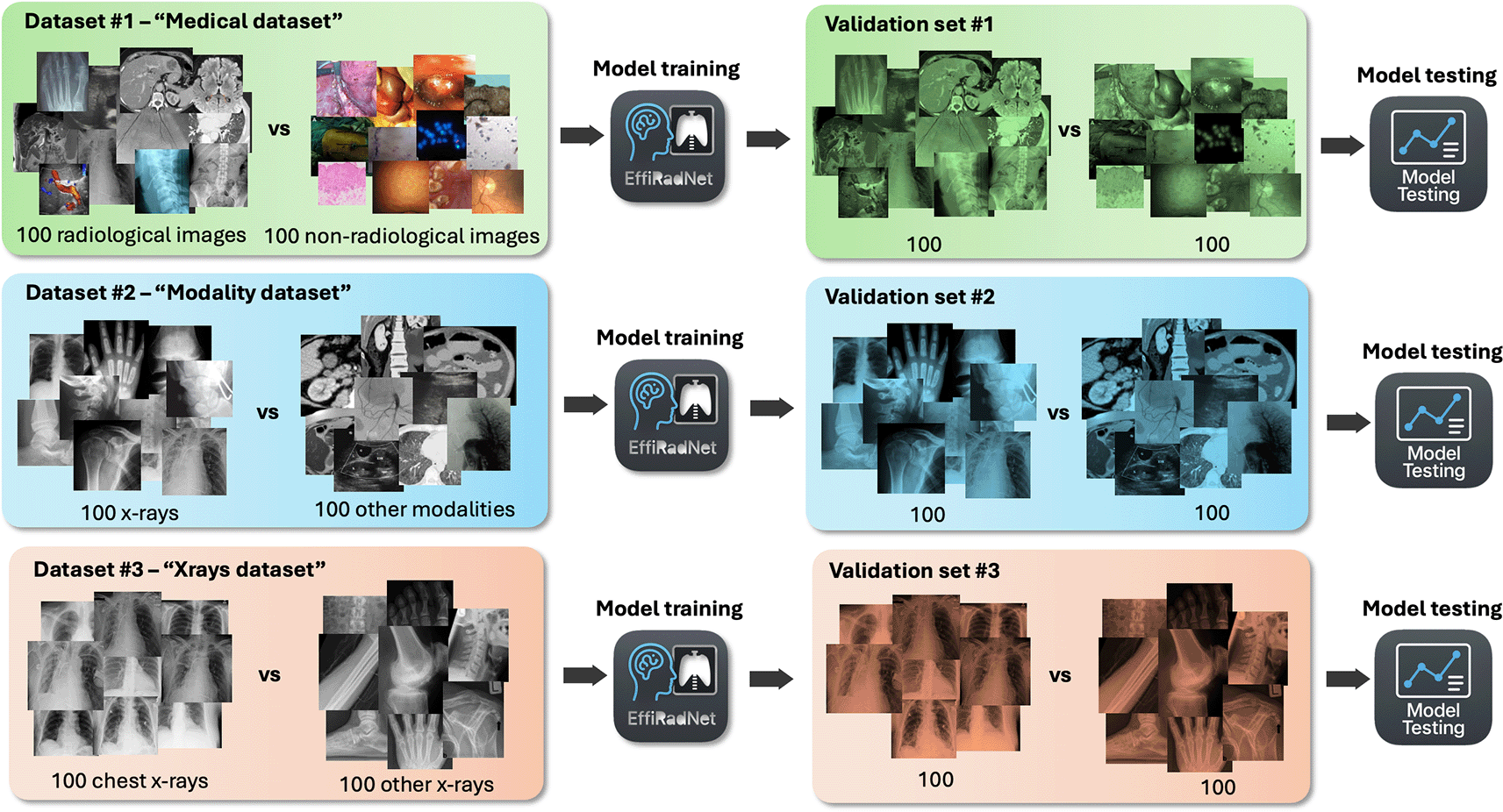
Each dataset consists of 200 images, evenly divided into two classes (100 images per class). The models are trained on these datasets and subsequently evaluated using a validation set of 200 distinct images with identical class distribution. The first dataset, “Medical dataset”, is designed to classifies radiological images from other medical images. The second dataset, “Modality dataset”, classifies X-rays from other radiological images. The third dataset, “Validation dataset”, classifies chest X-rays versus other types of X-rays.
Identical validation datasets (same image distribution and sample sizes) were created for evaluation of the trained models.
Each Dataset contained 400 images, 200 for training and 200 for validation. Both training and validation sets were class-balanced, with 100 images per class (class 1/class 2) to mitigate bias during model development.
Given the limited dataset size and EfficientNet’s pre-trained efficiency, we prioritized a class-balanced training/validation split (200/200) over a traditional three-compartment paradigm (training/validation/test sets).
The first image dataset, named the “Medical” dataset, was compiled with the aim of classifying between 100 radiological images and 100 non-radiological medical images. Non-radiological images included 10 subgroups of 10 images of different and popular non-radiological images (pathology macro, pathology micro, pathology fluorescence, endoscopy thorax, endoscopy abdomen, surgery thorax, surgery abdomen, clinical ophthalmology, clinical dermatology, clinical dental). Radiological images included 5 subgroups of 20 images of popular radiological images modality (radiography, CT-scan, MRI, ultrasound, fluroscopy).
The second image dataset, named the “Modality” dataset, was compiled with the aim of classifying between 100 x-rays images and 100 other radiological modality images such as computed tomography (CT), magnetic resonance imaging (MRI), ultrasound (US) or x-ray angiography (XA). Other radiological modality images included 10 subgroups of 10 images of different modality and anatomical location (chest CT, abdomen CT, head CT, abdomen MRI, head MRI, chest MRI, abdomen US, musculoskeletal US, chest XA, abdomen XA).
The third image datasets, named the “Xrays”, was compiled with the aim of classifying 100 chest x-rays images and 100 other organs x-rays images. X-ray images of other organs were put into 10 subgroups of 10 images of different organs x-rays (neck, shoulder, arm, wrist, hand, abdomen, leg, knee, ankle, foot).
Images were collected in JPEG (.jpg) format and labelled individually (e.g. abdomenCT001.jpg). If the images had any markings, such as letters, they were manually removed or hidden in order to prevent “shortcut learning” whereby the algorithm learns to recognize features such as letters or chest-tubes to prevent them being used as a proxy to classify images.13 For each dataset and validation sets, images were organised in two separate folders, with each name corresponding to a class (e.g. one folder with all class A images and the other with all class B) images. Once the EfficientNet algorithm is initialized, input radiological images undergo the following preprocessing steps. All images were resized to a standardized 224×224 pixels to match the model’s input dimensions. Pixel values were automatically scaled to [0, 1] using PyTorch’s ToTensor() to normalise them. Data augmentation (e.g., rotation, flipping) was considered but not implemented in this version to keep in line with the concept of a straightforward, easy-to-use algorithm
The model is based on EfficientNet-B0, a lightweight and computationally efficient convolutional neural network known for its high performance on image classification tasks with relatively low resource usage.
We employed transfer learning by using a pretrained EfficientNet-B0 model (ImageNet weights) and fine-tuning the final layers to adapt to our radiological classification task. The output layer was modified to include 2 output nodes, corresponding to the two target classes (ClassA and ClassB). Additional Dense layers were not introduced beyond the EfficientNet head, as the architecture provided sufficient representation power for the classification task.
The model was trained using the Adam optimizer with a learning rate range of 0.01 to 0.001. We used cross-entropy loss, as it is suitable for multi-class classification problems. Dropout regularization (p = 0.5) was applied in the classifier head (as per EfficientNet-B0 default) to mitigate the risks of overfitting.
The training parameters included a batch size range of 16 to 32 (shuffle=True), and training was performed for 5 to 40 epochs, depending on convergence behaviour observed during early experiments. All parameters are manually adjustable in the code.
At each epoch, the model parameters were updated using backpropagation based on the computed loss. Model performance was monitored by printing the training loss after each epoch. No early stopping or learning rate scheduling was applied at this stage, as the goal was to establish a baseline for performance.
After training, the final model weights were saved using PyTorch’s torch.save() function. The model’s state dictionary was exported to a.pth file, which is markedly smaller than standard pretrained architectures commonly used in medical imaging, such as DenseNet-121 (≈ 32 MB), or 3D UNet and Swin-UNETR models (≈ 300 MB – 1 GB), allowing for future loading and inference without retraining.
To the lightweight capability and accessibility of the lightweight model, a non-professional computer was deliberately chosen for training and testing EffiRadNet. The computer used was a 2021 Apple MacBook Pro M1 Pro, with 32 GB of unified memory, equipped with a 10-core CPU (8 performance and 2 efficiency cores), a 16-core integrated GPU, and a 16-core Neural Engine. This configuration supports efficient on-device AI computation and demonstrates that training and testing can be performed without access to high-end GPU clusters.
The three training datasets (i.e., “Medical”, “Modality”, and “Xrays” datasets, as defined above) were organized into three folders named accordingly. Each folder contained two subfolders, one for each class, named using the dataset and class label (e.g., “medical-radiology” and “medical-other” for the “medical” dataset folder). The subfolders contained all the corresponding JPEG images. The three validation datasets were organized using the same folder structure and naming convention as the training datasets. Both the training and validation dataset folders were placed within a single root directory for each set, allowing for straightforward path input and identification within the EffiRadNet code during training and validation. All output models (.pth files) were saved within the corresponding set root directory.
The model was implemented and trained using Visual Studio Code (VS Code; Version 1.99.3, Universal build, Microsoft Corporation, Redmond, WA, USA) on the macOS platform. All code was executed in a Python 3.10.1 environment with GPU acceleration via PyTorch’s Metal Performance Shaders (MPS) backend.
To ensure consistency, VS Code was configured with default localization settings (English/US) and extensions for Python development (e.g., Pylance, Jupyter).
To maximize accessibility and reproducibility for non-engineering users, the code was separated into main sections (i.e. “Training” and “Testing” sections) fully annotated in Python using clear, sectioned comments to help users understand each step, from data loading to performance evaluation. Key operations (e.g., model training, metric calculation) were explicitly labelled to enhance readability without requiring coding expertise.
This study was conducted in accordance with the Checklist for Artificial Intelligence in Medical Imaging (CLAIM), a validated framework for assessing AI applications in medical imaging (available in the Data availability section).
We evaluated the three distinct models (“Medical”, “Modality” and “Xray”) under identical conditions to compare performance. Our aim was to find the hyperparameter sets yielding the highest AUC and balanced sensitivity/specificity for each model. To identify trade-offs between metrics (e.g., high sensitivity vs. specificity) under different configurations we varied key hyperparameters. These were the number of epochs (5 to 40), the batch size (16 to 32) and the learning rate (0.0001 to 0.001). Grid searches were conducted to identify optimal hyperparameter combinations for each model.
Finally, we evaluated the performance metrics, looking at the sensitivity (true positive rate) and specificity (true negative rate). The VPP (Positive Predictive Value) and VPN (Negative Predictive Value) were also evaluated. We computed an AUC (Area Under the ROC Curve) to evaluate overall discriminative ability. Training and testing times were automatically recorded for each experiment using Jupyter Notebook’s native output capture in order to maintain a record.
The algorithm was tested on three validation datasets representing different clinical scenarios (“Medical” validation set: radiological images vs other images; “Modality” validation set: r-rays images vs other radiological modalites images; “Xrays” validation set: chest x-ray images vs other x-rays images).
The “Medical” model achieved high specificity (often 1.0) and strong AUC (up to 1.0), with varying sensitivity (0.72 – 1.0). It achieved its best performance at num_epochs = 30, batch_size = 16, lr = 0.0001 (100% on all metrics). However, there were occasional drops in sensitivity to 0.01 (e.g., batch_size = 32, lr = 0.001).
The “Modality” model achieved extremely high sensitivity (often 1.0) but inconsistent specificity (0.09 – 1.0). The greatest AUC (1.0) occured at num_epochs = 40, batch_size = 16/32, lr = 0.0001. It had low specificity (0.05 – 0.1) in some high-LR settings.
The “Xrays” model balanced sensitivity (0.96 – 1.0) and specificity (0.58 – 1.0), with near-perfect AUC (up to 1.0). The best configuration was found to be num_epochs = 40, batch_size = 32, lr = 0.001, with a score of 100% on all metrics.
During this experiment some general trends appeared such as increased epochs (e.g., 30 – 40) yielding improved performance across all models. Furthermore, a learning rate of 0.0001 yielded more stable results than 0.001. We also found that a batch_size = 16 often outperformed batch_size = 32 in sensitivity and AUC. All the models reached their peak performance (AUC = 1.0) under optimal hyperparameters (epochs ≥ 30, batch_size = 16, lr = 0.0001). These results are summarized in Tables 2–4 and Figure 2.
LR = Learning Rate; AUC = Area Under the Curve; PPV = Positive Predictive Value; NPV = Negative Predictive Value.
LR = Learning Rate; AUC = Area Under the Curve; PPV = Positive Predictive Value; NPV = Negative Predictive Value.
LR = Learning Rate; AUC = Area Under the Curve; PPV = Positive Predictive Value; NPV = Negative Predictive Value.
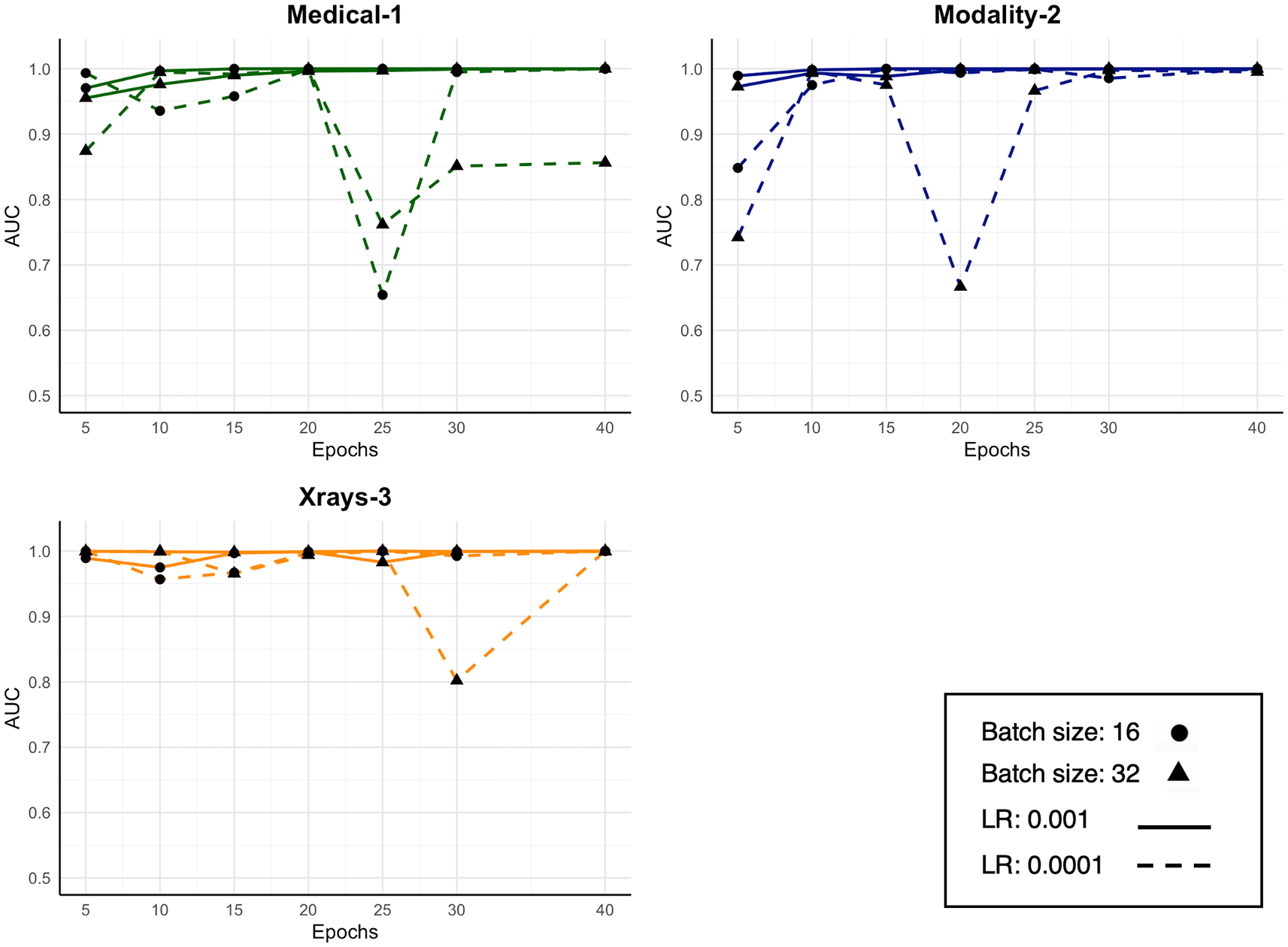
Solid lines represent learning rate = 0.0001, dashed lines represent learning rate = 0.001. Circular markers indicate batch size = 16, while triangular markers indicate batch size = 32. All models were evaluated over 7 epochs (5, 10, 15, 20, 25, 30, 40). Shaded areas represent the 95% confidence interval (if applicable). Note: The y-axis is truncated at AUC = 0.5 to highlight performance differences.
The computing times were 11 min38s for the Medical dataset, 11min43s for the Modality dataset and 12 min 22s for Xrays dataset. The testing time results were 25s, 29s and 27s for medical, modality and Xrays datasets, respectively. The final model file (model.pth) size remained lightweight at 16.3 mb for a fully trained model.
This is, to our knowledge, the only open-source algorithm that is fast, easy to run and efficient for radiological image classification. Testing the models showed that good performances were attainable but that hyperparameters should always be adapted to each trained task-specific model. We found that setting epochs to 40, batch size to 16 and learning rate to 0.0001 was the best default starting point based on the results on the three models, but that it should always be adapted after the initial training is completed. The proposed model has the advantages of being simple and fast to run. It should be noted that for the purposes of our experiment we ran the model on a non-professional machine to obtain a proof of concept, but it can run much faster with dedicated GPU. Due to the simple implementation, it is possible for a coding novice to train and test the algorithm without the need for advanced code engineering knowledge.
EfficientNet, as well as other efficient CNNs, have been explored with promising results, albeit rarely available as open-source implementations. It has been shown that EfficientNet-based CNN achieves 93.8% accuracy in classifying retinal diseases from fundus images14 and that it outperforms other transfer learning models in breast cancer detection accuracy using mammography images.15 Furthermore, an ensemble-based approach using EfficientNet was shown to achieve a high performance in automated malaria diagnosis from microscopic blood cell images.16 Another ensemble of fine-tuned EfficientNet models achieved high accuracy in classifying tuberculosis from chest X-rays.17 It has also been shown that an extremely lightweight CNN model called ExLNet could be applied for chest radiograph diagnosis in resource-constrained environments, however this model is not open source.18 Sahu et al. (2018) also proposed a lightweight CNN model for the rapid and accurate identification of lung diseases from chest X-ray images, designed for resource-constrained environments; however, this model is not open source, is heavier than EfficientNet-based models, and requires more hyperparameter tuning and longer training times.19 Lujan-Garcia et al. (2021) also developed NanoChest-Net, a simple yet effective convolutional neural network for classifying radiological images of diseases such as COVID-19, pneumonia, and tuberculosis; however, this model is also not available as open source.20 Efficient models are expected to further develop, for example, EfficientNetV2 has the potential for faster training times.21
Previous studies have explored classification of radiological images, but none have done so with the help of artificial intelligence.22,23 Medical image classification, in a broader context, has been explored with one study demonstrating the use of deep learning for classification on biopsy images of coeliac disease.24 Another paper from 2020 proposes an efficient and accurate deep learning-based approach for medical image modality classification using transfer learning with ResNet50.25 However, this model was not open source and was also heavier to run and more complicated than our model. Another model, also proposed in 2017, explored radiological modality classification with CNN-6, VGGNet-16 and ResNet-50.26 These models were also not open source and were equally heavy and complicated to run.
Open-source AI models have been tested in the context of radiology. One such model suggested using an open source machine learning and natural language processing pipeline to classify temporal bone radiology reports.27 Other models used28 an open-source CNN for binary classification of chest radiograph normality to aid in optimizing clinician workload. Finally, it was shown that the29 inclusion of radiologist-provided BI-RADS classification using open-source BI-RADS data sets in AI models improved accuracy for predicting histology compared to models using image parameters alone. However, despite a few forays into the field, there is still much work to be done. One notable area for improvement is the sharing of code, which is currently not the standard practice, thus making it difficult to verify the results and iterate and improve on the previous models.
AI models have a wide range of potential applications that are only now beginning to be explored. One interesting possibility would be to use it for modality or sequence classification, such as for x-ray modality classification (e.g., chest, abdomen, spine), MRI sequence type classification (e.g., T1, T2, FLAIR, DWI) or post-injection time classification (e.g., early vs. delayed imaging). It could also be used to triage between diagnosis-related vs. administrative images (e.g., exclude protocol screens, localizer views). Another potential application is in quality control, where AI may have the potential to verify whether images are correctly tagged (e.g., wrong DICOM tags), or detect poor quality radiographs. It might also be used for preprocessing in complex AI pipelines to rapidly pre-select relevant images for training a more complex AI model (e.g., select only CT slices showing the liver across full abdomen series).
Our model has some limitations. First, it only allows binary classification and is therefore not suitable for multi-class problems, although the architecture could be adapted for that purpose. Secondly, it can be used obvious features mainly as the model was trained on resized 2D images with visually distinct features. Thirdly, it can only be used for 2D images and cannot process 3D volumes. Finally, it was not designed for complex model optimization as the architecture and training pipeline are intentionally simplified for ease of use by non-engineers. Thus, it does not include advanced fine-tuning mechanisms, hyperparameter search, or automated optimization.
In conclusion, EffiRadNet achieves high performance on simple binary classification tasks using a lightweight architecture that can be deployed and retrained without the need for engineering expertise or specialized hardware. Its open-source availability, combined with its accessibility and efficiency make it suitable for a wide range of simple applications, including modality or sequence classification, quality control, annotation support, and preprocessing in AI pipelines.
Source code available from: https://github.com/gfahrni/effiradnet
Archived software available from: https://doi.org/10.5281/zenodo.18491642
License: MIT
| Views | Downloads | |
|---|---|---|
| F1000Research | - | - |
|
PubMed Central
Data from PMC are received and updated monthly.
|
- | - |
Provide sufficient details of any financial or non-financial competing interests to enable users to assess whether your comments might lead a reasonable person to question your impartiality. Consider the following examples, but note that this is not an exhaustive list:
Sign up for content alerts and receive a weekly or monthly email with all newly published articles
Already registered? Sign in
The email address should be the one you originally registered with F1000.
You registered with F1000 via Google, so we cannot reset your password.
To sign in, please click here.
If you still need help with your Google account password, please click here.
You registered with F1000 via Facebook, so we cannot reset your password.
To sign in, please click here.
If you still need help with your Facebook account password, please click here.
If your email address is registered with us, we will email you instructions to reset your password.
If you think you should have received this email but it has not arrived, please check your spam filters and/or contact for further assistance.

Comments on this article Comments (0)