Keywords
Graph coloring, Chromatic polynomial, Cartesian product, Friendship graph, Combinatorial mathematics, Recurrence relation, Closed-form expression, Scheduling.

This article is included in the Fallujah Multidisciplinary Science and Innovation gateway.
Graph coloring, Chromatic polynomial, Cartesian product, Friendship graph, Combinatorial mathematics, Recurrence relation, Closed-form expression, Scheduling.
This revised version addresses the reviewers’ comments by strengthening the derivation of the transition polynomial ψ(k), adding a formal conditional-independence lemma, and replacing the earlier brief argument with a structured combinatorial case analysis. The computational complexity statement has been clarified as applying only to fixed-k numerical evaluation, and the asymptotic-growth result has been refined to distinguish the general absolute-value formulation from the positive integer coloring range. The scheduling section has been revised as an illustrative two-period model with explicit vertex-to-session and edge-to-conflict mappings. The interpretation of ψ(k) has also been corrected: it is now presented as the fixed-room team-growth factor, while the effect of increasing the number of rooms is measured separately by ratios of chromatic polynomial values. We also revised the Discussion, corrected notation and formatting, and improved the presentation of tables and formulas.
See the authors' detailed response to the review by Wafiq Hibi
See the authors' detailed response to the review by Siti Amiroch
Chromatic polynomials are fundamental objects in algebraic graph theory. Introduced by Birkhoff (1912) in connection with the four-color problem, they were further developed through Whitney’s (1932) deletion–contraction recurrence and Read’s (1968) systematic studies, culminating in the comprehensive treatment of Tutte and Read (1988). For a graph , the chromatic polynomial counts the number of proper -colorings of , thereby connecting combinatorial structure with algebraic and enumerative properties.
Beyond their theoretical importance, chromatic polynomials and graph coloring methods arise in several applied settings, including task scheduling,1 data analysis,2 network design,3 theoretical chemistry,4 and statistical physics.5 However, computing the chromatic polynomial is #P-hard in general. This difficulty is especially relevant for graph Cartesian products, where the chromatic polynomial of a product graph is not determined by a simple formula involving only the chromatic polynomials of its factors. Consequently, explicit formulas are usually obtained only for structured graph families.
Cartesian products of graphs provide an important setting for studying layered and composite structures. Their structural and coloring properties have been investigated extensively.6,7 Recent studies have derived chromatic polynomials for particular families such as triangular snake graphs, -centipede graphs, layered graphs, and grid-type products using recursive, transfer-matrix, or decomposition-based methods.8–12
While many results are known for Cartesian products involving paths and cycles, the graph family , formed from the friendship graph and the path , has received limited direct attention. This family combines local triangular clusters with a two-layer product structure, making it suitable for recursive chromatic analysis.
This paper provides an analytical framework for by:
1. deriving a recurrence relation and closed-form expression for its chromatic polynomial;
2. establishing its structural properties and chromatic number;
3. analyzing the transition polynomial, its real roots, and the asymptotic growth rate;
4. validating the formulas through numerical computation;
5. presenting an illustrative two-period scheduling interpretation based on the graph-coloring model.
The scheduling interpretation is motivated by established graph-coloring approaches to scheduling and resource allocation 1, 13, and illustrates how the derived chromatic polynomial can be used to quantify feasible room assignments in a two-period resource-allocation setting with explicitly defined conflict constraints. This applied perspective complements the algebraic results by showing how the recurrence and closed-form expression translate into concrete scheduling counts.
14: The friendship graph , for , is defined as the union of copies of sharing a common vertex. This common vertex is called the central vertex.
where is the center vertex, and
and
Figure 1 (Friendship graphs F n):
6: The Cartesian product of two graphs and , denoted by , is the graph whose vertex set is , with two vertices and adjacent if:
Throughout this paper, the symbol denotes the Cartesian product of graphs.
15: The chromatic polynomial is a polynomial in that expresses the number of proper vertex -colorings of , such that adjacent vertices share distinct colors.
The graph is the Cartesian product of a friendship graph with a path , forming two parallel layers of with corresponding vertices connected by edges.
Figure 2 (Cartesian product F n × P2):
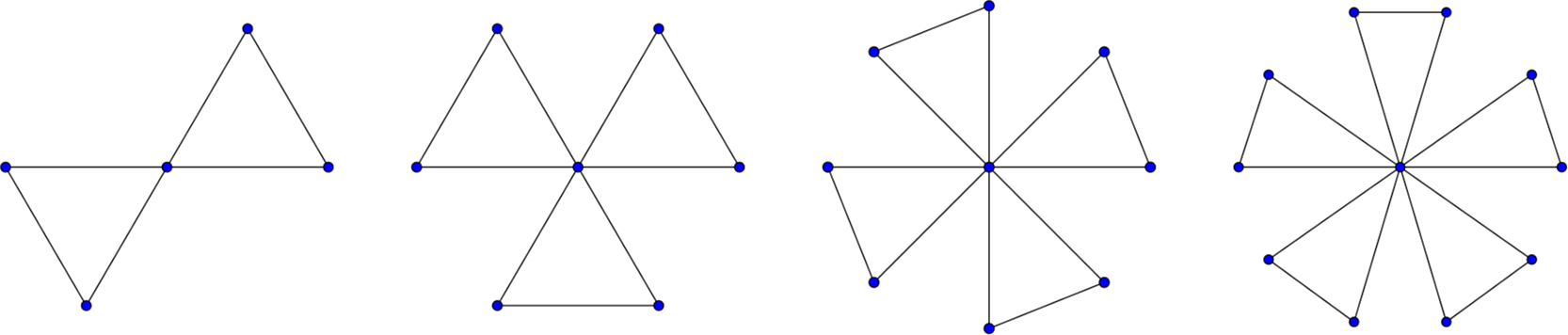
Each graph is formed by triangles sharing a common central vertex , illustrating the recursive structure of the friendship graph family.
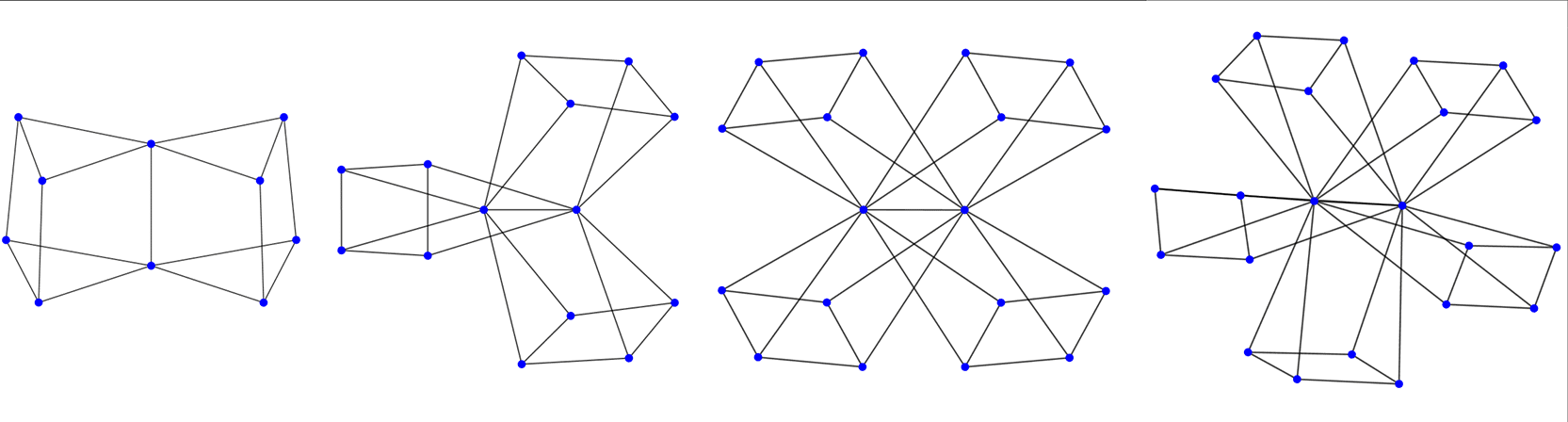
This construction yields two parallel layers of , with corresponding vertices connected by vertical edges.
This is a theoretical study in algebraic and combinatorial graph theory, analyzing the chromatic polynomial of the graph family The core of our approach is a structural decomposition that reveals a recursive block construction. The graph consists of two copies of , denoted by layers and , with corresponding vertices connected by vertical edges. For , the graph is obtained from by attaching a new block . This block contains the four new peripheral vertices together with the edges forming the two new triangles, one in each layer, and the two vertical edges between corresponding peripheral vertices. The block meets the previously constructed graph only through the two central vertices and . This localized attachment is the key structural feature that isolates the chromatic contribution of each recursive step.
(Conditional independence of the recursive block)
Let be the block added when passing from to in the recursive construction of The block contains the four new peripheral vertices The only vertices of adjacent to vertices of are the two central vertices Consequently, once distinct colors are assigned to and , every coloring constraint involving the new peripheral vertices is local to . Hence the number of proper extensions to depends only on the number of colors , and is denoted by
Proof: By construction, the -th triangle of the friendship graph shares only the central vertex with the preceding triangles. Therefore, in the Cartesian product , no new peripheral vertex in is adjacent to any peripheral vertex of an earlier block.
The only connections between the new block and the previously constructed graph occur through the two central vertices Thus, after the colors of and are fixed, the coloring constraints involving the four new vertices are exactly the triangle constraints in the two layers together with the two vertical constraints between corresponding new peripheral vertices. None of these constraints involves a peripheral vertex from any earlier block.
Since and are adjacent, they receive distinct colors in every proper coloring. Moreover, by symmetry of the color palette, the number of valid completions depends only on , not on the particular labels assigned to and . Therefore, every proper coloring of admits the same number of extensions to , namely . This proves the claim. ∎
We now compute , the number of admissible color extensions to the block . Since and are adjacent, we may assume by symmetry that
Thus is the number of ordered quadruples satisfying these constraints. We count according to whether the ordered pair contains the color .
Case 1. The pair contains the color
Since , the color appears in exactly one position. The other color is chosen from the colors different from and . Hence there are
choices for (x, y).
For each such choice, the number of admissible choices for is . Indeed, if and , where , then , while . Before imposing , this gives
choices. The forbidden equality occurs for exactly common colors, namely all colors different from and Therefore,
The same count holds when . Thus, the contribution of this case is
Case 2. The pair does not contain the color
In this case, x and y are distinct colors chosen from the k−2 colors different from 1 and 2
choices for (x, y).
For fixed such and , the color must avoid and , while must avoid and . Hence, before imposing , there are
choices for (z, t). The forbidden equality z = t occurs when the common color is different from 2, x, and y, giving k − 3 forbidden choices. Therefore, the number of valid choices for (z, t) is
Thus, the contribution of this case is
Combining the two cases, we obtain
The enumeration is summarized in Table 1.
| Case | Choices for | Choices for | Contribution |
|---|---|---|---|
| contains color | |||
| does not contain color |
As an independent algebraic verification, direct symbolic computation gives
Let denote the chromatic polynomial of . By Lemma 3.1.1, every proper -coloring of can be extended to the new block in exactly ways. From the direct enumeration in Section 3.2 ,
Since both sides are polynomials in and the equality holds for all positive integers , the recurrence holds as a polynomial identity.
Applying this recurrence repeatedly gives
(Structural Properties of )
For , the graph possesses the following structural properties, which directly affect its chromatic behavior:
Where the notation denotes vertices of degree .
1. Vertex count: The friendship graph has vertices. Since has two vertices, the Cartesian product has
2. Edge count: The graph consists of two copies of , giving
3. Connectivity: Since is connected and is connected, their Cartesian product is connected. Therefore, is connected for all .
4. Degree sequence: There are two central vertices, one in each layer. Each central vertex is adjacent to peripheral vertices in its own layer and to the corresponding central vertex in the other layer. Hence each central vertex has degree
There are peripheral vertices in total. Each peripheral vertex is adjacent to one central vertex in its layer, one partner vertex in the same triangle, and its corresponding vertex in the other layer. Hence each peripheral vertex has degree
Therefore, the degree sequence is
(Edge classification in )
The edge count in Theorem 4.1.1 can be refined by classifying the edges of into three types, as shown in Table 2. There is one central edge joining the two central vertices. The center-peripheral edges consist of the edges incident with the center in each layer, giving edges in total. The remaining peripheral edges consist of the triangle-base edges in the two layers and the vertical edges between corresponding peripheral vertices, giving edges. Hence,
which agrees with the edge count in Theorem 4.1.1.
(Recurrence Relation)
For all , the chromatic polynomial of satisfies a first-order linear recurrence
By Lemma 3.1.1, once the colors of the two central vertices are fixed, the number of admissible extensions to the newly attached block is independent of the coloring of . Hence,
By the direct combinatorial enumeration in Section 3.2,
We prove the formula by induction on . For , we have
Assume that the formula holds for , where . That is,
Using the recurrence relation from Theorem 4.2.1,
Therefore, the formula holds for all . ∎
(Computational Efficiency for Fixed )
For a fixed numerical value of , the closed-form expression
allows to be evaluated using arithmetic multiplications by applying exponentiation by squaring to .
This complexity statement concerns numerical evaluation at a fixed value of k. It should not be interpreted as a bound for computing the fully expanded symbolic polynomial , since the degree and output size of the polynomial increase with Indeed,
Thus, the closed-form expression gives an efficient method for fixed- numerical evaluation, whereas the fully expanded symbolic polynomial has size growing with .
Since contains copies of , at least three colors are required. Hence,
It remains to show that three colors are sufficient. Define a coloring as follows:
In layer , each triangle receives the three distinct colors . In layer , each triangle receives the three distinct colors . The central vertical edge satisfies
Combining the lower and upper bounds gives
(Real Roots of
The chromatic transition polynomial
has exactly two real roots. One root is , and the other lies in the interval . In particular, both real roots lie in .
Direct evaluation gives
, , .
The first and second derivatives are
and
Since the leading coefficient of is positive, it follows that
Therefore, has a unique zero . Thus, is strictly decreasing on and strictly increasing on .
Since and , the polynomial becomes negative immediately to the right of . On the other hand, . Hence, by the Intermediate Value Theorem, has a root .
Finally, because is decreasing before and increasing after , it can have at most one real root on each side of . Since is one root and is another, these are the only real roots of . The remaining two roots are non-real complex conjugates. ∎
(Exponential Growth Rate)
Let be fixed and suppose that . Then
In particular, for every integer ,
From the closed-form expression in Theorem 4.2.2, we have
For integer counts proper -colorings, so . Also, , since it counts the number of admissible extensions to one additional block. Therefore
This proves the result. ∎
(Absolute Values and the Combinatorial Range)
The absolute values are necessary when is treated as a real or complex parameter, since may be negative or complex-valued. The simpler expression
By Theorem 4.2.1,
Interpretation
The value is the exponential growth constant of the sequence for fixed with . In the combinatorial range , , the recurrence gives the exact relation
(Root distribution)
From the closed-form expression in Theorem 4.2.2, we have
If is a root of but not a root of , then its multiplicity in is . Hence, as increases, the locations of the roots remain in a fixed finite set, while the multiplicities of the roots contributed by grow linearly with .
To verify the recurrence relation from Theorem 4.2.1 and the closed-form expression from Theorem 4.2.2, we computed the chromatic polynomials for using Wolfram Mathematica.
For the tested integer values , the computations showed agreement among the following three approaches:
• direct computation of ;
• evaluation using the recurrence relation;
• evaluation using the closed-form expression.
The numerical values of the transition polynomial and the chromatic polynomials , , , and are listed in Table 3.
| 3 | 2 | 24 | 48 | 96 | 192 |
| 4 | 22 | 5,808 | 127,776 | 2,811,072 | 61,843,584 |
| 5 | 96 | 184,320 | 17,694,720 | 1,698,693,120 | 163,074,539,520 |
| 6 | 284 | 2,419,680 | 687,189,120 | 195,161,710,080 | 55,425,925,662,720 |
The following sample calculations illustrate the agreement:
Moreover, the recurrence gives the exact growth ratio for fixed :
This exact ratio should be distinguished from the asymptotic -th root behavior established in Theorem 4.3.2. In the positive integer coloring range , that theorem gives
For finite , however, the quantity need not be close to . For example,
The explicit polynomial expressions used as the basis for these computations are:
These computations provide computational confirmation of Theorem 4.2.1 and Theorem Theorem 4.2.2 for the tested values. They also illustrate the ratio identity , which is an exact consequence of the recurrence for . The asymptotic growth statement remains the limit result established in Theorem 4.3.2.
This section presents a two-period scheduling interpretation in which the derived chromatic polynomial counts feasible room assignments under explicitly stated conflict constraints. The model is formulated under homogeneous-room and pairwise-conflict assumptions, providing a controlled resource-allocation setting for interpreting the recurrence relation and the closed-form expression.
4.5.1 Model specification
Consider a conference with one coordinator and independent teams. The schedule is divided into two consecutive periods, denoted by and . The available resources are identical meeting rooms.
The graph is used as a conflict graph. Each vertex represents one session requiring a room, and each edge represents a pair of sessions that cannot be assigned to the same room. Thus, a proper -coloring of corresponds to a valid assignment of rooms to all sessions.
4.5.2 Precise vertex-to-session mapping
represent the coordinator sessions in periods and , respectively.
represent two team-related sessions in period , while
4.5.3 Edge-to-conflict mapping
The edge set of encodes the scheduling constraints as follows.
For each and each period , the edges
represent coordinator-team conflicts within the same period. These sessions cannot be assigned to the same room.
Thus, feasible schedules are exactly the proper -colorings of . Consequently, counts the number of feasible room assignments using rooms.
4.5.4 Interpretation of scheduling parameters
Within the proposed two-period scheduling model, the parameter denotes the number of available rooms and is therefore restricted to positive integer values. The feasibility of the scheduling problem is governed by the chromatic number of the conflict graph. Since
Thus, three rooms are necessary and sufficient to obtain a valid room assignment for every .
Hence, measures the multiplicative factor in the number of feasible schedules when one additional team is added, while the number of available rooms is kept fixed. For example,
Accordingly, with rooms fixed, increasing the model from to teams multiplies the number of feasible schedules by 22. With rooms fixed, the corresponding multiplicative factor is 96.
For a fixed conference size , the effect of changing the number of rooms is quantified by comparing the chromatic polynomial at different room numbers:
Thus, the recurrence factor describes scalability with respect to the number of teams for fixed , whereas the ratio describes the change in scheduling flexibility obtained by increasing the number of available rooms for fixed .
4.5.5 Quantitative illustration
We now illustrate the two distinct quantitative effects described above. The first concerns the growth in the number of feasible schedules when the number of teams increases while the number of rooms is fixed. The second concerns the change in scheduling flexibility when the number of rooms increases while the number of teams is fixed.
Scheduling with the minimum number of rooms ( ).
At the minimum feasible room count, we have . By the recurrence relation,
Thus, with three rooms, each additional team doubles the number of feasible schedules. Table 4 gives the corresponding values.
| Conference scale | Teams | Valid schedules | Growth from previous |
|---|---|---|---|
| Small conference | 3 | 48 | — |
| Medium conference | 4 | 96 | |
| Medium conference | 5 | 192 | |
| Large conference | 6 | 384 |
Scalability with respect to the number of teams
To illustrate the effect of adding one team while keeping the room count fixed, we compare and . The ratios are shown in Table 5, and they coincide exactly with .
The ratios in Table 5 compare with for the same value of ; they therefore describe the effect of adding one team under fixed room availability. By contrast, the effect of increasing the number of rooms is measured by comparing at different values of for a fixed value of .
Effect of increasing the number of rooms
For a fixed conference size , the effect of increasing the number of available rooms is measured by comparing at different values of . Table 6 illustrates this effect for , using as the baseline.
| Number of rooms | Flexibility ratio relative to | |
|---|---|---|
| 3 | 192 | |
| 4 | 61,843,584 | |
| 5 | 163,074,539,520 |
Thus, for n = 5, increasing the number of rooms from to gives a flexibility ratio of Similarly,
In comparison, the value is the fixed-room growth factor from to , namely
4.5.6 Summary of the Graph-Scheduling Correspondence
The correspondence between the graph model and the scheduling interpretation is summarized in Table 7.
4.5.7 Model Limitations and Assumptions
This scheduling interpretation is formulated under a controlled set of assumptions that make the correspondence between graph colorings and feasible room assignments explicit. It assumes that:
1. all teams have the same conflict structure;
2. all rooms are homogeneous and interchangeable;
3. the only constraints are those encoded by the edges of ;
4. cross-period constraints require corresponding sessions to use different rooms;
5. no room capacities, time durations, preferences, or probabilistic constraints are included.
These assumptions delimit the scope of the model while preserving its role as a quantitative interpretation of the chromatic polynomial in a two-period resource-allocation setting.
This work provides an explicit algebraic characterization of the chromatic polynomial of , a Cartesian product graph family with a layered triangular structure. The main result is the first-order recurrence together with the closed-form expression where is the degree-four transition polynomial derived in Section 3.2.
The key structural reason for this formula is the conditional independence of the recursively attached block , as formalized in Lemma 3.1.1. Once the colors of the two central vertices are fixed and distinct, the four new peripheral vertices form a local extension problem whose number of admissible colorings depends only on . Thus, the global chromatic polynomial is controlled by repeated copies of the same local transition count.
This result complements existing work on graph products and coloring6,7 and on related structured families.8–12 Compared with earlier Cartesian-product families such as , , , and , the present family has a different recursive mechanism: the parameter increases the number of friendship triangles sharing a common center rather than extending a path direction. This shared-center structure reduces the chromatic recurrence to a single degree-four transition polynomial, reflecting the four new peripheral vertices added at each recursive step.
The structural results show that
Hence, the graph grows linearly in size while its chromatic number remains constant. This separates chromatic feasibility from enumerative growth: three colors are sufficient for all , but the number of proper colorings grows according to the transition polynomial .
The closed-form expression also has a direct computational consequence. For fixed numerical , the value can be evaluated efficiently from the closed form using exponentiation by squaring in arithmetic multiplications. This applies to fixed- numerical evaluation, not to full symbolic expansion, since
Thus, the formula is both algebraically explicit and computationally useful for evaluating large members of the family.
The two-period scheduling interpretation gives a quantitative meaning to the same polynomial. In that model, counts feasible room assignments under the stated conflict constraints. The chromatic number gives the minimum feasible number of rooms, while
The present work focuses on . A natural extension is for , which would correspond to a multi-period layered model and may require multiple boundary-coloring states rather than a single transition polynomial.
Another direction is to incorporate heterogeneous resources using list-coloring or weighted-coloring models. Such extensions could represent room capacities, team-specific requirements, or restricted availability of resources.
Finally, since the roots of are contained in the union of the zero sets of and , as described in Remark 4.3.5, this family may provide a tractable setting for studying chromatic-root multiplicities and their relation to partition-function phenomena such as the Potts model.16
This study does not involve human participants, animal subjects, or sensitive data. Therefore, no ethical approval was required.
During manuscript revision, AI-assisted tools, including ChatGPT and DeepSeek, were used as supplementary aids for language editing, formatting support, and algebraic-verification checks. The authors critically reviewed all outputs and take full responsibility for the accuracy, originality, and integrity of the final manuscript.
This is a theoretical study in algebraic graph theory. All results, including the recurrence relation, the closed-form expression for the chromatic polynomial, and all numerical values, are derived analytically and presented within the article. No external datasets were generated or analyzed. All findings are fully reproducible using the formulas and methods provided in Sections 3 and 4.
| Views | Downloads | |
|---|---|---|
| F1000Research | - | - |
|
PubMed Central
Data from PMC are received and updated monthly.
|
- | - |
 , where Fn
 denotes the friendship graph and P2
 is the path on two vertices. The topic is relevant to algebraic and combinatorial graph theory, and the
... Continue reading
is the path on two vertices. The topic is relevant to algebraic and combinatorial graph theory, and the
... Continue reading
Provide sufficient details of any financial or non-financial competing interests to enable users to assess whether your comments might lead a reasonable person to question your impartiality. Consider the following examples, but note that this is not an exhaustive list:
Sign up for content alerts and receive a weekly or monthly email with all newly published articles
Already registered? Sign in
The email address should be the one you originally registered with F1000.
You registered with F1000 via Google, so we cannot reset your password.
To sign in, please click here.
If you still need help with your Google account password, please click here.
You registered with F1000 via Facebook, so we cannot reset your password.
To sign in, please click here.
If you still need help with your Facebook account password, please click here.
If your email address is registered with us, we will email you instructions to reset your password.
If you think you should have received this email but it has not arrived, please check your spam filters and/or contact for further assistance.

 minor, but no explicit construction of such a minor is provided. This is a substantial mathematical claim and should either be proved rigorously by specifying the required branch sets or revised if the claim does not hold.
 to O(log n) is too broad. This claim is valid only for numerical evaluation at a fixed value of k using exponentiation by squaring. It does not apply to symbolic expansion of the polynomial, since the degree and output size increase with n. The statement should be qualified accordingly.
 should be formulated more carefully. For general real or complex values of k, the mathematically safer formulation should involve Pn(k)1n
 . The current expression is valid only under additional restrictions, for example for integer k ≥ 3. These restrictions should be made explicit.
Comments on this article Comments (0)