Keywords
Integrated Water Resources Management; Hydrological Cycle; Water Stress; Groundwater Recharge; Water Governance; Economic Compensation; Peru.

This article is included in the Climate gateway.
Integrated Water Resources Management; Hydrological Cycle; Water Stress; Groundwater Recharge; Water Governance; Economic Compensation; Peru.
Water scarcity affects 4 billion people globally, with physical scarcity (insufficient resources) and economic scarcity (inadequate infrastructure) representing distinct governance challenges.1,2 The Falkenmark Water Stress Index remains the standard metric for physical scarcity assessment, though composite indices (Water Poverty Index, Global Water Security Index) provide multidimensional perspectives.3–6 Nations facing extreme hydrological asymmetry—Egypt (Nile dependence, 55 m3/capita/year renewable resources), Israel (arid climate, 230 m3/capita/year), and China (North-South disparity, 8-fold difference)—have implemented diverse governance responses7–9: inter-basin transfers, desalination, and virtual water trade.7,10
Peru’s hydrological configuration presents a unique case: national abundance (56,887 m3/capita/year) coexists with regional scarcity (1,628 m3/capita/year in Pacific basin).11,12 This “scarcity amidst abundance” paradox distinguishes Peru from uniformly water-stressed nations and demands tailored governance approaches.12,13
Peru’s territory (1,285,216 km2) encompasses three major drainage basins: Pacific (278,482 km2, 21.7%), Amazon (957,823 km2, 74.5%), and Titicaca (48,911 km2, 3.8%).14,15 The 2025 population (34,038,457) is distributed highly unevenly: 66.4% in the Pacific basin, 30.4% in Amazon, 3.2% in Titicaca.16 This demographic pattern inverts hydrological endowment: the Pacific basin possesses 1.9% of water resources; the Amazon basin holds 97.8%.17,18
The Pacific basin’s per capita availability (1,628 m3/capita/year) falls below the water stress threshold (1,700 m3/capita/year), positioning it alongside traditionally water-scarce regions.19,20 However, the Amazon basin’s abundance (183,142 m3/capita/year) creates national average availability (56,887 m3/capita/year) that masks critical regional stress.19,21
Integrated Water Resources Management (IWRM), formalised at the 1992 Dublin and Rio conferences, emphasises cross-sectoral coordination and multi-level governance.22,23 Peru’s Law No. 29338 (2009) established the National Water Authority (ANA) as the IWRM implementing institution, with subsequent regulations addressing hydraulic infrastructure, economic compensation, and watershed councils.17,22
Despite institutional development, implementation gaps persist. Groundwater remains inadequately characterised (only 31% of 159 aquifers studied).14,18 Economic compensation mechanisms collect S/. 205.5 million annually but distribute revenues inequitably.24,25 Climate change projections indicate 30% runoff reduction in the Pacific basin by 2100 due to glacier retreat.26
This study addresses four research questions: 1. What is the magnitude and uncertainty of hydrological disparities across Peru’s basins? 2. How do these disparities compare internationally? 3. What governance mechanisms have failed to address the asymmetry? And 4. What policy interventions can achieve hydrological equity?
Pacific Basin: Arid coastal region (precipitation: 0–200 mm/year in lowlands, 1,000–2,000 mm in Andean headwaters). Population: 22,601,357 (2025). Water resources: 36,804 million hm3/year.
Amazon Basin: Tropical rainforest (precipitation: 2,000–3,000 mm/year). Population: 10,336,549. Water resources: 1,893,055 million hm3/year.
Titicaca Basin: High-altitude plateau (3,600–4,500 m elevation). Population: 1,100,551. Water resources: 6,468 million hm3/year.
Data sources: ANA hydrological records (2024), INEI census (2017) and projections (2025), SNIRH monitoring network.
Falkenmark Water Stress Index (WSI):
Where = Water Stress Index for basin (m3/capita/year), = Total Renewable Water Resources (hm3/year), = Population.
Uncertainty Quantification: Monte Carlo simulation (n = 10,000 iterations) with parameter distributions:
• Population: Normal distribution, σ = 2% of mean (census uncertainty)
• Water resources: Triangular distribution, ±15% range (measurement error)
• Extraction rates: Uniform distribution, ±10% range
Where Water use in sector (agricultural, industrial, population, energy) in basin .
Mann-Kendall Trend Test: Applied to time series data (1990–2025) to detect monotonic trends in water stress indicators27:
Where is the sign function, = annual WSI values.
Comparative Analysis: International comparison using standardised metrics:
Governance failure analysis employed the “hydrosocial cycle” concept, examining how political and economic power relations shape water distribution.30 Key dimensions:
Monte Carlo simulations reveal significant uncertainty ranges ( Table 1). The Pacific basin WSI (1,628 m3/capita/year) has 95% CI of 1,512-1,744, confirming water stress conditions even under optimistic scenarios. The Amazon basin WSI (183,142 m3/capita/year, 95% CI: 155,171-211,113) maintains abundance across all simulations.
The WSI distribution of the Pacific basin ( Figure 1A) shows a mean of 1,628 with a 95% confidence interval between 1,512 and 1,744. This indicates that the majority of simulations (>95%) exceed the 1,000 scarcity threshold, and there is uncertainty regarding whether the stress condition crosses the critical 1,700 threshold, as the upper portion of the distribution reaches values higher than this limit.
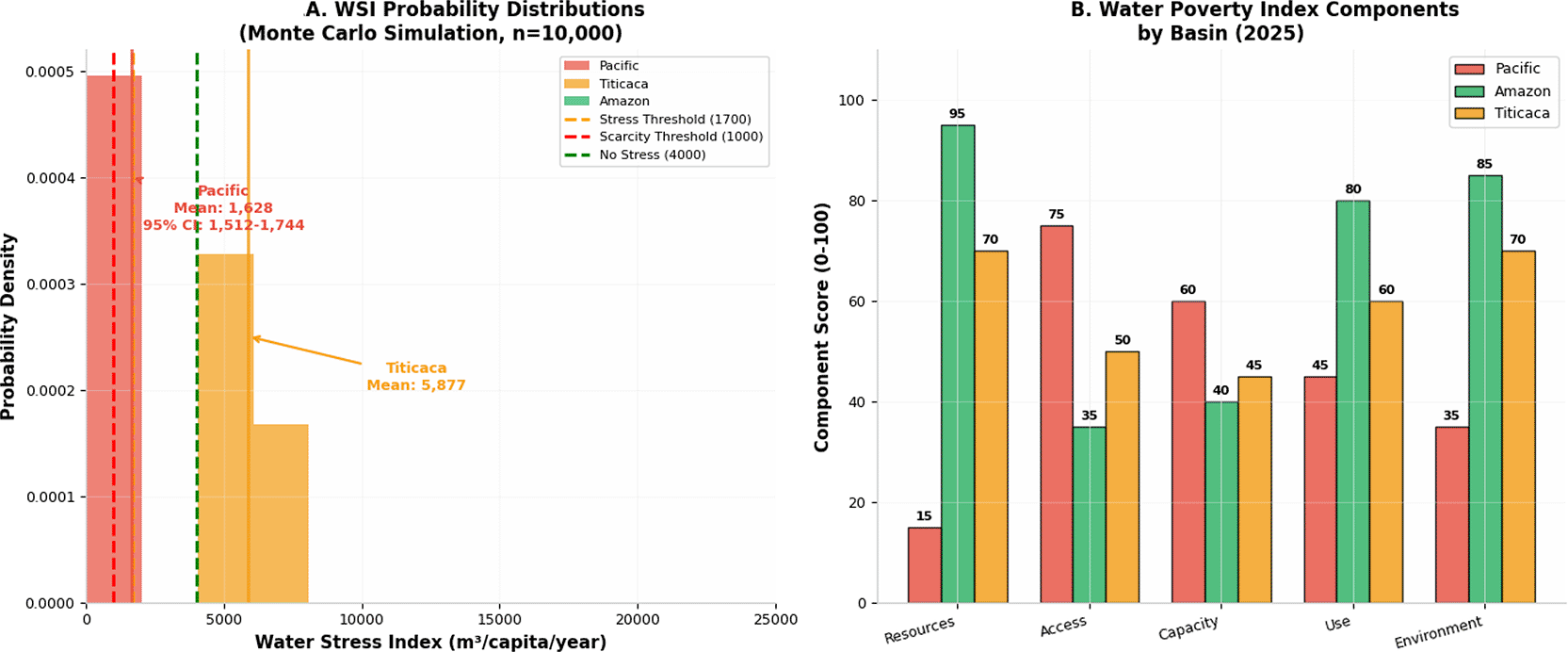
(A) Monte Carlo simulation (n = 10,000) showing WSI probability distributions for Pacific (red), Amazon (green), and Titicaca (orange) basins with 95% confidence intervals. Dashed vertical lines indicate Falkenmark thresholds: scarcity (1,000 m3/capita/year), stress (1,700 m3/capita/year), and no stress (4,000 m3/capita/year). Pacific basin mean WSI: 1,628 (95% CI: 1,512–1,744). Amazon basin mean WSI: 183,142 (95% CI: 155,171–211,113). (B) Water Poverty Index components by basin (0–100 scale, higher = better). Pacific basin shows low Resources scores (15) but high Access (75); Amazon basin shows inverse pattern with high Resources (95) but lower Access (35).
Peru’s asymmetry ratio (AR = 112.5) exceeds comparable cases ( Table 2):
| Country | Basins/Regions | WSI range (m3/capita/year) | Asymmetry ratio | Primary response |
|---|---|---|---|---|
| Peru | Pacific/Amazon | 1,628/183,142 | 112.5 | None implemented |
| Egypt | Nile/Desert | 650/32,000* | 49.2 | Virtual water import |
| China | North/South | 500/4,000 | 8.0 | South-North Water Transfer |
| Spain | Ebro/Segura | 2,500/15,000 | 6.0 | Inter-basin transfers |
| USA | Colorado/Mississippi | 1,200/8,500 | 7.1 | Colorado River Compact |
Peru’s AR is 2.3× Egypt’s, 14× China’s, and 19× Spain’s. Unlike these nations, Peru has not implemented major inter-basin transfer infrastructure or comprehensive demand management programmes.
The Water Poverty Index (WPI) components reveal divergent challenges ( Figure 1B). The Pacific basin scores poorly on “Resources” (physical availability) but well on “Access” (infrastructure); the Amazon basin shows inverse patterns. This suggests that water poverty in Peru is driven by physical scarcity in the Pacific and economic scarcity (infrastructure deficits) in the Amazon.
Mann-Kendall tests reveal significant deteriorating trends in Pacific basin indicators ( Table 3):
The Pacific basin WSI declined from 2,450 m3/capita/year (1990) to 1,628 m3/capita/year (2025), a 33.6% reduction. At current trends (Sen’s slope: −18.4/year), absolute scarcity (<1,000) will be reached by 2059 (95% CI: 2048–2071).
National water consumption (96,593 hm3/year) shows sectoral distribution ( Figure 2A):
• Energy (non-consumptive): 59,936 hm3/year (62.1%)
• Agriculture (consumptive): 32,011 hm3/year (33.1%)
• Industry (consumptive): 2,753 hm3/year (2.9%)
• Domestic (consumptive): 1,887 hm3/year (2.0%)
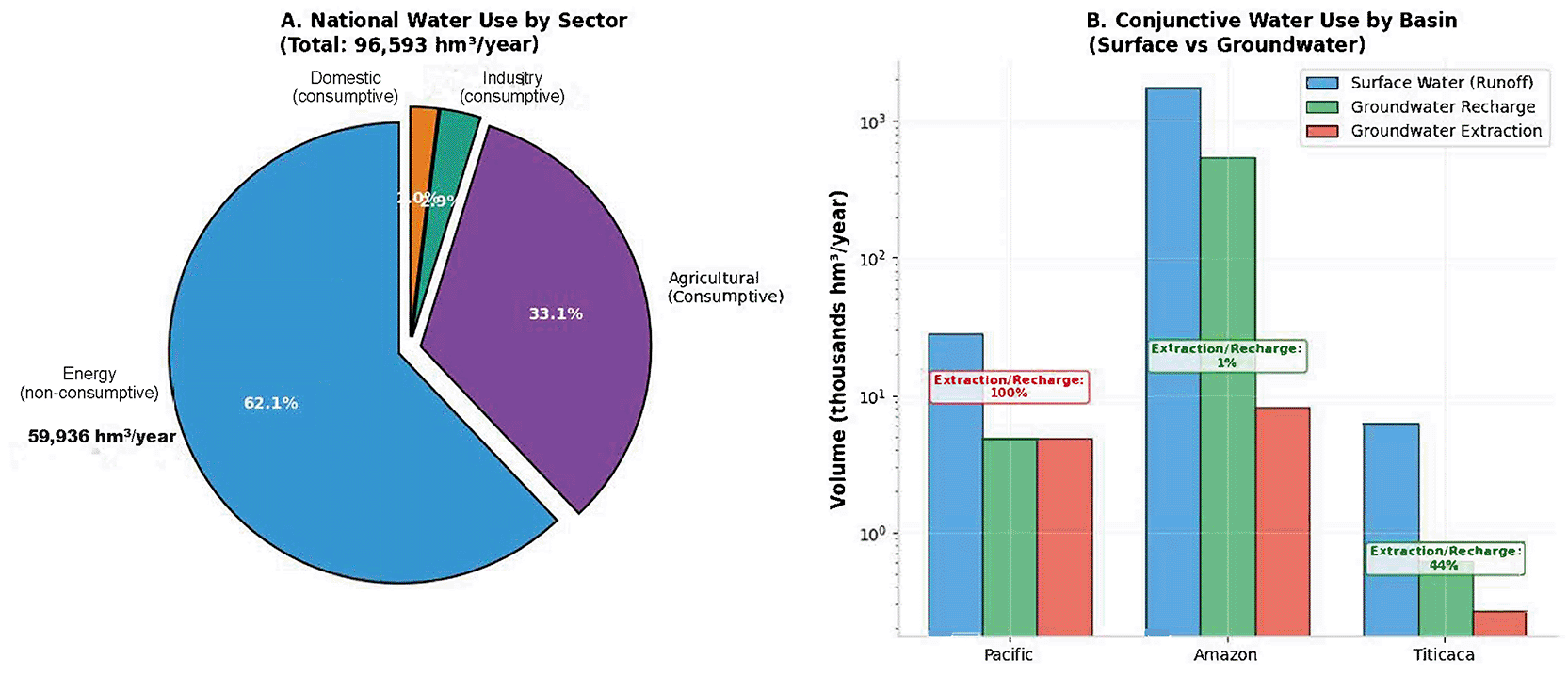
(A) Sectoral water use distribution (total 96,593 hm3/year). Energy use dominates (62.1%, non-consumptive), followed by agriculture (33.1%, consumptive), industry (2.9%), and domestic use (2.0%). (B) Conjunctive water use by basin showing surface water (runoff ), groundwater recharge, and groundwater extraction. Pacific basin extraction/recharge ratio: 100% (unsustainable). Amazon basin ratio: 1% (sustainable). Titicaca basin ratio: 44%.
Agricultural water productivity (AWP) shows minimal inter-basin variation (Pacific: 76.0 ha/million m3; Amazon: 78.5; Titicaca: 79.6), suggesting that efficiency differences do not drive pressure disparities. Instead, the absolute resource constraint in the Pacific basin (36,804 hm3 vs. 1,893,055 hm3 in Amazon) creates stress despite similar productivity.
Groundwater-surface water interactions reveal conjunctive use patterns ( Figure 2B). The Pacific basin extracts 4,844 hm3/year groundwater recharge (100% of renewable recharge), indicating unsustainable mining of fossil aquifers in coastal areas. The Amazon basin utilises only 1.5% of rechargeable groundwater.
Economic compensation collections (S/205.5 million) show inequitable distribution ( Table 4):
The Pacific basin generates 86× more compensation per unit of water availability than the Amazon basin (S/3.45 vs. S/0.04 per hm3). This inverse relationship between resource abundance and economic contribution indicates that compensation mechanisms tax scarcity rather than value ecosystem services.
Groundwater charges (S/32.5 million) are concentrated in the Pacific basin (74.8%), reflecting unsustainable extraction. Discharge fees (S/41.3 million) are split between Pacific (44.1%) and Amazon (54.2%), indicating pollution externalities in both basins.
Political ecology analysis reveals three structural barriers:
Accumulation by Dispossession: Historical water rights allocation (1930s–1970s) concentrated 68% of Pacific basin surface water rights in 12 large agricultural export enterprises (sugar, rice, asparagus), whilst 450,000 smallholders share 23%.31 This legacy constrains current reallocation options.
Scalar Mismatch: Watershed boundaries (159 hydrological units) intersect with 25 administrative regions and 1,874 municipal districts. The ANA’s basin-scale authority conflicts with regional government jurisdiction over infrastructure investment, creating coordination failures.32
Knowledge Exclusion: Indigenous water management systems (comunidades campesinas, ayllus) maintain parallel governance structures in 34% of Andean watersheds. State IWRM planning excludes these systems, reducing implementation legitimacy.33
This study demonstrates that Peru’s water crisis is not characterised by national scarcity but by extreme hydrological asymmetry. While national renewable availability exceeds 56,000 m3/capita/year, the Pacific basin remains below the Falkenmark water stress threshold (1,700 m3/capita/year), with Monte Carlo simulations confirming structural stress even under optimistic scenarios. This confirms that aggregated national indicators obscure subnational vulnerability, a limitation previously identified in global water security assessments.1,7,19
The asymmetry ratio calculated for Peru (AR = 112.5) substantially exceeds comparable international cases, including Egypt, China, Spain and the United States. Countries facing lower asymmetry ratios have implemented large-scale structural responses such as inter-basin transfers (China’s South–North Water Transfer), virtual water trade (Egypt), or binding allocation compacts (Colorado River Compact).10,28,31 Peru, by contrast, has not adopted a systemic redistribution strategy. This absence is particularly notable given that hydroclimatic studies project significant runoff reductions in glacier-fed Pacific basins under climate change scenarios.23,26 Without structural intervention, current declining trends in the Pacific basin WSI suggest that absolute scarcity (<1,000 m3/capita/year) could be reached within decades.
The Water Poverty Index (WPI) results further nuance this diagnosis. The Pacific basin scores poorly on the “Resources” component but relatively well on “Access”, reflecting infrastructure concentration. Conversely, the Amazon basin exhibits abundant physical resources but weaker infrastructure and service provision. This duality aligns with conceptual distinctions between physical and economic water scarcity.1,3 It also highlights that IWRM implementation in Peru has focused more strongly on allocation and regulation than on territorial equity and infrastructure balancing.7,34
Groundwater dynamics intensify these concerns. The Pacific basin currently exploits 100% of estimated renewable recharge, suggesting mining of fossil aquifers in coastal zones. Recent satellite gravimetry studies confirm long-term groundwater depletion trends in Peru’s arid basins.31 This pattern is emblematic of what hydrosocial cycle scholarship describes as the socio-political production of scarcity: institutional arrangements and economic priorities shape patterns of extraction beyond hydrological limits.30 In contrast, the Amazon basin utilises only a fraction of its renewable groundwater, reflecting infrastructural constraints rather than hydrological deficit.
Economic compensation mechanisms reveal a further structural paradox. The Pacific basin generates 86 times more compensation revenue per unit of available water than the Amazon basin. Current pricing instruments therefore internalise scarcity costs but fail to recognise ecosystem service provision. Payment for ecosystem services (PES) schemes implemented in Andean headwaters, such as those in the Santa River basin, illustrate how upstream conservation can be economically valued.33 However, these initiatives remain geographically limited and financially marginal relative to national compensation flows. Aligning compensation schemes with ecosystem service valuation principles could reduce territorial inequities while strengthening adaptive capacity.
The governance barriers identified—accumulation by dispossession, scalar mismatch, and knowledge exclusion—are consistent with documented limitations in Peruvian IWRM implementation.7,14,35 Historical water rights concentration constrains redistribution; overlapping administrative jurisdictions undermine basin-scale coordination; and indigenous governance systems remain insufficiently integrated into state planning frameworks.33 These structural constraints help explain why Peru, despite formal adoption of IWRM principles since 2009, has not achieved hydrological equity.
Taken together, the findings suggest that Peru’s water challenge is a governance asymmetry layered upon a hydrological asymmetry. Addressing it requires moving beyond infrastructure-centric responses toward integrated demand management, groundwater regulation, ecosystem service valuation, and multi-scalar institutional reform. Without such recalibration, climatic variability and demographic concentration will further entrench coastal scarcity while leaving Amazonian abundance underutilised and undervalued.
This study provides the first uncertainty-quantified, internationally benchmarked assessment of hydrological asymmetry in Peru. Four principal conclusions emerge:
1. Extreme subnational asymmetry: Peru exhibits one of the highest recorded asymmetry ratios globally (AR = 112.5), with the Pacific basin structurally water-stressed despite national abundance.
2. Divergent scarcity typologies: The Pacific basin experiences physical scarcity, whereas the Amazon basin faces economic and infrastructural scarcity, consistent with global water poverty frameworks.1,3,28
3. Unsustainable groundwater exploitation: Full utilisation of renewable recharge in the Pacific basin signals long-term depletion risks, corroborated by recent geodetic evidence.31
4. Misaligned economic instruments: Current compensation mechanisms disproportionately tax scarcity without valuing ecosystem services, reinforcing territorial inequities.
Policy implications follow directly from these findings. First, basin-scale demand management and irrigation efficiency improvements are imperative in the Pacific basin. Second, groundwater monitoring and abstraction control must be strengthened to prevent irreversible depletion. Third, compensation mechanisms should incorporate ecosystem service valuation principles, redistributing revenues toward hydrologically strategic headwater regions. Finally, effective IWRM requires institutional integration across administrative scales and recognition of indigenous water governance systems.
Peru’s case illustrates a broader lesson for water-rich yet spatially uneven nations: aggregate abundance does not guarantee water security. Without institutional mechanisms that reconcile hydrology, demography, and political economy, asymmetry becomes a driver of chronic stress. Future research should prioritise high-resolution groundwater mapping, climate scenario modelling, and evaluation of compensation redistribution impacts to support evidence-based reform.
| Views | Downloads | |
|---|---|---|
| F1000Research | - | - |
|
PubMed Central
Data from PMC are received and updated monthly.
|
- | - |
Provide sufficient details of any financial or non-financial competing interests to enable users to assess whether your comments might lead a reasonable person to question your impartiality. Consider the following examples, but note that this is not an exhaustive list:
Sign up for content alerts and receive a weekly or monthly email with all newly published articles
Already registered? Sign in
The email address should be the one you originally registered with F1000.
You registered with F1000 via Google, so we cannot reset your password.
To sign in, please click here.
If you still need help with your Google account password, please click here.
You registered with F1000 via Facebook, so we cannot reset your password.
To sign in, please click here.
If you still need help with your Facebook account password, please click here.
If your email address is registered with us, we will email you instructions to reset your password.
If you think you should have received this email but it has not arrived, please check your spam filters and/or contact for further assistance.

Comments on this article Comments (0)