Keywords
Bingham fluid, thermal transfer, concentration, magnetohydrodynamic (MHD), inclined porous channel

Bingham fluid, thermal transfer, concentration, magnetohydrodynamic (MHD), inclined porous channel
A Bingham fluid is a category of non-Newtonian fluid that exhibits solid-like behavior at low-stress levels and flows as a viscous liquid under elevated stress levels. They demonstrate yield stress, indicating that the fluid remains static until the applied stress is above a specific critical threshold. Below this yield stress, the material exhibits rigid body behavior. Upon surpassing the yield stress, the flow behavior becomes linear, characterized by a constant viscosity. The linear correlation between stress and strain rate manifests similarly to that observed in Newtonian fluids. Typical instances encompass toothpaste, mayonnaise, and concrete. These materials necessitate a certain force to initiate flow. Bingham fluids are significant in numerous industrial and scientific applications, especially where materials necessitate exact regulation of flow characteristics. Bird et al.1 examined the behaviour of a Bingham fluid within a hard circular tube. Kapur2 introduced several mathematical models, such as Cais-son, the Bingham, and Herschel-Bulkley models. Rathy3 examined the fluid dynamics of a Bingham fluid within a channel and an annulus featuring impermeable barriers. Vajravelu et al.4 conducted an experimented on the flow of Bingham fluid in an annular tube with a porous wall. Ramakrishna et al5 investigated the flow behaviour of a Bingham fluid on a permeable bed in an enclosed channel. Goverdhan6 examined the flow of Bingham fluid in a porous channel. Narahari et al.7 Investigate the movement of a Bingham fluid between two porous substrates, focusing on its unsteady behaviour. Recently, Murthy et al.8 focused on analysing the flow of a Bingham fluid, which is not stable, in contact with a Newtonian fluid within two parallel plates. The objective is to determine the velocity field, mass flow rates, and interface velocity. Tsangaris et al.9 conducted on the movement of a Bingham fluid between two porous walls that are parallel to each other. One wall moves steadily in the same direction as the other wall, which remains stationary. At the same time, there is a pressure difference throughout the length of the wall, and there is a flow of fluid across the walls due to their porous nature. Adnan and Abdulhadi10 performed an investigation on the influence of an inclined magnetic field on the flow of incompressible Bingham plastic fluid within an inclined symmetric channel. The study also considered the effects of mass transfer and heat transfer. Slip circumstances are utilised for heat transmission and focus. Lakshminarayana et al.11 examined the impact of wall slip circumstances, elasticity wall characteristics, and heat transfer on the movement of conducting Bingham fluid in an irregular channel using the presumptions of a lengthy wavelength and low Reynolds number. The current research by Mahabaleshwar et al.12 investigates how radiation and chemical reactions affect the two-dimensional boundary layer flow of a bi-viscous Bingham fluid on a thermosolutal Marangoni boundary that is accompanied by a magnetic field and thermal source or sink. A mathematical model is developed using the Navier-Stokes equations to represent the physical flow problem. In order to convert these nonlinear PDEs into a system of nonlinear ODEs, they employed a similarity transformation. The study conducted by Basavarajappa et al.13 examines the multilayer flow of a bi-viscous Bingham fluid within a vertical slab with a hybrid nanofluid, using the nonlinear Boussinesq approximation.
Heat transport in Bingham fluids entails intricate interplay between the fluid’s rheological features and thermal aspects. The existence of a yield stress, which regulates flow commencement, profoundly influences heat transfer processes. Vradis et al.14 numerically resolved the concurrent evolution of thermal fields and hydrodynamic at the entry region of a cylindrical pipe for a non-Newtonian Bingham-type fluid by employing the completely elliptic mathematical models of continuity, momentum, and energy. Mustafa et al.15 conducted a heat transfer simulation for the swirling flow of a Bingham fluid constrained by a permeable rotation disk. The influence of concentration and temperature variations on magnetohydrodynamic (MHD) oscillatory flow in a porous media has numerous practical implications in the fields of engineering, industry, medical research, and issues related to the extraction and transportation of petroleum. Hamza et al.16 conducted a study on the impact of slip condition, radiative heat transfer, and transverse magnetic field on the unsteady flow of a conducting optical thin fluid via a channel equipped with a porous media. Khudair and Al-Khafajy17 proposed a heat transfer model for MHD oscillating flow of Williamson fluid over a porous plate, considering two different forms of flow. Al-Aridhee and Al-Khafajy18 examined the impact of mass and heat transfer on the peristaltic movement of MHD flow of a non-Newtonian Jeffrey fluid via a cylindrical porous media channel. The investigation focuses on the flow within a wave frame of reference that is travelling at the velocity of the wave. Al-Khafajy and Labban19 conducted a study on the combined impact of concentration and thermo-diffusion on the fluctuating flow of an incompressible Carreau fluid via an angled permeable channel. Liu et al.20 investigate the steady flow and thermal transfer of Bingham fluid over a spinning disk of limited radius with radially varying thickness in the boundary layer. Eldabe et al.21 examined the flow of non-Newtonian Bingham blood fluid down an irregular conduit. The fluid exhibits electrical conductivity, and an external uniform magnetic field is added to this motion. Heat and mass transmission are considered, leading to an examination of the Dufour and Soret effects. Al-Khafajy and Mohammed22 examined a mathematical model elucidating the effects of thermal transfer on the oscillating flow of Bingham fluid with changing viscosity in a porous channel within the context of magnetohydrodynamics. Salahuddin et al.23 performed a study analyzing numerical behavior utilizing the Adams-Bashforth predictor-corrector method of numerical analysis for the Williamson fluid model, considering variable viscosity, natural convection, and an angled magnetic field. Additionally, thermal radiation, Joule heating, and heat source/sink effects are incorporated into the thermal considerations. Akram et al.24 studied the peristaltic flow of Bingham fluids under an inclined magnetic field, while Humnekar and Darbhasayanam25 investigated variable-viscosity nanofluid flow in inclined porous media. These recent studies highlight the ongoing need for improved formulations that incorporate thermal, magnetic, and viscous variations simultaneously.
In an inclined channel, the influence of gravity is crucial in propelling the flow. The gravitational force acting along the slope of the channel affects the overcoming of yield stress, allowing the fluid to flow. In the case of Bingham fluids, flow takes place when the shear stress surpasses the yield stress. The angle of inclination in a channel influences the critical shear stress required to initiate flow. Lakshminarayana et al.26 investigated the concurrent impacts of heated Joules and slip on the peristaltic flow of a Bingham fluid within an inclination tapered permeable channel featuring elastic walls. Mohammed and Al-Khafajy27 examined the impact of temperature and concentration on magnetohydrodynamic oscillatory flow of Bingham fluid with varying viscosity in a sloped channel. umbinarasaiah28 conducted a numerical investigation of entropy generation in an incompressible Casson fluid moving through an inclined permeable channel subjected to magnetic influence. Jha and Aina29 offered a mathematical model for the complete magnetohydrodynamic mixed convection flow of an electrically conducting, viscous, incompressible fluid in an inclined permeable channel subject to time-periodic boundary constraints.
Prior studies stimulate interest in examining the MHD flow of a Bingham fluid under no-slip conditions within an inclined porous channel, influenced by variations in viscosity, temperature, and concentration at the channel wall. This study comprises five sections. The initial section is the introduction, which encompasses a historical review of the factors being examined. The second involves constructing the mathematical model. The third portion presents the resolution to the issue. The fourth portion encompasses an analysis of the outcomes via the function diagrams we acquired. The investigation was ended with a discussion and conclusions.
Let us consider the flow of a non-Newtonian (Bingham) fluid with variable viscosity under the effects of radioactive heat transfer and electrically-applied magnetic field as depicted through an inclined porous channel with a width of (Figure 1). Fluids are supposed to have minimal electromagnetic power produced with a low electrical conductivity. We think of the system of Cartesian coordinates so that is the velocity vector.
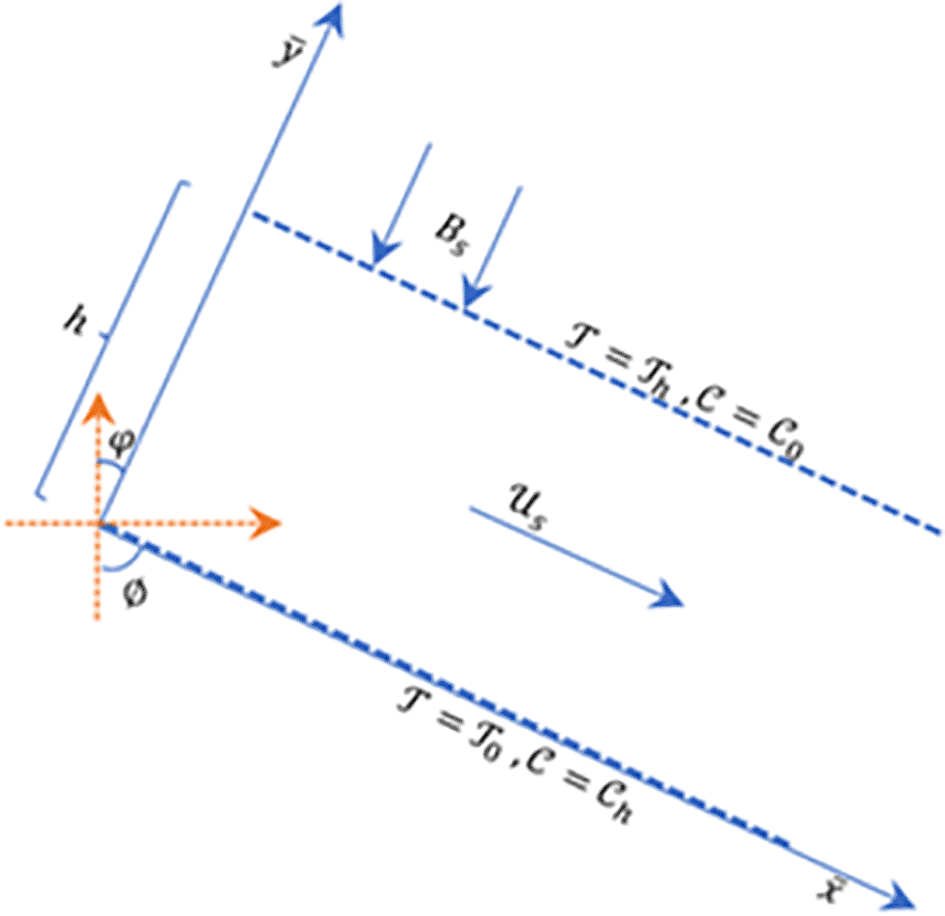
The basic equations governing the problem are provided as:
The continuity equation is given by:
The basic equation for the Bingham fluid,26 given by:
Where “pressure”, “unit tensor”, “fluid viscosity”, “yield stress”, and “shear rate”.
When compensating for the velocity vector and the concentration and temperature functions, taking into account the magnetic field generated by the passage of a simple electric current over a porous wall of the inclined flow channel, and by compensating for the shear stress (Equation 6), and after simplifying, we rewrite the nonlinear partial differential system (1)-(4) as follows:
The stress components are given by:
By substituting the equation (12) into the governing equations and after simplifying, we obtain:
The equation (14) shows that the pressure does not depend on . To solve the above system of equations, we use its non-dimensional conditions as follows:
By substituting equations from Table 1 into equations (13), (15), (16) and the equations of boundary conditions equation (5), we have the following non-dimensional equations:
This section includes solving a system of differential equations. We begin by solving the heat equation, passing through the concentration equation, and then we end by solving the velocity equation.
3.1.1 Solution of the heat and concentration equations
Using the separating variables method to solve the heat equation (19) and the concentration equation (18) with the boundary conditions equation (20), respectively. Let be the frequency of oscillation, and let
By substituting equation (21) into equations (19) and (18), respectively, and after simplifying the two equations, we obtain
The solution of temperature equation is
The solution of concentration equation is
3.1.2 Solution of the momentum equations
The Reynolds model for the variation of viscosity with temperature is , taking the Maclaurin’s expansion, we get , .
Using the separating variables method to solve the momentum equation (17) with the boundary conditions equation (20). Let
Where is a real pressure constant. Substituting Maclaurin’s formula for the fluid viscosity variable in addition to the (22) equation in the (17) equation, we get
The equation’s solution will be examined in two distinct cases.
Case I (when )
In the specific instance when , indicating that the viscosity remains constant, we obtain from (23)
Due to the complexity of solving the velocity equation, we shall analyze the behavior of the solution by graphing the function rather than deriving its formula.
Case II (when
Equation (23) is a nonlinear differential equation and it is hard to find an exact solution, so we will use the perturbation technique to find the solution to the problem as follows:
Substituting equation (25) in equation (23), we obtain:
Equating the like powers of , we obtain the following results presented in the forthcoming subsections:
It is consistent with the Case I.
The nonlinear characteristics of equation (27) render the derivation of an exact analytical formula for velocity difficult. Consequently, we employed an approximate method utilizing perturbation and separation of variables to examine the effects of varying viscosity and other flow characteristics. In the current investigation, the governing equations initially excluded the explicit description of the yield-stress factor related to Bingham rheology. To overcome this constraint and offer a more physically accurate depiction of the flow, the formulation has been enhanced to explicitly include the yield criterion and the Bingham number (B), which denotes the ratio of yield to viscous stresses. The updated formulation is detailed in the subsequent subsection.
The momentum equation was revised to explicitly include the yield-stress impact through the Papanastasiou regularization [Papanastasiou, 1987]. This formulation eliminates discontinuities between yielded and unyielded regions, facilitating seamless numerical analysis. The effective shear stress is written as:
The yield surface is defined as the location where the local shear stress equals the yield stress, i.e., . For , the material behaves as a rigid plug region, while for , it flows as a viscous fluid.
This regularized form was substituted into the non-dimensional momentum equation (17), allowing explicit inclusion of the Bingham number . The modified governing equation therefore becomes:
This expression correctly accounts for yield-stress effects and ensures the influence of both yielded and unyielded regions is captured in the flow field. The velocity profiles in Figures 8–24 were reinterpreted under this framework, showing clear flattening within the central plug region, consistent with expected Bingham behaviour.
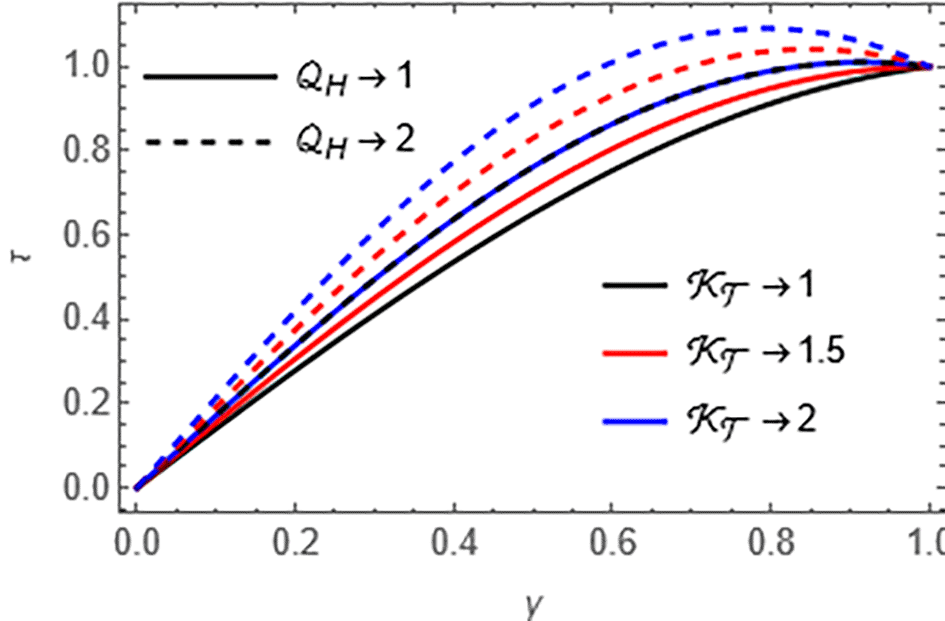
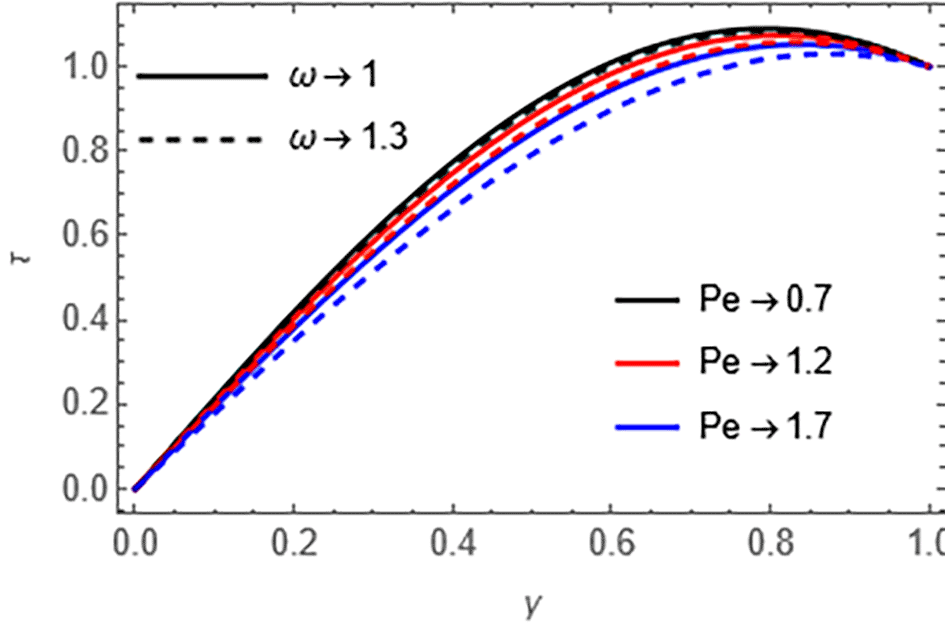
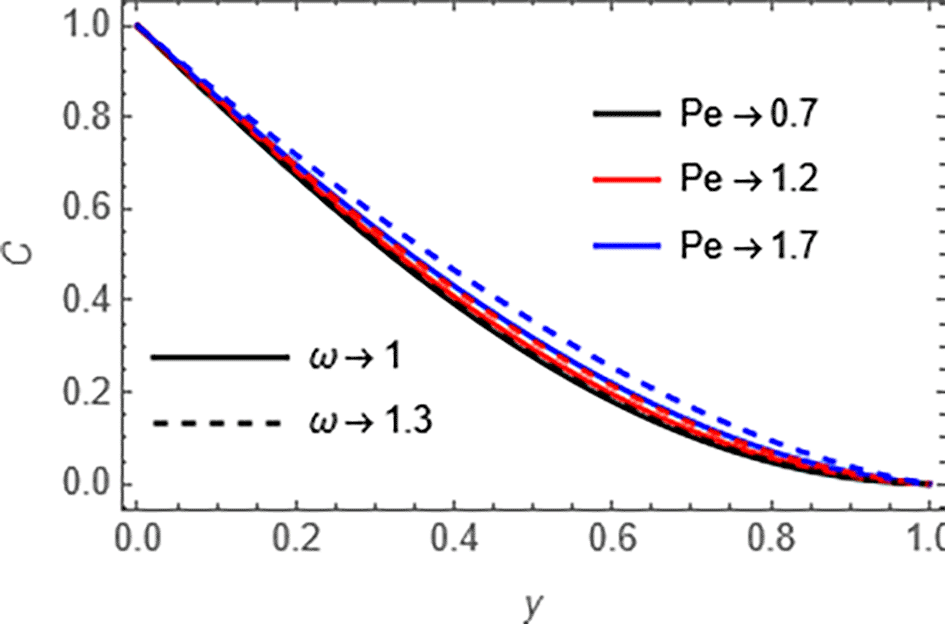
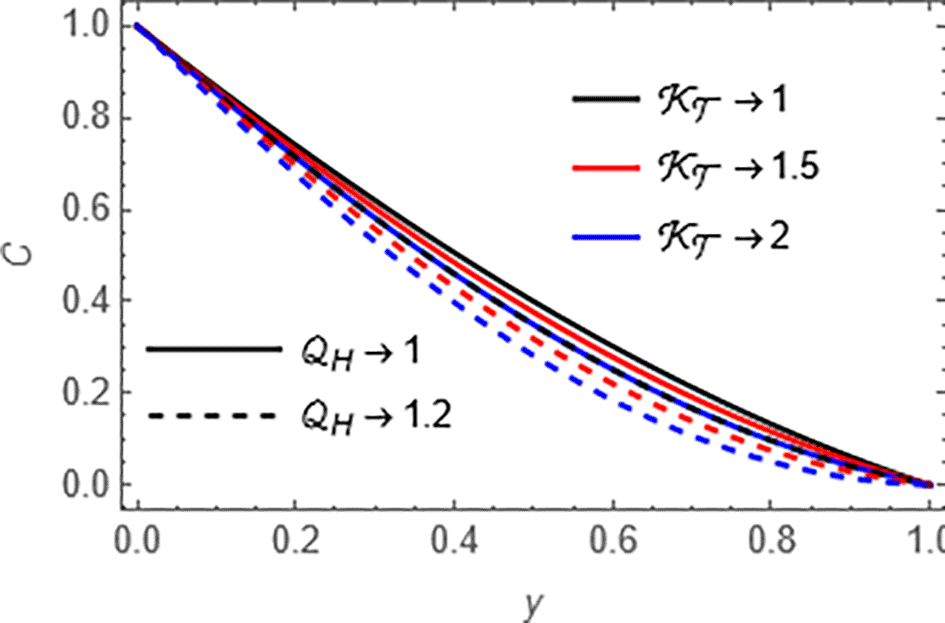
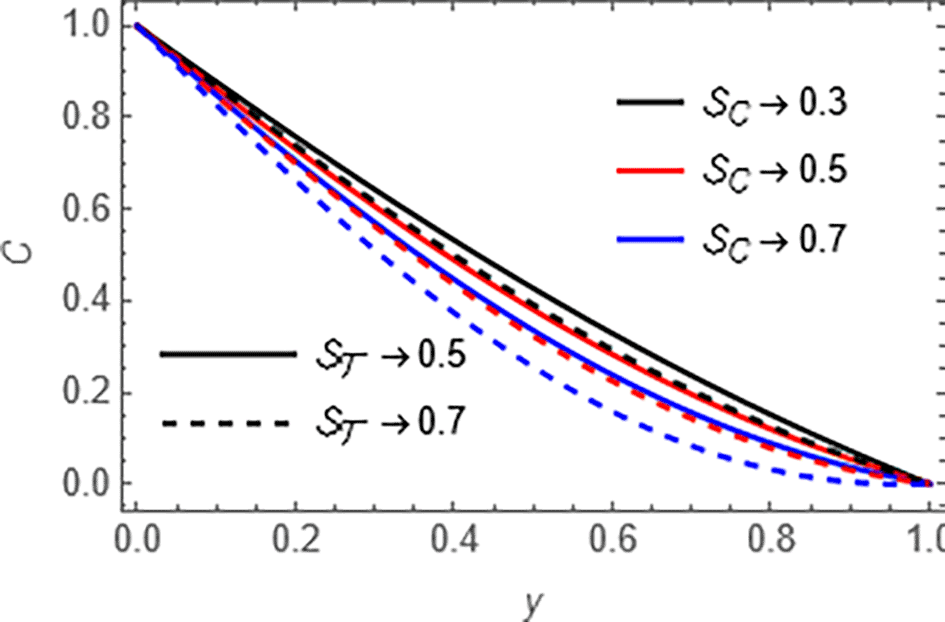
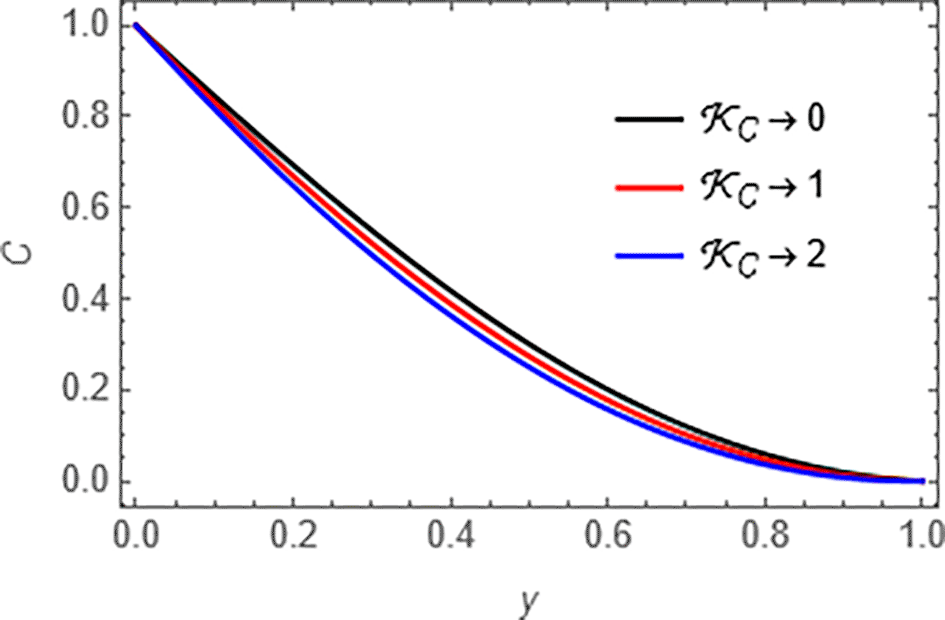
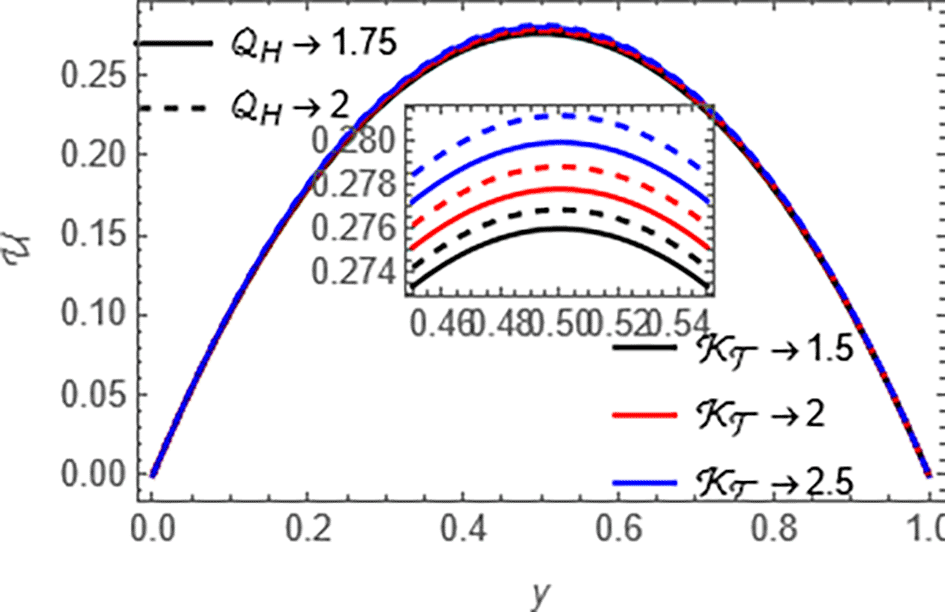
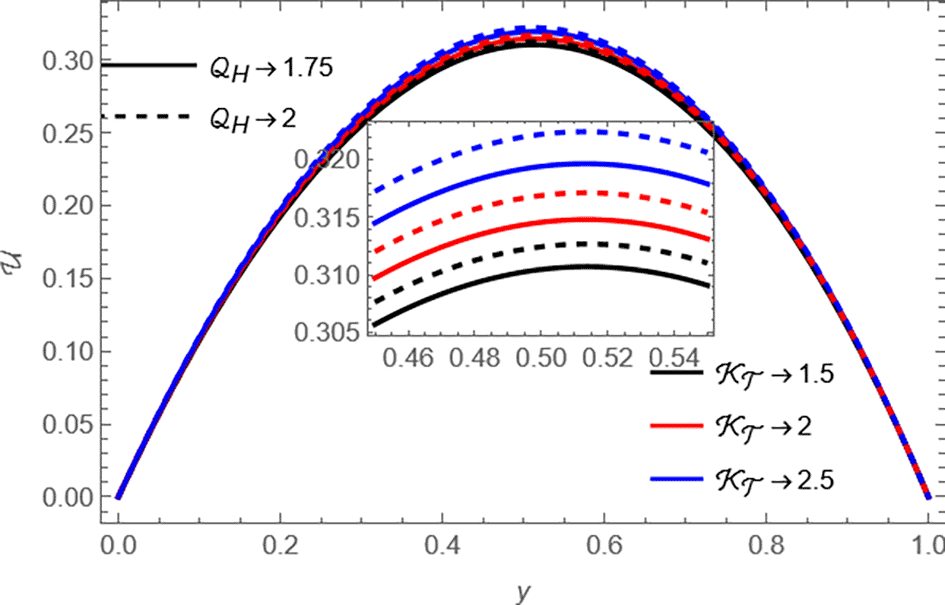
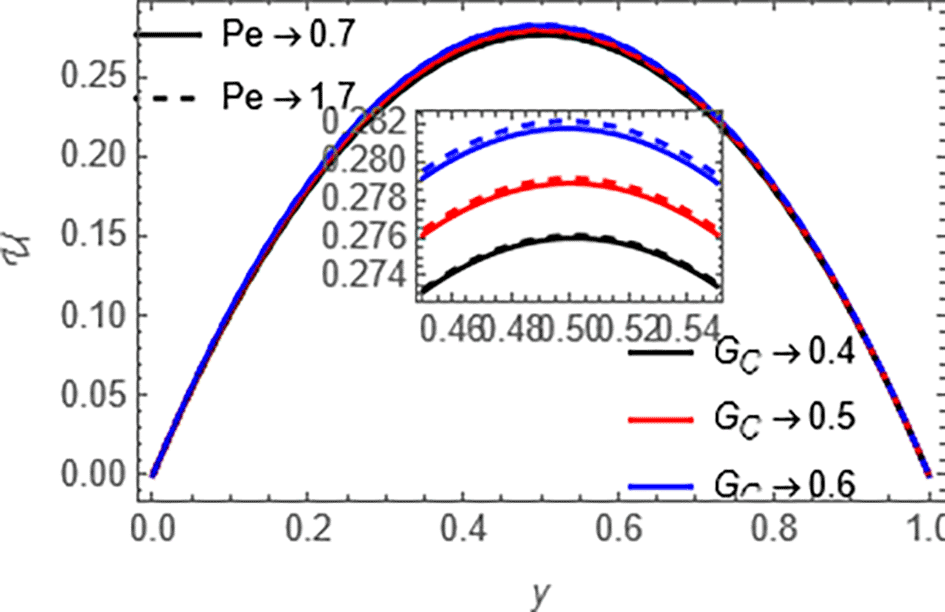
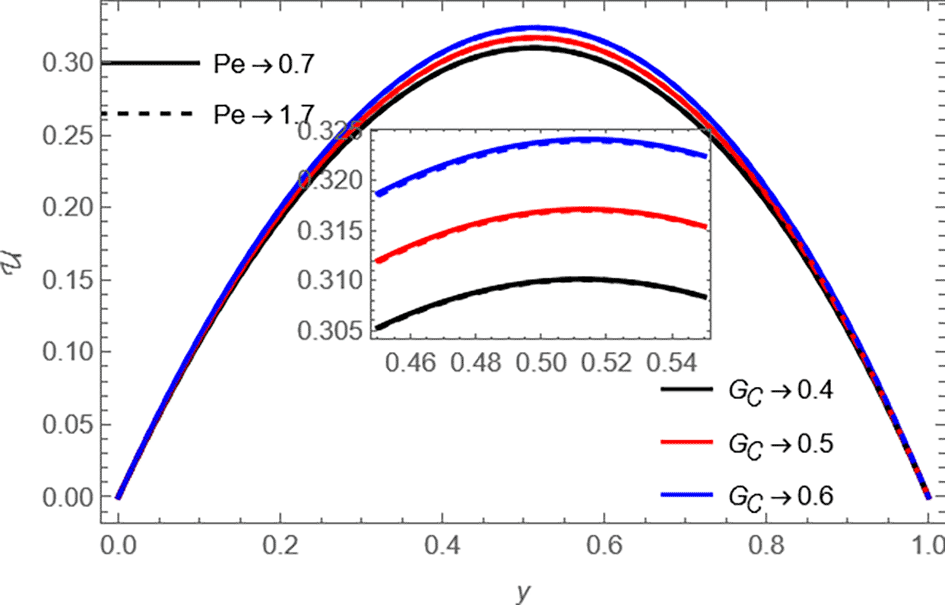
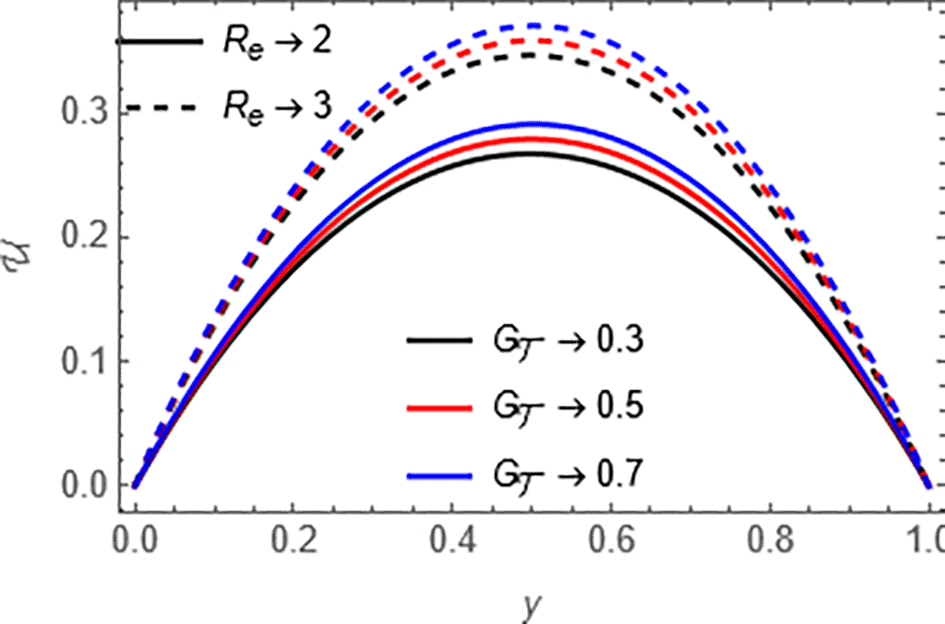
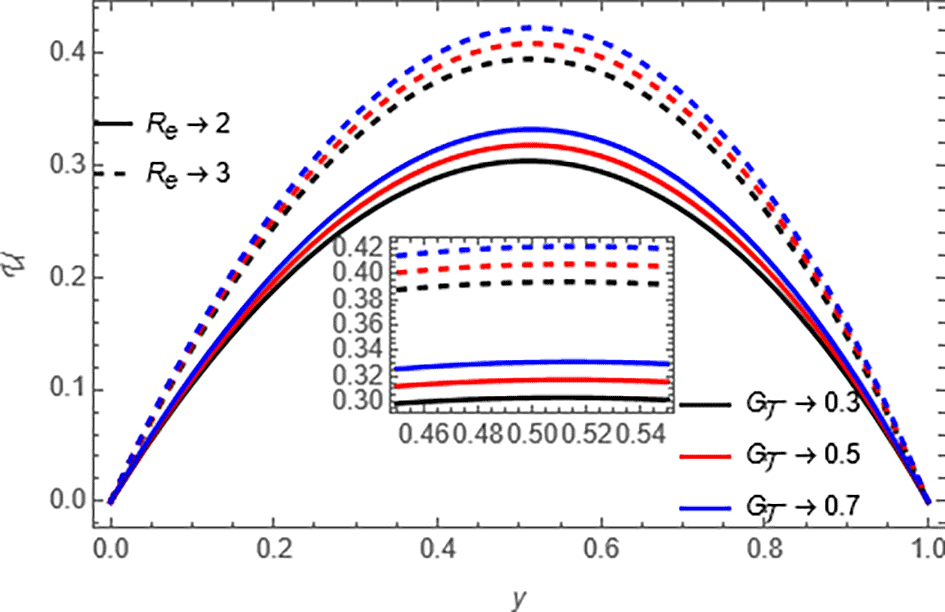
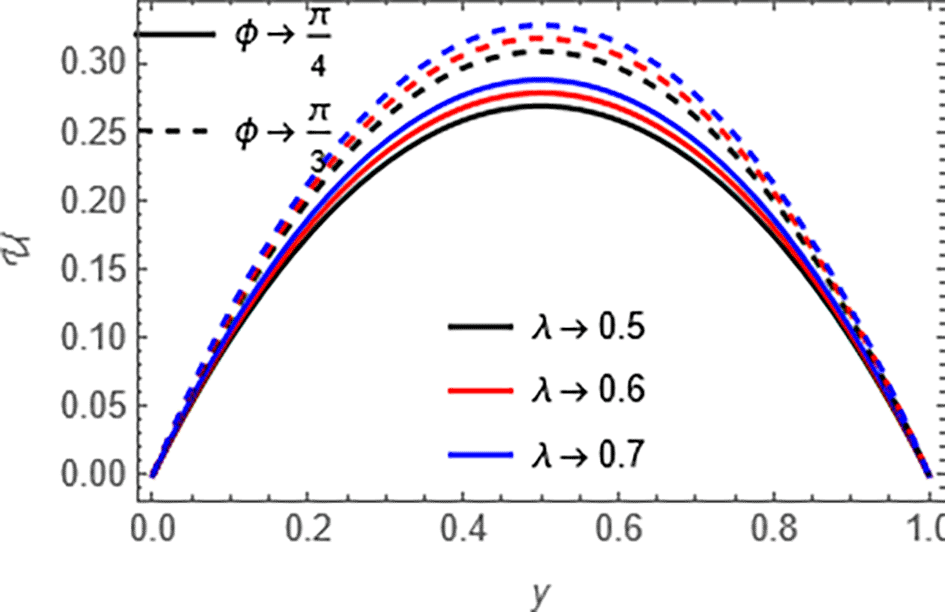
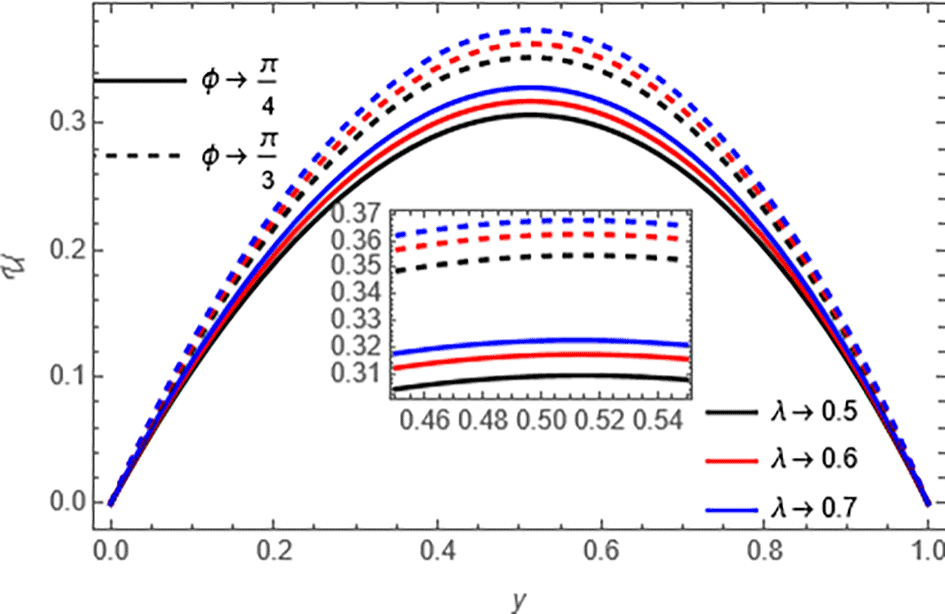
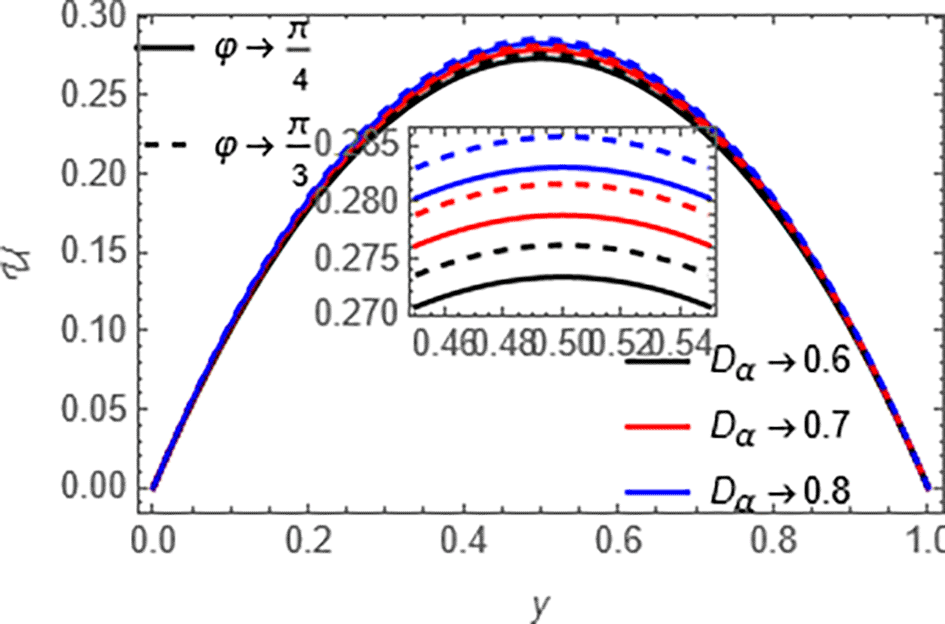
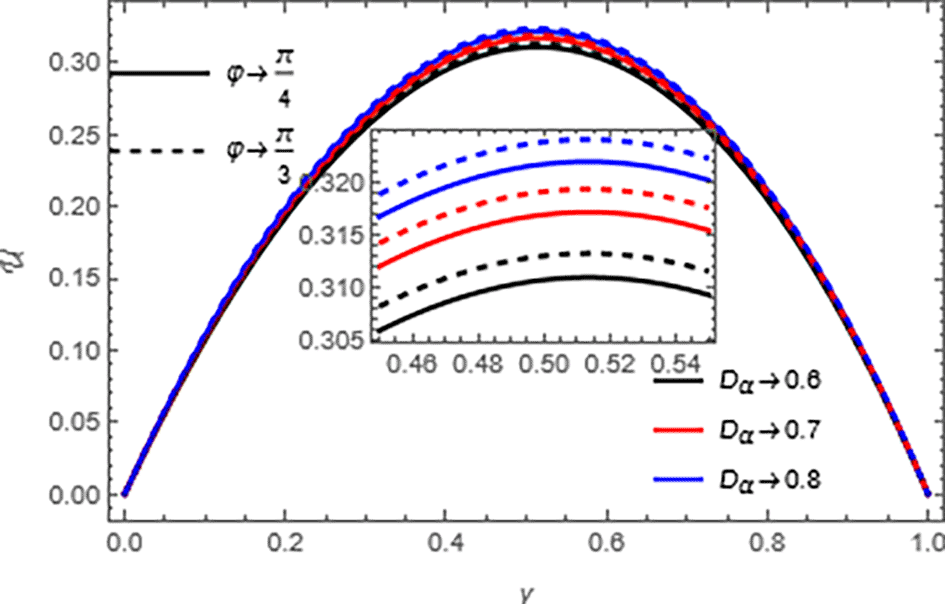
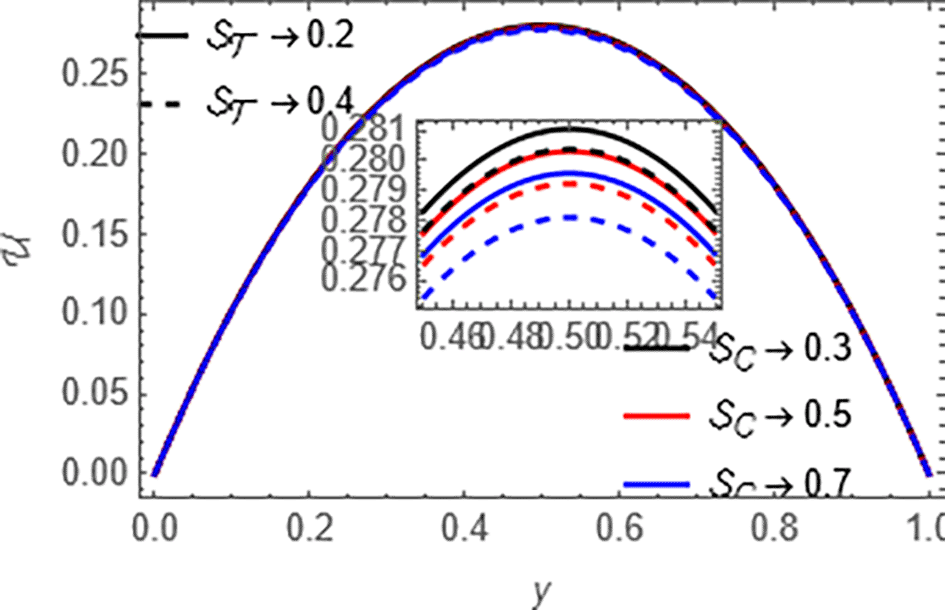
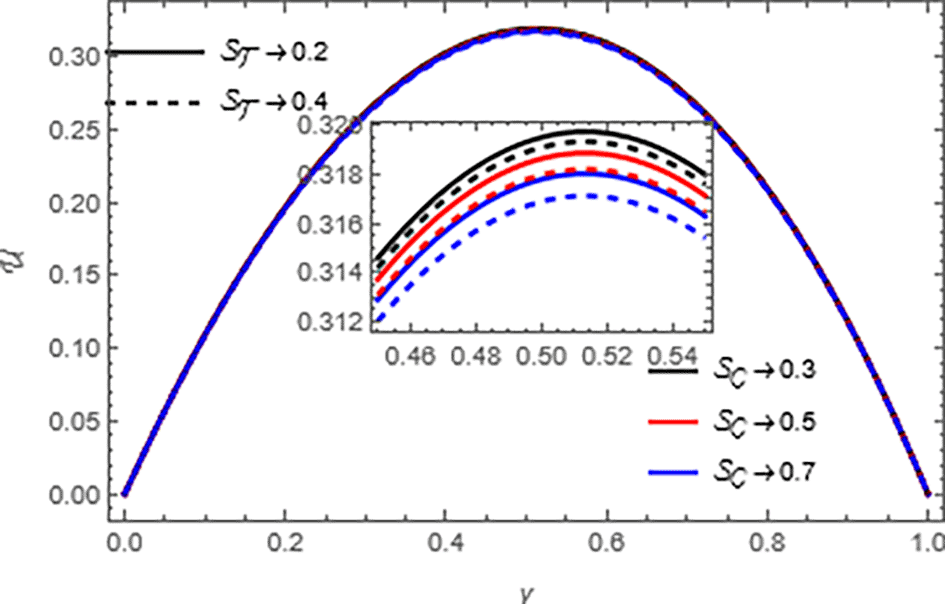
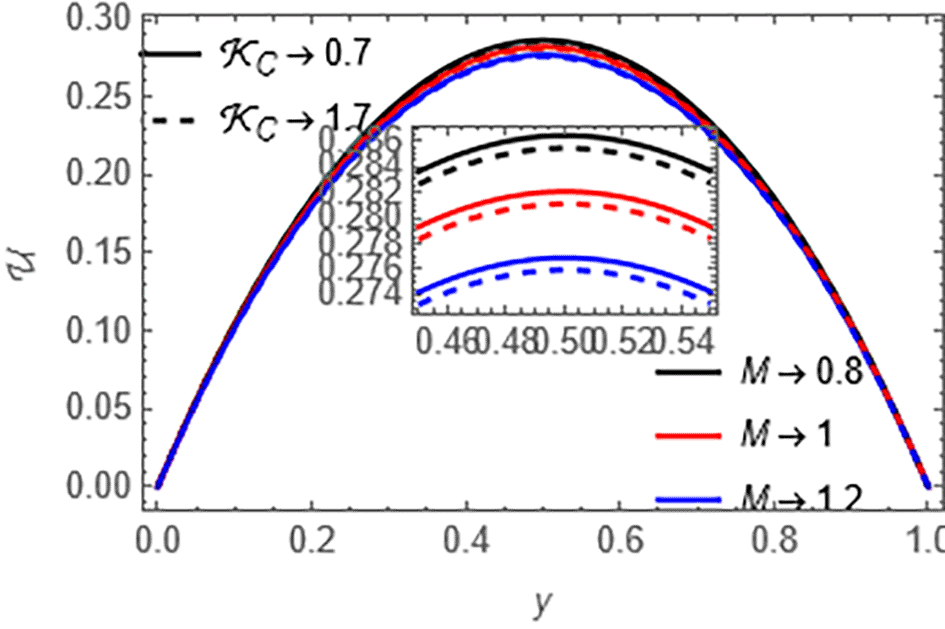
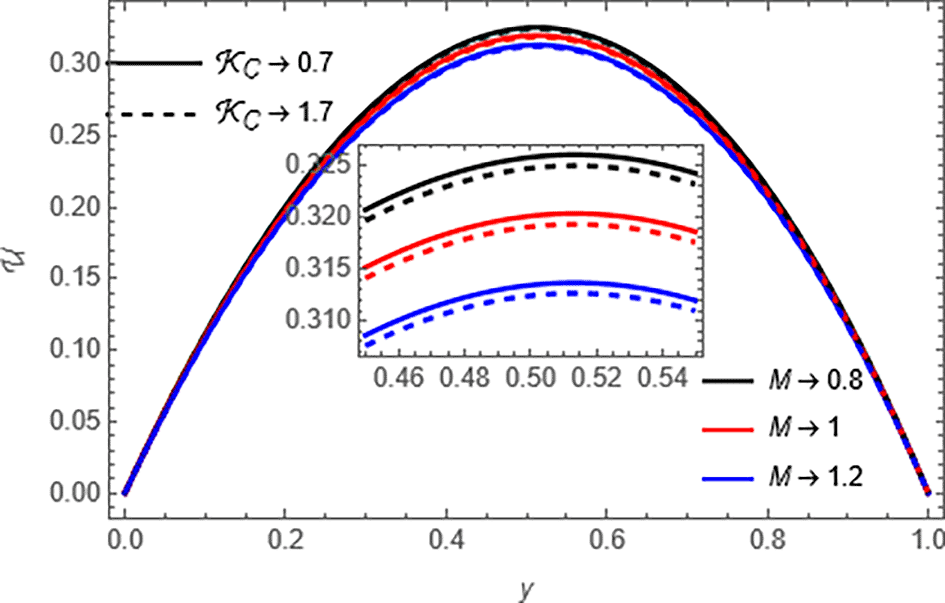
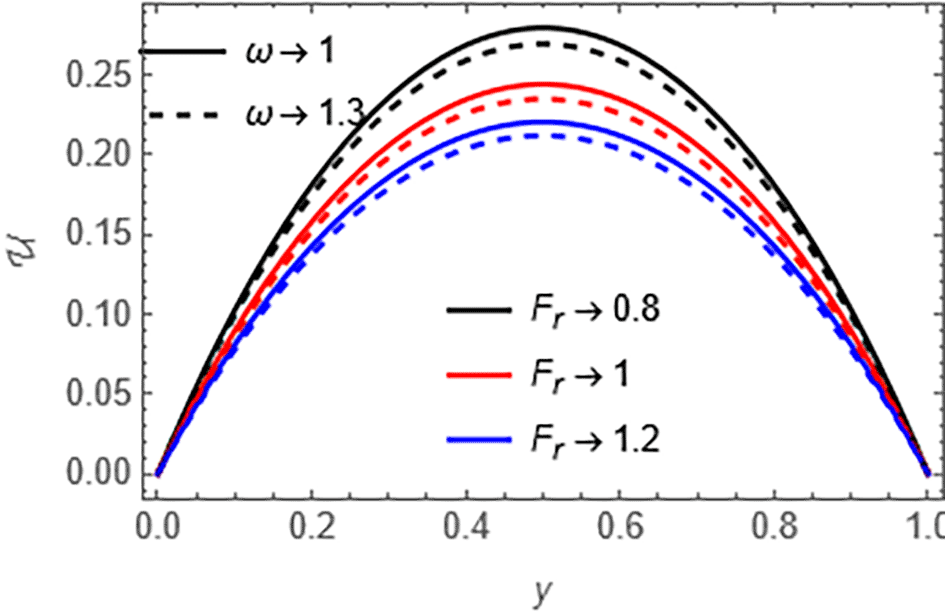
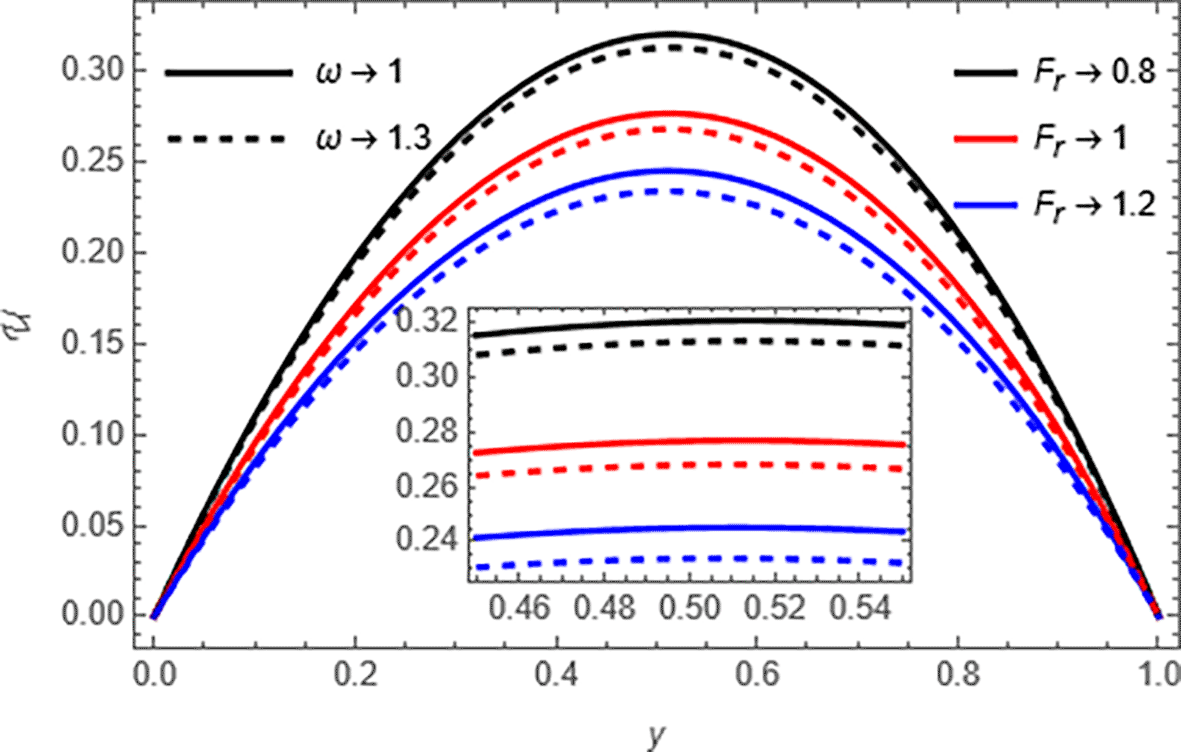
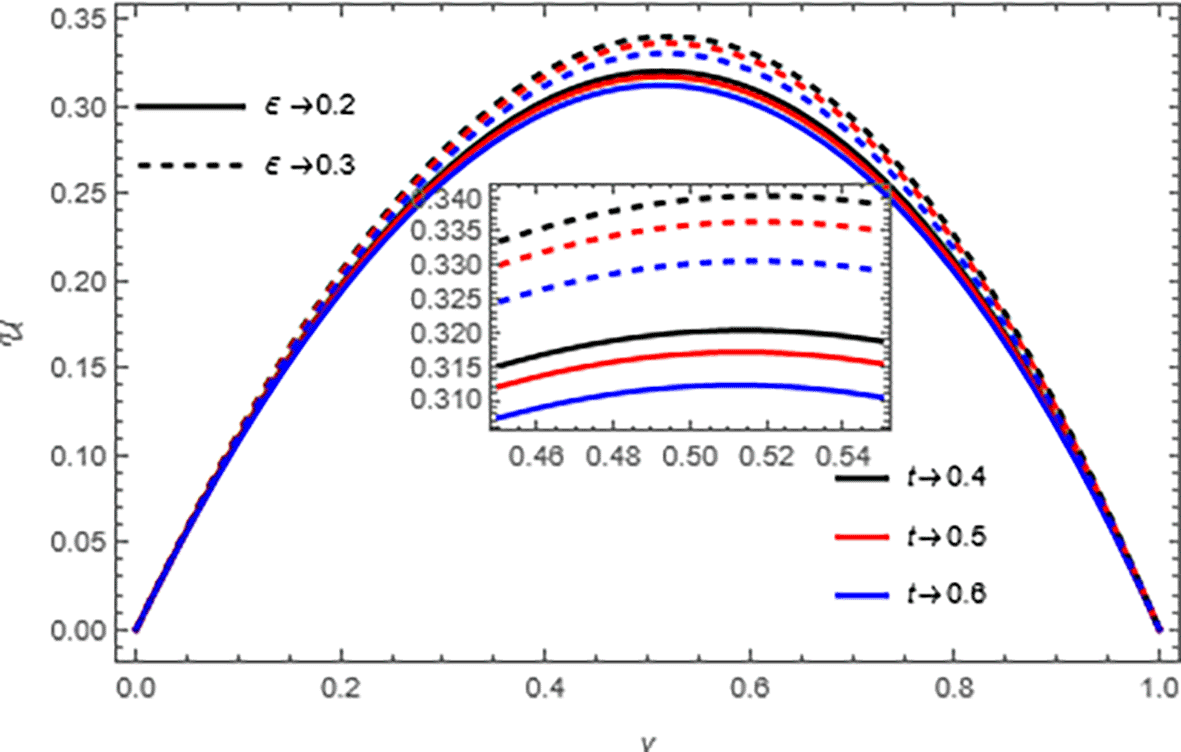
This part includes analyzing the solutions we obtained. We start with the temperature function Figures 2 and 3, then the concentration function Figures 4–7, and then the fluid velocity function Figures 8–24.
Figure 2 The data indicates that the temperature of the fluid rises as and increase. In contrast, Figure 3 shows that temperature fluid decreases by increasing and .
Figures 4–7, Fluid concentration rises with higher values of ω and Pe, but decreases with increased , , , , and .
Figures 8–24, Exhibit that fluid velocity escalates with an increase in , , , , , , , , , and , while diminishing with an increase in , , , , , and . It is evident that the velocity fluctuates more significantly in the scenario of changing viscosity compared to that of constant viscosity.
This study analyzed the transient, incompressible magnetohydrodynamic (MHD) oscillatory flow of a non-Newtonian Bingham fluid through an inclined porous channel, considering variable viscosity, heat generation, and concentration effects. The governing nonlinear equations were solved using the separation of variables technique with computational assistance from Wolfram Mathematica 13. The obtained results were interpreted in terms of the influence of several dimensionless parameters on temperature, concentration, and velocity distributions.
• The velocity of the fluid was observed to increase with larger values of the solutal Grashof number , Reynolds number , thermal Grashof number , and pressure gradient constant . In contrast, the velocity decreased when the magnetic parameter , and Froude number were increased. Moreover, the fluid motion was enhanced with a higher channel inclination angle ϕ, as this promotes gravitational acceleration along the channel wall, whereas the effect of the magnetic field inclination φ was relatively minor.
• Increasing the Schmidt number Soret number and chemical reaction parameter resulted in a reduction in concentration, which in turn caused a slight decline in fluid velocity. These trends confirm the coupling between mass diffusion and flow resistance within the porous medium.
• The fluid temperature and velocity rose with larger heat generation and radiation parameters, as internal heating reduces viscosity and promotes stronger convective motion. Conversely, higher values of the oscillation frequency and Péclet number led to a decrease in both temperature and velocity, accompanied by an increase in concentration. This behavior indicates that the influence of temperature on flow acceleration is more dominant than that of concentration.
• The explicit inclusion of the Bingham number ( ) and the adoption of the Papanastasiou regularization substantially improved the physical fidelity of the model. The revised formulation accurately represents yield-stress effects, capturing both yielded and unyielded (plug) regions within the channel. Increasing expands the plug zone near the channel center, while reducing velocity gradients near the walls. These effects become more prominent under higher yield stress or reduced shear conditions, consistent with classical results (Vajravelu et al., 1987; Lakshminarayana et al., 2018). Additionally, it was observed that thermal softening mitigates yield resistance, indicating that elevated temperature partially offsets the retarding influence of yield stress. This refinement enhances the realism of the current Bingham fluid model and aligns it closely with physical flow behavior.
• An increase in the viscosity variation parameter ( ) amplified the velocity magnitude, particularly near the channel center, signifying that thermal dependence of viscosity plays a critical role in controlling the flow field.
• In summary, the present analysis demonstrates that the combined effects of variable viscosity, temperature, concentration, and yield stress govern the dynamic behavior of MHD oscillatory Bingham fluid flow through inclined porous channels. The inclusion of radiation and heat generation parameters provides a more comprehensive understanding of heat and mass transfer mechanisms relevant to industrial, biological, and geophysical transport processes. The extended formulation incorporating the Bingham number and yield-surface representation ensures a more robust and physically accurate model for predicting complex non-Newtonian flow phenomena.
• Software: Wolfram Mathematica 13;
• Method: symbolic + numerical integration of the ODE system;
• Mesh size = 500 points, tolerance = 10−8, maximum residual < 10−5;
• Convergence criteria and supporting computational materials are provided as extended data in the public repository (see Data Availability section).
• All parameter values used for figures provided.
| Views | Downloads | |
|---|---|---|
| F1000Research | - | - |
|
PubMed Central
Data from PMC are received and updated monthly.
|
- | - |
Provide sufficient details of any financial or non-financial competing interests to enable users to assess whether your comments might lead a reasonable person to question your impartiality. Consider the following examples, but note that this is not an exhaustive list:
Sign up for content alerts and receive a weekly or monthly email with all newly published articles
Already registered? Sign in
The email address should be the one you originally registered with F1000.
You registered with F1000 via Google, so we cannot reset your password.
To sign in, please click here.
If you still need help with your Google account password, please click here.
You registered with F1000 via Facebook, so we cannot reset your password.
To sign in, please click here.
If you still need help with your Facebook account password, please click here.
If your email address is registered with us, we will email you instructions to reset your password.
If you think you should have received this email but it has not arrived, please check your spam filters and/or contact for further assistance.

Comments on this article Comments (0)