Keywords
adverse childhood experiences, posttraumatic stress disorder, depression, generalized anxiety disorder, wise intervention

This article is included in the Social Psychology gateway.
adverse childhood experiences, posttraumatic stress disorder, depression, generalized anxiety disorder, wise intervention
Mental health disorders (MDHs) affect approximately 14% of adolescents globally and have their onset mostly in middle adolescent years. This contributes to 15% of the global burden of disease, with most of those affected residing in low-and middle-income countries (LMICs).1–2 Adolescents are at high risk for adverse childhood experiences (ACEs),3 with prevalence rates among high-risk groups of Kenyan adolescents ranging from 60–94.8%.4–5 The impact of ACEs on mental health is influenced by the type, number, and timing of ACEs,6–11 and is linked to a range of physical, social, emotional, and behavioural issues,12–14 with significant associations found with posttraumatic stress disorder (PTSD), depression, and anxiety.6,14,15
Sociodemographic factors influence exposure to ACEs which often cluster within families, thus increasing the likelihood of multiple experiences16 with adverse experiences in adulthood having effects on children through psychosocial, environmental, and biological pathways, particularly when parents suffer from MHDs.17,18 Risk factors for ACEs among Kenyan adolescents include orphanhood, the female gender, low parental education, and living in communities prone to violence.4,5,19 Despite prevalence rates of PTSD, depression, and anxiety being high among Kenyan adolescents,5,19–21 data on the burden of ACEs in association with these psychopathologies in this population is limited, with many especially those in high school settings remaining unrecognised due to various barriers in mental health care.5,22,23 Treatment gaps for mental health disorders in LMICs reach up to 90% for children and adolescents, these being significantly higher than rates in high-income countries.24–26
Research highlights the adolescent years as critical for school-based mental health interventions,27 with early intervention emphasized as being more effective before academic issues arise, which often signal mental health disorders.28 Social belonging is crucial for self-identity and well-being during adolescence since it significantly influences social development and identity formation.29,30 Social support and connectedness help mitigate effects of ACEs,31–33 and protective factors against loneliness include friendships, school hobbies, societal belonging, various therapies and skill trainings.34–36 The study advocates for the cost-effective social belonging wise intervention to complement traditional treatments37,38 since social support is crucial for enhancing self-esteem32,33 which in turn protects against the psychopathologies under this study.39–47
The wise interventions (WIs) approach will be utilized since they enhance developmental, academic, and health outcomes for adolescents with MHDs, and due to their brief nature, they are effective in resource-limited settings and complement traditional therapies while reducing stigma through non-explicit labelling of the psychopathologies.22,37,38 WIs align with the Kenya’s Mental Health Policy 2015–2030 and the Mental Health Action Plan 2021–2025, which focus on support for vulnerable youth and on integrating mental health into school programs and policies.48,49
The study investigates the relationship between ACEs, academic performance, well-being, loneliness and three common MHDs namely PTSD, depression, and generalised anxiety disorder (GAD), among Kenyan high school students. It highlights the limited comprehensive local research noting that previous studies often focused on high-risk populations of Kenyan adolescents.4,5 The findings aim to affirm that ACEs negatively affect adolescents, supporting evidence from other contexts,50–58 and emphasizes the importance of understanding the impacts of ACEs on Kenyan adolescents. It explores social belonging as a school-based psychosocial intervention, advocating for a comprehensive preventive approach at the levels of policy, family, community, and schools.59,60
Study design and setting
A quasi-experimental pretest and post-test design will be utilized in the study. Participants exposed to ACEs from two public boarding high schools in Kenya will be recruited and assigned into treatment and comparison groups by non-random allocation. The comparison group will be chosen from the same school setting using a non-equivalent group design approach to ensure similarity to the treatment group. The treatment group will undergo the intervention while the comparison group will remain passive.
Purposeful sampling will be used to select the two public boarding high schools and students in the second year of schooling will be recruited from the boys’ school which has an approximate population of 1280 students, and from the girls’ school with an approximate population of 1400 students. A systematic sampling approach using class registers will be used for selection of eligible participants. An estimated sample size of 338 students based on the modified Cochran’s formula,61 adjusted to 372 students to account for a 10% dropout rate will be used, with 178 drawn from the boys’ school, and 194 drawn from the girls’ school. The justification is that for a finite population of the two schools, with a 95% confidence interval (Z = 1.96), a 5% margin of error, and 50% proportion (p = 0.5), the sample of 338 is adequate, then adjusted by 10%. Secondly, for an independent samples t-test to detect a medium effect size of 0.5, a power of 0.95, and an alpha of 0.05, a minimum sample of 210 participants will be sufficient, with 105 per group.
Eligibility criteria for study participants
Inclusion Criteria
1. Students will be aged between 14 and 18 years, and whose parents will give consent.
2. Students above 18 years who will give consent, and those under 18 years who will give assent.
3. Students who will have ACEs scores of 1–13.
Exclusion Criteria
Students who will have severe depression (these be referred to the school counsellors for further support).
Consenting process
The researcher will meet with school principals to explain the purpose of the study and facilitate obtaining of parental consent after assurance of voluntary participation and confidentiality. After this, consent forms will be distributed to students in sealed envelopes at the end of the school term for parental consenting and returned to the principal’s office at the start of the next school term. The researcher and data assistants will then visit the school and distribute consent forms to eligible students if over 18 and assent forms if under 18, explain the content of the forms, and give them time to read through and sign. These will be collected after the exercise. The researcher will request school principals to facilitate selection of six senior students (3 from each school) drawn from the final year of study, who will fill out consent/assent forms and respond to pre-prepared questions. These will be compiled into prewritten accounts that will form part of the intervention.
Recruitment and participant enrolment
The researcher and data assistants will recruit those who meet the eligibility criteria until the desired sample is obtained. To ensure adequate participant enrolment, the researcher will explain the purpose and the benefits of the study to the eligible participants and seek voluntary participation. They will be assured of confidentiality and an assurance that the intervention will be offered to those who fall into the comparison group before study closure. Also, the pre-written accounts obtained from senior students from the respective schools, and the choice of lay health workers (LHWs) who are close in age to the study participants to offer the intervention, and the use of videos with relatable adolescent strategies of belonging as part of the intervention will encourage them to look forward to the sessions. Based on their class streams, participants will be assigned to the treatment, for example streams ‘G’ and ‘T’ and comparison groups streams ‘R’ and ‘S’.
Confidentiality
Confidentiality will be maintained using codes for the psychopathologies which will not be revealed to other participants and no personal identifying information will be obtained throughout the study.
Study outcomes
The primary outcomes comparing the treatment and comparison groups pre and post intervention will be:
1. Improved academic performance as depicted by improved mean scores for subjects
2. Improved general well-being scores
3. Reduced loneliness scores
The secondary outcomes comparing the treatment and comparison groups pre and post intervention will be the reduction of symptom scores for PTSD, depression, and GAD.
Data collection instruments and measures
A researcher-developed questionnaire will be used to gather sociodemographic characteristics of study participants, which will include age, gender, year of study, religion, family setup, parents’ highest education level, parents’ employment status, type of housing, and location of residence if urban or rural. ACE types and scores, will be assessed using the WHO ACEs International Questionnaire (WHO ACE IQ)62 with binary scores ranging from 0 to 13 of which four or more indicate a high ACE burden. It demonstrated good psychometric properties in Malawian adolescents63 and positively correlated with the original 10-item ACEs questionnaire used in Kenyan adults.64 Well-being will be assessed using the WHO-5 wellbeing index (WHO-5), a 6-point Likert scale (0 to 5), with raw scores from 0 to 25 and converted to a percentage with higher scores indicating better well-being.65 The scale showed adequate reliability of Cronbach’s alpha 0.86 and 0.75 among Ghanaian adolescents and Kenyan adolescents66,67 respectively. Feelings of loneliness will be assessed using the UCLA Loneliness scale-8 (ULS-8) with scores ranging from 8 to 32, higher scores indicating greater loneliness.68 It showed good convergent validity with other loneliness measures and construct validity, among Kenyan adolescents who had depression and anxiety (Cronbach α = .74).69 PTSD will be evaluated using the Child PTSD Symptom Scale Self-Report (CPSS-5 SR), with severity scores ranging from minimal (0–10) to very severe (61–80).70 It demonstrated excellent psychometric properties of moderate test-retest reliability (.62–.68) in Zambian adolescents,71 correlating.80 with the Child’s PTSD checklist used in Kenya high school students.72
Depression will be assessed using the Patient Health Questionnaire 9 modified for Adolescents (PHQ-A), with severity cut-offs of 5–9 for mild, 10–14 for moderate, 15–19 for moderately severe, and 20–27 for severe depression.73 Psychometric properties of the English and Kiswahili versions are comparable, with internal consistency values of 0.862 and 0.834, respectively among Kenyan adolescents.74 The Generalized Anxiety Disorder screener (GAD-7), will be used to assess for anxiety levels, categorized as mild (5–9), moderate (10–14), or severe (15–21).75 It showed good internal consistency and effectively identified suicide risk and depression in Ghanaian adolescents and Kenyan adolescents (Cronbach’s alpha = 0.69 and 0.70) respectively.22,76 Social support in schools will be measured as a mediating variable using the Oslo’s Social Support Scale (OSSS-3) categorizing scores as 3–8 for poor support, 9–11 for moderate support, and 12–14 for strong support.77 It demonstrated convergent and discriminant validity for family support and discriminant validity for support by friends for mental health disorders among Ghanaian adolescents,44 had good psychometric properties in linking social support to depression in Ethiopian adolescents78 and demonstrated a strong correlation with the 12-item Multidimensional Scale of Perceived Social Support, validated in Kenyan adolescents (Cronbach’s α 0.86).22 Academic performance will be evaluated through comparison of mean scores of term marks across subjects from three periods: term three (September to October 2025, pre-intervention), term one (January to March 2026, during intervention), and term two (May to July 2025, post-intervention) between the treatment and comparison groups.
Data collection procedures
Pretesting
Pretesting of the data collection instruments will be conducted at a different public high school involving twenty students in the second year of study.
Preintervention stage and measures
Recruiting and training of lay health workers and data assistants
The researcher will develop a training manual for the LHWs, recruit them from recent college/university graduates, and train them on delivery of the intervention.
Eligibility criteria for LHWs will be:
1. Aged between 23 and 25 years
2. Having attended a Kenyan high school
3. Fluent in English and Kiswahili
4. Be a recent graduate of either a university/college
5. Have good interpersonal skills
6. Have an interest in working with high school students
Similarly, data assistants will be recruited from recent college/university graduates, undergo an online research ethics course for certification before being trained on recruitment, informed consent, group allocation, administration of the assessment scales, and data management. A follow-up on their skills will be done two weeks post-training.
Quality assurance procedures
Quality assurance for the LHWs will include follow-up sessions with a psychologist and the researcher, held two weeks after training. These sessions will aim to reinforce and monitor skills acquired on delivery of the intervention. Quality assurance by the researcher for the data assistants will involve follow-up sessions focusing on recruitment, informed consent role plays, and data management procedures. Regular checks will ensure data accuracy, with missing data issues will be communicated to the data assistants to reduce their occurrence.
Intervention fidelity
Independent assessors will receive training from the researcher regarding the intervention and assessment rubric for the LHWs. The assessment will focus on two aspects: adherence to the intervention protocol, graded as “N” for no or “Y” for yes, and competence in delivering the intervention, evaluated on a scale of 1 to 3. The assessors will give feedback to LHWs following each session.
Preintervention measures
Pretests will include the sociodemographic questionnaire, the WHO ACE IQ questionnaire, the CPPS-5 SR, the PHQ-A, the GAD-7, the WHO-5 wellbeing, the ULS -8 loneliness and the OSSS-3 scales; and preintervention academic reports.
Harms definition and assessment
Harms will be signified by psychological distress such as looking anxious, looking disinterested or crying because some of the questions in the WHO ACE IQ questionnaire and the CPPS-5 SR scale may be intrusive. These signs will be assessed for by the LHWs and those affected will be referred to the psychologist on the team and the school counsellor for further support. This will be done through the different stages of engagement with the participants.
The intervention stage and intervention components
The researcher will divide the participants into groups of 15 prior to the sessions, and the LHWs will deliver the interventions to their allocated group in three sessions at one monthly intervals with each intervention lasting one hour. The three sessions of the interventions are designed to help participants develop a sense of social belonging and will be as follows: the first session will include establishing rapport, presentation of the goals and benefits of the intervention, video presentations on what belonging is, reading of a senior student’s pre-written account on belonging, and a discussion on practical ways to belong in school. The second session will aim to foster comprehension of useful strategies for school belonging and will entail a review of the goals and benefits of the intervention, videos on struggles faced by students in belonging and the connection between belonging, effort, and time. This will be followed by reading of a senior student’s pre-written account that promotes belonging and a discussion to reinforce the participants’ understanding of the content of the session. The third session will emphasize the importance of belonging to the school community through a video, a senior student’s account and a first-hand story from the LHW of their experience of belonging to their school community. The session will be concluded with a discussion focusing on the participants view of the benefits of belonging to community.
Participants’ adherence and retention
To promote participant adherence to the intervention, retention and complete follow-up, the researcher will send reminders of the scheduled sessions through the school counsellor and class teacher one week prior to the intervention and hold the sessions during the free times for the participants. If any participants deviate or drop out, the reason will be sought through the school counsellors and addressed.
Post intervention stage and measures
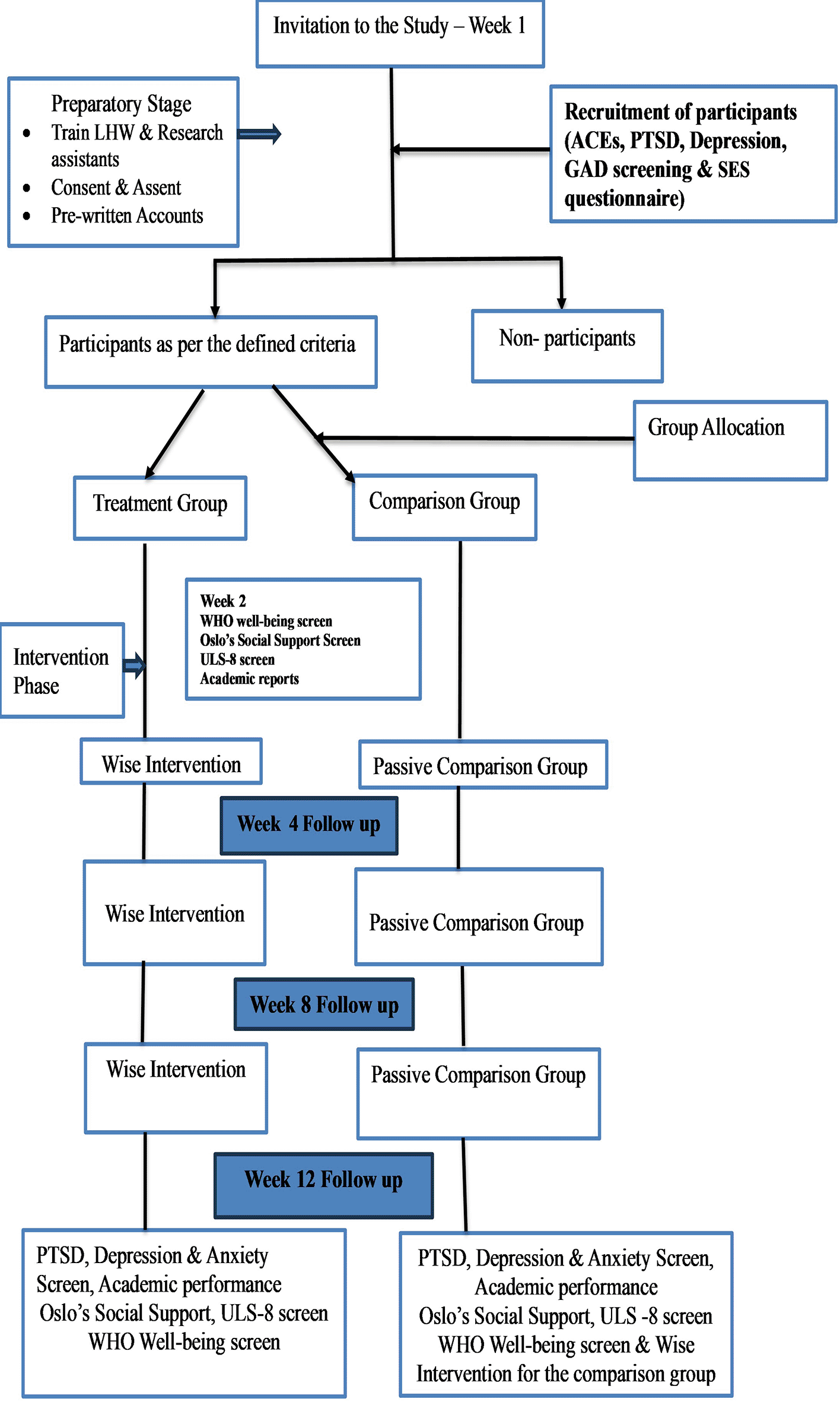
Post-tests will include the CPSS-5 SR, the PHQ-A, the GAD-7, the WHO-5 Well-being, the ULS-8 loneliness, and the OSSS-3 scales; and academic reports for both groups obtained one month post intervention. The intervention will be administered to the comparison group before closure of the study so the group benefits. Table 1 shows the schedule of study visits and activities and Figure 1 shows the flowchart for the recruitment and follow-up processes.
Data storage and security
Data will be in the form of filled out questionnaires and these will be stored in labelled files for the respective schools under lock and key. Data will be cleaned, coded and entered into EpiData Entry version 3.1, then exported to IBM SPSS Statistics version 29 for analysis. This will be saved in a laptop that will be accessible to the researcher and the statistician once entered, then backed up in iCloud.
Data analysis techniques
All tools except the Oslo Social Support-3 scale have been validated in the Kenyan context and will be tested pre-intervention. Reliability will be assessed using Cronbach’s alpha, targeting ≥0.7 internal consistency. Normality testing and skew kurtosis analysis will precede testing for assumptions of multiple linear regression. Missing data will be imputed with the k-Nearest Neighbours algorithm. Descriptive statistics will include frequencies, percentages, and measures of central tendency for sociodemographic characteristics, ACE scores, and Oslo social support. The chi-square test will be utilized to analyze differences in ACE category distributions by gender and PTSD, depression, and GAD scores in the treatment and control groups. Cohen’s d will evaluate the effect of the intervention on academic performance, general well-being and loneliness, with an expected effect size of 0.5. Inferential statistics will evaluate the relationships between the intervention, academic performance, general well-being and loneliness using a significance level of p-value 0.05 and confidence interval set at 95%. Multiple linear regression models will assess the strength of these associations while controlling for ACEs and social demographic characteristics as moderating variables, and Oslo’s social support as a mediating variable. High R-squared values will indicate stronger associations. Paired t-tests will assess symptom reduction in PTSD, depression, and anxiety between treatment and comparison groups across beginning point and endpoint assessments.
Dissemination
The results of the study will be presented at the University of Nairobi’s Department of Psychiatry, and a summary report will be done for the Ministry of Education, the Ministry of Health and the school administrations. The findings will also be presented at scientific conferences and published in peer-reviewed journals and shared with the National Commission for Science, Technology, and Innovation (NACOSTI) and the University of Nairobi library and repository.
Study status
Recruitment of study participants and data collection began on 13th October 2025. Data collection is ongoing and is planned to be concluded on 31stAugust 2026, with results anticipated by October 2026.
Adolescents in sub-Saharan Africa experience a significant prevalence of ACEs and mental health disorders which often remaining undiagnosed. This study seeks to enhance care through the social belonging wise intervention that is expected to give better academic outcomes, improve general well-being, reduce loneliness and symptoms of PTSD, depression and GAD. Culturally relevant concepts of belonging will be integrated into school environments and findings will inform policymakers on the prevalence of ACEs among Kenyan high school adolescents. The outcomes will guide the development of ACEs prevention and management policies and improve adolescent mental health care systems. The data gathered will support resource allocation, increase awareness of effects of ACEs on youth mental health disorders, and promote mental health discussions in schools, ultimately supporting counselling programs. The research also will set the groundwork for future interventions aimed at reducing the mental health disorder burden associated with ACEs in Kenyan youth.
In conclusion, the study is particularly valuable in a LMIC context where adolescents face a significant burden of ACEs and MHDs amidst challenges in accessing mental health care.
The limitations are overestimation of the effect size since there is no randomization and thus there will be need to control for confounding variables to improve internal validity. A second limitation is selection bias which will be reduced by selecting a comparison group that has similar characteristics to the treatment group. Thirdly, since the study will be carried out in two high schools, the results will not be generalizable to all Kenyan high school students.
Ethical approval was obtained from the Kenyatta National Hospital – University of Nairobi) Ethics and Research Committee (KNH-UoN ERC P59/02/2024) dated 26.06.2024, and NACOSTI issued a permit. In accordance with the Declaration of Helsinki, only participants who give written consent will be included in the study.
| Views | Downloads | |
|---|---|---|
| F1000Research | - | - |
|
PubMed Central
Data from PMC are received and updated monthly.
|
- | - |
Provide sufficient details of any financial or non-financial competing interests to enable users to assess whether your comments might lead a reasonable person to question your impartiality. Consider the following examples, but note that this is not an exhaustive list:
Sign up for content alerts and receive a weekly or monthly email with all newly published articles
Already registered? Sign in
The email address should be the one you originally registered with F1000.
You registered with F1000 via Google, so we cannot reset your password.
To sign in, please click here.
If you still need help with your Google account password, please click here.
You registered with F1000 via Facebook, so we cannot reset your password.
To sign in, please click here.
If you still need help with your Facebook account password, please click here.
If your email address is registered with us, we will email you instructions to reset your password.
If you think you should have received this email but it has not arrived, please check your spam filters and/or contact for further assistance.

Comments on this article Comments (0)