Keywords
Domination theory, Fairness in networks, Wireless sensor networks, Turiyam graph, equitable domination

Domination theory, Fairness in networks, Wireless sensor networks, Turiyam graph, equitable domination
The idea of uncertainty in real-world systems was first addressed by L.A. Zadeh in 1965 through the introduction of fuzzy set theory.1 In graph theory, the representation of fuzzy graphs and several fuzzy analogues of connectivity were later introduced by Rosenfeld.2 The study of dominating sets in graphs began with the works of Berge and Ore,3 while paired domination was initiated by Teresa et al.4 V.R. Kulli further expanded the theory by developing the concept of domination in graphs.5 Cockayne6 was the first to define the independent domination number in graphs, and Swaminathan and Dharmalingam7 introduced the concept of equitable domination.
A. Meenakshi contributed significantly to the field by developing and analyzing paired equitable domination8 as well as inflated graphs and their counterparts.9,10 Strong and weak domination in fuzzy graphs were defined and studied by Nagoor Gani and M. Basher Ahmed.11 K.T. Atanassov introduced intuitionistic fuzzy relations and intuitionistic fuzzy graphs (IFGs),12 while Shannon and Atanassov,13 along with M.G. Karunambigai et al., 14 identified IFGs as a specific class of fuzzy graphs. Additionally, strong and weak domination in fuzzy graphs were investigated by Jayalakshmi and Harinarayanan.22 The terms “order,” “degree,” and “magnitude” in IFGs were established by Shajitha Begum and A. Nagoor Gani.15 Domination in split intuitionistic fuzzy graphs was introduced by S. Anu Priya and A. Nagoor Gani,16 and Dombi fuzzy graphs were later examined by the same researcher.17 Equitable domination in neutrosophic graphs was developed by A. Meenakshi and J. Senbagamalar.18 Further advancements in Turiyam theory including Turiyam relations, Turiyam graphs, and their applications were proposed by Ganati G.A.19–21 Domination and paired domination in Turiyam graphs were subsequently developed by Erana A.G., Srinivasa Rao Repalle V.N., and Agama F.T.23
In this study, we construct and analyze the equitable domination parameter in Turiyam graphs using strong arcs. The motivation for our work arises from the existing research on domination and equitable domination in Turiyam graphs, as well as applications involving strong arcs. The split domination work in intuitionistic fuzzy graphs found in16 primarily focused on vertex and edge cardinality; in contrast, our study extends the investigation to equitable domination in Turiyam graphs, aiming to determine the optimal degree, size, and order of their vertices. Inspired by the concepts of weak and strong domination in fuzzy graphs,13 we further explore both strong and weak equitable domination in Turiyam graphs using the score function.
11 If is finite vertex set of such that;
11If and }. Then, an arc ( ) is a strong arc.
11 The degree of a node in an IFG, is the sum of the weights of strength arcs incident at and Neighborhood of . Additionally, is the smallest degree of , and is the greatest degree of .
11 Node in an IFG, is an isolated node if and
11 If there is a strength of arc between and , we say that dominates in where . A subset is a dominance set in if for each , there is dominates .
4 Let be a generic element and a point space. One neutrosophic collection with values (SVNS) is specified by , and .
For each point in , , and A SVNS,
: , , .
4 Consider the sets and on a set be single valued neutrosophic set. If is a SVN relation on then, }.
, and for all in .
4 If , , of of the neutrosophic graph then, an arc of is strong where and .
4,24 Let u be a node in a NSG, . The degree of a node is represented by deg ( ), which is the total weight of the strong arcs that incident at that node. is a strong arc} represents the neighborhood of .
is the smallest degree of and is the maximum degree of .
25 If there is at least one that dominates for each , then the subset is considered a dominance set. The symbol represents the dominance number, which is the minimum dominating set’s cardinality.
25 If no appropriate subset of is a dominance set of , then the dominance set of is a minimum.
Assume u is a node in . The degree of a node is explained as the total weight of the powerful arcs that occurred at and is represented by deg ( ). The neighbourhood , is a strong arc, and is the smallest degree of and is the greatest degree of .
The subset of is an overwhelming set which is symbolized as , if there is at least one that dominates for each .
The dominance set of is minimum, if no proper subset of is an overwhelming of .
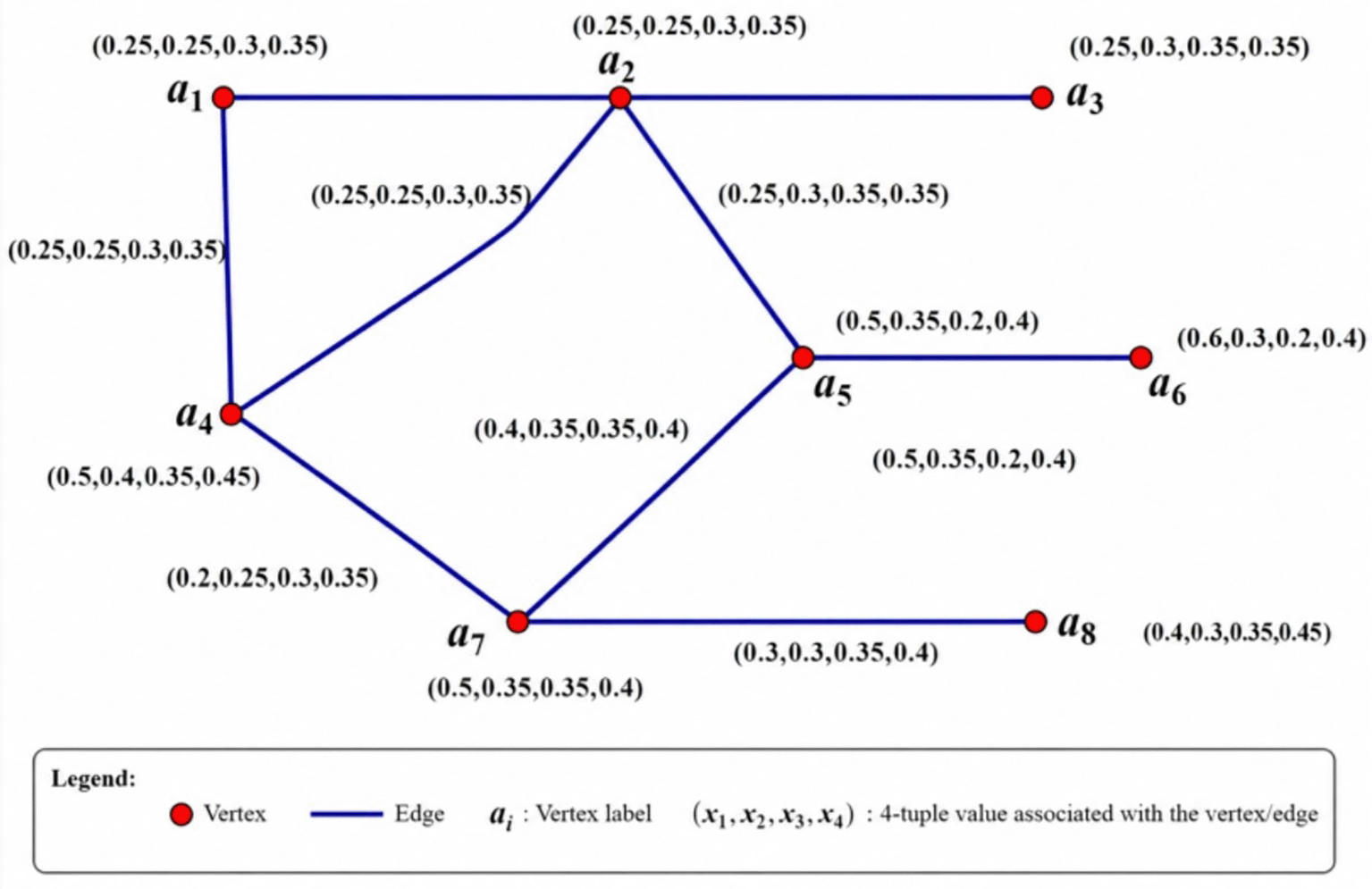
Let be shown in Figure 1.
From Figure 1, the arcs and are not strong arcs. The degrees of the vertices are given as follows:
Hence, the smallest truth, indeterminacy, falsity, and liberal membership values of are:
Therefore, the minimum degree of is
Similarly, the greatest truth, indeterminacy, falsity, and liberal membership values of are:
Thus, the maximum degree of is
is minimal. If and only if one of the following criteria is met for each , where is Turiyam dominance set.
Proof: Assume that a vertex of does not satisfy any of the previously mentioned requirements. As a result, for each node . Additionally, will be a minimal and overpowering of , which is contrary to the assumption, if is not an isolate in , according to condition (ii).
A dominance set is a subset of , where . Then, there are two nodes such that at least one vertex of is present in every path.
Presume that is a dominant set of G. Since each vertex in is dominated by at least one vertex of , there is a path that comprises at least one vertex of .
The dominant set has fewer vertices than since , where is the number of nodes in the strong arc. This is demonstrated by taking to be a of order . Additionally, by the concept of , the maximum truth values membership of among all nodes of and , Furthermore, we verify the others for falsity membership, indeterminacy membership, and liberal membership as follows:
Let be a Turiyam graph. A dominating set is called an equitable dominating set if for every vertex , there exists a vertex such that
The equitable domination number of , denoted by is the minimum cardinality of an equitable dominating set in .
Let be a Turiyam graph. An equitable dominating set is said to be minimum if no proper subset of is an equitable dominating set of .
Let be with and let we have arcs , , which are weak arcs and their degrees can be given as, deg ,
Let Now, consider the set .
For each vertex , there exists a vertex such that:
Indeed:
Let be a Turiyam graph and let be a balanced equitable dominating set. Then is a minimum equitable dominating set if and only if every vertex satisfies at least one of the following conditions:
1. There exists a vertex such that is the only vertex in adjacent to , that is,
2. The vertex is isolated within the induced subgraph on , i.e.,
(⇒) Assume that is a minimum equitable dominating set.
Suppose to the contrary, that there exists a vertex which does not satisfy either of the stated conditions. Then:
is not the unique neighbor of any vertex in , meaning every such vertex dominated by is also dominated by another vertex in ; and
is not isolated in the induced subgraph , so it has at least one neighbor within .
These observations imply that removing from does not affect the domination of vertices outside the set and does not disrupt the internal structure required for equitable domination. Hence, the set would still be an equitable dominating set. This contradicts the minimality of . Therefore, every vertex in must satisfy at least one of the given conditions.
(⇐) Conversely, assume that every vertex satisfies at least one of the conditions.
Suppose that is not minimum. Then there exists a proper subset that is also an equitable dominating set. This means there exists a vertex such that .
We consider two cases:
i. If uniquely dominates some vertex , then removing leaves undominated, contradicting the assumption that is a dominating set.
ii. If is isolated in , then it does not share its role with other vertices in . Removing it would violate the conditions required for equitable domination.
In both cases, a contradiction arises. Therefore, no proper subset of can be an equitable dominating set. Hence, is a minimum equitable dominating set if and only if every vertex in satisfies at least one of the stated conditions.
Let be a Turiyam graph. Then the domination number of is less than or equal to its equitable domination number, that is,
Let be a minimum equitable dominating set of . Then,
Since every equitable dominating set is also a dominating set, it satisfies all domination requirements along with additional equitable conditions. Therefore, is also a dominating set of . However, it may not be the smallest dominating set, and let be a minimum dominating set of , so that Since is the smallest among all dominating sets, we must have Hence,
Consider the diagram below and let be the shown in the below Figure 2.
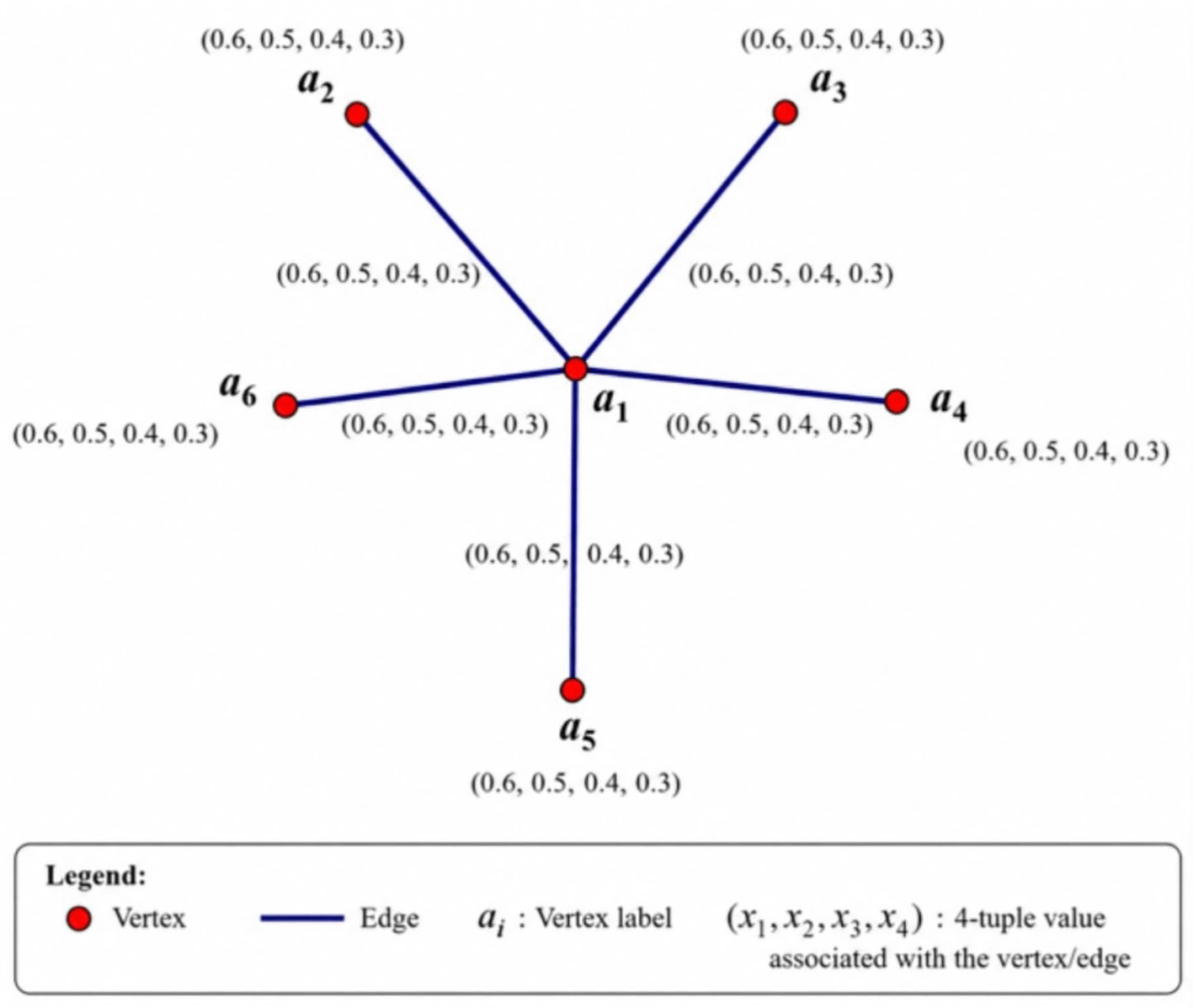
As we have seen from Figure 2, above all arcs are strength arcs and the only possible balanced dominance set is , since for each = 2, 3, 4 & 5.
Let be a Turiyam graph and let be an equitable dominating set. Then there exist two vertices such that every path between and contains at least one vertex from .
Assume that is an equitable dominating set of . Suppose, for contradiction, that for every pair of vertices , there exists at least one path between and that does not contain any vertex from . This means that the subgraph induced by is path-connected, i.e., all vertices outside the dominating set are connected without involving any vertex from . Now consider any vertex . Since is a dominating set, there exists a vertex such that is adjacent to .
However, due to the assumed connectivity of , the vertices outside are sufficiently interconnected. This implies that the domination provided by some vertices in may become redundant, and it may be possible to remove at least one vertex from while still maintaining domination. This contradicts the defining property of an equitable dominating set, which requires a structured and balanced domination across the graph. Therefore, our assumption is false.
Hence, there must exist at least one pair of vertices such that every path between them contains at least one vertex of .
Let be a Turiyam graph of order . Then the equitable domination number of satisfies the following bounds:
Let be a Turiyam graph with , and let be a vertex such that its degree attains the maximum in one of the components, say .
By definition, is adjacent to at least vertices (with respect to the -component). Consider the set where denotes the neighborhood of .Then:
Thus, the set forms a dominating set of . Now observe that: Since the equitable domination number is defined as the minimum cardinality among all equitable dominating sets, we obtain Using the same argument for the other degree components , , and , we similarly obtain:
It is more challenging to handle the concepts of strong and weak domination in Turiyam graphs because the degree of edge membership values is determined by the membership values of the incident vertices. To address this issue, which is analogous to the concept of strong and weak equitable domination, we employ an edge cardinality score function for each edge and a vertex cardinality score function for every vertex. In a Turiyam graph, the existence of both strong and weak equitable domination is determined by the degree of the Turiyam graph.
Let be a Turiyam graph. The node score function and edge score function of are defined as follows:
The degree of the vertex , denoted by , is defined as the sum of the scores of all strong arcs incident to . That is, where denotes the edge score function of the arc . The neighborhood of , denoted by , is defined as
The minimum degree and maximum degree of are defined, respectively, as
The order of is the sum of the score function of node cardinality of each vertex and is represented by . The size of is the total of the score of the function of edge cardinality of each edge.
Consider the Turiyam graph . If and is a member of the equitable dominance set, we say that is extremely equitable and predominates for any .
Take the Turiyam graph into consideration. For each , we say that weakly equitable dominates if deg deg is a member of the equitable dominance set.
If there is at least one such that is extremely equitable and predominates for each , then the dominance set of of a Turiyam graph is a strong equitable dominance set. As the minimum cardinality of a strong equitable dominating set, a strong equitable domination number is denoted as .
If there is at least one such that weakly equitable dominates for each , then a dominance set of of a Turiyam graph is a weak equitable dominance set. A weak equitable dominance number, denoted as , is the minimal cardinality of a weak equitable dominance set.
For every Turiyam graph , , or
Let: be a minimum strong edge-dominating TG set of , so .
Step 1: Relationship between strong and weak conditions
By definition: Every strong edge-dominating TG set satisfies stricter conditions than a weak edge-dominating TG set and hence, any set that is strong edge-dominating is also weak edge-dominating.
Therefore,
Step 2: Minimality argument
Since is a weak edge-dominating TG set, but not necessarily minimum for the weak case, we compare it with the minimum weak set.
Let: be a minimum weak edge-dominating TG set, so . By minimality of ,
Step 3: Substitute parameters . Thus, for every Turiyam graph ,
Let be a Turiyam graph. Since , where nodes in a strong arc are represented by , but an equitable dominant set has fewer vertices than . Additionally, according to the concept of minimal strong equitable dominance set and the maximum truth membership values of among all of the nodes of , we have . Similarly, we prove .
Follows from the above theorem
Proof: Let be a Turiyam graph and its strong equitable dominance number be .
Hence, . Similarly, .
In networks (such as communication, computer, social, or sensor networks), domination in Turiyam graphs is used to identify a minimal set of key nodes (dominators) that can efficiently monitor, control, or provide service to the rest of the network. Turiyam domination accounts for uncertain, indeterminate, and contradictory relations in networks (extending neutrosophic graphs). Equitable Turiyam domination adds a fairness criterion: all dominator nodes must cover nearly equal numbers of neighbors, balancing workload or service responsibility.
3.3.1 Communication Networks (Wi-Fi/LAN)
Turiyam domination: Selects the minimal number of access points (APs) so every device is within range of at least one AP, even if some connections are uncertain or fluctuating. While Equitable Turiyam domination: Ensures that no AP is overloaded; each AP covers approximately the same number of devices, preventing bottlenecks.
At a university campus, APs are installed in three buildings.
➢ Turiyam domination identifies two APs sufficient to cover the whole campus.
➢ Equitable domination redistributes load so each AP serves ~20–25 students instead of one AP covering 40 while another covers 5.
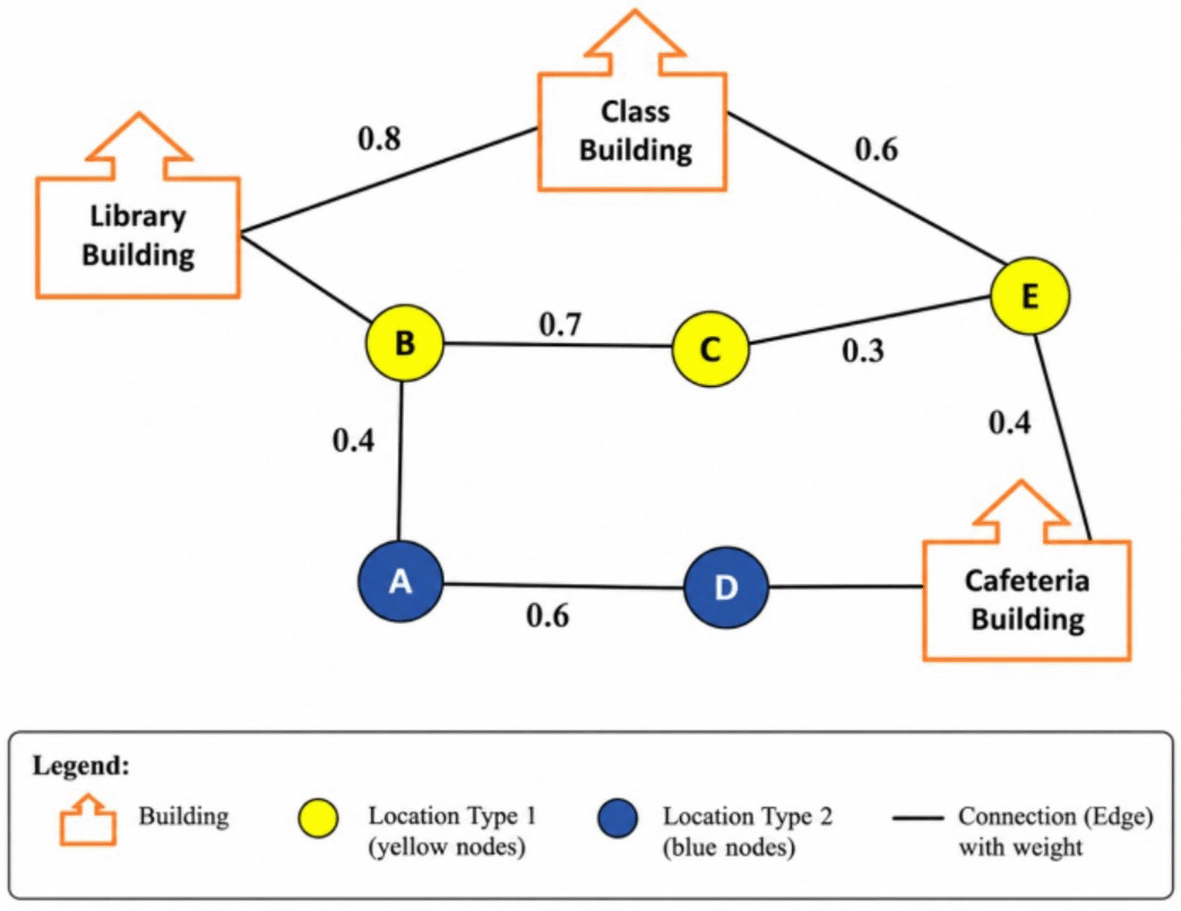
Key Insight: From the Table 1 and example , we understand that Turiyam domination is about efficiency (minimize resources) and Equitable Turiyam domination is about efficiency + fairness (minimize resources while balancing service). Both are critical: first ensures coverage, second ensures sustainability. Now by considering the below Figure 3, as a network connection between different buildings we can apply equitable dominating Turiyam graph as follows:
Figure 3 shows that a campus with three buildings and five network nodes A, B, C, D and E. Each node represents a device (Ap, hub or logical controller). Edges are labeled with weights between 0 and 1(these are the link “truth”/reliability values). The two blue nodes A and D are highlighted as the chosen equitable dominating set; they jointly cover the network while keeping the load roughly balanced between them. As represented in diagram above;
Building (icons): Spatial anchors (library, class and cafeteria buildings) useful for mapping nodes to physical region.
Blue Nodes (A, D): The dominators in the diagram (selected controllers).
Yellow Nodes (B, C, E): Regular/client nodes that need coverage.
Edge labels (numbers like 0.8, 0.6, 0.4, 0.7, 0.3 …), link reliability/truth membership between node and closer 1 which is more reliable link.
Turiyam nodes value (not drawn in the picture) and each node also have four Turiyam components (t, i, f and l). To get domination strength we need to combine node and edge values.
A node dominates a node if the combined reliability of (its truth) and the link is high enough. In Turiyam graphs we account for uncertainty and refusal. So, we typically compute scholar domination strength and compare it to a threshold . If , then effectively covers . Equitable domination requires that the numbers of nodes assigned to each dominator be nearly equal (most formal definition: difference ). This avoids overloading a single controller and spreading responsibility more fairly. In diagram A and D were chosen because their coverage responsibilities are roughly balanced given the link strengths shown.
To compute domination strengths;
Node ’s truth/reliability, link reliability between and (edge label on diagram)
: Node falsity and liberal/refusal (reduce effective domination)
If the diagram show edge labeled and if node has then, . If we use a threshold that value means dominates . If it would not. Also, we can use the same computation for every ordered pair that has a non-zero link to form the domination matrix.
Now to verify as equitable dominating set we use the following algorithms:
Step 1: Pick a threshold
Decide how conservative we want coverage to be (example is moderate, is permissive).
Step 2: Assemble Turiyam inputs
If we already have node (t, i, f, l) values from measurement) and we read link from the diagram’s edge/label’s
Step 3: Compute for each pair use the formula above that yields a numeric matrix (rows dominators, column targets).
Step 4: Build coverage sets . For each candidate dominator list which nodes it reliably covers at .
Step 5: Check domination (Coverage union)
A proposed dominating set (here is valid if
Step 6: Check equitability
Compute coverage size . For a simple check assign each covered node to the dominator with the highest.
Step 7: Refine if needed
If {A, D} covers everything but is not equitable, try adding equitable a third dominator (e.g C or B) or lowering/raising depending on your priorities (fairness versus fewer dominators).
Summary of the diagram
Node is located near the library building and has medium-strength links to nodes and . It likely covers ( , and possibly ) at a moderate . Node is located near the cafeteria building and connects to nodes , , and . It likely covers ( , and possibly and ) at a moderate . Together, nodes and are positioned so that the union of their high-confidence coverage reaches all five nodes. Because each serve approximately half of the clients covering the left/central clients and covering the right/central clients-the workload is balanced. This balanced distribution reflects the equitable property demonstrated in the picture.
3.3.2 Equitable Domination in Social Networks
A Turiyam Graph model’s social networks more realistically than classical or even neutrosophic graphs, because it represents truth indeterminacy ( , falsity ( and latent components of relationships. Each connection (friendship, influence, or communication) between two individuals is defined as: , Where:
: Strength or reliability of connection (e.g., consistent interaction).
: Uncertainty in the relationship (e.g., inconsistent communication).
: Contradiction (e.g., misinformation, conflict).
: Latent potential (e.g., shared background or unseen similarity).
In a social network, a dominating set ( ) is a group of leaders or influencers who can reach or influence all members of the network. A Turiyam dominating set accounts for uncertainty in connections, selecting minimal influencers under varying levels of trust or indeterminacy. An equitable dominating set (EDS) ensures that influence responsibility is fairly distributed, and no single leader dominates excessively or becomes overburdened.
Formally: for all . Meaning, each influencer reaches approximately the same number of followers with similar influence strength.
Consider the Scenario -Online Student Community
Setting: A university has a student social media platform connecting students across departments. There are five main representatives or leaders:
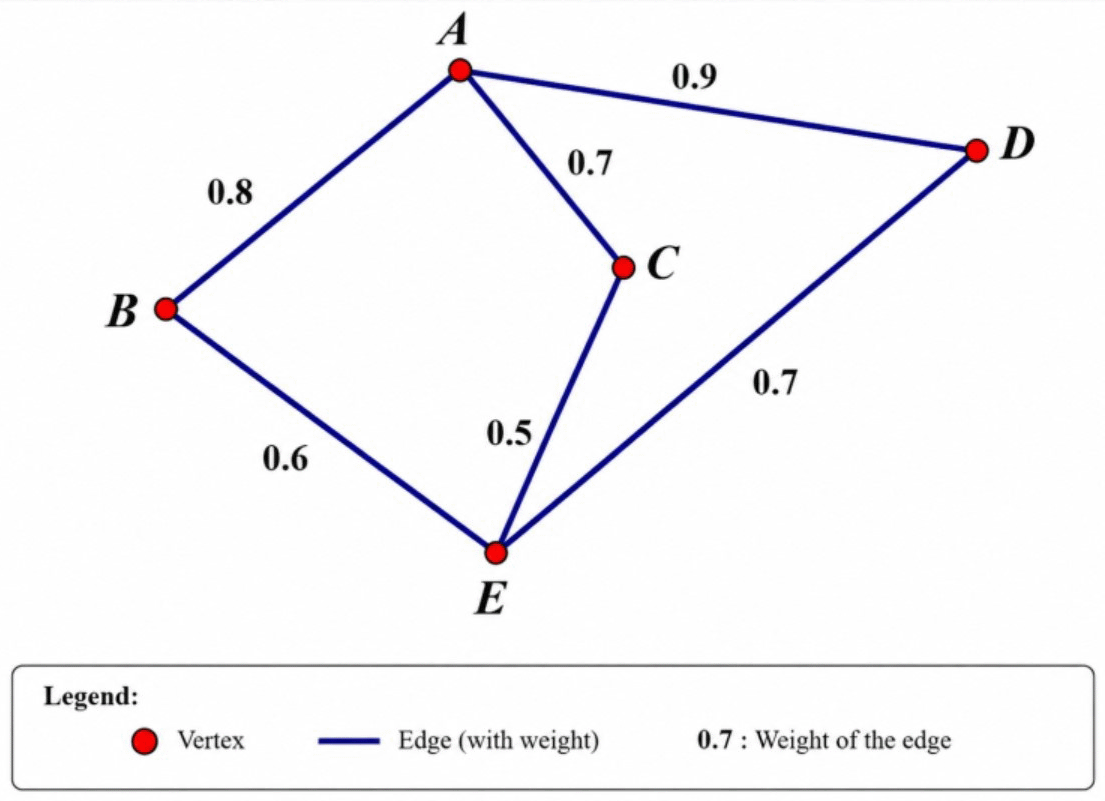
A (Admin), B (Tech Club Head), C (Sports Leader), D (Cultural Club Head), and E (General Member). Their influence strengths vary due to student interests, department ties, and posting frequency. Consider the diagram below to illustrate the example.
From Figure 4, we have the weights between each edge vary from one another and it indicates the relationship between everyone. These relationships can also be represented as Table 2.
| Edge | Description | |
|---|---|---|
| Strong admin-tech coordination | ||
| Moderate link via events | ||
| Very strong link | ||
| Medium student engagement | ||
| Weak indirect link | ||
| Cultural connection strong |
From Table 2, we observe that A and D have very strong links, and we can see the domination and its equitable domination analysis step by step:
Step 1: Domination . Nodes dominate others if and
dominates , dominates , dominates , is dominated by , and only dominated by . Hence, dominating set = {A, D} (all nodes covered).
Step 2: Check Equity
Being dominator has influenced members which count 3, and dominator has influenced members which count 2. Therefore, the difference → Equitable domination achieved. In this community network; Admin (A) and Cultural Leader (D) form an equitable dominating pair. Both cover complementary subgroups: technical, sports, and cultural clusters. Their influence load differs only by one node which means fair, sustainable community leadership. The benefits of this domination include, preventing one leader (Admin) from overloading communication tasks, each subgroup (sports, tech, and culture) is equally represented, and balanced influence promotes fair participation and diversity. Additionally, Turiyam graph is superior here because of; It models uncertain, fuzzy, and contradictory social ties, Latent factors (L) represent potential friendships or shared goals not yet active and Equitable domination ensures information diffusion fairness even under uncertainty.
The mathematical intuition of Example can be explained by the domination strength from to .
Equitable domination optimizes the set such that; Max min , ensuring balanced influence across all dominators.
Real-world applications of equitable domination in Turiyam graphs are simplified and presented in Table 3. From Figure 4 and Table 3, the model of Turiyam graph captures truth, uncertainty, falsity, latent potential and its goal is balanced social influence via equitable domination to reduced overload, increased fairness and better engagement. The network shows student leaders forming balanced influencer coverage and the result impact on sustainable and inclusive community communication.
The concept of equitable dominance in Turiyam graphs offers a powerful framework for analyzing and designing real-world networks under conditions of uncertainty, contradiction, and partial truth. Unlike classical domination, which focuses solely on minimizing the number of dominators, equitable domination ensures that the responsibility of domination is fairly balanced across the selected nodes. Overall, equitable domination in Turiyam graphs represents a next-generation approach to network optimization-ensuring coverage, fairness, and sustainability simultaneously. It bridges theoretical graph models with practical engineering needs, making it particularly valuable for modern complex systems where both efficiency and equity are essential.
| Views | Downloads | |
|---|---|---|
| F1000Research | - | - |
|
PubMed Central
Data from PMC are received and updated monthly.
|
- | - |
Provide sufficient details of any financial or non-financial competing interests to enable users to assess whether your comments might lead a reasonable person to question your impartiality. Consider the following examples, but note that this is not an exhaustive list:
Sign up for content alerts and receive a weekly or monthly email with all newly published articles
Already registered? Sign in
The email address should be the one you originally registered with F1000.
You registered with F1000 via Google, so we cannot reset your password.
To sign in, please click here.
If you still need help with your Google account password, please click here.
You registered with F1000 via Facebook, so we cannot reset your password.
To sign in, please click here.
If you still need help with your Facebook account password, please click here.
If your email address is registered with us, we will email you instructions to reset your password.
If you think you should have received this email but it has not arrived, please check your spam filters and/or contact for further assistance.

Comments on this article Comments (0)