Keywords
Boundary Value Problem, Dirichlet boundary conditions, Neumann boundary conditions, Absolutely stability, Diagonally Implicit Runge-Kutta Nyström (DIRKN), Linear Shooting Technique, Second-Order Ordinary Differential Equation.

This article is included in the Fallujah Multidisciplinary Science and Innovation gateway.
Boundary Value Problem, Dirichlet boundary conditions, Neumann boundary conditions, Absolutely stability, Diagonally Implicit Runge-Kutta Nyström (DIRKN), Linear Shooting Technique, Second-Order Ordinary Differential Equation.
Numerous methodologies have been developed to numerically address the two-point BVPs associated with special second order ODEs that take the following form:
With boundary conditions:
Where are real numbers
One type of special second order ODEs (1) is a linear which have the from:
Where are continuous functions on the interval .
Two-point boundary value problems are prevalent in various applications, including the modeling of chemical reactions, boundary layer theory pertinent to fluid mechanics, and theories associated with heat transfer, among others. These problems can be articulated through various forms of boundary conditions, such as Dirichlet, Neumann, or mixed types, contingent on the defined boundary conditions. The Dirichlet boundary condition, recognized as the most extensively employed, has been examined by several researchers, including Hamid et al.1 and Mohamad.2 Furthermore, Liu3 investigates the Neumann-type boundary value problems.
The shooting method is employed to transform the BVP into two IVPs, where the shooting method is defined to find up the missing initial value, condition until the argument boundary conditions with respect to the other end reaches it’s valid values.17 Shooting method has been employed by Ha4 to solve BVPs. A two-point BVP has been studied in various applied fields. For solving numerically such problems, shooting methods5,6,18 are the most popular. Shooting methods are useful in that it enjoys advantages like fast solver and small system size; however, it is time-consuming in obtaining a reasonable approximation, especially for nonlinear problems.7
The class of DIRKN methods has been extensively studied in the context of initial value problems (IVPs). For example, Sommeijer,19 Van der Houwen et al.,20 Imoni et al.,14 Sharp et al.,21 Senu et al.,15 Papageorgiou et al.,22 and Medvedev et al.23 developed and analyzed various DIRKN schemes for IVPs, while explicit RKN approaches were considered by Zanariah Abdul Majid et al.18 In fact, a substantial body of literature focuses on DIRKN methods for IVPs (see, e.g.,11–13). However, their direct application to boundary value problems (BVPs) has received far less attention. In most studies, second-order BVPs are first transformed into equivalent first-order systems before applying numerical schemes, which increases the system size and may obscure the physical meaning of the variables.
To address this gap, one of the main objectives of this paper is to construct new high-order DIRKN schemes that solve Equation (1) directly in its second-order form under the boundary conditions (2)–(3), without conversion to a first-order system. This approach not only reduces computational cost but also preserves the structure of the original problem. Here we highlight the major contributions and findings of this article as follows:
• Derivation of high-order DIRKN schemes: construction of DIRKN(3,4) (third-stage, fourth-order) and DIRKN(4,5) (fourth-stage, fifth-order) with coefficients chosen to satisfy the order conditions and minimize the leading global truncation error.
• Use of linear shooting to handle boundary conditions (2)–(3) in the native second-order form.
• Absolute-stability analysis of the proposed DIRKN schemes.
• Implementation the proposed methods in applications.
To achieve the above objectives, in Sections 2 and 3, the materials and methods are addressed, respectively. Section 4 presents the numerical results, while the final section 5 provides a discussion and conclusions drawn from the study.
The RKN method, originally proposed by Nyström (1925), is a class of methods for solving second-order IVPs. The diagonally implicit version (DIRKN) is particularly attractive due to its efficiency and stability, and its coefficients are commonly represented in a Butcher tableau ( Table 1).
The DIRKN scheme tailored for special second-order IVPs is outlined as follows:
m is the number of stages and the parameters are the coefficients of the method such that , and in DIRKN coefficients and all entries of A are equal.16
The order conditions of an m-stage RKN method up to the six orders were introduced in reference9 as follows:
for
Shooting method works in three steps8:
1. The given BVP is transformed in two IVPs in the same order.
2. Solution of these two IVPs can be found by any technique.
3. The solution to the given boundary value problem can be expressed as a linear combination of the two solutions provided.
Let represent the singular solution to the IVP10:
(Non-homogeneous IVP)
Let as the singular solution to the IVP:
(Homogeneous IVP).
By setting C1 = 1, the resultant solution y(t) in Equation (30) aligns with the specified boundary conditions.
Either, boundary condition Type I (2) the linear combination
Imposing the boundary condition in (31) produces
Therefore, if , the distinct solution for the boundary value problem (1) which expressed by:
Or, for boundary condition Type II the linear combination
Therefore, if , the distinct solution for the boundary value problem (1) which expressed by:
In studying the linear stability of DIRKN methods, we apply the scalar test equation
Setting and multiplying (37) by , then (36) and (37) becomes:
Introducing the functions
Then the characteristic equation corresponding to the difference Equation (41) is of the form:
The roots and of (42) determine the behavior of the solution.
(Absolute-stability interval on the negative real axis)14: For a DIRKN method with stability matrix (41), an interval is called the absolute stability interval of the characteristic Equation (42) if, for all we have , where is the (largest) stability threshold on the negative real axis for the method.
In this subsection, the coefficients of DIRKN (3,4) are derived by using the order conditions up to fourth order for y and . As a result, a system of eight nonlinear equations with thirteen unknown variables is obtained. These equations are derived from the algebraic order conditions (7)–(9) and (15)–(19), by impose and solve these equations by using solve command in Maple software, we get the values of . According to Dormand,10 the free parameters are selected by minimizing the global truncation error for the fifth-order conditions of y and y′ by using Maple where:
is the global truncation error and , and are the local truncation error terms which gives from the Equations (10)-(11) and (20)-(22) of the RKN method for y, and y’, respectively. We get:
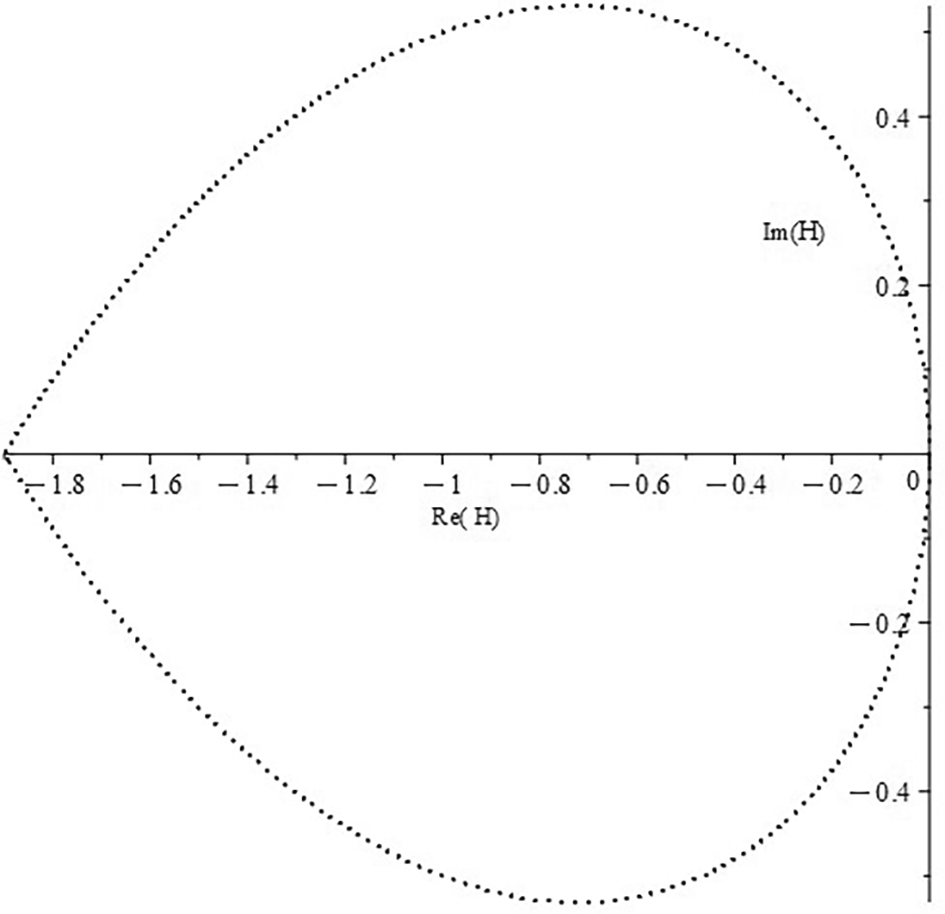
We obtained . Lastly, all the coefficients of the DIRKN(3,4) are written in Table 2. The stability interval (which show in the subsection 2.4) of the new DIRKN(3,4) is approximately (−1.964,0) while the stability region show in Figure 1 show the of the proposed method in Im(H) - Re(H) plane is determined by substituting in the characteristic Equation (42) with 1, -1 and for . The wider stability interval indicate that larger step sizes can be taken without loss of stability.
| 0.211 | 0.12 | 0 | 0 |
| 0.789 | 0 | 0.12 | 0 |
| 0.789 | 0.0307 | -0.0772 | 0.12 |
| 0.394 | 0.106 | 0 | |
| 0.5 | 0 | 0.5 |
In the same way, the coefficients of DIRKN (4,5) were derived, but fifth-order equations were used, which affects the number of variables and the number of equations. Thirteen nonlinear equations have obtained with nineteen unknown variables. By impose and solve the Equations (7)-(11) and (15)-(22). The free parameters are selected by reducing the error in Equations (12)-(14) and (23)-(27). We get;
and all the coefficients of the DIRKN(4,5) are written in Table 3.
| 0 | 1 | 0 | 0 | 0 |
| -0.970 | 0 | 1 | 0 | 0 |
| 0.845 | -1.88 | 1 | 1 | 0 |
| 0.355 | 0.63 | -0.736 | -0.85 | 1 |
| 0.111 | 0 | 0.058 | 0.330 | |
| 0.111 | 0 | 0.376 | 0.512 |
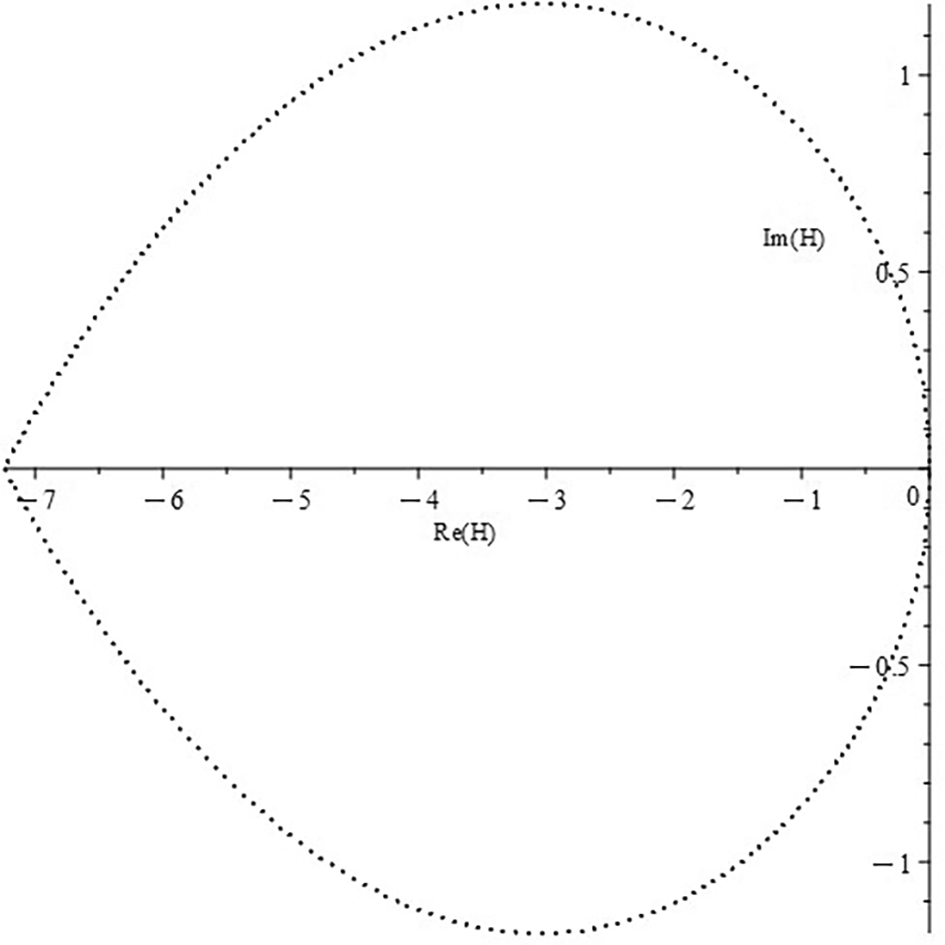
The stability interval of the new DIRKN(4,5) is approximately (−7.244,0) and Figure 2 show the stability region of the proposed method in Im(H) - Re(H) plane.
approximate solution BVP (1) with boundary conditions (2) or (3)
INPUT: Parameters α, β1, β2 boundary conditions; endpoints a, b; number of subintervals N; coefficients of suggestion DIRKN method the vectors b, , c, and the matrix A.
OUTPUT: Numerical solution at for all
Step 1: Initialization
set
Set
Set
Step 2: Solve IVPs (28)- (29) via DIRKN (5a)- (6)
for do Step 3 and Step 4
Step 3: Set
Use fsolve in Maple command to solve above implicit equation to find
Use fsolve in Maple command to solve above implicit equation to find
Step 4: Apply Boundary Conditions
if Type I
then
if Type II
then
Step 5: Output Solution
Output
Step 6: The process is complete
In this part, a suggested DIRKN (3,4) and DIRKN (4,5) approaches was utilized to address ODEs (1) with (2) or (3) boundary conditions. The method had been applied on fourth problems, The first two problems are used conditions of Type I (2) and the last second problems are used conditions of Type II (3). For comparison purpose, the numerical results are compared by the function calls and maximum errors between exact and numerical solution measurements by a proposed methods with the three previous studies. The Tables 4 and 5 utilize the subsequent notations:
• h: Step size.
• N: Number of partitions of interval.
• FC: Number of function Call.
• Max.Error: Max which the maximum absolute errors between exact solutions and proposed numerical solutions .
• DIRKN (3,4): 3-stage 4-order DIRKN which was proposed in this paper.
• DIRKN (4,5): 4-stage 5-order DIRKN which was proposed in this paper.
• RKN (3,4) H: The 3-stage 4-order RKN derived by Hairer et al.21
• RKN (3,4) G: The 3-stage 4-order was developed by Garcia et al.22
• TSRKN(3,4)A: The 3-stage 4-order two-step explicit RKN method derived by Abdulsalam et al.24
(Application Problem – Rod Heat Conduction Model)25:
Suppose a slender rod of length L, with the temperature at the location x = 0 fixed at , while the opposite end at x = L is thermally insulated. It is assumed that the rod possesses a cross-sectional area that remains constant and is denoted as M, and that its perimeter is represented by p. The temperature u of the rod at a generic position x within the interval (0, L) is expressed as:
Exact solution: where and assume that the rod’s length is L = 100 cm and that the rod has a circular cross-section of radius 2 cm (and thus, M = 4π , p = 4π cm). Also set C and .
(Application Problem - the Reaction-Diffusion Model)26:
Consider a homogeneous one-dimensional medium of length L = 1, where y(x) denotes the steady concentration (or temperature) at position . The process includes linear diffusion together with a constant reaction rate
Exact solution:
Non homogonous linear BVPs of type I1:
To further illustrate the effectiveness and performance of the proposed methodologies, we present the efficiency curves for DIRKN(3,4) and DIRKN(4,5) in comparison other established methods.
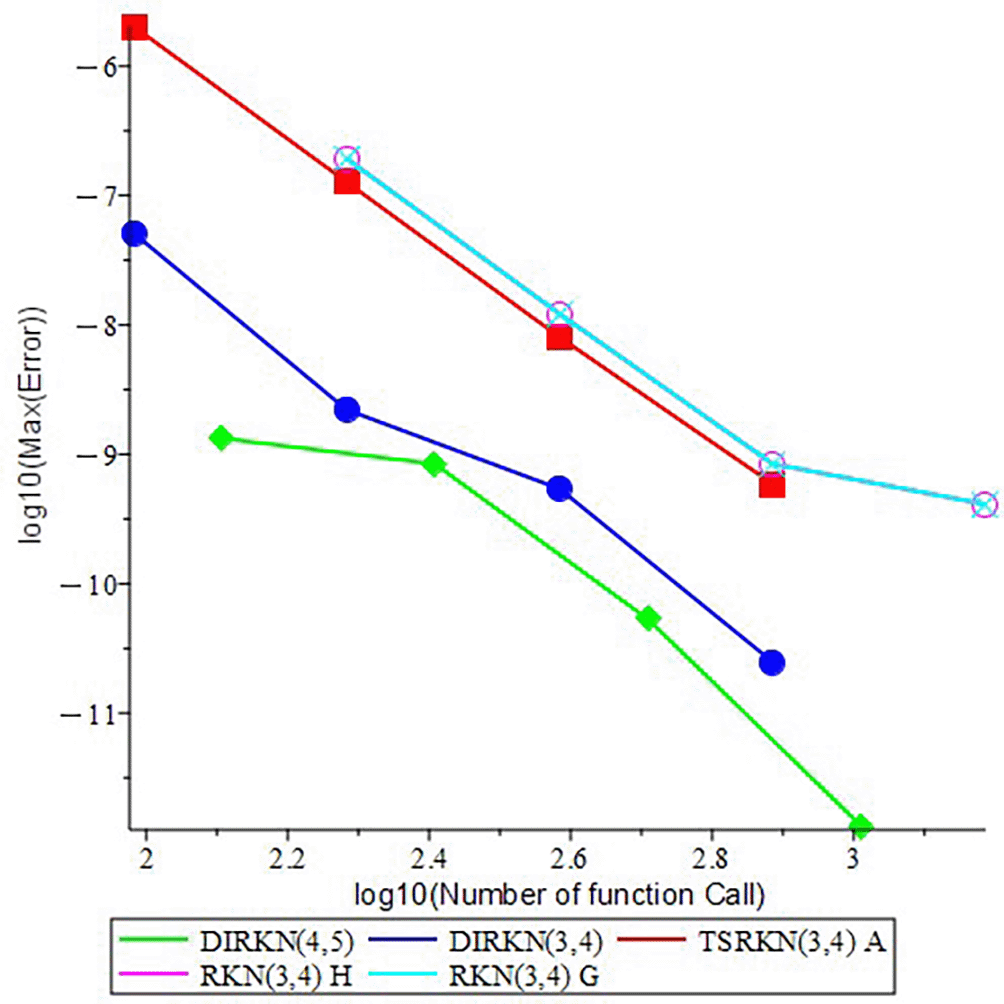
Figures 3-6 display the efficiency curves corresponding to the problems (1)-(4) that have been analyzed, respectively.
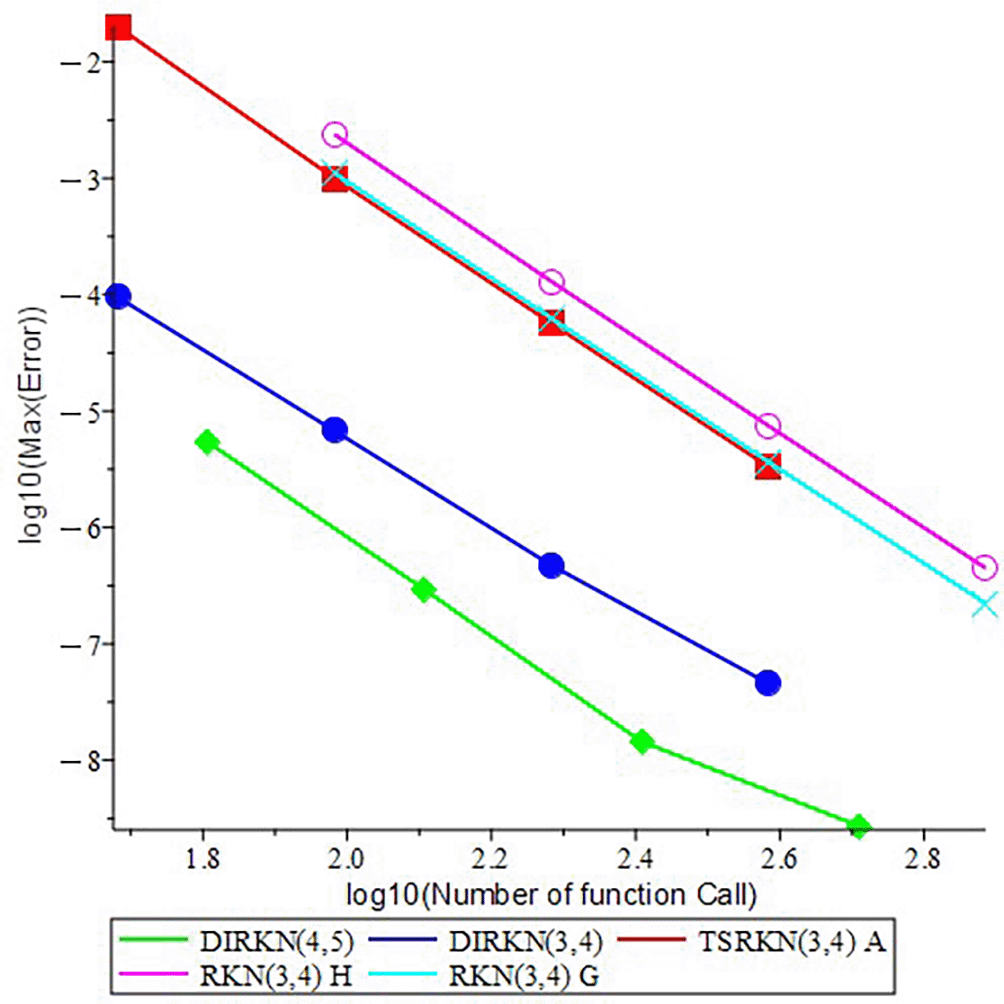
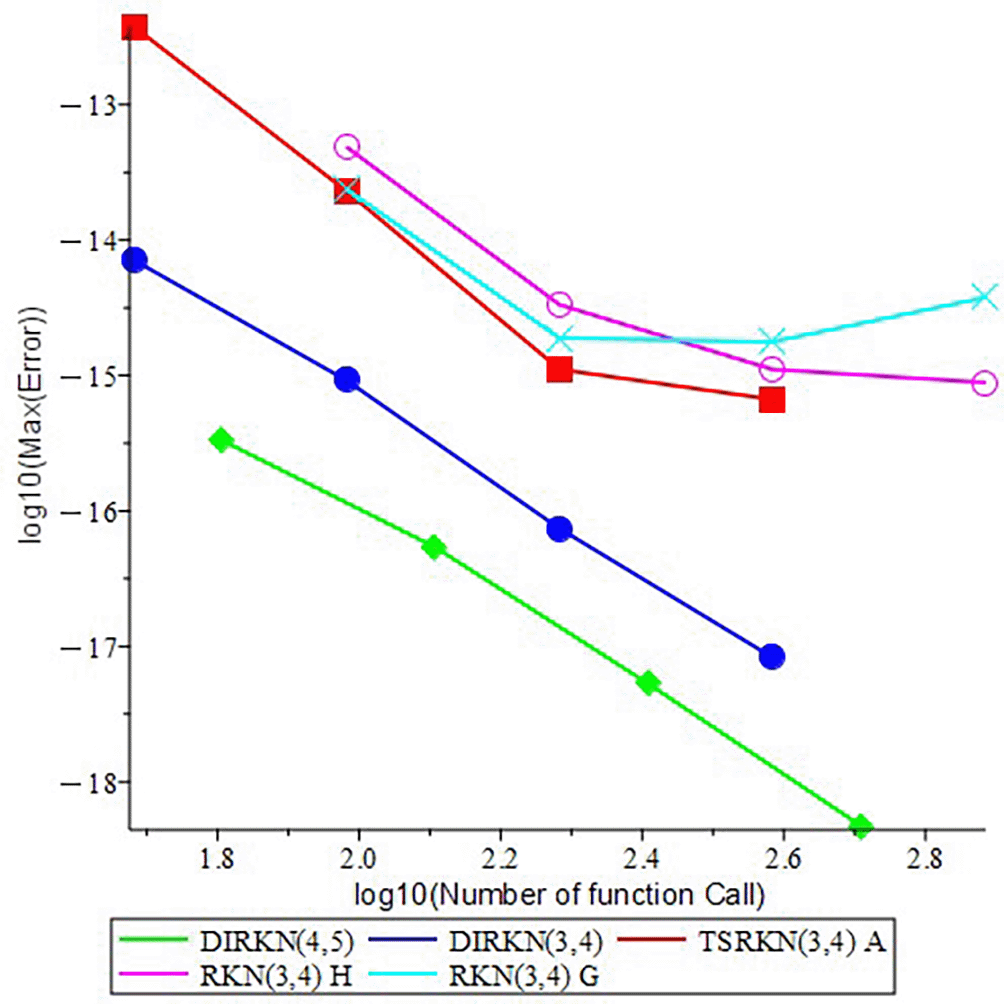
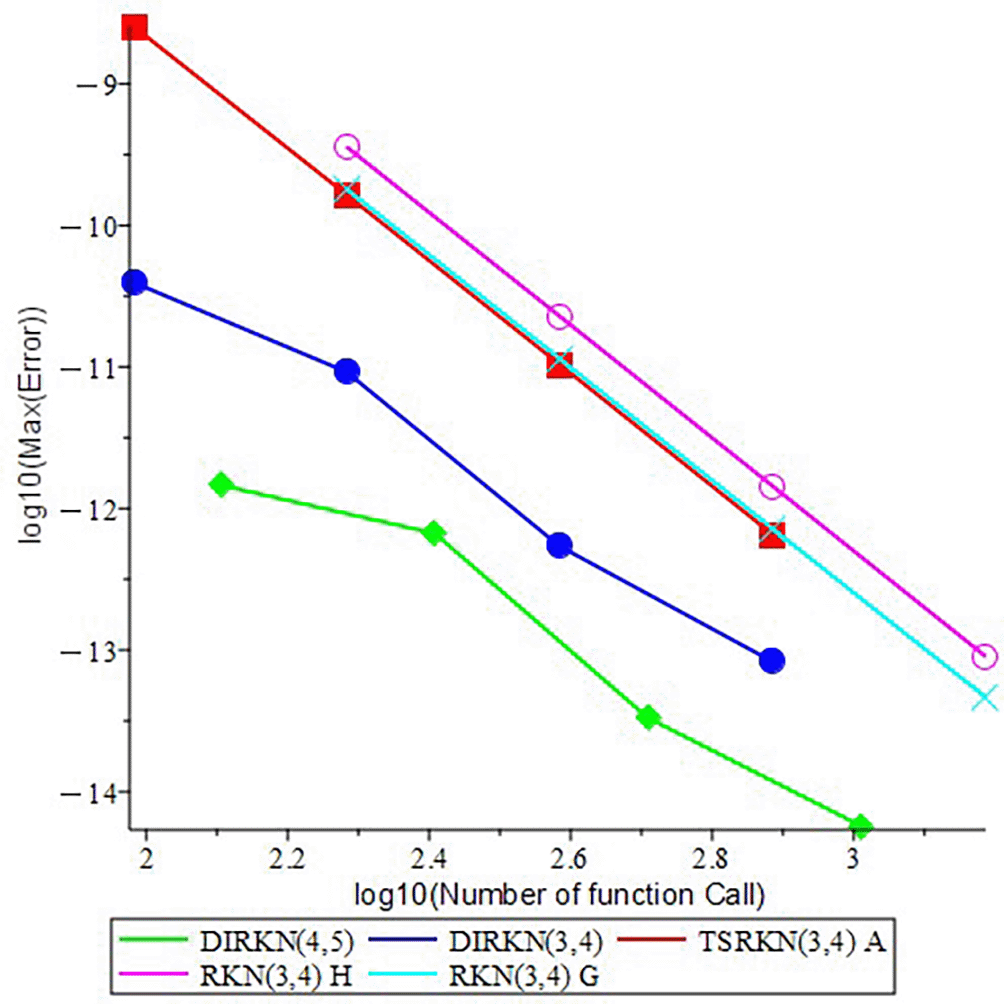
• Accuracy of numerical results. For all Type I (problems 1-2) and Type II (problems 3-4) problems, both methods, DIRKN(3,4) and DIRKN(4,5), produce very small maximum errors (Max.Error). At the same number of partitions of interval N, DIRKN(4,5) is usually more accurate than DIRKN(3,4) and both is more accurate than TSRKN (3,4) A, RKN (3,4) H and RKN (3,4) G but TSRKN (3,4) A have a small N because it two step method.
• Efficiency (error vs. cost). Efficiency plots (Max.Error vs. FC in Figures 3-6) show that DIRKN(4,5) needs fewer function calls to reach a given accuracy than the reference. As the accuracy demand increases (smaller Max.Error), the gap becomes larger. Thus, DIRKN(3,4) and DIRKN(4,5) offers a better accuracy cost trade off.
• Linear stability and its impact. The absolute stability interval on the negative real axis is wider for DIRKN(4,5) than for DIRKN(3,4) ((-7.24, 0) vs. (-1.96, 0)). This helps in problems with oscillation or stiffness: we can take a larger step h while staying stable, so we keep accuracy with less cost. This agrees with the efficiency results.
• Robustness for both boundary types and application models. On application models heat conduction in a rod (problem 1) and reaction–diffusion (problem 2), the methods preserve high accuracy under Type II conditions and match the exact solutions closely. Solving the BVP in its second-order form (without converting to a first-order system) keeps the physical structure and reduces the system size.
• Shooting strategy. The experiments use linear shooting because the problems are linear. This approach is simple and effective. Parallel shooting methods were not employed since all test problems are linear and can be efficiently solved using linear shooting. However, extending the proposed DIRKN schemes with parallel shooting will be an interesting direction for future research, particularly for nonlinear or stiff problems.
We constructed DIRKN(3,4) and DIRKN(4,5) schemes for second-order linear BVPs and chose coefficients to satisfy the order conditions and reduce the leading global truncation error. On Type I and Type II tests, both methods show high accuracy and good stability. In most cases, DIRKN(4,5) gives the lowest Max.Error for the same N (or the same FC). The wider stability interval of DIRKN(4,5) explains its practical advantage on oscillatory or stiff problems: we can keep stability with larger h, which improves efficiency. Working directly with the second-order form avoids increasing the dimension and keeps a clear physical meaning of the variables. Overall, the proposed DIRKN methods are reliable and efficient tools for linear second-order BVPs with conditions (2) or (3).The present study was restricted to linear BVPs. Extending the proposed DIRKN methods to nonlinear problems will be considered in future work.
| Views | Downloads | |
|---|---|---|
| F1000Research | - | - |
|
PubMed Central
Data from PMC are received and updated monthly.
|
- | - |
Provide sufficient details of any financial or non-financial competing interests to enable users to assess whether your comments might lead a reasonable person to question your impartiality. Consider the following examples, but note that this is not an exhaustive list:
Sign up for content alerts and receive a weekly or monthly email with all newly published articles
Already registered? Sign in
The email address should be the one you originally registered with F1000.
You registered with F1000 via Google, so we cannot reset your password.
To sign in, please click here.
If you still need help with your Google account password, please click here.
You registered with F1000 via Facebook, so we cannot reset your password.
To sign in, please click here.
If you still need help with your Facebook account password, please click here.
If your email address is registered with us, we will email you instructions to reset your password.
If you think you should have received this email but it has not arrived, please check your spam filters and/or contact for further assistance.

Comments on this article Comments (0)