Keywords
sleep, post-stroke insomnia, stroke, insomnia, Asian.

sleep, post-stroke insomnia, stroke, insomnia, Asian.
Post-stroke insomnia (PSI) is a common problem around the world. The prevalence rate ranges from 35% to 43% from the acute to the chronic phase.1,2 Stroke patients with insomnia have a higher risk of developing cognitive impairment3 and reduced health-related quality of life.4,5 Researchers and clinicians are now paying high attention to managing the insomnia problem.
Previously, two studies investigating the global prevalence of PSI using a meta-analytic design have been published.1,2 One meta-analysis, involving 22 studies on insomnia, found the prevalence to be 38.2%.1 The updated meta-analysis, which included 28 studies, suggested a prevalence rate of 39.7%.2 However, most of the included studies were derived from Western populations. Adding evidence by investigating the PSI prevalence among Eastern populations is important.
As a note, gender plays a critical role in the prevalence of insomnia. Previous meta-analyses suggest that females are more prevalent than males in terms of insomnia in the general population in China.6 However, the effect of gender on PSI remains under research. Moreover, the available studies involved a small sample size.1,2 Hence, there is a need to conduct an updated study investigating the effect of gender on PSI and using a larger sample size. This study aims to investigate the effect of gender on the prevalence of PSI among stroke survivors using multicenter nationwide data.
The data utilized in this study were obtained from the 2018 Basic Health Research (Riset Kesehatan Dasar, RISKESDAS) conducted by the Indonesian Ministry of Health. The RISKESDAS survey is a thorough national evaluation conducted quinquennially to collect health-related data. The National Institute of Health Research and Development (NIHRD) administers it under the Ministry of Health in Indonesia. The survey was administered by enumerators possessing formal education in health, holding at least health diplomas. The enumerators performed face-to-face interviews utilizing validated questions for accuracy and dependability. Furthermore, they performed measurements and assessments during home visits, as outlined in the supplementary document issued by the Ministry of Health in Bahasa Indonesia (Kementerian Kesehatan, 2019). Members of each household (those residing on the premises for at least six months and sharing the same food income source) were solicited to partake in the survey. Health-related data on patients diagnosed with stroke was obtained from the 2018 RISKESDAS dataset.
We only considered participants who satisfied the requirements listed below in order to meet the inclusion criteria: 1) having received a stroke diagnosis in the past; and 2) having submitted the necessary information for the insomnia variable. Participants whose insomnia variable had missing values were not included in the study.
A question related to insomnia was examined: “In the past two weeks, have you experienced any sleep disturbances, such as difficulty initiating sleep, nocturnal awakenings, or early morning arousal?” The insomnia status was assumed if participants answered ‘yes’.
2.4.1 Sociodemographic variables
Sociodemographic characteristics encompassed age, gender, educational attainment, marriage status, occupation, and degree of urbanization. We classified educational attainment into three categories: ‘no formal education’ (0), ‘non-university level’ (1), and ‘university level’ (2). Marital status was classified as ‘single’ (0) or ‘married’ (1), and ‘widow or widower’ (2). Occupation status was categorized as ‘unemployed’ (0) and ‘employed’ (1), and urbanization level as ‘rural’ (0) and ‘urban’ (1).
2.4.2 Health and lifestyle behavior variables
In this research, we incorporated health conditions and lifestyle behaviors, including regular follow-up, comorbidities (such as cancer, asthma, cardiovascular disease, and chronic renal illness), vigorous and moderate physical activity, smoking status, and alcohol consumption.
The evaluation of regular follow-up for stroke was conducted using the subsequent inquiry: Has your stroke state been consistently monitored by a physician at the healthcare facility? the potential responses of “yes,” ‘sometimes,’ and ‘no.’
Comorbidities were identified based on the response (‘yes’ = 0 or ‘no’ = 1) to the question: ‘Have you received a diagnosis of (….) from a physician?’
Smoking status was assessed by the inquiries: ‘Are you a smoker?’ and ‘Have you smoked in the past month?’ Smoking status was classified as ‘non-smoker’ (code = 0), ‘occasional smoker’ (code = 1), and ‘daily smoker’ (code = 2).
Alcohol intake was evaluated by the inquiry: ‘Have you ingested alcohol in the past month?’ with response options of ‘yes’ and ‘no.’
Physical activity was evaluated utilizing the modified Global Physical Activity Questionnaire (GPAQ) from the World Health Organization for surveillance purposes. The GPAQ gathers data on physical activity in three areas: occupational or domestic activities, transportation, and leisure pursuits. All activities must have been conducted uninterrupted for a minimum of 10 minutes per week. Participants were requested to enumerate activities they typically engaged in daily, categorizing them as ‘yes’ for activities performed and ‘no’ for those not performed, for both vigorous and moderate physical activity. The assessment of GPAQ in Indonesia demonstrated satisfactory inter-rater reliability for categorical variables, with kappa values between 0.44 and 0.78, and test-retest reliability for continuous variables, with Spearman’s rho ranging from 0.45 to 0.80.7
Ethical approval for the original RISKESDAS 2018 data collection was granted by the Ethical Committee of Health Research, NIHRD, Ministry of Health, Republic of Indonesia (No. LB.02.01/2/KE.267/2017). Secondary analysis for the present study was approved by the Health Research Ethics Committee of the Faculty of Medicine, Universitas Halu Oleo (No. 62/UN29.20.2/ETIK/2025). Written informed consent was obtained from all participants in the original survey. As this study uses only de-identified secondary data, no additional consent was required.
Statistical analysis was conducted utilizing SPSS (Version 29, SPSS Inc., Chicago, IL, USA). Descriptive statistics were analyzed for demographic features and aggregated responses, encompassing the mean and standard deviation for continuous variables and percentages for categorical data. Subsequently, we performed analyses utilizing χ2 (Chi-square) for categorical variables and the Mann-Whitney U-test (given the data’s deviation from a normal distribution) for continuous variables to investigate the presence of gender disparities in sociodemographic characteristics, health conditions, and lifestyle behaviors.
Subsequently, forward and stepwise logistic regression analyses were conducted to examine the impact of sociodemographic variables, health problems, and lifestyle behaviors on stroke populations with and without insomnia, accounting for gender differences. Hosmer–Lemeshow goodness-of-fit tests were performed to evaluate the models’ alignment with the observed outcome. The alpha criterion for hypothesis testing was established at p < 0.05.
At the beginning, 713,783 individuals were screened for eligibility. Among them, 705,741 participants were excluded because they did not have a stroke diagnosis. Furthermore, 895 participants were excluded because they had missing values on the insomnia variable. The final analysis comprised 7,147 stroke participants ( Figure 1).
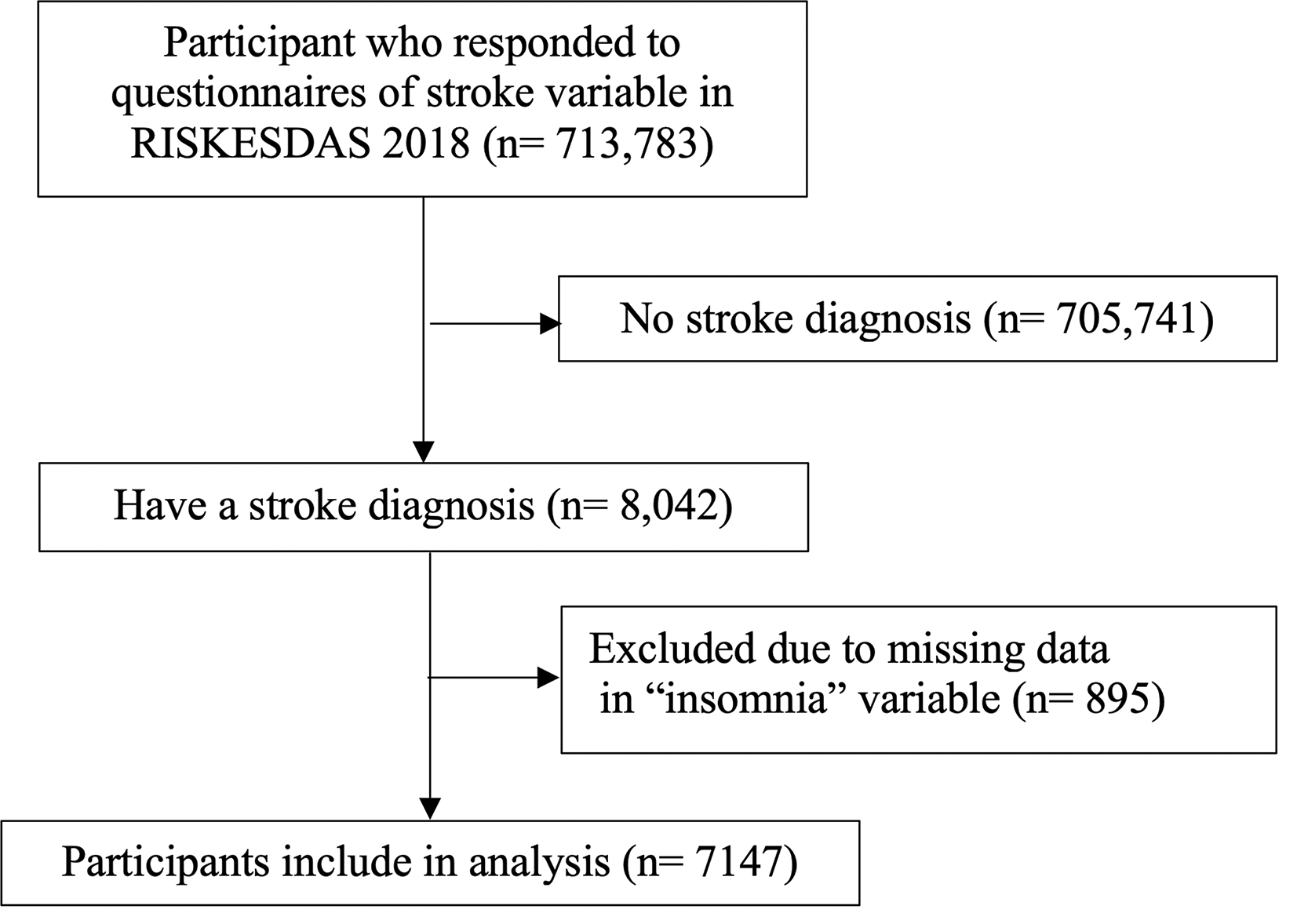
n = number of participants.
Table 1 presents a comparison of participants’ characteristics between males and females. The insomnia cohort exhibited a greater mean age than the non-insomnia cohort across both genders. Among males, educational attainment, work position, urbanization, consistent follow-up, and the presence of comorbidities such as cancer, heart disease, asthma, and participation in regular physical exercise exhibited significant differences between the insomnia and non-insomnia groups (all P < 0.05). Among females, educational attainment, marital status, and the occurrence of comorbidities such as cardiovascular disease and asthma exhibited significant differences between the insomnia and non-insomnia cohorts (all P < 0.05). Additional demographic information is available in Table 1 and Table 2.
| Male | p-value | Female | p-value | |||||||||
|---|---|---|---|---|---|---|---|---|---|---|---|---|
| Total | Insomnia | Non-insomnia | Insomnia | Non-insomnia | ||||||||
| Variables | n | (%) | n | (%) | n | (%) | n | (%) | n | (%) | ||
| 5366 | (100) | 653 | (24.6) | 2002 | (75.4) | 895 | (33) | 1816 | (67) | |||
| Regular follow-up, n (%) | 0.02 | 0.47 | ||||||||||
| No | 2821 | (39.5) | 228 | (24.5) | 534 | (20.2) | 268 | (21.8) | 470 | (20.1) | ||
| Sometime | 2826 | (39.5) | 348 | (37.3) | 1037 | (39.3) | 487 | (39.6) | 954 | (40.7) | ||
| Yes | 2821 | (39.5) | 356 | (38.2) | 1071 | (40.5) | 475 | (38.6) | 919 | (39.2) | ||
| Cancer, n (%) | 0.04 | 0.61 | ||||||||||
| No | 7099 | (99.3) | 924 | (99.1) | 2633 | (99.7) | 1218 | (99) | 2324 | (99.2) | ||
| Yes | 48 | (0.7) | 8 | (0.9) | 9 | (0.3) | 12 | (1) | 19 | (0.8) | ||
| Heart disease, n (%) | 0.04 | <0.001 | ||||||||||
| No | 6447 | (90.2) | 827 | (88.7) | 2403 | (91) | 1070 | (87) | 2147 | (91.6) | ||
| Yes | 700 | (9.8) | 105 | (11.3) | 239 | (9) | 160 | (13) | 196 | (8.4) | ||
| Asthma, n (%) | 0.03 | <0.001 | ||||||||||
| No | 6776 | (94.8) | 871 | (93.5) | 2517 | (95.3) | 1143 | (92.9) | 2245 | (95.8) | ||
| Yes | 371 | (5.2) | 61 | (6.5) | 125 | (4.7) | 87 | (7.1) | 98 | (4.2) | ||
| CKD, n (%) | 0.19 | 0.43 | ||||||||||
| No | 7010 | (98.1) | 909 | (97.5) | 2595 | (98.2) | 1210 | (98.4) | 2296 | (98) | ||
| Yes | 137 | (1.9) | 23 | (2.5) | 47 | (1.8) | 20 | (1.6) | 47 | (2) | ||
| Vigorous PA, n (%) | <0.01 | 0.95 | ||||||||||
| No | 6295 | (88.1) | 805 | (86.4) | 2177 | (82.4) | 1140 | (92.7) | 2173 | (92.7) | ||
| Yes | 852 | (11.9) | 127 | (13.6) | 465 | (17.6) | 90 | (7.3) | 170 | (7.3) | ||
| Moderate PA, n (%) | <0.001 | 0.13 | ||||||||||
| No | 3516 | (49.2) | 587 | (63) | 1384 | (52.4) | 553 | (45) | 992 | (42.3) | ||
| Yes | 3631 | (50.8) | 345 | (37) | 1258 | (47.6) | 677 | (55) | 1351 | (57.7) | ||
| Alcohol consumption, n (%) | 0.47 | 0.76† | ||||||||||
| No | 7014 | (98.1) | 897 | (96.2) | 2556 | (96.7) | 1227 | (99.8) | 2334 | (99.6) | ||
| Yes | 133 | (1.9) | 35 | (3.8) | 86 | (3.3) | 3 | (0.2) | 9 | (0.4) | ||
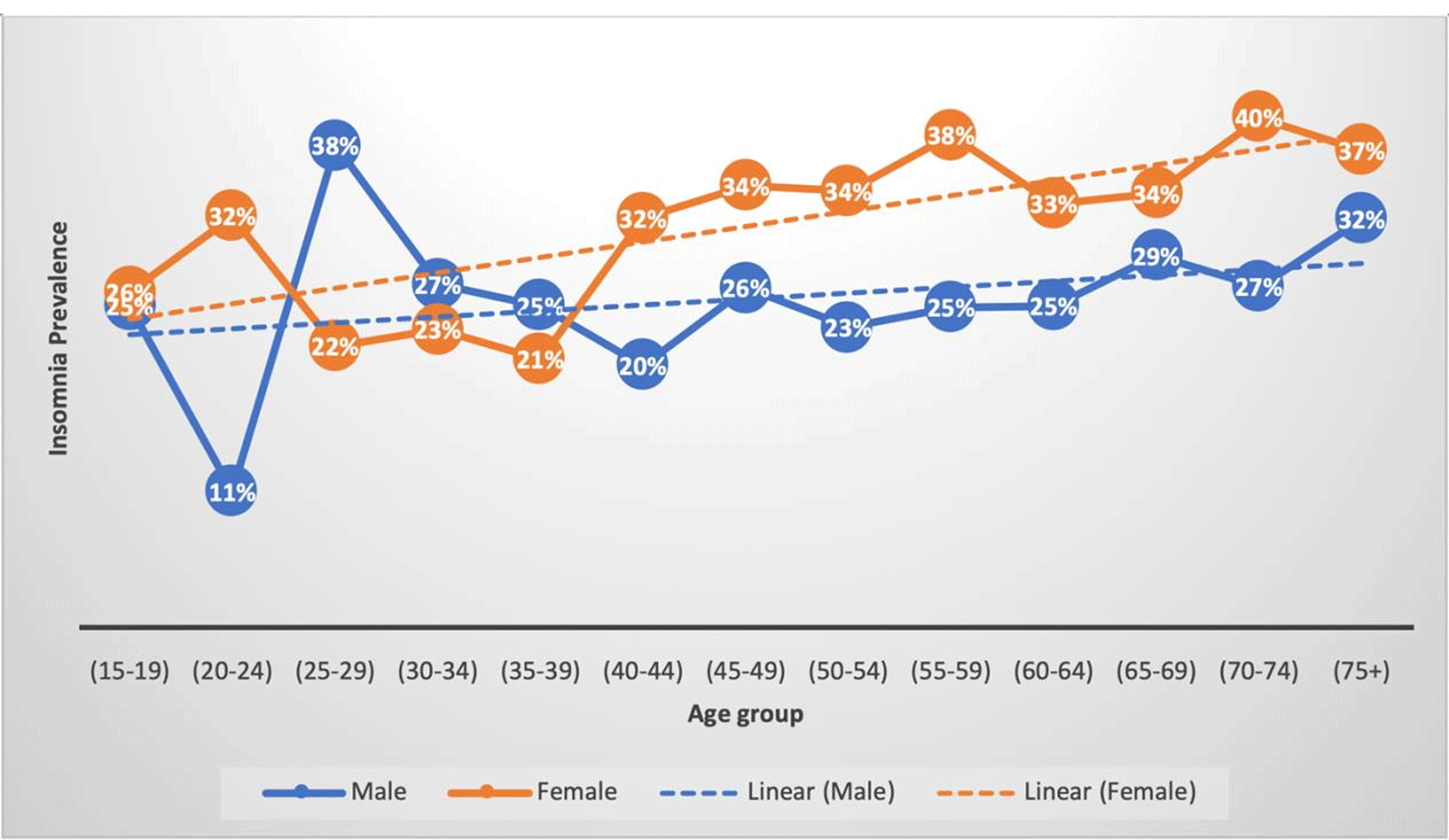
The overall prevalence of PSI among stroke survivors in Indonesia was 28.4%. Figure 2 depicts the comparative prevalence of PSI among males and females across different age groups. Our findings demonstrate that the incidence of insomnia increases with age. We grouped the age into 13 age groups, ranging from 15–19 years old to more than 75 years old. There is a trend of increasing prevalence in the male insomnia group, ranging from 25% to 32%. Similarly, we also find an increasing trend in insomnia prevalence for the female age group (26% to 37%). Overall, we found that females have a higher trend in PSI prevalence compared to males (25.6% vs 31.2%, respectively).
The univariate regression analyses are displayed in Table 3 and Table 4. Multivariate regression analyses are displayed in Table 5 and Table 6. Active smoking elevates the probability of insomnia development in comparison to non-smokers among subjects. Individuals with a greater educational attainment (university level) are less prone to developing insomnia. Individuals residing in urban environments are less prone to sleeplessness than those inhabiting rural regions. Individuals who partake in physical activity are less prone to developing insomnia. Female participants with comorbidities, including heart disease and asthma, exhibited a higher propensity for developing insomnia.
This study is the first to investigate the impact of gender on the prevalence of post-stroke irrationality (PSI) among stroke survivors in Indonesia, to the best of our knowledge. Our findings indicate that the overall prevalence of PSI remains high among the Indonesian population. It is worth noting that females have a higher prevalence of PSI than males. Our research should be considered credible due to the utilization of a substantial sample size and stringent methodology.
It is important to observe that the prevalence of insomnia following a stroke has increased over time. Females were found to have a higher increase in prevalence than males. Consistent with a previous study, increasing age was associated with the presence of insomnia.8 Moreover, females exhibited a greater prevalence of sleep disturbances than males among American adults.9 This indicates the necessity of improving sleep instruction uniformly across various genders.
The study reveals a prevalence of insomnia at 28.4%. This contrasts with previous meta-analyses that suggested the prevalence of PSI was between 35% and 43%.1,2 The disparity in insomnia prevalence arises from the variability in assessment methodologies; research employing standardized diagnoses reveal lower prevalence rates than those utilizing self-reported instruments.2,10 However, this present study has a higher estimation compared to previous work that used hospital-based data and found the PSI incidence to be 8.2% in Taiwan (using ICD codes).3 Early detection of insomnia using precise measurement scales is critical.
Although the mechanics underlying PSI remain undetermined, the putative mechanisms can be explained in part. The stroke’s site, including the right hemisphere, thalamus, or brainstem, is associated with PSI.11 Moreover, a confluence of environmental factors (e.g., hospitalization)12 and biological factors (e.g., heightened sympathetic activation, intermittent hypoxemia, oxidative stress, inflammatory processes leading to frequent arousals, and disrupted sleep-wake regulation) may exacerbate post-stroke insomnia.13
Interestingly, male participants engage in physical activity associated with fewer insomnia symptoms. A previous meta-analysis found that exercise may increase sleep quality.14 The results are also consistent with previous research indicating that exercise improves sleep quality across all age groups.15,16 Hence, we recommend regular exercise to improve sleep quality.
This study identifies a number of limitations. This dataset’s absence of objective data, such as polysomnographic information, may result in other sleep disorders being undiscovered or misinterpreted as insomnia. The failure to acquire pertinent confounders, including dietary details, environmental influences, and possible hypnotic usage, may compromise internal validity. This study possesses several strengths. The study population was selected from volunteers across Indonesia, assuring national representation. Secondly, each interviewer received training to comprehend the structure and methodology of the questionnaire.
In conclusion, the prevalence of PSI remains high over time among stroke survivors in Indonesia. Females have a higher prevalence of PSI compared to males. These preliminary findings provide crucial insights for healthcare providers and policymakers. Implementing early insomnia screening with accurate metrics is strongly advised.
Ethical approval for the original RISKESDAS 2018 data collection was granted by the Ethical Committee of Health Research, NIHRD, Ministry of Health, Republic of Indonesia (No. LB.02.01/2/KE.267/2017). Secondary analysis for the present study was approved by the Health Research Ethics Committee of the Faculty of Medicine, Universitas Halu Oleo (No. 62/UN29.20.2/ETIK/2025).
Written informed consent was obtained from all participants (or their legal guardians for minors or cognitively impaired individuals) during the original RISKESDAS 2018 data collection. As the present study involves only secondary analysis of de-identified, publicly available data, no additional informed consent was required.
| Views | Downloads | |
|---|---|---|
| F1000Research | - | - |
|
PubMed Central
Data from PMC are received and updated monthly.
|
- | - |
Provide sufficient details of any financial or non-financial competing interests to enable users to assess whether your comments might lead a reasonable person to question your impartiality. Consider the following examples, but note that this is not an exhaustive list:
Sign up for content alerts and receive a weekly or monthly email with all newly published articles
Already registered? Sign in
The email address should be the one you originally registered with F1000.
You registered with F1000 via Google, so we cannot reset your password.
To sign in, please click here.
If you still need help with your Google account password, please click here.
You registered with F1000 via Facebook, so we cannot reset your password.
To sign in, please click here.
If you still need help with your Facebook account password, please click here.
If your email address is registered with us, we will email you instructions to reset your password.
If you think you should have received this email but it has not arrived, please check your spam filters and/or contact for further assistance.

Comments on this article Comments (0)