Keywords
Cosmology, large-scale structure of universe, relativistic processes.

Cosmology, large-scale structure of universe, relativistic processes.
There are three main changes in this version. The pruning of a lot of repetitious text coupled with some attempted further clarification of the philosophy and mathematics behind the theory. A major change is the correction of the time v. radius relationship of the universe's expansion (Equation 30, Fig.7). Previous versions followed an incorrect path in going from the Hubble equation to its required integral. Finally the symbol for the universe's scale factor has been changed from "s" to "a" to bring it more into line with common usage.
See the author's detailed response to the review by Boudewijn F. Roukema
See the author's detailed response to the review by Jackson Levi Said
The success of the current theories of special (SR) and general relativity (GR) in describing localised phenomena, such as objects undergoing high speed motion, located in local gravitational fields or generating gravitational waves, needs no further elaboration. However, when applied to the evolution of the universe several problems arise which require either an additional model, e.g., inflation to account for the flatness or the horizon problems, or adjustments to coefficients and/or parameters to account for phenomena such as the universe’s late-time acceleration and the lack of observable mass to match the universe’s expansion1.
This paper is not intended as a detailed review of current cosmology and the reader is assumed conversant with the problems mentioned above, hence only the outlines of such problems will be discussed. The paper is intended as a test-of-concept investigation into whether the approach developed therein might be more fruitful in tackling some of these problems than that utilised by the Standard Cosmology Model (SCM). The ability to do so is assessed as being able to dispense with some or all of the theoretical additions needed by SCM while still providing the same standard of fit that SCM achieves to the observed expansion of the universe.
In exploring an approach which attempts to answer at least some of these cosmological problems, while still satisfying the basic postulates of relativity, it will be shown that it is possible to utilise the same Minkowski space-time metric when constructing a set of coordinates that produce an alternative overall structure of the universe. This set of coordinates is based on leaving aside any philosophical questions about what space and time “really” are and just concentrating on the phenomena that humans consider as providing realistic analogues of such phenomena, i.e., as discussed in the following section, changes in energy are considered to be analogues of changes in time (clocks) while a spatial dimensions can be considered as corresponding to a distribution in mass (rulers). It is these analogues that are used to provide quantifiable tests of relativistic theories and so are of prime importance in describing the universe. However, as also explored below, they also illustrate the problems of mixing time and space to provide the coordinate systems used to form the space-time of standard, or indeed any, theory of relativity.
When discussing coordinate systems, it will be argued that care must be taken over the definitions of what is directly observable and what can only be inferred. Changes in coordinates that occur in the observer’s present can be defined as direct observations. When transforming these changes into a dimension, we can define the resulting coordinates as being directly observed if they can be revisited and are able to have different actions carried out at their location. Inferred coordinates are those that are based on a location which can only be visited once. The former can be associated with spatial dimensions while the latter is associated with time. Any temporal dimension must be constructed from indirect observations such as the reliance on memory or artificial aids such as film. Current theories rely on such a construction to complete a four-dimensional space-time, which has been very successful but has some problems on a universal scale such as those outlined above. The alternative approach is discussed which assumes, for reasons explained below, that it is the energy and momentum of objects that are fundamental to their behaviour, and from which the time element of a four-dimensional space-time coordinate system can be inferred, rather than starting from a four-dimensional coordinate system against which the energy and momentum of objects can be measured. Such an approach using the Minkowski metric allows Cartesian coordinates to be transformed into an Euclidean form (see Equation (7)–Equation (11) below). The changes between coordinate systems will be discussed, and the consequences of such changes are explored.
Any modification of the current theory must still conform to both the observation that the speed of light (c) is a constant in all inertial frames, and to the principle that the laws of nature are the same in all inertial frames. It also must conform to the principle of consistency, i.e., any new theory has to account for the successful predictions of the Newtonian and relativistic theories that it attempts to modify.
When carrying out such modifications the alternate set of coordinates will be labelled as “Dynamic” to distinguish them from the Standard set of coordinates which are currently used. The transformation between the two sets of coordinates within a single frame of reference will be derived in the following sections.
Under the “Cosmology” section it will be shown that the simplest model of the universe that can be constructed using dynamic coordinates will create a surface of three spatial dimensions whose evolution is based entirely on SR. In this model gravitational effects are assumed to exist along this surface and are orthogonal to its expansion in the fourth dimension.
Since the resulting model of the universe does not account for gravity, it is not related to the Friedmann-Lemaître-Robertson-Walker (FLRW) models. However, its results can be compared to those from the FLRW Standard Cosmology Model (Figure 5–Figure 6) and the combined Friedmann equations (Figure 7), which are assumed by this paper to currently give the best fits to astronomical observations. Consequently, it will be argued that the fact that the dynamic theory gives a good fit to such models implies it also gives a good fit to the corresponding astronomical data without the paper being sidetracked into extensive explanations and attributions of this data. It should also be emphasised that the goodness of fit shown in the above figures is achieved without any recourse to either GR or the additional models and coefficients that make up the SCM.
To summarise, the paper is in two main parts, with both parts concentrating on using SR as the basis. The first part discusses a possible alternative way of expressing SR and how coordinates in space-time arising from this can be transformed into “Standard” coordinates (Equation 7–Equation 10a) within a given inertial frame. It also shows agreement between the two theories in the non-cosmological (or local) area which is required for the new (“Dynamic”) theory to have any validity, e.g. the Minkowski space-time is still retained (although mapped differently), while both the Lorentz transformation between inertial frames and the 4-momentum relationship are unchanged. The consequences of this approach are discussed and in the second main part (labelled “Cosmology”) are applied to give a simple model of the universe’s expansion (Equation 24, Equation 26 & Equation 30) in order to test this concept.
A possible area that could lead to more than one approach to producing an SR coordinate system arises with the need to include time as the equivalent of a spatial dimension in either of the theories (standard or dynamic) discussed in this paper. As stated in the Introduction, for the dynamic theory this paper leaves aside any philosophical questions about what space and time “really” are and just concentrates on the phenomena that humans consider as providing realistic analogues of such phenomena, i.e., as discussed below, changes in energy are considered to be analogues of changes in time (clocks) while a spatial dimension can be considered as corresponding to a distribution in mass (rulers). It is these analogues that are used to provide quantifiable tests of relativistic theories. They also illustrate the problems of mixing time and space to form the space-time of standard, or indeed any, theory of relativity.
Basically, relativistic effects are measured with a clock and a ruler. To state the obvious a ruler is composed of a distribution of matter which is taken to define a spatial dimension. For the purposes of relativistic measurements, the ruler is unchanging for an observer in the same inertial frame, i.e. the coordinates it provides along a spatial dimension are static within an inertial frame and any position on this ruler can be revisited at will (albeit at different times). In contrast a clock gives a continuous (and regular) conversion of potential into kinetic energy, which is able to do work on its surroundings, e.g. the release in energy from a clock spring to continuously move the clock’s hands, or the decay of radioactive material to activate a counter. This is intended to correspond to what an observer experiences as time, i.e. he is always trapped in the current moment in the sense that he can only influence or be influenced by events which happen in his present (memories of past events may be said to influence him, but can only do so in his present), but this moment is always changing*. Since the observer is always in his present, past events can only be accessed by memory or aids such as film. This access is of a different order to the interactions granted to events in the present. An observer can physically visit a spatial location many times and interact with what is happening at that location. The ability to physically interact with an event in time is restricted by the fact that a temporal location can only be physically visited once. Since the observer only exists in his changing present, temporal coordinates can only be inferred by integrating experiences of the changing present using memories or other recording devices. The ever-changing present has no real coordinate that can be directly observed in the sense of spatial coordinates, there are only directly observed changes in time - see definitions of observable and inferred events given in the Introduction... Hence from within an inertial frame no dimension can be directly observed in what can be assumed as the time direction. It can only be inferred.
Consequently, there are two routes that can be taken when attempting to mix space and time. The coordinate route of the standard theory keeps the spatial dimension unchanged while integrating the changing temporal view to give an inferred fourth dimension which is analogous to space. The dynamic view keeps time as an ever-changing entity but requires this to be linked to objects (including other observers) which have an ever-changing spatial position. Hence the dynamic view is based on energy and momentum while the coordinate view is based on dimensions.
Since the integral of the dynamic view will also give space-time coordinates (albeit artificially constructed), and since it has already been stated that, at least locally, the standard and dynamic theories must match for the dynamic view to have any validity, the next two sections show where the coordinates generated by the two theories coincide; where they diverge; the derivation of the dynamic metric, and the transformation between dynamic and standard coordinates within a single inertial frame.
To clarify which theory is being referred to in the following, the derivatives in the standard theory result from infinitesimal changes in intervals which are used to obtain the dimensional coordinates and can be used to construct trajectories. In this paper such changes are denoted by d(). In the dynamic theory D() are infinitesimal changes in coordinates which are derived from the magnitude of the change in energy experienced in the present (located in what can be constructed as the time direction - i.e., orthogonal to the spatial directions), and the momentum of objects in the spatial dimensions. These are changes along trajectories. Subscripts N and M denote any inertial frame, in contrast to A and B which usually have specified conditions such as which frame contains the observer and which the observed.
In the standard theory a single subscript is used to denote the frame in which the coordinates are located, e.g. dtA, dxB, see Equation (1) below. In the dynamic theory more than one subscript is used to describe the direct observation within a single frame (A in what follows) of how other frames appear relative to A’s measuring apparatus, e.g. two subscripts are used for time, DtAB, where the first subscript is the frame containing the observer and the second the frame in which the object being observed is located. For space there are three subscripts, e.g. DtACB where the first and third subscripts are as in the description for time, while the middle subscript is the frame in which the ruler is located against which the spatial motion is measured. In this example A is the observer, B is the object being observed relative to A’s space and C is the frame containing the ruler against which A measures B’s motion and again is relative to A’s space. Coordinates are transformed between dynamic and standard descriptions within a given frame by Equation (7), while both dynamic and standard coordinates are transformed between different frames by Lorentz transforms. The dynamic transform is given in Table 1 and the standard in Table 2 in the sections below.
| Column 1 | Column 2 |
|---|---|
| DxBBG = γ(DxAAG – vDtAA): | DxAAG = γ(DxBBG + vDtBB) |
| DtBB = γ(DtAA – v DxAAG/c2): | DtAA = γ(DtBB + v DxBBG/c2). |
| Column 1 | Column 2 |
|---|---|
| dxB = γ(dxA – vdtA): | dxA = γ(dxB – vdtB) |
| dtB = γ(dtA – v dxA/c2): | dtA = γ(dtB – v dxB/c2). |
Both theories must satisfy the condition that the speed of light is the same in all inertial frames.
For the standard dimensional coordinate theory, this leads to the Minkowski metric which provides the following Cartesian relationship between space and time
where A and B are inertial frames of reference, and dτ is defined as the proper time interval, i.e. it is time recorded by a clock which moves with the object of interest and is an invariant quantity. In this paper, for brevity - but without any loss of generality – the total component of spatial motion is usually assumed to be lying along the x axis. For photons dτ = 0.
In the dynamic theory several points must be considered.
The view of all inertial frames is always done from the present of an observer, and since both theories agree that there is no such thing as a universal present, the continuous changes are seen from a single viewpoint.
The dynamic theory deals with energy and momentum, i.e. the constant change in time (where coordinates must be inferred) and space (real coordinates). For brevity, these phenomena will sometimes be referred to as “motion”. As already outlined, this motion will be denoted by DtNM for time – where M is the frame in which the clock resides, and N is the frame containing the observer – while DxNNM refers to spatial motion where M is the frame in motion relative to both a ruler (middle subscript) and observer (first subscript) located in N.
The key point in dynamic SR is that the theory assumes that the fundamental parameters are the energy/momentum (motions) of objects (which includes observers) which are used to construct a 4-vector coordinate system, and not a 4-vector coordinate system that the motion is measured against. Consequently, for the dynamic theory, when the spatial component of motion lies entirely along the x axis, the above equation has to be written as
to preserve both the existence and equivalence of two unique viewpoints - A sees B as B sees A - as well as the constant value of the speed of light from both viewpoints, i.e. if B is a photon then DtAB = 0. However, as will now be shown, the grouping of the parameters and the general invariance of the time term will be different.
Concentrating on A as the observer with the single viewpoint, then in an inertial frame the only motion that he can directly experience is that of his clock (DtAA). He does not experience any spatial motion (DxAAA = 0), and any such motion that could be inferred from movement of objects outside the frame can, from A’s view, be added to the spatial motion of B. This motion A sees as being relative to A’s own ruler (DxAAB). However, A is able to see (for this illustration and accounting for relativistic Doppler effects) B’s clock (DtAB). Consequently, grouping the motion that A can see of himself, and the motion that A sees of B on separate sides of the above equation gives the infinitesimal changes in dynamic coordinates (which should be compared to the changes in standard coordinates in Equation (1)) as
The same view can be seen from B with the appropriate change in subscripts, i.e.
The first thing to note is that the invariant is now DtNN as this is the only changing parameter that N can experience of itself, and one of the main principles of SR is that nature’s laws must be the same when seen from inside an inertial frame. Since a lot of these laws are time-dependent, then if DtAA ≠ DtBB there should be an effect seen from outside the frame which cannot be ascribed to either relative velocity or gravity. No such effect has ever been reliably reported so it is a safe postulate that DtAA ≡ DtBB
The second thing is that the only coordinates that A can directly observe are spatial. Hence the three subscripts for Dx – where the middle one relates to a ruler - compared to the two subscripts for Dt. However, as already mentioned, a time coordinate can be inferred by simply integrating Dt between two recorded events. If there is to be any overlap between the dynamic and coordinate theories, we need to find the relationship between the inferred and standard coordinates and, consequently, the relationship between their differentials.
In the standard coordinate theory, it is dτ that is the invariant between inertial frames, i.e. when we look for where the two coordinate systems overlap, we are looking for specific conditions where dτ = DtNN. This will be shown to be along the time-like hyperbolas in Figure 1a where dτ is an invariant for all possible inertial frames that have their origin at O, i.e. frames containing OA, OB and OG all have the same value of cdτ for any given hyperbola.
Since the dynamic theory has an ever-changing present, this is equivalent in Cartesian coordinates to mapping out time-like trajectories such as OB in Figure 1a.
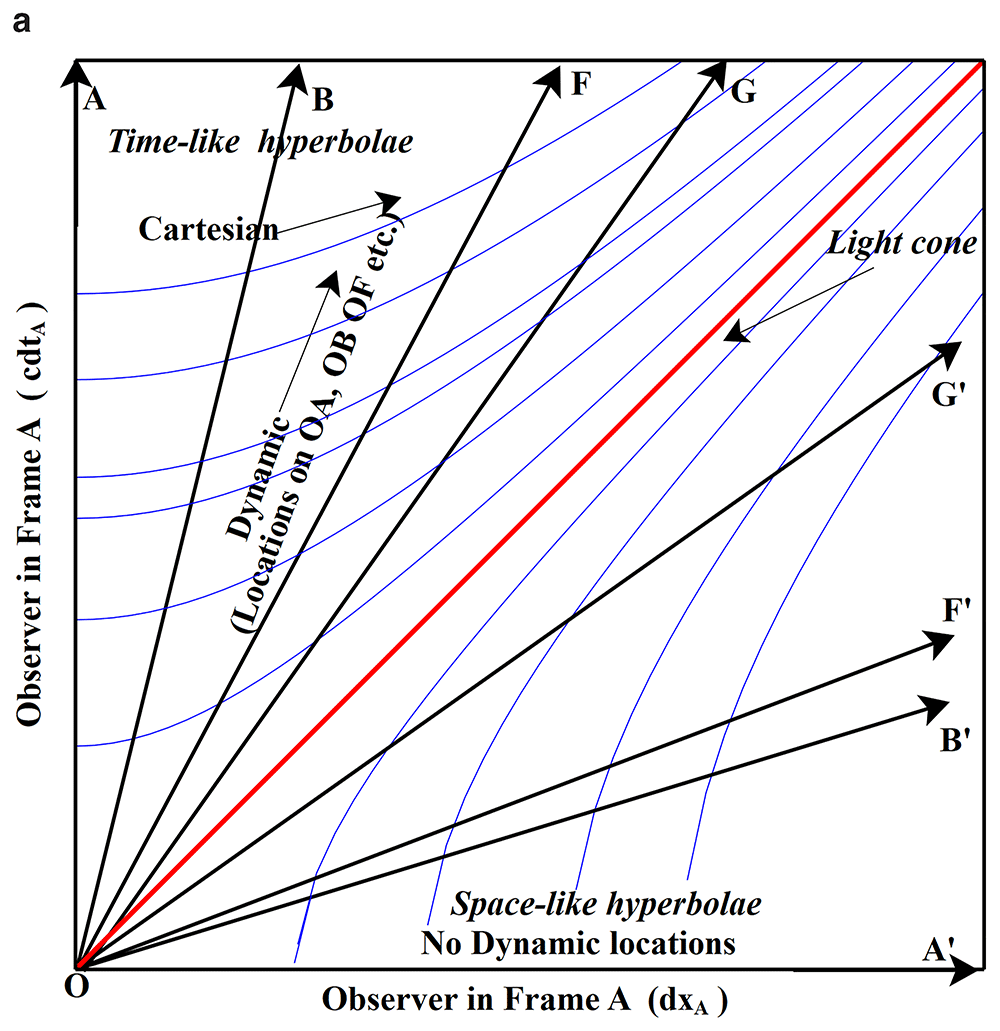
Standard coordinates follow the blue lines (hyperbolae) while dynamic coordinates follow the time-like axes OA, OB, OF etc. Note the time-like hyperbolae are also the locus of all time axes for inertial frames with an origin at O. As shown in Figure 1b, there are no dynamic locations on the space-like hyperbolae because in Equation (3), Equation (4), DXNNN = 0, while only DXNNM ≠ 0. (See text for nomenclature.).
In Figure 1a, A is the observer, and the condition dτ = DtNN can only occur where the observer and the event or object being observed lie entirely on their respective time axes, e.g. along OA, OB, OF and OG in Figure 1a. This condition corresponds to dxN = 0 in Equation (1), and DxNNM = DxNNN = 0 in Equation (3) and Equation (4). The four sets of inertial axes (A, B, F and G) in this figure are shown from A’s viewpoint. All frames have a common initial location at O. These positions are consistent with the dynamic hypothesis that from within any inertial frame, the only features of the frame that changes are those entirely connected with changes in time (i.e. DtNN).
In Figure 1b it can be seen that all inertial time axes with a common origin (O) must intersect the hyperbolas defining different values of cdτ, and so these hyperbolas can be considered as the loci of intersections of all the time axes of objects undergoing different inertial spatial motions as seen from A.
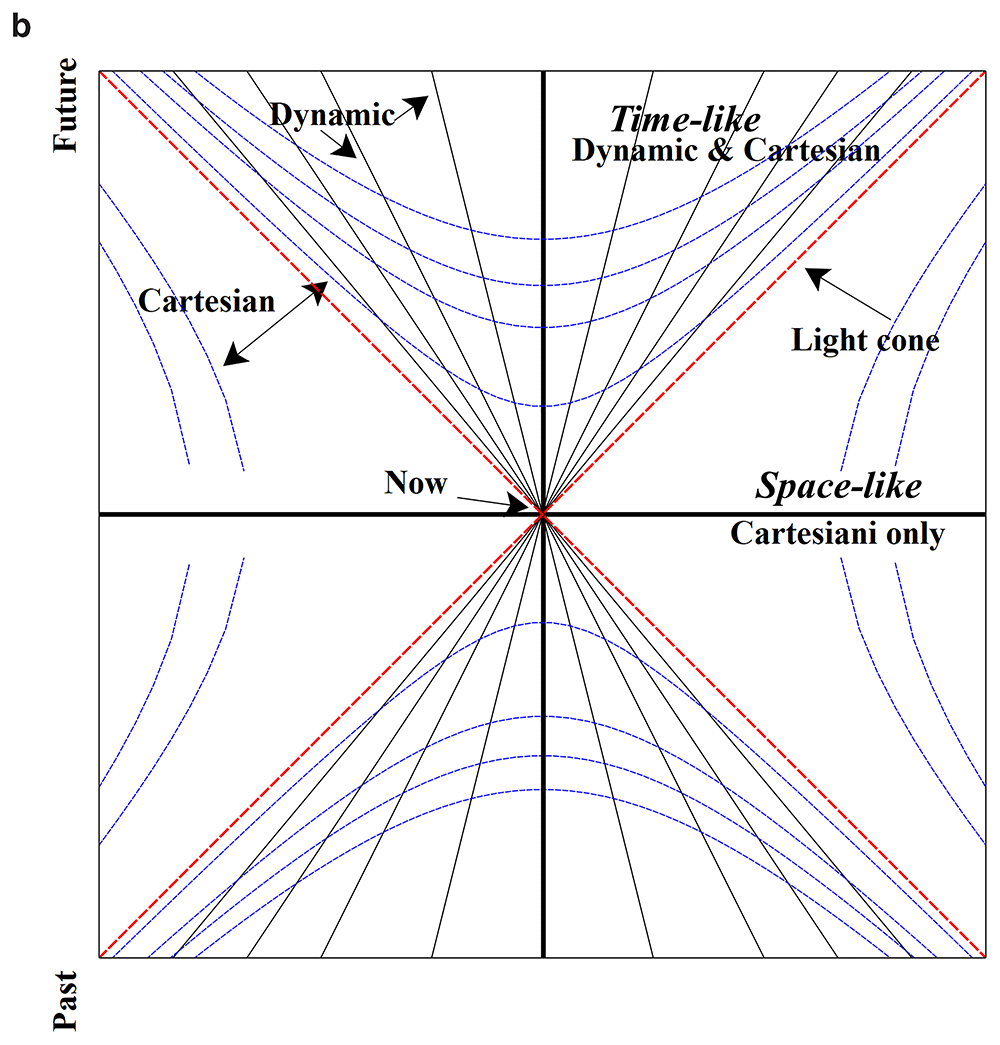
Consequently, for these conditions to be met, the dynamic equivalence of the Cartesian coordinate viewpoint requires that every object (and hence every observer) must be located on its own time axis, even though such an axis can only be inferred by such an observer. This corresponds to the initial definitions that were given about the dynamic condition. Every point on a given hyperbola coincides with a time axis of an object which has a given relative velocity to A, and whose velocity is different to every other point on the curve. The location of an object on its own time axis means that DtAA = DtNN. However, since this occurs at every point along this curve, in general terms, DtNN and dτ are both invariant along this hyperbola.
Hence, from the above along the time-like hyperbolas
And since
Let
From this and Equation (6) we can, after some manipulation, derive the following relationships
Where
Consequently, we can rewrite the dynamic portion of Equation (6) in terms of standard coordinates to give
To express the standard and dynamic coordinates in more familiar nomenclature, let
The Minkowski metric is
Where in standard coordinates
While the dynamic coordinates transformed into standard coordinates are
From the above it is straightforward to show the dynamic theory gives the same 4-momentum vector as the standard theory, i.e. let
Then Uμ = γN(c, V) where V is the complete spatial vector, and by multiplying by the mass (m) of the object under investigation in frame M, we get
which is the 4-momentum of the standard theory. The main difference between the theories is that one corresponds to an Eulerian form while the other does not. This gives rise to the following relationship between spatial motion and a changing present.
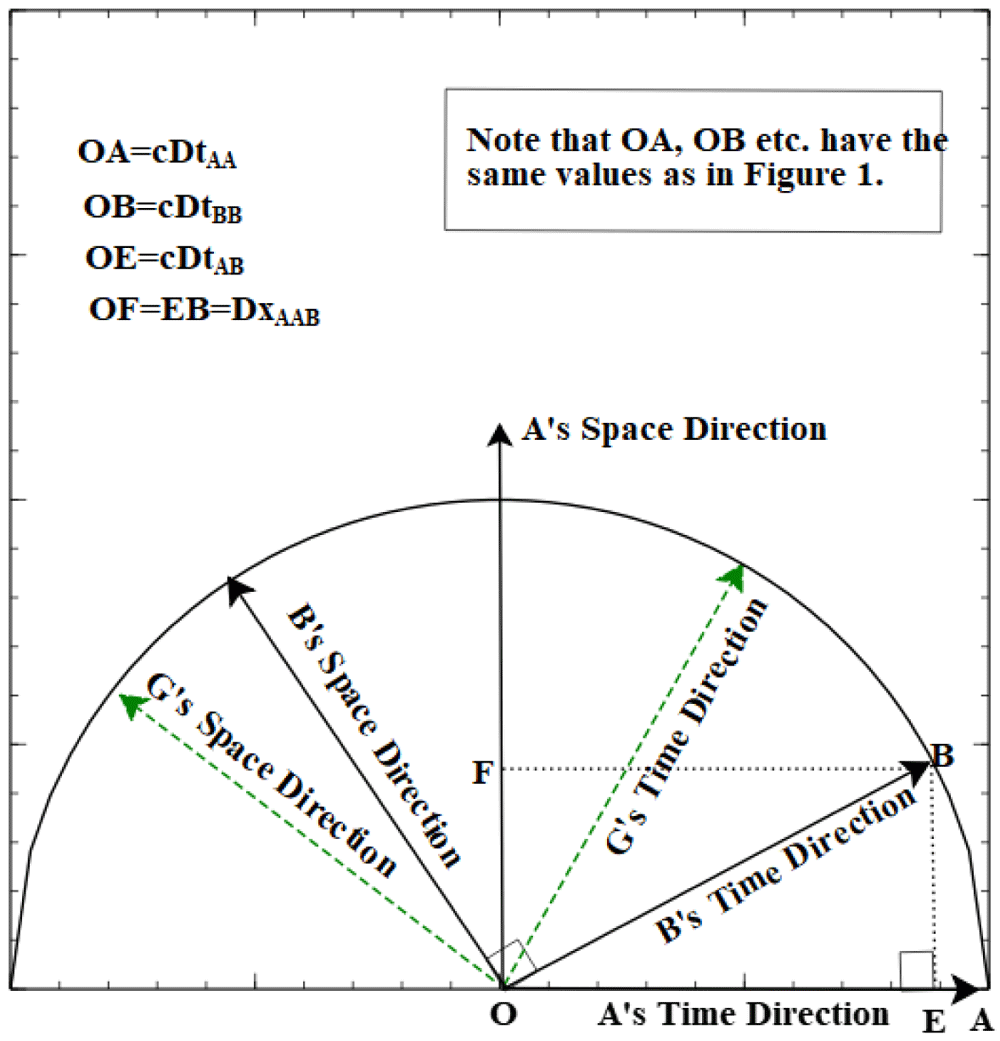
The equivalent dynamic diagram to Figure 1a is, from A’s viewpoint, given in Figure 2. However, from this Figure when B moves relative to A in the dynamic theory, it appears to A that B’s time is partly at a reduced time rate and partly as a motion against A’s spatial dimensions. In the limit a photon would appear to A as only having a spatial motion and with no time element present. Although to an imaginary observer within the photon’s frame of reference, according to the requirement of nature’s laws having to be constant, the photon’s time would appear to proceed at DtNN while A would only have a motion along the photon’s spatial dimension during which A’s clock would appear frozen. Hence in this limit of possible frame rotations, what appears to be time from within the frame is seen from the outside as a motion through space against the background of the outside observer’s spatial dimensions. To an observer within a frame there is no observation (as distinct from inference) of any dimension of any sort - temporal or spatial - in the time direction and so it appears that the space against which this motion takes place does not exist, i.e. it has collapsed to a point on the time axis where it corresponds to the ever-changing, dimensionless present. However, the summation of all the views from every possible frame indicates the overall framework within which any individual observation is made is of four orthogonal spatial dimensions. It is just that the individual observer can only see three of them plus a changing present (see Cosmology Section).
Time dilation. It is straightforward to show that Equation (3) can be manipulated to give to give a dynamic time dilation that is the same as for the standard theory. Indeed we note that from the transform in Equation 7 we can immediately write
Length contraction. The key element when dealing with spatial dimensions in the dynamic theory is that no spatial dimension can be seen to exist by an observer in his own time direction. However, there will be items that have unchanging spatial coordinates within an inertial frame, and which can also be seen outside of that frame. Take frames A and B as being stationary relative to each other at some point in time. Both are equipped with rods of equal length along the x axis. The frames are then given a relative velocity of v, and A then compares B’s rod with his own. The dynamic equations given above can be represented by a simple axis rotation equal to ζ = sin –1(v/ c), and by the acknowledgement that the spatial x coordinates lie in the same direction as Dx.
For the dynamic theory let any coordinate terms be represented (e.g. the rod length) by δx, δy etc. Being a coordinate within an inertial frame, this is unchanging in time, in contrast to Dx which we have defined as constantly changing to match the ever-changing present. The subscript convention is the same as for Dx, e.g. δxABC where A is the observer, B the frame containing the ruler and C is the frame containing an object that A wishes to measure, and which lies in A’s x direction. For a complete four-dimensional Euclidean-type coordinate transform, A would see δxBBB as having a component δxBBB cos ζ in A’s spatial direction and δxBBB sin ζ along A’s time axis. However, since there is no spatial dimension that can be observed by A along his own time axis, the length of B’s rod which is present in A’s inertial frame is seen by A to only be
This is the same length contraction result as for the standard theory, and this length contraction is independent of time since we are using δx.
Both the time and space effects in special relativity are apparent effects. The word "apparent" is used as the changes in the parameters are brought about by changes in perspective rather than any fundamental change of the value of the parameter, e.g. in the length contraction discussed above, the same contraction is seen by B in A’s rod. Fundamental changes may be assumed to only occur once gravitation (or acceleration according to Einstein’s equivalence principle) is considered, but this is beyond the scope of the present paper.
It should also be noted that in the dynamic theory while DxNNN and DxNMM are always zero (the frame cannot move relative to its own ruler), δxNNN and δxNMM can have non-zero values.
Lorentz transformation. This is the transformation of coordinate systems (standard and dynamic) between different frames, in contrast to Equation (7) where the transformation is between coordinate systems in the same frame.
An additional spatial motion must be used by the dynamic theory to obtain the Lorentz transformation, as DxNNN is zero. For all spatial motions taking place along A’s x direction, the transformation can be derived as follows.
Take frame G moving relative to both A and B, where the spatial motion of G relative to the ruler in B is observed by B to be DxBBG, and the spatial motion relative to a ruler in A (observed by A) is DxAAG. The velocity of B (observed by A) is given by v = DxAAB/DtAA; the velocity of G relative to B (observed by B) is w = DxBBG/DtBB and the velocity of G relative to A (observed by A) is u = DxAAG/DtAA.
Let
Where in Table 1, γ = (γ1γ2)/γ3 for Column 1, and γ = (γ1γ3)/γ2 for Column 2.
Dividing the top row by the bottom in Column 1 gives
while dividing the top row by the bottom in Column 2 gives
When comparing these equations with the standard coordinate version of the Lorentz transformation, they give both the same velocity-addition relationships and, as will be shown, the same coordinate transforms.
In Table 1 multiply both sides of each equation by γ and substituting the appropriate d() term from Equation (7). This gives substitute Table 2 in standard Cartesian coordinates which corresponds to the standard transformation.
The 4-vector, energy and momentum. As already shown the dynamic theory gives the same 4-momentum relationship as the coordinate theory, but this results in a change of interpretation of the role of rest mass energy (E0). This result can be obtained geometrically for the dynamic theory by taking the top right-hand quadrant of Figure 2, but omitting the G axis. In the following, the terms OA, OB, OE and EB are those used in Figure 2.
Note that γ = γ1 in the rest of the text,
Let each of the sides of the triangle OBE in this figure be divided by cDtAB and denote them by a dashed superscript, which then gives OB′ = OB/cDtAB; OE′ = OE/CDtAB. Hence triangles OBE and OB′E′ are similar which gives
OB′ = OA′ = cDtBB/cDtAB = cDtAA/cDtAB = γ;
E′ B′ = DxAAB/cDtAB = γv/c;
OE′ = 1.
The energy/momentum vectors can then be obtained by multiplying each of the sides by B’s rest mass energy (E0 = mc2) where m is B’s mass. In turn this gives
OE′ = E0.
OB′ = γE0 = E.
E′ B′ = γmvc2/c = pc,
where p is momentum, i.e. p = γmv.
From Figure 2, OB2 = OE2 + EB2. Hence (OB′)2 = (OB′)2 + (E′B′)2, and so
as in the standard theory.
It should be noted that the rest mass energy lies in A’s time direction and so appears to be linked to the continually changing time, which is seen from other frames of reference as having components of both spatial velocity and time. As discussed above, these components have a vector addition which always adds up to the velocity of light and so within a frame, which cannot observe any spatial motion of itself, this velocity is entirely expressed as a changing time i.e. E0 is a kinetic rather than a static phenomenon.
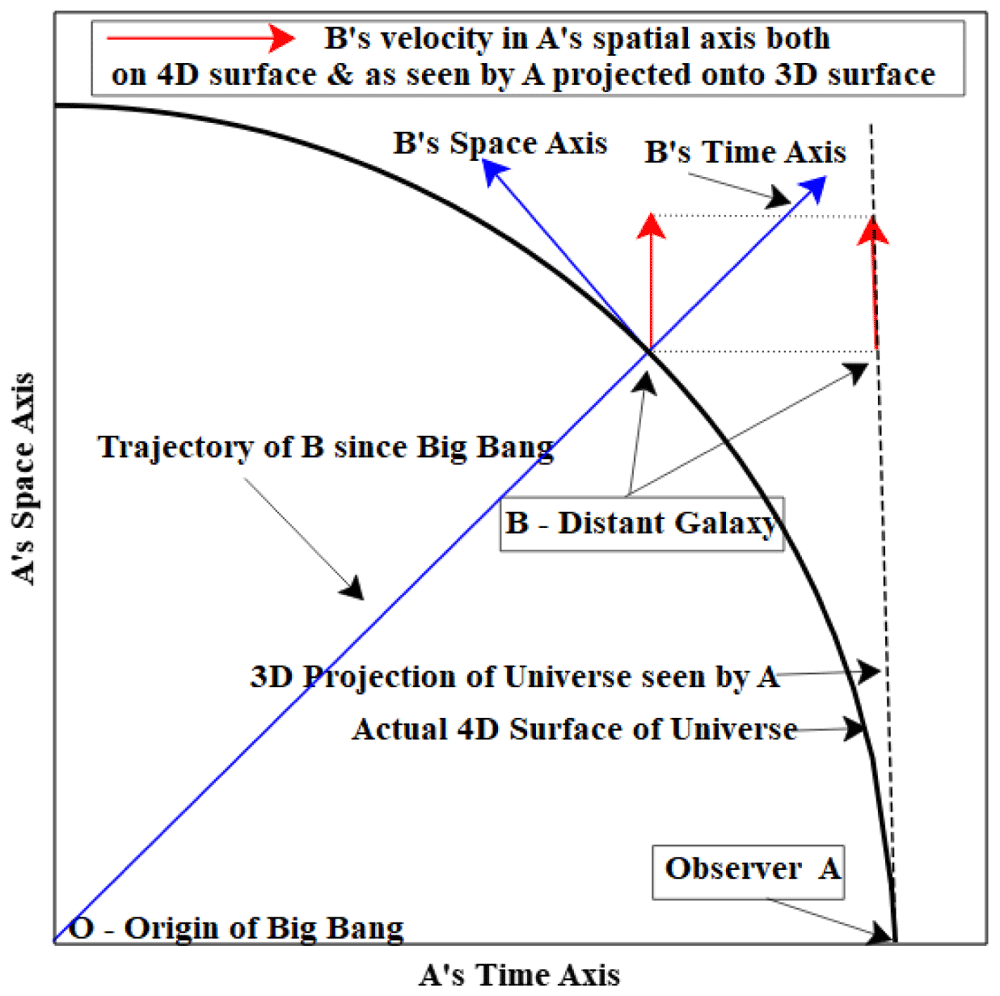
In the next section it will be hypothesised that the time directions of all frames of reference lie in the local directions of the radial expansion of the dynamic model of a 4D universe. In this simple model this is the only motion that is allowed. The 3D space is everywhere orthogonal to this direction and, as discussed below, an observer can only see other frames moving in his space due to the curvature of the universe in this model and the radial expansion of this surface (see Figure 3). Consequently, despite having a total motion equivalent to the velocity of light, this is only seen from within a frame as temporal changes and is driven entirely by the expansion of the 3D surface of this universe along a radial direction in the fourth dimension. There are no objects moving along the 3D surface independently of this expansion, i.e. as previously discussed, all objects are time-like and none are space-like.
In describing the universe, the standard theory has evidence of an expanding space-time which started from a singularity and was impelled outwards by the Big Bang some 13.8 billion years ago. In the simplest model the mass of the universe is assumed to be uniformly distributed and the expanding 4D space-time is taken as analogous to the surface of an expanding balloon in which all views and expansions are along the surface. Nothing is assumed to exist outside of this surface so what can be taken in an ordinary balloon as an expansion which is normal to its surface, is only seen in the standard model as a stretching surface. There are a number of problems with this model1 which can be summarised as
The need for an inflation model. This postulates that at very early times the universe underwent a very rapid expansion which was abruptly switched on and then off and has never been seen since. There currently appears no solid physical explanation for this model1,3 and the reason for adopting it is that it provides an explanation of some of the following observational conundrums.
The flatness problem. From observation the universe is very close to its critical mass density which means the curvature of space-time is near zero4. Since the universe is thought to start from a point, the inflation model is needed to suddenly expand to a surface whose curvature is locally insignificant.
The isotropic or horizon problem. The microwave background radiation is very uniform in all directions. Either we are somehow at a unique place in the cosmos, or all parts of the universe were in contact at the earliest times after the Big Bang. However, the areas that needed to be in contact exist along a line of sight that precludes even the speed of light to be fast enough to provide a connection. Again, the inflation theory can be used to provide an initial expansion that was far faster than the speed of light and so allowed such connections to exist at early times.
The existence of quantum fluctuations needed to provide the seeds of the current galaxies. The origin of such fluctuations requires the formation of virtual particles that are separated by space-time expanding too fast for them to recombine. An inflation-type model is needed for this expansion.
And some items which may not be explained by inflation.
Dark matter. There is a lack of observable mass in the universe needed to account for its expansion using the standard general relativity theory. There also appears to be too little mass to account for the rotation of galaxies. The shortfall is sometimes postulated as being due to a so-far unobserved particle and is often referred to as dark mass. To account for the dynamics of the universe’s expansion using the standard theory, this dark mass would have to consist of about 25% of the matter in the universe.
Dark energy. It has recently been found5,6 that the expansion of the universe appears to be accelerating, rather than decaying as would be expected if the expansion were only controlled by gravitational effects (or at least, effects due to the standard theory of gravitation**). This energy would be equivalent to about 70% of the matter needed to model the universe using the standard theory.
The “Hubble tension” where the current Hubble parameter which is obtained from the cosmic wave background (i.e. the early stages of the universe’s expansion) is some 10% lower than that found from recent cosmological features (e.g. 10).
The dynamic theory will attempt to answer all of the above points based on the different structure of the universe generated by the differences between standard and dynamic relativistic models. In the dynamic theory no further models, such as inflation, will be needed. The next segment will construct the simplest model of the universe that is consistent with the dynamic theory. The last segment will compare quantitative predictions from this theory with FLRW fits to observations. The reasons and basis for this approach have been outlined at the start of this paper.
In the simplest model the dynamic theory assumes the universe started from a singularity embedded in four spatial (not space-time) dimensions at, what we consider, the time of the Big Bang. This provides a uniform radial expansion in the four dimensions if we assume that mass is uniformly distributed throughout the history of the expansion. This is assumed to be analogous to the expanding shell of a 3D sphere, where the mass can be taken as lying at the centre of the sphere, despite all the material being located in the shell, and there is no gravitational potential along the shell normal to the radial expansion vector.
Time comes into being as soon as the expansion starts. This is the radial expansion vector and in effect the model is the opposite of the standard theory. There nothing exists apart from a 4D surface undergoing expansion, while gravitation, spatial motion etc. takes place along this surface. In the dynamic theory, assuming uniform mass, the expansion only occurs radially into a 4D space. For the model discussed in more detail below, our 3D space exists as a surface which is orthogonal to the radial expansion. This radial expansion is experienced as time from within an observer’s reference frame, but with all other frames seen as having their spatial components of motion (and gravitational effects) along this 3D surface in the same fashion as already discussed in the previous sections on SR (see Figure 3). The observer has no observation of a fourth spatial dimension; it can only be inferred from clocks as previously discussed.
Quite when this expansion transforms to a Minkowski space-time is not clear other than it is assumed by the dynamic theory to occur soon after the Big Bang. Also, like the standard theory, quantum effects should be important in these very early stages but are not considered in this paper. Equally speculation on what exists in the space outside the expanding surface is again outside the scope of the current paper.
Because this is a radial expansion and the 3D spatial surface is analogous to a sphere, an observer (A) sees a non-local galaxy (such as B) as having a spatial motion away from him as the radial expansion occurs at increasing angles to A’s time direction. This 3D spatial surface is assumed to be flat, i.e., there is zero intrinsic curvature along this surface while the curvature exists in the fourth dimension, seen locally as time, and non-locally as providing an increasing velocity of the 3D surface in relation to A, so providing a stretching surface (see Figure 3).
The trajectories of all objects are assumed in this simple model to be constant and are seen from outside their frames of reference (and inferred) to obey R = cT, R being the dynamic spatial coordinate of the surface at time cT, and T is the dynamic time coordinate relative to the Big Bang, i.e. which is the integral of DtNN along N’s trajectory as inferred by an observer located within N’s frame of reference. and is the position of a photon in frame P, emitted at the Big Bang, in N’s spatial axes while All inferred surfaces are coloured blue (see Figure 4) and are the loci of all such trajectories originating from the Big Bang.

It is worth re-emphasising that the above trajectories relate to the expansion of these surfaces and not to what we would consider to be velocities along the three spatial dimensions of the surface. The surface of the universe can be postulated as everywhere (in the dynamic non-gravitational simple model) expanding radially at the speed of light. But this is in the fourth dimension which can only be inferred in terms of trajectory and observed as changes in time. No particle with a rest mass could move along the surface with this velocity. As explained in the SR section, this leads to all particles having a time-like trajectory, and this is the only trajectory linked to the radial expansion of the universe that can be inferred from within a reference frame that also contains the observer (see Figure 3 and Figure 4).
There are some points which have to be attached to the simple 4D picture of the dynamic universe (see also Figure 3):-
There is no motion along the surface normal to the radial expansion otherwise matter will tend to clump, and the uniform mass model will be invalid. Obviously clumping does happen to an extent in the real universe due to gravitational effects along the 3D surface as galaxies etc. exist. But in this model we are taking the simplest possible mass distribution where in spatial terms it is assumed that most of the universe can be treated as having a uniformly smooth matter distribution.
Consequently, from the previous assumption, there can be no overall gravitational potential along the 3D surface as it is assumed analogous to a uniform shell of material which forms the surface of a 3D sphere in Newtonian space, where the potential gradient lies along the radius but is zero along the surface normal to this radius. Locally the same comment about non-uniformity applies as in the previous bullet.
As a consequence of the previous points General Relativistic effects can, to a first approximation, be ignored when considering the observed overall motion of this surface, in contrast to the standard theory where they dominate due to all forces having to lie along a 4D surface***.
In the standard theory the redshift in B, as seen by A, could be generated by either a receding velocity or a gravitational redshift (or a combination of both). From the previous bullets, in the dynamic theory it is assumed that to fit the simple theory the redshift is entirely provided by a receding velocity, which in turn results from the angle the radial velocity at any location makes with an observer. Hence, to reiterate previous bullets, it is assumed that there is little matter (compared to the mass of the universe) that is trapped in intense local gravitational fields (in a black hole or around stars) or moving at high speeds along the 3D surface.
The expansion velocity of the universe would be inferred to be constant (and equal to the velocity of light) once the perspective effects due to curvature have been subtracted, despite the overall expansion probably decreasing. This apparently contradictory situation results from there being no direct way for 3D observers to measure changes in the actual 4D radial expansion rate from within the universe. Any real change in radial motion will be equally seen in both the passage of time and the expansion of space (see Figure 3), so that a phenomenon such as velocity remains unchanged.
Although the time dimension does not exist when observed from within a given reference frame, the remaining analysis requires the construction of an inferred “time dimension” in order to situate the relative position of bodies and events, e.g. such as where and when A locates galaxy B, or where events are located relative to the Big Bang. It is constructed by integrating the radial motion to provide a dimension in which events lie relative to A.
There are two types of surface shown in the following diagram (Figure 4). Solid blue lines are inferred surfaces which consist of the locus of 4D trajectories from the Big Bang to the present. Each trajectory is locally constructed, e.g. OA and OB in the Figure. The present is the surface constructed from the termination of these trajectories such as at A and B. This surface is where the 4D sphere lies but is not observable other than locally since information about B can only arrive at A in B’s past.
The second type (solid red line) is the directly observed surface. Observer A sees time dilation effects in B because of the galaxy’s recessional velocity, and these, plus the time delay for photons from B to reach A (vertical lines such as CF in the figure), only allows A to see B in B’s past. This is the only directly observable surface due to observations of the Doppler effect, and as such its position is linked to the change in scale factor with time (see below for a more detailed analysis of the scale factors relating to the universe). Such observations always occur in A’s continually changing present (which is equivalent in Cartesian terms of laying down a time-like trajectory) since this is the only location at which A can interact with events or phenomena such as photons. However, that the observation is of B’s past allows A to construct B as a point on A’s own time axis, e.g. OF in Figure 4.
It should be re-emphasised that from A’s viewpoint his time axis is an inferred construct where the observable surface (solid red line) is seen in A’s present and consists of a single view of all other trajectories where the time dilated surface (solid red line), the object’s trajectory (e.g. OB) and the photon trajectory (e.g. CF) intersect. From the photon trajectory A calculates B as apparently appearing at a location OF in time relative to the Big Bang. Although the result of every intersection is seen at A, he has (in the current theory) artificially spread out these locations along an inferred dimension (OA). The method by which the events are calculated is discussed below.
Also note that temporal simultaneity occurs along the inferred surfaces such as ABL and ECK, and not along the vertical lines which connect different times such as OF and OC between the observed surface and the observer.
A’s construction of the surfaces required by the simple model
Let us assume that A and B had clocks travelling with them that were set to zero at the Big Bang and have been accumulating time ever since. Because of the fourth-dimension curvature, A sees B moving at velocity v/c along A’s spatial axis. Because B has a straight radial trajectory, this velocity has not changed over time.
We are only dealing with special relativity so that A’s observation of B is from point C where OC/OB = OE/OA = (1 − v2/c2)1/2, i.e. to A the galaxy at B has not travelled as far along OB as it should due to the time dilation factor of the apparent velocity.
The geometric construction of the surfaces can be obtained by remembering we are only dealing with concentric circles and straight lines, and by letting cT0 = OB; cTG = OG; cTF = OF; cTE = OE; XR = CF and X0 = BE in Figure 4. Then
The inferred present surface ABL is given by
The time-dilated observed surface (solid red line) relative to A is
The evolution of the universe is calculated in terms of the scale factor a of the universe at time T after the Big Bang, which can be expressed in Figure 4 as
Since a dynamic coordinate is being used (e.g. T or R) it should be emphasized that this is along a given trajectory (e.g. OA or OB), but inferred surfaces (e.g. FDJ in Figure 4) link constant values of a. This parameter can measure the amount of stretch in the surface between then (T) and now (T0), and is often used when comparing experiment and theory The connection between the observed and inferred surfaces, and the scale factor is given by the location where three phenomena, discussed below, meet (C) in the example shown in Figure 4 :-
The relativistic Doppler redshift.
The only scale factor that can be directly seen by A is the value of a given by the Doppler redshift (z), and corresponds to the frequency of light emitted at any point along the trajectory OB (fe) since B’s velocity along this trajectory is, from A’s viewpoint, a constant due to the assumption of a straight trajectory. The frequency observed at A by at locations such as F and G is f0, where z = fe/f0 – 1) and a is assumed as equal to 1/(1 + z).
The Doppler redshift is then related to the recessional velocity of the object (or galaxy) by the standard relativistic relationship
In dynamic coordinates in Figure 4, sinζ = v/c, and so cosζ = (1 – v2/c2)1/2. From this and Equation (19) we then have
This is the key equation which provides the link between construction geometry and observation, and which is further explored below. Note that Equation 20 only applies to A’s observation of scale factors resulting from B’s trajectory as cosζ is completely dependant on the Doppler velocity.
The trajectory reduction.
As already mentioned, A will see B’s trajectory foreshortened due to the space-time dilation effects of B’s relative velocity. B will have only apparently travelled to OC rather than OB.
The photon travel.
Photons travel vertically in dynamic coordinates and so while time dilation places B at OC on B’s trajectory, B appears at OF on A’s trajectory from A’s perspective. Hence from A’s viewpoint a = OF/OA and it should be noted that since simultaneity occurs along inferred surfaces, a will be constant along arc FDJ, and consequently it can be inferred that a is also equal to OD/OB.
A’s observations of B are that, because v/c is constant along OB (according to A), a location on OB is related to a location on OA by OA = OB cosζ, e.g.
where in Figure 4, OD; OC and OB are located on trajectory OB. Equally OG; OF and OE are located on OA.
However, the inferred geometric relationships in Figure 4 obtained from the concentric surfaces can be summarised as
OA = OB; OC = OE; OD = OF and by substituting such values into Equation (21), we can write
OF/OE = OE/OA which lie entirely on the OA trajectory.
Multiplying through by OE/OA gives OF/OA = (OE/OA)2
and since a = OF/OA, then OE/OA = a1/2. These values of a also apply to a = OD/OB and a1/2 = OC/OB.
Hence A’s view of location OC, where the Doppler effect, time dilation surface and photon trajectory intersect, can be obtained from (Equation 21) as
OF/OC.(OC/OB) = OE/OB.(OC/OB) or
Consequently from (Equation 20 and Equation 22) the key equation for the dynamic theory can now be expressed as
Let H(T) be the Hubble parameter at time T after the Big Bang and H0 is the present value of the parameter. Then H0 = 1/T0 and along a trajectory that is frozen at R0, T0 ≡ RL, TA, we have H(T) = a–1 da/dT.
From A’s viewpoint H(T) varies along the time axis (OA) and at a point along this axis, e.g. DRJ/DTF = dRJ/dTF = RJ/TF = c, (c being the velocity of light).
The observed surface on which A sees B is at RJ = cTF. Since a = RJ/R0 then and so
Hence H(TF) = 1/TF. So
Let H(T) be designated as H. In the standard (GR-based) coordinate theory for a flat universe, we have the first Friedmann equation which is
where G is the universal gravitational constant and k is the curvature parameter which is zero for a flat universe.
where ρ0 is the current average universal density. So for the standard theory
where ΩM is the current normalised density of matter. The Standard Cosmology Model (SCM) value quoted in 9 is 0.32 for this parameter; ΩR is the normalised density of radiation equal to 5×10⁻⁵; and the SCM value for ΩΛ (the normalised dark energy coefficient) is 0.68.
Figure 5 shows a comparison of the two theories (Equation (24) and Equation (25)).
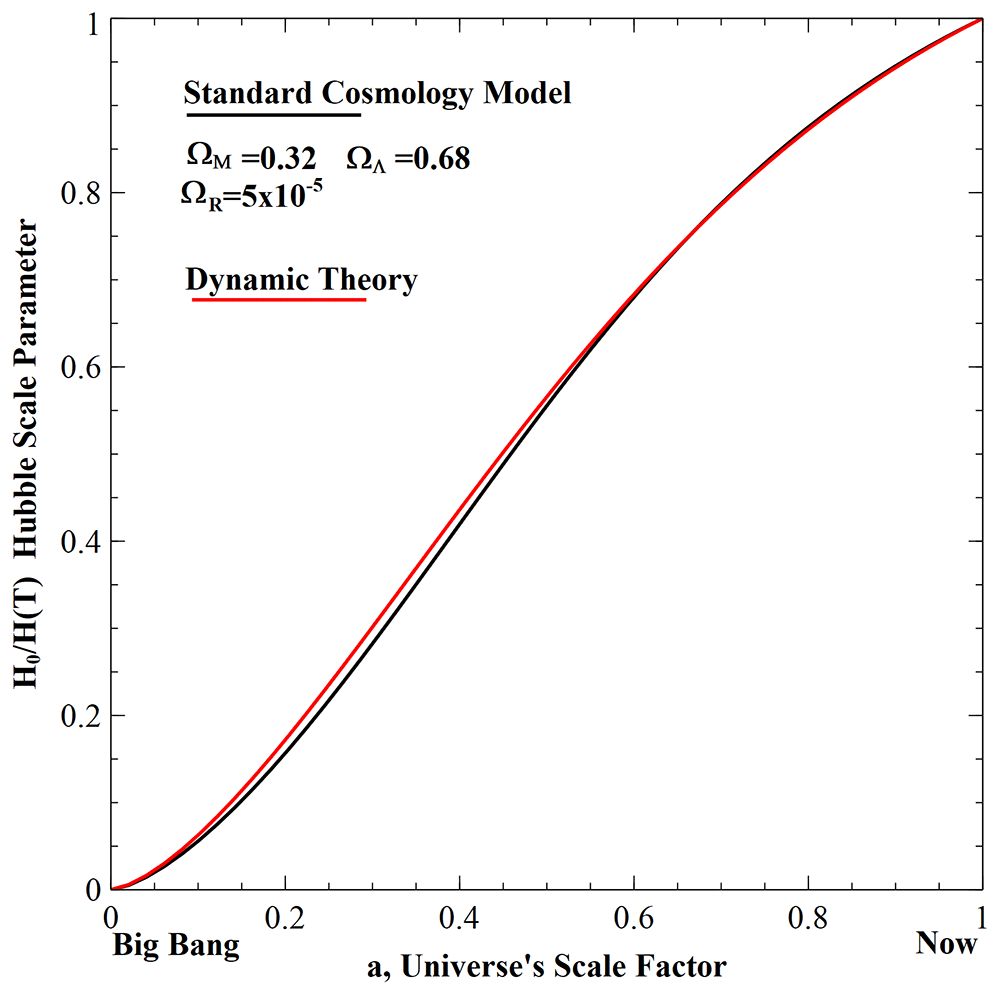
Considering the simplicity of the model used in the dynamic theory (red line), it is remarkably close overall to the SCM coordinate theory’s values for the coefficients (black line, in the Figure) considering SCM is based on GR for a flat universe and incorporating the lambda coefficient while the dynamic theory is based on SR and the simplest assumptions about the universe’s geometry.
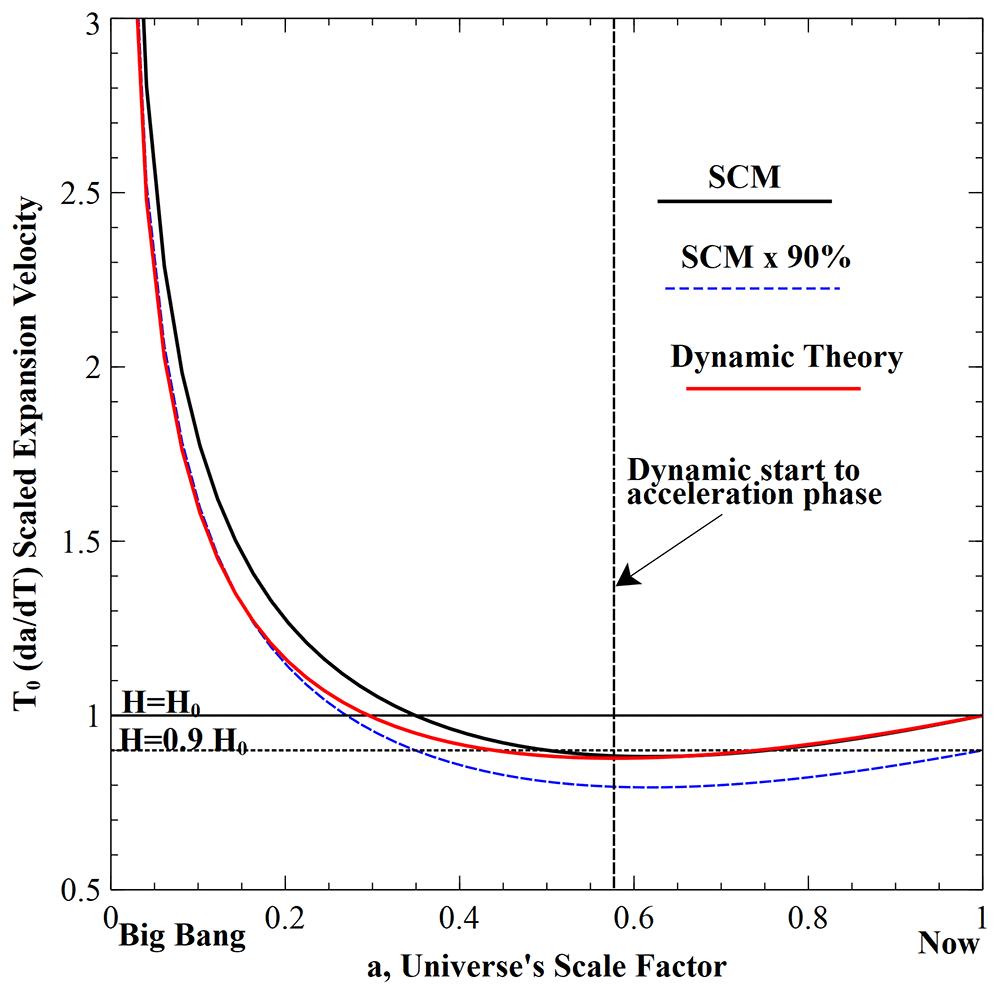
At the early time low expansion of the universe (low a or high z), a good fit is obtained to the dynamic theory by the SCM’s coefficients when this curve is reduced by 10%. This is shown in Figure 6 (blue dotted curve). Consequently, to fit to the dynamic curve over the complete range of a two SCM curves are needed, the low a (high z) curve needing a value of H0 which is 10% lower than its value obtained from nearby (high a) cosmological data. This might allow the dynamic theory to explain the current “tension” between values of H0 obtained from the cosmic microwave background (high z) and from more recent (low z) cosmological feature (e.g. 10).

It should be noted from Figure 6 that when the dynamic curve is divided by T0 - the current age of the universe for an observer - the shape of the curve (i.e. the late time acceleration) is independent of the epoch in which the observation is made.
The differential da/dT of A’s observation of B in both the standard and dynamic theories is given by H(T) = a–1 da/dT. Hence for the dynamic theory, substituting this into Equation (24) gives
In the standard theory a similar substitution in Equation (25) gives the SCM scale velocity as
These equations are shown in terms of the scale factor (a) in Figure 6 and za, the redshift at the start of the recent universe’s acceleration, in Table 3 below.
| za | Comments | Reference |
|---|---|---|
| 0.732 | Shape independent of T0. | Dynamic Theory |
| 0.619 | Value at current epoch. | SCM9 |
| 0.752 +/-0.041 | Astronomical data | 4 |
| 0.72 +/-0.05 to 0.84 +/-0.03 | 5 models plus 38 measurements of H(z) | 11 |
The match between the theories means that it is possible that dark energy (the accelerating universe represented by ΩΛ) could be just a feature of perspective. This follows from the scale velocity (da/dT) of the observable surface that shows the universe slowing down at large redshifts - as would be expected in the standard theory from the effects of gravity - and then in the relatively recent past beginning to accelerate. In the dynamic theory this is due to the model’s geometry which is independent of gravity (see previous discussion) and yet which still provides a good fit to the trend of the SCM, as shown above in Figure 5 & Figure 6). Also the position, in terms of redshift, where the dynamic theory predicts the acceleration to start to accelerate (za) agrees well with results from various models based on both the standard theory and observational astronomy, and are given in Table 3.
The position versus time of the universe’s radius is given by the integral of Equation 26 for the dynamic theory, and the integral of the combination of Friedmann’s first equation (above) with his acceleration equation
where ρ and p are the density and pressure in the universe at time T. Assuming pressure- free matter, negligible radiation density and spatial flatness gives an integral for the standard theory of
where To convert TΛ to units of time it has to be multiplied by c.
Then T/cTΛ = T/T0.(T0/cTΛ) = KT/T0. Here K is a dimensionless constant equal to 13.8Gyr divided by (4/3Λ)1/2. Using cTΛ ≈ 3.72x10¹⁷ s allows Equation 28 to have a scale factor of unity at T = T0 in Figure 7. Hence Equation 28 can be rewritten as
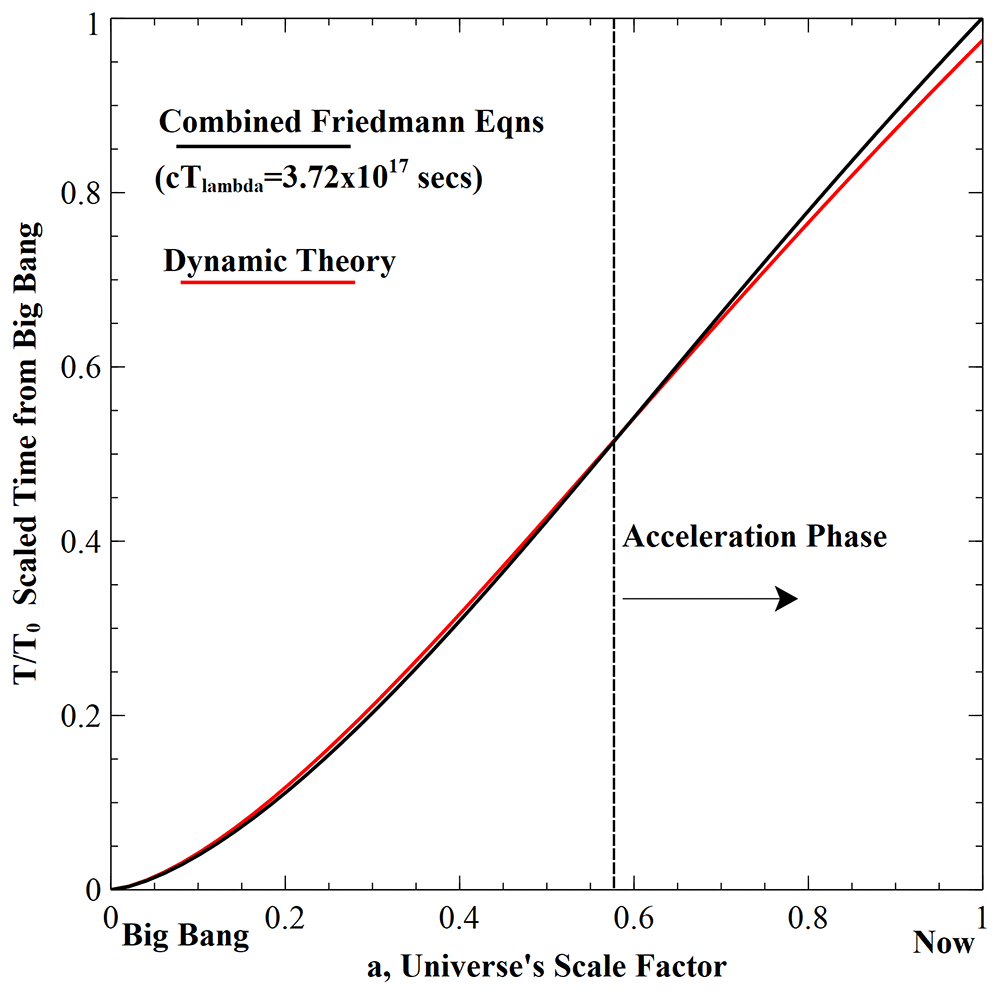
The equivalent curve from the dynamic theory is obtained by the rearrangement and integral of Equation 26, i.e.,
This gives
The key elements in the dynamic theory are: -
Very much like in special relativity A’s view of B is due to perspective rather than any real relationship. B’s view of A will be identical.
The match between the dynamic and coordinate theories in describing the universe’s evolution means that if there is any merit in the dynamic solution, there is no need to consider that the overwhelming proportion of dark mass (represented by ΩM in the coordinate theory) exists. However, some must be present (or some currently unknown physical phenomenon must apply) as the rotation of galaxies requires more mass than is observable.
The match can also mean that dark energy (the accelerating universe represented by ΩΛ) is also just a feature of perspective. This follows from the differential of the observable surface that shows the universe slowing down at large redshifts - as would be expected in the coordinate theory from the effects of gravity - and then in the relatively recent past beginning to accelerate. This is shown in Figure 6 & Figure 6a, along with the position, in terms of redshift, where the dynamic theory predicts the acceleration to start. Comparisons of this acceleration start in terms of redshift (za ) with results from various models based on both the coordinate theory and observational astronomy are given in Table 3
The basis of this paper results from a paradox. The way we measure space and time show that they are two very different entities. And yet it has also been shown beyond doubt that they need to be fused into space-time to accurately describe our universe. One may argue that “real” space and time are far removed from the way we define them, and this could well be the case. However, at its most basic construction these two entities have been defined by the ruler and the clock, and on this has been erected one of the most successful theories in science. However, it is a theory which on a cosmic scale has produced conundrums. It has been argued in this paper that such conundrums have arisen because there is more than one way that this fusion of space and time can be achieved.
The use of a dynamic theory to create such a fusion utilises the Minkowski metric, but where the standard Cartesian coordinates have been transformed into an Eulerian configuration (the dynamic coordinates) by multiplying them by a function of γ (see Equation 7–Equation 10) within a given inertial frame. The resulting two sets of coordinates (standard Cartesian and dynamic) give the same local descriptions of motion for special relativity (SR) but has these motions occurring against the background of a different universal structure.
From this paper the difference in the universe’s structure have led the following current cosmological problems to have possible dynamic solutions
The flatness problem. In the dynamic theory the curvature is always caused by the radial velocity. In turn this is always in the time direction for human observers - a direction in which locally they cannot see any sort of dimension. This is illustrated in qualitative terms by Figure 3 in which it is assumed that A can see the current (according to both A’s and B’s clocks) position of B with no account taken of time dilations or delays. See previous Sections for a more quantitatively precise description of A’s view of B in the dynamic theory. In Figure 3, A is again the main observer and B a distant galaxy. The real (i.e., total) motion of B lies along B’s time axis, which is orthogonal to the 4D surface. A directly sees only the spatial component of B’s real motion as a velocity lying parallel to A’s spatial dimension, and hence, from A’s viewpoint, projected onto it. In the Figure, a photon would have its time direction aligned with A’s spatial axis and its space direction along A’s time axis.
The dynamic universe has an extrinsic curvature, the curvature being confined to the fourth dimension. However, to any observer on this 4D surface one of these dimensions is missing (it is in the time direction) and the three remaining spatial dimensions having no intrinsic curvature appear flat.
Consequently, it is possible for this 3D space to appear flat from the viewpoint of any observer located on the 4D surface (B and A can be interchanged in terms of what each sees of the other). The only view an observer such as A has of this curvature is the projection of the radial velocity onto his 3D space by distant objects.
The horizon problem. This is simply solved in the dynamic theory because all elements of the universe are in contact in the 4D space at the location of the Big Bang. While the coordinate theory must deal with connections between various parts of the universe within an expanding surface when trying to explain the isotropic nature of the microwave radiation, the dynamic theory postulates that all parts were initially in contact and expanded radially outwards.
Dark mass and dark energy. The dark energy needed to explain the late-time acceleration of the universe in the coordinate theory, appears in the dynamic theory to be due to the perspective created by the presence of a directly observed surface (see above), i.e. in the dynamic theory there is no requirement for it to exist.
A lot of the dark mass also appears to be due to problems with the perspective and can be explained away as not required in the dynamic theory. However, this may not be true for all of it as there remains some unanswered questions about the rotation of galaxies for instance.
Inflation-type behaviour. The redshift formulation of Equation (26) tends to infinity for values of R close to zero at T = 0. Hence the inflation-type behaviour is implicit in the model without resorting to a separate phenomenon.
The “Hubble tension”. The dynamic scale velocity of the universe fits two SCM curves in different regions of the universe’s expansion (Figure 6 & Figure 6a). The SCM curves have values of H0 that differ by 10%. This may be an interesting indicator that the dynamic model provides a better (or at least simpler) approach to solving this problem.
In Figure 5–Figure 7, considering the simplicity of the model used in the dynamic theory, it is remarkably close overall to the SCM theory considering SCM is based on GR (albeit for a flat universe in the comparisons shown) and incorporating the lambda coefficient. This is while the dynamic theory is based on SR and the simplest assumptions about the universe’s geometry.
The dynamic theory is far from the complete answer to every conundrum, but it is hoped that it may provide some alternative pathways to explore in the future.
| Views | Downloads | |
|---|---|---|
| F1000Research | - | - |
|
PubMed Central
Data from PMC are received and updated monthly.
|
- | - |
Provide sufficient details of any financial or non-financial competing interests to enable users to assess whether your comments might lead a reasonable person to question your impartiality. Consider the following examples, but note that this is not an exhaustive list:
Sign up for content alerts and receive a weekly or monthly email with all newly published articles
Already registered? Sign in
The email address should be the one you originally registered with F1000.
You registered with F1000 via Google, so we cannot reset your password.
To sign in, please click here.
If you still need help with your Google account password, please click here.
You registered with F1000 via Facebook, so we cannot reset your password.
To sign in, please click here.
If you still need help with your Facebook account password, please click here.
If your email address is registered with us, we will email you instructions to reset your password.
If you think you should have received this email but it has not arrived, please check your spam filters and/or contact for further assistance.
 ) and Dynamic changes
  within the same inertial frame that contains the observer. See paper for nomenclature and note that
  is always zero. Note also this transform is different to the Lorentz transform which applies to both Dynamic and Standard coordinates between frames.
Comments on this article Comments (0)