Keywords
Banach Spaces, Iterative Schemes, Total Asymptotically Non-Expansive Mappings, Fixed Points, Strong Convergence, Weak Convergence, Stability.

This article is included in the Fallujah Multidisciplinary Science and Innovation gateway.
Banach Spaces, Iterative Schemes, Total Asymptotically Non-Expansive Mappings, Fixed Points, Strong Convergence, Weak Convergence, Stability.
Dear Professors and Colleagues,
Thank you very much for your efforts in supporting research activities.
I am uploading a carefully revised version, and I hope it meets your approval.
I would like to clarify the following:
- The texts have been written in standard format.
- The stability theorem has been revised.
- The reason for presenting 2D-Volterra integral equations as an application is:
They provide powerful mathematical models for systems with two variables, serving as an important theoretical framework in functional analysis, PDEs, and fixed-point theory. Additionally, this type of equation has been rarely used in research papers on approximate fixed points.
Regards
See the authors' detailed response to the review by Rahim Shah
See the authors' detailed response to the review by Tanakit Thianwan
Fixed point theory in Banach spaces has developed through successive generalizations of contractive-type mappings. Early foundational contributions by Browder (1965) and Kirk (1965) in,1,2 initiated the systematic study of nonexpansive mappings and established fundamental fixed-point results in uniformly convex Banach spaces. This line of research was later extended by Goebel and Kirk (1972) in,3 who introduced the asymptotically nonexpansive mappings, thereby broadening the scope of fixed-point analysis to operators whose iterates exhibit asymptotic nonexpansiveness. Building upon these developments, Alber, Chidume, and Zegeye (2005) in4 a introduced the class of totally asymptotically nonexpansive TAN-mappings. Let be a Banach space and let . The mapping Ψ is said to be totally asymptotically nonexpansive if there exist nonnegative real sequences and satisfying , together with a strictly increasing continuous function with such that for all .
This framework unifies nonexpansive and asymptotically nonexpansive mappings as particular cases and provides a flexible framework for analyzing convergence behavior of iterative schemes in Banach spaces. Since their introduction, TAN-mapping has been extensively investigated through various iterative procedures. Classical schemes such as Mann, Ishikawa and Halpern iterations laid the foundation for subsequent developments.10 More recently, increasing attention has been devoted to accelerated and hybrid techniques. For instance, Abed and Abed (2022) in5 analyzed a Fibonacci–Halpern iteration for monotone TAN-mappings in partially ordered Banach spaces, establishing stability and improved convergence properties. Salman and Abed (2023)24 proposed a five-step iterative process for (λ,ρ)-firmly nonexpansive multivalued mappings in modular spaces. Further developments were reported by Khomphungson and Nammanee (2024),6 who analyzed modified Mann–Ishikawa algorithms, and proved strong convergence under Condition (A) in uniformly convex Banach spaces. Similarly, Balooee and Al-Homidan (2024) in4,7 introduced hybrid resolvent-based methods for fixed-point problems involving TAN-mappings and generalized variational-like inclusions, ensuring the existence of a common solution belonging simultaneously to the solution set of the inclusion problems and to the fixed-point set of a TAN-mapping. These formulations are closely related to integral and differential equations, which frequently arise as operator inclusions problems a Banach spaces. Additional generalizations have been proposed in recent contributions. Galisu et al. (2024)8 introduced enriched asymptotically nonexpansive mappings with center zero in a reflexive and strictly convex Banach space, providing a broader framework that includes TAN-mappings as a subclass. More recently, Sun (2025)9 extended the analysis to random asymptotically nonexpansive mappings in uniformly convex modules, emphasizing stochastic generalization within Banach-type structures. Collectively, these studies demonstrate the progressive fixed-point theory from classical nonexpansive mappings,1,2 to asymptotically nonexpansive mappings,3 and ultimately to the general class of TAN-mappings.4 A wide spectrum of iterative schemes, including Mann, Ishikawa, Halpern, Fibonacci-Halpern, modified Mann-Ishikawa, and hybrid resolvent-based algorithms, has played a central role in establishing convergence, stability, and applications to variational inclusions and integral-differential models in.5,6
Motivated by the growing interest in accelerated iterative framework, the main objective of the present work is to investigate the convergence and stability properties of an inertial accelerated four-step iterative scheme for TAN-mappings in Banach spaces. Inspired by the inertial accelerated technique proposed by Harbau et al. (2022),10 we establish weak convergence under Opial’s condition and strong convergence under an additional semi-compactness assumption. Furthermore, stability under perturbations is analyzed. A comparative numerical study with existing iterative methods is conducted to illustrate the performance of the proposed scheme. Finally, the theoretical results are applied to a nonlinear two-dimensional Volterra integral equations, demonstrating the practical relevance and the applicability of the developed framework.
This section presents the fundamental definitions and auxiliary results that will be used in establishing the main convergence theorems.
11 A Banach space X is said to be uniformly convex if for any there exists a such that for any with , and , then, .
10 Every Hilbert space is uniformly convex and therefore satisfies Definition (1)
Symbols
i) denotes the real Banach Space.
ii) denotes the dual of .
iii) ⇀ for weak convergence and, ⟶ for strong convergence.
iv) The set of - cluster point of a sequence is denoted by .
v) in denotes the set of fixed points of .
vi) The duality pairing on denoted by .
10 A mapping defined by is called a generalized duality mapping, where is a gauge function.
If for all then is a normalized duality mapping and can be written as .
12 The duality mapping is said to be weakly sequentially continuous if, for any sequences in such that , implies .
It is known that space has a weakly sequentially continuous duality map if J φ is single-valued and sequentially continuous from with the weak topology to with the weak∗topology.23
13 A mapping Ψ: said to be.
(1) Demi-closed at , if for any sequence in C such that and , it holds that .
(2) Semi-compact if for any bounded sequence in C such that there exists a subsequence such that
Suppose a fixed-point iteration is defined by the general form
14 Let be a sequence in . Then an iteration procedure converging to a fixed point z is said to be -stable (or stable) with respect to if and only if for , we have
15 Let and are two sequences that converging to the same fixed point and and for all . If the sequence and converge to a and b, respectively, and then we say that converge to faster than .
16 A Banach space is said to satisfy Opial’s condition if for each sequence in X converging weakly to z1, we have for all such that .
It is known that:
Any Banach space with a weakly sequentially continuous duality mapping satisfies Opial’s condition,23 Any Hilbert space satisfies Opial’s condition.23
23 A set of X is said to be convex if for any in and .
The following lemma represents Opial’s property.
17 If in a Banach space X having a weakly continuous duality mapping , the sequence is weakly convergent to , then for any
In particular, if the space is uniformly convex, then equality hold if and only if .
18 Let be a real uniformly convex Banach space, let C be a nonempty closed convex subset of X. If is a TAN-mapping, then ( ) is demiclosed at zero, that is whenever and , it follows that .
19 Let and be nonnegative real sequences satisfying the relation with and then
20 Let r > 0 be a fixed number. Then, a real Banach space is uniformly convex if and only if there exists a continuous and strictly increasing function with such that: , for all .
22 Suppose that is uniformly convex Banach space and let be real sequence such that for all v ≥ 1. Let and be sequence in X such that and hold for some Then .
This section investigates of weak and strong convergence properties, stability, analysis and comparative performance of the proposed iterative algorithm.
The following assumptions are adopted from21
(i) Choose sequence , and with which mean
(ii) Let be arbitrary points, for the iterates and for each choose , such that where, for any define
Under Assumption 1 that for each we have.
Let be a real uniformly convex Banach space with Opial’s property. Let be TAN-mapping with sequences and a strictly increasing continuous function with and Fix(Ψ) ≠ ∅. Let be the sequence generated as follows:
is bounded.
The proof is divided in to five steps:
Step (1), the condition ( ) implies that thus, there exists such that , for all . Let be define as follows:
Then, the hypothesis (C3), implies that hold. Presume that for some , then:
Step (2), from the algorithm (4),
By (5), (6), and for any we obtain:
Let
Combining (7) and (8), we obtain:
By Remark 2, we know that the sequence converges, so there exists some constant say such that for all , thus:
Next, using (7), (9), and for some any we obtain:
Hence, using Lemma 5 and condition (C1), it follows that exists. Consequently, the sequence is bounded.
Step (3) since the sequence is bounded, it follows that is bounded. Let and by (10), Lemma 4, and condition C1, we obtain.
Since the exists for any , then using (2) it follows from (8) that there exists such that
Since exists for any z , then the sequence is bounded; therefore, there exists such that for all . Hence,
Using (C1), we obtain
. Which implies that: By condition (C2), we obtain:
Taking the sum over of both sides and considering (2), we obtain: . Which implies that:
Since is TAN-mapping, we obtain:
Continuity of (12) and (13) in (14) implies that:
It follows from (12), (16), and (C1) that:
Step (4) Since every uniformly convex Banach space is reflexive,23 so the reflexivity of makes each bounded sequence has a weakly convergent subsequence.23 Applying this fact, has a subsequence such that , therefore, from (18), and consequently by Lemma 2, . Hence, .
Step (5) To prove that the sequence converges weakly to a fixed point of , it is enough to demonstrate that consists of a single element. For this purpose, using Lemma 1 and Definition 7, let and consider subsequences and of such that.
This leads to a contradiction. Hence is a singleton, and is ω-convergence to a fixed point.
If in addition to all the hypothese of Theorem 1, the mapping is semi-compact. Then the sequence generated by (4) converges strongly to a fixed point of .
Suppose that is semi-compactness. Starting from steps 2 and 3 in the proof of Theorem 1, and the boundedness of the sequence with , then there exists a subsequence of such that as Therefore and so From step 2 in the proof of Theorem 1, exists, then , which means that .
Under the assumptions of Theorem 1, assume that be a nonexpansive mapping with F . Then the sequence generated by (4) with and initial value , converges weakly to a point in , provided that conditions (C1) − (C3) hold.
Under the assumptions of Theorem 1, assume that be a Asymptotically nonexpansive mapping with . Then the sequence generated by (4) with λ and initial value , converges weakly to a point in Fix(Ψ) , provided that conditions (C1) − (C3) hold.
Let be a real Hilbert space and be either a TAN-mapping or a nonexpansive mapping with . Then the sequence generated by (4) with λ , and , converges weakly to a point in , provided that conditions (C1) − (C3) hold.
Let be a real Hilbert space and be either a TAN-mapping or a Asymptotically nonexpansive mapping with . Then the sequence generated by (4) with λ , and , converges weakly to a point in , provided that conditions (C1) − (C3) hold.
Theorem 1 applies to the broader class of asymptotically nonexpansive mappings and therefore extends Theorem 3.1 of Dong et al., see,20 to real uniformly convex Banach spaces, which include real Hilbert spaces as special case. Hence, the present result generalized several known convergence theorems in the literature.
In this section, we analyze the stability of the iterative sequence defined by (4) with respect to a fixed point of the TAN-mapping. The associated iterative operator is given by
Let be a Banach and be a TAN-mapping. Suppose X has a fixed point z. Let the sequence be a sequence generated by (4) with and . If Assumption 1 holds and the sequence is bounded, then is stable.
Let be an arbitrary sequence in the sequence generated by (4) is converging to a unique fixed point and . We will prove that .
Since , and assumption it follows that as . Therefore, by Lemma 3, we have , which gives
On the other hand, suppose that Then,
Taking the limit as v → ∞ by both sides, we get
Now, recall HR-iteration24 which is defined by
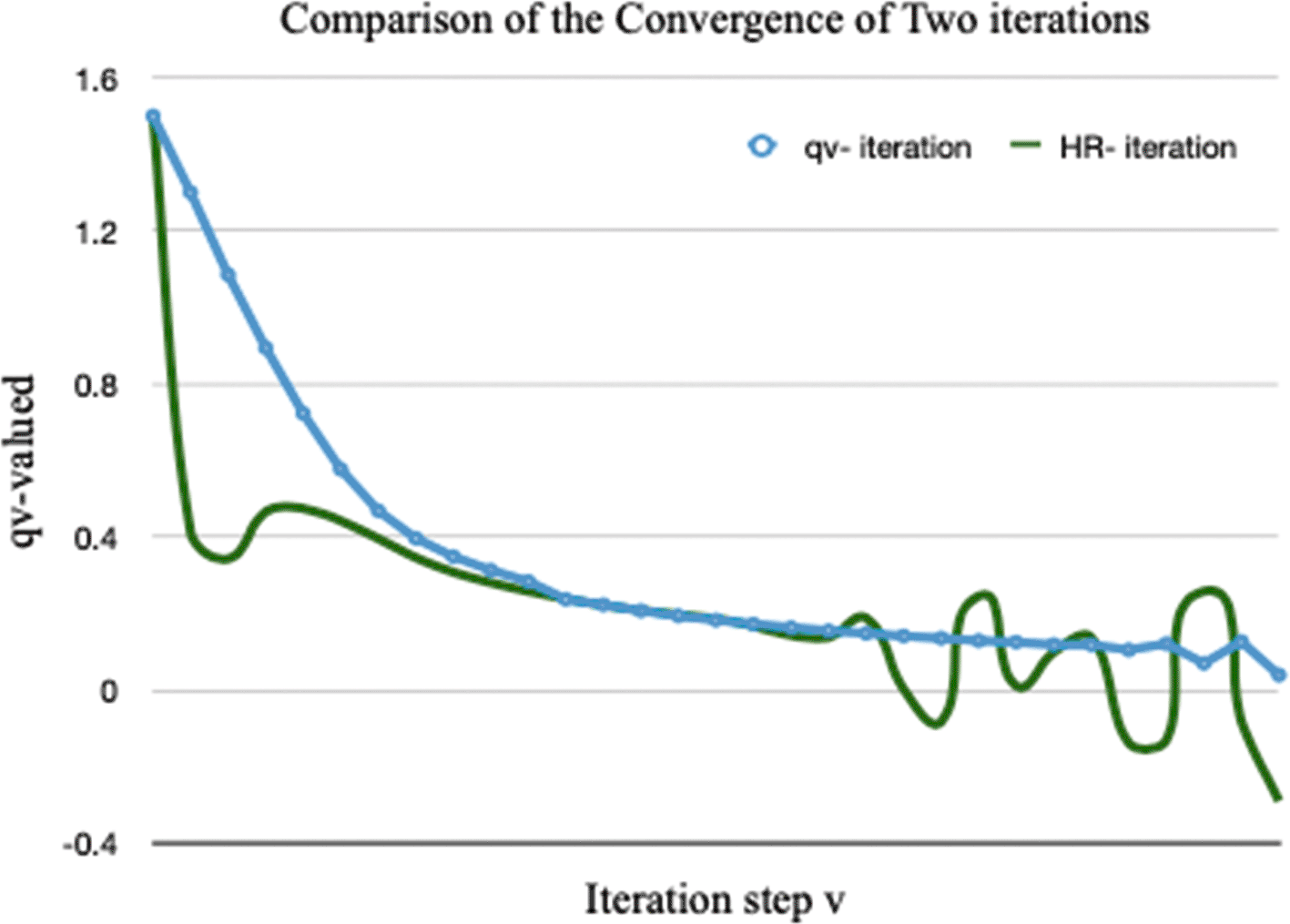
Let be a nonempty closed convex subset of a Banach space X and be a TAN-mapping. For a given q0 = d0, let be sequence generated by (4), with and and let, be sequence generated by (19). Then converges to z faster than .
Let and define the mapping by for all . It can be verify that { from a family of TAN-mappings. For the iterative defined by (4), the initial values and parameters are chosen as . For the HR-iteration sequence defined by (19), the initial values and parameters are selected as where the fixed point is . The numerical results are presented in Table 1 and a graphical comparison is shown in Figure 1.
Next, we consider the AU-iteration be sequences generated by the following scheme25:
Let be a nonempty closed convex subset of a Banach space X and be a TAN-mapping with . Let the sequence and be defined by (4) and (20), respectively.
Under the above assumptions for , the following statements are equivalent:
Since initial points and all operations involved in both iteration algorthim consist of convex combinations and bounded perturbations, it follows that all generated sequences remain in the closed convex subset . In particular, the sequence and are bounded. Assume first that converges to z ∈ Fix(Ψ). By Theorem 1, this convergence is ensured under the stated assumption. To prove that also converges to the same fixed point z, we estimate.
Since μ → 0, kv → 0, and all invloved sequences are bounded, Lemma 3 implies that converges to . Finally, define , to show .
Since both sequences converge to the same fixed point , we have: , which implies that . Therefore, the two statements are equivalent.
In this section, we apply the proposed framework of TAN-mapping to a nonlinear two-dimensional Volterra integral equation of the form.
Assume that is a nonempty closed convex subset of and described as
Also assume the assertions below are true
Then the two-dimensional Volterra integral equation (21) has a solution in provided that has a fixed point.
Let . By direct estimation and using Assumption (2), we obtain:
Let . By Assumption 3, we obtain , it follows that Ψ is a TAN-mapping.
Therefore, by
Theorem 1, the iterative algorthim generated by (4) converges weakly to a solution of the integral Equation (21).
The following example supports Theorem 6.
Consider the following two-dimensional Volterra integral equation.
It is clear that problem (22) is a special case of (21) with, , , , , and .
Since the cosine function is Lipschitz continuous on bounded intervals and the constants satisfy the contraction type bound required in Assumption (3) all assumptions of Theorem 6 are satisfied, Therefore, Equation (22) admits at least one solution in X.
In this paper, we investigated the convergence properties of the modified iterative algorithm (4) in the Banach space X. The main results establish both weak convergence (Theorem 1) and strong convergence (Theorem 2) of the proposed scheme under appropriate assumptions on the space and on the structure of the iterative process. Furthermore, stability of the generated sequence was analyzed, and a comparative study demonstrated that the proposed method converges faster than the HR-iteration scheme. Algorithm 4 was shown to be equivalent to Algorithm 20 in the sense that both methods converge to the same fixed point, while the proposed algorithm exhibits a superior convergence rate. The theoretical findings were supported by a numerical example and illustrated through convergence plots generated using MATLAB. To further demonstrate the applicability and significance of the proposed method, the theoretical results were applied to the solution of a nonlinear two-dimensional Volterra integral equation. The obtained results demonstrate that the proposed framework provides a unified approach for analyzing convergence, stability, and acceleration of iterative algorithm under TAN-mapping conditions. Future research directions may include the investigation of a related iterative algorithms and their extensions under weaker contractive type assumptions, such as those proposed in Refs. 26 and 27.
| Views | Downloads | |
|---|---|---|
| F1000Research | - | - |
|
PubMed Central
Data from PMC are received and updated monthly.
|
- | - |
Provide sufficient details of any financial or non-financial competing interests to enable users to assess whether your comments might lead a reasonable person to question your impartiality. Consider the following examples, but note that this is not an exhaustive list:
Sign up for content alerts and receive a weekly or monthly email with all newly published articles
Already registered? Sign in
The email address should be the one you originally registered with F1000.
You registered with F1000 via Google, so we cannot reset your password.
To sign in, please click here.
If you still need help with your Google account password, please click here.
You registered with F1000 via Facebook, so we cannot reset your password.
To sign in, please click here.
If you still need help with your Facebook account password, please click here.
If your email address is registered with us, we will email you instructions to reset your password.
If you think you should have received this email but it has not arrived, please check your spam filters and/or contact for further assistance.

Comments on this article Comments (0)